ZoomInfo vs Supered ProspectorOne database, or every database through Clay.
ZoomInfo sells its own contact database, its own extension and a growing set of AI agents, on a quote.
Prospector sells none of that: it puts the Clay tables your GTM engineer already built in every rep's hands, inside Sales Navigator, on company sites and in the CRM record, for $45 per rep per month. If you have no Clay and want one enterprise vendor for data and intent, buy ZoomInfo. If you run Clay, Clay plus Prospector is the better way for a sales team to prospect: GTM engineers build in Clay, reps never open Clay.
01Supered ProspectorTeams already on Clay who want every rep running the tables from where they prospect, a one-click CRM sync, and each list tracked found, worked and closed. $45 per rep per month, billed annually, from 1 rep.
02ZoomInfoMid-market and enterprise teams with no Clay who want one vendor for contacts, intent and AI agents, and a contract they negotiate. No published price.
03ApolloSmaller teams with no Clay who want one database, an extension and sequences in one self-serve plan, from $49 per user per month billed annually.
G2 on 2 October 2026: GTM Workspace (ZoomInfo) 4.5 out of 5 from 9,170 reviews; Supered 4.9 out of 5 from 81 reviews. HubSpot marketplace: Supered 5.0 from 122 reviews.
Status check
What is ZoomInfo selling in October 2026?A database that is adding agents.
ZoomInfo's pricing page lists three sales tiers, ZoomInfo Professional, Copilot Advanced and Copilot Enterprise, prints no prices, and meters use in one sentence: "Each export costs one credit, and credits can be added to any package as needs change" (zoominfo.com/pricing, checked 2 October 2026). Its Chrome extension, "Free for ZoomInfo customers," describes the data underneath as 500M+ contacts and 100M+ companies with "Verified business emails, direct dials, and mobile numbers" and "Intent, buying signals, and account fit score" (Chrome Web Store).
The direction is upmarket and toward agents. In May 2026 ZoomInfo's board approved a reduction of about 600 roles, roughly 20% of headcount, and its CEO wrote that the company is "accelerating our move upmarket, and reducing the resources we allocate downmarket" (SEC 8-K). By its August results, 76% of contract value sat upmarket (Q2 2026 release). On 1 October 2026 it launched Agent Teams, built on its purchase of DoubleO.ai, which it says runs "complete GTM motions from signal to action, without a person babysitting every step" (ZoomInfo IR).
One more fact matters for teams on Clay: ZoomInfo is already in Clay. Clay lists a ZoomInfo integration, joined 15 January 2025, with actions such as "Enrich Contact with ZoomInfo," each marked "Bring Your Own Account Required" (clay.com, checked 2 October 2026). So the choice is never "ZoomInfo data or Clay data." It is which front door your reps use, and whether ZoomInfo is the whole shelf or one step in a waterfall.
The decision table
ZoomInfo vs Prospector at a glanceNine lines that decide it.
ZoomInfo
Supered Prospector
Job it is built for
One vendor for B2B contacts, company data and intent, now with Copilot and Agent Teams for AI-run plays.
Clay in every rep's hands: the tables your GTM engineer built become a button reps press where they already prospect. No agents, no outreach writing.
Data source
ZoomInfo's own database: "500M+ contacts, 100M+ companies," with verified emails, direct dials, mobiles and intent signals.
Clay's waterfall across 200+ providers, on your own Clay account and credits. If you hold a ZoomInfo account, Clay can run it as one step.
Where reps use it
ZoomInfo's web app, mobile app and Chrome extension (3.5 out of 5 from 298 ratings, 300,000 users), signed in with a ZoomInfo seat.
Inside the Supered Chrome extension: LinkedIn profiles, Sales Navigator, company websites, and HubSpot, Salesforce and Pipedrive records. Reps never log into Clay.
CRM sync
Pushes contacts and accounts to "Salesforce, HubSpot, Outreach, Salesloft, and 10+ more."
One click to HubSpot, Salesforce or Pipedrive, field mapping set once by Ops. Before the push, the rep sees the matching CRM record and whether the person was worked before.
Pricing model
No published price. Tiers sold by quote; one credit per export. Vendr's median buyer pays $33,500 a year, across 1,574 purchases.
Published: $45 per rep per month, billed annually ($540 a rep a year), from 1 rep. Enrichment runs on the Clay credits you already buy.
Contract and trial
Vendr: "Often requires multi-seat, annual commitment," with annual escalators typically 5% to 10%. A 7-day free trial, no credit card.
Annual, from a single seat. No free trial yet: it starts with a demo on your own Clay account.
What leaders see afterward
Credits consumed per export. What happens to the contact after that lives in your CRM reports.
Every list found, worked and closed, per rep, with closed outcomes Qualified, Recycled or Disqualified, and no duplicate work across reps.
Security
Trust center lists SOC 2, ISO 27001, ISO 27017 and ISO 27701.
SOC 2 Type II and GDPR (Supered).
G2
GTM Workspace (ZoomInfo): 4.5 out of 5 from 9,170 reviews.
Supered: 4.9 out of 5 from 81 reviews. Prospector is new and has no reviews of its own yet.
How we graded: by the job, because the two products do different ones. Lane one is a team with no Clay that wants a single vendor for contacts and intent. Lane two is a team on Clay that wants every rep running the tables. Weights in both lanes: contact coverage the rep can reach (35%), where the rep works and the CRM sync (25%), what a leader sees about each list afterwards (20%), price and contract for a 10 to 50 rep team (20%).
Tool
Lane
Grade
Rank
Why it ranks here
ZoomInfo
One vendor, no Clay
A
1
The deepest single database in the field, intent signals, enterprise security and now agents. Price is the weak line: no list price and a multi-seat annual contract.
Apollo
One vendor, no Clay
B+
2
A smaller database than ZoomInfo, with sequences built in and a self-serve price from $49 per user per month.
Supered Prospector
One vendor, no Clay
C
3
Out of scope: Prospector runs on Clay and brings no database of its own.
Supered Prospector
Clay in every rep's hands
A
1
Built for this: your tables as a button in Sales Navigator, on company sites and in the CRM record, a CRM check before the push, found to closed per list, a published price.
ZoomInfo
Clay in every rep's hands
C
2
Its extension runs ZoomInfo's data only. On Clay, ZoomInfo is best used as one step in the waterfall on your own account.
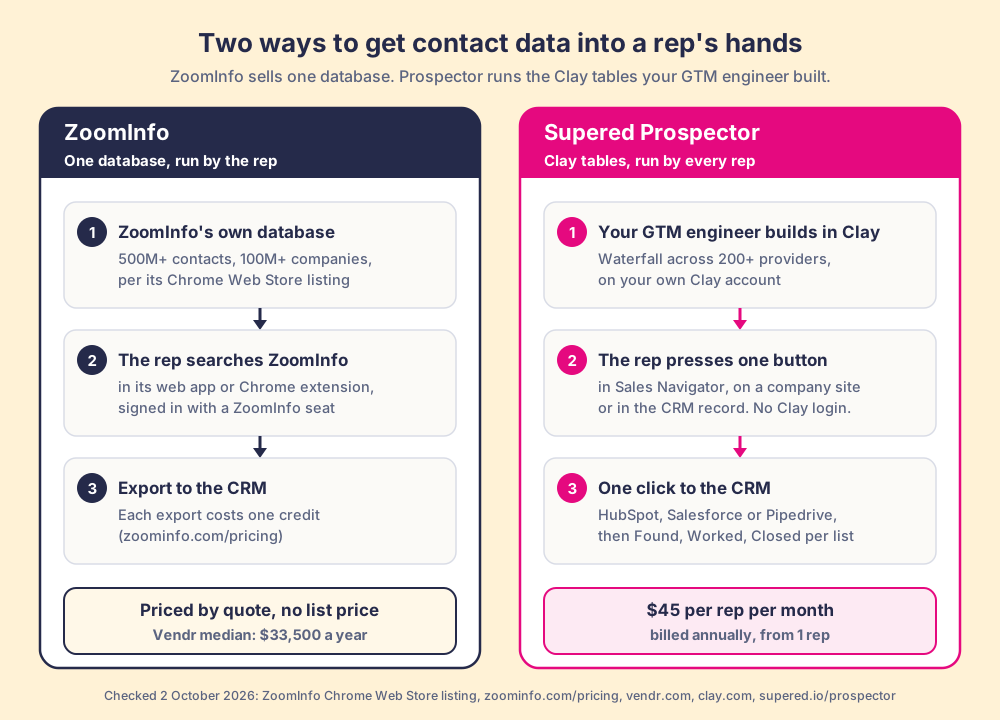
Two paths to the same goal, a contact in the CRM that a rep works. ZoomInfo: its own database (500M+ contacts, 100M+ companies per its store listing), searched in its app or extension, one credit per export, priced by quote (Vendr median $33,500 a year from 1,574 purchases). Prospector: Clay's waterfall across 200+ providers on your Clay account, one button for the rep, one click to the CRM, $45 per rep per month billed annually. All checked 2 October 2026.
Fair to them first
What is ZoomInfo best at?The deepest single shelf in the trade.
If you want one vendor to answer for your contact data, ZoomInfo is the safest single bet. Its own filings describe more than 100 million companies and 500 million contacts, and Forrester named it a Leader with the highest current-offering score in The Forrester Wave: Marketing and Sales Data Providers for B2B, Q1 2026 (Q1 2026 release). Emails, direct dials, mobiles and intent signals arrive from one place, with one support team and one security review, which its trust center backs with SOC 2 and three ISO certifications.
It is also a real platform, not only a list. Two of its three sales tiers are Copilot tiers, Agent Teams arrived on 1 October, and its G2 page shows 4.5 out of 5 across 9,170 reviews. For an enterprise sales org with no GTM engineer and no Clay, a rep with a ZoomInfo seat can be productive on day one.
The trade-offs are the ones its own buyers name. Vendr's ZoomInfo page describes the contract minimum as "Often requires multi-seat, annual commitment," puts annual escalators at typically 5% to 10%, and warns that exports past the credit allotment trigger overage fees. On the Chrome Web Store the extension sits at 3.5 out of 5 from 298 ratings. None of that makes the data worse. It makes ZoomInfo a purchase that fits a large team with budget and fits a 12-rep team on Clay poorly.
Why buyers compare
Why are ZoomInfo customers looking at Clay and Prospector?One shelf, one price you cannot see.
The question is rarely whether ZoomInfo's data is good. It is whether one database is still the right shape of purchase once a GTM engineer is building in Clay.
One shelf, when Clay asks many.ZoomInfo returns what is in ZoomInfo. A Clay waterfall asks provider after provider until one returns a verified email or phone, and can include ZoomInfo on your own account. Teams on Clay already pay for that reach.
A quote, not a price.There is no list price to plan against. Vendr's median is $33,500 a year, and its range runs from $7,220 to $155,730, so two teams of the same size can pay very different amounts.
Seats for reps who mostly search.A ZoomInfo seat gives a rep the whole database. Many reps only need the contacts for the account or the lead in front of them, which is what a Clay table, run from that page, returns.
The list after the export.Exports are metered. What happens next, whether the contact was worked and how it ended, sits outside the product. Leaders on Clay ask Prospector to show that per list.
Prospector, for teams on Clay
What does Prospector do that a ZoomInfo seat does not?You build it. Reps run it. Everyone sees it work.
Prospector is the rep side of Clay. Your GTM engineer builds the tables once, person enrichment, the buying committee for an account, the new-logo list for a campaign, and each becomes a flow a rep picks from a Push menu. A rep on a LinkedIn profile, a company's website or a HubSpot, Salesforce or Pipedrive record presses one button, and your Clay table runs on your own Clay account. In Sales Navigator, reps add leads to a prospect list and push the list to a Clay table. Your logic stays yours: waterfalls, tiers, tags and sequence variables. The engineer stops being the list desk.
Before anything syncs, the rep sees whether the person already has a CRM record, who owns it, and whether they were prospected before, so two reps do not work the same buyer. One more click sends the contact to HubSpot, Salesforce or Pipedrive with the field mapping Ops set once. Reps never log into Clay, and they do not need a separate database seat to build their own lists. The plays are the ones a sales team runs every week: research an account, new logos, expansion inside customers, job changers, and adding the economic buyer to a stalled deal before the forecast call.
Then the part a ZoomInfo export does not show. A sales leader sees every list found, worked and closed, rep by rep, and every lead ends the way your process says: Qualified, Recycled or Disqualified. When a leader can see what the tables produced, the Clay budget grows. The full loop is on the sourcing use case, and the rep's view is on Prospector for reps.
Prospector costs $45 per rep per month, billed annually, which is $540 a rep a year and $5,400 a year for ten reps, and you can buy it for one rep. It runs on the Clay plan and credits you already pay for. There is no free trial yet. It starts with a demo on your own Clay account, and the details are on the Prospector page.
Choose something else when the job looks like this
No Clay and no one to build in it.Prospector runs only on Clay. Without a GTM engineer, a single-vendor database a rep can use on day one, ZoomInfo or Apollo, is the faster start.
One vendor for intent and agents.If you want contacts, intent topics and AI agents from one enterprise vendor under one contract, ZoomInfo does that and Prospector does not try to.
Reps who live in an AI chat.If your reps work inside ChatGPT or Claude, Clay's own MCP brings Clay there, governed by Ops.
Run your Clay table from Sales Navigator.
A demo on your own Clay account. Bring the table your reps ask for most often.
ZoomInfo vs Prospector: which should you choose?Decide by whether you run Clay.
If you have no Clay and want one enterprise vendor for contacts, intent and agents, ZoomInfo is the best pick. If you run Clay, Prospector is the best pick: Clay plus Supered is the best way for a sales team to prospect, because GTM engineers build in Clay and reps never open it.
Choose ZoomInfo if
You have no Clay and no builder. A rep with a seat can search and export on day one.
You want one vendor to answer for the data. Contacts, direct dials, intent and org data from one contract, one security review and one support team.
You are the customer its filings describe. An upmarket team with budget for a negotiated, multi-seat annual contract and an appetite for AI agents.
Choose Prospector if
You already run Clay. Every rep runs your tables from Sales Navigator, company sites and the CRM record, with no Clay login.
You want lists you can follow. Found, worked and closed for each list, rep by rep, with no duplicate work.
You want a price you can read today. $45 per rep per month, billed annually, from 1 rep, on the Clay you already pay for.
You do not have to pick a side of the data. If you keep a ZoomInfo account, Clay can call it as one step in the waterfall, and Prospector puts that waterfall in front of every rep.
Why trust this page
Why trust a comparison written by Supered?Weigh it, then check the sources.
We sell one of the two products on this page, so weigh what follows. Every ZoomInfo fact links to its source and carries the date we checked it, 2 October 2026, and where ZoomInfo is the better buy we say so in the verdict. When ZoomInfo publishes a price or changes what it sells, this page changes with it.
Supered is the #1 sales enablement app on the HubSpot marketplace and a HubSpot Premier Tech Partner, with 6,000+ installs. It holds 5.0 from 122 reviews on the HubSpot marketplace and 4.9 out of 5 from 81 reviews on G2. Those reviews cover Supered as a whole. Prospector is the newest product and runs inside the Supered Chrome extension, so judge it in a demo on your own Clay account.
Switching, or using both
How do you move from ZoomInfo seats to Clay and Prospector?Keep what works, move the front door.
You do not have to rip ZoomInfo out on day one. The gentler path is to route it through Clay first, then decide at renewal.
Put ZoomInfo inside the waterfall.Clay's ZoomInfo integration runs on your own ZoomInfo account, so your contract keeps paying off as one step among 200+ providers while it runs.
Turn the tables into buttons.An admin connects Clay inside Supered, and each table or custom workflow becomes a flow reps pick from the Push menu. Start with the Supered Clay template or bring your own tables.
Set the CRM mapping once.Ops maps fields for HubSpot, Salesforce or Pipedrive, and every sync after that is one click.
Watch the lists, then decide at renewal.With found, worked and closed per list, you can see what the tables produce before the ZoomInfo renewal. Vendr advises negotiating to cap or remove the annual escalator.
What else should a ZoomInfo buyer look at?The rest of the shortlist.
If neither ZoomInfo nor Clay plus Prospector fits, these are the other names buyers put next to ZoomInfo. Each has a full head-to-head on our blog.
Apollo.One database with a Chrome extension and built-in sequences, self-serve from $49 per user per month billed annually (apollo.io, checked 2 October 2026). The usual pick for smaller teams with no Clay. Apollo vs ZoomInfo.
Cognism.Sold on a quote like ZoomInfo, and the usual pick when most of your buyers are in Europe. Cognism vs ZoomInfo.
Lusha.A lighter database and extension with self-serve plans, for teams that need contacts more than intent. Lusha vs ZoomInfo.
RocketReach.Published prices and a free account, for teams that mostly need emails. RocketReach vs ZoomInfo.
LinkedIn Sales Navigator.Not a contact database: it finds people, it does not give you their email or phone. It pairs with Prospector, which turns a Navigator list into enriched CRM contacts. ZoomInfo vs Sales Navigator.
For teams on Clay, yes. Prospector brings no database of its own: it runs your Clay tables, Clay's waterfall across 200+ providers, from Sales Navigator, LinkedIn profiles, company websites and HubSpot, Salesforce or Pipedrive records, then syncs to the CRM in one click. For teams with no Clay, it is not a substitute; ZoomInfo or Apollo is.
How much does ZoomInfo cost compared with Prospector?
ZoomInfo publishes no prices; its pricing page lists tiers by name and says each export costs one credit. Vendr's median ZoomInfo buyer pays $33,500 a year, across 1,574 purchases (checked 2 October 2026). Prospector costs $45 per rep per month, billed annually, from 1 rep, and runs on the Clay plan and credits you already have.
Can I keep my ZoomInfo data and use Prospector?
Yes. Clay lists a ZoomInfo integration that runs on your own ZoomInfo account, so ZoomInfo can be one step in your Clay waterfall. Prospector then puts that waterfall in front of every rep, so they get ZoomInfo's results and the other providers' in one click.
Do reps need a Clay login or a ZoomInfo seat to use Prospector?
Neither. Prospector runs on your company's Clay account and Clay credits, so the team needs Clay, but reps never log into it. They press a button inside the Supered Chrome extension where they already prospect.
Does Prospector scrape LinkedIn?
Prospector works within LinkedIn's terms and does not copy search results in bulk; the contact data comes from Clay's waterfall on the customer's Clay account. In Sales Navigator, reps add leads to a prospect list and push the list to a Clay table.
Which CRMs does Prospector work with?
HubSpot, Salesforce and Pipedrive. Ops sets the field mapping once, reps sync in one click, and before they do, they see the matching CRM record and whether the person was worked before.