ZoomInfo Pricing in 2026: The Standing Charge, the Meter, and What Neither Can See
What ZoomInfo costs in 2026 from Vendr's transaction data, how the platform fee, seats, and credit blocks stack, the levers that move a quote, why the vendor is moving its meter, and the one-contract arithmetic for a team that has Clay.
ZoomInfo pricing in 2026 is quote-only, structured as a base platform fee plus per-seat licences plus blocks of export credits, with Vendr's dataset of 1,573 purchases putting the median contract at $33,500 a year inside a range of $7,213 to $155,820.
A gas bill has two lines, and only one of them cares whether you cooked. The standing charge pays for the pipe into the house, and it arrives every month whether the stove was lit or the family ate out. The unit rate is the meter, and it turns only when gas leaves the pipe. Neither line records whether dinner was any good.
ZoomInfo pricing in 2026 is quote-only, structured as a base platform fee plus per-seat licences plus blocks of export credits, with Vendr’s dataset of 1,573 purchases putting the median contract at $33,500 a year inside a range of $7,213 to $155,820 (Vendr, ZoomInfo, opened September 25, 2026). That is a gas bill with three lines instead of two: the pipe, a charge per burner, and the meter. Most pages on ZoomInfo cost stop at the median. This one walks the bill line by line, reads what ZoomInfo’s CEO told the SEC in May about where the meter is going, runs the one-contract arithmetic for a team that already has Clay, and ends where no meter can go, at whether anyone worked the contact.
| ZoomInfo pricing at a glance (2026) | What the sources show |
|---|---|
| Pricing model | Base platform fee + per-seat licences + credit blocks; quote only (Vendr) |
| Public list price | None. “ZoomInfo does not publish transparent list pricing” (Vendr) |
| Sales tiers named on zoominfo.com | ZoomInfo Professional, Copilot Advanced, Copilot Enterprise (captured Sept 25, 2026) |
| Median contract | $33,500 / yr on 1,573 purchases; buyers save 22% on average (Vendr) |
| Range | $7,213 to $155,820 / yr (Vendr) |
| Credit rule | ”Each export costs one credit” (zoominfo.com/pricing) |
| Overages reported | $10,000 to $50,000+ over a term when credits were not negotiated up front (Vendr) |
| Escalator | 5 to 10% a year, commonly inside an auto-renewal clause (Vendr) |
| Fiscal quarter-ends | March, June, September, December (Vendr) |
How much does ZoomInfo cost in 2026?
ZoomInfo does not publish a price. Its pricing page (zoominfo.com/pricing, captured September 25, 2026) names three sales tiers, carries a G2 badge of 4.5 from 9,384 reviews, and states one rule in its FAQ, “Each export costs one credit,” with no dollar figure anywhere. (A later visit the same day served a press-and-hold bot check; the tier names and the credit rule come from the earlier capture.) Vendr’s words: “ZoomInfo does not publish transparent list pricing.”
So every number below is transaction data. It is what buyers paid. It is also a median, which is a point, when the price is a range.
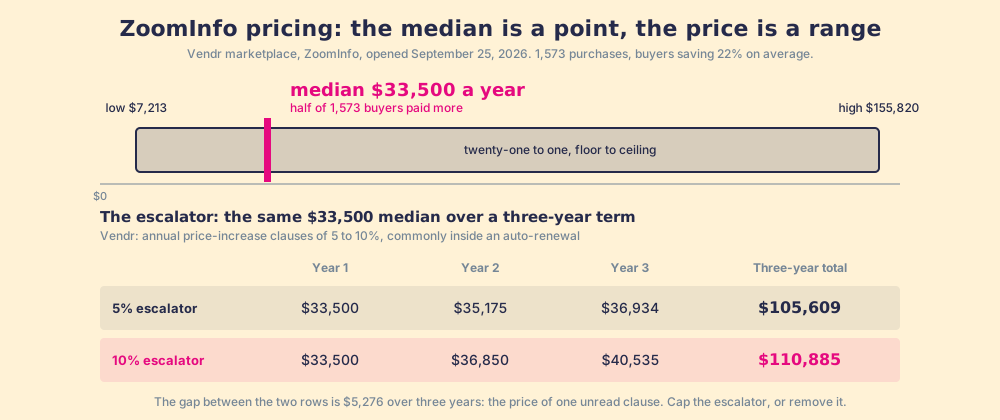
- The median. $33,500 a year, based on 1,573 purchases, with buyers saving 22% on average off the first quote (Vendr’s header shows the same $33,500 beside 1,012 deals handled and 21.81% average savings). If you searched how much does ZoomInfo cost and wanted one number, it is this one, and half of Vendr’s buyers paid more.
- The range. $7,213 at the floor, $155,820 at the ceiling. Twenty-one to one. Seats, modules, credits, and term set where you land, in roughly that order.
- The escalator. Vendr reports annual price-increase clauses of 5 to 10%, usually riding inside an auto-renewal. Compound the median at 5% and a three-year term reads $33,500, $35,175, $36,934, a total of $105,609. At 10% it reads $33,500, $36,850, $40,535, a total of $110,885. The gap is $5,276, the price of one unread clause.
- The overages. Buyers who did not negotiate credit terms up front report $10,000 to $50,000 or more in unexpected overage fees over a term. The low end adds nearly a third to the median. The high end more than doubles it.
Third-party guides circulate tier prices for SalesOS. ZoomInfo publishes none of them and neither does Vendr, so none appears here. Read every figure on this page as a reported contract, never a list price.
What are the ZoomInfo pricing plans, and what does each line on the bill do?
Back to the gas bill. Vendr describes the structure in two sentences: “ZoomInfo typically structures contracts with a base platform fee plus per-seat licensing. Data access is governed by credit allocations or export limits, which vary by tier and can be purchased in blocks.” Three lines. Read them as the pipe, the burners, and the gas.
- The platform fee (the pipe). Charged once, for the connection. It is why a five-seat contract is dear per seat and a fifty-seat contract cheap per seat: the pipe costs the same either way. Vendr notes that teams with 10 to 20 seats “typically pay higher per-seat rates than teams with 50+ seats.”
- The seats (the burners). Per user, per year. ZoomInfo’s page names the sales tiers Professional, Copilot Advanced, and Copilot Enterprise; the ZoomInfo pricing plans differ by what a seat carries, with intent signals, technographic filters, and deeper integrations in the higher tiers per Vendr’s description of SalesOS. A burner costs the same whether the rep cooks on it daily or never turns the knob.
- The credit blocks (the gas). “Each export costs one credit.” Credits arrive as a contracted allocation, and past it ZoomInfo charges overage rates “often priced at a premium to the base rate” (Vendr). The one line that moves with use, and it moves at the tap, when the contact leaves the database.
- The modules and add-ons (more rooms on the same pipe). SalesOS is the core. MarketingOS, TalentOS, and OperationsOS are separate platforms, “purchased individually or bundled.” Intent data, Chorus conversation intelligence, website visitor identification, and advanced API access are add-ons with their own fees. Standard CRM integrations (Salesforce, HubSpot, Microsoft Dynamics) are typically included.
Then the fine print, where a quote becomes a total ZoomInfo cost: the 5 to 10% escalator, the auto-renewal that carries it, notice periods Vendr puts at 30 to 90 days (90 to 120 is the figure to negotiate), onboarding fees that “may apply for enterprise contracts” and are often waived on multi-year deals, and the $10,000 to $50,000-plus overage band.
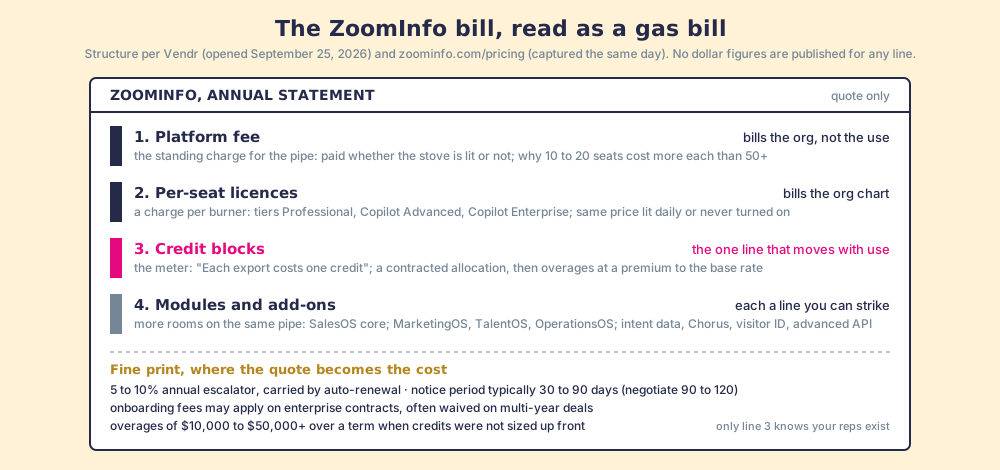
Of the four lines, only the gas knows your reps exist. The pipe and the burners bill the org chart.
How do you negotiate ZoomInfo pricing?
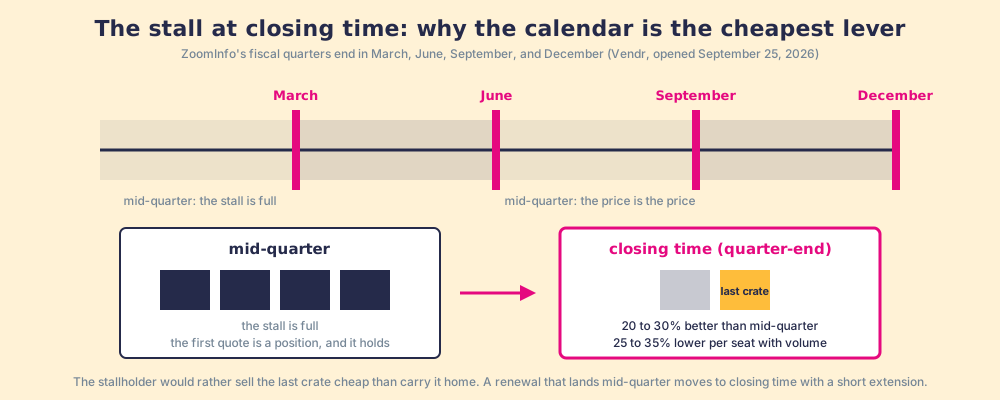
A stallholder at the end of market day would rather sell the last crate cheap than carry it home. ZoomInfo’s fiscal quarters end in March, June, September, and December, and Vendr’s buyers negotiating in those months “commonly report stronger discount outcomes”: 20 to 30% better than mid-quarter, and 25 to 35% lower per-seat pricing when timing is combined with volume. The calendar is the cheapest lever on this list; it costs a short extension if your renewal lands mid-quarter.
The rest, each with Vendr’s range:
- The budget anchor. Vendr’s wording is that ZoomInfo’s sales teams “are trained to anchor high and extract maximum budget.” Buyers who set a ceiling early and hold it land 20 to 35% below the first quote. The first number is a position.
- The multi-year trade, with protection. Two- and three-year terms bring 15 to 30% off; 50-plus seats combined with multi-year terms bring 20 to 35%. Take the discount only with the right to adjust seats and credits annually without penalty and a cap on the escalator, or its removal. Otherwise the escalator repays the discount by year three, as the $105,609 against $110,885 ladder showed.
- Prepayment. Annual prepayment brings 10 to 20% off. Quarterly or monthly payment comes at a premium.
- Credits, sized before signature. Count exports per rep per month, then negotiate a larger allocation, discounted overage rates (Vendr suggests asking for 50% of the standard rate), the right to buy additional blocks at the contracted rate, and rollover of unused credits. This lever is worth $10,000 to $50,000 or more over a term.
- Module removal. Bundled platforms price better per seat, so bundle what you will use at signature and strike what you will not. Intent data, Chorus, MarketingOS, and OperationsOS are each a line you can delete before the quote is final, which beats discounting them after.
- A live alternative. Vendr names Apollo, Cognism, 6sense, and Lusha as the pressure that moves a ZoomInfo quote. Bring a parallel quote; Apollo vs ZoomInfo and the graded field in ZoomInfo competitors are built for that meeting.
- The renewal clock. Start 90 to 120 days out, and write that notice period into the contract, because Vendr puts the default at 30 to 90.
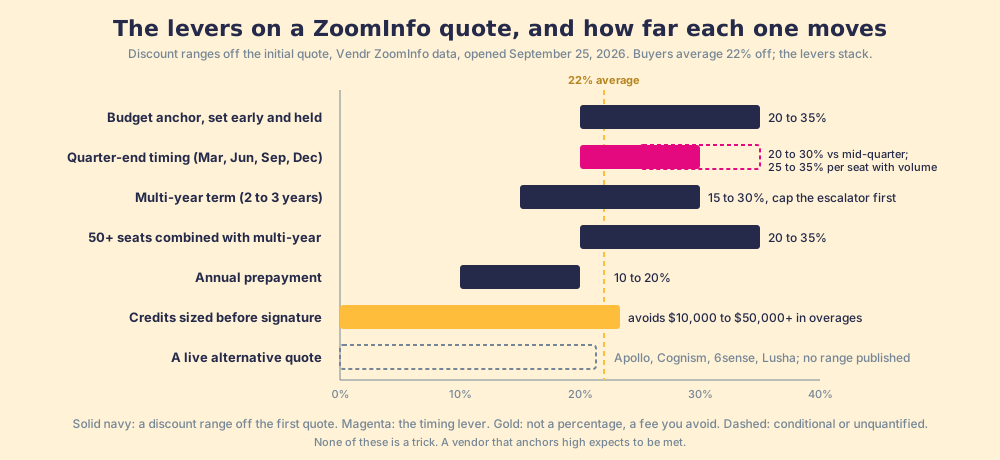
None of these is a trick. They are the shape of a quote-only market, and a vendor that anchors high expects to be met.
Why is ZoomInfo moving its meter, and what does that mean for a mid-market buyer?
On May 5, 2026, ZoomInfo’s board approved what it calls the 2026 Restructuring Program: about 600 roles, roughly 20% of headcount, $45 million to $60 million in charges, and about $60 million in annual run-rate savings (SEC Form 8-K, May 2026). Six days later CEO Henry Schuck’s note to staff, filed with the same 8-K, said the company is “accelerating our move upmarket, and reducing the resources we allocate downmarket,” and added a sentence about the bill itself: “the industry is moving toward consumption-based pricing.”
Read the August numbers with that sentence beside them. Revenue of $310.4 million, up 1.2% year over year. Net revenue retention of 89%, which means the average existing customer spends 11% less than a year ago. 76% of contract value upmarket, and 1,891 customers paying $100,000 a year or more (Q2 2026 results, August 5, 2026). The company has traded as GTM since May 13, 2025 (investor release), calls itself “the all-in-one AI GTM platform,” and in the same release launched GTM.AI, a “headless GTM context layer” with MCP integrations into Claude, Codex, Agentforce, and HubSpot Breeze. Forrester scored its data highest in the category three months before the cut, a Leader in the Q1 2026 Wave with top marks in 20 of 27 criteria (Q1 2026 results).
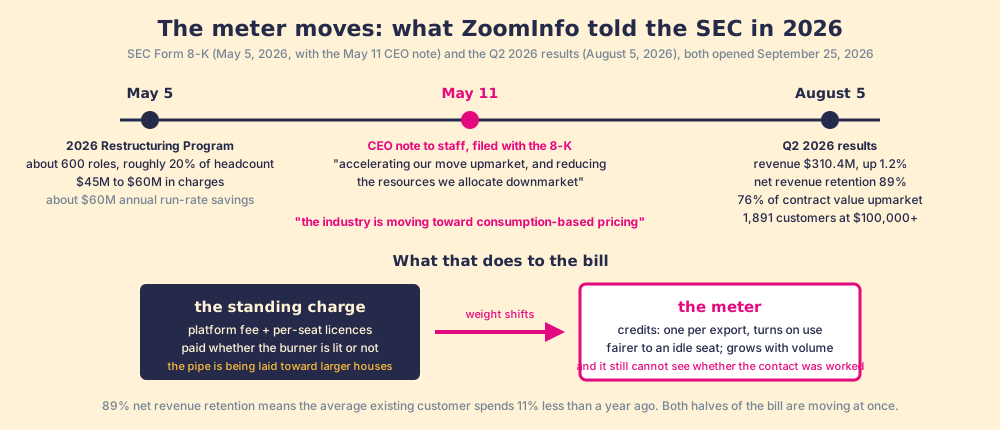
The two halves pull a mid-market buyer in opposite directions. A meter is fairer to a small team than a standing charge: an idle burner stops costing, and you pay for what left the pipe. But a meter turns on volume, and the volume that grows fastest in this category is exports no rep ever works, which is where this page ends. And the upmarket line is plain: a twenty-seat team is buying from a vendor that has told the SEC where 76% of its contract value sits, and “reducing the resources we allocate downmarket” describes the twenty-seat team.
The picture has an edge. A gas company does not choose which houses to serve; ZoomInfo has said in a filing which houses it is walking toward. That does not make its data worse, and Forrester’s scoring says the opposite. It changes what a smaller buyer should expect over a three-year term, and how hard to negotiate the escalator.
Do you need a ZoomInfo contract at all?
For a team that already has Clay through RevOps, the question changes shape, and the arithmetic is short enough to do in the open.
Clay’s pricing page (clay.com/pricing, opened September 25, 2026) lists the Growth plan starting at $495 a month, or $446 on annual billing, with 6,000 data credits a month (the page states it as 72,000 a year), 40,000 actions a month, and CRM auto-sync. At the monthly rate that is $5,940 a year. Extra data credits “start at $0.05 each,” and “if an enrichment returns no result, you’re not charged Data Credits or Actions.” The homepage says one contract buys data from 200+ data and AI vendors (clay.com, same day; the pricing FAQ still says 150+ partners, so both numbers are dated here).
Set the two bills side by side. $5,940 is less than a fifth of ZoomInfo’s $33,500 median. To spend the ZoomInfo median on Clay’s Growth plan you would have to buy $27,560 of extra credits beyond the 72,000 included, which at the $0.05 starting rate is about 551,000 additional results a year. That is arithmetic at list rates, a supposition rather than a measurement: credit costs vary by provider, and a contact whose email and phone come from two providers draws credits at each step. Clay says the most-used enrichments cost 50% fewer credits on average since its March 2026 repricing (Clay, “Introducing Clay’s new pricing”). The direction survives every caveat.
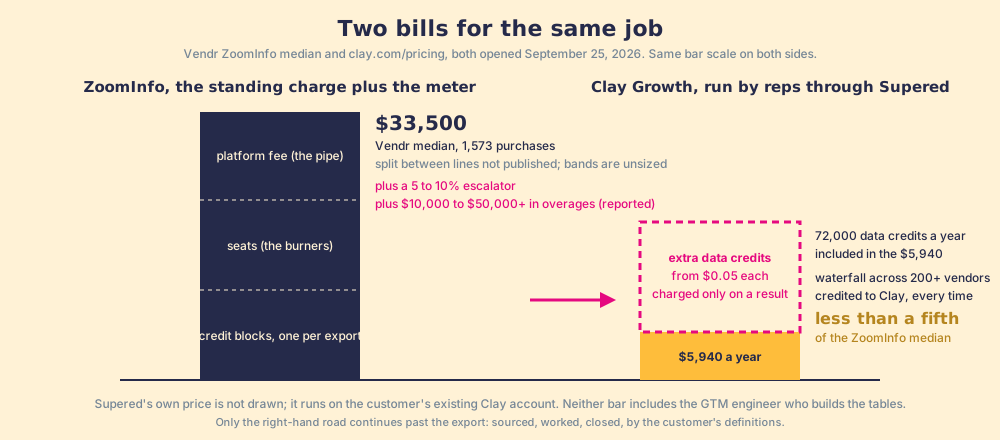
Supered does not bring its own database. It brings Clay’s waterfall, which is every database, routed. That is the reason we chose Clay as our only data provider. ZoomInfo, Apollo, Cognism, and Lusha are each one database, and when the mobile number you need is not in the one you licensed, the rep is standing at the tap with nothing coming out. Clay’s waterfall asks provider after provider until one returns a verified email or phone, and the meter turns only when water comes. The rep on a LinkedIn profile, a Sales Navigator list, a company’s website, or a HubSpot or Salesforce record gets that waterfall in one click from Supered, with no Clay login, and syncs the contact with the field mapping RevOps set once. The two models are compared in Clay vs ZoomInfo; the plain explainer is what Clay is.
Two cautions. Clay needs someone to build the tables and the waterfall; Clay says “GTM engineers build on Clay,” and that person is overhead the $5,940 does not include. And Supered’s sourcing is only for teams that have Clay. If you do not, the negotiation section above is your page, and the lanes in ZoomInfo competitors name the vendor for your job.
What does the meter miss?
Go back to the kitchen. The gas meter counts what left the pipe. It does not know whether the burner was lit under a pan or under nothing, and it has no opinion on dinner. ZoomInfo’s meter is the same instrument bolted to a database: “Each export costs one credit,” and after the export it sees nothing. No blame attaches to the vendor for that. Its job ends at the tap. A revenue leader’s job starts there.
Across 198 sales teams in The State of Sales Enablement, 89% had a defined sales process and 36% saw reps run it as designed, and the teams that inspected adherence consistently hit quota at 6.3 times the rate of those that did not. Sourcing a contact is step one of that process. When step one is the only step anyone meters, the renewal conversation writes itself: a CRM full of contacts, a credit balance draining, a $33,500 invoice with an escalator on it, and no answer to “is the prospecting engine working?”
You can only expect what you inspect. So the layer worth paying for after Clay is the one that treats the sourced contact as the start of a motion with an expectation attached: was it worked, by your definition of worked; did it advance; did it close, by your definition of closed. Supered is that layer. Clay governs the data. Supered governs the motion. The next expected action reaches the rep in the flow of the work, the way a sales cadence is meant to, and the manager sees sourced, worked, and closed per rep against the standard they set, so the coaching conversation starts from the signal instead of a hunch.
The payoff lands on the buyer before it lands on a dashboard. In the same study, quota attainment ran 49% when process guidance reached reps in the flow of work against 15% when it lived in documents. A contact sourced and then worked to one standard is a buyer who gets the same experience from every rep, and that consistency is what the buyer notices. The reasoning sits in the sales process guide.
The verdict
Three ways forward, each earned by the numbers above.
- ZoomInfo, negotiated. Choose it if you are the customer its filings describe, a $100,000-plus contract that wants the deepest single database, intent data, and one vendor’s roadmap. It is the Forrester Leader with the top current-offering score, and it is walking toward you. Sign at quarter-end, size the credits before the seats, strike the modules you will not use, and cap the escalator; on Vendr’s data those moves are the difference between the first quote and 22% off it.
- Another single database. Choose Apollo for a ten-to-fifty-rep team that wants a published seat price and outreach bundled, or Cognism for EMEA mobiles, if you do not have Clay. The lanes and grades are in ZoomInfo competitors.
- Clay via Supered. Choose it if your reps already have Clay through RevOps and never open it. The platform fee is less than a fifth of the ZoomInfo median, the meter turns only when a result comes back, coverage is Clay’s waterfall across 200+ vendors, and the export becomes the first step of a measured process instead of the last thing anyone sees.
What we recommend follows from the bill. The standing charge is the line to negotiate hardest, because it pays for a pipe ZoomInfo has said it is laying toward larger houses. The meter is the line to size before signature, because it is the only one that will grow. And the line that matters most is not on the bill at all: whether the contacts your reps pulled were ever worked, which only a meter past the tap can read. We priced the other new meter, the one Gong put on its AI, in Gong pricing, and the lesson was the same: a meter measures a process your reps may not be running. The demo is where you can watch the one that measures the process itself, on your own Clay account.
Frequently asked questions
How much does ZoomInfo cost in 2026?+
What are the ZoomInfo pricing plans?+
How do ZoomInfo credits work?+
How much can you negotiate off a ZoomInfo quote?+
Is ZoomInfo moving to consumption-based pricing?+
Is there a cheaper alternative to a ZoomInfo contract for a team that has Clay?+
Your process, running itself.