Kaspr vs ZoomInfo in 2026: A Bike Off the Shop Floor or a Company Car Lease
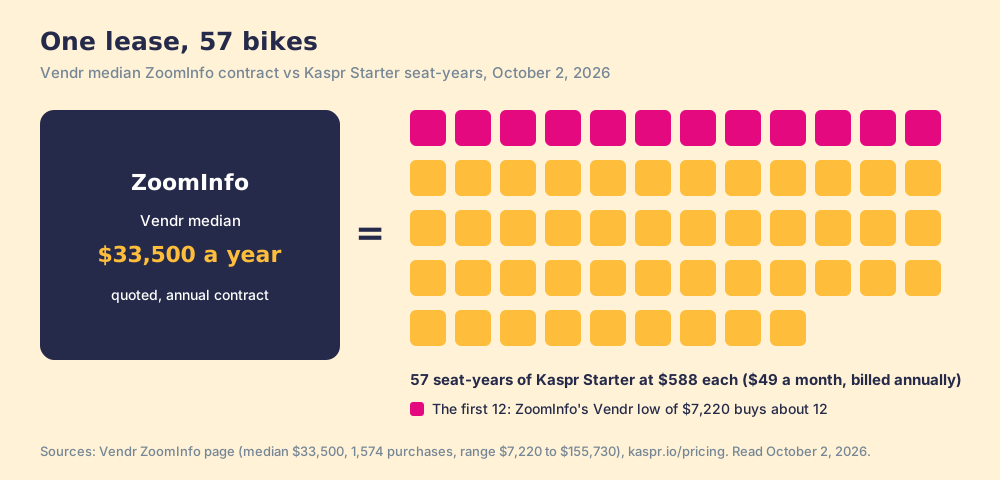
One median ZoomInfo contract buys 57 years of Kaspr Starter seats.
Kaspr vs ZoomInfo priced and checked on October 2, 2026: what each contract commits you to, whose data fits which map, the free doors, and the Clay route.
Kaspr vs ZoomInfo is a choice between a self-serve LinkedIn contact extension sold by the seat from $49 a month, owned by Cognism and strongest in Europe, and an enterprise data platform sold on quoted annual contracts with a Vendr median of $33,500, strongest in North America.
Kaspr vs ZoomInfo is a choice between a self-serve LinkedIn contact extension sold by the seat from $49 a month, owned by Cognism and strongest in Europe, and an enterprise data platform sold on quoted annual contracts with a Vendr median of $33,500, strongest in North America. Searched as kaspr vs zoominfo or zoominfo vs kaspr, they look like the same thing on paper: a rep opens a profile and gets an email and a phone number. In the buying, they could hardly be further apart. The short answer, by who it fits:
- Supered Prospector. Teams whose RevOps already runs Clay. The GTM engineer’s Clay tables, ZoomInfo’s step among 200+ providers if you bring a ZoomInfo account, run by reps from Sales Navigator, a company site, or the CRM record. $45 per rep per month, billed annually.
- ZoomInfo. North American teams of 25 or more that want one vendor’s depth, intent and workflow tools, and will negotiate a multi-year contract. Quote only; Vendr’s median is $33,500 a year.
- Kaspr. One to a dozen LinkedIn-first reps, especially selling into Europe, buying on a card. From $49 per user per month on annual billing.
Think of a bicycle bought off the shop floor and a company car lease. You pay for the bike, wheel it out, and ride. The lease comes with a fleet manager, servicing, fuel cards, a mileage allowance and an exit clause, and the paperwork takes longer than the drive home. Both get a rep from A to B. The lease does far more, and it also commits you to far more, for far longer. One median ZoomInfo contract would buy 57 years of a single Kaspr Starter seat.
How do Kaspr and ZoomInfo compare at a glance?
Prices are the plan that includes the job, opened on kaspr.io/pricing and zoominfo.com/pricing on October 2, 2026, with ZoomInfo’s contract values from Vendr the same day. Grades come from the weighted scoring below, on the lens of a five-to-fifty-rep sales team.
| Rank | Tool | Grade | Best fit | CRM integration | Setup effort | Price (plan with the feature) | Reason to switch |
|---|---|---|---|---|---|---|---|
| 1 | Supered Prospector (on your Clay) | A | Teams that already have Clay | Native in HubSpot, Salesforce and Pipedrive; one-click sync | Live in under a week; admin connects Clay inside Supered | $45/rep/mo billed annually, from 1 rep, plus your Clay plan | 200+ providers behind one button, ZoomInfo’s step included if you bring an account |
| 2 | ZoomInfo | B | North American teams buying one vendor’s depth and intent | Native Salesforce, HubSpot and 40+ more | Sales-led contract and onboarding | Quote only (Professional, Copilot Advanced, Copilot Enterprise); Vendr median $33,500/yr | North American depth, intent, workflows, a Clay step if you keep the contract |
| 3 | Kaspr | B- | Small LinkedIn-first teams, European lists | HubSpot, Salesforce, Pipedrive, Zoho, Lemlist, Brevo | Self-serve in minutes; G2 ease of setup 9.0 | Starter $49/user/mo annual ($65 monthly); Business $79 ($99) | Unlimited B2B emails, no contract, works today |
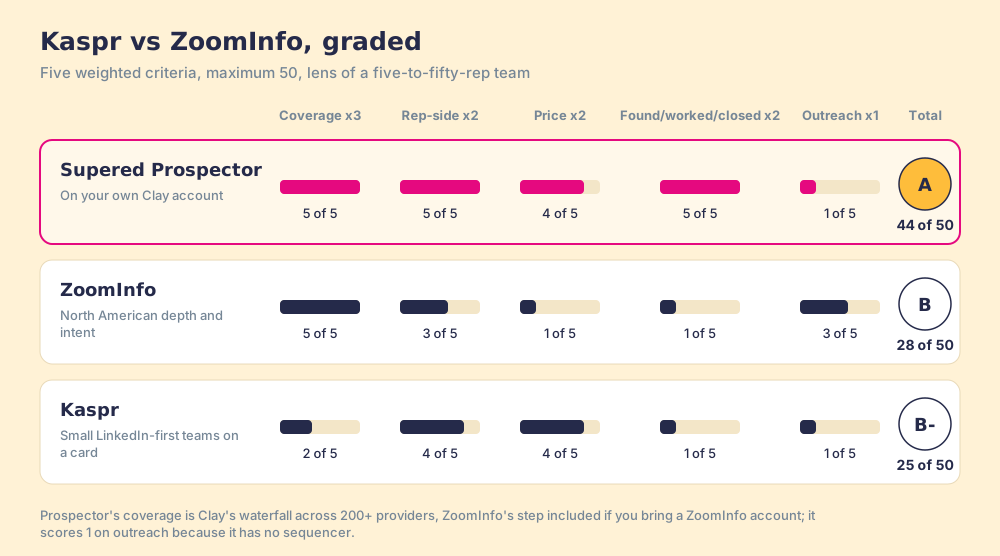
The scoring, so you can argue with it. Each criterion is scored 1 to 5 and multiplied by its weight, for a maximum of 50. The rows match the Kaspr alternatives page and Cognism vs ZoomInfo.
| Tool | Coverage (x3) | Rep-side delivery (x2) | Price for the job (x2) | Found, worked, closed visibility (x2) | Bundled outreach (x1) | Total |
|---|---|---|---|---|---|---|
| Supered Prospector | 5 | 5 | 4 | 5 | 1 | 44 |
| ZoomInfo | 5 | 3 | 1 | 1 | 3 | 28 |
| Kaspr | 2 | 4 | 4 | 1 | 1 | 25 |
Flip the lens to a European list and Kaspr’s coverage score rises while ZoomInfo’s falls; flip it to a 200-rep North American team and ZoomInfo wins outright. Prospector scores 1 on outreach on purpose: it has no sequencer. Its coverage score belongs to Clay, because Prospector has no database of its own.
Why trust this comparison?
Supered is my company, so weigh that first. Before it, I started RevPartners, a HubSpot partner that did only sales implementations, sold roughly twice as much Sales Hub as any other partner, and reached Elite tier in 13 months. I have helped clients through ZoomInfo renewals and watched the same reps keep a $49 extension open beside a five-figure platform. Supered holds 4.9 out of 5 from 81 reviews on G2 (October 1, 2026). The disclosure that matters: ZoomInfo is a step in Clay’s marketplace and Kaspr is not, so Prospector can route through one of these two. The price section favors Kaspr anyway, because the arithmetic does.
Why do teams compare Kaspr and ZoomInfo?
Because both sit on the same LinkedIn page and do the same thing there, and because the reviews look alike from a distance. On G2, ZoomInfo’s sales product, listed as GTM Workspace, holds 4.5 from 9,110 reviews and Kaspr 4.4 from 837. Kaspr leads on ease of use, 9.2 to 8.8, and on contact data accuracy as its reviewers rate it, 8.1 to 7.7; ZoomInfo edges support, 8.7 to 8.6. The buyers differ: 48.2% of ZoomInfo’s reviewers are mid-market, while 69.2% of Kaspr’s are small businesses (G2, Kaspr vs ZoomInfo, read October 2, 2026).
The browser tells a sharper story. Kaspr’s Chrome extension holds 4.7 from 1.2K ratings across 100,000 users. ZoomInfo’s holds 3.5 from 298 ratings across 300,000 users, and carries the line “Free for ZoomInfo customers” (Chrome Web Store, read October 1, 2026). ZoomInfo moved the extension into a side panel in summer 2026, and the store reviews since are blunt. One user, July 23, 2026: “It lost about 95% of its functionality, and the navigation of the new extension is extremely unintuitive.” ZoomInfo’s developer replied that “the extension needs to sit in that dedicated panel, not an overlay” to fix speed problems.
- The Kaspr complaint. The meter and the landline. A mid-market account manager on G2, December 2025: “the credit system depletes rapidly when engaging in high volume sourcing.” A small-business reviewer, July 2025: “Sometimes the phone number data isn’t available or only includes landlines.”
- The ZoomInfo complaint. The bill and the map edge. A small-business reviewer, September 2026: “The pricing feels extremely steep compared to platforms like Apollo.” Another, October 1, 2026: “Data coverage can be patchy for UK-based contacts and mid-sized companies.”
(G2 snippets read via a page summary, October 1, 2026.) A bike rider complains about the hills; a lease holder complains about the invoice and the countries the fuel card does not cover.
How much does ZoomInfo cost compared with Kaspr?
Kaspr posts its prices. Starter is $49 per user per month billed annually, or $65 monthly, with unlimited B2B emails under a 10,000-credit monthly fair-use limit per account and 100 phones a month. Business is $79 annually or $99 monthly for 200 phones and 200 direct emails a month, 2,400 phones a seat a year (kaspr.io/pricing, October 2, 2026). The full ladder is on the Kaspr pricing page.
ZoomInfo posts tiers and no prices: ZoomInfo Professional, Copilot Advanced and Copilot Enterprise on the sales side, with “Chrome extension and mobile app” listed under Professional and each export costing one credit (zoominfo.com/pricing, October 2, 2026). Vendr’s buyers report the rest. “Median buyer pays $33,500 per year. Based on data from 1,574 purchases, with buyers saving 22% on average,” in a range from $7,220 to $155,730 (Vendr, ZoomInfo, page last updated February 2026, read October 2, 2026). Vendr’s notes, read September 25, 2026, add typical annual escalators of 5 to 10% and $10,000 to $50,000 or more in overage fees for buyers who do not negotiate credits up front. Our ZoomInfo pricing page walks the negotiation.
| One year | Annual cost | In Kaspr Starter seat-years |
|---|---|---|
| Kaspr Starter, 1 seat | $588 | 1 |
| Kaspr Starter, 10 seats | $5,880 | 10 |
| Kaspr Business, 10 seats | $9,480 | about 16 |
| ZoomInfo, Vendr low | $7,220 | about 12 |
| ZoomInfo, Vendr median | $33,500 | about 57 |
| ZoomInfo, Vendr high | $155,730 | about 265 |
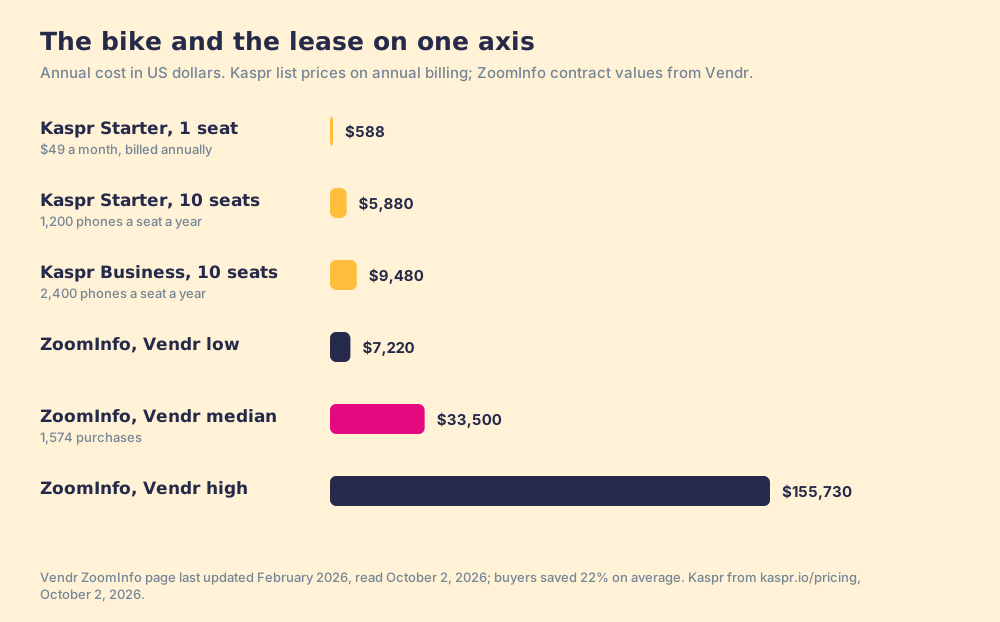
The low end is where the two touch. A ZoomInfo contract at Vendr’s $7,220 floor costs about what ten Kaspr Starter seats cost, and less than ten Business seats. That floor is real but thin: it is the bottom of 1,574 purchases, it rarely covers ten users with full data access, and it does not come with the multi-year discount that makes the median look tolerable. For a team of ten, plan on the median, which is almost six times ten Kaspr Starter seats.
What the lease buys is breadth. ZoomInfo sells intent, buying signals, account fit scores, workflows and an agent layer on top of the contact data; Kaspr sells contact data and a lead list. A team that uses only the contact data inside ZoomInfo is paying for a fleet and driving one car.
Which has better data, Kaspr or ZoomInfo?
Each vendor counts its own database differently, and Kaspr counts its own three ways. Kaspr’s data page: “Unlock 200 million + European B2B contacts,” “Powered by 120+ verified data sources and providers” (kaspr.io/our-data). Kaspr’s ZoomInfo comparison: “Kaspr has +120M European B2B contacts.” Kaspr’s Waalaxy comparison: “120 sources, covering 500M+ phone numbers and email addresses” (all read October 2, 2026). ZoomInfo’s store listing says “500M+ contacts, 100M+ companies.”
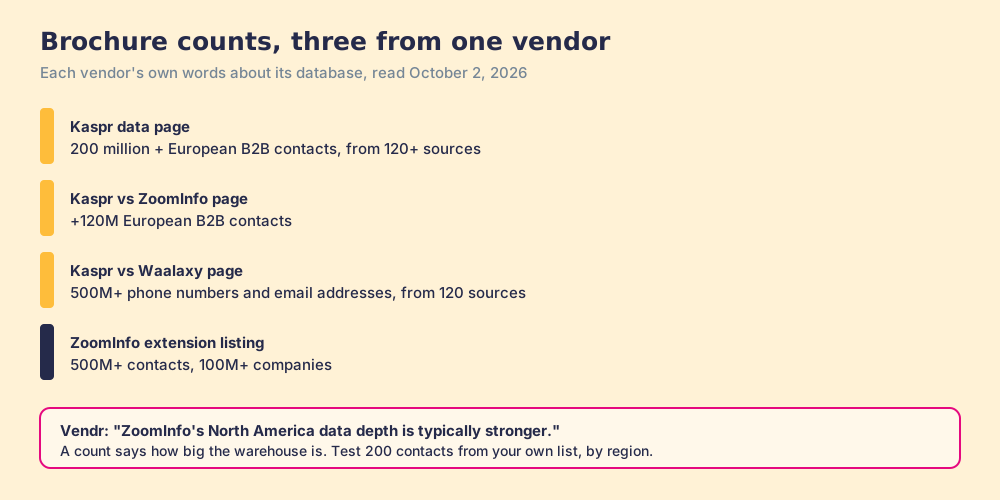
A brochure count tells you how big the warehouse is, never whether the item you want is on the shelf in your town. Two things are more useful than the counts.
- The map each one was drawn for. Kaspr is a Paris company and sells European coverage first; its owner Cognism is the EMEA specialist. Vendr’s ZoomInfo page says “Cognism is often positioned as a strong alternative for EMEA-focused teams” and “ZoomInfo’s North America data depth is typically stronger.” ZoomInfo’s own reviewers agree from the inside: an enterprise account executive on G2 in August 2026 found that accuracy for direct mobiles “drops noticeably in EMEA, APAC, and niche regional markets.”
- One outside test. An email-only benchmark of 500 contacts with known addresses, run in May 2026 by b2b-email-finder.com, an anonymous review site that ranks a different tool first, found Kaspr’s addresses for 61.3% of contacts at 80.1% accuracy, and concluded “No single tool exceeded 89% coverage” (b2b-email-finder.com, published June 8, 2026). ZoomInfo was not in the test. No public, independent benchmark sets the two side by side.
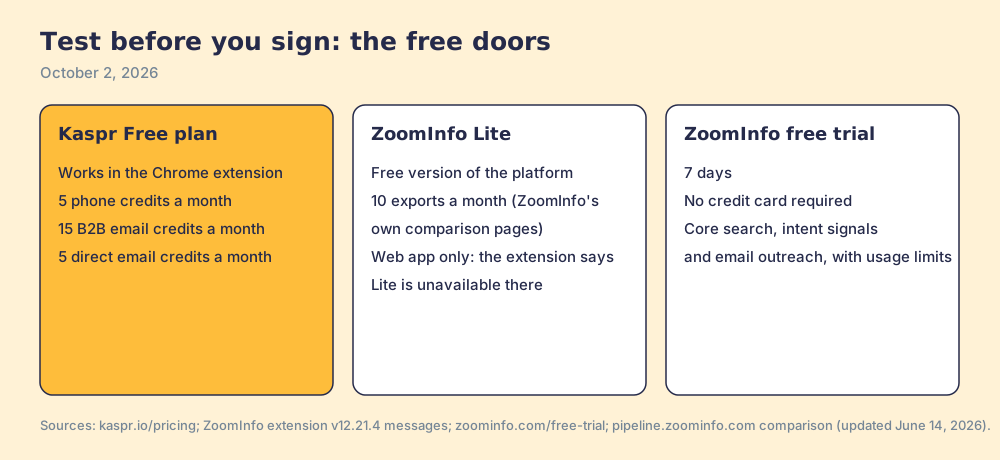
So run your own. Kaspr’s free plan gives 5 phones and 15 B2B emails a month; ZoomInfo offers a 7-day free trial. Pull 200 contacts from your target list, split by the regions you sell into, and count the numbers that ring the right person.
What changed at ZoomInfo and Kaspr in 2026?
ZoomInfo trades on Nasdaq as GTM and calls itself “the all-in-one AI GTM platform.” On September 30, 2026 it acquired DoubleO.ai, “an agentic orchestration platform built to help teams create reliable, multi-agent automation,” terms undisclosed, and on October 1 launched Agent Teams on the back of it (Business Wire). The extension moved to a side panel in the summer. ZoomInfo also runs ZoomInfo Lite, a free version its own comparison pages describe at 10 exports a month, though the extension now says “ZoomInfo Lite is currently unavailable in this extension.”
Kaspr has been part of Cognism since April 2022, and its about page still reads “Kaspr is a prospecting tool for individual contributors and SMBs.” The biggest Kaspr event of the last two years was a regulator’s: in December 2024 France’s CNIL fined KASPR SAS €240,000 for collecting contact details of LinkedIn members who had limited their visibility, and ordered deletion (CNIL). Cognism vs Kaspr covers the decision and the owner. A news search on October 2, 2026 found no acquisition of either company.
Kaspr vs ZoomInfo for a team on Clay
For a team that already pays for Clay, the choice changes shape. Clay is closer to a car-share network than to a third vehicle: “200+ providers in one place,” a waterfall that asks one provider after another until a verified email or phone comes back, and a rule neither Kaspr nor ZoomInfo offers across vendors. “If an enrichment returns no result, you’re not charged Data Credits or Actions” (clay.com/pricing, October 2, 2026).
The two sit in different places on that network. ZoomInfo is a listed step: Clay’s page shows “Joined in Jan 15, 2025,” with each action marked “Bring Your Own Account Required” (Clay, ZoomInfo integration, October 2, 2026). Kaspr is not; its Clay URL returned a 404 the same day. So a Clay team that already holds a ZoomInfo contract can make it one step in the waterfall, and a team that likes Kaspr keeps a separate extension and meter. The lease details are on Clay vs ZoomInfo.
Clay names the gap in its own copy: “GTM engineers build on Clay.” The tables live with the GTM engineer and the reps live in Sales Navigator and the CRM, so they keep asking for extension seats. Clay plus Supered is the best way for a sales team to prospect: GTM engineers build in Clay, reps never open Clay. Supered Prospector runs inside the Supered Chrome extension on the team’s own Clay account.
- The GTM engineer’s table as a button. The GTM engineer builds named flows once, such as person enrichment or a buying committee, and reps pick one from a Push menu in Sales Navigator, on a company’s website, or in a HubSpot, Salesforce or Pipedrive record. Waterfalls, tiers and tags stay the GTM engineer’s. Start from the Supered Clay template or bring your own tables.
- Sales Navigator lists into Clay. Reps add Navigator leads to a prospect list and push the list to a Clay table. Prospector works within LinkedIn’s terms and does not copy search results in bulk; the contact data comes from Clay’s waterfall on the customer’s Clay account. Ask every vendor what it reads from LinkedIn, ours included.
- A check before the push. The rep sees the matching CRM record, who owns it, and a flag when the prospect was already worked, so two reps do not chase the same person.
- Found, worked, closed. The leader sees every list found from the team’s tables, who is working their list and who is not, and how each lead ended: Qualified, Recycled, or Disqualified, the way your process says.
The price, done straight. Prospector is $45 per rep per month, billed annually, from one rep, on your own Clay account and credits (Prospector). Ten Prospector seats cost $5,400 a year. If you are buying Clay for this, Growth at its $495 monthly rate is $5,940 a year, so Clay plus ten seats is $11,340, about a third of the ZoomInfo median and about twice ten Kaspr Starter seats ($5,880). The phones come out of your Clay data credits, roughly six credits for an email plus a phone on our reading of Clay’s calculator, explained on the Clay pricing page. The head-to-head with Kaspr is on Prospector vs Kaspr.
Choose something else if:
- No Clay, and no plan to buy it. Prospector runs only on Clay. Pick ZoomInfo or Kaspr from the branches below. If you want Clay built for you, RevPartners, the company I founded, is a Clay Elite Studio Partner that builds and tunes the tables.
- One vendor for data, intent and workflows. If the buying committee wants a single platform with intent and an agent layer under one contract, ZoomInfo sells that and Prospector does not.
- A solo rep on a card. Kaspr Starter is a simpler purchase than a Clay plan plus a seat.
- A field or mobile-first team. Supered runs at the computer and has no mobile product.
Kaspr vs ZoomInfo: which should you choose?
Back to the bike and the lease. Decide how far you are going and for how long before you sign anything with a fleet manager.
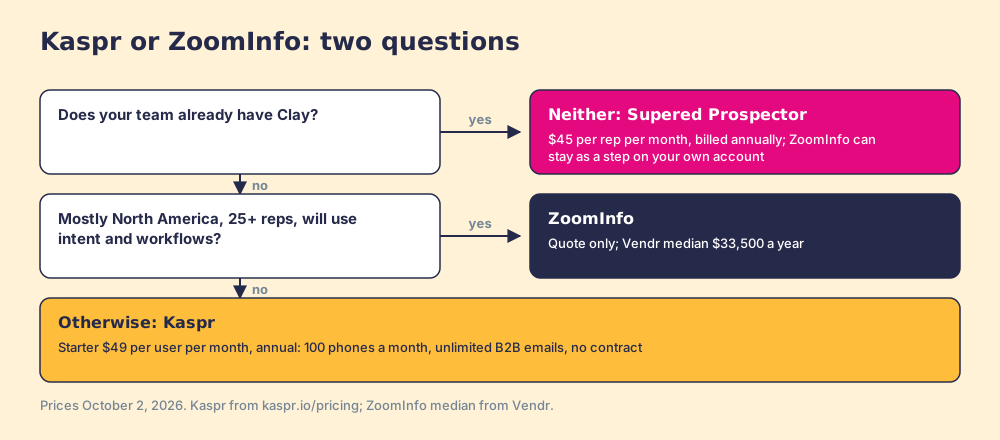
- ZoomInfo. Choose ZoomInfo if you sell mostly into North America, run 25 or more reps, and will use the intent and workflow layers as well as the contact data. Plan on the Vendr median of $33,500, negotiate credits and escalators up front, and know the extension now lives in a side panel.
- Kaspr. Choose Kaspr if one to a dozen reps work LinkedIn all day, sell into Europe, and want numbers today with no contract. Starter is $588 a seat a year for 1,200 phones and unmetered B2B emails. Ask Kaspr in writing about the CNIL remediation and whether the fair-use limit is per user or per account.
- Neither: Supered Prospector. Choose neither if your RevOps already runs Clay. Keep ZoomInfo as a step if you hold the contract, let reps run the GTM engineer’s tables from the screen they are on with no Clay login, and see every list found, worked and closed. $45 per rep per month, billed annually, on your own Clay account.
If you want to compare Kaspr with its nearer neighbors first, Apollo vs Kaspr sets it against the same $49 sticker with a sequencer attached, and Kaspr vs Lusha prices a phone on two LinkedIn extensions. If you already have Clay, book a Prospector demo and bring the account.
Frequently asked questions
Is Kaspr cheaper than ZoomInfo?+
Is Kaspr or ZoomInfo better for Europe?+
Does ZoomInfo have a free plan like Kaspr?+
Who owns Kaspr and ZoomInfo?+
Can I use ZoomInfo or Kaspr inside Clay?+
Do I need Kaspr or ZoomInfo if my team has Clay?+
Everything we have written on Kaspr
More on Kaspr
Supered Prospector vs Kaspr: the side-by-side- Kaspr Alternatives in 2026: Bottomless Bread, Wine by the Glass, and One Kitchen
- Kaspr Pricing in 2026: Four Meters on One House
- The Kaspr Chrome Extension in 2026: A Hotel Minibar With Three Price Tags
- Apollo vs Kaspr in 2026: The Same $49 at the Door, Two Very Different Clubs
- Cognism vs Kaspr in 2026: One Owner, a Flagship, and the Outlet Round the Corner
- Kaspr vs Lusha in 2026: Unlimited Texts or a Prepaid Card
Everything we have written on ZoomInfo
More on ZoomInfo
Supered Prospector vs ZoomInfo: the side-by-side- ZoomInfo Competitors in 2026: The Database Was Never the Purchase
- ZoomInfo Pricing in 2026: The Standing Charge, the Meter, and What Neither Can See
- ZoomInfo Reviews 2026: The Equipment Scores 4.5, the Membership Scores 1.8
- ZoomInfo Chrome Extension in 2026: A Free Key Card to a $33,500 Room
- ZoomInfo HubSpot Integration (2026): Setup, Plans, Limits, and What It Reads Back
- ZoomInfo Salesforce Integration in 2026: A Loading Dock With Two Doors
Your Clay waterfall, where reps already work.