Sales Prospecting: The Process Behind the Tools, and Why Sourced Is Not Pipeline
Sales prospecting has had five eras, from printed directories to Clay's waterfall and the GTM engineer, and every one of them changed who finds the contact without changing who works it. The history, the market in 2026, the tools scored against the job, the sourced-to-worked-to-closed process, and the framework for running it so it can be inspected.
Sales prospecting is the first stage of the sales process: finding the people at target accounts who could become buyers, reaching them, and turning a name into a conversation. In 2026 the finding is largely solved by data tools. What decides whether prospecting produces pipeline is the process that follows, sourced to worked to closed, and a process exists only to the degree it is inspected. A sourced contact is not pipeline.
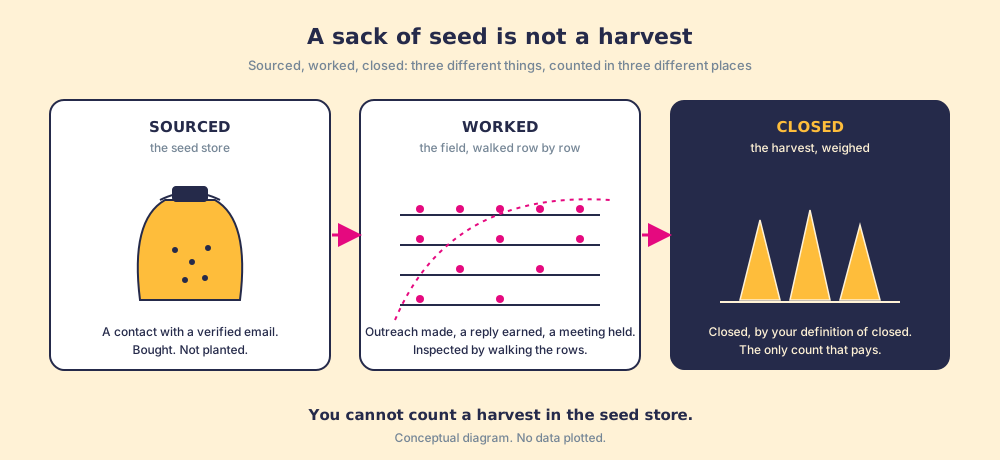
A sales leader opens the CRM at the end of the month and finds the count of new contacts created, longer than last month's. The number feels like progress, the way a full seed store feels like a harvest. It is a reasonable feeling and it is wrong in a specific, expensive way, because the CRM has counted the seed and called it the harvest. Sales prospecting in 2026 has a strange shape: the part that used to be hard, finding the person and their verified email, is now close to solved, routed through 200 plus data vendors on one contract, one click from the LinkedIn profile. The part that was always hard, whether the rep worked that person to a standard and whether the manager could see it, is exactly as unsolved as it was when the contact came off a printed list. This guide is about that gap. Sourcing is a process. A process exists only to the degree adherence to it is inspected. And "sourced" is not pipeline, no matter how good the data was.
The argument runs like this, and the rest of the page is the evidence for it. The value in modern prospecting tooling is the waterfall and the workflow, both built by one person and consumed, in theory, by every rep. In practice the consumption rarely happens, because reps live on LinkedIn, in the CRM, and in email, and a workflow that requires another tab is a workflow that does not get run. So the investment is capped by rep adoption, which RevOps sees only as credits consumed. The teams that get pipeline out of prospecting are the ones that removed the tab and added the inspection, so that the sourced contact enters a motion with an expectation, a measure, and a manager who can coach off it. The Bridge Group's 2025 research on 351 B2B companies is the cleanest picture of what happens otherwise: a record 3.78 million dollars of raw pipeline per SDR, and the lowest share of SDRs at quota the study has ever recorded. Full stores. Thin harvests.
What is sales prospecting?
Sales prospecting is the work of finding the people who could buy and starting the conversation. Say it plainly and it sounds like one activity. Look at what a rep does and it is three, and the three get confused with each other constantly, which is where most of the trouble starts. The first is sourcing: deciding which accounts and which titles are worth the effort, finding the named person, and getting a working email or phone for them. The second is working: the outreach, across whatever channels the team uses, until the person replies or a meeting is held or the attempt is abandoned by rule. The third is the handoff: the sourced-and-worked contact becomes a qualified conversation that someone (the same rep, or an account executive) carries into the sales process proper. Each of the three can be done well or badly on its own, and each has its own tools and its own vocabulary, which is why a "prospecting tool" can mean a database, a sequencer, or a dialer depending on who is selling it to you.
A definition needs an edge, so mark where prospecting stops. It is distinct from lead qualification, which is the judgment about whether a conversation is worth continuing, and from the sales process as a whole, which is the sequence of stages a deal moves through once it exists. Prospecting is the manufacture of the raw material those stages consume. That framing matters because it tells you what the output of prospecting is: a conversation, with a real person, at an account you chose on purpose. The output is never a contact record. A contact record is an input, the sack of seed, and the whole error this page is written against is the habit of counting inputs as outputs because the inputs are easier to count.
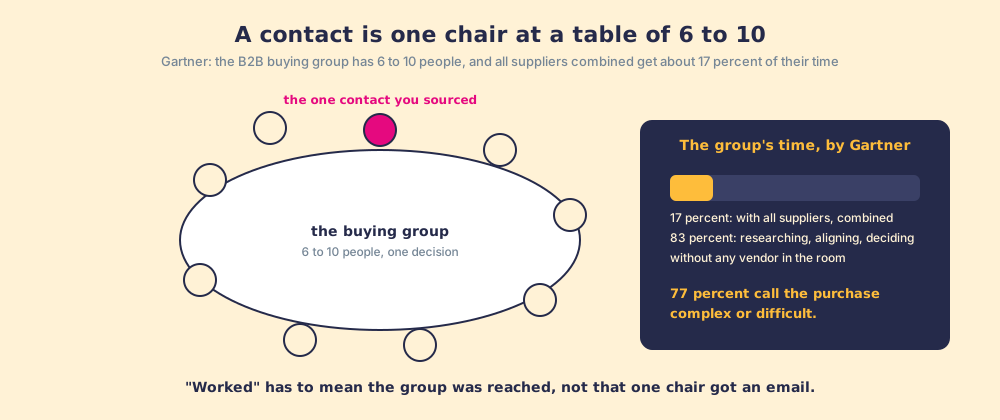
B2B prospecting adds one wrinkle that consumer prospecting never had, and it changes the definition of "worked." Gartner's research on the B2B buying process puts the typical buying group at 6 to 10 people, spending only about 17 percent of their buying time with all potential suppliers combined, and 77 percent of those buyers describe the purchase as complex or difficult. A sourced contact is one chair at that table. Reaching the chair is sourcing. Reaching the table is prospecting. Keep that distinction in your pocket; it comes back in the section on segments, and it is the reason "worked" has to be defined by you, for your motion, rather than borrowed from a vendor's dashboard.
Where did sales prospecting come from?
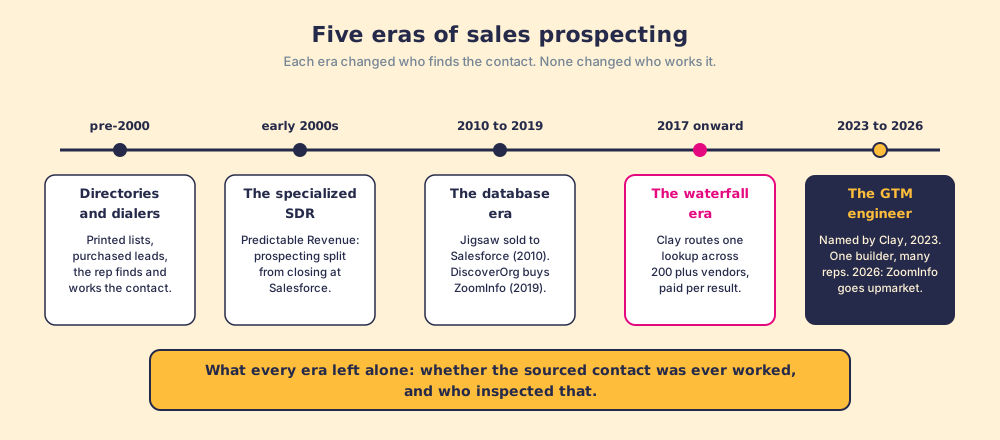
Prospecting is older than the software that sells it, and knowing the eras tells you which problem each one solved and which problem none of them touched. The first era was directories and dialers. A rep worked from a printed list, a purchased lead sheet, a trade directory, or a card file, and the same person found the contact and worked it. Sourcing was slow and manual, and so was working, and because one person did both, the two were never confused. If a rep had a thick stack of cards and an empty calendar, the manager could see the gap from across the room.
The second era split the job. In the early 2000s at Salesforce, Aaron Ross took prospecting away from the account executives who were spending most of their time on it, gave it to a dedicated team he called sales development reps, and had them qualify and hand off. The model became Predictable Revenue, the book that turned specialization into the default structure of B2B sales: an SDR sources and works, an AE closes. This was a genuine advance, and it also introduced the seam this guide is about. Once one person sources and another closes, the handoff becomes a place where a contact can be counted as progress by the first team and never touched by the second, and somebody has to decide what "worked" means at the seam. The Bridge Group's 2025 data says the ratio settled at one SDR for every 2.4 account executives, and that 82 percent of teams now align SDRs to AE territories, up from 56 percent in 2018, which is the field slowly rediscovering that the seam needs stitching.
The third era was the database. Sourcing became a product. Jigsaw, a crowd-sourced contact directory, was bought by Salesforce in 2010 for 142 million dollars and became Data.com, then was retired before the decade ended. DiscoverOrg, founded in 2007, acquired ZoomInfo in February 2019 and took its name, and the combined company became the category's incumbent, later listed on Nasdaq under the ticker GTM. Apollo built a large database with a free tier and a Chrome extension; Cognism built a European-heavy one and bought Kaspr in April 2022 for individual and small-team LinkedIn prospecting. The database era's promise was coverage: buy a seat, search the database, export the contact. Its structural flaw was also coverage. Each vendor was one database, so a rep who could not find a phone number in one was stuck, and the organization bought a second contract to fill the gap, then a third.
The fourth era is the waterfall, and it is the one we are in. Clay, founded in 2017, did not build a bigger database. It built a routing layer over the databases that already existed. In Clay's words, its "signature data waterfalls check multiple providers to return the most verified emails (lower bounce rate) and phone numbers (higher connect rate)". The lookup asks provider after provider until one returns a result, and the team pays per result rather than per seat per database. Clay's homepage counts "200+ data and AI vendors" in its marketplace as of September 2026 (the same rep-prospecting page still says 150 plus, which tells you how fast the number moves). This changed the economics of sourcing more than any era before it, and it introduced a new problem: the waterfall is built by one person, in a tool the reps were never given a login for.
Which produced the fifth era, the GTM engineer. Clay says it "coined this role in 2023" and that "about 100 GTME job listings go live every month"; its definition is one sentence: "GTM engineers build revenue engines using AI and automation." The GTM engineer builds the waterfall, the enrichment tables, the CRM sync, the signals. And then Clay's own copy finishes the sentence the way this guide would: "Build centralized workflows for any rep to run." The builder builds. The rep is supposed to run. Each era changed who finds the contact. None of them changed who works it, and none of them added a way to see whether it was worked. That is the empty chair in the history, and it is where the rest of this page sits.
Why is a sourced contact not pipeline?
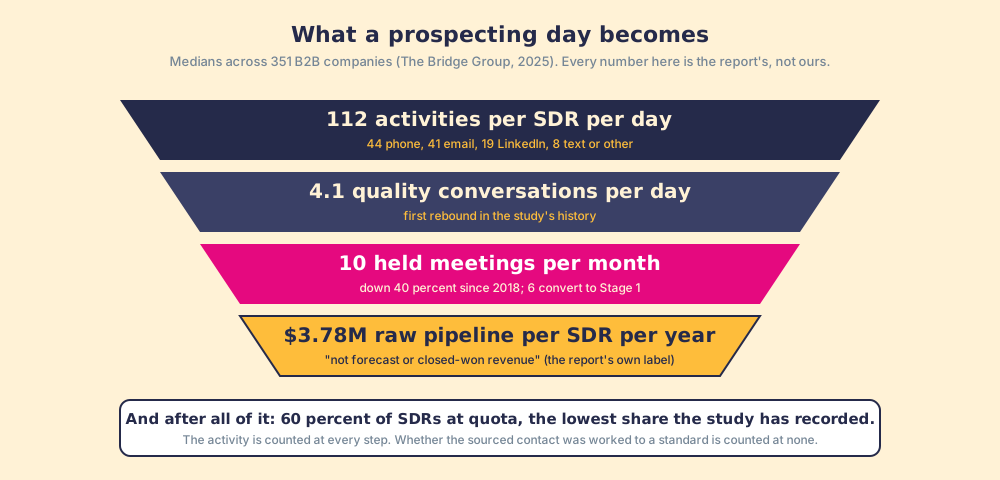
Because the people who measure prospecting say so themselves, in the footnotes. The Bridge Group has benchmarked the SDR role every two years since 2007, and its 2025 edition, drawn from 351 B2B companies, reports a median of 3.78 million dollars of pipeline sourced per SDR per year, up sharply from 2.83 million in 2022. Then it adds the line that matters most: "Pipeline figures represent raw pipeline generated, not forecast or closed-won revenue." The report also notes that the jump reflects higher average selling prices, 44,000 dollars in 2024 against 27,000 in 2022, "rather than more meetings." So the headline number rose because deals got bigger, not because more of them happened, and the report is careful to say the number is raw. The field's own benchmark treats "sourced" as a count that is worth reporting and not worth forecasting.
Now put the rest of the study beside it. The median SDR logs 112 activities a day: 44 phone, 41 email, 19 LinkedIn, 8 text or other. Those produce 4.1 quality conversations a day, which the report calls the first rebound in the study's history. The monthly quota for held meetings sits at a global median of 10, down 40 percent since 2018, and the median for meetings converted to Stage 1 is 6, down 43 percent over the same period. And after all of that, 60 percent of SDRs made quota in 2025, "the lowest reported in study history," a metric that "has trended down since 2018." Read the numbers in order and a picture forms. Activity is high and precisely counted. Raw pipeline is at a record. Quota attainment is at a floor. The seed store has never been fuller and the harvest has never been thinner, and the study measures every step of the seed store's inventory and nothing about the field.
Our own research found the same shape one layer down. In The State of Sales Enablement, 89 percent of teams reported a defined sales process and 36 percent reported seeing reps run it as designed, a 53-point gap between the process on paper and the process in motion. Prospecting inherits that gap intact, and probably worse, because prospecting is the stage with the least supervision: a rep can source a full list and work a handful of it with no one the wiser until the pipeline review weeks later. The same study found that teams whose managers inspect consistently hit quota at 6.3 times the rate of teams that do not. That is the mechanism in one number. Inspection is what converts a defined process into a run one, and prospecting is the stage where inspection is rarest.
Here the seed analogy earns its keep, and also needs its edge marked. A farmer who measured the season by sacks bought would be laughed off the land, and yet that is the exact measure a CRM offers when it reports contacts created. Seed is necessary. It is not sufficient, and its quantity says nothing about the harvest unless someone walked the rows and counted what came up. Sourcing is buying seed. Working is planting and tending. Closing is the harvest, weighed. The analogy stops being true in one place: a farmer cannot choose to plant only the seed that looks easy, and a rep can, which is why the working stage needs a definition as well as a count. With that edge marked, the picture holds, and it gives the leader a sentence to carry into the next pipeline review: you cannot count a harvest in the seed store.
What does a sales prospecting process look like?
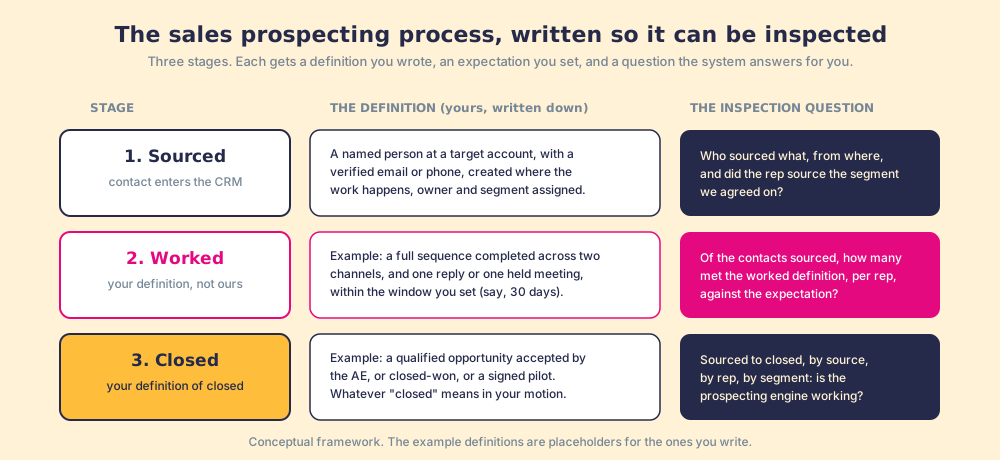
A sales prospecting process is three stages with a written definition for each, an expectation set against each, and a question the system can answer about each without asking the rep. That last clause is the difference between a process and a hope. Teams usually have the stages; few have the definitions written down; and the question, if it gets asked at all, gets asked of the rep in a one-on-one, which means the answer is a self-report. Take the stages one at a time.
- Sourced. A named person at a target account, with a verified email or phone, created where the work happens (the CRM, and the sequencer if the team runs one), with an owner and a segment assigned. The inspection question: who sourced what, from which source, and did the rep source the segment we agreed on? Sourcing the easy segment instead of the assigned one is the drift hardest to see, because the count looks identical either way.
- Worked. This is yours to define, and the definition is the process. An example: a full sequence completed across at least two channels, and one reply or one held meeting, inside a window you set (say, 30 days). The inspection question: of the contacts sourced, how many met that definition, per rep, against the expectation? Note that "sequenced" is a weaker word than "worked." Enrolling a contact in an automated cadence is a click; working a contact is the cadence completed and the human touches made. Sequencing a contact is not working a contact.
- Closed. Also yours to define, and the definition depends on your motion: an opportunity accepted by the account executive, a signed pilot, closed-won. The inspection question: sourced to closed, by source, by rep, by segment. This is the only line on the page that says whether the prospecting engine works, and it is the line the tools in the next section do not produce, because "sourced" was never recorded as a stage with a source attached.
Inside the working stage, the moves themselves are well documented, which is the uncomfortable part: the knowledge is solved and the behavior is not. Gong's call-analytics team has published what its recorded-call data shows about cold calls, and the findings are specific enough to act on. "Gong data shows a 2.1x higher success rate for salespeople who state their reason for calling," and successful cold calls run nearly twice as long as unsuccessful ones. On the talk ratio, Gong's finding cuts against the usual advice: "Reps take the burden of the conversation in successful cold calls, talking 55% of the time." Opening with "how've you been" performed 6.6 times better than calls without it, and the successful call's longest monologue ran 53 seconds against 25 in the unsuccessful one. Any rep can read that page in ten minutes. Whether the rep states the reason for the call on the fourth dial of the afternoon, with the buyer half-listening and the number short, is a different question, and it is the question the process exists to answer. The fuller treatment of the moves is in cold calling tips and the sales cadence; the point here is that the moves are known.
Jeb Blount, whose Fanatical Prospecting is the book SDR teams commonly hand new hires, put the time dimension of the process into a rule that is easy to remember and easy to break. As one reader's notes on the book record it, "The 30-Day rule: the prospecting you do in this 30-day period will pay off for the next 90 days," alongside the line Blount is best known for: "The more you prospect, the luckier you get." Blount's rule is an argument for consistency, and consistency is a property you can only claim about a process you can see. A manager who cannot tell which contacts were worked this month cannot know whether the 30-day rule is being kept, and will find out, as Blount warns, about 90 days later. Blount's framing does carry a risk worth naming: read carelessly, it makes prospecting a matter of the rep's willpower, and when the number misses, the fix becomes a talk about grit. Our reading of the same evidence goes the other way. When reps do not prospect consistently, it is a system failure: the next action was not in front of them, the sourced contact did not resurface, and no one inspected the gap until it was 90 days old. The rule is right. The remedy is the system.
Which sales prospecting tools do you need?
Fewer than the category suggests, and the ones you need sort by the job they do rather than by the logo. Sales prospecting tools fall into three jobs that map to the three stages: find the contact, work the contact, inspect the process. The vendors mostly sell the first, bundle some of the second, and offer nothing for the third, which is why a team can own four prospecting tools and still be unable to say what happened to last month's sourced contacts. Before the matrix, the market as it stands in September 2026, because a tools page written before this year's moves would be wrong in ways that cost trust.
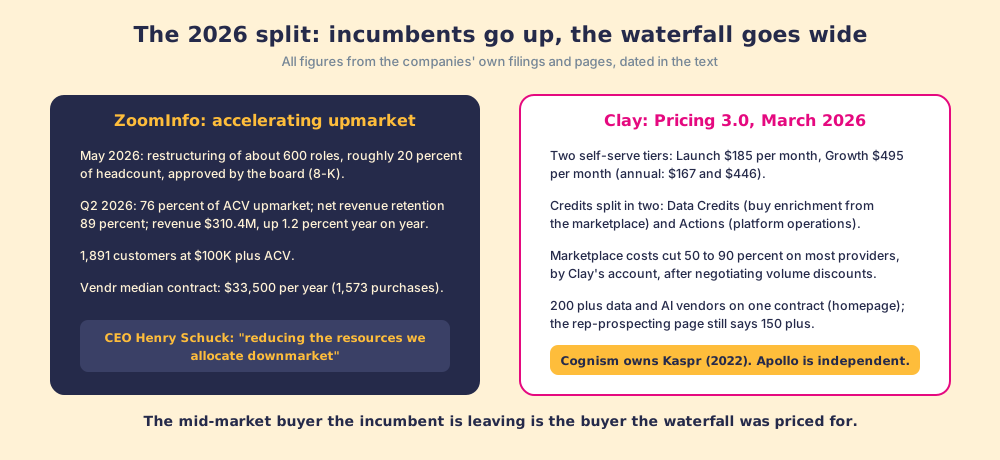
ZoomInfo, the database era's incumbent, is leaving the market this guide is written for. On May 5, 2026 its board approved a restructuring of approximately 600 employees, about 20 percent of its ending first-quarter headcount, and CEO Henry Schuck's email to staff the following week said the company was "accelerating our move upmarket, and reducing the resources we allocate downmarket," adding that "the industry is moving toward consumption-based pricing." The second-quarter results in August showed where that leads: 76 percent of contract value now upmarket, 1,891 customers at 100,000 dollars or more, net revenue retention of 89 percent, and revenue of 310.4 million dollars, up 1.2 percent year on year. Vendr's marketplace page, opened this month, puts the median ZoomInfo contract at 33,500 dollars a year across 1,573 purchases. A mid-market team evaluating ZoomInfo in 2026 is evaluating a vendor that has said, in a securities filing, that it is allocating fewer resources to teams like them.
Clay moved the other way. Its Pricing 3.0, announced March 11, 2026, collapsed three self-serve tiers into two, Launch at 185 dollars a month and Growth at 495 (167 and 446 on annual billing), and split credits into Data Credits, which buy enrichment from the marketplace, and Actions, which pay for platform operations. Clay says it negotiated volume discounts with its providers and cut marketplace costs 50 to 90 percent on most of them. The direction is plain: the incumbent is pricing for the 100,000-dollar account, and the waterfall is pricing for the team that used to buy one seat of the incumbent. Cognism remains independent and still owns Kaspr; Apollo remains independent, lists plans at 49, 79, and 119 dollars per user per month on annual billing, carries a G2 rating of 4.7 from 9,690 reviews on its own pricing page, and ships a feature it calls Waterfall Enrichment, which is a database vendor conceding the waterfall's premise. Vendr's Cognism page, opened the same day, shows a median of 32,750 dollars on 94 purchases and lists Apollo's median contract at 15,750.
With the market placed, the matrix. This scores tool types against the three jobs of the process rather than against each other's feature lists, because the feature list is what every vendor page already gives you. Read the columns as questions: does this tool find the contact, does it work the contact, and does it inspect whether the contact was worked to your definition? A team needs a yes in all three columns somewhere in its stack. Vendor names in the first row are examples of the type, not a ranking; the ranked comparisons live in the cluster posts linked below.
| Tool type | Examples | Find the contact | Work the contact | Inspect the process | Where it fits |
|---|---|---|---|---|---|
| Single database with extension | ZoomInfo, Apollo, Cognism and Kaspr, Lusha, LeadIQ | Yes, capped by that one database's coverage; a second contract fills the gaps | Partial: some bundle a sequencer or dialer | No: usage reports (credits, exports), not a sourced-to-closed funnel | Teams with one motion, one region, and a data need a single vendor covers well |
| Waterfall and orchestration layer | Clay (routes across 200 plus vendors; the row that contains the row above) | Yes, per result, across every provider in the marketplace | Partial: native sequencer and CRM sync, built by the GTM engineer | No: credits consumed and workflows run, not whether reps worked what they sourced | Any team with a RevOps builder; the ceiling is rep adoption of what was built |
| Sequencer | Outreach, Salesloft, the CRM's own sequences | No (some bundle data) | Yes: cadences, tasks, dialer, email | Partial: sequence completion, which is activity, not the worked definition | Any team; note that sequencing a contact is not working a contact |
| The CRM | HubSpot, Salesforce | No | Yes, as the system of record for the touches | Partial: contacts created and deals opened, with no sourced stage or source field unless you build one | Any team; the place the process has to be visible |
| Behavior layer | The category this guide argues for; Supered is our instance, described in the recommendation | Only through the waterfall it runs on; no database of its own | Yes: the next expected action in the flow of work, adherence measured | Yes: sourced, worked, closed, by your definitions, per rep and source | Teams with Clay and reps who never open it; the third column is the reason it exists |
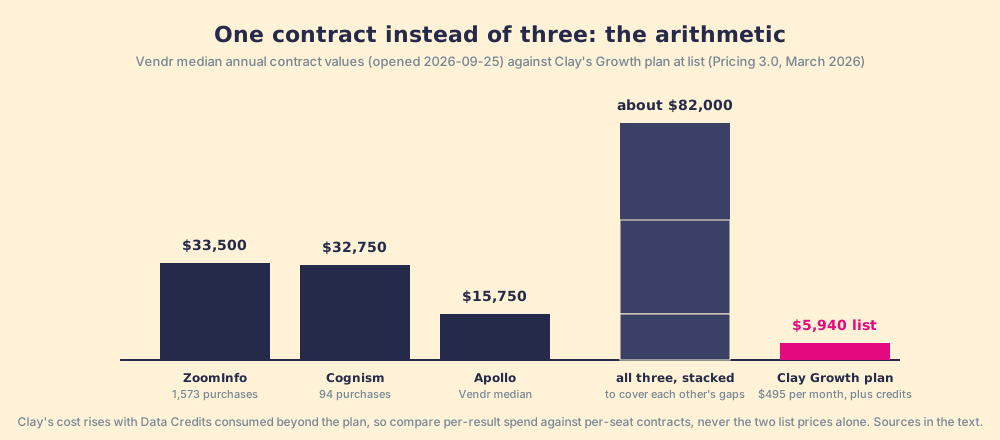
Two things fall out of the matrix. First, the third column is nearly empty across the market, and that emptiness is not an oversight vendors will fix next quarter. A database vendor's incentive is to report exports, because exports are what it sells. A sequencer's incentive is to report sequence completions, because that is what it does. Neither has a reason to report that a sourced contact was never worked, since that number indicts the purchase. Second, the "one contract instead of three" argument is arithmetic, not a slogan, so here it is with the numbers. Using Vendr's medians opened this month, a team that stacks ZoomInfo (33,500 dollars), Cognism (32,750) and Apollo (15,750) to cover each other's gaps is paying about 82,000 dollars a year for coverage; Clay's Growth plan lists at 495 dollars a month, about 5,940 dollars a year, plus Data Credits beyond the plan's allowance. The comparison that holds is per-result spend against per-seat contracts, and it holds only if the reps use the waterfall, which is the subject of the next two sections. The ranked versions of this argument, vendor by vendor, are in ZoomInfo competitors.
What is Clay, and why is it not a data source?
This distinction is easy to fumble, so it gets its own section and its own picture. Apollo, ZoomInfo, Cognism, Lusha, LeadIQ: each is one database. A database is a well. You lower the bucket, and either there is water or there is not, and when there is not, you are standing in a field with an empty bucket and a seat license. The organization's answer to a dry well has been to dig a second one, which is how a mid-market sales team ends up with three data contracts that overlap heavily and still miss the phone number for the one VP the rep needed on the day it mattered.
Clay is the bucket carrier. It owns no well. Its waterfall takes one lookup and carries it to provider after provider, across a marketplace Clay counted at 200 plus data and AI vendors on its homepage this month, until one returns a verified email or phone, and the team pays for the result, not for a seat at each well. Clay's rep-prospecting page describes the motion in a sentence: "One click runs Clay's waterfall enrichment. If one source misses, it tries the next". That is why the coverage claims around waterfalls exist at all. The lift comes from asking many sources, and it does not come from any one source being better. (Exportly, the extension Clay's page names as its Chrome partner, claimed "2x more verified emails and phones" in early 2026 without publishing a source; we do not print that multiplier, and neither should you until someone measures it.)
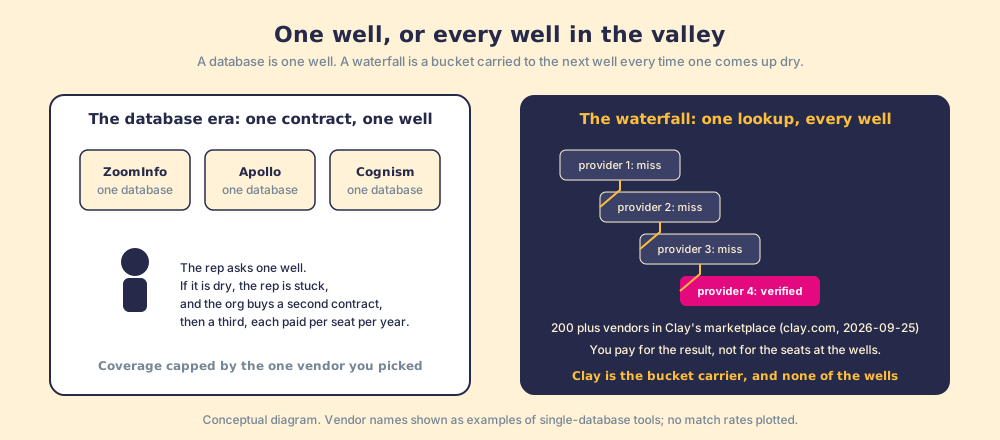
Two consequences follow for anyone writing a vendor comparison or buying from one. Never list Clay as a row beside Apollo and ZoomInfo; it is the row that contains those rows, and scoring it on "database size" is a category error. And when a comparison scores "data coverage," a waterfall's score is the union of its providers' coverage, which is the point. The second consequence is the one that matters for this guide. Clay is built by one person. Its own homepage says "GTM engineers build on Clay," and its rep-productivity pages say reps should be able to "self-serve the best prospecting data" and that a team can "build centralized workflows for any rep to run." Clay has been consistent about this frame: the GTM engineer builds, the rep runs, and Ops keeps control of the data, the spend, and the write-back rules.
Picture the workshop. The GTM engineer has hung the waterfall on the wall, next to a premade table for the mid-market segment, a custom table that maps a buying committee, a signals feed for job changes, and a CRM sync with the field mapping done once. It is a good workshop. The reps are in another building, on LinkedIn, in Sales Navigator, in the CRM record, in Gmail, on a company's website, in the sequencer. Between the two buildings sit a login and a tab the rep has to remember to open. A tool that lives in another building does not get used, no matter how good it is, and this is not a criticism of the tool or of the reps. It is a statement about distance. The Clay investment is capped by rep adoption, and adoption is what no one in the workshop can see, because the workshop's meter counts credits consumed and nothing about who consumed them or what they did next.
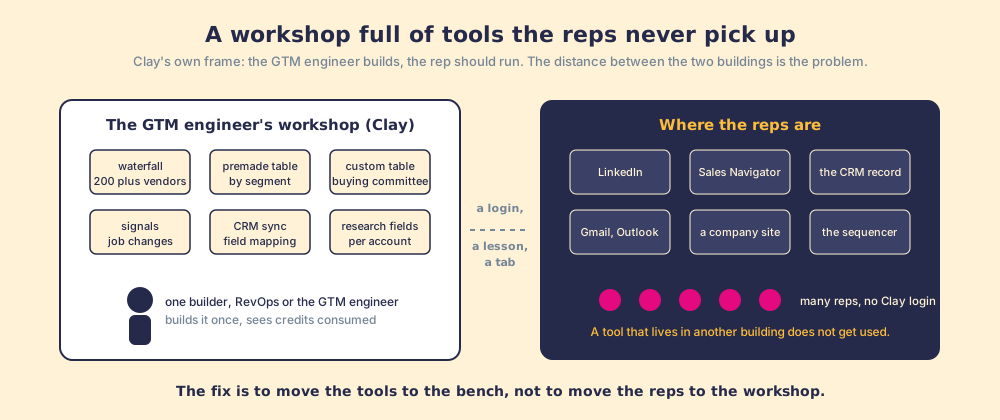
Clay's own framing, then, is the first half of this guide's argument, stated by the vendor: the builder builds, the rep should run. The second half is the one the vendor cannot say, because it is not a data problem. Running is a behavior, and a behavior exists, for management purposes, only to the degree someone inspects it. Clay governs the data. Something else has to govern the motion.
How do you run prospecting with Expect, Equip, Measure, Reinforce?
The framework is the same four-part loop we use for any behavior a sales team needs to run consistently, and it maps onto the three prospecting stages as a grid: four rows, three columns, twelve cells, each one a question to answer for your own team. What makes it a framework rather than a checklist is that each part rests on a mechanism with a study behind it, so a skeptic can check whether the part is load-bearing. Walk the rows.
Expect. Write the expectation for each stage in the form the brain executes best. The psychologist Peter Gollwitzer spent his career on the gap between intending and doing, and his 1999 paper in American Psychologist named the fix: "When people encounter problems in translating their goals into action (e.g., failing to get started, becoming distracted, or falling into bad habits), they may strategically call on automatic processes" through implementation intentions, plans of the form "Whenever situation x arises, I will initiate the goal-directed response y!" Gollwitzer and Sheeran's later meta-analysis of 94 studies put the effect of this if-then structure at d=0.65, a medium-to-large lift in follow-through. For prospecting, that means the sourcing expectation reads "if I open a profile in segment A, then I enrich and add it with the segment tag," the worked definition reads "if a sourced contact has had no reply in 10 days, then the second channel starts," and the closed definition names the exact event that counts. A goal ("source 40 a week") is the form the brain executes worst. A trigger is the form it executes best.
Equip. Put the tool and the next step where the work is, at the moment the situation arises. This is tenet-level for us and it is also measured: in The State of Sales Enablement, teams that deliver guidance in the flow of work hit quota at 49 percent, against 15 percent for teams that deliver it elsewhere. For sourcing, equip means the waterfall and the segment's table are one click from the LinkedIn profile, the Navigator list, the company site, and the CRM record, with no Clay login and no Clay lesson. For working, it means the next expected touch surfaces in the CRM and the sequencer the moment the rep opens the record. For closing, it means the handoff rule and the qualification questions arrive at the stage where they apply, not in a document from onboarding. Equip is what moves the tools from the workshop to the bench.
Measure. Count sourced, worked, and closed against the expectation, per rep and per source, and have the system do the counting. The same study found inspection-consistent teams at 6.3 times the quota attainment of the rest, and the mechanism is not mysterious: a process that is measured gets run, and a process that is self-reported gets reported. The manager's time is the scarce resource here. Manual inspection eats the hours a manager should spend coaching, so the inspection has to be automatic and the human time has to go to the gap the inspection reveals. That is also the answer to the objection that measurement is surveillance. Measuring activity and the buyer's position is how you verify the process is followed and how you shape the buyer's experience of it; the failure is letting a stage advance on activity alone, never the act of counting the activity.
Reinforce. Bring the expectation back every time the situation recurs, because memory will not. Ebbinghaus's forgetting curve, first published in 1885 and replicated since, has roughly 70 percent of new information lost within a day without reinforcement. A segment rule taught at kickoff is gone by the following week. So the rule reappears on the profile, every time; the untouched sourced contact resurfaces with its next step, every time; and the sourced-to-closed rate by source feeds next month's expectation, so the loop closes on itself instead of on a calendar.
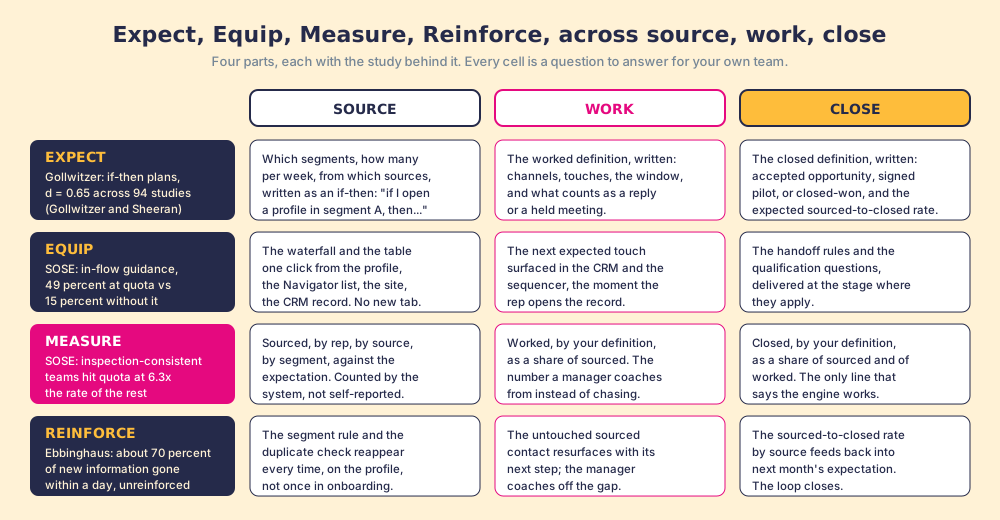
Run the grid against a real team and the empty cells are obvious within the hour, and they cluster. The Expect row is usually half-filled: there is a sourcing quota and rarely a worked definition. The Equip row is filled for working (the sequencer) and empty for sourcing (the waterfall lives in the workshop). The Measure row is the emptiest, and it is empty at exactly the cell that matters, worked as a share of sourced. The Reinforce row is a kickoff deck. A team does not need to fill all twelve at once. It needs to fill the Measure row first, because you cannot ask "what should we change about our prospecting" until you can answer "is the prospecting process being followed," and the grid is how you find out you cannot answer it.
Does AI replace sales prospecting?
It replaces the part that was already close to solved, and it sharpens the part that was not. Take the direction of the tooling seriously, because it is where the market is putting its money. Clay's MCP page offers to "give reps the best prospecting data in their AI tools", meaning ChatGPT, Claude, and Codex, with Clay's frame intact: "Reps get the right data faster while Ops keeps control," and "Turn your best reps' playbooks into Functions the whole team can run." LeadIQ ships a verified connector in Claude's directory whose page reads, "Prospect in natural language. Find companies and contacts without leaving your AI workflow," and promises that "Claude becomes your prospecting copilot." ZoomInfo's August 2026 results announced a "headless GTM context layer" with MCP integrations into Claude, Codex, Agentforce, and HubSpot's Breeze. The Bridge Group's 2025 study recorded "AI SDRs" as a distinct category for the first time, at 1 percent of respondents. The serious vendors are all moving the data into the chat window.
Grant that move its full force, because it is real. A rep who can ask a model for "VPs of operations at mid-size logistics firms who changed jobs this quarter" and get a verified list back has done in a minute what the database era took an afternoon to do. Drafting the outreach is cheap now too. So the knowledge half of prospecting, who to contact and what to say, is commoditized, and any page that tells you AI "cannot find good prospects" is describing 2022. The question AI puts to a sales leader is a governance question, and it is the same one this guide has been asking. The list now lives in a chat transcript. Sourced: a list. Worked: unknown. Closed: unknown. The rep's own credits were spent, the model was helpful, and the manager has no more visibility into what happened next than they had when the list came off a card file, arguably less, because the card file at least sat on the desk.
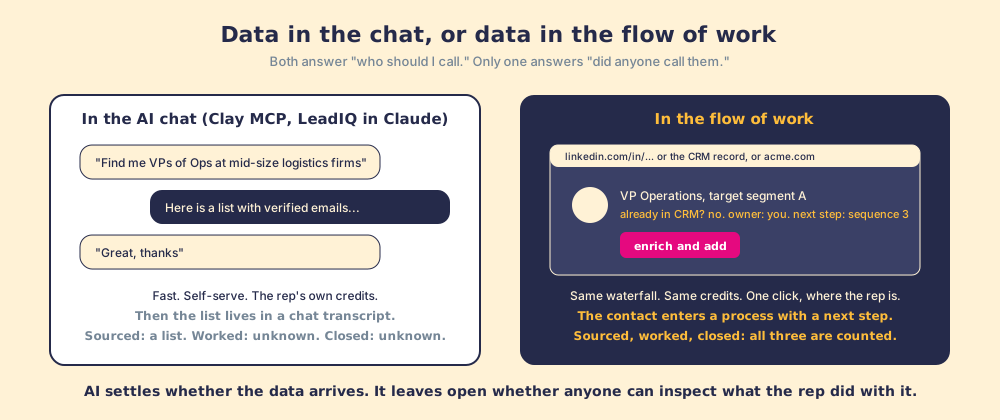
Our position on AI in prospecting is about sequence. AI amplifies whatever process it lands on. Land it on an adopted, inspected sourced-to-closed process and it compounds: more contacts sourced in the right segment, worked to the definition, with the funnel visible. Land it on a team with no worked definition and no inspection and it amplifies the failure, faster and at scale: the seed store fills in an afternoon, and the field is as unwalked as before. The governance that AI creates is the ability to inspect, at the level of the individual buyer interaction, whether the human or the machine did what you intended, and to answer the question that decides the buyer's experience: are the people we sourced getting the motion we designed, or a hundred automated touches no person chose? That is a behavior question, and the data vendors, correctly, are not trying to answer it. The fuller argument is in the AI SDR; the short version is that the surface the rep already works on, the profile or the CRM record, is a better place for the data to land than the chat, because that is where the next step can be attached and the trail can be inspected.
How does B2B prospecting change by segment and motion?
The process keeps its shape across segments; the definitions inside it change, and the mistake teams make is borrowing a definition built for a motion they do not run. Return to Gartner's table. In a small-business motion, the buying group is often one person, and "worked" can mean one person reached and one meeting held; the sourcing stage carries most of the risk, because the volume is high and the drift toward easy segments is invisible in the count. In a mid-market motion, the group is real but reachable, a few people across two functions, and "worked" has to mean at least two chairs reached before the contact counts as more than a name. In an enterprise motion, with Gartner's 6 to 10 buyers and 17 percent of their time available to all vendors combined, a single contact reached is a chair, and "worked" means the group was mapped, several chairs reached, and a champion identified, which is why enterprise prospecting blends into account planning and the account plan becomes the unit of work.
Inbound and outbound change the source, and the source has to be recorded, or the closed rate by source is unknowable. An inbound contact who filled a form arrives sourced by marketing, and the process picks up at "worked" with a tighter window, because a raised hand cools fast. An outbound contact sourced from a Navigator list or a company site arrives with no signal and needs the full sequence. Both belong in the same funnel with a source field, because the question a leader eventually asks, "which source of sourced contacts closes," is only answerable if the source was written down at the moment of sourcing. A team that sources from four places and records none of them has a prospecting process with no memory.
The specialization question, SDR versus full-cycle AE, is a segment question in disguise. The BDR and SDR split makes sense where volume is high enough to keep a sourcing specialist busy and the handoff can be defined; Bridge Group's ratio of one SDR to 2.4 AEs is the field's settled answer for the mid-market SaaS company it surveys, with a median ASP around 50,000 dollars. Below that, a full-cycle rep who sources and closes has the advantage the directory era had: one person does both, and the seam disappears. Either way, the inspection question is identical. What did the rep source, was it worked to the definition, and did it close. The org chart decides who answers; it does not change the question.
Why do prospecting programs fail?
They fail the way sales initiatives usually fail, and the pattern is worth drawing because a leader who can see the loop stops blaming the rep for it. A prospecting process is set at a kickoff: segments, targets, the sequence, the rule for when to stop. Then the rule lives in a document and the rep lives on LinkedIn, so when the situation the rule was written for arises, the rule is somewhere else and the rep improvises: sources what is easy, works what replies, abandons what does not. No one inspects the sourced contact, so the count climbs and "worked" stays unknown. The manager finds out at the pipeline review, weeks on, when a month's worth of sourced contacts turns out to have been touched once. And then the fix goes to the rep, in a one-on-one about discipline, while the system that dropped the rep at four separate points stays exactly as it was. The next kickoff sets the process again.
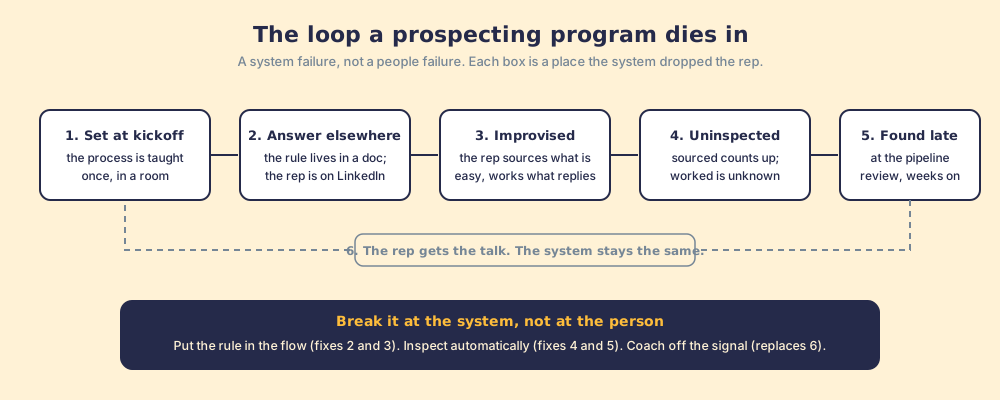
The behavioral science says the loop is predictable, not a character flaw. Pfeffer and Sutton named the knowing-doing gap in 2000: organizations rarely fail for lack of knowledge; they fail because knowledge does not convert into action. Gollwitzer's work explains the conversion: a rule held in memory as a goal loses to the situation in front of the rep, and the same rule delivered as an if-then trigger at the moment its situation arises wins, at d=0.65. Ebbinghaus explains why the kickoff never holds: about 70 percent of it is gone within a day. And our own data explains why the manager finds out late: the 53-point gap between defined and run processes is the gap between what leadership believes is happening in prospecting and what is happening, and it closes only where inspection is consistent, where teams hit quota at 6.3 times the rate. Put the four together and non-adherence in prospecting reads as what it is: friction (the tool in another building), late delivery (the rule in a doc), and missing inspection (no worked stage), with the rep at the end of the chain absorbing the blame for all three.
This is why the remedy is tooling and never exhortation. A talk about grit does not move the waterfall to the bench, does not surface the next step on the record, and does not count worked as a share of sourced. The system does those things or nothing does. And there is a buyer on the other end of every prospecting touch, which is the reason the whole exercise matters beyond the internal control: the difference between a sourced contact who receives the motion the team designed and one who receives whatever the rep improvised is felt by the buyer, in the form of a coherent conversation or a hundred untargeted touches. Gartner's 77 percent of buyers who call the purchase complex are describing, in part, what it feels like to be prospected by a process no one inspects. The consistency is for them.
The recommendation
A guide that lays out a problem this carefully owes the reader a verdict, so here are the ways forward as we see them, and which one we recommend. The first path is to keep buying coverage: renew the database contract, add a second when the first misses, and measure prospecting by contacts created. The evidence on this page says it produces record raw pipeline and record-low quota attainment, and that the incumbent selling it has told its shareholders it is moving away from you. The second path is to buy the waterfall and stop there: put Clay in the GTM engineer's hands, build the tables, and hope the reps walk to the workshop. This is the right data decision and an incomplete adoption decision; the investment is capped by a number no one is measuring. The third path is to treat sourcing as the first stage of a process you can inspect: the waterfall in the rep's hands where they already work, a written definition of worked and closed, and the funnel counted automatically, sourced to closed, per rep and per source, so the manager coaches off the signal instead of chasing it.
We recommend the third, and we hold it firmly, because every line of evidence here points at it. The Bridge Group's raw-pipeline label, Gartner's buying group, Gollwitzer's if-then effect, the forgetting curve, and our own 53-point gap and 6.3x inspection finding all say the same thing from different rooms: the finding is solved, the running is not, and the running is a system property you build rather than a virtue you demand. Do it in this order. Write the worked and closed definitions first, since without them there is nothing to inspect. Fill the Measure row of the grid next, because you cannot ask what to change until you can answer whether the process is being followed. Then move the tools to the bench.
That last step is the job we built Supered's sourcing for, and it is the one place on this page the product belongs. Supered is the Behavior Layer: it runs on the customer's own Clay account, so the waterfall the GTM engineer built and the premade or custom tables for each segment are one click from the LinkedIn profile, the Sales Navigator list, the company website, or the CRM record the rep already has open, with no Clay login and nothing to learn. One click sends the enriched contact to HubSpot or Salesforce with the field mapping Ops set once, and from there the contact enters the motion Supered guides and measures: the next expected action reaches the rep in the flow of the work, and the manager sees sourced, worked, and closed, by the team's own definitions, against the expectation the manager set. Clay governs the data. Supered governs the motion. If you have Clay, you have Supered; if you do not, Supered's sourcing is not for you yet, because a single-source tool is the problem this page describes.
Read the lane in depth: the vendor-by-vendor version of the one-database-versus-waterfall argument in ZoomInfo competitors; the moves inside the working stage in cold calling tips and the sales cadence; what the sourced contact becomes in what is a sales pipeline and sales pipeline stages; the science of getting any process run in the sales playbook guide; and the stages that follow prospecting in the sales process guide.
Sales prospecting FAQ
What is sales prospecting?+
What is the difference between sales prospecting and lead generation?+
What are the steps in a sales prospecting process?+
What are the best sales prospecting tools?+
Is Clay a sales prospecting tool or a data provider?+
What is a GTM engineer?+
How many prospecting activities should an SDR do per day?+
Why do SDRs miss quota even when activity is high?+
Does AI replace the SDR or the prospecting process?+
How is B2B prospecting different for SMB and enterprise?+
What should a manager inspect in a prospecting process?+
Do we still need a data vendor contract if we have Clay?+
Sourced is not pipeline.