RocketReach vs ZoomInfo in 2026: The Lending Library, the Archive, and Interlibrary Loan
RocketReach posts its prices and ZoomInfo quotes them, yet on G2 RocketReach edges ZoomInfo on contact data accuracy. RocketReach vs ZoomInfo, priced from pages opened October 2, 2026, graded for a ten to fifty rep team, with the third option for teams that already run Clay.
RocketReach vs ZoomInfo is a choice between RocketReach, a self-serve contact database with posted prices, and ZoomInfo, a quote-only enterprise platform whose median buyer pays $33,500 a year; on G2, RocketReach scores 7.9 for contact accuracy to ZoomInfo's 7.7.
RocketReach vs ZoomInfo is a choice between RocketReach, a self-serve contact database with posted prices, and ZoomInfo, a quote-only enterprise platform whose median buyer pays $33,500 a year; on G2, RocketReach scores 7.9 for contact accuracy to ZoomInfo’s 7.7. The short answer, by who it fits:
- Supered Prospector, for teams that already run Clay. Clay’s waterfall across 200+ providers, your ZoomInfo account as one step if you keep it, run from the rep’s LinkedIn tab and CRM record. $45 per rep per month, billed annually.
- RocketReach, for one rep to a small team buying on a card. A posted price, the better-rated Chrome extension, and a phone file from Pro at $899 a seat a year.
- ZoomInfo, for mid-market and enterprise teams buying depth and intent. The deepest single database, intent signals and a platform to match. Vendr median $33,500 a year.
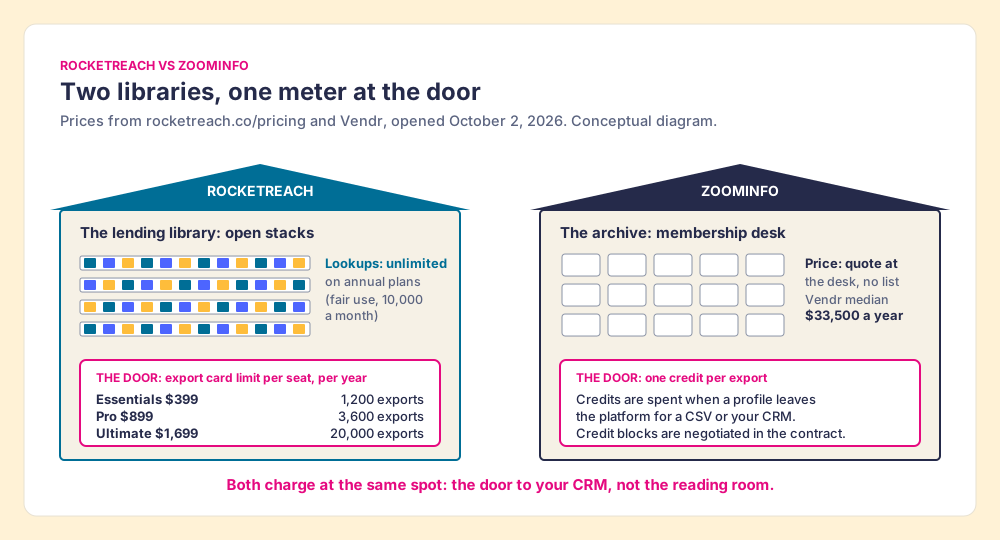
A town can have two libraries. The public one has open stacks: you walk in, read whatever you like for as long as you like, and the only limit is the number of books stamped on your card when you leave. The other is a private archive. There is a membership desk, the fee depends on who you are and what you ask for, and each box you carry out costs a token. The two buildings look nothing alike, and yet both charge you at the same spot, the door. RocketReach is the lending library and ZoomInfo the archive, and once you see where each meter sits, most of this comparison gets simple.
RocketReach vs ZoomInfo at a glance: the decision table
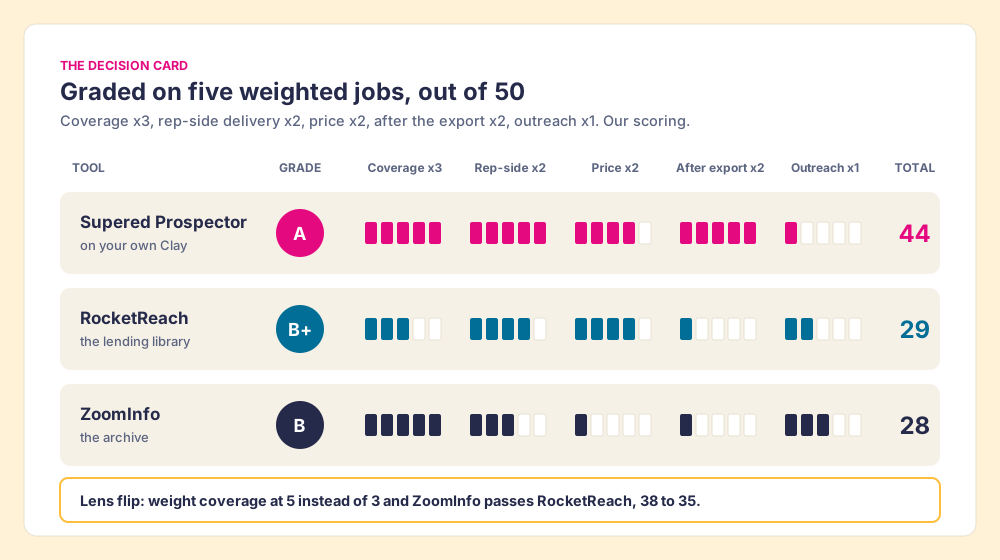
The grades use the same five weights as the Lusha vs ZoomInfo comparison and the ZoomInfo competitors page, on a lens of ten to fifty reps: coverage of the contact you need (x3), rep-side delivery where reps already work (x2), price structure (x2), what happens to the list after the export (x2), and bundled outreach (x1). Prices come from pages opened October 2, 2026.
| Rank | Option | Grade (score of 50) | Best fit | CRM integration | Setup effort | Pricing (plan with the job) | Reason to switch |
|---|---|---|---|---|---|---|---|
| 1 | Supered Prospector | A (44) | Teams that already run Clay | Native HubSpot, Salesforce and Pipedrive; one-click push | Admin connects Clay inside Supered; the GTM engineer builds flows or starts from the Supered Clay template | $45 per rep per month, billed annually, from 1 rep, plus your Clay plan | Clay’s waterfall across 200+ providers as a button where reps sell, and every list visible from found to closed |
| 2 | RocketReach | B+ (29) | One rep to a small team buying on a card | Salesforce, HubSpot, Outreach, Salesloft and Bullhorn from Pro | Self-serve in minutes; G2 ease of setup 9.1 | Pro $899 per seat a year (phones); team plans from $6,000 a year | A posted price, the better-rated extension, and a higher G2 accuracy score |
| 3 | ZoomInfo | B (28) | Mid-market and enterprise teams buying depth and intent | Native, with Salesforce and HubSpot among 40+ integrations | Sales-led quote and an annual contract | Quote only; Vendr median $33,500 a year | The deepest single database, intent data, Forrester Wave Leader in Q1 2026 |
| Tool | Coverage (x3) | Rep-side (x2) | Price (x2) | After the export (x2) | Outreach (x1) | Weighted total |
|---|---|---|---|---|---|---|
| Supered Prospector | 5 | 5 | 4 | 5 | 1 | 44 |
| RocketReach | 3 | 4 | 4 | 1 | 2 | 29 |
| ZoomInfo | 5 | 3 | 1 | 1 | 3 | 28 |
One point separates the two databases, and one weight moves it. Score coverage at 5 instead of 3, the lens of an enterprise team that buys depth above all, and ZoomInfo passes RocketReach 38 to 35. RocketReach scores 23 on our RocketReach alternatives page; it earns more here because this page adds G2’s head-to-head accuracy score and the extension ratings, both of which favor it over ZoomInfo. Prospector scores 1 on outreach because it drafts nothing and sends nothing. RocketReach and ZoomInfo score 1 on the fourth column because both meters stop at the export, and neither tells a manager whether the list was worked.
Why do teams switch between RocketReach and ZoomInfo?
The reasons run both ways, and they come from the customers on G2 (pages opened October 2, 2026).
- The ZoomInfo price. “Premium pricing creates a steep barrier to ROI, especially with occasional CRM sync lags,” a mid-market reviewer wrote on September 5, 2026. Vendr’s buyers who did not negotiate credits up front report $10,000 to $50,000 or more in overage fees over a term (Vendr, ZoomInfo).
- ZoomInfo’s mid-market records. “Contact info stays sharp at enterprise level, but mid-market records go stale faster,” a mid-market director of channel operations wrote on May 29, 2026. That fits the company’s own direction: in May its CEO told staff ZoomInfo is “accelerating our move upmarket, and reducing the resources we allocate downmarket” (SEC Form 8-K, May 2026).
- The RocketReach card limit. “The credits can run out quite quickly when doing a lot of prospecting,” a small-business sales manager wrote on April 14, 2026. Pro’s 3,600 exports a year come to about fourteen a working day per seat.
- RocketReach misses. “Rocket Reach’s information is inaccurate more often than it’s useful,” a mid-market business development director wrote on April 17, 2026, and a small-business reviewer on September 13 said “The only thing I really use on RocketReach is finding email addresses.”
Turned into buying questions, those complaints become three. How many contacts a day does each rep need to carry into the CRM? Are your buyers enterprise accounts or the mid-market? And what happens to a contact once it leaves the library? The first two decide between these vendors. The third decides whether you need either.
Why trust this comparison?
I started RevPartners, a HubSpot partner that did only sales implementations, sold roughly twice as much Sales Hub as any other partner, and reached Elite tier in 13 months. Supered grew out of that work and is the #1 sales enablement app on the HubSpot marketplace, with 6,000+ installs and 5.0 out of 5 from 122 reviews there, and 4.9 out of 5 from 81 reviews on G2 (checked October 1, 2026). I have watched contact databases get bought, renewed and dropped from inside the CRM where the contacts land.
The disclosure matters here. We sell a third option, Prospector, and it has no database of its own. It runs on Clay, and Clay carries ZoomInfo as a step. So I have a reason to like both vendors and a reason to sell you something else. The weights are printed so you can change them, and the price section below favors RocketReach because the arithmetic does.
How much does RocketReach cost compared with ZoomInfo?
At the lending library the fees are on a board by the door. RocketReach’s pricing page, opened October 2, 2026, sells three individual plans, and annual billing is where the lookups become unlimited (rocketreach.co/pricing):
| RocketReach plan | Annual price per seat | Exports a year | Lookup type | Monthly price (lookups capped) |
|---|---|---|---|---|
| Essentials | $399 ($33 a month) | 1,200 | $69 (100 a month) | |
| Pro | $899 ($75 a month) | 3,600 | Email and phone | $119 (250 a month) |
| Ultimate | $1,699 ($142 a month) | 20,000 | Email and phone | $209 (1,000 a month) |
The monthly column comes from our capture of the monthly toggle on September 25, 2026; the annual column matched again today. All three plan cards list “MCP & API access,” and team plans with pooled credits “start at $6K annually.” RocketReach’s own FAQ explains the meter: “A lookup pulls the contact data of the person and stores it within the RocketReach platform. An export allows you to download the data in CSV format or move the data to a third-party system,” and API lookups, bulk lookups, list uploads and CRM pushes all spend export credits (RocketReach unlimited credits FAQ). Annual lookups carry a fair-use limit of 10,000 a month. The full ladder, with per-export math, is on the RocketReach pricing page.
At the archive there is no board. ZoomInfo’s pricing page lists no prices, names sales-led tiers, and says “Each export costs one credit.” Vendr, opened October 2, 2026, shows what buyers pay:
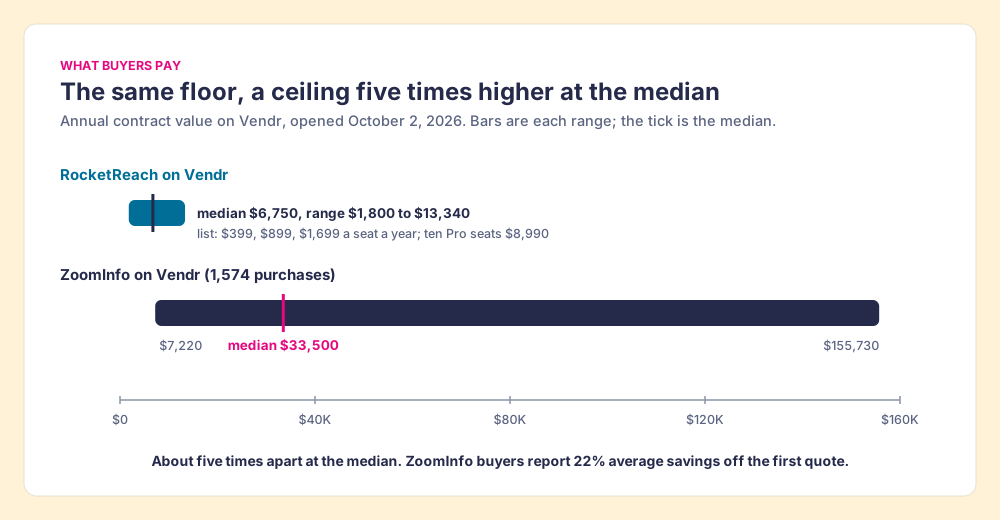
- ZoomInfo. Median $33,500 a year across 1,574 purchases, a range from $7,220 to $155,730, and 22% average savings off the first quote. Buyers who negotiate in ZoomInfo’s fiscal quarter-end months (March, June, September, December) commonly report better outcomes. More on the ZoomInfo pricing page.
- RocketReach. Median $6,750 a year, a range from $1,800 to $13,340 (Vendr, RocketReach). One buyer note on the page got “3 enterprise users to $6750” by buying through a rep instead of online.
ZoomInfo’s median is about five times RocketReach’s. Ten Pro seats at RocketReach list cost $8,990 a year; ten Ultimate seats cost $16,990. Both sit under the ZoomInfo median, and both buy a card limit you can read in advance: Essentials works out to about five exports a working day per seat, Pro about fourteen, Ultimate eighty.
Why do the two vendors’ comparison pages disagree on price?
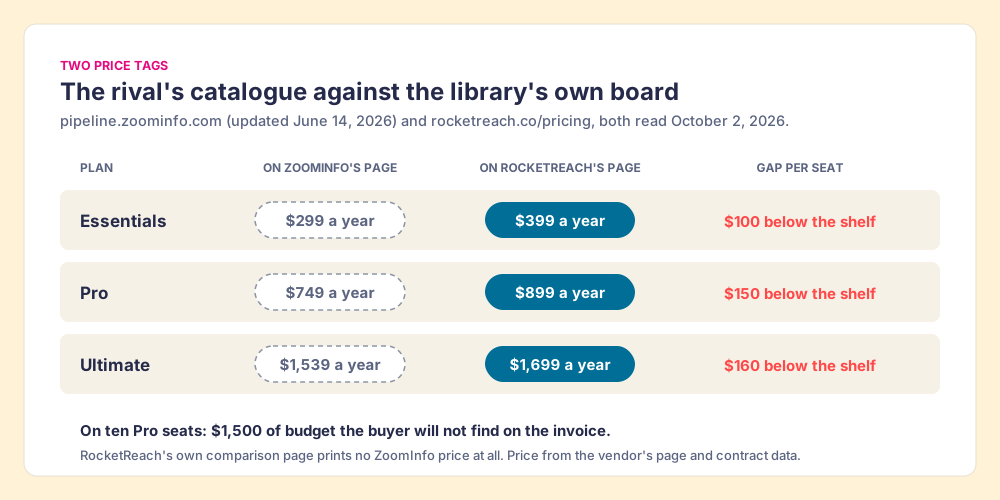
Both vendors rank for this search with their own comparison page, and the two pages handle price in opposite ways. RocketReach’s page, published September 3, 2026, names no ZoomInfo price at all; it says ZoomInfo’s enterprise products “generally use a sales-assisted pricing model” and that “There is no B2B database that will be the most accurate option for every company, industry, role, and geographic market” (rocketreach.co). That is a fair sentence from a vendor, and rare.
ZoomInfo’s page, the one Google’s AI Overview cites, does print RocketReach’s prices: “Essentials at $299/year, Pro at $749/year, Ultimate at $1,539/year per seat” (pipeline.zoominfo.com, updated June 14, 2026). RocketReach’s own pricing page, opened the same day we read ZoomInfo’s, shows $399, $899 and $1,699. All three of ZoomInfo’s numbers sit below the shelf price, by $100, $150 and $160 a seat. On ten Pro seats that is $1,500 of budget a buyer would not find on the invoice.
I do not read malice into that. Prices move and comparison pages age. The lesson for a buyer is plain: price a vendor from its own pricing page and from contract data such as Vendr, never from a rival’s comparison page, ours included.
Whose data is better, RocketReach or ZoomInfo?
Each is best at something real, so start with the praise.
- ZoomInfo, the deep archive. Its August 2026 filing claims “more than 100 million companies, 500 million contacts” (Q2 2026 results), and Forrester named it a Leader in the Q1 2026 Wave for B2B marketing and sales data providers, with the highest current-offering score and top marks in 20 of 27 criteria (Q1 2026 results). Intent data, org charts and a platform that spans sales, marketing and operations come with it. If you sell into enterprise accounts with a large team and want one vendor’s depth, ZoomInfo is the better of these two.
- RocketReach, the open stacks. A posted price, five free lookups with no card, and a refund rule worth copying: “A lookup is used if we find and verify email or phone, otherwise it is refunded.” Its page claims “700 million professionals and 60 million companies.” Its own comparison page places it with “Sales teams, recruiters, marketers, SMBs, and growing revenue teams,” and G2 agrees: 69% of its reviewers are small businesses. If you run one to ten reps who need verified emails and phones without a sales cycle, RocketReach is the better of these two.
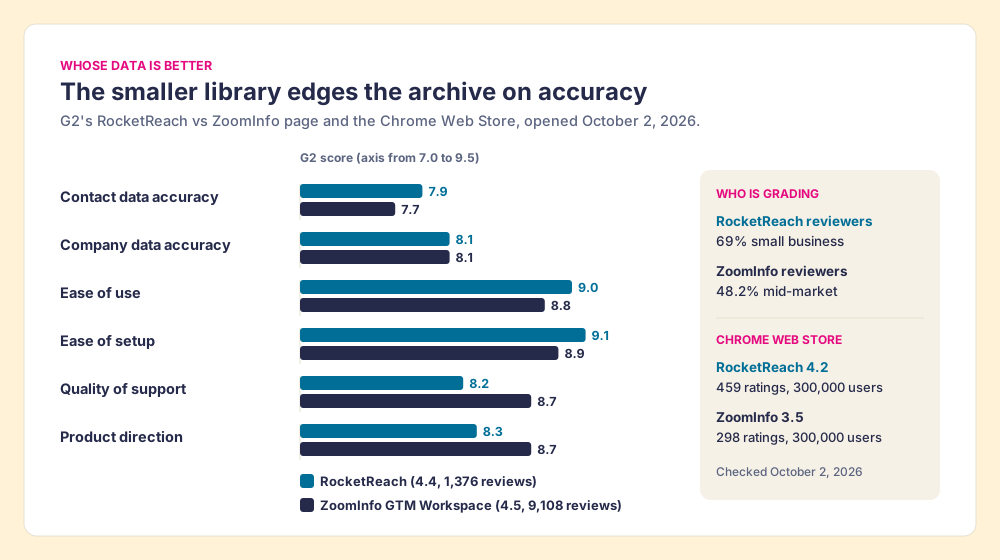
On the data itself, G2’s reviewers give the smaller library the edge. The head-to-head page, opened October 2, 2026, scores contact data accuracy 7.9 for RocketReach and 7.7 for ZoomInfo, and company data accuracy 8.1 for both (G2, RocketReach vs ZoomInfo). ZoomInfo leads on quality of support (8.7 against 8.2) and product direction (8.7 against 8.3); RocketReach leads on ease of use (9.0 against 8.8) and ease of setup (9.1 against 8.9). Read the accuracy score with its audience in mind: RocketReach’s reviewers are mostly small businesses, ZoomInfo’s are 48.2% mid-market, and they are grading the contacts each of them chases.
- The Chrome extension. RocketReach’s shows 4.2 out of 5 from 459 ratings and 300,000 users (Chrome Web Store); ZoomInfo’s shows 3.5 from 298 ratings and also 300,000 users (Chrome Web Store), both checked October 2, 2026. ZoomInfo’s listing says it is “Free for ZoomInfo customers,” so the extension rides on the contract. More on the ZoomInfo Chrome extension.
- The overall rating. ZoomInfo’s GTM Workspace holds 4.5 from 9,108 reviews on the head-to-head page and RocketReach 4.4 from 1,376.
The fair test of data is still the one you run yourself: a few hundred contacts from deals you won last year, split by segment, sent to both trials in the same week, with email bounce and phone connect scored apart.
How did my info get on RocketReach, and what is the ZoomInfo lawsuit?
Both questions sit in Google’s “People also ask” box for this search, so they deserve a straight answer. Both companies have been sued under state right-of-publicity laws for using free preview pages, which show a person’s name and job to visitors, to sell subscriptions.
- ZoomInfo. In Ramos v. ZoomInfo Technologies (N.D. Illinois, 1:21-cv-02032), ZoomInfo “denies all allegations of wrongdoing and liability” and settled; the settlement agreement funds more than $25 million across California, Illinois, Indiana and Nevada classes (settlement agreement), with final approval in November 2024.
- RocketReach. In Sant v. RocketReach (W.D. Washington, 2:24-cv-01626), the court declined to dismiss the publicity claims in July 2025 (Bloomberg Law). In McClure v. RocketReach, a separate case alleging that listed personal cell numbers violate a Colorado telemarketing law, Judge Tana Lin denied RocketReach’s motion to reconsider its arbitration ruling on June 22, 2026 (Justia). Neither case had reached a verdict when we checked.
None of this makes either database unusable; ZoomInfo says it serves 35,000+ companies and RocketReach claims over 30 million users. It does mean the question “where does this number come from, and can the person ask to be removed” belongs in the security review for both vendors, and for any vendor you consider, Clay providers included.
What changed at RocketReach and ZoomInfo in 2026?
ZoomInfo had a year of rebuilding. Its board approved a restructuring on May 5, 2026 that removes about 600 roles, roughly 20% of headcount. Its August 5 results showed revenue of $310.4 million, up 1.2% year over year, net revenue retention of 89%, and 76% of contract value upmarket. On September 30, 2026 it acquired DoubleO.ai, “an agentic orchestration platform built to help teams create reliable, multi-agent automation” (Business Wire), and on October 1 launched Agent Teams on top of it. The archive is building a new reading room for its largest members.
RocketReach had a smaller public year. Brighton Park Capital has held a majority stake since August 2020 (Cascadia Capital), and a news search on October 2, 2026 found no 2026 acquisition, funding round or rebrand. What moved was the shelf: Essentials and Pro went up to $399 and $899 a year, and “MCP & API access” now appears on all three plan cards. Both companies are independent as of October 2, 2026.
Is there a better option than RocketReach or ZoomInfo for a team on Clay?
For a team that already runs Clay, yes, and it is why Prospector ranks first in the table. Prospector does not bring its own database. It brings Clay’s waterfall, which is every database, routed. We chose Clay as our only data provider for that reason.
Go back to the town. Clay is interlibrary loan: “Buy data from 200+ providers in one place,” in Clay’s words, with a waterfall that asks one provider after another until one returns the verified email or phone. If none has it, the loan desk charges nothing: “If an enrichment returns no result, you’re not charged Data Credits or Actions” (clay.com/pricing, October 2, 2026). ZoomInfo is on the network: Clay lists it as an integration that joined January 15, 2025, with every enrichment action marked “Bring Your Own Account Required” (Clay, ZoomInfo), and Clay’s pricing page says bringing your own API keys skips Data Credits. Clay’s directory also lists RocketReach, joined July 26, 2024, under multi-provider enrichment, with no named actions on the page when we checked.
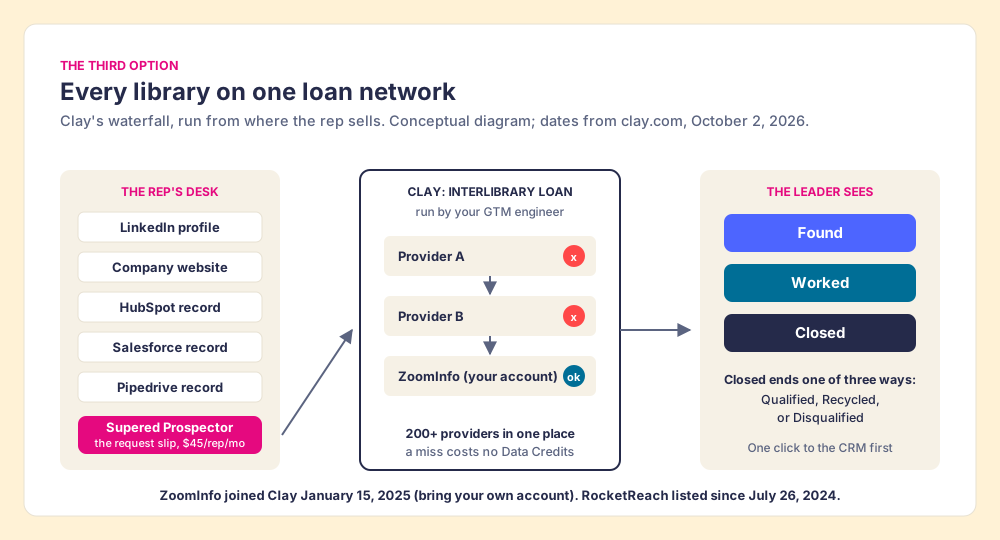
The loan desk has one problem, and Clay names it on its own homepage: “GTM engineers build on Clay.” The tables live in the GTM engineer’s workshop and the reps live in LinkedIn and the CRM, so the engineer becomes the list desk, fielding requests for lists all day. Clay plus Supered is the best way for a sales team to prospect: GTM engineers build in Clay, reps never open Clay. Prospector runs inside the Supered Chrome extension, on your own Clay account.
- Flows built once. The GTM engineer maps each flow to a Clay table or function and a destination, a sequence in your sales engagement tool or the CRM on the account. Reps pick the flow from a Push menu, and your waterfalls, tiers, tags and sequence variables stay yours. Start from the Supered Clay template or bring your own tables.
- A button where the rep sells. On a LinkedIn profile, a company website or a HubSpot, Salesforce or Pipedrive record, the rep runs the table in one click. In Sales Navigator, reps add leads to a prospect list and push the list to a Clay table. Prospector works within LinkedIn’s terms and does not copy search results in bulk; the contact data comes from Clay’s waterfall on the customer’s Clay account.
- An owner check before the push. The rep sees the matching CRM record, who owns it, and whether the prospect was worked before, so two reps do not chase one buyer.
- Found, worked, closed. The leader sees who is working their list and who is not, and every lead ends the way your process says: Qualified, Recycled or Disqualified. Your VP sees it too, which is how the Clay budget grows.
The price, laid out plainly. Prospector is $45 per rep per month, billed annually, from one rep, on your own Clay account and credits (Prospector). If RevOps already pays for Clay, ten reps add $5,400 a year. If you are buying Clay for this, Clay Growth at its $495 monthly rate is $5,940 a year, so Clay plus Prospector is $11,340 for ten reps and $16,740 for twenty. That sits well under ZoomInfo’s $33,500 median at both sizes. Against RocketReach it does not win on price from a cold start: ten Pro seats at $8,990 cost $2,350 less than Clay plus Prospector. The case for the loan network is coverage across 200+ providers, the rep’s own surface, and a leader who can see what each list became, and it is strongest for the team that already holds the library card. More on how reps build and work lists from Clay is on the sourcing use case and the Clay Chrome extension page.
Choose something else if any of these is true:
- No Clay, and no plan to buy it. Prospector runs only on Clay. Pick RocketReach or ZoomInfo from the branches below. If you want Clay built for you, RevPartners, a Clay Elite Studio Partner, builds and tunes the tables (disclosure: I founded RevPartners).
- A solo rep on a card. RocketReach Essentials at $399 a year is a simpler purchase than a Clay plan plus a seat.
- Agents that write and send the outreach. Prospector drafts nothing. ZoomInfo’s Agent Teams is aimed at that job.
- A field or mobile-first team. Supered runs at the computer and has no mobile product.
ZoomInfo vs RocketReach: which should you choose?
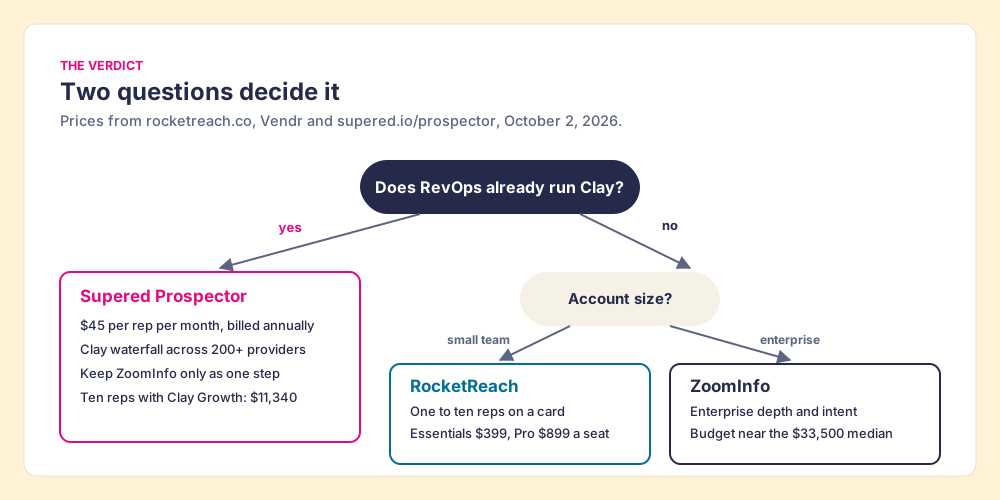
The branch comes before the score. If your problem is a few reps who need verified emails and phones this week on a posted price, RocketReach is the best pick. If your problem is enterprise depth with intent data across a large team and a budget for it, ZoomInfo is the best pick. If your reps already have Clay, the best pick is the waterfall in their hands, and the zoominfo vs rocketreach question shrinks to whether either one earns a step in it.
- RocketReach, the lending library. Choose it for one to ten reps buying on a card: Essentials $399 a seat a year for emails, Pro $899 for phones, 7.9 on G2 for contact data accuracy. Size the plan by exports a day per rep (about five, fourteen or eighty), buy annual so lookups are unlimited, and price the team plan from $6,000 a year once you pass six or seven Pro seats.
- ZoomInfo, the archive. Choose it for enterprise depth and intent across a large team: 500 million contacts, a Forrester Leader, agents on the roadmap. Budget near the $33,500 median, size the credits before the seats, sign in a quarter-end month, and cap the renewal escalator.
- Prospector on Clay, interlibrary loan. Choose it if RevOps already runs Clay. Coverage becomes Clay’s waterfall across 200+ providers, your ZoomInfo account can be one step in it, reps work from LinkedIn, the company site and the CRM record with no Clay login, and you see each list found, worked and closed: $11,340 a year with Clay Growth for ten reps, $16,740 for twenty.
If you do not have Clay, walk into the building that fits your reading: the lending library for a small team that wants the fees on the board, the archive for a large team that needs the deep boxes, and price each against the other. If you do have Clay, both buildings are already on your loan network, and the only purchase left is a desk your reps will use. The next comparisons in this set run the same test on other pairs: Apollo vs ZoomInfo weighs the archive against the all-in-one platform, Clay vs ZoomInfo prices the archive against the loan network, and the RocketReach review asks whether RocketReach is legit on its own terms.
Frequently asked questions
Is RocketReach better than ZoomInfo?+
How much does RocketReach cost compared with ZoomInfo?+
Which has more accurate data, RocketReach or ZoomInfo?+
What is the lawsuit against ZoomInfo, and has RocketReach been sued?+
Can I use RocketReach or ZoomInfo inside Clay?+
Do I need RocketReach or ZoomInfo if my team already has Clay?+
Your process, running itself.