The Sales Coaching Guide: Coaching That Survives a Real Week
Sales coaching is the highest-leverage thing a manager does and the first thing cut, because inspection eats the hours.
The science of the right dose, why AI changes the job, and how to coach behavior so it sticks.
Sales coaching is the ongoing work of a manager observing how reps sell against a defined standard and helping them close the gap deal by deal. It changes behavior when it is weekly, behavior-based, and built on inspection a machine does, so the scarce human hours go to coaching rather than to digging for what happened.
In 2011 one of the best surgeons in the country decided he had stopped getting better. Atul Gawande had been operating for eight years, his complication rate had flattened, and he did something surgeons almost never do: he asked a retired senior surgeon to stand in his operating room and watch him work. The case went well, or so Gawande thought; he walked out confident his coach would have little to add. He was wrong. Robert Osteen had a page dense with notes on small things Gawande could no longer see in himself, the angle of his elbow drifting up, a surgical drape that had swung and was cutting his light. None of it was dramatic. All of it mattered. Gawande's own line about that first debrief is the one to keep: "that one twenty-minute discussion gave me more to consider and work on than I'd had in the past five years." His complication rate started falling again. His conclusion, in his New Yorker essay "Personal Best," is the line to keep: "Coaching done well may be the most effective intervention designed for human performance."
Sales leaders already believe this. Ask any of them whether coaching matters and the answer is an immediate yes. Then watch their week, and coaching is the thing that slips. This guide is about that contradiction, the highest-leverage act a manager has and the first one cut, and why the cause is not the one everyone names. The argument runs in one line, and the rest of the page earns it: coaching fails for a structural reason, not a human one, because inspecting what the rep did eats the hours the coaching needed; there is an optimal dose, and it is smaller and more regular than anyone guesses; and now that AI does the analysis for nothing, the acts a machine cannot do are the only ones left that matter. Get those three right and coaching survives a real week. Get them wrong and it stays a thing you believe in and never do.
Gawande's experiment is the proof to keep in view the whole way down, because it strips coaching to its bones. He was already an expert. He was not failing. He could not see his own elbow drift toward his shoulder, or notice that for half an hour he was operating by reflected light, because, as he put it, "like most work, medical practice is largely unseen by anyone who might raise one's sights." A rep on a discovery call is in the same blind spot. The thing they cannot see is the thing holding them back, and only an outside observer against a standard can name it. That is what coaching is, in surgery and in sales, and it is why no amount of effort substitutes for it.
The objection arrives fast, and Gawande voiced it himself before answering it. Athletes and singers keep coaches for life; the rest of us do not, on the assumption that schooling ends and competence carries us the rest of the way. "The coaching model is different from the traditional conception of pedagogy," he wrote, "where there's a presumption that, after a certain point, the student no longer needs instruction. You graduate. You're done." That presumption is exactly what most sales organizations run on. A rep is hired, put through onboarding, certified, and then, the logic goes, they are done learning and the manager's job becomes scorekeeping. Gawande's whole essay is an argument that the presumption is false for any work that involves the complexity of people, and selling is nothing but the complexity of people. The question he poses cuts straight to the sales floor: "What about regular professionals, who just want to do what they do as well as they can?" That is the reader of this guide. The answer is the same as it was for the surgeon, and the rest of this page is about why the answer is so rarely acted on.
What is sales coaching, and how is it different from training?
Sales coaching is the ongoing work of a manager observing how a rep really sells, measured against a defined standard, and helping them close the gap one deal at a time. It is worth being strict about the borders, because three jobs get blurred together and the blur is expensive. Training transfers knowledge: the rep now knows the discovery framework. Managing tracks outcomes: the rep is at 70 percent of quota. Coaching changes behavior: the rep now runs the discovery framework on a real call when the buyer pushes back. Training is an input, managing watches a result, and coaching is the only one of the three that touches the thing in between, what the rep does in the moment, which is where revenue is made or lost.
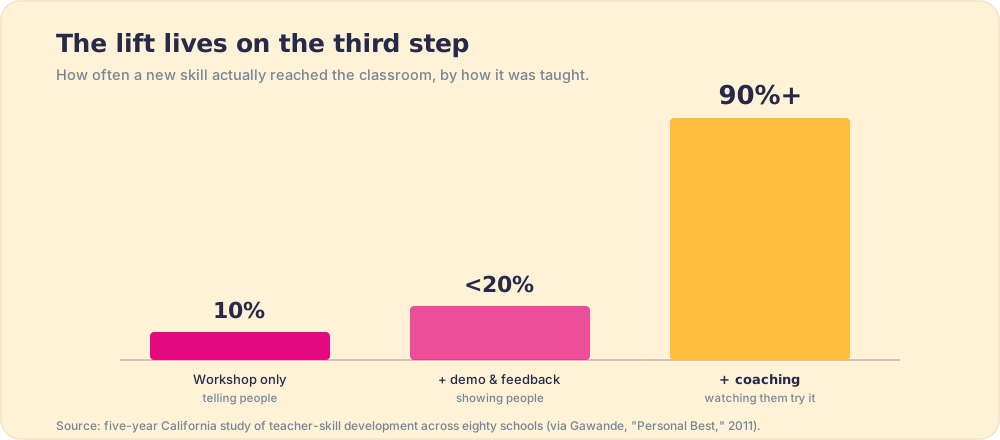
The distinction between training and coaching is not academic, and there is a hard number behind it. Gawande relays a finding from a five-year California study of teacher-skill development in eighty schools that should stop any leader who believes a workshop changes behavior. "Workshops led teachers to use new skills in the classroom only ten per cent of the time," he writes. "Even when a practice session with demonstrations and personal feedback was added, fewer than twenty per cent made the change. But when coaching was introduced, when a colleague watched them try the new skills in their own classroom and provided suggestions, adoption rates passed ninety per cent." Read those three numbers as a staircase. Telling people moves one in ten. Telling them and showing them moves fewer than one in five. Watching them try it and correcting them on the spot moves nine in ten. The sales-training industry sells the first two steps and calls them transformation. The lift lives on the third step, and the third step is coaching. This is the field-data form of our fourth tenet: knowing better is not doing better, so the lever that changes behavior is the one applied to the behavior, in the field, not to the knowledge, in a classroom.
There is a craft inside that third step, and Gawande names it precisely: "Good coaches know how to break down performance into its critical individual components." A workshop hands a rep a whole framework at once, discovery, qualification, objection handling, multi-threading, and trusts them to assemble it on a live call under pressure. A coach does the opposite. They take the one component that is breaking, the failure to ask about the cost of inaction, say, and work only that, the way a tennis coach isolates a serve toss before touching the swing. This is why "go on more ride-alongs" or "review more calls" is not coaching by itself. Observation without decomposition is one more person watching the same blur. The value is in naming which component, of the dozen at play, is the one to fix now, and that judgement is the part of the job that does not automate.
Why does sales coaching fail on real teams?
The standard explanation is that managers lack the skill or the discipline, so the standard fix is to send them to coaching training and tell them to do more of it. That explanation is wrong, and you can see it is wrong by watching where a manager's coaching hour goes. Before anyone can coach a rep, they have to find out what the rep did: listen to the calls, read the CRM, reconstruct the deal. That reconstruction is slow manual work, and it eats most of the hour the coaching was supposed to fill. The believed-in thing loses to the forensic thing, and not because anyone stopped believing.
Our own research says the stakes of losing that hour are high. In The State of Sales Enablement, inspection frequency was the single strongest predictor of quota attainment we measured, with the highest-frequency teams hitting quota at several times the rate of the lowest. The decay clock runs hard the other way too. Hermann Ebbinghaus mapped the forgetting curve in the 1880s and it has held up since: without reinforcement, a large share of new information is gone within a day, which is why a lesson delivered once, far from the deal, is mostly gone by the next real call. Coaching works through reinforcement, and reinforcement only compounds when it recurs close to the work. The diagnosis writes itself: do not coach harder, stop spending the coaching hours on inspection.
It helps to put a clock on the problem, because the time budget is where the structural failure becomes visible. A frontline manager with seven reps who wants to give each one a genuine weekly hour has spent seven hours before doing anything else, and that is the easy part. The hard part is preparing for those hours. If preparing for one rep means listening to even two thirty-minute calls and reconstructing where three open deals really stand, that is well over an hour of forensics per rep, per week, on top of the session. Multiply by seven and the manager is asked to find the better part of two working days for coaching alone, inside a week already full of forecast calls, escalations, and their own deals. No one finds two days. So the preparation gets skipped, the session becomes a status update because status is the only thing the manager had time to gather, and the rep leaves with nothing to practice. The failure looks like a willpower failure and is a time failure wearing its clothes. Korn Ferry, surveying the same problem, calls effective coaching "the biggest untapped performance lever in the commercial engine," and reports that roughly 80 percent of sales leaders run no formal or only inconsistent coaching. A lever that valuable, left unpulled by four teams in five, is not a coincidence of bad managers. It is a design defect in how the hour is structured.
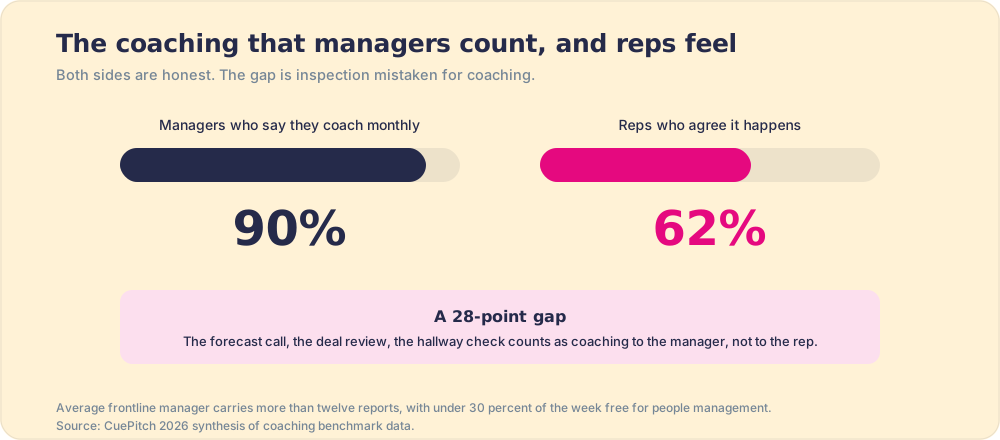
The clock has gotten worse, not better, which is the part most coaching advice ignores. Spans of control have widened. Synthesizing recent benchmark data, the analysts at CuePitch put the average frontline sales manager at more than twelve direct reports and note that managers now have under 30 percent of their week available for people management at all; the rest is pipeline review, forecasting, internal meetings, and their own deals. Run that arithmetic and the picture is bleak before a single call is listened to: under thirty percent of a forty-hour week is roughly twelve hours, split across twelve reps, which is an hour of total people-time per rep, of which the actual skill coaching is a sliver once the status check and the team standup take their cut. The hour the previous paragraph asked for does not exist. It was spent before the manager sat down.
This is why the second-most-cited statistic in coaching is a perception gap, and why it is so revealing. CuePitch's synthesis finds that 90 percent of sales managers report coaching their reps monthly, while only 62 percent of reps agree it happens. The managers are not lying. They are counting the forecast call, the deal review, the hallway "how's it going," all the things that fill the sliver of people-time, as coaching, because from the inside, talking to a rep about a deal feels like coaching. The reps, on the receiving end, know the difference between being asked about the number and being helped to change the behavior behind it, and they report the second one missing. The gap between the two numbers is the gap between inspection-disguised-as-coaching and the real thing. It is not a gap of effort. It is the visible residue of an hour eaten by forensics before the coaching could begin.
There is a second cost to losing the hour, less obvious than the performance one, and it shows up in the numbers as turnover. A rep who is never coached is a rep who is only ever judged, told the result, asked why the result was not better, and left to figure out the how alone. That is the relationship Korn Ferry's turnover figure measures: teams with consistent coaching see voluntary attrition nearly 30 percent lower, because coaching is the part of management that develops a person rather than only scoring them. When inspection eats the coaching hour, what the rep experiences is not a neutral absence. It is a manager who has time to point at the scoreboard and no time to help them play, and good reps leave that. The thing to hold onto is that the cause is identical to the performance problem. The same stolen hour that flattens skill also corrodes the relationship, which is why the fix, giving the hour back, pays twice.
Why does coaching change behavior when training does not?
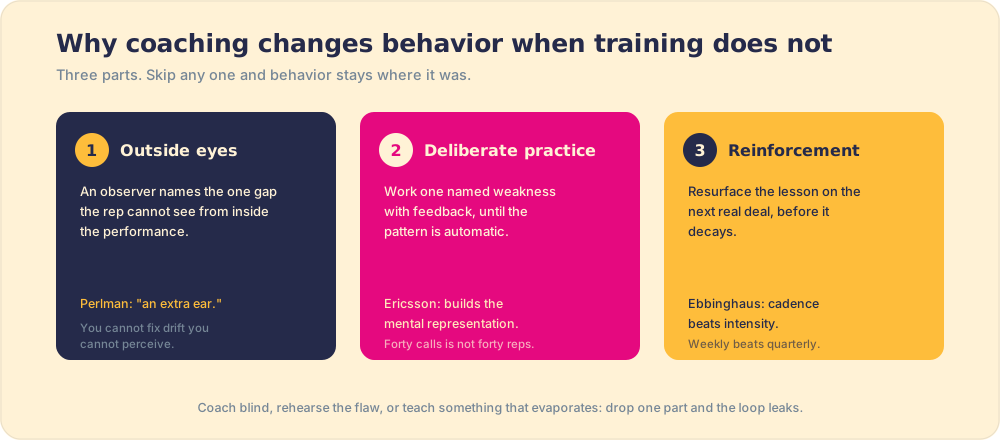
Knowing why coaching works, mechanically, is what lets you build it instead of only admiring it, and the mechanism has three parts that the research names precisely. Start with the part Gawande found in the operating room: the outside observer. People cannot reliably see their own performance while they are inside it. The violinist Itzhak Perlman told Gawande that his wife serves as "an extra ear" because "the great challenge in performing is listening to yourself. Your physicality, the sensation that you have as you play the violin, interferes with your accuracy of listening." A rep on a call has the same problem. The pressure of the conversation, the momentum of their own talking, the relief when the buyer nods, all of it interferes with their accuracy of hearing what they did. Gawande puts the coach's role in one sentence: "The coach provides the outside eyes and ears, and makes you aware of where you're falling short." That awareness is not available from the inside at any level of skill, which is the deep reason effort alone cannot replace coaching. You cannot fix the drift you cannot perceive.
The second part is what you do once the gap is named, and here the authority is the psychologist Anders Ericsson, whose work on expertise is the foundation of the whole field. Ericsson's central finding is that skill is built not by repetition but by a specific kind of practice. In "Peak," he and Robert Pool draw a careful line between three things people lump together. There is naive practice, which is, in their words, "essentially just doing something repeatedly, and expecting that the repetition alone will improve one's performance." There is purposeful practice, which adds well-defined goals, full attention, and feedback, but which a motivated person can do alone. And there is deliberate practice, the gold standard, which is purposeful practice plus a teacher or coach who can see what the learner cannot and design the next correction. The shorthand worth carrying: deliberate practice is purposeful practice that knows where it is going and how to get there. The phrase that matters is "knows where it is going," and the reason it requires a coach is that the learner, inside the performance, usually does not know.
This is why a rep who runs forty discovery calls a quarter is not practicing discovery forty times. They are doing naive practice forty times, repeating whatever they already do, grooving the habit deeper, including the flaw, expecting the repetition alone to make them better. Ericsson's whole career is a demonstration that it will not. Worse, he found that once a performer reaches a level that feels acceptable and lets the skill go on autopilot, additional years of experience produce no further gains and often a slow decline, because the automatic version is no longer being examined. The veteran rep coasting on "I've done a thousand of these" is not at the top of a learning curve; they are on a plateau they cannot see the edges of, which is precisely Gawande's surgeon eight years in. Experience is not practice. Only practice aimed at a named weakness, with feedback, is practice.
Ericsson also explains, mechanically, what coaching is building when it works, and the answer reframes the whole exercise. Skill, in his account, is the accumulation of "mental representations," the rich, pre-loaded patterns an expert holds that let them recognize a situation and know the right move before they have consciously reasoned it out. A chess master does not calculate every legal move; they see a board and a handful of strong continuations present themselves, because thousands of studied games built the representation. "The main purpose of deliberate practice," Ericsson and Pool write, "is to develop effective mental representations." For a rep this is the difference between knowing the discovery framework and having internalized it so completely that, when a buyer deflects, the next question is already forming. Coaching builds that representation one corrected repetition at a time, which is why a dozen scattered notes cannot do it: a representation is built by depth on one pattern, not by breadth across many. Coach one thing until it is automatic, then the next. That sequence is not a stylistic preference; it is how the neural pattern forms.
The third part is the clock again, now as an ally instead of an enemy. Ebbinghaus showed that a lesson learned once decays fast without reinforcement; the corollary is that a lesson reinforced on a schedule, close to where it is used, compounds. This is why the cadence of coaching matters more than its intensity, and why the quarterly business review is structurally incapable of changing behavior no matter how good the conversation in the room. A brilliant insight delivered in March is mostly gone by the live call in April, because nothing carried it forward to the moment the rep needed it. A modest insight reinforced every week, anchored to a real deal in motion, is present at the moment of the work, which is the only moment behavior is decided. Put the three together and coaching is a machine with a clear blueprint: an outside observer names one gap against a standard, the rep practices that one thing with feedback, and the lesson is reinforced in the flow of work before it decays. Skip the observer and you coach blind. Skip the focus and you rehearse the flaw. Skip the reinforcement and you teach something that evaporates. The reason most coaching fails is that the manager, starved of hours by the inspection burden, manages to do none of the three with any consistency.
How much sales coaching is enough?
"More" is the intuitive answer and the wrong one. Coaching has a dose-response curve, and it has been measured. CSO Insights, now part of Korn Ferry, found that teams running dynamic, formal coaching at about three hours per rep per month, with weekly touchpoints, attained quota at 91.2 percent versus 84.7 percent for informal approaches, with roughly 28 percent higher win rates. Three hours is the threshold where the lift turns on. Below it, coaching is too sparse to reinforce anything; above about five hours, the curve flattens and extra time stops paying. The lever is not volume. It is hitting a consistent, modest dose, every week, on the right behavior.
The shape of that curve carries a lesson most coaching advice gets backward. The instinct, when a rep is struggling, is to schedule more sessions; the data says the missing variable is rhythm, not hours. A weekly thirty-minute conversation that happens every week, fifty weeks a year, is roughly three hours a month wherever the math lands, and it beats a heroic three-hour session once a quarter that the rep forgets before the ink dries. Reinforcement is the active ingredient, and reinforcement is a function of frequency, not of any single dose. Korn Ferry's own analysis converges on the same place from a different dataset: in their fifth annual study, companies with consistent sales coaching and impact measurement see 32 percent higher win rates and 28 percent higher quota attainment, along with double the seller engagement and nearly 30 percent lower voluntary turnover. Two independent bodies of field data, CSO Insights and Korn Ferry, point at the same conclusion: the lift is in the consistency, and it is large. The number that should worry a leader is not the dose, which is achievable, but the gap between believing in coaching and resourcing it, which is where the believed-in thing keeps losing to the urgent thing.
Who should you coach: your stars, your strugglers, or the middle?
The middle, which runs against instinct. The instinct is to pour coaching into the top reps, who are pleasant to coach and win anyway, or into the strugglers, who obviously need help. Both instincts waste the hour. CEB, now part of Gartner, analyzed coaching's effect across performance bands and found the return concentrates on the core performers, the middle 60 percent of the team (CEB / Gartner, "Coaching the Middle"). The stars will hit their number with or without you. The bottom often have a fit or motivation problem that coaching does not repair. The middle is the largest group and the easiest to move, so a point of improvement there, multiplied across the largest headcount, is where the revenue is.
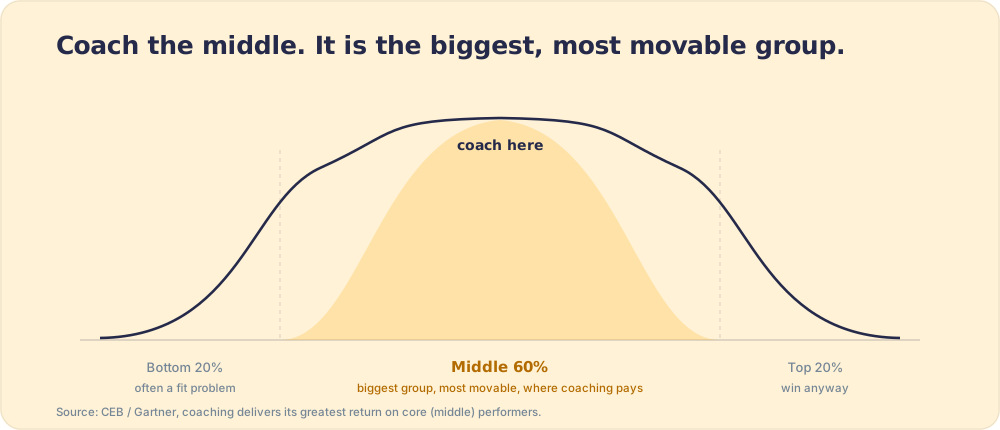
So coaching is a system for raising the floor of the largest part of the team, neither triage for the weak nor a reward for the strong. It follows the same logic that makes a shared, well-run process beat scattered brilliance: a motion the middle 60 percent runs a little better moves more revenue than heroics from a few. The highest-return coaching is tied to the process every rep is meant to run, the subject of sales process adoption, not to a grab-bag of personal tips.
Is more coaching always better?
The honest objection to everything so far is the natural one: if coaching is the most effective intervention for human performance, why stop at three hours? Why not coach every call, every day, until the rep is perfect? It is worth granting the objection its full weight, because the instinct behind it is correct in spirit. Coaching does work, the evidence is strong, and a leader watching a rep struggle feels the pull to do more of the thing that helps. The trouble is that "more of the thing that helps" assumes a straight line, and the data describes a curve.
The dose-response shape from CSO Insights is the answer, and it bends for two reasons worth separating. The first is simple saturation. Past roughly five hours per rep per month the curve flattens, because a rep can only run so many real deals in a month, and coaching has nothing to bite on without fresh at-bats to examine. The eleventh review of the same week's calls surfaces no new gap; it relitigates the ones already named. You cannot practice a serve you have not yet had a chance to hit. The second reason is more interesting and cuts against the leader's instinct hardest: over-coaching breeds the dependence coaching is supposed to cure. A rep coached on every micro-decision stops making decisions. They wait to be told. This is the deal-rescue mistake (the next section) turned into a standing operating mode, and it produces a seller who performs well under a manager's eye and falls apart the moment the manager is busy. Gawande's coach Robert Osteen understood the limit exactly. He refused to hand Gawande answers, because, as Osteen put it, "most surgery is done in your head"; the performance is set by the judgement, and judgement does not develop in someone who is never left to exercise it.
So the steelman holds only up to a point, and the point is measurable. More coaching is better until about three hours a month, decisively; roughly neutral between three and five; and past five it stops buying skill and starts buying dependence and crowding. The leader who wants to help a struggling rep is right to act, but the action that helps is not a heavier dose. It is a more consistent one, aimed more precisely, at the single behavior that is losing pipeline. The lever was never volume. It was rhythm and aim, and both of those are cheap once the inspection burden is lifted.
What are the common sales coaching mistakes?
Coaching fails in a handful of recognizable ways, and each one feels, in the moment, like good management. Naming them is the fastest diagnostic a leader has, because the antidote to every one is the same machine described above: an outside view, one behavior, reinforced over time. If your coaching is busy and changing nothing, the cause is almost certainly on this list.
- Coaching the deal, not the rep. The most common and most seductive error. A rep brings a stuck opportunity, the manager has good instincts, and the manager solves the deal, tells the rep what to send, who to call, how to handle the objection. The deal may advance, and the rep learned nothing they can use next time, because the manager did the thinking. This is the opposite of what Gawande's mentor Robert Osteen did, refusing to hand over the answer so that the rep is forced to build the judgement themselves. Coaching the deal trains dependence. Coaching the rep, the decision behind the deal, builds a seller who handles the next ten without you.
- Coaching the result instead of the behavior. Reviewing a lost deal at quarter close, when nothing can be changed, is autopsy, not coaching. The result is downstream of behaviors that happened weeks earlier, and by the time the number lands the behavior is cold. Coach the leading behavior the rep can still change on the open deal, not the lagging outcome they can only mourn.
- The everything review. A manager listens to a call, finds nine things to fix, and lists all nine. The rep, facing nine corrections, internalizes none, because, as Ericsson showed, skill is built by focused repetition on one target with feedback, not by a comprehensive critique. Nine notes is zero deliberate practice. One note, worked until it holds, is the unit that changes behavior.
- Coaching on memory and feeling. "How is the deal looking? I think you talk too much on discovery." Without the evidence of what the rep did, coaching becomes the manager's hunch versus the rep's, and the rep, reasonably, defends themselves. Coaching on observed behavior, the moment in the call, the step the rep skipped, removes the argument and the defensiveness with it, because both people are looking at the same fact instead of trading impressions.
Read down the list and one pattern connects them: each substitutes something easier for the harder thing coaching is supposed to do. Solving the deal is easier than building the rep. Reviewing the result is easier than catching the behavior in time. Listing nine fixes is easier than insisting on one. Trusting your gut is easier than gathering the evidence. The craft of coaching, exactly like the craft of a sales process, is refusing those substitutions, and the reason managers reach for them is rarely laziness. It is that the harder version takes preparation time the inspection burden already stole.
How has AI changed sales coaching?
To see what AI changed, watch how the job evolved. For decades coaching meant the ride-along: a manager rode shotgun in the car or sat in the room, formed an impression, and gave notes from memory days later, by which point both of them remembered the call differently. The whole apparatus rested on one person's recollection, which is the weakest possible foundation given Perlman's point that we cannot reliably hear ourselves. Conversation intelligence changed that. When Gong arrived in 2015 and Chorus alongside it, calls became reviewable for the first time, so the impression could rest on a recording instead of a memory. Dedicated readiness platforms such as Mindtickle and Allego added structured practice and scorecards, so the rep could rehearse and the manager could grade against a rubric. Then AI arrived and made the analysis nearly free: tools like Second Nature and Hyperbound run infinite roleplay, and every serious platform now auto-scores calls and flags where a rep drifted from the talk track. Gartner folded the whole field into a single Revenue Enablement Platforms category in 2025, a sign the analysis tooling had matured into a commodity. Each wave made it cheaper to see what a rep did and cheaper to let them practice, and not one of them touched the human judgment in between.
None of those waves did the thing that changes behavior. AI can score the call; it cannot, as Gawande's coach did, see the one habit the rep is blind to in themselves and make them feel why it matters. AI can run a hundred roleplays; whether they help depends on the principle Ericsson spent his career on, that improvement comes only from deliberate practice, focused repetition of one specific weakness with immediate feedback, not from volume. A hundred unfocused roleplays is the everything review at machine scale. And AI can remind a rep of a lesson; only a human and a system can make sure the lesson is reinforced on the next real deal before the forgetting curve erases it. AI has commoditized the analysis. That throws the entire weight onto the human acts it cannot do, which is the opposite of replacing the coach. It frees the coach.
There is a caution Gawande raises that AI makes sharper, not softer. "Bad coaching can make people worse," he writes, and an AI coaching at scale can make a whole team worse at the speed of software. A model that scores calls against the wrong rubric, or runs roleplays drilling a script your best reps abandoned two quarters ago, will reinforce the wrong behavior across every rep at once, with all the confidence of an automated dashboard. This is our eighth tenet in practice: AI has to be governed by its effect on behavior, and you must be able to inspect, at the level of the individual call and deal, whether it is reinforcing the standard you want or some plausible-looking substitute. The governance question for AI coaching is the same one you ask of a human coach, only harder to answer because it runs silently across the whole team: is it coaching toward the motion your winners run, or toward an average it inferred from the data? Point the analysis at the right standard and AI is the thing that finally gives managers their hours back. Point it at the wrong one and it industrializes a bad habit.
Map the three waves of tooling onto the mechanism and the pattern is clean. Conversation intelligence solved the outside-eyes-and-ears problem at the level of seeing: the call is now reviewable, so the manager need not have been in the room. AI roleplay solved the at-bats problem: a rep can practice an objection fifty times before it costs a real deal. Auto-scoring solved the decomposition-at-scale problem: the system flags which component drifted on which call. Each wave took a piece of what used to be the manager's manual labor and made it a feature. And yet the rep does not improve from any of it directly, because none of it does the deliberately-practiced, reinforced, judgement-laden work that Ericsson and Gawande describe. The tools deliver a perfectly diagnosed gap to a manager who, until now, had no hours free to coach it. The bottleneck did not disappear; it moved from seeing to acting, and acting is the human's job.
The reframing is this: AI did not make the coach redundant; it made the scarce part of the coach the entire job. For a hundred years the bottleneck on coaching was the labor of seeing what the rep did. That labor is now close to free. What remains, the outside judgment about which gap matters, the focused practice that builds the skill, the reinforcement that beats the forgetting curve, is exactly the human work that was always the point and was always getting crowded out. The technology removed the chore. It left the craft.
What makes sales coaching stick?
Coaching that changes behavior runs as a loop of four moves, each resting on one of the findings above. Skip any one and the loop leaks back into the quarterly review that changes nothing.
- A defined standard. You cannot coach a gap you have not named. Coaching rests on the process and plays a rep is expected to run, the subject of the sales playbook guide.
- Automatic inspection. Surface where the rep drifted before the 1:1, so the session is coaching, not forensics. This is the move that gives the other three their time.
- Deliberate practice on one behavior. Pick the single habit that moves the most pipeline and work it with feedback, the way Ericsson showed skill is built, rather than reviewing a dozen things and changing none.
- Reinforcement in the flow. The lesson has to resurface on the next real deal, before the forgetting curve erases it, which a weekly cadence anchored to deals in motion provides and a quarterly review cannot.
Notice that the loop maps one-to-one onto the mechanism. The standard is what the outside observer measures against. Inspection is how the observer sees without burning the hour. Practice is Ericsson's deliberate practice on one named gap. Reinforcement is the answer to Ebbinghaus. The four moves are not a tidy framework invented to look complete; each one is a load-bearing piece of why coaching works, and dropping any of them is why a team can run "coaching" on the calendar every week and watch behavior stay exactly where it was. The order matters too. There is no point inspecting against a standard you have not defined, no point practicing a gap inspection has not surfaced, and no point reinforcing a lesson the rep never practiced. The loop is a sequence, not a menu.
What does good sales coaching look like in practice?
The loop is abstract until you watch it run on a real rep, so here are three cases, drawn from the patterns we see most: a skill gap, a deal-strategy gap, and a new-hire ramp. They are illustrative composites, not single named accounts, and the mechanics are what to take from them.
The rep who talks through discovery. A solid mid-market rep, call her the senior closer on the team, has a discovery problem she cannot see. On call after call she fills the silence, pitches features before the buyer has named a problem, and leaves with a polite "send me a proposal" that converts at half her demo-stage average. The old way to coach this is the everything review: the manager listens to one call, finds talking, interrupting, weak follow-up questions, no cost-of-inaction question, and lists all four. The rep nods and changes nothing, because four corrections is no target. The loop runs differently. The standard says discovery is not complete until the buyer has named the cost of the problem in their own words. Automatic inspection flags that on six of her last eight discovery calls the buyer never did, and surfaces the exact moment she pivoted to pitching. That is the one gap. In the weekly thirty-minute session they practice a single move: when she feels the urge to present a feature, she asks instead what the problem is costing today. They roleplay it twice. Then the reinforcement, the part that decides whether it sticks: on her next discovery call, the standard surfaces the cost-of-inaction prompt in the flow of work, at the stage where it applies, so the lesson is present at the moment she needs it rather than a memory from a meeting last week. Three weeks of that one gap, reinforced, and her demo-to-proposal conversion moves. Not because she learned something new in the classroom sense, she knew she should ask, but because the behavior finally happened on a real call, repeatedly, until it became automatic.
The deal that is one champion deep. The second case is not a skill the rep lacks but a strategy they keep getting wrong, which is a different gap with the same loop. A strong rep is forecasting a six-figure deal at 80 percent, and on paper it looks healthy: champion engaged, demo done, pricing sent. The standard, though, says a deal this size is not real until a second stakeholder, ideally the economic buyer, is in the room, because single-threaded deals die when the one champion changes jobs or goes dark. Inspection against that standard surfaces the gap the optimistic forecast hides: across the rep's last several large deals, the ones that slipped were all single-threaded, and this one is too. That is the coaching subject, and notice it is not a deficiency of charm or product knowledge. The rep can sell. They have a grooved strategic habit, lean on the friendly champion, avoid the harder conversation with power, that feels safe and loses big deals slowly. The session works one move: the specific ask that earns a meeting with the economic buyer, the language that frames it as helping the champion rather than going over their head. They practice it against the real deal on the table. Then reinforcement, on the next large opportunity the standard surfaces the multi-threading step at the stage it matters, so the habit is prompted in the flow of work rather than remembered from a meeting. The rep does not need to be told this twice a quarter forever; once the move is built into a mental representation, it fires on its own, and the forecast gets more honest because the deals in it are better defended.
The new hire who looks ramped and is not. A third case, because it shows the same machine pointed at onboarding. A new rep clears training, passes the certification, and the dashboard says ramped. Three months in, the deals are not closing, and the manager, reading outcomes, concludes the hire was a miss. Inspection against the standard tells a truer story before the outcome does: the rep is skipping the multi-threading step on every deal, working a single champion and never reaching the economic buyer, a behavior the certification never tested because a quiz tests knowledge and ramp is behavior. The fix is not more training, which the rep has already passed. It is the loop: name the one gap (single-threaded deals), practice the specific move (the email and the ask that brings in a second stakeholder), and reinforce it on the next deal where the situation arises. Ramp, treated this way, is measured behavior against the standard rather than a finished course, which is the argument of sales onboarding. The same loop that lifts a senior rep's one weak skill is what turns a new hire from credentialed to genuinely productive, because in both cases the lever is the same: a named gap, deliberate practice, reinforcement in the flow.
What the three cases share is what the manager did not have to do. They did not spend the session digging for what happened, because inspection surfaced it. They did not coach a dozen things, because the standard named the one that mattered. They did not deliver a lesson and hope, because reinforcement carried it to the next real moment. The hour was spent on judgment and practice, the two things only a person can supply. That is coaching that survives a real week, and it is reachable only when the forensic labor has been lifted off the manager's plate.
How does coaching change for new reps, tenured reps, and remote teams?
The loop is constant, the standard, the inspection, the deliberate practice, the reinforcement, but the situation changes the gap and the dose, and a coach who applies one cadence to everyone wastes effort on some reps and starves others. Three situations come up enough to be worth treating directly.
New reps. A new hire needs the highest frequency and the most structured practice, for a reason rooted in the same forgetting curve that governs everyone. Early on there are no grooved habits to lean on, every skill is being built from scratch, and Ebbinghaus's decay runs steepest over freshly learned material, so a lesson left unreinforced for two weeks is mostly gone. The mistake managers make with new reps is the inverse of the one they make with veterans: they over-train and under-coach, pouring in knowledge through certifications and then waiting for the dashboard to say "ramped." But ramp is behavior, not knowledge, and a quiz cannot test whether the rep runs the motion on a live call. New-rep coaching is the loop run tight and often, against the same standard the team uses, with practice on the one or two foundational behaviors that everything else depends on. Done this way, ramp is measured as adherence to the standard rather than as a completed course, which is the argument of sales onboarding.
Tenured reps. The veteran presents the harder coaching problem, and it is precisely Gawande's. They do not lack knowledge; they have years of it. Their gaps are grooved habits gone automatic and therefore invisible to them, the discovery shortcut that worked in an easier market, the discount reflex that closes the deal and trains the buyer. As Gawande put it, "the existence of a coach requires an acknowledgement that even expert practitioners have significant room for improvement," and a tenured rep's ego is the first obstacle, exactly as a senior surgeon's was. The dose is lighter, a veteran does not need weekly drilling on fundamentals, but the evidence has to be airtight, because a tenured rep will out-argue a hunch. This is where observed behavior against a standard earns its keep: you are not telling a fifteen-year seller they talk too much, you are showing them the six of eight calls where the buyer never named a cost, and letting the pattern do the persuading. Coach veterans on one stubborn pattern at a time, with proof, and grant them the room to fix it themselves.
Remote and hybrid teams. Distributed selling removed the last informal channel coaching used to ride on. The bullpen taught by osmosis: a new rep overheard the closer down the row handle an objection and absorbed it without a session ever being scheduled. Remote, that ambient learning is gone, and the manager can no longer wander past a desk to catch a deal going sideways. The instinct is to replace it with more meetings, which lands the team in the over-coaching trap and Zoom fatigue at once. The better answer is that remote makes the inspection layer mandatory rather than optional, because the only way a manager sees what a distributed rep did is through the recorded call and the system of record, not through proximity. A remote team with automatic inspection is in some ways easier to coach well than a co-located one running on memory, because the evidence is captured by default and the coaching can be asynchronous and precise: a clipped moment from a real call, a specific note, a practice rep before the next meeting. The proximity that distance removed was never the thing that changed behavior anyway. Reinforcement against a standard was, and that travels over any distance.
The recommendation
Stop treating coaching as a willpower problem and treat it as a time problem, because that is what the evidence says it is. The leaders who win this do three things in order. First, define the standard, the motion your best reps already run, so there is something concrete to coach against; a gap cannot be named until the target is. Second, automate the inspection so drift is visible without anyone digging, because this is the move that gives the other three their hours, and without it the rest collapses back into status updates. Third, spend the freed hours on the loop: a weekly thirty-minute conversation anchored on one behavior and real deal evidence, deliberate practice on that one gap, reinforced in the flow of work before it decays. Aim for three consistent hours a month per rep, not a coaching marathon, because the data rewards rhythm over volume, and let AI do the analysis while the manager does the judgment, the practice, and the reinforcement it cannot. New reps get the same machinery pointed at ramp, the subject of sales onboarding.
The way to read all of it: coaching was never failing because managers stopped believing in it or stopped trying. It was failing because the one scarce resource it needs, the manager's attention, was being spent on forensics the whole time. Gawande could only get his hours back by paying a retired surgeon to stand in his operating room. A sales team can get them back by lifting the inspection burden off the manager so the seeing is automatic and the hour goes to the human work. The inspection layer is the part we build. Across more than 100 sales implementations, the variable that decided whether a sales system worked was adoption, and adoption tracks how present the leader feels on each deal. Supered is built to recreate that presence in HubSpot, Salesforce, or Pipedrive. The part we call Real-time enablement puts a coaching cue on the deal when the standard slips: a missing next step gets flagged, the rep fixes it, and the cue clears. Every rep gets a daily list with streaks, and managers see who is following the framework. When the standard changes, Change management lets you announce it inside the CRM the same day and reinforce it on the deal and in Slack until it is habit. Supered measures adherence against your standard in the flow of work, deal by deal, so a manager arrives at every 1:1 already knowing where to coach instead of reconstructing what happened, which is the difference between coaching that survives a real week and coaching that gets cut by Wednesday.
Read sales coaching end to end: sales coaching software, sales accountability, sales performance management, and sales onboarding, all built on the standard in the sales playbook guide.
Sales coaching FAQ
What is sales coaching?+
Why does most sales coaching fail?+
How often should you coach sales reps?+
What is the difference between sales coaching and sales training?+
Does AI replace the sales manager as coach?+
Does sales coaching improve performance?+
What are the most common sales coaching mistakes?+
What should a weekly sales coaching session cover?+
Is more sales coaching always better?+
How do you coach tenured reps versus new reps?+
The hour, spent coaching.