Prospector vs Hunter: email from the website, or the whole Clay marketOne careful source, or Hunter plus 200 more.
Prospector vs Hunter comes down to where the email comes from.
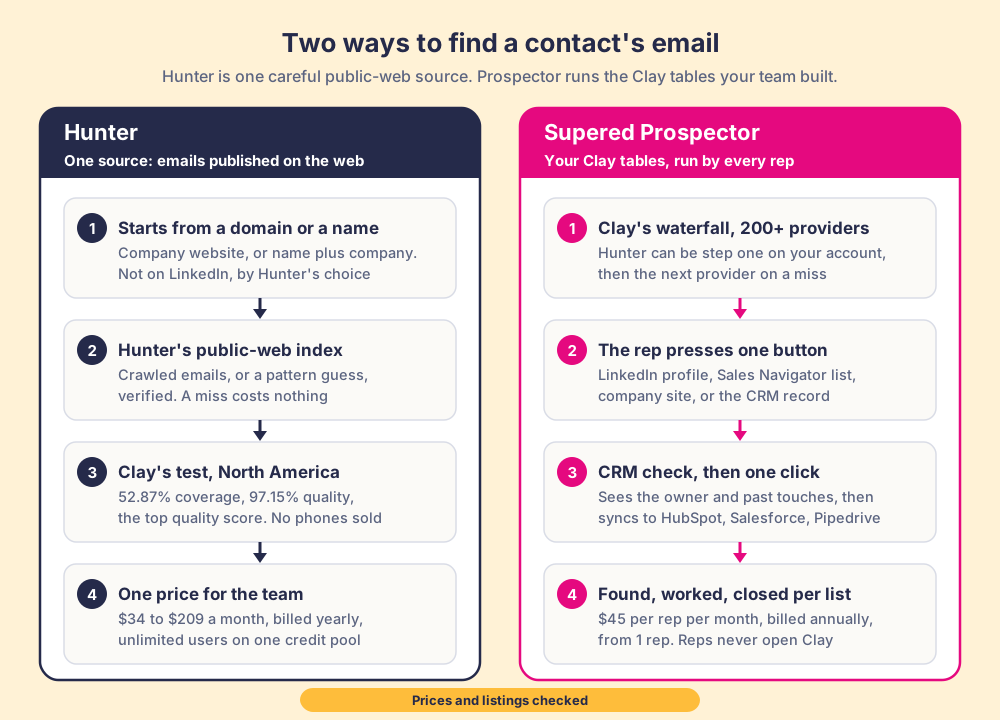
Hunter (hunter.io) finds work emails a company has published on the web, starting from its domain, for $34 to $209 a month billed yearly with unlimited users, and it sells no phone numbers. Supered Prospector runs your team's Clay tables from Sales Navigator, a company site or the CRM record, so Clay's waterfall can ask Hunter first and 200+ other vendors after it, for $45 per rep per month, billed annually, plus your Clay plan. If your reps only email and you have no Clay account, Hunter is the better buy.
01Supered ProspectorTeams on Clay, on HubSpot, Salesforce or Pipedrive, who want reps building lists from Sales Navigator, company sites and the CRM record, with emails and phones. $45 per rep per month, billed annually, from 1 rep, plus your Clay plan.
02HunterEmail-first teams with no Clay who research from company websites and never dial. Free plan; Starter from $34 a month billed yearly, unlimited users on one shared credit pool.
03FindymailTeams with no Clay who want a like-for-like email finder that also sells phones: Starter at $99 a month for 5,000 credits, 1 per email and 10 per phone.
G2 on 3 October 2026: Hunter 4.4 out of 5 from 656 reviews; Supered 4.9 out of 5 from 81 reviews. Chrome Web Store: Hunter 4.7 from 12.5K ratings, 600,000 users. HubSpot marketplace: Supered 5.0 from 122 reviews (1 October 2026).
Status check
Which Hunter, and what does it sell in October 2026?Hunter.io, the email finder.
Two products answer to the name. This page is about Hunter.io, the email finder from Hunter Web Services. Salesforce also calls its outbound sales agent "Hunter," and Apollo announced itself as that agent's flagship data partner on 15 September 2026 (Apollo newsroom). The two are unrelated. A 3 October 2026 news search found no acquisition, funding round or rebrand for Hunter.io.
Hunter's plans have not moved this autumn. On 3 October 2026 its pricing page lists Free with 50 credits a month, Starter at $34 a month billed yearly ($408) or $49 monthly with 2,000 credits a month, Growth at $104 ($1,248 a year) or $149 with 10,000, and Scale at $209 ($2,508) or $299 with 25,000. All plans carry unlimited users, and "Everyone added will share the same pool of credits" (hunter.io/pricing).
Two limits are Hunter's own statements. It does not run on LinkedIn: "Hunter cannot be integrated with LinkedIn as we need to comply with LinkedIn's Terms of Use that prohibits the use of any extension on its website" (Hunter help center, dated 22 November 2024). And its pricing page lists no phone product; its help center says Domain Search returns "Phone numbers (only for personal emails)."
The decision table
Hunter vs Prospector at a glanceEight lines that decide it.
Hunter
Supered Prospector
Job it is built for
Find and verify work emails from a company's domain or a person's name, then send cold email from Hunter's own Sequences.
Run your team's Clay table from where the rep already prospects, sync the contact, then follow each list rep by rep.
Custom enrichment and campaigns
Hunter's own email data. No custom Clay tables or campaigns from its extension.
Your own Clay tables and custom campaigns. Ops pairs a Clay table with a destination (the CRM or a sequence) once, and reps pick the campaign from the Push menu on LinkedIn, a company site or the CRM record. Your waterfalls, tiers and tags stay yours.
Leads worked to your standard
Not offered. Reporting covers usage, credits or activity, not whether each lead was worked the way you want.
Yes. Supered checks every lead a rep adds against your standard and shows each list as sourced, worked and closed, rep by rep, so you see whether leads are worked the way you want.
Where the data comes from
One source: emails Hunter's crawlers found public on the web (30M pages a day, by its count), or a pattern-based guess marked as a guess, then verified.
Clay's waterfall across 200+ data and AI vendors on your own Clay account, in the order your GTM engineer set, with no charge on a miss. Hunter can be one of the steps.
Phones
No phone product on the pricing page. Domain Search shows phone numbers only for personal emails.
Whatever mobile providers your Clay table runs, from the same button.
Where reps use it
The web app, Google Sheets and a Chrome extension that lists the emails for the website a rep is visiting. Not on LinkedIn, by Hunter's choice.
Sales Navigator and LinkedIn profiles, a company's website, and inside a HubSpot, Salesforce or Pipedrive record.
CRMs
Native HubSpot, Salesforce, Pipedrive and Zoho; Close and Copper through Zapier.
HubSpot, Salesforce and Pipedrive, as a place to start and as the sync target.
Pricing
Free; Starter $34 a month billed yearly ($49 monthly); Growth $104 ($149); Scale $209 ($299); Enterprise custom. Unlimited users on every plan.
$45 per rep per month, billed annually ($540 a year), from 1 rep, plus your Clay plan. Demo first, no free trial yet.
Credits
1 credit per email found, nothing for a miss, 0.5 per verification. One pool for the whole team: 2,000, 10,000 or 25,000 a month.
Your Clay plan's credits. Growth includes 6,000 Data Credits a month for the team.
Security
See Hunter's own security or trust page.
SOC 2 Type II (audited, zero exceptions), GDPR compliant, and SSO. Reports in the Supered Trust Center at trust.supered.io.
G2
4.4 out of 5 from 656 reviews.
Supered: 4.9 out of 5 from 81 reviews. Prospector is new and has no reviews of its own yet.
How we graded: for a team on Clay, from one rep to a whole floor, that wants enrichment without asking ops and leads that get worked. Weights: easy enrichment from the page the rep is already on (30%), your own Clay tables and custom campaigns (20%), CRM check and one-click sync (15%), leads worked to your standard (15%), published price and setup (20%). Where Hunter is the better pick for a different job, the verdict below says so.
Tool
Lane
Grade
Rank
Why it ranks here
Supered Prospector
Team on Clay
A
1
Built for this, from one rep up: easy enrichment from LinkedIn, a company site or the CRM record through Clay's 200+ vendor waterfall, your own Clay tables and custom campaigns from one Push menu, an owner and past-prospecting check before a one-click sync, and every lead worked to your standard. Published price per rep.
Hunter
Team on Clay
B+
2
The best email quality in Clay's test at about a cent an email, but about half the coverage, no phones and no LinkedIn starting point.
Two paths to a contact a rep can work. Hunter: starts from a domain or a name, one public-web source, 52.87% coverage and 97.15% quality on North American work emails in Clay's test (last run 22 October 2025), no phones, $34 to $209 a month billed yearly for unlimited users. Prospector: starts on LinkedIn, Sales Navigator, a company site or the CRM record, Clay's waterfall across 200+ vendors, one click to the CRM, $45 per rep per month billed annually.
Fair to them first
What is Hunter best at?Clean emails from the company's own site.
Hunter is careful in a way few finders are. Its Email Finder looks first for "a match in our extensive database of email addresses found publicly on the web," and only when there is none does it work out the likely pattern on the domain; it tells you which one you got, and it drops records that lose their public source after six months (hunter.io/our-data). Accuracy shows. In Clay's North American work-email test, Hunter scored 97.15% quality, the highest of 13 providers (Clay data test, last run 22 October 2025).
The price is hard to beat for email. A miss costs nothing, users are unlimited, and Growth's 120,000 yearly credits work out to about a cent an email found. Ten reps share them for $1,248 a year. The Chrome extension does one job well: on a company's website it lists every address Hunter has seen for that domain, with the sources and the most common pattern. Its users rate it 4.7 from 12.5K ratings on the Chrome Web Store, and G2 reviewers give Hunter 4.4 from 656 reviews.
Hunter is a reference librarian for the public web. Ask for someone and it hands you what has been published, tells you where it found it, and says plainly when it is guessing. What it cannot do is lend a book that was never put on a shelf: in the same Clay test it found 52.87% of the North American work emails, and it holds no mobile numbers at all. Clay is the interlibrary loan. If an address or phone sits with any of 200+ vendors, the waterfall asks until one answers, and Hunter can still be the first desk it tries. If your reps only email and the library is enough, keep Hunter.
Why buyers compare
Why do Hunter customers look for an alternative?Half the emails, none of the phones.
Hunter's users like its accuracy and its price. The reasons to look around are coverage, phones and the place reps start.
Coverage.About 53 of every 100 North American work emails in Clay's test, against 90.26 for Findymail, the top finder in the same run. On G2, Karthick P., a GTM manager, wrote in February 2026: "Limited data coverage especially for small and new companies in the market."
No phones.Hunter sells no mobile numbers. A rep who dials needs a second tool. Avi K. wrote on G2 in September 2026: "It doesn't provide the phone numbers for prospects, so I have to switch to other prospecting tools like Apollo or ZoomInfo."
Not on LinkedIn.Hunter withdrew its LinkedIn integration and sends users to search by name and company instead. Reps who prospect in Sales Navigator copy names across by hand or by CSV.
One shared pool.Unlimited users share one credit pool with no per-user split on the pricing page, so one busy rep can spend the team's month. Brandon H. wrote on G2 in February 2026: "The credit system can feel limiting, especially when working on larger prospecting campaigns."
Prospector, for the Hunter job
What does Prospector do for a team on Hunter?Hunter first, the rest of the market behind it.
A rep on a Sales Navigator lead, a company's website or a HubSpot, Salesforce or Pipedrive record presses one button and your Clay table runs. Clay's waterfall asks provider after provider across 200+ data and AI vendors (Clay's count on clay.com) until one returns a verified email or phone, and "If an enrichment returns no result, you're not charged Data Credits or Actions" (clay.com/pricing). Hunter is a Clay integration, run on Clay credits or your own Hunter account (Clay, Hunter), so your GTM engineer can put it first for its quality and let the next providers fill the other half. Before anything syncs, the rep sees whether the person already has a CRM record and whether they were worked before. One more click sends the contact to the CRM with the field mapping Ops set once. Reps never log into Clay.
On a company's website, where Hunter's extension lists the addresses it has seen, Prospector's buying-committee lookup takes your own titles, departments and seniority and pulls the people your team sells to, with emails and phones from the waterfall. A rep can add leads to a prospect list and push the whole list into a Clay workflow your GTM engineer built.
A sales leader then sees each rep-built list as found, worked and closed, and who added what, with no duplicate work across reps. Your process applies to the prospects reps work. The full loop is on the sourcing use case.
The money, for ten reps. Hunter Growth is $1,248 a year for the whole team (12,000 email credits a rep, no phones), and Scale is $2,508. Prospector is $5,400 a year, and with Clay Growth at $446 a month on annual billing ($5,352, clay.com/pricing, 3 October 2026) the stack is $10,752. For email alone, Hunter is far cheaper and should stay that way in your budget. For a team already paying for Clay, Prospector adds $5,400, uses the credits you already buy, and brings phones and the LinkedIn starting point with it. There is no free trial yet. It starts with a 30-minute demo on your own Clay account, implementation is included and takes under a week, and the details are on the Prospector page.
Choose something else when the job looks like this
No Clay account.Prospector runs only on Clay. For email from company websites without Clay, Hunter is the strong pick, and the Hunter.io pricing breakdown shows which plan to buy.
Email only, small budget.If nobody on the team dials, Hunter Growth at $1,248 a year for unlimited users beats any Clay stack on cost.
Phones without Clay.A finder that sells phones, such as Findymail at 10 credits a phone, fills Hunter's gap. The Hunter.io alternatives page grades the field.
Put Hunter first in your Clay waterfall.
A 30-minute demo on your own Clay account, on HubSpot, Salesforce or Pipedrive. Bring the list your reps could only half fill.
Prospector vs Hunter: which should your team choose?Decide by phones, then by Clay.
For any team on Clay, from one rep up, Prospector is the best pick: easy enrichment from the page the rep is already on, your own Clay tables and custom campaigns, a CRM check and one-click sync, and every lead worked to your standard. If your reps only email, research from company websites and you have no Clay account, Hunter is the best pick. If your team already runs Clay, dials as well as emails, or prospects in Sales Navigator, Prospector is the best pick, and Hunter can stay on as the first step in its waterfall.
Choose Hunter for
Email accuracy. 97.15% quality on North American work emails in Clay's test, the top score.
A team price. Unlimited users from $34 a month, billed yearly.
Company-site research. Every published address for a domain, with sources, in one click.
Choose Prospector for
Easy enrichment for any rep. One click on LinkedIn, a company site or the CRM record runs Clay across 200+ vendors. No Clay login, no extra database seats, and you can start with one rep.
Custom campaigns and enrichment. Your own Clay tables and campaigns, picked by the rep from one Push menu, with your waterfalls and logic intact.
Every lead worked to your standard. Supered checks each lead against your standard, so you see which lists get worked the way you want, rep by rep.
Coverage from 200+ vendors. Clay's waterfall on your own account, Hunter included, with no charge on a miss.
Phones and LinkedIn. Mobile providers in the same table, run from Sales Navigator and the CRM record.
Lists you can follow. Found, worked and closed for each list, rep by rep.
The two fit together. Hunter can sit inside your Clay table as the first email step, run on your Hunter account or on Clay credits, and Prospector puts that table in front of every rep.
Why trust this page
Why trust a comparison written by Supered?Weigh it, then check the sources.
We sell one of the two products on this page, so weigh what follows. Each Hunter fact links to its source and carries the date we checked it, 3 October 2026 unless marked. The coverage and quality numbers come from Clay's own provider tests, which Clay ran, and Hunter wins one of them outright. When Hunter changes its plans, this page changes with it.
Supered started inside RevPartners, the HubSpot partner Matt Bolian founded, which sold roughly twice as much Sales Hub as any other partner and reached HubSpot's Elite tier in 13 months. Supered is the #1 sales enablement app on the HubSpot marketplace and a HubSpot Premier Tech Partner, with 6,000+ installs. It holds 5.0 from 122 reviews on the HubSpot marketplace and 4.9 out of 5 from 81 reviews on G2. Those reviews cover Supered as a whole. Prospector is the newest product, so judge it in a demo on your own Clay account.
Switching
How do you move from Hunter to Prospector?Keep Hunter as a step if you like.
Leads Hunter synced to HubSpot, Salesforce or Pipedrive stay in the CRM, so the move is about the next list.
Clay connection.An admin connects Clay inside Supered, with no engineering, and each Clay table or custom workflow becomes a button for reps.
Hunter in the waterfall.Your GTM engineer can add Hunter to the Clay table on your own Hunter API key or on Clay credits, and decide where it sits in the order.
CRM field mapping.Ops sets it once for HubSpot, Salesforce or Pipedrive, and each sync after that is one click.
Credits.Hunter says yearly-plan credits last the full 12 months, while monthly-plan credits reset each cycle and do not carry over, so time a downgrade to the end of a cycle.
Time to live.Implementation is included and takes under a week.
What is the difference between Prospector and Hunter?
Hunter is one email source: it finds work emails published on the web, starting from a company's domain or a person's name, and sells no phone numbers. Supered Prospector brings no data of its own. It runs your Clay tables from Sales Navigator, company websites and the HubSpot, Salesforce or Pipedrive record, so reps get Clay's waterfall across 200+ vendors, Hunter included if you add it, and sync to the CRM in one click.
Is Prospector a good Hunter.io alternative?
For a team that already pays for Clay, yes: it adds phones, a LinkedIn and CRM starting point and every other provider behind Hunter, for $45 per rep per month, billed annually, plus your Clay plan. For an email-only team with no Clay, Hunter is cheaper and simpler, and we would keep it.
How much does Hunter cost compared with Prospector?
On 3 October 2026 Hunter listed Free (50 credits a month), Starter at $34, Growth at $104 and Scale at $209 a month billed yearly ($49, $149 and $299 monthly), with unlimited users. Prospector is $45 per rep per month, billed annually, plus your Clay plan. For ten reps, Hunter Growth is $1,248 a year, and Prospector with Clay Growth at $446 a month on annual billing is $10,752.
Does Hunter find phone numbers?
Not as a product. Hunter's pricing page lists no phone credits, and its help center says Domain Search shows phone numbers only for personal emails. Prospector returns phones when your Clay table includes a mobile provider.
Can Prospector use Hunter inside Clay?
Yes. Hunter is a Clay integration whose actions run on Clay credits or your own Hunter account. Your GTM engineer places it in the waterfall, and reps run that table from Prospector without opening Clay.
What does each tool read from LinkedIn?
Ask every vendor what it reads from LinkedIn, ours included. Hunter says it does not run on LinkedIn at all, to comply with LinkedIn's terms, and its extension shows only emails its own crawlers found on the public web. In Prospector, the contact data comes from Clay's waterfall on your own Clay account.