ZoomInfo Reviews 2026: The Equipment Scores 4.5, the Membership Scores 1.8
ZoomInfo reviews, checked October 2, 2026: G2 4.5 from 9,170 users against Trustpilot 1.8 from 339, what the data complaints and contract complaints say, the $29.5 million settlement, how to get off it, and whether ZoomInfo is worth it for a mid-market team.
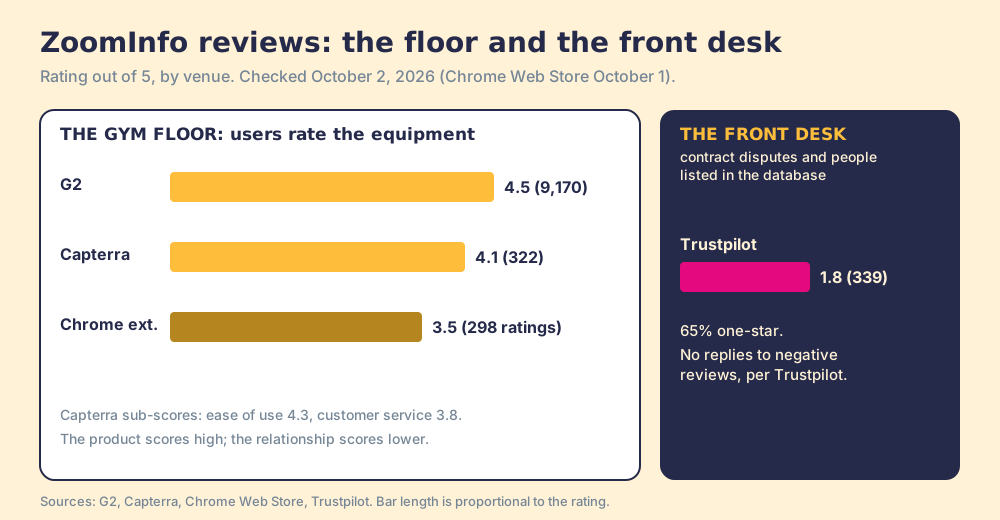
ZoomInfo reviews, gathered on October 2, 2026, split by who writes them: users rate the product 4.5 out of 5 from 9,170 reviews on G2, while Trustpilot, where contract disputes and people listed in the database land, scores it 1.8 from 339.
A gym collects two kinds of reviews. The people on the floor write about the equipment: the racks are good, the treadmills mostly work, the place is clean. The people at the front desk write about the membership: the cancellation that took four letters, the renewal the salesperson never brought up, the price that rose by itself. Both groups are describing the same gym, and both are right. ZoomInfo reviews in 2026 have that shape, with a third group on the pavement outside: people who never joined and found their names on the member list anyway. The quick answer, checked October 2, 2026:
- ZoomInfo itself. Worth it for enterprise teams that want North American coverage, intent data and many seats on one paper, and have someone who negotiates contracts for a living. Vendr’s median is $33,500 a year.
- Supered Prospector. The pick for a sales team that already pays for Clay: reps run Clay’s waterfall across 200+ vendors from where they sell. $45 per rep per month, billed annually.
- Apollo. The non-Clay switch for a small team that wants data, a dialer and sequences in one seat from $49 a month.
ZoomInfo reviews, gathered on October 2, 2026, split by who writes them: users rate the product 4.5 out of 5 from 9,170 reviews on G2, while Trustpilot, where contract disputes and people listed in the database land, scores it 1.8 from 339. Report only one of those numbers and you have reviewed half a company.
What do ZoomInfo reviews say, venue by venue?
| Where | Who is reviewing | Rating | Reviews | Checked |
|---|---|---|---|---|
| G2 (“GTM Workspace, powered by ZoomInfo”) | Users, mostly reps and ops | 4.5 of 5 | 9,170 | October 2, 2026 |
| Capterra (ZoomInfo Sales) | Verified users | 4.1 of 5 | 322 | October 2, 2026 |
| Chrome Web Store (extension) | Installed users (300,000) | 3.5 of 5 | 298 ratings | October 1, 2026 |
| Trustpilot | Anyone: buyers in disputes, people in the database | 1.8 of 5 | 339 | October 2, 2026 |
Sources: G2, Capterra, Chrome Web Store, Trustpilot.
Capterra shows the same split inside one venue: 4.3 for ease of use, 3.8 for customer service.
ZoomInfo publishes its own roundup of these ratings (ZoomInfo, updated July 9, 2026), and to its credit it prints the Trustpilot number (1.7 from 320 when it wrote it) and concedes that “Pricing opacity is a recurring complaint,” naming auto-renewal clauses and thinner coverage outside North America. When a vendor’s own page agrees with its harshest reviewers on the contract, believe both of them.
What do ZoomInfo reviews say about the data?
G2 sorts reviews into theme tags. On October 2 the three largest praise tags were “Comprehensive contact information” (353), “Ease of use” (349) and “Data accuracy” (325). The three largest complaint tags were “Inaccurate data” (205), “Outdated data” (203) and “Outdated contacts” (186). Accuracy is the top compliment and, added up across its three complaint tags, the top grievance too.
Both camps are reporting their own lists faithfully. Evan C., an account manager at a mid-market company, put the working version in August 2026: “Contact information can also occasionally be outdated or incomplete, which means I still need to verify some data before starting an outbound sequence.”
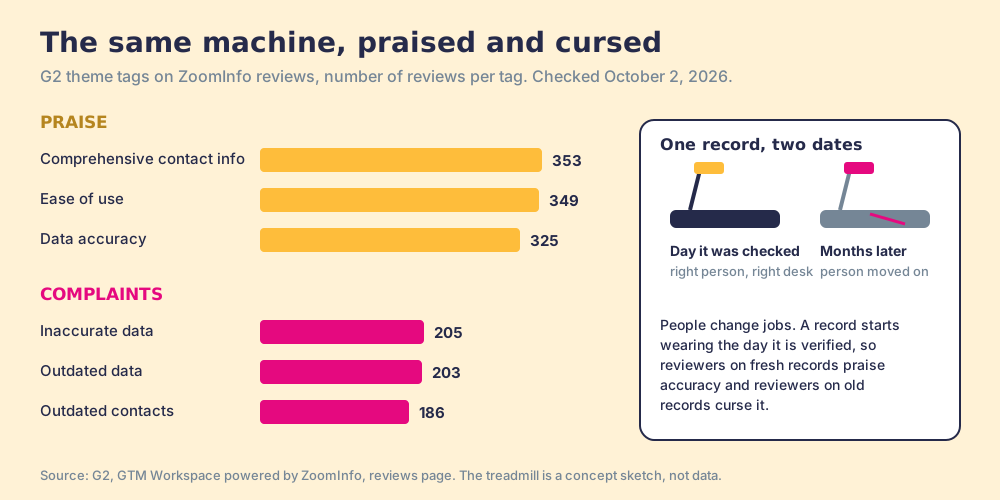
The mechanism is ordinary and has nothing to do with ZoomInfo being careless. A contact record is a treadmill serviced on one date. People change jobs, and the record starts wearing from the day it was checked. Apollo, a ZoomInfo rival, cites research that B2B data decays about 2.1% a month, “roughly 22.5% annually” (Apollo, April 22, 2026); treat the figure as directional, but if it holds, more than a fifth of any single database’s records age out within a year. ZoomInfo says it fights the wear with a “Data Training Lab of 300+ human researchers” and systems that “scan 28 million company domains daily” (ZoomInfo).
Why are ZoomInfo reviews on Trustpilot so low?
Trustpilot’s 1.8 comes 65% from one-star reviews and 27% from five-star, with little in between, and the page notes that ZoomInfo “Hasn’t replied to negative reviews.” Read the one-stars and they sort into two piles.
- The membership pile. Customers in disputes about leaving or paying. Bianca Tubolino wrote on September 16, 2026: “When we signed up, we were explicitly told we could cancel at any time.” Steven B., on August 11: “I now have exchanged over four hundred emails trying to get a corrected balance on an invoice.” On Capterra, Casey A., a staffing co-founder, wrote in 2023: “$60K for lists they will make you delete once your term is over. Very crafty tricks in the contract.”
- The member-list pile. People who never bought anything. “Collating personal information and selling to 3rd parties. Seemingly impossible to get data removed,” one reviewer named Matt wrote in late September 2026.
The membership pile follows from how ZoomInfo sells. There are no list prices on its pricing page, and “Each export costs one credit” (ZoomInfo pricing). Vendr, which negotiates software contracts for buyers, describes the paper: annual prepayment is standard, auto-renewals often carry a 5 to 10% annual price escalator, and notice periods typically run 30 to 90 days, which it advises stretching to 90 to 120 (Vendr). Miss the notice window by a week and the gym renews you, a little more expensive than last year.
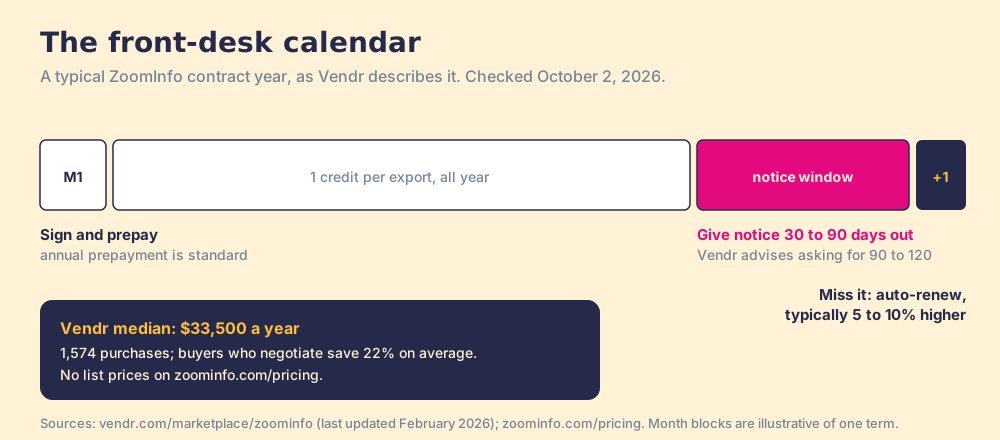
None of it is hidden. Vendr’s buyers who negotiate save 22% on average; the one-star reviews come from buyers who signed the first quote and found the calendar later.
How did ZoomInfo get my details, and has it been sued?
ZoomInfo names three sources: its researchers, its domain scanning, and a contributory network in which users of its free ZoomInfo Lite share “email signature blocks or business contact books.” Your details can arrive because someone you emailed shared their inbox. ZoomInfo’s privacy page adds that “If we have your email address, you may receive a Personal Information Notice from ZoomInfo,” which is how some people first learn they are listed.
The way off is the removal form at privacyrequest.zoominfo.com/remove/verify. ZoomInfo says “Once processed, your profile will no longer be available in our products,” and the request doubles as an opt-out of sale or sharing where state law grants one (ZoomInfo, Your Privacy).
On the lawsuit question that Google suggests next, the record is one large settlement. In Ramos v. ZoomInfo Technologies (N.D. Ill., No. 21-cv-02032), residents of California, Illinois, Indiana and Nevada alleged that ZoomInfo displayed their names and job details on its website to market paid subscriptions without consent, under state right-of-publicity laws. ZoomInfo settled for $29,557,612.50, split by state from $14,228,617.50 for California to $1,331,055 for Nevada, with no admission of liability (motion for preliminary approval). The gym picture has an edge here: a real gym never puts non-members’ names in its window as advertising, and four states’ laws objected when ZoomInfo’s profile pages did.
Is ZoomInfo worth it?
Worth is a ratio: what the contract costs against what the team uses. Three facts from ZoomInfo’s own filings shape it for a mid-market team.
- The direction of the business. ZoomInfo reported that 76% of its annual contract value now comes from upmarket customers, with 1,891 customers paying $100,000 or more a year (Q2 2026 results, August 5, 2026).
- The restructuring. In May 2026 ZoomInfo cut about 600 roles, roughly 20% of headcount. CEO Henry Schuck wrote: “We are simplifying our operations, accelerating our move upmarket, and reducing the resources we allocate downmarket” (8-K, May 2026).
- The renewal vote. Net revenue retention was 89% in the same quarter, so the average existing customer is spending about 11% less than a year earlier.
The gym is redesigning itself for corporate members, a fair business choice. For a 200-seat enterprise with a procurement team, ZoomInfo’s breadth (500 million contacts by its own count), its intent data and its Agent Teams, launched October 1 after it bought DoubleO.ai, can be worth the paper. For ten to twenty reps, the club is spending less on you each quarter, in its own CEO’s words.
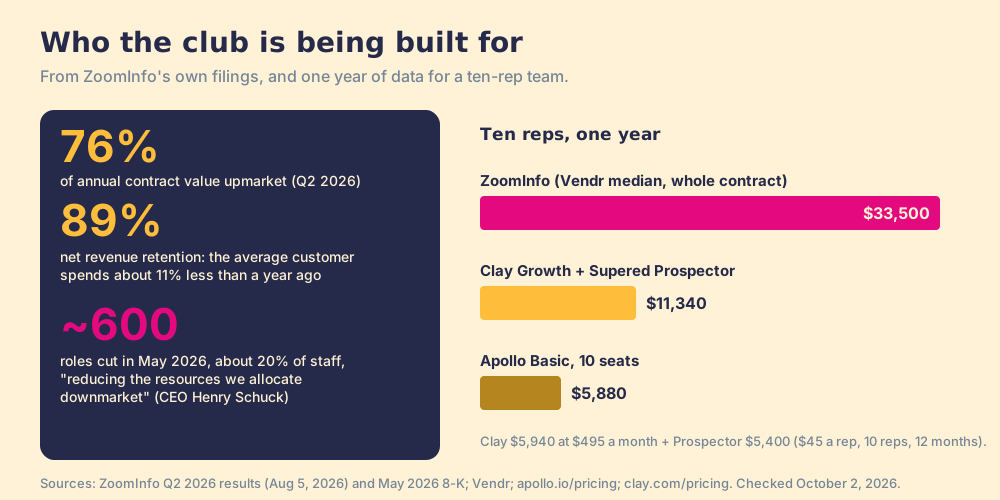
The arithmetic for ten reps, one year. Vendr’s ZoomInfo median is $33,500 for the whole contract. Ten Apollo Basic seats list at $5,880 (Apollo pricing). Clay Growth lists at $495 a month, $5,940 a year (Clay pricing), plus Prospector at $45 per rep per month billed annually, $5,400 for ten, so $11,340, about a third of the ZoomInfo median. The Capterra reviewers reached the same place on instinct: “Pricing is a little high-SMEs are moving to Apollo for the same reason,” Suvankar R. wrote in October 2025.
Why trust this ZoomInfo review?
I built RevPartners, a HubSpot partner that did only sales implementations and reached Elite tier in 13 months. Supered grew out of it and is the #1 sales enablement app on the HubSpot marketplace, rated 5.0 from 122 reviews there and 4.9 from 81 on G2, checked October 1, 2026. We make Supered Prospector, which competes with ZoomInfo for sales teams on Clay, and it ranks first below for that job only. The ratings above carry dates and links, and the scores show their weights.
How does ZoomInfo compare with the alternatives?
The lens is a sales team of ten to fifty reps that wants contact data reps will use where they already sell, and a leader who can see which lists turn into pipeline. Each tool scores 1 to 5 on five criteria, weighted: coverage of the contact you need (x3), rep-side delivery (x2), price structure (x2), what the leader sees after the export (x2) and bundled outreach (x1), out of 50. The scores match the ZoomInfo competitors ranking; the ZoomInfo pricing breakdown covers the negotiation in full. The lawsuit is not scored; it is reported above for you to weigh.
| Rank | Tool | Grade | Score | Best fit | CRM integration | Setup effort | Pricing | Reason to switch from ZoomInfo |
|---|---|---|---|---|---|---|---|---|
| ref | ZoomInfo | B | 28 | Enterprise teams buying breadth, intent and many seats | Native (Salesforce, HubSpot, Dynamics) | Weeks, with a contract cycle | Quote only; Vendr median $33,500 a year | Stay if you use the intent data and negotiate the renewal |
| 1 | Supered Prospector | A | 44 | Sales teams that already pay for Clay | Native (HubSpot, Salesforce, Pipedrive) | Under a week on an existing Clay account | $45 per rep per month, billed annually, plus your Clay plan | 200+ vendors behind each lookup, no data contract to renew, lists followed to closed |
| 2 | Apollo | A- | 36 | Small teams wanting data, dialer and sequences in one seat | Native (HubSpot, Salesforce, Pipedrive) | A day | $49 per seat per month, billed annually | Posted prices and monthly billing |
| 3 | Lusha | B+ | 29 | LinkedIn-first reps on a low commitment | Native (HubSpot, Salesforce, Pipedrive) | Minutes | Free to $3,599.10 a year | A free tier and no annual escalator to watch |
ZoomInfo’s 28 is coverage 5, rep-side delivery 3, price 1, what the leader sees 1, outreach 3: the deepest single database here, on quote-only paper with an escalator. Prospector’s coverage 5 belongs to Clay’s waterfall, and its outreach 1 reflects that it has no dialer or sequencer.
Where does Supered Prospector fit?
Clay plus Supered is the best way for a sales team to prospect: GTM engineers build in Clay, reps never open Clay. Prospector holds no database of its own. It runs inside the Supered Chrome extension, on the team’s own Clay account, and turns the tables the GTM engineer built into a button on the page where the rep is working. We chose Clay as our only data provider because Clay is the waterfall across 200+ data and AI vendors, asking provider after provider until one returns a verified email or phone, and its pricing page says “If an enrichment returns no result, you’re not charged Data Credits or Actions” (clay.com/pricing).
Back to the gym. ZoomInfo sells one club on annual paper. Clay’s waterfall is a pass to 200+ clubs, and the GTM engineer decides which ones to visit and in what order. ZoomInfo can even be one of them: Clay lists a ZoomInfo integration marked “Bring Your Own Account Required” (Clay), so a team that keeps a smaller ZoomInfo contract can run it as one step among many.
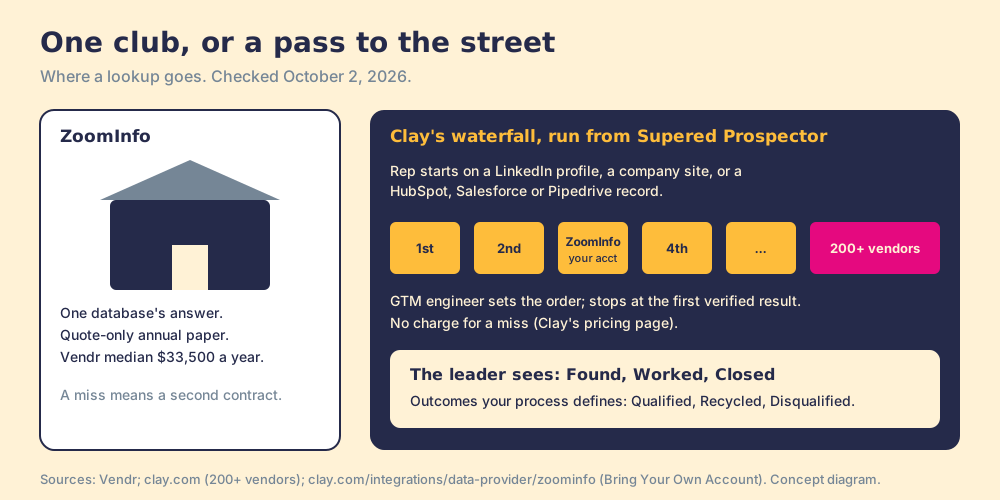
What each person around the table gets:
- The GTM engineer. No more list desk. Named flows built once, each a Clay table with a destination, picked by reps from a Push menu; your waterfalls and tiers stay yours.
- The rep. The table as a button on a LinkedIn profile, a company website, or a HubSpot, Salesforce or Pipedrive record, with the record owner and any past prospecting shown before the push.
- The leader. Found, Worked, Closed: who is working their list and who is not, and how each lead ended, Qualified, Recycled or Disqualified, the way your process says.
Prospector works within LinkedIn’s terms and does not copy search results in bulk; the contact data comes from Clay’s waterfall on the customer’s Clay account.
Choose something else if you have no Clay account: Prospector runs on the customer’s Clay account and does nothing without one, and someone has to build the tables. RevPartners, a Clay Elite Studio Partner I founded, builds and tunes them for teams that want help. Choose ZoomInfo instead if your reps live on intent data in enterprise North America. The sourcing use case shows the setup.
Which should you choose?
- ZoomInfo. The pick for enterprise teams with procurement muscle who use the intent data. Negotiate at a quarter end, calendar the notice date the day you sign, and cap the escalator.
- Supered Prospector. The pick for a team that already pays for Clay. A Prospector demo runs on your own Clay account.
- Apollo. The pick for a small team without Clay that wants posted prices and outreach in the same seat; the Apollo review covers what its users say.
- The removal form. The pick if you are reading this because you found yourself listed.
What I would do rests on what the reviews say. ZoomInfo’s equipment is good, and 9,170 users say so. Its membership is built for a customer with hundreds of seats, and its own CEO says it is putting fewer resources downmarket. A ten-rep team buying ZoomInfo in 2026 is paying enterprise dues to a club that is moving its trainers upstairs. If you have Clay, put the money into the pass and let the GTM engineer pick the clubs. If you do not, start with Apollo’s posted price, and come back to ZoomInfo when your seat count makes you the customer it is building for. The RocketReach review covers the cheaper single directory one step below.
Frequently asked questions
Is ZoomInfo legit?+
Is ZoomInfo worth it?+
Why are ZoomInfo reviews on Trustpilot so low?+
How did ZoomInfo get my information, and how do I remove it?+
Has ZoomInfo been sued?+
What is a cheaper alternative to ZoomInfo for a team that has Clay?+
Everything we have written on ZoomInfo
More on ZoomInfo
Supered Prospector vs ZoomInfo: the side-by-side- ZoomInfo Competitors in 2026: The Database Was Never the Purchase
- ZoomInfo Pricing in 2026: The Standing Charge, the Meter, and What Neither Can See
- ZoomInfo Chrome Extension in 2026: A Free Key Card to a $33,500 Room
- ZoomInfo HubSpot Integration (2026): Setup, Plans, Limits, and What It Reads Back
- ZoomInfo Salesforce Integration in 2026: A Loading Dock With Two Doors
- Apollo vs ZoomInfo in 2026: Two Tailors, Walking in Opposite Directions
- Clay vs ZoomInfo: The Warehouse and the Buying Desk
- Cognism vs ZoomInfo in 2026: Two Good Maps, Each Tested on Its Own Streets
- Kaspr vs ZoomInfo in 2026: A Bike Off the Shop Floor or a Company Car Lease
- Lusha vs ZoomInfo in 2026: The Corner Shop, the Wholesaler, and the Market Hall
Your Clay waterfall, where reps already work.