Lusha vs ZoomInfo in 2026: The Corner Shop, the Wholesaler, and the Market Hall
Lusha posts its prices and ZoomInfo quotes them, and their contact accuracy scores on G2 sit a tenth apart. Here is Lusha vs ZoomInfo priced from sources opened October 1, 2026, graded for a mid-market team, with the third option for teams that already have Clay.
Lusha vs ZoomInfo is a choice between Lusha, a self-serve contact-data extension with posted prices, and ZoomInfo, a quote-only enterprise database whose median buyer pays $33,500 a year, and on G2 their contact data accuracy scores sit a tenth of a point apart.
Lusha vs ZoomInfo is a choice between Lusha, a self-serve contact-data extension with posted prices, and ZoomInfo, a quote-only enterprise database whose median buyer pays $33,500 a year, and on G2 their contact data accuracy scores sit a tenth of a point apart. The short answer, by who it fits:
- Supered Prospector, for teams that already have Clay. Clay’s waterfall across 200+ providers, with your own Lusha or ZoomInfo account as one step if you keep it, in every rep’s LinkedIn tab and CRM record. $45 per rep per month, billed annually.
- Lusha, for one to five LinkedIn-first reps. The quickest reveal and a price on the shelf. Premium is $3,599.10 a year for 5 seats.
- ZoomInfo, for North American enterprise depth. The biggest single database, intent data, and a contract to match. Vendr median $33,500 a year.
A corner shop and a wholesaler can sell you the same tin of beans. The shop puts the price on the shelf, lets you buy one tin, and takes a card. The wholesaler has no prices on the door: you sign a membership, you buy by the case, and what you pay depends on who you are and how well you haggle. Neither is cheating you. They are built for different shoppers, and the mistake is walking into the wrong one. Lusha is the corner shop and ZoomInfo the wholesaler, and since March 2026, both of them also rent a stall in the same market hall, which changes the question for any team that already has a pass to it.
Lusha vs ZoomInfo at a glance: the decision table
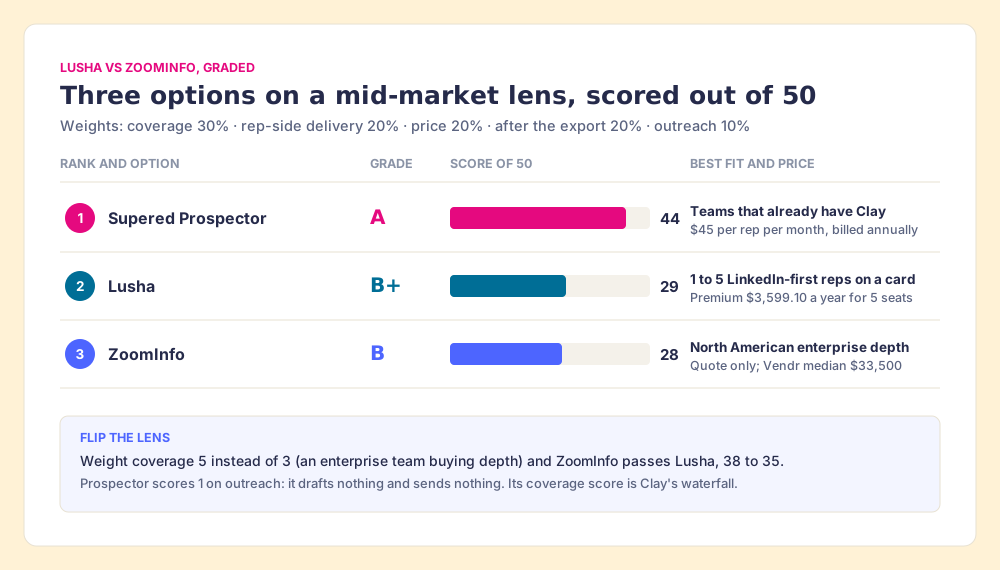
The grades use the same five weights as the Lusha alternatives page, the ZoomInfo competitors page, and Cognism vs ZoomInfo, on a mid-market lens of ten to fifty reps: coverage of the contact you need (30%), rep-side delivery where reps already work (20%), price structure (20%), what happens to the list after the export (20%), and bundled outreach (10%). Prices come from pages opened October 1, 2026.
| Rank | Option | Grade (score of 50) | Best fit | CRM integration | Setup effort | Pricing (plan with the job) | Reason to switch |
|---|---|---|---|---|---|---|---|
| 1 | Supered Prospector | A (44) | Teams that already have Clay | Native HubSpot, Salesforce, and Pipedrive; one-click push | RevOps connects Clay once; reps need no Clay login | $45 per rep per month, billed annually, from 1 rep, plus your Clay plan | Clay’s waterfall across 200+ providers, run from the page the rep is on, and each sourced list visible from worked to closed |
| 2 | Lusha | B+ (29) | 1 to 5 LinkedIn-first reps | CRM integrations from the Free plan | Self-serve in minutes; G2 ease of setup 9.0 | Starter $449.10/yr (1 seat), Pro $629.10/yr (2 seats), Premium $3,599.10/yr (5 seats) | The easiest extension and a posted price |
| 3 | ZoomInfo | B (28) | North American enterprise teams buying depth and intent | Native, with Salesforce and HubSpot among 40+ integrations | Sales-led quote; multi-seat annual commitment often required (Vendr) | Quote only; Vendr median $33,500 a year | The deepest single database; Forrester Wave Leader, Q1 2026 |
| Tool | Coverage (x3) | Rep-side (x2) | Price (x2) | After the export (x2) | Outreach (x1) | Weighted total |
|---|---|---|---|---|---|---|
| Supered Prospector | 5 | 5 | 4 | 5 | 1 | 44 |
| Lusha | 3 | 4 | 4 | 1 | 2 | 29 |
| ZoomInfo | 5 | 3 | 1 | 1 | 3 | 28 |
One point separates the two databases, and it moves with one weight. Raise coverage from 3 to 5, the lens of an enterprise team that is buying depth above all, and ZoomInfo passes Lusha 38 to 35. Prospector scores 1 on outreach because it drafts nothing and sends nothing; it hands contacts to the CRM and to your sequencer. Lusha and ZoomInfo score 1 on the fourth column because both meters stop at the export, and neither tells a manager whether the list was ever worked.
Why do teams switch between Lusha and ZoomInfo?
The reasons come from the customers, and they run both ways.
- The ZoomInfo bill. “The pricing feels extremely steep compared to platforms like Apollo,” a small-business ZoomInfo reviewer wrote on G2 on September 17, 2026. Vendr’s buyers who did not negotiate credits up front report $10,000 to $50,000 or more in overage fees over a term (Vendr, ZoomInfo).
- The ZoomInfo direction. In May its CEO told staff the company is “accelerating our move upmarket, and reducing the resources we allocate downmarket” (SEC Form 8-K, May 2026). A ten-rep team reading that line is reading about somebody else.
- The Lusha credit meter. “Credits can run out quickly, making it costly at scale,” a small-business reviewer wrote on April 21, 2026, and a mid-market reviewer on December 20, 2025 found “The credit system can sometimes feel limiting for high-volume outbound teams” (G2, Lusha). A phone costs 5 credits, so Starter’s 400 credits a month is 80 phones.
- The Lusha ceiling. Pro includes 2 seats and Premium 5, and the pricing FAQ says “For teams larger than 5 users, please reach out to our Sales team.” The posted price ends where a mid-market team begins, and past that point Lusha is a quote too. A mid-market reviewer on September 2, 2026 put it bluntly: “Credit pricing, with add-ons and extra credits price is becoming really high, no discounts.”
- The miss, on both sides. A ZoomInfo reviewer on October 1, 2026 found “Data coverage can be patchy for UK-based contacts and mid-sized companies,” and a Lusha reviewer on June 10, 2026 wrote “The data is not always accurate.”
Turned into buying criteria, those five complaints become three questions. How many reps will hold a seat? Where do your buyers live? And what happens to a contact once it leaves the vendor? The first two decide between these vendors. The third decides whether you need either one.
Why trust this comparison?
I started RevPartners, a HubSpot partner that did only sales implementations, sold roughly twice as much Sales Hub as any other partner, and reached Elite tier in 13 months. Supered grew out of that work and is the #1 sales enablement app on the HubSpot marketplace, with 6,000+ installs and 5.0 out of 5 from 122 reviews there, and 4.9 out of 5 from 81 reviews on G2 (both checked October 1, 2026). I have watched a great many contact databases get bought, renewed, and abandoned from inside the CRM where the contacts land.
The disclosure matters more on this page than most. We sell a third option, Prospector, and it has no database of its own. It runs on Clay, and Clay carries both Lusha and ZoomInfo as steps. So I have a reason to like both vendors here and a reason to sell you something else. The weights are printed so you can change them, and the price section below favors Lusha because the arithmetic does.
How much does Lusha cost compared with ZoomInfo?
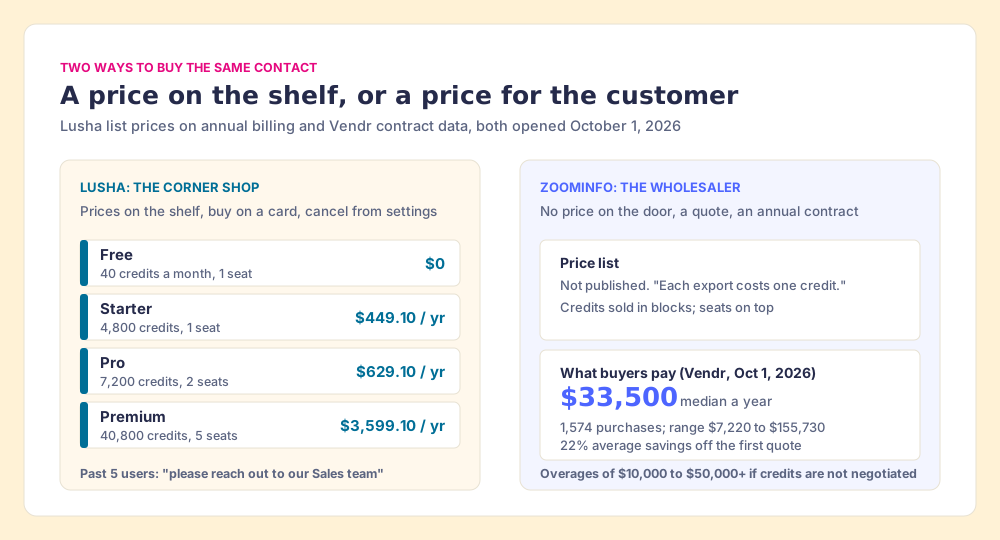
At the corner shop the prices are on the shelf. Lusha’s pricing page, opened October 1, 2026, sells on yearly billing at 25% off monthly (lusha.com/pricing):
| Lusha plan (yearly billing) | Price per year | Credits per year | Seats | Phones per year (5 credits) |
|---|---|---|---|---|
| Free | $0 | 40 a month | 1 | 8 a month |
| Starter | $449.10 | 4,800 | 1 | 960 |
| Pro | $629.10 | 7,200 | 2 | 1,440 |
| Premium | $3,599.10 | 40,800 | 5 | 8,160 |
An email costs 1 credit and a phone 5. Monthly billing exists too (Starter $49.90 for 400 credits a month, Premium $399.90 for 3,400), and the monthly credits roll over up to twice the allowance while yearly credits reset at term end. The full ladder is on the Lusha pricing page.
At the wholesaler there is no shelf. ZoomInfo’s pricing page lists no prices, names sales-led tiers, and says “Each export costs one credit” (captured September 25, 2026; the page served a bot check on October 1). Vendr, opened October 1, 2026, shows what buyers pay:
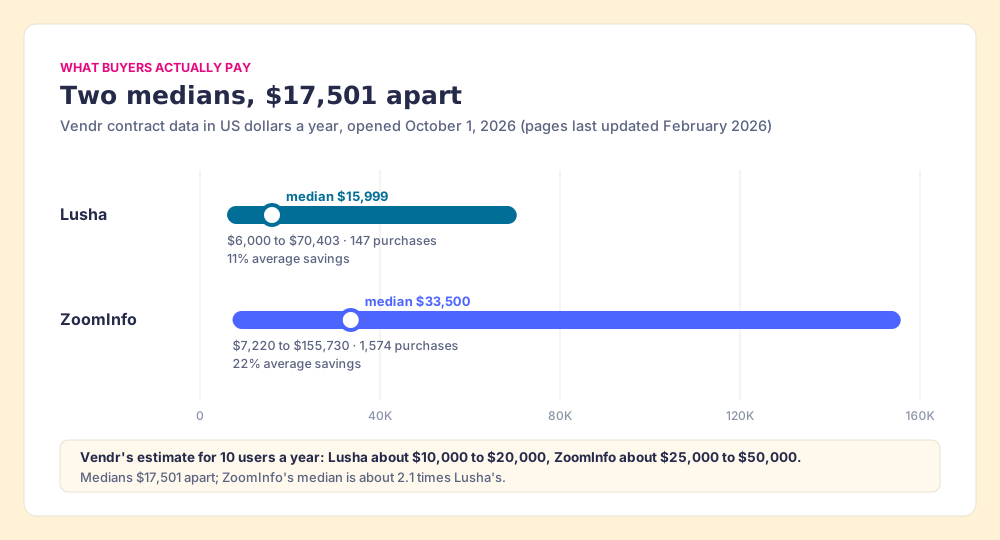
- ZoomInfo. Median $33,500 a year across 1,574 purchases, a range from $7,220 to $155,730, and 22% average savings off the first quote. Vendr reports that buyers who negotiate in ZoomInfo’s fiscal quarter-end months (March, June, September, December) commonly get better outcomes. More on the ZoomInfo pricing page.
- Lusha. Median $15,999 a year across 147 purchases, a range from $6,000 to $70,403, and 11% average savings (Vendr, Lusha). The discount is small because a posted price leaves little to haggle over.
The medians sit $17,501 apart, and ZoomInfo’s is about 2.1 times Lusha’s. Vendr’s Lusha page also estimates a typical year for ten users: about $10,000 to $20,000 on Lusha and $25,000 to $50,000 on ZoomInfo. Both Vendr pages were last updated February 2026.
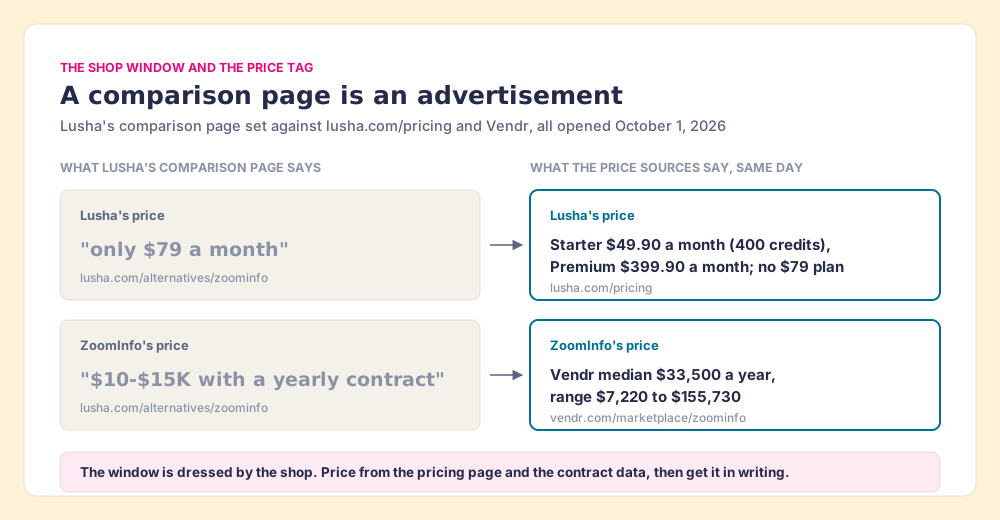
One warning before you trust any price you read on a vendor’s own comparison page. Lusha’s “Lusha vs ZoomInfo” page, which ranks near the top for this search, says Lusha costs “only $79 a month” and puts ZoomInfo at “$10-$15K with a yearly contract” (lusha.com, opened October 1, 2026). Lusha’s own pricing page, the same day, has no $79 plan, and Vendr’s median ZoomInfo buyer pays more than twice the top of that range. A comparison page is a shop window, dressed by the shop. Price from the pricing page and from contract data, then ask each vendor to put the number in writing.
Whose data is better, Lusha or ZoomInfo?
Each is best at something real, so start with the praise.
- ZoomInfo, the deep warehouse. Its August 2026 filing claims “more than 100 million companies, 500 million contacts” (Q2 2026 results), and Forrester named it a Leader in the Q1 2026 Wave for B2B marketing and sales data providers, with the highest current-offering score and top marks in 20 of 27 criteria (Q1 2026 results). On G2 its GTM Workspace holds 4.5 out of 5 from 9,108 reviews on the head-to-head page. If you sell into North American enterprise accounts and want one vendor’s depth, org charts, and intent data across a large team, ZoomInfo is the better of these two.
- Lusha, the quick reveal. A LinkedIn extension a rep learns in an afternoon, a price on a card, and cancellation “at the end of your plan cycle” from settings. G2 holds it at 4.3 out of 5 from 1,665 reviews, with 46.8% of reviewers in the mid-market. Clay added Lusha as a waterfall step on March 10, 2026 with the line “Add Lusha as a step in your existing contact enrichment waterfall for better EMEA match rates” (Clay changelog). If you run one to five reps who reveal contacts from LinkedIn profiles, with a European mobile in the mix and no appetite for a sales cycle, Lusha is the better of these two.
On the data itself, G2’s reviewers barely separate them. The head-to-head page, opened October 1, 2026, scores contact data accuracy 7.7 for ZoomInfo and 7.6 for Lusha, and company data accuracy 8.1 against 7.7 (G2, Lusha vs ZoomInfo). The bigger warehouse does not stock a noticeably better tin. Where the two pull apart is the counter, the place where the rep meets the tool:
- Ease of use. Lusha 9.2, ZoomInfo 8.8 on G2.
- Ease of setup. Lusha 9.0, ZoomInfo 8.9.
- The Chrome extension. Lusha’s shows 4.6 out of 5 from about 1,900 ratings and 400,000 users (Chrome Web Store); ZoomInfo’s shows 3.5 from 298 ratings and 300,000 users (Chrome Web Store), both checked October 1, 2026.
- Quality of support. ZoomInfo 8.7, Lusha 8.1, the one counter score ZoomInfo wins.
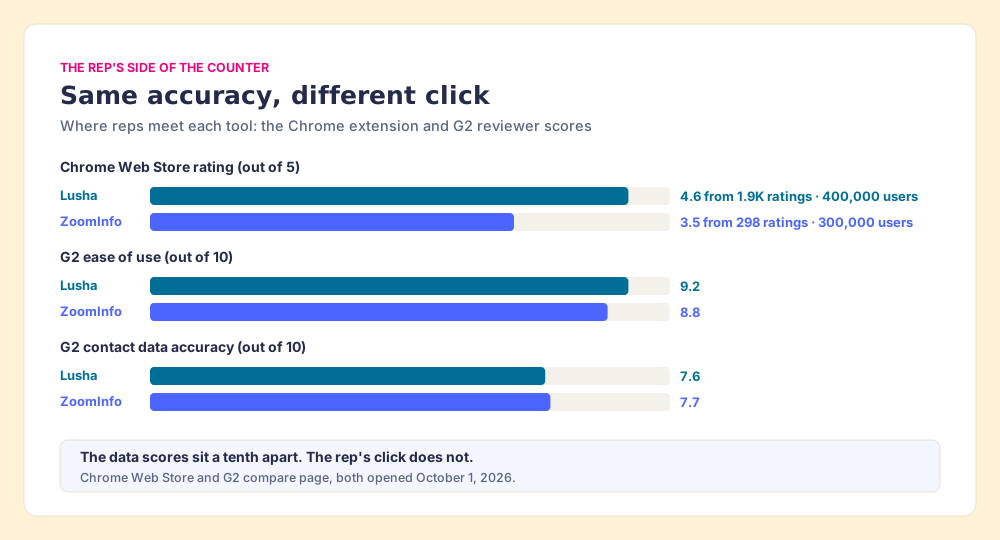
That gap matters more than it looks. A contact database earns its fee only when a rep uses it, at the moment a profile is open and a buyer is worth a call, and a tool reps find clumsy gets used less, however deep its shelves. The extension pages go further on install steps, plan gates, and complaints: the Lusha Chrome extension and the ZoomInfo Chrome extension. And the fair test of data is still the one you run yourself: a few hundred contacts from deals you won last year, split by region, sent to both trials in the same week, with match rate and connect rate scored apart.
What changed at Lusha and ZoomInfo in 2026?
ZoomInfo had a year of rebuilding. Its board approved a restructuring on May 5, 2026 that removes about 600 roles, roughly 20% of headcount. Its August 5 results showed revenue of $310.4 million, up 1.2% year over year, net revenue retention of 89%, and 76% of contract value upmarket. On September 30, 2026 it acquired DoubleO.ai, “an agentic orchestration platform built to help teams create reliable, multi-agent automation” (Business Wire), and on October 1 launched Agent Teams on top of it. The wholesaler is moving its loading dock toward bigger trucks.
Lusha had a smaller year, and a telling one. In December 2025 it cut about 8% of its staff (Calcalist). On March 10, 2026 it joined Clay’s marketplace. On September 23, 2026 its changelog said “Data Waterfall was previously limited to Pro plans and above. It is now available on every paid plan” (Lusha changelog); the feature falls back to third-party providers when Lusha’s own data cannot match a field. Both companies are independent as of October 1, 2026.
Read those two lists side by side and one move stands out. The corner shop now sends a runner to other shops when its own shelf is bare. A shop does not hire a runner unless customers keep asking for tins it does not stock.
Is there a better option than Lusha or ZoomInfo for a team on Clay?
For a team that already has Clay, yes, and it is why Prospector ranks first in the table. Prospector does not bring its own database. It brings Clay’s waterfall, which is every database, routed. We chose Clay as our only data provider for that reason.
Go back to the street. Clay is the market hall: “Buy data from 200+ providers in one place,” in Clay’s words, with waterfalls that “Combine multiple data providers for the best coverage” (clay.com, October 1, 2026). The waterfall walks stall to stall until one returns the verified email or phone, and Clay’s pricing page says “If an enrichment returns no result, you’re not charged Data Credits or Actions” (clay.com/pricing).
Both shops on this page now rent a stall in that hall. Clay lists ZoomInfo as an integration that joined January 15, 2025, and Lusha as one that joined March 10, 2026, and on both pages the person and contact enrichment actions read “Bring Your Own Account Required” (Clay, ZoomInfo; Clay, Lusha; checked October 1, 2026). Clay’s pricing page adds that when you bring your own API keys for a provider, “you skip Data Credits entirely and only use Actions.” So for a Clay team, Lusha vs ZoomInfo stops being a choice between two shops. It becomes a smaller question: does either contract earn a stall in your waterfall, and in which position?
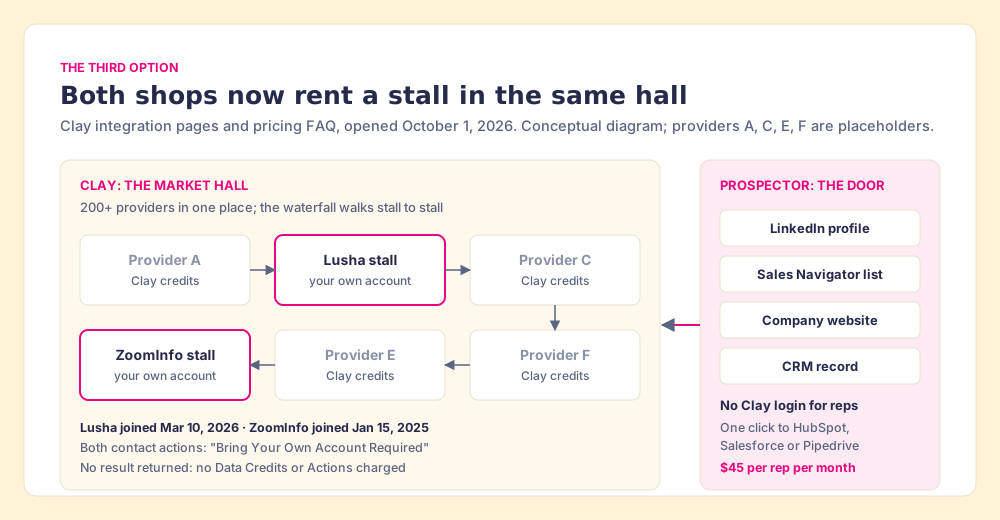
The hall has one problem, and Clay names it on its own homepage: “GTM engineers build on Clay.” The tables and the waterfall live in the GTM engineer’s workshop, and the rep lives in LinkedIn and the CRM. Prospector puts the power of the GTM engineer in the rep’s hands, where they already are. Clay governs the data. Supered governs the motion.
- A start from anywhere the rep is. A LinkedIn profile, a Sales Navigator list, a company’s website (with company research on the page), or a HubSpot, Salesforce, or Pipedrive record. One click runs the Clay table your Ops team built.
- A CRM check before the add. On a LinkedIn profile the rep sees the matching CRM record and whether the prospect was already worked, so two reps do not chase one buyer.
- The rep’s own list. The rep builds the list, pushes it into any custom Clay workflow, and syncs it to the CRM in one click, with field mapping set once. Reps never need a Clay login.
- The list, worked and closed. Supered applies your process to the prospects reps work, and the manager sees each sourced list move to worked and closed, so coaching starts from what is converting.
The price, laid out plainly. Prospector is $45 per rep per month, billed annually, from one rep, on its own plan, running on your Clay account and your Clay credits (Prospector). If RevOps already pays for Clay, ten reps add $5,400 a year. If you are buying Clay for this, Clay Growth at its $495 monthly rate is $5,940 a year, so Clay plus Prospector is $11,340 for ten reps and $16,740 for twenty. That sits under ZoomInfo’s $33,500 median at both sizes. Against Lusha it is close: ten reps on Clay and Prospector cost about the same as Vendr’s $10,000 to $20,000 ten-user Lusha estimate, and a five-rep team on Lusha Premium at $3,599.10 pays less than Clay alone. The case for the hall is coverage across 200+ providers, the rep’s surface, and one contract, and it is strongest for the team that already owns the pass. More on how reps build and work lists from Clay is on the sourcing use case and the Clay Chrome extension page.
Choose something else if any of these is true:
- No Clay, and no plan to buy it. Prospector runs only on Clay, and Clay needs someone to build the tables. Pick Lusha or ZoomInfo from the branches below.
- A solo rep or a team of five on a card. Lusha Starter at $449.10 a year, or Premium at $3,599.10 for five seats, is a simpler and cheaper purchase than a Clay plan plus seats.
- Agents that write and send the outreach. Prospector drafts nothing. ZoomInfo’s Agent Teams is aimed at that job.
- A field or mobile-first team. Supered runs at the computer and has no mobile product.
ZoomInfo vs Lusha: which should you choose?
The branch comes before the score. If your problem is a handful of reps who need a number from a LinkedIn profile today, Lusha is the best pick. If your problem is enterprise depth across North America with intent data and a budget for it, ZoomInfo is the best pick. If your reps already have Clay, the best pick is the waterfall in their hands, and the zoominfo vs lusha question shrinks to whether either deserves a stall in it.
- Lusha, the corner shop. Choose it for one to five LinkedIn-first reps, light on phones, buying on a card: Starter $449.10 a year, Premium $3,599.10 for five seats, 9.2 on G2 for ease of use. Buy monthly if you cannot size the jar, since monthly credits roll over and yearly ones reset. Past five users you are a sales-led buyer either way, so get a ZoomInfo quote to price against.
- ZoomInfo, the wholesaler. Choose it for North American enterprise depth and intent across a large team: 500 million contacts, a Forrester Leader, agents on the roadmap. Budget near the $33,500 median, size the credits before the seats, sign in a quarter-end month, and cap the renewal escalator.
- Prospector on Clay, the market hall. Choose it if RevOps already runs Clay. Coverage becomes Clay’s waterfall across 200+ providers, your own Lusha or ZoomInfo account can be one step in it, reps work from LinkedIn, Sales Navigator, the company site, and the CRM record with no Clay login, and you see which lists turn into pipeline: $11,340 a year with Clay Growth for ten reps, $16,740 for twenty.
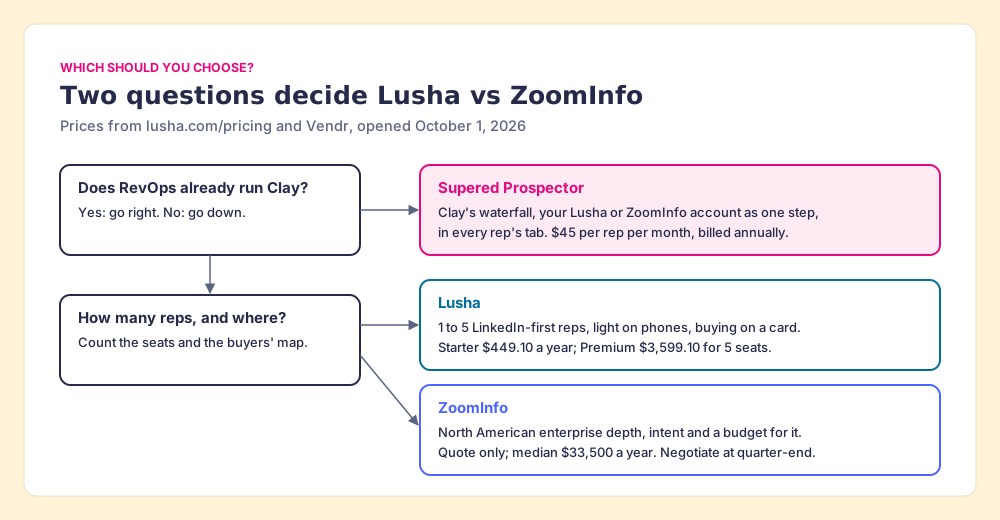
If you do not have Clay, walk into the shop that fits your basket: the corner shop for a few reps and a few tins, the wholesaler for a large team buying by the case, and price the second against the first either way. If you do have Clay, the shops are already inside your hall, and the only purchase left is a door your reps will use. The next comparisons in this set run the same test on other pairs: ZoomInfo vs Seamless.AI weighs ZoomInfo against the unlimited-reveal model, Apollo vs Lusha prices Lusha’s phone against Apollo’s, and Exportly alternatives covers the Clay front ends for reps.
Frequently asked questions
Is Lusha better than ZoomInfo?+
How much does Lusha cost compared with ZoomInfo?+
Does ZoomInfo have better data than Lusha?+
Which Chrome extension is better, Lusha or ZoomInfo?+
Can I use Lusha or ZoomInfo inside Clay?+
Do I need Lusha or ZoomInfo if I already have Clay?+
Your process, running itself.