Apollo vs ZoomInfo in 2026: Two Tailors, Walking in Opposite Directions
Apollo vs ZoomInfo used to be a feature fight. In 2026 one vendor is moving upmarket by SEC filing and the other is growing 5x on a credit meter. Here is the head-to-head, priced from sources opened this week, and the case for choosing neither.
Apollo vs ZoomInfo is a choice between Apollo.io, a self-serve prospecting platform priced by the seat and metered by the credit, and ZoomInfo, a quote-based B2B data platform that in 2026 is moving its business upmarket, and both stop measuring at the export.
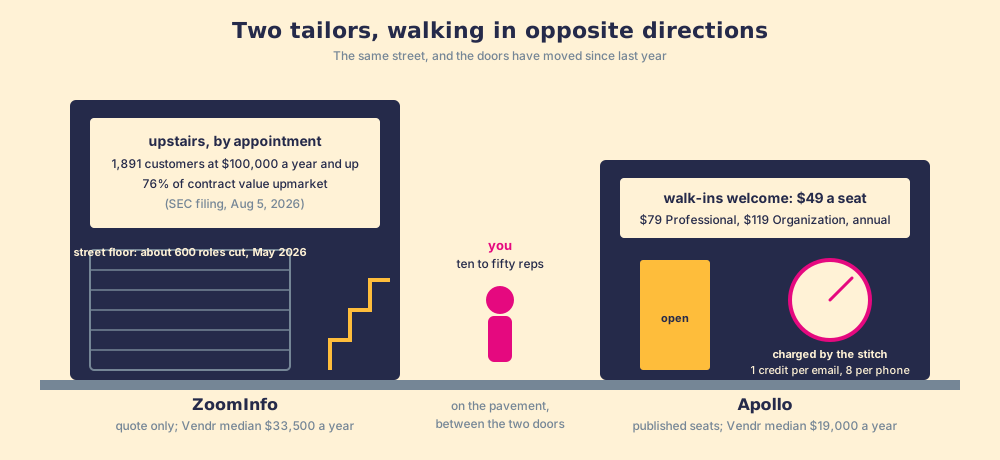
Two tailors have traded on the same street for years, and a buyer used to choose between them by feeling the cloth. That stopped being the choice in 2026. One tailor has moved the fitting room upstairs, by appointment: ZoomInfo’s board approved a restructuring on May 5, 2026 that removes about 600 roles, roughly 20% of headcount, and six days later its CEO told staff the company is “accelerating our move upmarket, and reducing the resources we allocate downmarket” (SEC Form 8-K, May 2026). By August its filings showed 76% of contract value upmarket and 1,891 customers paying $100,000 a year or more (Q2 2026 results). The other tailor has propped the street door open and charges by the stitch: Apollo lists $49 a seat in large type and, further down, a meter that reads 1 credit per email and 8 per phone number (apollo.io/pricing, opened September 25, 2026). If you run ten to fifty reps, you are standing on the pavement between them with two questions the cloth cannot answer: which door is still open to you, and what each tailor does once you have left with the suit.
Apollo vs ZoomInfo is a choice between Apollo.io, a self-serve prospecting platform priced by the seat and metered by the credit, and ZoomInfo, a quote-based B2B data platform that in 2026 is moving its business upmarket, and both stop measuring at the export. This page puts the two side by side on seven rows with every price taken from a page opened this week, tells the two 2026 stories that most zoominfo vs apollo comparisons were written before, and then gives the verdict in three branches, one of which is neither.
Who is Apollo for, and who is ZoomInfo for?
Be fair to both first, with proof, because the verdict is only worth reading if the praise is real.
- ZoomInfo, the deeper well. Its August 2026 filing claims “more than 100 million companies, 500 million contacts.” Forrester named it a Leader in its Q1 2026 Wave for B2B marketing and sales data providers with the highest current-offering score, top marks in 20 of 27 criteria (Q1 2026 results). Its pricing page shows a G2 badge of 4.5 from 9,384 reviews. If your job is one vendor’s depth and intent data across a 200-seat sales floor, with a success manager on call, ZoomInfo is the best pick on this page and you can stop reading here.
- Apollo, the open door. The pricing page lists Basic at $49, Professional at $79, and Organization at $119 per seat per month on annual billing, with a free plan, and it carries a G2 badge of 4.7 from 9,690 reviews, the highest in the category. Sequences, a dialer, and Gmail and Salesforce extensions come in every paid plan, so a twelve-person team gets data and outreach under one login without a procurement cycle. If your job is a published price, a small team, and outbound bundled with the data, Apollo is the best pick.
Both are strong in their lane, and the lanes have moved apart since you last compared them.
Apollo vs ZoomInfo side by side: what does each row say?
Seven rows, every number from a source opened on September 25, 2026. The last row is the one this page is about.
| Row | Apollo | ZoomInfo |
|---|---|---|
| Data coverage (each vendor’s own count) | 240M contacts, 30M companies (apollo.io/pricing) | 500M contacts, 100M companies (Q2 2026 8-K) |
| Phone numbers (what each publishes) | 8 credits per phone, 1 per email; G2 4.7 on 9,690 reviews | ”Each export costs one credit”; Forrester Wave Q1 2026 Leader, top current-offering score |
| Seat and credit model | $49 / $79 / $119 a seat, annual; 30,000 / 48,000 / 72,000 credits per seat per year | Quote only; platform fee plus seats plus credit blocks; no list price |
| Contract size (Vendr, opened Sept 25, 2026) | Median $19,000 a year on 101 purchases; range $4,284 to $45,000; 30% average saving | Median $33,500 a year on 1,573 purchases; range $7,213 to $155,820; 22% average saving |
| CRM and sequencer | Sequences, dialer, Gmail and Salesforce extensions in every paid plan | CRM integrations; engagement sold as separate modules (SalesOS, MarketingOS, per Vendr) |
| Compliance (as published) | “GDPR Compliant” beside the G2 badge on the pricing page | zoominfo.com/pricing served a bot check when opened this session; verify SOC 2 and GDPR on its trust center before signing |
| The funnel after export | Meters at the export; sees nothing after | Meters at the export; sees nothing after |
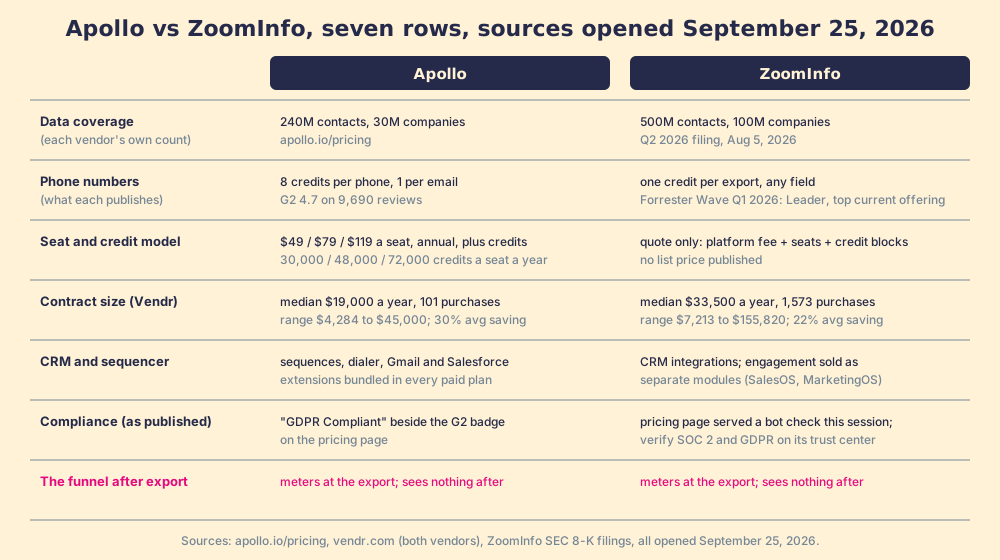
Coverage is the row where ZoomInfo wins by a wide margin, and the win is real. Twice the contacts and three times the companies, by the vendors’ own counts, and Forrester’s scoring agrees. The catch is the one that applies to every single database: however big the well, the mobile number you need this afternoon is either in it or it is not. Apollo’s answer to that is a feature it calls Waterfall Enrichment, on every paid plan, which chains a handful of partners inside Apollo’s own credits. A wider bucket, and a real improvement over one, but the meter still turns at Apollo’s rates.
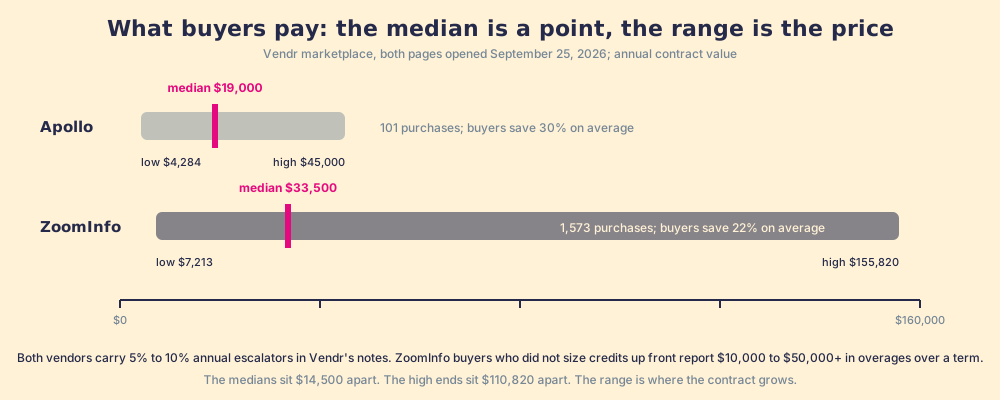
Contract size is the row where the seat price misleads. Vendr’s Apollo median of $19,000 a year is twenty seats at the $79 tier, and Vendr’s buyer notes report mobile overages at $0.50 to $1.00 per credit under the older model plus annual escalators of 5% to 10% written into the renewal (Vendr, Apollo). ZoomInfo’s $33,500 median comes with the same escalator range and a sharper warning: buyers who did not size credits up front report $10,000 to $50,000 or more in overage fees over a term (Vendr, ZoomInfo). For the arithmetic on Apollo’s credits, a phone-first rep on the Bridge Group’s median of 44 dials a day, and what the meter does to a Basic seat, see the Apollo alternatives page; the burn-down there applies unchanged here. Laid on one axis, the two medians sit $14,500 apart and the two high ends sit $110,820 apart, which is the plainest way to say that the range, and the credits inside it, is where a ZoomInfo contract grows.
The seventh row is the one to hold on to. ZoomInfo’s pricing FAQ says “Each export costs one credit.” Apollo’s page says credits are consumed “whenever you export a contact outside of Apollo.” Two meters, bolted to the same spot, which is the door. Neither knows whether the suit was ever worn.
What changed at ZoomInfo in 2026?
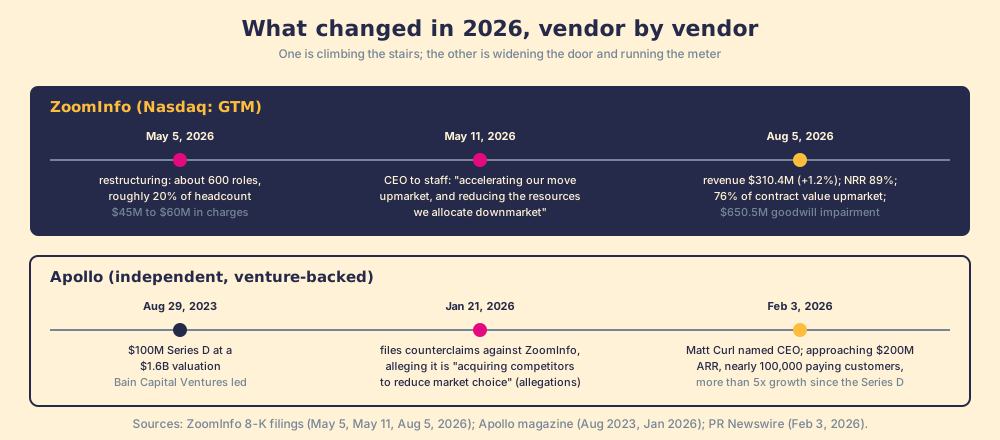
The restructuring is the headline, and it is bigger than a cost cut. The 8-K expects $45 million to $60 million in charges and about $60 million in annual run-rate savings, with roughly one-fourth of the eliminated roles reallocated, an Israel site closing, and the program substantially complete by the end of 2026. Henry Schuck’s note to staff named the direction: “We are simplifying our operations, accelerating our move upmarket, and reducing the resources we allocate downmarket,” and added that “the industry is moving toward consumption-based pricing.”
Read the August numbers with that note beside them. Revenue of $310.4 million, up 1.2% year over year. Net revenue retention of 89%, which means the average existing customer spends 11% less than a year ago. A goodwill impairment of $650.5 million. And, on the same page, the launch of GTM.AI, described as a “headless GTM context layer” with MCP integrations into Claude, Codex, Agentforce, and HubSpot Breeze. The company is public (Nasdaq: GTM since May 13, 2025, when it changed its symbol from ZI, per its investor release), it still owns Chorus, and it now calls itself “the all-in-one AI GTM platform.”
None of this makes ZoomInfo a worse product. Forrester scored it highest in the category three months before the cut. What it makes ZoomInfo is a vendor that has told the SEC, in plain words, which customers it is walking toward, and a twelve-seat team on the pavement is not among them.
What changed at Apollo in 2026?
Three things, and the order matters.
- A new chief executive. On February 3, 2026 Apollo appointed Matt Curl, previously its COO, as CEO, with founder Tim Zheng continuing as chairman. The release put the company at “approaching $200M in annual recurring revenue and nearly 100,000 paying customers,” and said it “has also grown more than 5x since its Series D” (PR Newswire, February 2026). That Series D was $100 million led by Bain Capital Ventures at a $1.6 billion valuation, announced August 29, 2023 (Apollo), so the 5x is roughly two and a half years of growth, and Apollo is independent and venture-backed as of this week.
- Counterclaims against ZoomInfo. On January 21, 2026 Apollo announced it had “filed counterclaims in our litigation with ZoomInfo,” alleging that ZoomInfo is “acquiring competitors to reduce market choice,” “asserting patents it doesn’t even appear to practice,” and “enforcing restrictive contract provisions that limit customer mobility and choice” (Apollo, January 2026). Those are Apollo’s allegations, not findings, and the case is not resolved. But the two names in the search box are in court with each other, and a buyer signing a multi-year contract with either one should know that.
- The unified credit system. Apollo’s pricing page says some features “are only available with our new credit system,” that new customers are on it automatically, and that existing customers are being migrated. Vendr’s page still describes the older shape, unlimited email credits and a capped bucket of mobile credits per user. Under the new model an email is 1 credit and a phone is 8, and the seat carries a fixed annual allowance: 30,000 credits on Basic, 48,000 on Professional, 72,000 on Organization. A company does not grow 5x on the seat price. It grows on the meter.
One convergence sits in those two lanes. ZoomInfo’s August filing launches an MCP-integrated context layer for AI chat tools; Apollo’s product menu lists Apollo MCP as a feature and its Organization tier now advertises a “Dedicated GTM Engineer” for contracts above a minimum value. Both are borrowing Clay’s vocabulary, the GTM engineer who builds and the AI surface where a rep asks for data, which is a fair sign of where the category thinks the rep will be working next. Our surface is the other one: the LinkedIn profile, the company site, the CRM record, the place the rep already is. That difference is the reason the third branch of the verdict exists.
Which is better for a mid-market team, Apollo or ZoomInfo?
The load-bearing sentence of any apollo io vs zoominfo comparison is a branch, and the score comes second. If your problem is enterprise-grade depth and intent data for a large sales floor, with a $100,000-plus budget and a taste for one vendor’s roadmap, ZoomInfo is the best pick. If your problem is a ten-to-fifty-rep team that needs a published price, a free tier to start on, and outreach bundled with the data, Apollo is the best pick. On a mid-market lens the second problem is the common one, and the grading on the ZoomInfo competitors page, which scores seven vendors on the same weights, puts Apollo at A- and ZoomInfo at B for exactly that reason.
Now the objection, in your words: “We are a growing team, and ZoomInfo’s coverage is twice Apollo’s. Surely the bigger database is the safer buy.” Fair, and for coverage alone it is. Two things cut against it. The first is the filing: a vendor that has said it is reducing what it allocates downmarket will, over a three-year term, put its engineering and its success managers where it said it would, and a $33,500 median contract sits at the low end of a range that runs to $155,820. The second is smaller in print and applies to Apollo too. Twice the contacts still means one well. The phone number you need is either in the one you licensed or it is not, and the industry’s fix for a miss is a second contract, which is how Vendr’s buyer notes come to include a team “using ZoomInfo in tandem with Cognism” (Vendr, Cognism).
Supered does not bring its own database. It brings Clay’s waterfall, which is every database, routed. That is the reason we chose Clay as our only data provider. Clay is not a row in the table above because Clay is not a database; it is an aggregation layer across 200+ data and AI vendors under one contract (clay.com, September 25, 2026), and its waterfall asks provider after provider until one returns a verified email or phone, paid per result rather than per seat per well. Clay’s own words: its “signature data waterfalls check multiple providers to return the most verified emails (lower bounce rate) and phone numbers (higher connect rate).” On a mid-market team that already has Clay through RevOps, the apollo or zoominfo question dissolves, because the coverage row stops being a choice between two wells and becomes a key to all of them.
Two cautions, so the picture does not overreach. Clay needs someone to build the tables and the waterfall; Clay says “GTM engineers build on Clay,” and that person is real overhead. And Supered’s sourcing is only for teams that have Clay. If you do not, the branch above stands: Apollo for the mid-market team, ZoomInfo for the enterprise one.
What happens after the export?
Go back to the tailor’s door. Both shops hand you the suit there and print the receipt there, one credit per export at ZoomInfo, eight credits per phone at Apollo, and neither knows what happens next. The suit goes home and into the wardrobe. Whether it is ever worn, whether it reaches the interview, is invisible to the shop, and no blame attaches to the shop for that; its job ended at the door.
A revenue leader’s job starts at the wardrobe. The wardrobe is the CRM, and the number a leader answers for is how many suits were worn and how many reached the meeting; the count at the door is where that number begins. Across 198 sales teams in The State of Sales Enablement, 89% had a defined sales process and 36% saw reps run it as designed, and the teams that inspected adherence consistently hit quota at 6.3 times the rate of those that did not. Sourcing a contact is step one of that process. If the only step anyone measures is the door, you get the renewal conversation neither vendor can help you with: a CRM full of contacts, a credit balance draining, and no answer to “is the prospecting engine working?”
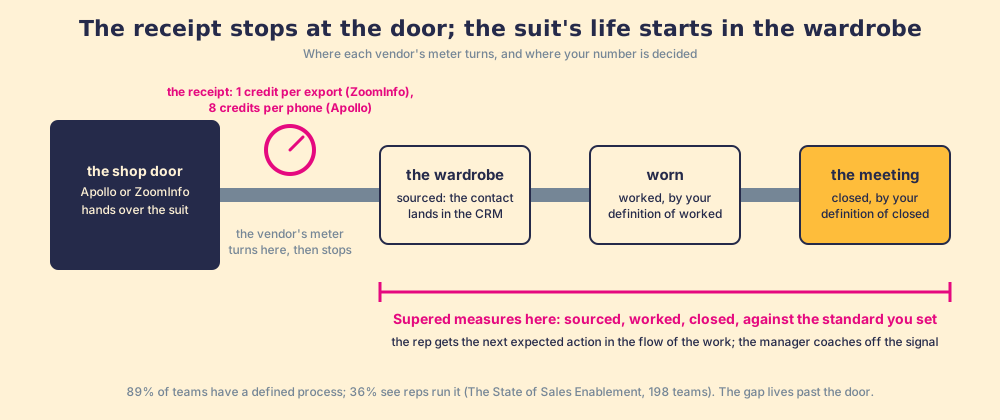
You can only expect what you inspect. So the layer worth paying for after Clay is the one that treats the sourced contact as the start of a motion with an expectation attached: was it worked, by your definition of worked; did it advance; did it close, by your definition of closed. Supered is that layer. Clay governs the data. Supered governs the motion. The rep gets the next expected action in the flow of the work, the way a sales cadence is meant to reach them, and the manager sees sourced, worked, and closed per rep against the standard they set, so the coaching conversation starts from the signal instead of a hunch.
The second payoff is the one the buyer feels. In the same study, quota attainment ran 49% when process guidance reached reps in the flow of work against 15% when it lived in documents. A contact that gets sourced and then worked to a standard is a buyer who gets the same experience from every rep on the team, and consistency is what the buyer notices long before a dashboard does. The full reasoning sits in the sales process guide; the call itself, once the number is in hand, is in cold calling tips.
The verdict: Apollo, ZoomInfo, or neither
Three branches, each earned by the rows above.
- Apollo. Choose Apollo if you run ten to fifty reps, want a published price and a free tier to start on, and want sequences and a dialer in the same plan as the data. It holds the higher G2 score (4.7 on 9,690 reviews), a $19,000 Vendr median, and the open door. Size the credits before the seats: count the phone-heavy reps, multiply by 8, and negotiate the allocation the way Vendr’s buyers do, at 30% off the first quote, with the escalator capped.
- ZoomInfo. Choose ZoomInfo if you are the customer its filings describe, a $100,000-plus contract that wants the deepest single database, intent data, and one vendor’s roadmap, and you can absorb a quote-based deal near the $33,500 median. It is the Forrester Leader with the top current-offering score, and it is walking toward you. Sign at quarter-end, size the credits up front, and cap the 5% to 10% escalator.
- Neither: Clay via Supered. Choose neither if your reps already have Clay through RevOps and you want the funnel inspected. Coverage becomes Clay’s waterfall across 200+ vendors, credited to Clay and paid per result; delivery becomes the rep’s own screen, the LinkedIn profile, the company site, the HubSpot or Salesforce record, one click to enrich and one to sync with no Clay login; and the export becomes the first step of a measured process instead of the last thing anyone sees. Price is Clay’s per-result credits on the customer’s own Clay account. It is the only branch on this page that answers “was the contact worked?”
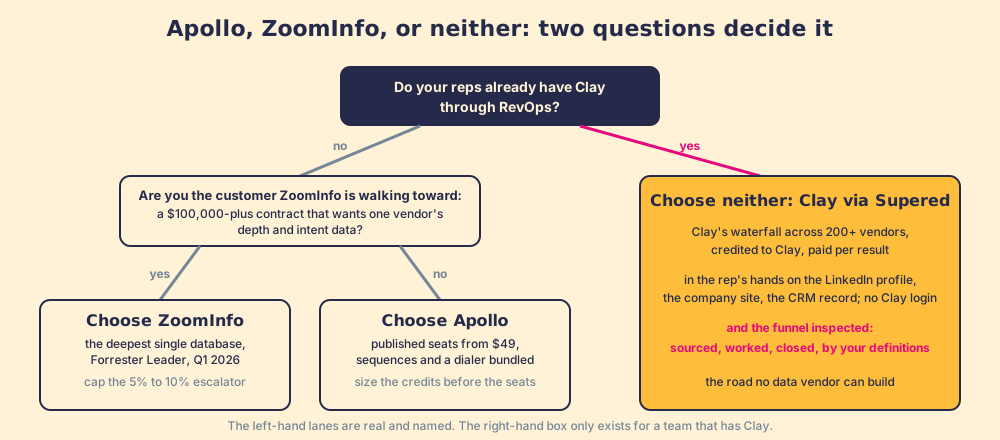
So here is what we recommend. If you do not have Clay, buy the door that is open to you: Apollo for the mid-market team, ZoomInfo for the enterprise one, and read the escalator clause twice either way. If you have Clay, do not sign another database at all. The two tailors are walking in opposite directions, and both of them stop at the door. Put Clay in your reps’ hands where they already work, and measure what happens to every suit after it leaves the shop, because the receipt was never the number. The wardrobe is. The demo is where you can watch that run on your own Clay account.
Frequently asked questions
Is Apollo or ZoomInfo better for a mid-market sales team?+
How much does ZoomInfo cost compared with Apollo?+
What is the difference between ZoomInfo and Apollo?+
What changed at ZoomInfo in 2026?+
What changed at Apollo in 2026?+
Why would a team choose neither Apollo nor ZoomInfo?+
Your process, running itself.