Cognism vs ZoomInfo in 2026: Two Good Maps, Each Tested on Its Own Streets
Cognism and ZoomInfo each publish a head-to-head page, and each one wins its own test. This comparison prices both from sources opened October 1, 2026, shows the coverage test to run on your own list, and covers the option for teams that already have Clay.
Cognism vs ZoomInfo is a choice between two quote-only B2B contact databases with different home ground: Cognism, built for phone-verified European outbound, and ZoomInfo, the deeper North American database, which is moving upmarket in 2026.
Cognism vs ZoomInfo is a choice between two quote-only B2B contact databases with different home ground: Cognism, built for phone-verified European outbound, and ZoomInfo, the deeper North American database, which is moving upmarket in 2026. The short answer, by job:
- Cognism, for EMEA phone-first teams. Phone-verified mobiles and Do Not Call screening; Vendr median $32,750 a year.
- ZoomInfo, for North American enterprise depth. The largest single database; Vendr median $33,500 a year.
- Supered Prospector, for teams that already have Clay. Clay’s waterfall across 200+ providers in every rep’s hands, at $45 per rep per month.
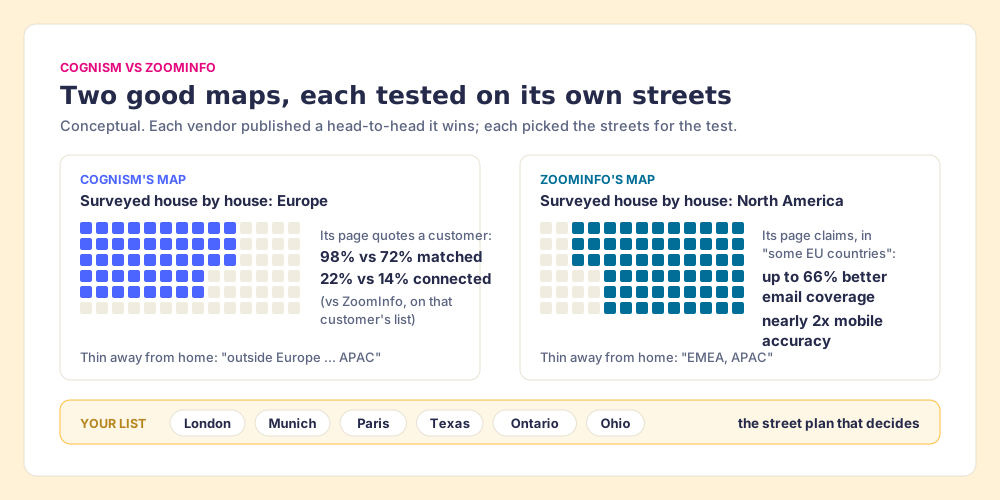
Both vendors publish a page called Cognism vs ZoomInfo, and both pages win. Cognism’s page quotes a customer: “Cognism’s match rate was 98% vs. 72% by ZoomInfo,” with calls connecting 22% of the time against 14% (cognism.com, opened October 1, 2026). ZoomInfo’s page claims “up to 66% better email coverage and nearly 2x mobile accuracy in some EU countries” (zoominfo.com, opened October 1, 2026). Neither number has to be false for both to be true.
Two mapmakers can each publish a test showing their map finds more streets than the rival’s, and both can be right, so long as each one picked the streets for the test. A map of London drawn house by house is superb in London and sketchy in Chicago. The Chicago map is the reverse. Cognism surveyed Europe first and ZoomInfo surveyed North America, and a match rate is measured on a list, so the only test that settles anything is the one run on yours. Some buyers settle it by carrying both maps, which is how a buyer note on Vendr comes to describe “using ZoomInfo in tandem with Cognism” (Vendr, Cognism).
Cognism vs ZoomInfo at a glance: the decision table
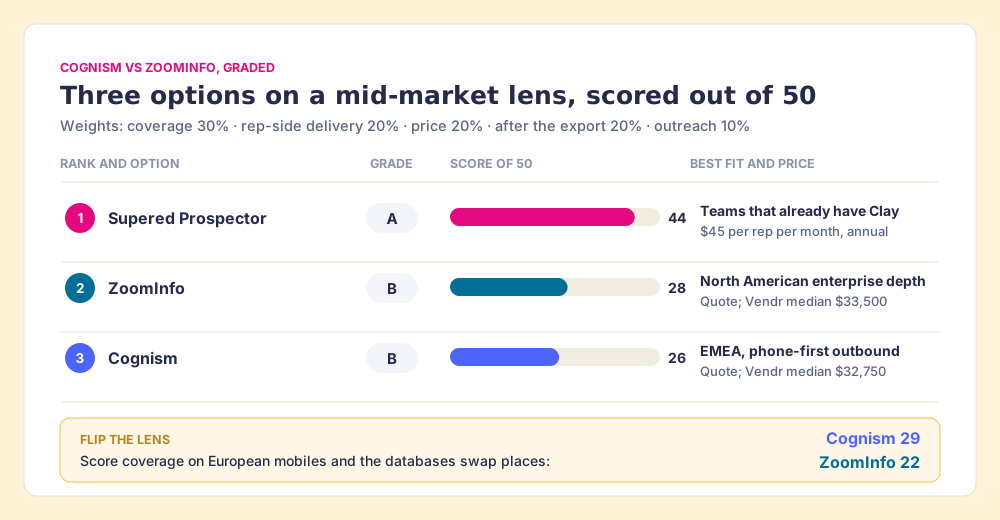
The grades use the same five weights as the Cognism alternatives page and the ZoomInfo competitors page, on a mid-market lens of ten to fifty reps: coverage of the contact you need (30%), rep-side delivery where reps already work (20%), price structure (20%), what happens to the list after the export (20%), and bundled outreach (10%). Prices come from pages opened October 1, 2026.
| Rank | Option | Grade (score of 50) | Best fit | CRM integration | Setup effort | Pricing | Reason to switch |
|---|---|---|---|---|---|---|---|
| 1 | Supered Prospector | A (44) | Teams that already have Clay | Native HubSpot and Salesforce; one-click push | RevOps builds the Clay tables once; reps need no Clay login | $45 per rep per month, billed annually, from 1 rep, plus your Clay plan | Clay’s waterfall across 200+ providers, run where reps prospect, and you see which lists get worked and close |
| 2 | ZoomInfo | B (28) | North American enterprise teams buying one vendor’s depth and intent | Native, Salesforce and HubSpot among the 40+ ZoomInfo counts | Sales-led quote; multi-seat annual commitment often required (Vendr) | Quote only; Vendr median $33,500 a year | The deepest single database; Forrester Wave Leader, Q1 2026 |
| 3 | Cognism | B (26) | EMEA phone-first, compliance-led outbound | Native Salesforce and HubSpot, with two-way HubSpot sync launched in 2026 | Sales-led quote; Standard or Pro package, 5 seats included | Quote only; Vendr median $32,750 a year | Phone-verified mobiles, Do Not Call screening, top score on G2’s Europe grid |
| Tool | Coverage (x3) | Rep-side (x2) | Price (x2) | After the export (x2) | Outreach (x1) | Weighted total |
|---|---|---|---|---|---|---|
| Supered Prospector | 5 | 5 | 4 | 5 | 1 | 44 |
| ZoomInfo | 5 | 3 | 1 | 1 | 3 | 28 |
| Cognism | 4 | 3 | 2 | 1 | 2 | 26 |
Prospector scores 1 on outreach because it drafts nothing and sends nothing; it hands contacts to the CRM and your sequencer. ZoomInfo and Cognism score 1 on the fourth column because both meters stop at the export. Flip the lens and the order flips with it. Score coverage on European mobiles instead of overall depth, and Cognism’s coverage goes to 5 while ZoomInfo’s drops to 3: Cognism moves to 29 and ZoomInfo to 22. A two-point gap that reverses on one question tells you which question to ask first.
Why do teams switch between Cognism and ZoomInfo?
The reasons come from the customers, and they run in both directions.
- Thin coverage away from home, on both sides. A mid-market Cognism reviewer on G2 wrote on July 24, 2026 that “Coverage also thins out noticeably outside Europe; searching for contacts in APAC or more niche industries yields way fewer verified phone numbers.” An enterprise account executive reviewing ZoomInfo on August 10, 2026 said direct-mobile accuracy “drops noticeably in EMEA, APAC, and niche regional markets,” and a small-business reviewer on October 1, 2026 found ZoomInfo’s “Data coverage can be patchy for UK-based contacts and mid-sized companies” (G2, Cognism; G2, ZoomInfo).
- The ZoomInfo bill. “The pricing feels extremely steep compared to platforms like Apollo,” a ZoomInfo reviewer wrote on September 17, 2026. Vendr’s buyers report $10,000 to $50,000 or more in overage fees over a term when credits were not negotiated up front (Vendr, ZoomInfo).
- The ZoomInfo direction. Its CEO told staff in May that the company is “accelerating our move upmarket, and reducing the resources we allocate downmarket” (SEC Form 8-K, May 2026). A twelve-rep team reading that sentence is reading about someone else.
- The Cognism floor. cognism.com/pricing sells two packages, Standard and Pro, each marked “5 seats included,” with no price and a talk-to-sales button. The tiers have carried three sets of names in four years (Platinum and Diamond, Grow and Elevate, Standard and Pro), and Vendr’s listing still shows the older names beside the new ones.
Turned into buying criteria, those four complaints become four questions. Where do your buyers live? How many mobile numbers do your reps dial, against how many emails? Can you absorb a quote with a five-seat floor or a credit ceiling? And what happens to a contact once it leaves the vendor? The first question decides between these two vendors. The fourth decides whether you need either.
Why trust this comparison?
I started RevPartners, a HubSpot partner that did only sales implementations, sold roughly twice as much Sales Hub as any other partner, and reached Elite tier in 13 months. Supered grew out of that work and is the #1 sales enablement app on the HubSpot marketplace, with 6,000+ installs, and it holds 4.9 out of 5 from 81 reviews on G2 (October 1, 2026). I have watched a lot of contact databases get bought and renewed from inside the CRM where the contacts land.
The disclosure matters more here than usual. We sell a third option, Prospector, and it has no database of its own. So we gain nothing from either of these two vendors winning, and we do gain if you conclude you need neither. The weights above are printed so you can change them, and the EMEA flip shows what happens when you do.
Whose coverage is better, Cognism or ZoomInfo?
Each is best at something real, so start with the praise.
- ZoomInfo, the deeper well. Its August 2026 filing claims “more than 100 million companies, 500 million contacts” (Q2 2026 results). Forrester named it a Leader in the Q1 2026 Wave for B2B marketing and sales data providers, with the highest current-offering score and top marks in 20 of 27 criteria (Q1 2026 results). On G2 its GTM Workspace holds 4.5 out of 5 from 9,170 reviews (October 1, 2026). If your buyers sit in North America and you want one vendor’s depth and intent data across a large floor, ZoomInfo is the better of these two.
- Cognism, the verified mobile. On G2 it holds 4.5 out of 5 from 1,370 reviews (October 1, 2026). In G2’s Europe Regional Grid for Sales Intelligence, Autumn 2026, as Cognism published it, Cognism scored 88 on 759 verified European reviews with a satisfaction score of 100, against 65 on 188 reviews and a satisfaction score of 41 for ZoomInfo’s GTM Workspace (Cognism newsroom, September 2026). Its compliance page describes a notified database, phone numbers scrubbed against “15 major Do Not Call and TPS lists,” and ISO 27001, ISO 27701 and SOC 2 Type II certificates (cognism.com/compliance). If your buyers sit in Europe and your reps live on the phone, Cognism is the better of these two.
Vendr’s ZoomInfo page, which tracks both vendors’ contracts, lands in the same place in one sentence: “Cognism is often positioned as a strong alternative for EMEA-focused teams, with competitive pricing and GDPR-compliant data. ZoomInfo’s North America data depth is typically stronger.” The two vendors agree too, if you read each page for what it concedes. Cognism’s page talks about Europe. ZoomInfo’s page, making its European case, says “some EU countries.”
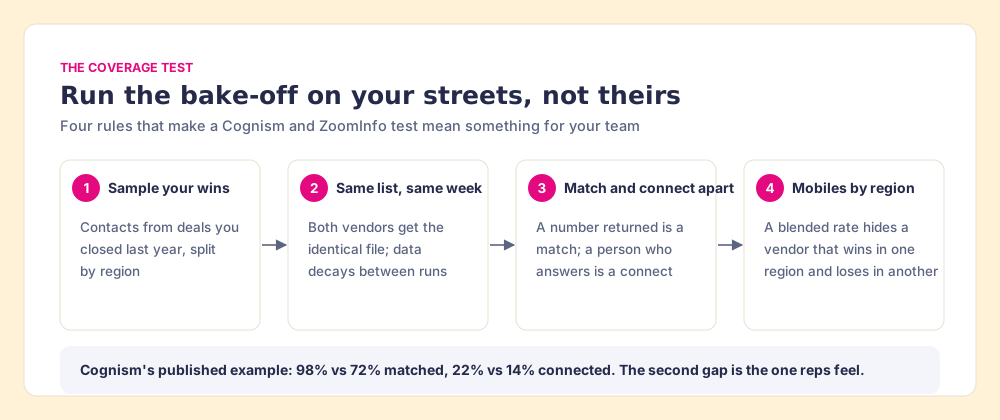
So run a Cognism ZoomInfo test yourself, because a vendor’s bake-off is a map tested on the vendor’s chosen streets. Four rules keep a home-grown test fair:
- A sample from your own wins. Pull a few hundred contacts from deals you closed last year, split by the regions you sell into, so the test looks like your next twelve months.
- The same list to both vendors, in the same week. Data decays; a test run a month apart measures the calendar.
- Match rate and connect rate, scored apart. A match is a number returned. A connect is a person who picks up. Cognism’s own example reports both, 98% against 72% matched and 22% against 14% connected, and the second gap is the one your reps feel.
- Mobiles counted by region. A blended rate can hide a vendor that wins in London and loses in Texas, and that split is the answer you came for, because it tells you to buy by region.
How much does Cognism cost compared with ZoomInfo?
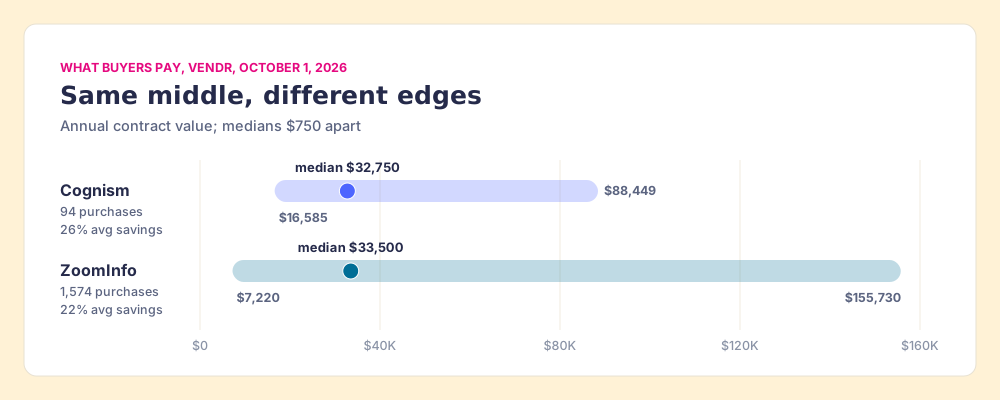
At the middle the two cost almost the same. Vendr, opened October 1, 2026, shows the median Cognism buyer paying $32,750 a year across 94 purchases, a range from $16,585 to $88,449, and 26% average savings off the first quote. The median ZoomInfo buyer pays $33,500 a year across 1,574 purchases, a range from $7,220 to $155,730, and 22% average savings. The medians sit $750 apart. Full breakdowns live on the Cognism pricing page and the ZoomInfo pricing page.
The shapes differ, and the shape is the price. Cognism’s floor is the higher one, $16,585 against $7,220, which fits a package that starts with five seats included. ZoomInfo’s ceiling is the higher one, $67,281 above Cognism’s, because its contracts stack a platform fee, seats, credit blocks, and add-ons such as intent and Chorus, then escalate 5% to 10% a year on auto-renewal.
- Cognism’s meter. “1 credit = 1 revealed contact,” with “No charge for viewing previously revealed contacts,” and a contact is charged again only if the person changes jobs. Cognism’s own comparison pages put Standard at 10,000 credits per user a year and Pro at 12,000.
- ZoomInfo’s meter. “Each export costs one credit,” per its pricing page, with credits sold in blocks. Vendr’s buyers who skipped the credit negotiation report the $10,000 to $50,000 overage range above.
Two shops on one street, each using the other’s price tag. Vendr’s Cognism buyer notes read like a manual for it: “We secured a 44% discount for a 1yr agreement because we made it competitive with our ZoomInfo renewal,” and another buyer got 28% by “mentioning using ZoomInfo in tandem with Cognism, so Cognism price matched.” On the other side, Vendr reports that ZoomInfo buyers who negotiate in its fiscal quarter-end months (March, June, September, December) commonly land 20% to 35% below the first quote. Each vendor is the other’s best discount. Get both quotes even if you already know which one you want.
What changed at ZoomInfo and Cognism in 2026?
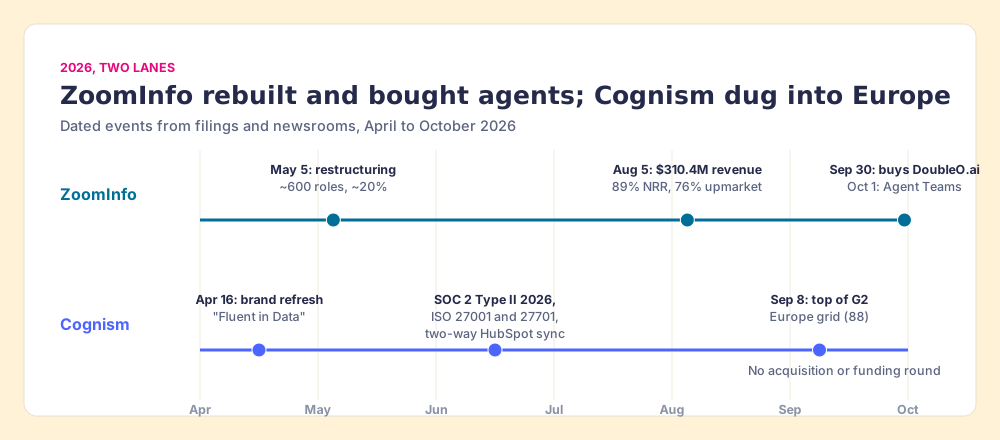
ZoomInfo changed a great deal this year and Cognism changed little, and both sets of moves point toward home.
ZoomInfo had a year of rebuilding. Its board approved a restructuring on May 5, 2026 that removes about 600 roles, roughly 20% of headcount, with $45 million to $60 million in charges. The August 5 results showed revenue of $310.4 million, up 1.2% year over year, net revenue retention of 89% (the average existing customer spending 11% less than a year earlier), 76% of contract value upmarket, and a $650.5 million goodwill impairment. Then came the agents. On September 30, 2026, ZoomInfo (Nasdaq: GTM since May 2025) announced it had acquired DoubleO.ai, “an agentic orchestration platform built to help teams create reliable, multi-agent automation,” with terms undisclosed (Business Wire, September 30, 2026), and on October 1 it launched Agent Teams on top of it. Henry Schuck’s line in the announcement: “Every revenue leader has seen an AI agent demo. Almost none have seen it actually run a real GTM motion end-to-end.”
Cognism had a calmer year, by design. It is private and London-based, owns Kaspr (bought in 2022), and announced no acquisition or funding round in 2026 as of October 1. It refreshed its brand as “Fluent in Data” in April, completed its 2026 SOC 2 Type II audit, added UKAS-accredited ISO 27001 and 27701 certification, and launched a native two-way HubSpot sync (Cognism newsroom). Its CEO, Dominic Allon, wrote in September: “Our ambition is clear: to lead the mid-market and enterprise sales data and intelligence market in Europe.”
Set side by side, the two companies are walking toward their own home cities. ZoomInfo is heading up the North American enterprise and into agents that run the outreach. Cognism is heading deeper into Europe and into compliance paperwork. Neither is walking toward the twelve-rep team that sells on both sides of the Atlantic.
Is there a better option than Cognism or ZoomInfo for a team on Clay?
For a team that already has Clay, the better option is to stop choosing between databases, and that is why Prospector ranks first in the table. Prospector does not bring its own database. It brings Clay’s waterfall, which is every database, routed. We chose Clay as our only data provider for that reason.
Go back to the maps. A rep carrying one map is lost the moment the street is off its edge. A rep carrying two has doubled the contracts and still owns no map for Singapore. Clay is an atlas that turns itself to the right page: “Buy data from 200+ providers in one place,” in Clay’s words, with waterfalls that “Combine multiple data providers for the best coverage” (clay.com, opened October 1, 2026). The waterfall asks one provider, and when that one misses it asks the next, and Clay’s pricing page says “If an enrichment returns no result, you’re not charged Data Credits or Actions” (clay.com/pricing).
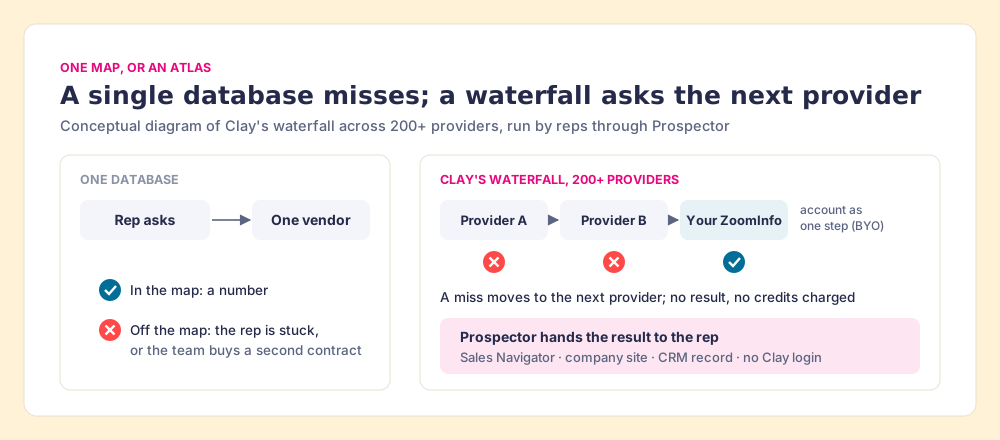
The atlas has one gap, and you should know where it sits before you buy. ZoomInfo is inside the atlas on your terms: Clay lists it as a Clay-built integration, joined January 15, 2025, with enrich and search actions that each require you to bring your own ZoomInfo account (Clay, ZoomInfo integration). A ZoomInfo contract you already pay for can become one step in a waterfall instead of the whole map. Cognism is outside it. Clay has no Cognism integration page (it returned a 404 on October 1, 2026), and Cognism’s own Clay comparison says Clay’s list “doesn’t include industry leaders ZoomInfo or Cognism,” which was true of ZoomInfo once and is still true of Cognism. For European match rates inside Clay, Clay added Lusha in March 2026 as a step “for better EMEA match rates” (Clay changelog).
What a rep does with it, on Prospector:
- Your Clay table as a button. RevOps connects any Clay table once. Reps press it in Sales Navigator, on a company’s website, or inside a HubSpot, Salesforce or Pipedrive record, and the table runs. Reps need no Clay login.
- The CRM check before the add. On a LinkedIn profile the rep sees the matching CRM record and whether the prospect was already worked, so two reps do not chase the same buyer.
- The buying committee, tuned to you. The lookup follows the titles, departments, and seniority your team sets.
- The list, worked and closed. Reps push to HubSpot, Salesforce, or your sequences, and you see who added what, which lists are being worked, and which ones close, the way your process defines it.
Prospector costs $45 per rep per month, billed annually, from one rep, on its own plan (Prospector pricing). It runs on your Clay account and your Clay credits. On list prices, Clay Growth ($5,940 a year) plus Prospector for 10 reps ($5,400) is $11,340 a year, and for 20 reps ($10,800) it is $16,740, both under either database’s Vendr median before any Clay credits beyond the plan. More on how reps build and work lists from Clay sits on the sourcing use case.
Choose something else if any of these is true:
- No Clay, and no appetite for it. Clay needs someone to build the tables and the waterfall. Without that person, one database is simpler, and the branch below between Cognism and ZoomInfo stands.
- Phone-verified European mobiles with DNC screening as the core job. Cognism is not in Clay’s marketplace. Keep Cognism.
- Agents that write and send the outreach. Prospector drafts nothing. ZoomInfo’s Agent Teams is aimed at that job.
Cognism vs ZoomInfo: which should you choose?
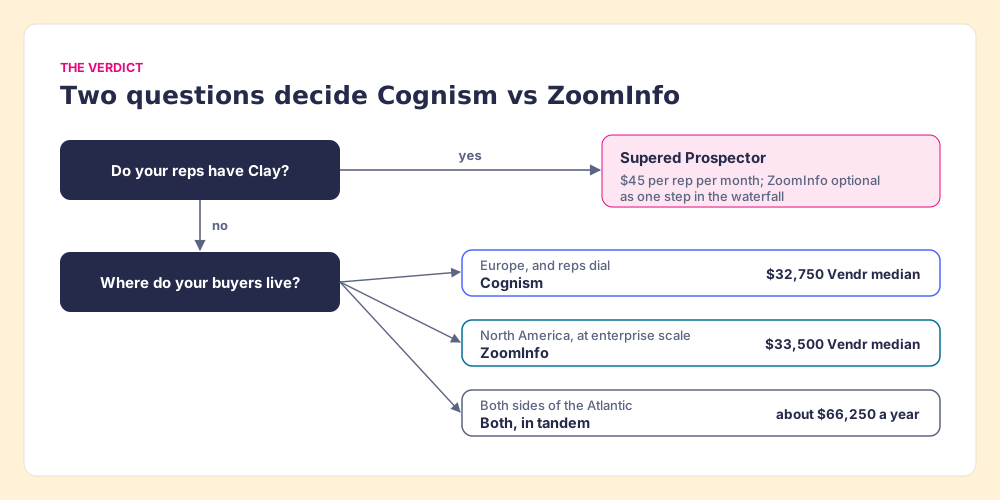
On a zoominfo vs cognism shortlist, the branch comes before the score. If your problem is phone-first outbound into Europe, Cognism is the best pick. If your problem is enterprise depth across North America, ZoomInfo is the best pick. If your reps already have Clay, the best pick is the waterfall in their hands, and the cognism or zoominfo question shrinks to whether either deserves to be one step in it.
- Cognism, the European specialist. Choose it if your buyers are mostly in the UK and Europe and your reps dial: phone-verified mobiles, Do Not Call screening against 15 lists, the top G2 Score in Europe (88 on 759 reviews). Budget near the $32,750 median with a five-seat floor, and bring a ZoomInfo quote to the table.
- ZoomInfo, the North American enterprise database. Choose it if your buyers are mostly in North America and you are the $100,000-plus customer its filings describe: 500 million contacts, a Forrester Leader, intent and agents on one roadmap. Budget near the $33,500 median, size the credits before the seats, sign at quarter-end, and cap the escalator.
- Both, in tandem. A real pattern in Vendr’s buyer notes, for teams selling hard on both sides of the Atlantic. Two medians come to about $66,250 a year, and each contract is the other’s best discount.
- Prospector on Clay, the atlas. Choose it if your reps already have Clay. Coverage becomes Clay’s waterfall across 200+ providers, your ZoomInfo account can be one step in it, reps work from Sales Navigator, the company site, and the CRM record with no Clay login, and you see which lists turn into pipeline: $11,340 a year with Clay Growth for 10 reps, $16,740 for 20.
A map is only as good as the streets it was drawn on, and both of these were drawn with care. Test them on yours before you sign. If one of them wins clearly in your regions, buy it and negotiate with the other’s quote in hand. If the answer comes back split, the choice is no longer between two maps. For the next comparison in this set, Cognism vs Apollo weighs Cognism against the self-serve option, and Apollo vs ZoomInfo does the same for ZoomInfo.
Frequently asked questions
Is Cognism or ZoomInfo better?+
How much does Cognism cost compared with ZoomInfo?+
Is Cognism's data better than ZoomInfo's in Europe?+
What changed at ZoomInfo in 2026?+
Can I use Cognism or ZoomInfo inside Clay?+
Do I need Cognism or ZoomInfo if I already have Clay?+
Your process, running itself.