ZoomInfo vs Clearbit in 2026: The Restaurant That Moved Into the Hotel
You cannot buy Clearbit anymore; you can buy HubSpot, and Clearbit comes with it.
ZoomInfo vs Clearbit compared job by job from pages opened October 2, 2026, including the July week HubSpot picked ZoomInfo to find contacts for its own agent.
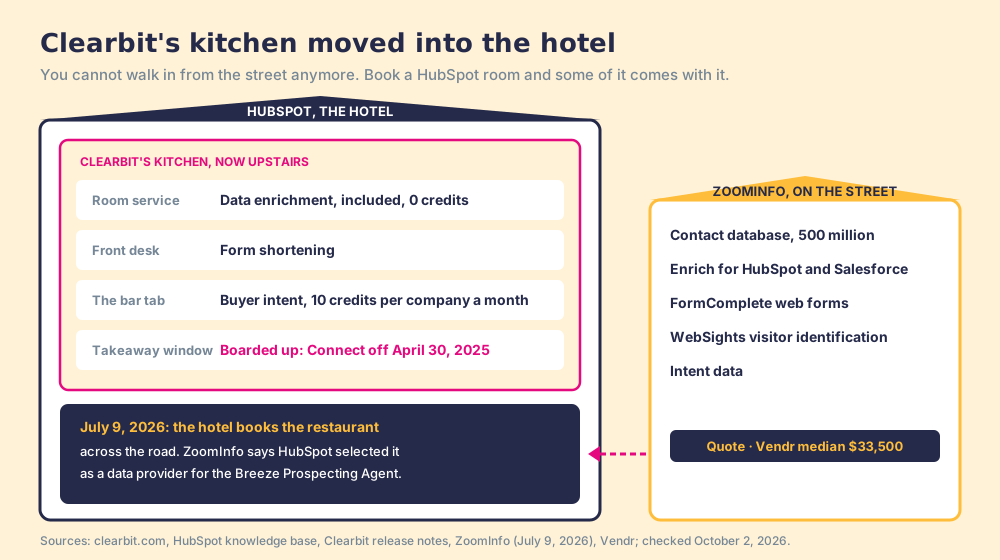
ZoomInfo vs Clearbit in 2026 compares ZoomInfo, an independent quote-only B2B database, with Clearbit, which HubSpot bought in 2023 and now runs only inside HubSpot as data enrichment, form shortening and buyer intent, without the email finder it once sold.
ZoomInfo vs Clearbit in 2026 compares ZoomInfo, an independent quote-only B2B database, with Clearbit, which HubSpot bought in 2023 and now runs only inside HubSpot as data enrichment, form shortening and buyer intent, without the email finder it once sold. The short answer, by who it fits:
- Supered Prospector, for HubSpot or Salesforce teams that already have Clay. HubSpot’s free enrichment for the fields, Clay’s waterfall across 200+ providers for the email and phone, run from the page the rep is on. $45 per rep per month, billed annually.
- HubSpot data enrichment, the Clearbit you can still get. For HubSpot teams that only ever used Clearbit to fill company fields, shorten forms and reveal visitors. No extra cost for enrichment from Starter.
- ZoomInfo, for teams buying a contact database in one contract. Emails, direct dials, intent and visitor identification, sold by quote at a Vendr median of $33,500 a year.
A restaurant used to stand on the corner of a busy street. Anyone could walk in, the menu was in the window, and the takeaway counter gave out free samples. Then the grand hotel across the road bought it, and the kitchen moved inside. The food is still good, and for hotel guests some of it now comes with the room. But the street door is locked, the takeaway window is boarded up, and if you want a meal you have to book a room first. Clearbit is the restaurant, HubSpot is the hotel, and ZoomInfo is the other big restaurant still trading on the street. The odd twist came in July 2026, when the hotel, with its own kitchen upstairs, hired the restaurant across the road to cook one dish.
What happened to Clearbit, and can you still buy it?
You cannot buy Clearbit on its own. You can buy HubSpot, and parts of Clearbit come with it. The sequence, from the sources:
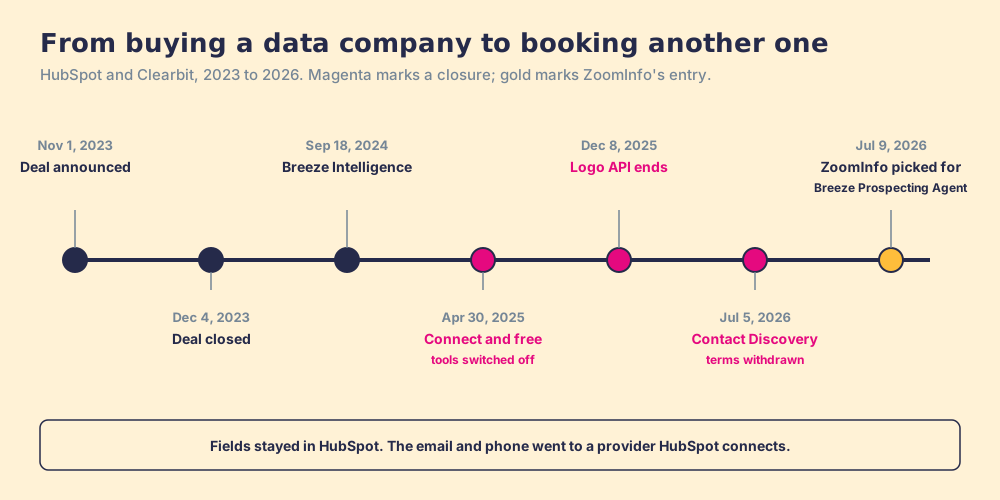
- The purchase. HubSpot announced the deal on November 1, 2023, citing Clearbit’s data on “more than 20M companies and 500M decision makers” from “250+ public and private data sources,” and closed it on December 4, 2023 (HubSpot).
- The rename. On September 18, 2024 HubSpot launched Breeze Intelligence, data enrichment, buyer intent and form shortening “powered by a dataset of over 200 million company and buyer profiles.” By 2026 HubSpot’s own knowledge base calls it plain data enrichment, and its product catalog names neither Clearbit nor Breeze Intelligence.
- The closures. On April 30, 2025 Clearbit switched off its free platform, the Weekly Visitor Report, the TAM Calculator and Clearbit Connect, the extension that found a person’s email. The public Logo API followed on December 8, 2025 (Clearbit release notes).
- The storefront today. clearbit.com, opened October 2, 2026, reads “Clearbit has joined HubSpot!” above a customer login, and /pricing redirects to the homepage. A Clearbit staffer wrote in HubSpot’s community that existing API customers are still supported.
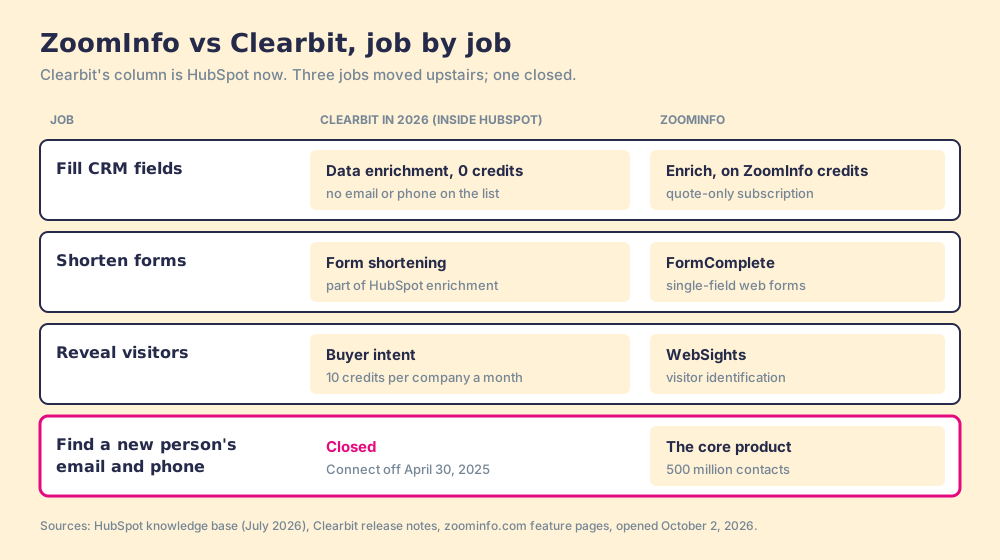
So the search for zoominfo vs clearbit is now a comparison between a company and a set of features inside another company. The fair way to run it is job by job, because Clearbit used to do four jobs and only some of them survived the move.
ZoomInfo vs Clearbit, job by job
What each job costs, and where it lives in October 2026, follows. The Clearbit column is HubSpot, because that is where the kitchen went.
| Job | Clearbit in 2026 (inside HubSpot) | ZoomInfo |
|---|---|---|
| Fill company and contact fields on CRM records | HubSpot data enrichment, Starter and up, no credits; contact fields like title, seniority and LinkedIn URL, but no email or phone | ZoomInfo Enrich for HubSpot and its Salesforce native app, on credits under a ZoomInfo subscription |
| Shorten forms | HubSpot form shortening, showing “only … the fields that can’t be enriched” | FormComplete, “single-field, data-enriched web forms” |
| Reveal website visitors | HubSpot buyer intent, 10 HubSpot Credits per tracked company a month | WebSights website visitor identification |
| Find a new person’s email and phone | Gone: Connect switched off April 30, 2025; no native replacement priced | The core product: 500 million contacts, Chrome extension, one credit per export |
| Salesforce | Legacy AgentExchange listing returns 404 | Salesforce Native Application, 4.6 from 348 reviews, $120 per user per year |
Read down the columns and the shape is plain. On the first three jobs, a HubSpot customer already owns Clearbit’s successor, and ZoomInfo’s version is a paid duplicate. On the fourth job, Clearbit has left the building, and ZoomInfo is one of the restaurants still cooking. The HubSpot enrichment list, last updated July 20, 2026, covers contact first name, last name, job title, seniority, role and LinkedIn URL, and for companies everything from revenue range to web technologies, with no contact email or phone anywhere on it (HubSpot knowledge base).
How do ZoomInfo and Clearbit grade for a ten to fifty rep team?
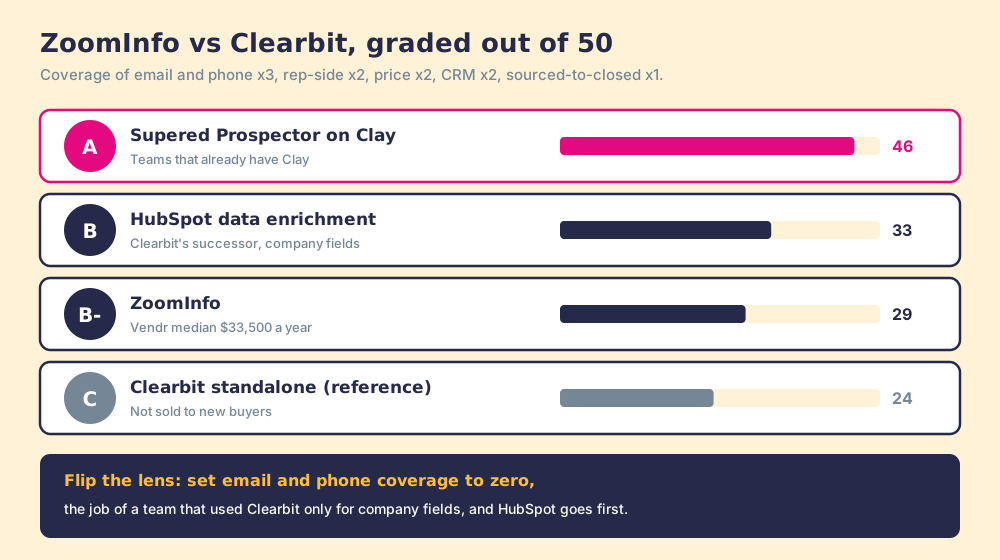
The grades reuse the weights from the Clearbit alternatives page so the two pages agree: coverage of the email and phone you need (x3), delivery where the rep works (x2), price for a ten to fifty rep team (x2), CRM fit (x2), and whether the manager sees which sourced contacts were worked and closed (x1). Bands: A 42 and up, B 32 to 34, B- 29 to 31, C 20 to 24.
| Rank | Option | Grade (score of 50) | Best fit | CRM integration | Setup effort | Pricing (plan with the job) | Reason to switch |
|---|---|---|---|---|---|---|---|
| 1 | Supered Prospector on Clay | A (46) | HubSpot, Salesforce or Pipedrive teams that already have Clay | Native HubSpot, Salesforce and Pipedrive; one-click push | RevOps connects Clay once; reps need no Clay login | $45 per rep per month, billed annually, plus your Clay plan | Emails and phones from Clay’s waterfall across 200+ providers, run from the page the rep is on |
| 2 | HubSpot data enrichment | B (33) | HubSpot teams that used Clearbit for company fields | Native to HubSpot only | A setting inside HubSpot | No credits from Starter; buyer intent 10 credits per company a month | Clearbit’s enrichment, already in the CRM you pay for |
| 3 | ZoomInfo | B- (29) | Teams buying a contact database, intent and visitor reveal in one contract | Native HubSpot and Salesforce | Sales-led quote and admin setup | Quote only; Vendr median $33,500 a year | The deepest single database, with emails and direct dials |
| Ref | Clearbit standalone | C (24) | Existing API customers only | Legacy | Not sold to new buyers | No price list | None for a new buyer |
| Tool | Coverage (x3) | Rep-side (x2) | Price (x2) | CRM (x2) | Sourced-to-closed (x1) | Total |
|---|---|---|---|---|---|---|
| Supered Prospector on Clay | 5 | 5 | 4 | 4 | 5 | 46 |
| HubSpot data enrichment | 1 | 4 | 5 | 5 | 2 | 33 |
| ZoomInfo | 4 | 3 | 1 | 4 | 1 | 29 |
| Clearbit today (reference) | 3 | 1 | 2 | 4 | 1 | 24 |
The weights decide the order, so flip them. A HubSpot team that only ever used Clearbit to fill company fields does not need emails or phones from it; drop coverage to zero and HubSpot data enrichment goes first, the lane where it earns its A. ZoomInfo scores 1 on price because a $33,500 median is a large number for a ten-rep team, and 1 on the last column because its meter stops at the export.
Why trust this comparison?
I started RevPartners, a HubSpot partner that did only sales implementations, sold roughly twice as much Sales Hub as any other partner, and reached Elite tier in 13 months. Supered grew out of that work and is the #1 sales enablement app on the HubSpot marketplace, with 6,000+ installs and 5.0 out of 5 from 122 reviews there, and 4.9 out of 5 from 81 reviews on G2 (both checked October 1, 2026). I have watched enrichment tools get bought, renewed and dropped from inside the CRM where their fields land.
The disclosure: we sell Prospector, which runs on Clay and has no database of its own, and Supered lives inside HubSpot. I have a reason to like HubSpot’s enrichment and a reason to steer you to Clay. The weights are printed so you can change them, and the first flip above favors HubSpot’s free enrichment over our own product, because for that job it is the better buy.
Is Clearbit’s data better than ZoomInfo’s?
On G2, yes, and the score describes a restaurant that has stopped taking new bookings. The head-to-head page, opened October 2, 2026, gives Clearbit 4.4 out of 5 from 632 reviews and ZoomInfo’s GTM Workspace 4.5 from 9,170 (G2):
| G2 score (of 10) | Clearbit | ZoomInfo |
|---|---|---|
| Contact data accuracy | 8.2 | 7.7 |
| Company data accuracy | 8.3 | 8.1 |
| Ease of use | 9.1 | 8.8 |
| Quality of support | 8.5 | 8.7 |
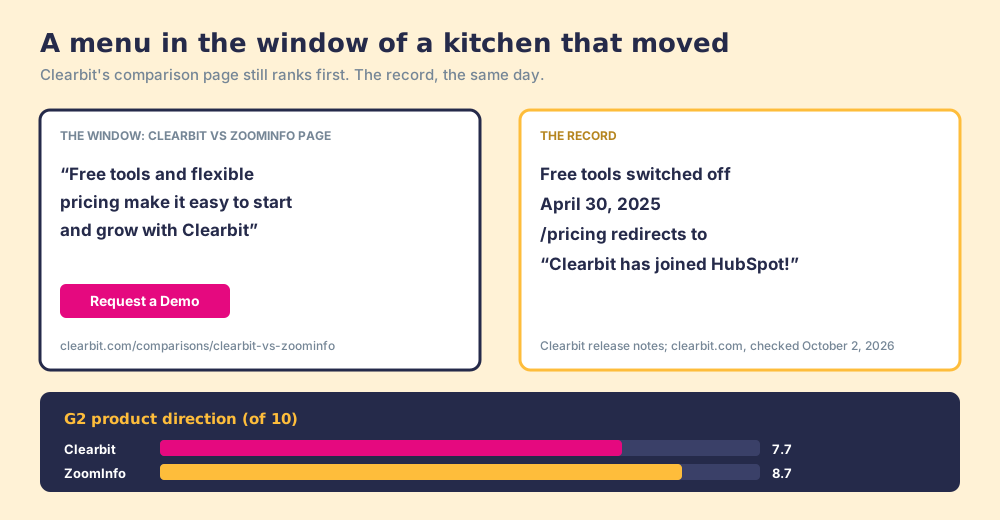
| Product direction | 7.7 | 8.7 |
Clearbit wins accuracy and ease of use. ZoomInfo wins product direction by a full point, the widest gap on the page, and reviewers are right about it. Most Clearbit reviews describe the product before HubSpot folded it in; the five newest on G2 run from January to April 2026, and Clearbit’s release notes show no feature work since August 2024, only sunsets. Clearbit’s reviewers also skew small: 49.9% small business, against ZoomInfo’s 48.2% mid-market. The review sites themselves have moved the furniture. Capterra’s Clearbit page now carries the title “HubSpot Agent Hub,” and TrustRadius files it under “Breeze Intelligence for Hubspot.” The full venue-by-venue reading is in the Clearbit review, and ZoomInfo’s split between happy users and unhappy contract holders is in the ZoomInfo review.
The accuracy scores still teach something. Clearbit was strongest on company data, and that is the half HubSpot kept, now free on Starter. ZoomInfo’s weakest score is contact data accuracy, and a mid-market reviewer in August 2026 wrote that “Contact information can also occasionally be outdated or incomplete, which means I still need to verify some data before starting an outbound sequence.” Neither a 7.7 nor an 8.2 replaces a test on your own won deals.
Whose comparison page should you believe?
The page ranking first for this search is Clearbit’s own, and it was written for a restaurant that no longer exists. Clearbit’s “Clearbit vs ZoomInfo MarketingOS” page, which ranked #1 in Ahrefs’ US snapshot and still loads on October 2, 2026, promises that “Free tools and flexible pricing make it easy to start and grow with Clearbit” and offers a “Request a Demo” form (clearbit.com). The free tools were switched off on April 30, 2025, and the pricing page now redirects to a homepage announcing that Clearbit has joined HubSpot.
The same page holds one line that has aged well. Asked whether customers use both, Clearbit answered: “ZoomInfo is known for its phone numbers and contact data, while Clearbit’s company data and IP intelligence are best-in-class. Customers use both when they want to supplement their demand generation and/or outbound strategies with complementary data.” In 2023 that was a sales line. In 2026 it describes HubSpot’s own architecture.
Why did HubSpot pick ZoomInfo to find contacts?
Because the takeaway window is still shut, and HubSpot tried and stepped back from opening its own. On July 1, 2026 HubSpot announced Contact Discovery, a way to “find, verify, and add net-new contacts without ever leaving HubSpot,” with new terms of service attached. Four days later its chief product and technology officer, Duncan Lennox, posted “We Got This Wrong. And We Are Fixing It,” and wrote: “We will not move forward with the terms of service changes we communicated on July 1, 2026” (PPC Land, July 6, 2026). We found no published field list or credit cost for Contact Discovery as of October 2.
On July 9, 2026, ZoomInfo’s chief marketing officer wrote that “ZoomInfo was selected as a third-party data provider for HubSpot’s Breeze Prospecting Agent, now in public beta,” activated when a customer chooses to “connect ZoomInfo in HubSpot” (ZoomInfo). The hotel that bought Clearbit for its data went across the road for the one dish Clearbit never fully cooked: a new person’s phone number.
For a HubSpot customer, that settles the shape of the stack. Company fields, form shortening and visitor reveal come from HubSpot. The email and phone come from somebody else, and you choose who. ZoomInfo is one choice; HubSpot has made it easier to connect. It is not the only one. For a Salesforce customer, Clearbit’s route is closed altogether: its legacy AgentExchange listing returns a 404, while ZoomInfo’s Salesforce Native Application holds 4.6 from 348 reviews at $120 per user per year. The Salesforce side is covered in the Clearbit Salesforce integration page.
What does each option cost a ten-rep team?
Put the jobs on one bill and the numbers separate fast.
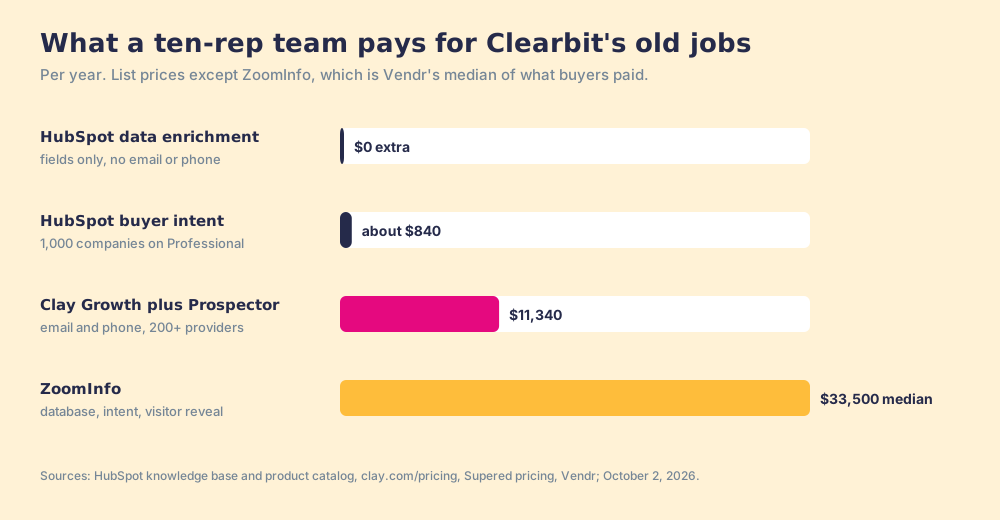
- HubSpot data enrichment. $0 extra on any Starter, Professional or Enterprise hub; HubSpot’s knowledge base, updated July 10, 2026, says “Data enrichment does not consume HubSpot Credits.” No email or phone.
- HubSpot buyer intent. 10 credits per tracked company a month. Sales Hub Professional includes 3,000 credits a month, so tracking 1,000 companies uses 10,000, and the 7,000 beyond the allowance cost $70 a month at $0.010 each, $840 a year. Unused credits do not roll over.
- ZoomInfo. Quote only. Vendr’s median buyer pays $33,500 a year across 1,574 purchases, range $7,220 to $155,730, with 22% average savings off the first quote (Vendr). The negotiation levers are on the ZoomInfo pricing page.
- Clay plus Supered Prospector. Clay Growth at its $495 monthly rate is $5,940 a year, and ten Prospector seats are $5,400, so $11,340 a year, about a third of ZoomInfo’s median.
Where does Supered Prospector fit?
For a team that has Clay, at the job Clearbit left behind. Prospector does not bring its own database. It brings Clay’s waterfall, which is every database, routed. We chose Clay as our only data provider for that reason.
Clay’s homepage puts it as “One contract to buy data from 200+ data and AI vendors,” and its waterfalls “check multiple providers to return the most verified emails (lower bounce rate) and phone numbers (higher connect rate)” (clay.com). A miss costs nothing: “If an enrichment returns no result, you’re not charged Data Credits or Actions” (clay.com/pricing). ZoomInfo sits in that marketplace as a bring-your-own-account step that joined January 15, 2025, and Clay still lists a Clearbit integration, though we did not test which of its actions still return data after HubSpot’s sunsets. The wider comparison of HubSpot’s meters and Clay’s is on Clay vs HubSpot.
The tables live with the GTM engineer, and the rep lives in LinkedIn and HubSpot. Prospector puts the power of the GTM engineer in the rep’s hands. Clay governs the data. Supered governs the motion.
- A start from wherever the rep is. A LinkedIn profile, a Sales Navigator list, a company website with company research on the page, or a HubSpot, Salesforce or Pipedrive record. One click runs the Clay table your Ops team built.
- HubSpot’s fields plus Clay’s numbers. HubSpot enrichment fills the title and the company; the Clay waterfall fills the email and phone that HubSpot’s list leaves blank.
- A CRM check before the add. The rep sees the matching record, who owns it, and whether the prospect was already worked.
- The list, found, worked and closed. Supered applies your process to the prospects reps work. The manager sees who is working their list, and each lead ends the way your process says: Qualified, Recycled, or Disqualified.
On LinkedIn specifically: Prospector works within LinkedIn’s terms and does not copy search results in bulk; the contact data comes from Clay’s waterfall on the customer’s Clay account. Prospector runs inside the Supered Chrome extension, from one rep, at $45 per rep per month, billed annually (Prospector). More on rep-built lists is on the sourcing use case.
Choose something else if any of these is true:
- Company fields only. If Clearbit was your form shortener and firmographic filler, HubSpot’s built-in enrichment does that job for no extra cost. Read HubSpot data enrichment and stop there.
- No Clay, and no plan to buy it. Prospector runs only on Clay. Pick ZoomInfo or a single-database tool from the Clearbit alternatives page.
- Intent and visitor reveal in the same contract as contacts. ZoomInfo sells all three; Prospector sells none of them.
Clearbit vs ZoomInfo: which should you choose?
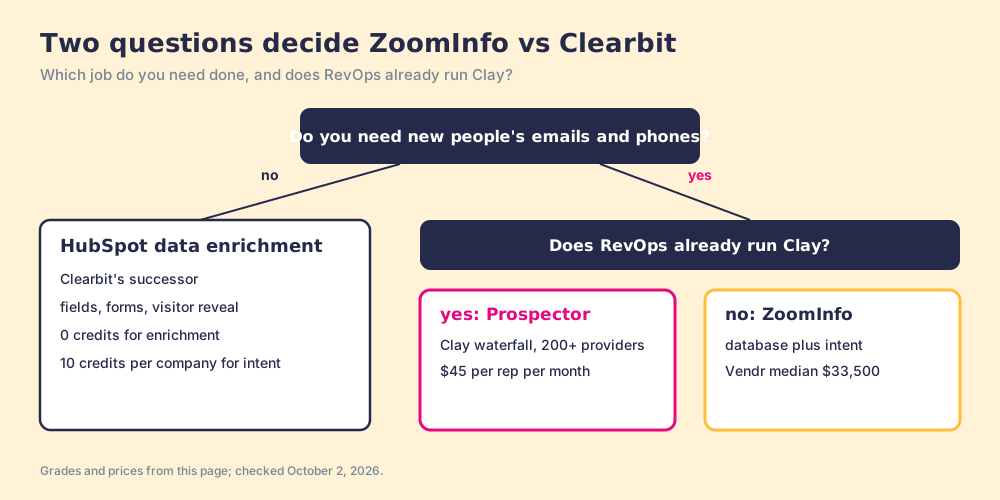
The branch comes before the score. If your problem is filling company fields, shortening forms and spotting visitors in HubSpot, Clearbit’s successor is the best pick, and you already own it. If your problem is a deep contact database with emails, direct dials and intent in one contract, ZoomInfo is the best pick. If your team has Clay, the best pick for the phone number is Clay’s waterfall in the rep’s hands, and the clearbit vs zoominfo question shrinks to whether ZoomInfo earns a step in it.
- HubSpot data enrichment, the restaurant inside the hotel. Choose it if you are on HubSpot and used Clearbit for fields, forms and visitor reveal. Turn on enrichment from Starter at no credit cost, budget 10 credits per tracked company a month for buyer intent, and do not pay ZoomInfo to fill the same fields.
- ZoomInfo, the restaurant on the street. Choose it for a team that wants the contact database, intent and WebSights from one vendor, or a Salesforce team that wants a native enrichment app. Budget near the $33,500 median, cap the renewal escalator, and turn off the overlapping HubSpot features you are not using.
- Prospector on Clay, for the dish the hotel stopped cooking. Choose it if RevOps runs Clay: HubSpot fills the fields for free, Clay’s waterfall across 200+ providers fills the email and phone, ZoomInfo can be one step on your own account, and reps work from LinkedIn, Sales Navigator, the company site and the CRM record: $11,340 a year with Clay Growth for ten reps.
If you came looking for Clearbit, you will find it upstairs in HubSpot, serving the fields it always served, at a better price than it ever charged. If you came for the email and phone, Clearbit is not in that race anymore, and the choice is between one database on a quote and a waterfall across many. The next pages in this set cover the rest of the kitchen: the Clearbit Chrome extension explains what replaced Connect in Gmail, and ZoomInfo competitors grades the databases ZoomInfo sells against.
Frequently asked questions
Can you still buy Clearbit?+
Is ZoomInfo better than Clearbit?+
What replaced Clearbit for finding emails and phone numbers?+
How much does ZoomInfo cost compared with Clearbit?+
Does ZoomInfo or Clearbit work with Salesforce?+
Do I need ZoomInfo if I have HubSpot and Clay?+
Everything we have written on ZoomInfo
More on ZoomInfo
Supered Prospector vs ZoomInfo: the side-by-side- ZoomInfo Competitors in 2026: The Database Was Never the Purchase
- ZoomInfo Pricing in 2026: The Standing Charge, the Meter, and What Neither Can See
- ZoomInfo Reviews 2026: The Equipment Scores 4.5, the Membership Scores 1.8
- ZoomInfo Chrome Extension in 2026: A Free Key Card to a $33,500 Room
- ZoomInfo HubSpot Integration (2026): Setup, Plans, Limits, and What It Reads Back
- ZoomInfo Salesforce Integration in 2026: A Loading Dock With Two Doors
Everything we have written on Clearbit
More on Clearbit
Looking past Clearbit? See Supered Prospector on your own Clay account- Clearbit Alternatives in 2026: HubSpot Kept Two Blades of the Pocketknife
- Clearbit Pricing in 2026: The Meter Moved Into HubSpot, and Half of It Was Switched Off
- Clearbit Review 2026: A 4.4-Star Product You Can No Longer Buy
- The Clearbit Chrome Extension in 2026: The Switch Is Still on the Wall, the Light Is Gone
- Clearbit Salesforce Integration (2026): Two Pipes Still in the Wall, No Parts on the Shelf
Your Clay waterfall, where reps already work.