The Sales Playbook Guide: Build a Sales Process Reps Run
A sales playbook is knowledge, and knowledge was never the gap.
The four forces that turn a written playbook into behavior reps run, the science behind each, and how to build, deliver, inspect, and reinforce one that holds.
A sales playbook is the sales process a team is expected to run, its stages marked by verifiable buyer commitments, the plays written for the moments inside them, and the inspection that keeps both honest. It counts only when reps run it on a real deal, not when it sits in a document.
Consider the surgeon. By the time someone is cutting into a chest, they have spent more than a decade learning what to do, and they are not the sort of professional who forgets the steps. Yet in 2008 a team led by Atul Gawande gave eight hospitals in eight cities a short paper checklist of things everyone in the room already knew, and watched what happened. In the study of 7,688 operations published in the New England Journal of Medicine (Haynes et al., 2009), major complications fell from 11.0 percent to 7.0 percent, and inpatient deaths fell from 1.5 percent to 0.8 percent, a drop of more than 40 percent. Nobody learned new medicine. The knowledge was already in the room. What changed was that the known thing now reliably happened.
Gawande named the problem precisely in "The Checklist Manifesto," and the sentence transfers to sales without changing a word: "the volume and complexity of what we know has exceeded our individual ability to deliver its benefits correctly, safely, or reliably. Knowledge has both saved us and burdened us." He drew the distinction the field of sales enablement keeps missing. There is failure from ignorance, not knowing the right thing to do, and there is a second kind, which he calls ineptitude, where, in his words, the knowledge exists and we fail to apply it correctly. Sales does not have an ignorance problem. The right moves are written down in a hundred books and a thousand playbooks. Sales has an application problem, and it has had one for a long time.
The case that proves the point is older than the surgical study, and it is the one Gawande built the book around. In 2001 a critical-care specialist at Johns Hopkins named Peter Pronovost wrote down the five steps doctors already knew for inserting a central line without infecting the patient: wash hands, clean the skin with antiseptic, drape the patient, wear a sterile mask and gown, and dress the site. Nothing on the list was new. All five had been taught for years. Then Pronovost asked the nurses to watch the doctors for a month and record how often each step was done. The finding is the entire argument of this guide in one sentence: in more than a third of patients, the doctors skipped at least one step. Not because they had forgotten it. Because, in Gawande's own words, "people can lull themselves into skipping steps even when they remember them." When the unit then required the checklist and empowered nurses to stop any doctor who missed a step, the ten-day line-infection rate fell from 11 percent to zero. Rolled across Michigan as the Keystone ICU project and published in the New England Journal of Medicine in 2006 (Pronovost et al.), the median infection rate dropped from 2.7 per 1,000 catheter-days to zero within three months, and the program was credited with preventing more than 1,500 deaths. Same doctors, same knowledge, a different result, produced entirely by a system that made the known step reliably happen and visible when it did not.
Hold that phrase, because it is the whole problem in a sales seat: people lull themselves into skipping steps they remember. Your reps remember to confirm the economic buyer. They remember to establish the cost of the problem before they demo. They remember not to quote a price before value is set. They skip these anyway, under pressure, in the moment, exactly as a trained surgeon skips the antiseptic, and for the same reason, which is not ignorance and not laziness but the ordinary physics of a busy human carrying a goal they cannot retrieve at the second it applies.
A sales playbook is the same story wearing a different coat. We surveyed 198 sales leaders for The State of Sales Enablement: 89 percent had a defined sales process, and 36 percent saw their reps follow it. That 53-point gap was the largest single performance variable in the study, ahead of territory, comp, and methodology. The reps were not missing the knowledge. They had the playbook. They were missing the thing the surgeons got, the system that converts a known good move into a done one.
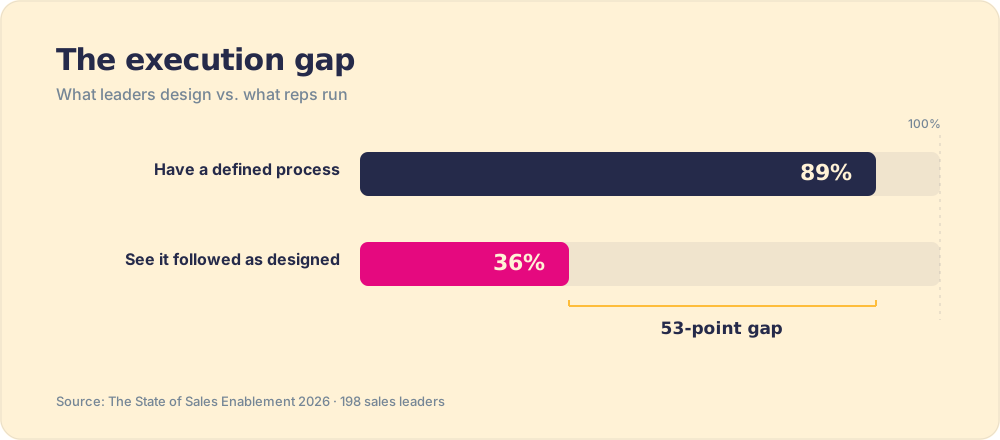
This is the reframe the guide rests on. The bottleneck in 2026 is not knowledge. Knowledge is solved, sitting in a document any rep or AI can pull in seconds. The bottleneck is conversion, the gap between what a rep knows and what a rep does when a buyer is live and the next move has four seconds to arrive. Most playbook advice answers the wrong job. It tells you how to write a better document, when the document was never where the loss occurred. So before the how-to, the history, and the why.
Where did the sales playbook come from?
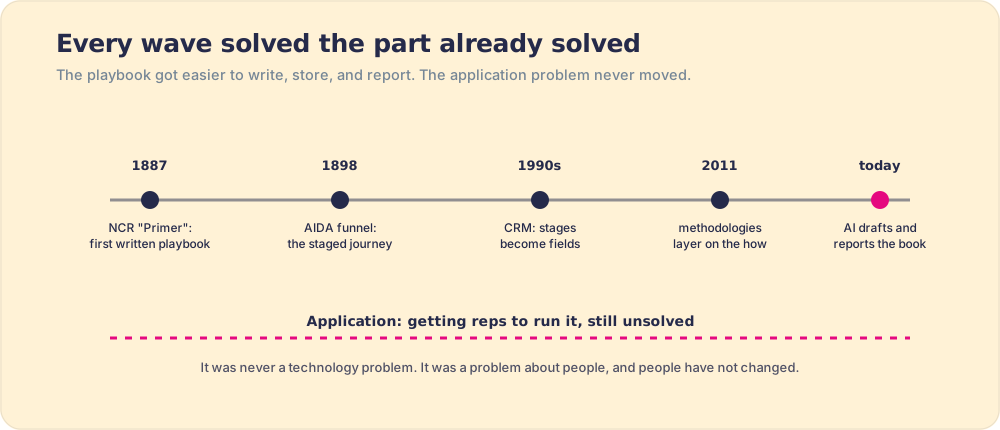
The idea is older than the automobile, and knowing its history tells you which part of the problem was solved long ago and which part you are still paying for. In 1884 John Henry Patterson bought control of a failing maker of cash registers, renamed it the National Cash Register Company, and confronted the same complaint every sales leader still files: his salesmen were not selling, no two of them sold the same way, and each blamed the territory. Patterson did something radical for the era. He found the agents who did sell, wrote down what they said and did, printed it as a manual called "The Primer" in 1887, and required every salesman to learn it. That manual is the first sales playbook, and Patterson's conviction behind it, that "good salesmen are made, not born," is the founding argument for the whole discipline. A written, shared motion let the best rep's method become the floor under everyone else.
The other parent of the modern playbook arrived a decade later: the idea of stages. The funnel is usually traced to Elias St. Elmo Lewis around 1898, whose attention-interest-desire-action sequence became the AIDA model every framework since has rephrased. Put Patterson's written motion together with Lewis's staged journey and you have the playbook in embryo: a shared, documented sequence of stages with prescribed moves inside each. For most of the twentieth century it lived on paper, reinforced by training programs like Xerox's Professional Selling Skills in the 1970s. Then customer relationship management software arrived in the 1990s and 2000s, and the stages stopped being a poster on the wall and became fields in a database. Most recently the methodology era layered on top: Neil Rackham's SPIN Selling in 1988 brought the first large body of evidence to how reps should work inside the stages, MEDDIC came off PTC's sales floor in the same decade, and Challenger arrived in 2011.
Read that arc and one thing is doing all the moving. Through every wave, the funnel, the CRM, the methodologies, the playbook got easier to write, store, search, and report. And through every wave the other half stood still. Patterson's salesmen who needed a manual to sell consistently in 1887 are the ancestors of the 64 percent of teams in 2026 whose documented process goes unfollowed. The technology kept solving the part that was already solved. The application problem, the one Gawande named, never moved, because it was never a technology problem. It was a problem about people, and people have not changed.
Why does the written sales playbook not get run?
Because behavior is not produced by information. We would all like it to be. It would make training simple and managers redundant. But the evidence runs the other way, and it runs that way everywhere, not only in sales. Surgeons with a decade of training needed a checklist. Pilots, the other profession we trust with our lives, do not fly from memory either; they read the list aloud, every time, because the cost of assuming the known thing will happen is too high.
There is a second reason, less obvious, and Gawande caught it. We resist the one tool that would close the gap, because using it wounds our self-image as experts. "It somehow feels beneath us to use a checklist, an embarrassment," he wrote. "It runs counter to deeply held beliefs about how the truly great among us, those we aspire to be, handle situations of high stakes and complexity. The truly great are daring. They improvise." A senior rep feels the same way about a playbook prompt. The veteran who has closed for fifteen years experiences a nudge to confirm the economic buyer as an insult to the craft, and skips it, and loses the deal to a no-decision that the prompt would have caught. The resistance is not laziness. It is pride, and pride is harder to design around than forgetfulness.
The deeper reason, though, is structural, and it has a name in the research. A written playbook is a description of good selling: "qualify thoroughly," "establish economic impact before the demo," "confirm a mutual action plan." Those are goals, and your reps already hold them. Nobody opens a deal hoping to qualify badly. A goal sitting in a document, though, has to survive a long and hostile journey before it becomes an action: the rep has to remember it exists, find it among forty other goals, recall it at the exact moment it applies, and choose it over the easier habit already running. A document helps with none of those steps. It only stores the goal.
Two forces in the rep work against the new motion the whole time. The first is inertia. Daniel Kahneman and Amos Tversky established that people weigh a potential loss about twice as heavily as an equivalent gain, and William Samuelson and Richard Zeckhauser named the consequence the status-quo bias in their 1988 study of the same name: faced with a change, people disproportionately default to doing nothing. To the rep, the documented new play is a felt loss of the comfortable old habit, so the old one wins even when the rep agrees the new one is better. The second force is the one Gawande caught above, the expert's reluctance to be seen following a script. Put inertia and pride together and you have a rep who knows the right move, holds it as a goal, and still does not make it, not from any failure of character but from a predictable property of how humans behave under load. The journey from a known goal to a done action is the real work, and four forces carry it. A playbook that supplies the knowledge and skips the four forces is a binder on a shelf, which is what most of them are.
What turns a written playbook into behavior reps run?
Four forces convert knowledge into a repeated behavior. They are not Supered features; they are how human behavior change is known to work, drawn from choice science, social psychology, and habit research. Name them with verbs, because each is something done to the playbook, not a property it has: Expect, Equip, Measure, Reinforce. Run all four and a document becomes a motion. Skip any one and the motion leaks back into old habit. "Put the playbook in the flow of work" is the second of the four. Necessary. Nowhere near sufficient.
Curate: the few plays, not the binder
The first force is subtraction. A playbook that lists everything a great rep might do has, in practice, told the rep to do nothing, because a person under pressure cannot choose from forty options in the moment a buyer goes silent. This is not a motivation problem; it is a known property of attention. Columbia's Sheena Iyengar and Stanford's Mark Lepper ran the experiment that named it, published in 2000 under a title that says the finding out loud, "When Choice is Demotivating: Can One Desire Too Much of a Good Thing?" They set a tasting booth in an upscale grocery and rotated between two displays, one of 24 jams and one of 6. The big display pulled a bigger crowd, as you would expect, more people stopped to look. But of the shoppers who stopped and tasted, 30 percent of those at the six-jam table went on to buy a jar, against 3 percent at the twenty-four-jam table. The larger assortment drew the eye and froze the hand. More choice, less action, and Iyengar and Lepper found a second effect that matters even more for a playbook: the people who chose from the smaller set reported greater satisfaction with what they picked, because they were not haunted by the options they had passed over.
George Miller's 1956 paper supplies the ceiling underneath the jam table. Its title is one of the most cited lines in psychology, "The Magical Number Seven, Plus or Minus Two," and its claim is that the number of distinct chunks a person can hold in immediate attention at once is small, around seven, give or take. A forty-play binder asks the rep to do something the architecture of human attention does not permit: hold the whole menu in mind and select the right item while a live buyer waits. The rep cannot, so the rep defaults, and the default is the habit already running, not the play on page nine. The binder is the twenty-four-jam table, and reps walk past it for the same reason shoppers did, not because they do not care but because the display itself defeats the act of choosing.
So the first job is to cut. Per stage, name the two or three plays that move the buyer, tied to a single clear expectation, and let the rest live in a reference nobody has to consult to do the job. Picture a discovery stage as most playbooks write it: a page with fourteen recommended discovery questions, a note on building rapport, a reminder to research the account, a framework for uncovering pain, a section on multi-threading, and a paragraph on qualifying budget. All of it is true. None of it is a play, because a play is the one or two moves that, if the rep does them, the buyer measurably advances, and if the rep skips them, the deal stalls no matter how well everything else went. For most discovery stages that move is singular: get the buyer to name, in their own words, the cost of leaving the problem unsolved. Cut the page of fourteen to that one play plus a backup, and you have replaced the twenty-four-jam table with the six. The rest is not deleted; it moves to a reference the rep can open when they want it and is never required to consult to do the job. Curation is what produces clarity, and clarity is what a rep can run under pressure.
Equip: the play at the trigger
The second force is timing. A curated play still does nothing if it arrives at the wrong moment, which for a document is always, because the rep has to leave the deal and go fetch it. What converts a goal into an action is a cue welded to a situation. Peter Gollwitzer named it the implementation intention: not "I will handle pricing objections well," but "if the buyer flinches at price, then I ask what the cost of doing nothing is." Gollwitzer and Paschal Sheeran's meta-analysis of 94 independent studies found this if-then form produced a medium-to-large lift in follow-through, an effect size of d=0.65, across goals from dieting to keeping appointments. BJ Fogg's behavior model puts the same truth in three letters: behavior fires when Motivation, Ability, and a Prompt land together (B=MAP). Reps have the motivation and the ability. The prompt is the part a shelved document cannot deliver and the moment of work can.
The reason the if-then form beats the goal is the mechanism the entire force rests on. A goal ("qualify thoroughly") leaves the hardest cognitive work, noticing that this moment is a qualifying moment and selecting the right response, to be done in real time, under load, while a buyer is talking. An implementation intention does that work in advance and hands the rep a pre-decided response keyed to a cue. The rep no longer has to recognize and choose; they only have to notice the cue, and the chosen action fires almost on its own. Gollwitzer's term for the effect is "strategic automaticity": the behavior comes to feel as automatic as a habit, but it was installed deliberately rather than grooved by years of repetition. That is precisely what a sales team needs, a way to make a deliberate good move behave like an instinct without waiting the months instinct usually takes to form.
Watch it run on the second call, when a buyer who likes the product turns to "so what does this cost?" The goal version of the playbook says "establish value before discussing price," which is correct and useless, because in the half-second before the helpful reflex answers the question, the rep has to recall the goal, judge that it applies, and override the instinct to be agreeable, three acts of cognition that rarely complete in time. The if-then version pre-loads the response: if the buyer asks price before value is set, then I ask what another year of the unsolved problem costs them. There is nothing to recall or weigh. The cue appears and the response is already chosen. The play arrives welded to the situation rather than filed under a category the rep would have to go looking for.
This is also why the buyer's calendar makes timing non-negotiable. Gartner finds B2B buyers now spend only about 17 percent of the journey with all suppliers combined, and barely 5 to 6 percent with any one rep. The live moments are scarce and they arrive without warning, so the play has to be standing there when the moment opens, not waiting to be looked up after it closes. A play delivered five minutes after the call, however good, is a play that fired into an empty room.
Measure: make adherence visible
The third force is the one most playbooks never get, and it is the one a manager feels the absence of every quarter. You can only expect what you inspect. An expectation nobody can see the state of is a wish, and a play whose use is invisible cannot be coached, defended, or improved, because no one can say whether it happened. Visibility is not surveillance; it is the precondition for the word "expectation" to mean anything. When a manager can see, deal by deal, which plays ran and which were skipped, two things become possible that were impossible before: the rep gets credit for running the hard play, and the leak gets found while the deal is still alive. CSO Insights, now part of Korn Ferry, found teams with a dynamic, inspected process attain quota at a 37 percent higher rate than teams running an informal one. The lift comes from the looking, not from a cleverer diagram.
This is also the force that answers the obvious objection to the surgical-checklist analogy. A checklist is a document too, so why does it work where a playbook does not? Gawande is blunt about the limit: a checklist by itself changes nothing. "By themselves, however, checklists cannot make anyone follow them," he writes. What made Pronovost's checklist work was not the paper. It was the second decision, the one teams skip when they copy the idea: a nurse read the steps in the room, at the moment of the procedure, and was empowered to stop any doctor who missed one. The use of the list was visible to another person in real time, and the gap had a consequence the instant it opened, not at a review three weeks later. The checklist succeeded because it was curated, delivered at the trigger, and made visible, three of our four forces sitting on a card. A sales playbook fails when it is the paper without the reading-aloud, the knowledge without the visibility. Measurement is the reading-aloud.
See what visibility changes by removing it. A rep runs the discovery stage and, on a hard account, never gets the buyer to name the cost of the problem, because the buyer was friendly and the call felt good and the rep advanced the deal on a strong demo instead. With no visibility, that skip is invisible until the deal dies at proposal, weeks later, by which point the manager can only autopsy it. With visibility, the deal record shows the cost-of-inaction commitment never landed, the manager sees it the same week, and the coaching conversation happens while the deal is still alive and the buyer still reachable. The play that was skipped is the same in both stories. What differs is whether anyone could see the skip in time to do something about it, and that single difference is most of the distance between a process that improves and one that merely accumulates losses it never learns from.
Two cautions keep this force honest. Inspecting on activity alone produces a captain's log that records how hard the crew rowed and never which way the ship moved, so a stage has to reflect the buyer's real position, not only that a box was checked. And manual inspection eats the hours a manager should spend coaching, so the visibility has to be automatic, or it stops happening and the expectation dies with it.
Reinforce: streaks and the arc of a habit
The fourth force is time. A play run once is not a behavior; it is an event. Behavior is what survives the third week, after the kickoff energy is gone and the old habit is whispering that the shortcut is fine. Phillippa Lally's team at UCL tracked 96 people forming a new daily habit and found automaticity took on average 66 days, with a range from 18 to 254. Two details in that study matter more than the headline number. The first is the shape of the curve: automaticity rose steeply at first and then flattened, which means the early repetitions buy the most habit per rep and the danger zone is the stretch before the curve has climbed, the exact weeks after a kickoff when attention moves on. The second is that missing a single day did not reset the gain, so the goal is not a perfect streak but a dense one, frequent repetition that tolerates the occasional gap without collapsing.
The lesson for a playbook is humbling: a play does not stick because you trained it once, any more than a gym membership makes you fit. It sticks through repetition with feedback, and the cheapest feedback signal a team has is the streak. The reason a streak works is not gamification gloss; it is that it supplies the missing reward. A new sales play has a delayed and noisy payoff, the deal it helped close lands months later and credit is impossible to assign, so the rep gets no signal that the hard new motion was worth the friction. A visible streak collapses that delay into an immediate, daily acknowledgment that the expected plays were run, which is the reinforcement the deal cycle is too slow to provide on its own. A rep who can see they have cleared their expected plays every day this week, and a manager who can see who hit zero and who did not, are both being handed the reward signal that turns a deliberate act into an automatic one. Reinforcement is the force that closes the loop and feeds it back to the expectation, which is why the engine is a loop and not a line.
Why do most sales playbooks fail?
A playbook fails in a handful of recognizable ways, and the value of naming them is that each one is a missing force, not a missing virtue in the rep. If a leader can read the symptom and name the absent force, the fix stops being a lecture and becomes a design change. Here is the field guide to the failures, each mapped to the force it lacks.
- The binder. A playbook that lists everything a great rep might do has, by listing everything, prioritized nothing, and a rep under pressure walks past it the way shoppers walked past the 24-jam table. This is the absence of the curation force, and it is the most common failure because thoroughness feels responsible.
- The wrong room. The playbook lives in a doc, a wiki, or an onboarding deck, and the deal lives in the CRM, so following the playbook costs the rep a context switch at the exact moment a live buyer needs an answer. The prompt never arrives, the habit fills the gap, and the absence of the equip force is mistaken for non-compliance.
- The invisible play. No one can see, deal by deal, which plays ran and which were skipped, so the hard play goes uncredited and the skipped one goes uncaught until the deal is already cold. An expectation whose state nobody can observe is a wish, and this is the absence of the measure force, the one Gawande pinned when he said a checklist by itself cannot make anyone follow it.
- The one-time launch. The playbook is rolled out at the sales kickoff with energy and slides, and by the third week the kickoff energy is spent and reps have reverted to the motion that is already automatic. Lally's 66-day average says a behavior trained once is an event, not a habit, and the absence of the reinforce force is why so many relaunched playbooks feel like reruns.
- The aspirational playbook. Designed around how leadership wishes the team sold rather than how the winners really win, it describes no real deal any rep can point to, and unrecognizable things get the adoption that all unrecognizable things get, which is none. Patterson's instinct was the opposite: he documented the agents who were already selling, so the standard was a description of success.
- Death by required field. Adherence is enforced by making dozens of CRM fields mandatory, on the theory that requiring the data produces the behavior. It produces the data and not the behavior, an instance of Goodhart's law: when a measure becomes a target, it stops being a good measure. Reps satisfy the field with whatever clears validation, and the pipeline fills with technically complete fiction.
One pattern connects all six. Each substitutes something convenient, a longer document, a tidier wiki, a mandatory field, a bigger kickoff, for the harder thing it was meant to stand in for, a curated motion delivered at the trigger, made visible, and reinforced until it holds. The craft of a playbook is refusing those substitutions, which is the same as saying it is the discipline of running all four forces rather than the one or two that come cheap.
Is a sales playbook bureaucracy that slows good reps down?
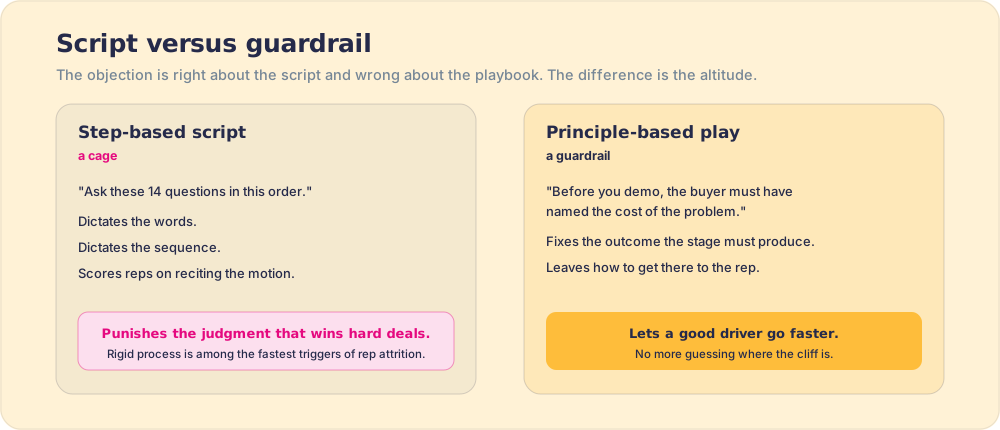
This is the sharpest objection to everything above, and it deserves a fair hearing rather than a brush-off, because the people who raise it are often the best reps a team has. The case against the playbook goes like this. Selling is judgment, not assembly. The reps who win the biggest deals are the ones who read a room and depart from the script, and a process that scores them on whether they ran the prescribed plays will punish exactly the improvisation that makes them great. There is real evidence behind the worry. SalesFuel's Voice of the Sales Rep survey finds that rigid adherence to process and needless approvals are among the fastest triggers of dissatisfaction and attrition among reps. A 2022 meta-analysis in the Journal of the Academy of Marketing Science found that intrinsic motivation, fed by autonomy and self-direction, predicts salesperson performance more strongly than extrinsic levers like commission. And the most-cited research on top performers, Dixon and Adamson's "Challenger" study of roughly 6,000 reps at CEB, found that the highest performers in complex sales win by tailoring the conversation to the customer in front of them, not by reciting a fixed motion. Grant all of it. A playbook that turns selling into compliance with a script does suppress the judgment that wins hard deals, and a leader who builds one has built a cage.
So the objection is right about the failure mode and wrong about the cause. It mistakes a bad playbook for the idea of a playbook. The fix is not less process; it is process written at the right altitude, what good operators call principle-based rather than step-based. A step-based play says "ask these fourteen questions in this order." A principle-based play says "before you demo, the buyer must have named the cost of the problem in their own words," and leaves entirely to the rep how to get there. The first is a script and deserves the objection's contempt. The second is a guardrail, and a guardrail does not slow a good driver, it lets them drive faster, because they no longer have to wonder where the cliff is. The plays this guide argues for are the second kind: they fix the outcome the stage must produce, the verifiable buyer commitment, and free the rep on everything else. That is the opposite of a cage. It is the small set of non-negotiables inside which improvisation is safe.
And here the "Challenger" finding cuts the other way from how the objection uses it. Dixon and Adamson's whole point was that the tailoring that wins is a learnable, repeatable behavior, not a gift the lucky few are born with, which is why they argued companies should train current reps in it rather than hunt for naturals. That is a playbook claim, not an argument against one. The same is true of Neil Rackham's research on 35,000 sales calls: his discovery that aggressive closing techniques reduce success in large deals was not a case for letting reps wing it, it was a case for codifying the better motion, the implication question, and spreading it. Patterson's original insight survives the objection intact. He did not script his salesmen into robots; he found the agents who already sold well, captured what they did, and made that the floor under everyone else, so the team's worst reps got better and the best ones lost nothing. The playbook that earns the best rep's buy-in is the one built from the best rep's own motion, which is the build sequence the next section describes, and it is why a process drawn from your winners is accepted where a consultant's template is resented.
How do you build a sales process reps will run?
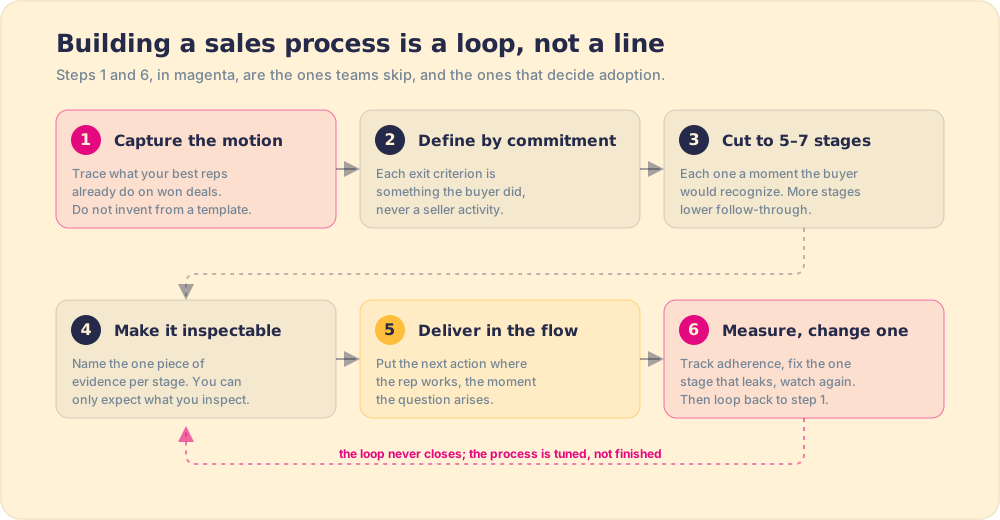
Theory earns its keep when it changes what a team does next week. Building a process is two jobs of wildly unequal size: drawing the stages is the easy tenth, and wiring in the four forces is the other nine. Build for the forces from the first day.
- Your winners' motion. The working process already lives in your best reps. Trace what they do on won deals that the strugglers skip, and pave that, rather than importing a template nobody believes in.
- Stages defined by buyer commitment. "Demo delivered" happens whether or not the buyer moved. "Buyer named the problem it solves and agreed a next step" happens only if the deal advanced. Define the stage by the second kind of thing.
- Two or three plays per stage, curated. Resist the binder. Name the few moves that move the buyer at this stage and let the rest be reference, so the rep faces a short list, not a library (the curation force).
- Each play written as a trigger. Turn "good selling" into an if-then: when this appears in the deal, the next move is that. Advice informs; a trigger fires (the equip force).
- Exit criteria a manager can inspect. Name the one piece of evidence per stage that proves the buyer's commitment is real, so adherence is visible without a meeting (the measure force).
- Five to seven stages, no more. Long pipelines feel like rigor and produce the opposite, because they map your internal handoffs instead of the buyer's decision.
What does the playbook look like on a real deal?
Theory is easy to nod at and hard to picture, so walk one play through all four forces, the way it would run for a mid-market account executive named Dana working a deal inside HubSpot. The abstraction will turn into something you can see.
Start with the moment. Dana is on a second call with a buyer who likes the product and then says, before any value has been established, "so what does this cost?" This is the single most common point where a good deal turns into a discount-led one, because the untrained instinct is to answer the price question, and the answer anchors the rest of the negotiation on cost rather than value. The play that wins here is well known and written in every negotiation book: do not answer the price the moment it is asked; ask what the cost of the unsolved problem is first. Dana knows this. Knowing it is not the issue. Doing it, on the call, in the half-second before the reflex to be helpful takes over, is the issue.
Now run the forces. Curate: the playbook for the negotiation stage does not hand Dana forty tactics; it names the two that move this buyer, and the price-objection play is one of them, so it is top of mind rather than buried on page nine of a binder. Equip: the play is written as an implementation intention, not advice. Not "handle price objections well" but "if the buyer raises price before value is established, then ask what the cost of doing nothing for another year is." That if-then form is the one Gollwitzer's meta-analysis found lifts follow-through, and because it is welded to the situation, it surfaces on Dana's deal record in HubSpot the instant the call notes or the stage signal the negotiation has opened, not after the call when it is too late. Measure: when Dana runs the play, the deal record reflects that the cost-of-inaction conversation happened, so Dana's manager can see, without a forecast meeting, that the deal advanced on a real buyer commitment rather than a sent quote. Reinforce: Dana ran the qualification and discovery plays cleanly all week, the streak shows it, and the manager's coaching time goes to the one play Dana keeps skipping rather than to reconstructing what happened on every deal.
The deal that results is not different because Dana learned something new. Dana knew the play before the call started. The deal is different because the system put the known move in front of Dana at the second it mattered, made it visible, and rewarded the repetition until it became automatic. That is the entire mechanism, on one deal, and it is the difference between a playbook that is read and a playbook that is run.
Consider the counter-example, the same call with none of the forces. Dana has read the playbook once, at onboarding, six months ago. The price question lands, the helpful reflex fires, Dana names a number, the buyer files it, and the deal proceeds to a proposal anchored on cost. The manager learns the deal went out at a discount at the forecast review three weeks later, far too late to coach the moment that caused it. No one did anything wrong, in the sense of breaking a rule. The knowledge was present and the system that converts knowledge to behavior was absent, which is Gawande's ineptitude in a sales seat: the move was known, and it failed to happen.
How does the playbook change by team and motion?
The four forces hold across every sales team, because they are facts about people, not about deal size. What changes is the dial setting on each force, and getting the setting wrong is its own failure, importing an enterprise playbook into an SMB team or a transactional one into a complex sale. Two distinctions decide most of the tuning.
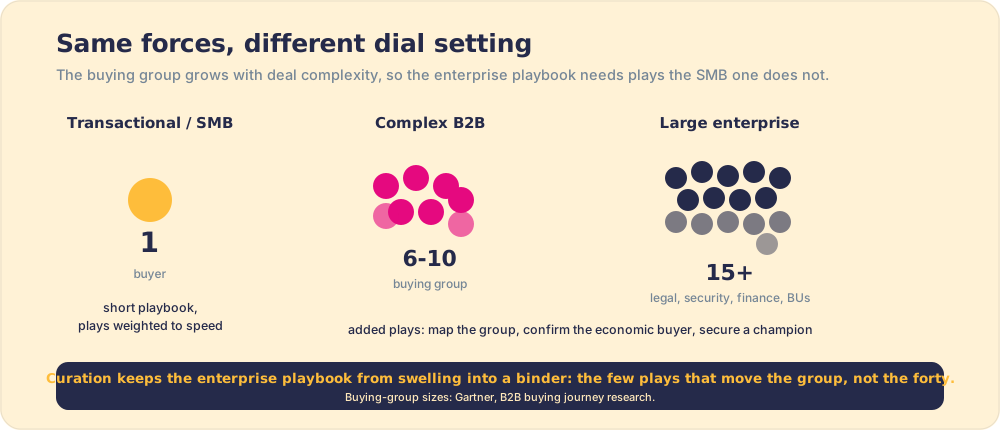
The first is deal complexity, which is mostly a question of how many people are in the room. A transactional SMB deal often has a single buyer who can say yes, so the playbook can be short, the stages few, and the plays weighted toward speed and momentum, because the enemy is the deal going cold, not a committee deadlocking. A complex enterprise deal is a different animal: Gartner finds the typical buying group for a complex B2B purchase runs six to ten people, and in large enterprise deals the number climbs past fifteen once legal, security, finance, and several business units are involved. The dominant risk there is not speed but a single unmanaged stakeholder who can veto, so the enterprise playbook needs plays the SMB playbook does not: confirm the economic buyer, map the buying group, secure an internal champion who will sell when the rep is not in the room. The curation force is what keeps this from becoming a binder again. An enterprise stage may carry three plays where an SMB stage carries one, but the discipline is the same, name the few that move the buying group at that stage, not the forty a great enterprise rep could theoretically run.
The second distinction is the motion, inbound versus outbound, and it changes where the early stages even begin. An inbound deal arrives with the buyer already aware they have a problem, so the front of the playbook is about qualifying intent and disqualifying fast, separating the buyer who is researching from the buyer who is ready, before a rep pours hours into a tire-kicker. An outbound deal starts colder, with a buyer who has not admitted the problem exists, so the front of the playbook is about creating the problem awareness an inbound buyer brought with them, the teaching motion the "Challenger" research found wins in complex sales. The back half of both playbooks, once the buyer owns a problem, converges, which is the useful thing to know: the divergence is concentrated at the top of the funnel, and a team running both motions needs two entries into the process, not two whole processes. In all of these cases the build sequence is identical, capture what your winners do in that specific motion, define each stage by the buyer commitment that fits it, curate, equip, measure, reinforce. The forces do not bend. The plays inside them are cut to the deal.
How do you improve a sales process?
Sales process improvement almost never means redrawing the stages. The stages are nearly identical across teams, because the buyer's path does not change much. Improvement means raising the rate at which the process gets run, and that starts with the third force: measure whether it is run at all. You cannot tell whether a weak result came from a bad stage or a skipped one, so adherence is the prerequisite to every other answer. Once you can see it, find the single stage that leaks, the one point where deals stall or jump ahead on activity rather than commitment, fix that, and watch again. Change one thing, because a process you tune by one variable teaches you something, and a process you redraw wholesale teaches you nothing. The deeper treatments are sales process adoption and compliance vs adoption.
What is sales process management?
It is the ongoing work of inspecting whether deals are being run against the stages and coaching where they are not, which makes it a habit rather than a launch you finish. In our research, inspection frequency was the single strongest predictor of quota attainment; teams in the highest inspection band hit quota at several times the rate of the lowest. The trap is that inspection done by hand consumes the hours coaching needs, so it slides, and the expectation slides with it. Three disciplines hold it together. Inspect on commitments, not feelings, because "show me the buyer's commitment for this stage" keeps a forecast honest in a way "how is it feeling" never will. Automate the inspection so the manager's scarce time goes to coaching the drift rather than hunting for it. And treat non-adherence as a system failure, because when reps go off-process the cause is friction, late delivery, and a missing prompt, and the fix is to the system, never a lecture to the rep.
Process, methodology, and template are not the same thing
Three words get used interchangeably, and they decide different purchases. A sales process is the sequence of stages a deal moves through, shared across the team: the road, and the thing a manager inspects. A methodology (MEDDIC, SPIN, Challenger) is how a rep works inside the stages, mostly how they qualify and run conversations; it sharpens a rep within a stage but does not tell you where the deal is. A template is a scaffold for the shape: use it to recall the skeleton, then replace every generic stage with the buyer commitment your own winners earn, the exercise in the sales process template. The order is fixed. Process first, then a methodology that fits how your best reps already sell, never the reverse.
Where should the playbook live, and what software runs it?
Now the four forces become a buying test, and a far more useful one than a feature list. Any tool can store a playbook. The question is how many of the four forces it supplies, because a home that delivers one force out of four will produce roughly one force worth of adoption. Score the options honestly and the category sorts itself.
| Where the playbook lives | Curate | Equip at the trigger | Measure / visibility | Reinforce / streaks |
|---|---|---|---|---|
| Static doc or deck (Google Doc, PDF) | No. Stores everything, prioritizes nothing | No. The rep must go find it | No. No signal it was opened | No |
| Wiki (Notion, Confluence, Guru) | Partial. Can be organized, rarely curated | No. Pull, not push | No. Page views, not play use | No |
| LMS / training platform | Partial. Curated for a course, not a deal | No. Teaches once, absent later | Completion, not field adherence | Quiz scores, not habit |
| Content & enablement suites (Highspot, Seismic) | Partial, for assets | Partial. Surfaces content, not the stage's next move | Content usage, not process adherence | No |
| CRM stages + guided selling (HubSpot, Salesforce) | Partial. Stages yes, plays no | Partial. Static fields, generic config | Stage data, often activity not commitment | No native streak |
| Business logic layer in the flow of work (Supered) | Yes. The few plays per stage | Yes. The play at its trigger, in the CRM | Yes. Adherence visible deal by deal | Yes. Streaks on the expected actions |
Read the matrix down the columns and the pattern is plain. Storage tools score "no" on the three forces that matter most, because they were built to hold a document, not to run one. The CRM owns the stages but not the plays, the prompt, or the reinforcement. The honest reading is that the row that supplies all four does not replace any of these; it sits in the flow of work on top of the CRM and supplies the forces the others leave out. One note on the field as it stands in 2026: the two best-known content and enablement suites, Highspot and Seismic, announced a merger in February 2026, which consolidates the asset-management category and underscores the point of the matrix, that the unsolved job is not storing better content but running the behavior. The full argument for why location is a question of timing is in where should your sales process live.
What does AI change about the sales playbook?
It makes the easy half nearly free and raises the stakes on the hard half, which is the pattern AI is producing across every part of selling. On the easy side, a model can now draft a competent set of stages in seconds, suggest the plays for each, summarize every call, and auto-advance a pipeline on signals it detects in email and calendar activity. The writing, storing, and reporting of a playbook, the part that improved relentlessly for 140 years, is approaching zero cost. If knowledge was already solved, AI solves it twice over.
The risk is specific, and it is the failure mode of the next decade. An AI that advances a deal on detected activity, an email sent, a meeting booked, a deck opened, manufactures exactly the false confidence that commitment-based stages exist to prevent, except now at machine speed and across the whole pipeline at once. The hollow pipeline a careless human builds one deal at a time, a careless model can build for the entire team overnight. And the scarcity of real signal makes it worse: Gartner finds B2B buyers now spend only about 17 percent of the journey with all suppliers combined, so genuine buyer commitments are rare and easily drowned out by the abundant noise of detectable activity that AI is so good at counting.
The defense is not to refuse AI; it is to apply the four forces to the model the way you apply them to a rep. An AI is a fast, tireless way to deliver a curated play at its trigger and to make adherence visible, which is the equip and measure forces running at scale, and that is its real promise for a playbook. But a stage still advances only on a verified buyer commitment, whether a human or an agent proposes the move, and you must be able to inspect whether the AI, like a rep, is following the process or gaming the activity. This is the governance point that does not go away: AI amplifies the process you already have, so a good, commitment-based playbook compounds faster and a vanity, activity-based one lies faster. Get the behavior right first, then let AI multiply it.
The recommendation
Build the process from your winners and define it on buyer commitments. Then stop treating the playbook as a document to be written better and start treating it as a behavior to be produced, which means wiring in all four forces: curate the few plays, equip each at its trigger, make adherence visible, and reinforce until the motion is a habit. Most teams have done the first force and a fraction of the second, which is exactly why the gap sits at 53 points. A mediocre process run through all four forces beats a brilliant one that stops at the document, because consistency is what the buyer feels and what the forecast stands on. When you are ready to make that real, it is the job we built Supered for: the Business Logic Layer that curates the next play, surfaces it the instant a rep needs it inside HubSpot, Salesforce, or Pipedrive, makes adherence visible deal by deal, and reinforces it with streaks, so the playbook stops being a binder and becomes the motion your team runs. The design comes from more than 100 sales implementations, where the one variable that decided whether a playbook worked was adoption. The goal is to recreate the feeling of a great sales leader beside each rep. The part we call Always with them lets reps search your playbook from the deal without leaving the CRM, with step-by-step instructions inside each pipeline stage. The part we call Real-time enablement flags a missing next step on the deal until the rep fixes it, and gives every rep a daily list with streaks, so managers can see who is running the plays and use the 1:1 for coaching. And Standardize delivery lets you build the rules by describing your process in your own words, with Supered setting them up for that pipeline, while action plans start every new rep the same way.
Read the sales process end to end: what is a sales process, the 7 sales process steps, how to build a sales process, the template, the execution gap, adoption, compliance vs adoption, and where the process should live.
Sales playbook FAQ
What is a sales playbook?+
Why do reps not follow the sales playbook?+
How do you build a sales process?+
How do you improve a sales process?+
What is the difference between a sales process and a sales methodology?+
Where should a sales playbook live?+
Why do most sales playbooks fail?+
How long does it take for a sales playbook to become a habit?+
What is the difference between a sales playbook and a sales process?+
Does a sales playbook slow down good reps?+
How does a sales playbook differ for SMB versus enterprise?+
Your process, running itself.