CRM ROI: The Return Is Real. Adoption Decides How Much You Keep.
Your CRM is one of the best investments you will make.
How to capture its full value, cut the waste most teams never see, and protect the biggest line on your revenue budget.
CRM ROI is the return a CRM produces for every dollar spent, a figure Nucleus Research measured at $8.71 for a well-run system, where how much of that return you actually keep is decided by adoption, not by the platform you bought.
A CRM is one of the best investments you will make. Run well, it pays back $8.71 for every dollar spent, a figure Nucleus Research has tracked for years and one almost no other line on the budget can touch. That return is real, and it is not theoretical. The teams that capture it are not the ones who bought the most software; they are the ones whose reps actually run the process inside it. That is what this comes down to, because the one thing that decides how much of that $8.71 you keep is adoption, not the platform you bought.
And most teams are keeping less of it every year. The same firm that produced the $8.71 figure now documents the average realized return falling about 37% over the decade, from $4.90 to $3.10 by its 2024 measure, as more of every CRM goes unused. Read that carefully: the platform did not get worse and the ceiling did not move. What changed is behavior. The money leaks in the widening gap between the process a leader designs and the process reps run.
That sets up the argument of this post, and the logic is simple. The return on a CRM is gated by adoption. Adoption is not a willpower problem; it is an operationalization problem. The process exists on a slide, but it is never turned into the everyday behavior of reps. The fix is to operationalize it: take your framework, turn it into a curated set of next actions, deliver them to the rep in the flow of work, measure who runs them deal by deal, and make the AI sitting on your CRM actually usable at the moment a rep acts. There is now a specific, provable way to do exactly that. Follow the chain and you arrive at the one move that recovers the return: operationalize the process and the CRM pays back like the $8.71 system it was built to be; leave it on the slide and you pay full price for partial value, quarter after quarter, without ever seeing the line where it disappears.
This is the case for closing it, and why the moment to do it is now.
The short version
- The return is real, and the ceiling is high. A well-run CRM pays back $8.71 per dollar, more than almost anything you buy. But the average realized return has slid about 37% over the decade, from $4.90 to $3.10, as more of every CRM goes unused (Nucleus Research).
- AI is the lever that reverses it. Nucleus names AI as the thing that turns the CRM from a passive record into a system that prompts the next action, and the 65% of companies running generative AI in their CRM are 83% more likely to beat their sales goals (Freshworks). AI only delivers that on a process that gets followed and data that stays clean.
- The leak. One thing decides how much of the return you keep: adoption. Estimates of CRM project failure range from 20% to 70%, with poor adoption the leading cause, and average adoption across sectors sits near 26% (Salt Creative, 2026, citing industry sources). That is most of your purchase, unused.
- The reason. You cannot train your way out of it. People forget a large share of what they are taught within weeks (Ebbinghaus, 1885), and reps spend only about a third of the week selling, so 89% of teams have a defined process and only 36% see it followed (The State of Sales Enablement, 2026).
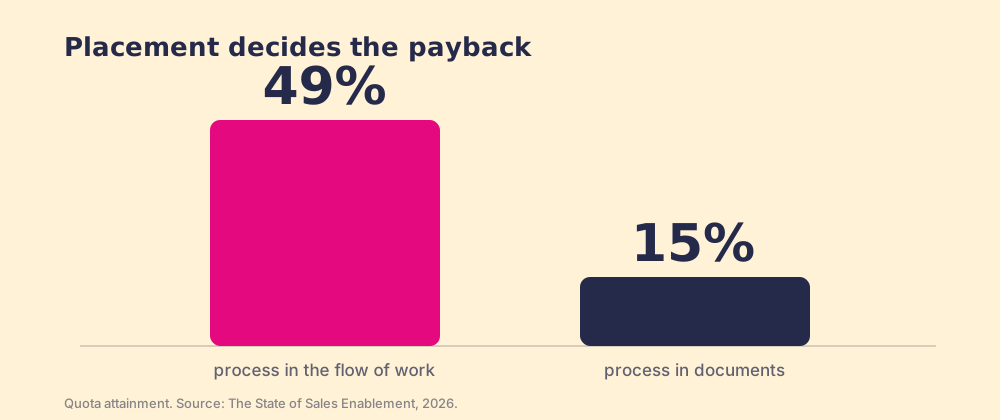
- The fix. Placement. When the process runs in the flow of work, teams hit quota at 49%. When it lives in documents, 15%.
Maximize the value. Cut the waste. Both come down to whether reps run the process, and that is a problem you can solve.
Is a CRM worth it?
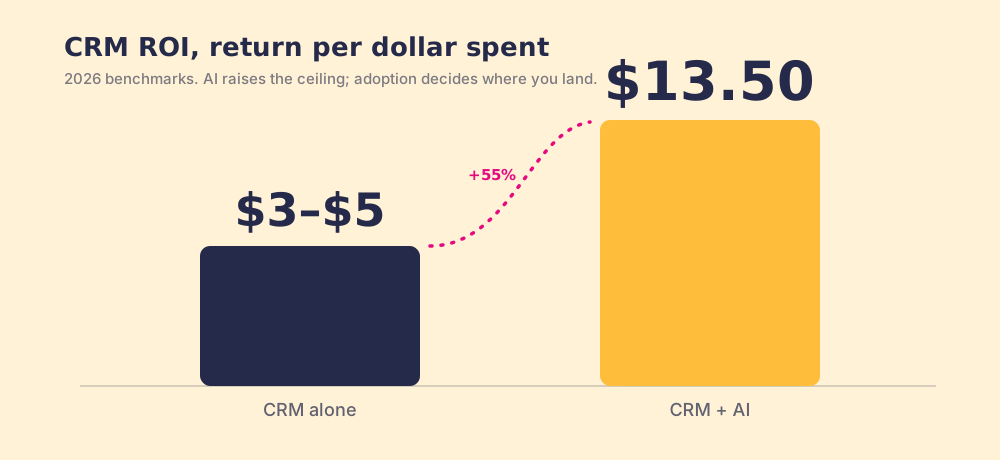
The return settles the first question fast. A well-run CRM does more than store contacts; it compounds revenue, paying back $8.71 for every dollar spent, ahead of almost any other tool a revenue team buys. And the teams that get the most out of it are not the ones who bought the most software. They are the ones who use it consistently: top-performing sales teams are about 81% more likely to use their CRM consistently than everyone else (Salt Creative, 2026).
That single finding tells you where the value lives. Not in the license. In the using.
A CRM is one of the few investments where even the average team, getting nowhere near the $8.71 a well-run system returns, still pays back more than three times its cost. The platform is worth every dollar. The only question is how much of that payback you keep, and that is a question about adoption.
Why does a CRM pay back more the more it gets used?
A CRM is not a purchase you make once and forget. It grows more valuable as the team works inside it, because every well-run deal sharpens the next forecast and shortens the next rep’s path. Each clean record improves pipeline visibility and conversion benchmarks for everyone. Other systems you own, from marketing automation to analytics to AI, sit on top of it and inherit the quality of what is there. And it gives time back, saving teams an estimated 5 to 10 hours a week by automating the busywork (Salt Creative, 2026).
There is a catch worth sitting with, because it is the heart of it. A CRM returns the quality of what reps put into it. Run the process and the record becomes a flywheel, where good data drives better decisions that drive better data. Skip the process and the same platform becomes an expensive filing cabinet. Same software. The behavior is the variable, and AI is about to make that variable worth far more.
How does AI change CRM ROI?
The biggest shift in the CRM story in a decade is AI, and Nucleus, the same firm that tracked the decline, names it as the lever that reverses it: AI shifts CRM systems “from passive data repositories to proactive tools capable of providing actionable insights and automating complex tasks” (Nucleus Research, 2024). Most sales teams are already moving: 65% of companies now run a CRM with generative AI features, and those that do are 83% more likely to beat their sales goals (Freshworks).
Now the part that decides whether any of that lands. Any AI that briefs a rep, scores a deal, or drafts the next step is reading the CRM record. Feed it a process that gets followed and data that stays clean, and it compounds the work. Feed it half-run deals and thin records, and it extends the gaps with total confidence. AI does not reduce the need for adoption. It raises the reward for getting it right and the price of getting it wrong.
AI does not replace the CRM. It compounds it. And it turns adoption into the difference between AI that works and AI that guesses.
Where does CRM ROI leak?
So if the platform is this good and AI makes it better, where does the return disappear? One place. Adoption. Not whether reps log in, but whether they run the process the CRM was bought to enforce. This is the leak, and it is wide.
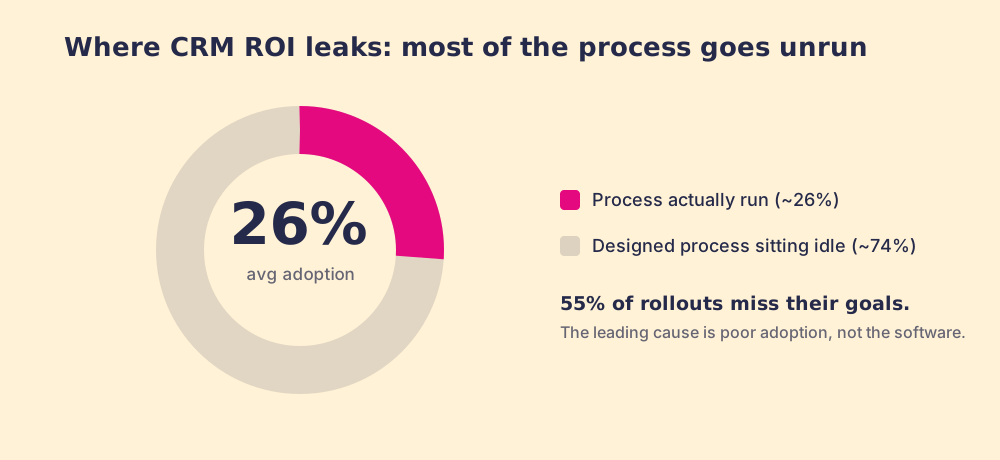
Industry estimates of CRM project failure range widely, from 20% to 70%, and across all of them the leading cause named is poor user adoption, not the software (Salt Creative, 2026, citing industry sources). Average adoption across sectors hovers near 26%, which means most of the designed process is not being run. The cost shows up in two directions at once:
- Value you never capture. Deals lost to skipped steps, a forecast running on partial inputs, and AI working off thin records.
- Money you spend twice. New reps unproductive longer, managers burning hours chasing updates, and re-training and re-configuration when a rollout stalls.
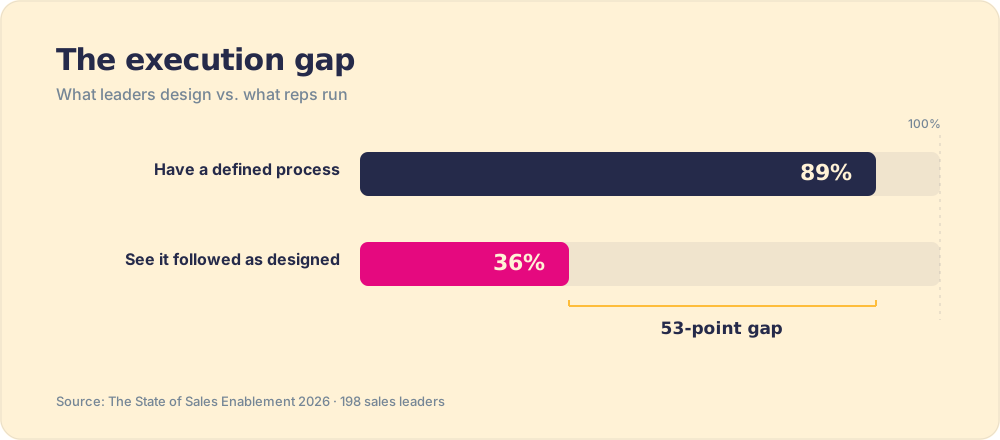
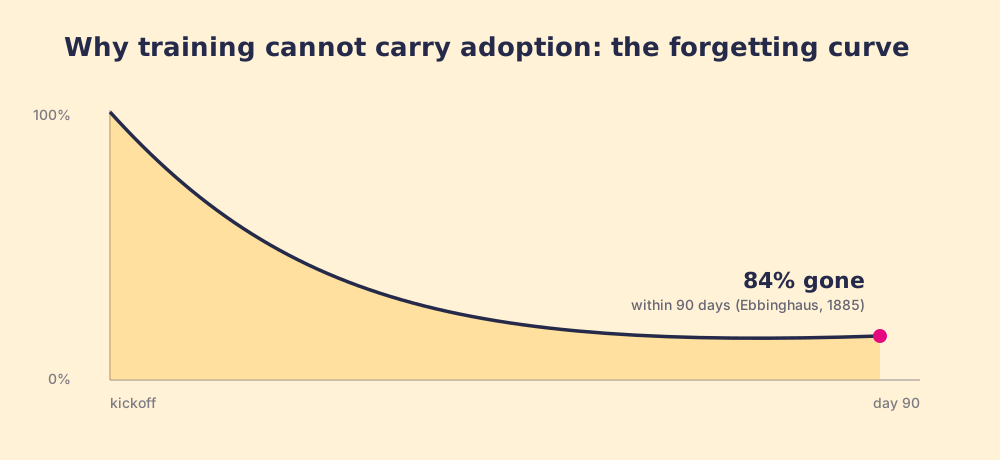
None of this is a people failure. It is how attention and memory work. In Hermann Ebbinghaus’s foundational memory experiments, recall of newly learned material dropped sharply within days without reinforcement (Ebbinghaus, 1885), so the playbook you launched at kickoff is mostly gone by the next quarter. Reps spend only about a third of the week actually selling, so any step that is not reinforced gets dropped under time pressure. The outcome is measurable: 89% of teams have a defined sales process, and only 36% see it followed as designed (The State of Sales Enablement, 2026).
Adoption is not a reason to hold back on a CRM. It is the line between the teams that capture the full return and the teams that pay full price for half of it.
Why doesn’t training fix CRM adoption?
Training is not useless. It is the wrong tool for the job most teams hand it. Training transfers knowledge, and adoption is a behavior, so the two break apart for reasons no amount of better content can fix:
- It is a one-time event against a daily problem. A kickoff or a bootcamp happens once; running the process happens on every deal, every day. Memory decays on a curve (Ebbinghaus, 1885), so the playbook you launched in January is mostly forgotten by April unless something keeps reinforcing it.
- It happens in the wrong place. Reps learn in a room or an LMS, then have to recall it later while a deal is live. The lesson and the moment of action are disconnected, and the live deal in front of the rep wins every time.
- It happens at the wrong time. The lesson lands weeks or months before the situation it was meant for. By the time a rep needs the renewal-save play, the training is a faint memory.
- It is not reinforced or measured. Without inspection there is no signal when behavior drifts and no coaching loop to pull it back, so the process reverts to whatever is easiest.
- It leans on memory and willpower. Both are scarce under quota pressure, where reps already spend only about a third of the week selling.
This is not an argument against training. You still teach the new way. The shift is toward putting the enablement in the flow of work, at the moment of action, reinforced and measured, so the right behavior happens whether or not the rep remembers a session from weeks ago. Training tells people what to do. In-flow enablement makes the doing the easy path.
The failure was never the training or the team. It was asking a one-time lesson to drive an everyday behavior.
You can only expect what you inspect
Here is the principle under all of it. You can only expect what you inspect. A standard you cannot see is a standard you cannot hold, and behavior you cannot measure drifts back to whatever is easiest. Measuring the behavior is what turns a process from a hope into a system, for three reasons:
- Reason one: expectation. When you can see whether the process is being run, you can expect it. A documented standard you never inspect is a suggestion. A measured one is a commitment.
- Reason two: management. What you can measure, you can manage. Inspection turns a vague sense that deals are slipping into a specific, coachable picture of who skipped what, on which deal, and when.
- Reason three: coaching to results. Coaching to an observable behavior beats coaching to a feeling. Managers stop chasing field updates and start improving the few moves that move win rate, which is where the return compounds.
Inspection is also how a process becomes a shared asset rather than a private one. Run it well and you can answer the questions a leader needs to answer:
- Standard. Do I have a set standard I can be sure is being executed on real deals, not a document that sits on a shelf?
- Expectations. Are the things I expect happening, on every deal, by every rep?
- Shared behavior. Does the whole team run the same plays, so performance does not live and die with my top rep?
- Shared experience. Does that shared behavior produce a consistent experience for every customer, the thing that builds a brand and renews?
- Visibility. Can I see, at a glance, whether the process is being followed, and where it is not?
When the answer to those is yes, you get better results and you can prove it. That proof is the difference between believing the CRM is paying off and knowing it is. And the difference is large: in our own field data, the most-inspected teams hit quota at 6.3 times the rate of the least-inspected (The State of Sales Enablement, 2026). That is a comparison across teams that differ in more than inspection, so read it as the mechanism pointing one direction rather than a controlled trial. But it points the same way the principle does.
Why does operationalizing the process decide the return?
Here is the heart of it, and it is the one place outside research and our own field data agree so cleanly that the convergence is worth naming. The single largest effect in our 2026 survey was not the quality of the process or the size of the budget. It was whether the process was operationalized: turned into actions reps actually run, in the flow of work, rather than left as a document to remember. Teams whose process ran in the flow of work, surfaced at the moment of action, hit quota at 49%. Teams whose process stayed in documents and training decks hit it at 15% (The State of Sales Enablement, 2026).
Why such a gap? Because following a process that lives somewhere else always costs a step the rep does not have the attention to spend. The playbook is in a doc; the deal is in the CRM. Reading the doc means a tab switch, a search, a moment of recall, and under quota pressure the rep skips it and improvises. Move the next right action onto the record the rep already has open, and following the process becomes the path of least resistance instead of an act of will. The behavioral science has a name for this. B.J. Fogg’s model, B=MAP, holds that a behavior happens when motivation, ability, and a prompt arrive at the same moment; the cheapest of the three to improve is almost always ability, by removing the friction, and the prompt, by putting it where the eye already is (BJ Fogg, Behavior Model). A process in the flow of work raises ability and supplies the prompt at once. A process in a binder does neither.
This is the same lesson as the surgical checklist, the most-cited proof that placement beats knowledge. Surgeons already knew the steps; what changed outcomes was a 19-item checklist run at the table, in the moment, every time. Across eight hospitals, inpatient deaths fell from 1.5% to 0.8% and complications from 11% to 7% (Haynes et al., NEJM, 2009). Same surgeons, same knowledge, a different place for the standard to live. The CRM is the operating room. The question is whether your process is the checklist on the table or the textbook on the shelf.
What closes the gap
So the prescription writes itself. You do not need better training or a better-documented process. You need the process to reach the rep at the moment of the work, and you need to measure whether it does. That is a different category of tool from the CRM and from training, and it is the one most teams are missing.
This is the job Supered does: it operationalizes your process. It takes the framework your best reps already run, turns it into a curated set of next actions, surfaces them on the record the rep already has open, measures who is running them deal by deal, and reinforces the gaps with coaching, all in the flow of work and on top of the CRM rather than replacing it. It also makes the AI on your CRM usable to reps in the moment, connecting to your systems through MCP so the next action is grounded in the live deal rather than a generic prompt. We are one instance of the principle, not the principle itself. The principle is that the return on a CRM is gated by adoption, and adoption is gated by whether the process is operationalized into behavior reps actually run. Any approach that puts the standard in front of the rep at the moment of action and measures it will move the same numbers.
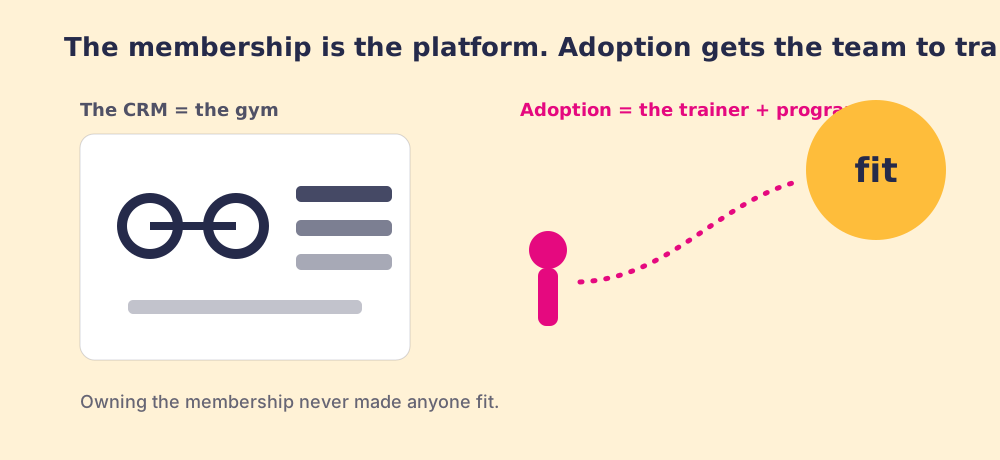
A CRM is the best gym in town. The membership is real, and so is the equipment. But owning the membership never made anyone fit; what makes anyone fit is showing up and doing the program, every day. A famous study of gym pricing found that members on flat monthly contracts attended so rarely they paid more than $17 a visit when a per-visit pass would have cost them $10, roughly 70% too much, because they overestimated how often they would actually show up (DellaVigna and Malmendier, AER, 2006). They had the membership. They lacked the prompt and the program. Your CRM is the membership. Adoption is the program that gets the whole team to show up and train.
The decision
The data has settled the first question. A CRM is one of the best investments a revenue team can make, even after a decade of declining returns, and AI is the lever that can lift those returns again. The only question left is the one that moves the number: do you capture the full return, or pay full price for part of it. That comes down to adoption, and adoption comes down to where the process lives.
So the move, in order:
- The platform. It still returns about three dollars for every one spent and anchors everything else. Buy it, and buy it well.
- The implementation. Design the process so it fits how you actually sell, not a generic template. This is the foundation the return is built on.
- The placement. Put that process in front of the rep at the moment of the work, and measure whether it runs. This is the difference between 49% quota attainment and 15%, and it is the step that decides your CRM return on investment.
Buy the CRM. Set it up right. Then make sure every rep runs the process inside it. That last step is where the return that Nucleus says is fading gets recovered, dollar by dollar. The mechanics of getting there are in how Supered works and sales process adoption, and pricing scales with the size of the team you are rolling it out to.
Frequently asked questions
What is CRM ROI?+
Is a CRM worth it?+
Why do CRM rollouts fail?+
Does AI improve CRM ROI?+
How do you improve CRM adoption?+
Your process, running itself.