Apollo vs Supered ProspectorSkip the extra seats. Run the Clay you have.
Apollo is the right buy for a team with no Clay that wants contact data, sequences and a dialer in one subscription, from $49 a seat. If your team already runs Clay, an Apollo seat for every rep buys a second database for contacts your Clay table can already find. Prospector puts that table in the rep's hands instead: a button in Sales Navigator, on a company site or inside the HubSpot, Salesforce or Pipedrive record, for $45 per rep per month, billed annually. Clay plus Supered is the best way for a sales team to prospect: GTM engineers build in Clay, reps never open Clay.
01Supered ProspectorTeams already on Clay. Reps run your Clay tables from where they prospect, see the CRM match first, sync in one click, and every list shows Found, Worked and Closed. $45 per rep per month, billed annually, from 1 rep.
02ApolloTeams with no Clay and no GTM engineer who want data, sequences, a dialer and AI in one tool. Free plan, then $49, $79 or $119 per seat per month, billed annually.
03Both: Apollo inside your Clay tableTeams that like Apollo's data but want one rep workflow. Clay can call Apollo as one step of the waterfall with your own Apollo account, and reps still press the Prospector button.
G2 on 2 October 2026: Apollo.io 4.7 out of 5 from 9,839 reviews; Supered 4.9 out of 5 from 81 reviews. Prospector is new and has no reviews of its own yet.
Status check
What is Apollo in October 2026?An AI GTM system, still sold by the seat.
Apollo is independent and busy. Its 2026 press releases run from an AI Assistant (March 4) and the purchase of Pocus (March 19) to an app in ChatGPT (April 29), a data partnership with Salesforce's outbound agent, Hunter (September 15), and on September 30 the launch of what it calls the "AI GTM System" (PR Newswire, checked 2 October 2026). Underneath, the product is still a contact database, "240M contacts & 30M companies" in Apollo's words, with sequences, a dialer and AI built on top (apollo.io).
The buying model has not moved. You pay per seat, and each seat comes with credits: on Apollo's plan data, an email costs 1 credit and a direct dial costs 8. "Credits are pooled across your entire team," "Unused credits expire at the end of each billing cycle," and every seat on an account sits on the same plan, so you cannot put a few reps on Professional and the rest on Basic (apollo.io/pricing, 2 October 2026).
The extension is large: 1,000,000 users and 4.7 from 2.2K ratings on the Chrome Web Store, updated 29 September 2026. On a Sales Navigator search, Apollo's own help center now says the extension shows suggested leads, and "You can't select leads or take bulk prospecting actions from the extension on the search results page" (Apollo help, updated 25 September 2026).
The decision table
Apollo vs Prospector at a glanceTen lines that decide it.
Apollo
Supered Prospector
Job it is built for
An all-in-one sales platform: find contacts in Apollo's database, then sequence, dial and research them in the same tool.
Clay in every rep's hands: your Clay tables become a button reps press where they already prospect, then leaders see which lists got worked and closed.
Where the data comes from
Apollo's own database ("240M contacts & 30M companies"), with Waterfall Enrichment from partners on paid plans.
Your Clay table: Clay's waterfall across 200+ providers, on your own Clay account and credits. Apollo can be one of the steps.
Where reps use it
The Apollo app, plus a Chrome extension on Gmail, Google Calendar, LinkedIn, Salesforce, HubSpot, Pipedrive, Salesloft and company websites.
Sales Navigator and LinkedIn profiles, a company's website, and inside a HubSpot, Salesforce or Pipedrive record. It runs inside the Supered Chrome extension.
Sales Navigator
Suggested leads on a search page; "You can't select leads or take bulk prospecting actions" there. Profile data "may appear on some" Navigator profiles.
Reps add Navigator leads to a prospect list and push the list to a Clay table. Prospector works within LinkedIn's terms and does not copy search results in bulk; the contact data comes from Clay's waterfall on the customer's Clay account.
CRM sync
Two-way sync with HubSpot, Salesforce or Pipedrive. "You can only connect one CRM to Apollo at a time."
One click to HubSpot, Salesforce or Pipedrive, with field mapping set once by Ops. Before the sync the rep sees the matching CRM record, who owns it and whether the person was worked before.
Outreach
Built in: sequences with A/Z testing, a US dialer, call recording and AI insights, an AI Assistant, and Agents on Professional.
None built in, by design. A flow your GTM engineer builds can send the contact on to a sequence in your sales engagement tool.
Pricing and contract
Free; Basic $49, Professional $79, Organization $119 per seat per month billed annually (Organization annual only, 3-seat minimum; Basic $65 and Professional $99 monthly). All seats on one plan; unused credits expire each cycle.
$45 per rep per month, billed annually, from 1 rep, plus the Clay plan you already have. Demo first, no free trial yet.
What leaders see afterward
"Analytics & Pre-built Reports" and "Goal Settings & Tracking" on Professional and up, across Apollo activity.
Found, Worked and Closed for every list: who is working their list and who isn't, and each lead ending Qualified, Recycled or Disqualified, the way your process says.
Security
"ISO 27001 and SOC 2 certified"; GDPR compliant.
SOC 2 Type II and GDPR.
G2
4.7 out of 5 from 9,839 reviews.
Supered: 4.9 out of 5 from 81 reviews. Prospector is new and has no reviews of its own yet.
How we graded: for a sales team of 10 to 50 reps that already pays for Clay. Weights: coverage through a waterfall (30%), working from the tab the rep already has open with a CRM check first (25%), the cost of adding the next rep (25%), and what a leader sees about each list afterwards (20%). We grade the opposite lane too, data plus outreach in one tool with no Clay, so you can flip the lens.
Tool
Lane
Grade
Rank
Why it ranks here
Supered Prospector
Team already on Clay
A
1
Built for this: your Clay tables as a button, CRM match first, one-click sync to three CRMs, Found to Closed per list, $45 a rep.
Apollo inside Clay, run by Prospector
Team already on Clay
A-
2
Keeps Apollo's data as one step of the waterfall on your own Apollo account; reps still press one button. Two vendor contracts to manage.
Apollo, a seat per rep
Team already on Clay
B-
3
A strong extension and a big database, but each seat buys a second source for contacts Clay already reaches, one CRM per account and no per-list view.
Apollo
Data plus outreach, no Clay
A
1
A free plan, published seats from $49, sequences, dialer and AI in one product, 4.7 from 9,839 G2 reviews.
Supered Prospector
Data plus outreach, no Clay
C
2
Out of scope by design: it needs a Clay account and writes no outreach.
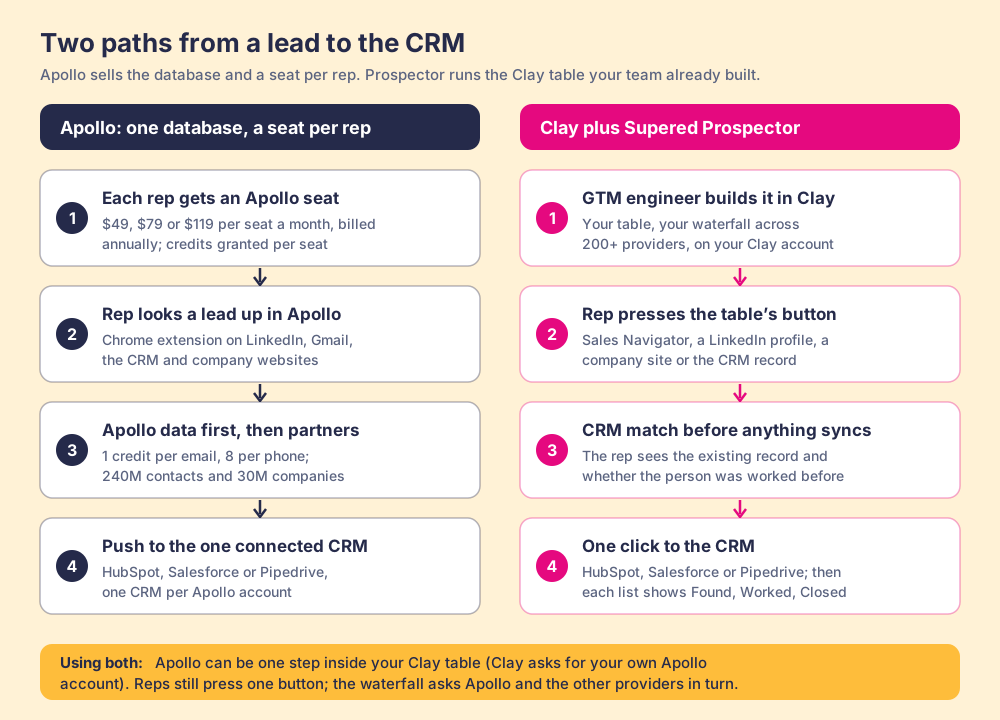
Two paths from a lead to the CRM. Apollo: a seat per rep at $49, $79 or $119 per seat per month billed annually, Apollo data first (240M contacts and 30M companies, its own count), 1 credit per email and 8 per phone, one connected CRM per account. Prospector: the table your GTM engineer built in Clay, a waterfall across 200+ providers, the CRM match before the sync, one click to HubSpot, Salesforce or Pipedrive, then Found, Worked, Closed per list. Apollo can also be one step inside the Clay table, on your own Apollo account. All checked 2 October 2026.
Fair to them first
What is Apollo best at?Everything in one tab, from a free plan up.
Apollo's strength is the bundle. A founder or a five-rep team can sign up free, find contacts, write a sequence, make calls from the US dialer and record them, all in one product, with no data team and no second contract. Paid seats are published at $49, $79 and $119 per month on annual billing, every plan includes the prospecting, Gmail and Salesforce extensions, and Professional adds Agents, A/Z testing and 4,000 minutes of call recording with AI insights (apollo.io/pricing, 2 October 2026). For a small team, that is a lot of product for the first dollar.
People like using it. Apollo holds 4.7 out of 5 from 9,839 reviews on G2, its extension has a million users, and the security page lists ISO 27001, SOC 2 and GDPR. It is also moving fast on AI: an assistant, an app in ChatGPT, a data partnership with Salesforce's outbound agent. If your team has no Clay and nobody whose job is to build tables, Apollo is the sensible default, and we would tell you so on a call.
Apollo is a well-stocked shop: one set of shelves, and a cashier who also helps you write the letter. Clay is the wholesale market behind many shops, 200+ suppliers asked in turn until one has the item, and your GTM engineer has already written the shopping list. Prospector is the counter where the rep picks up the order without walking into the market.
Why buyers compare
Why do teams on Clay compare Apollo with Prospector?Two meters for one contact.
Apollo's reviews are strong, so the reasons to look around are about how it fits next to Clay, not about quality.
Paying twice for the same people.The pattern we hear from teams on Clay: the GTM engineer built great tables, reps cannot reach them, so reps ask for Apollo seats to build their own lists. Now the company pays Clay credits and Apollo credits for overlapping contacts.
A meter per seat.Apollo charges 1 credit for an email and 8 for a direct dial. Credits are pooled and "Unused credits expire at the end of each billing cycle," so a seat bought for occasional lookups still carries its full price.
One plan, one CRM."All seats on an Apollo account are on the same plan," and "You can only connect one CRM to Apollo at a time." A team running HubSpot for sales and Salesforce elsewhere has to pick.
The list stops at the export.Apollo reports on Apollo activity. A sales leader who wants to know whether the list a rep built last Tuesday got worked, and how each lead ended, needs a view per list.
Prospector, for teams on Clay
What does Prospector do that an Apollo seat does not?Your tables, as a button for every rep.
Prospector runs inside the Supered Chrome extension on your own Clay account. A rep on a LinkedIn or Sales Navigator profile, a company's website or a HubSpot, Salesforce or Pipedrive record presses one button and the Clay table your GTM engineer built runs, with Clay's waterfall across 200+ data and AI vendors (Clay's count on clay.com, 2 October 2026). Before anything syncs, the rep sees the matching CRM record, who owns it and whether the person was prospected before, so reps do not double up on the same contact. One more click sends the contact to the CRM with the field mapping Ops set once. Reps never log into Clay.
The GTM engineer stops being the list desk. Flows are built once in Clay: person enrichment, the buying committee with your own titles, departments and seniority, or a campaign that loads a sequence. Reps pick the flow from a Push menu. Any custom Clay workflow runs from Prospector, and a rep can add Sales Navigator leads to a prospect list and push the whole list into a Clay table. An admin connects Clay inside Supered, with no engineering.
Then the leader's view. Every list shows Found, Worked and Closed: who used your tables, who is working their list and who isn't, and each lead ending Qualified, Recycled or Disqualified, the way your process says. Your VP sees it too. That is how the Clay budget grows. The full loop is on the sourcing use case, and the leader's version is on Prospector for sales leaders.
Prospector costs $45 per rep per month, billed annually ($540 a rep a year), and you can buy it for a single rep. Ten reps is $5,400 a year, on top of the Clay plan you already pay for. There is no free trial yet: it starts with a demo on your own Clay account, and the details are on the Prospector page.
Choose Apollo instead when the job looks like this
No Clay, no table builder.Prospector runs only on Clay. If nobody on the team builds Clay tables, Apollo's database and extension work out of the box.
Data and outreach in one bill.If you want sequences, a dialer and call recording in the same tool as the data, Apollo does that job and Prospector does not try to.
A solo rep on a budget.Apollo's free plan, with 900 credits a year, is a real start. Prospector starts at one rep, but it needs a Clay account behind it.
Run your Clay table from Sales Navigator.
A demo on your own Clay account. Bring the table your reps ask Ops to run most often.
Apollo vs Prospector: which should you choose?Decide by whether you already have Clay.
If you have no Clay and want data, sequences and a dialer in one subscription, Apollo is the best pick. If your team already runs Clay, Prospector is the best pick: it puts the tables you built in every rep's hands, from $45 a rep, and skips the extra seats.
Choose Apollo for
An all-in-one start. A free plan, then published seats from $49, with data, sequences and a dialer together.
A team with no data builder. Apollo works on day one without anyone building tables.
Outreach in the same tool. A/Z testing, call recording, an AI Assistant and Agents on Professional.
Choose Prospector for
The Clay you already pay for. Your tables run from Sales Navigator, company sites and the CRM record, with no Clay login for reps.
Every CRM you run. One-click sync to HubSpot, Salesforce or Pipedrive, with the CRM match shown first.
Lists you can follow. Found, Worked and Closed for every list, rep by rep.
You do not have to give up Apollo's data to do this. Clay can call Apollo as one step of the waterfall with your own Apollo account, and reps still press one button.
The wider field
What are the other Apollo alternatives?Pick by the job, not the logo.
If neither Apollo nor Prospector fits, these are the alternatives we have compared head to head, each with its own sourced, dated page. The full ranked list, with grades, is on Apollo alternatives.
LinkedIn Sales Navigator.For teams whose prospecting starts on LinkedIn. It finds people but gives no emails or phones, which is why teams pair it with Apollo or with Clay and Prospector. See Apollo vs Sales Navigator.
Lusha.For LinkedIn-first reps who want a low-commitment, credit-priced contact finder. See Apollo vs Lusha.
ZoomInfo.For enterprise teams buying one vendor's depth, intent data and org charts, on a negotiated contract. See Apollo vs ZoomInfo.
Cognism.For EMEA and phone-first outbound, where phone-verified mobiles matter most. See Cognism vs Apollo.
LeadIQ.For SDR teams that capture prospects straight into a sequencer. See Apollo vs LeadIQ.
Wiza.For reps who want an email finder on the LinkedIn profile itself. See Wiza vs Apollo.
Clay on its own.If the real question is whether to build in Clay instead of buying Apollo seats, start with Clay vs Apollo. Clay is the waterfall; Prospector is how reps use it.
Why trust this page
Why trust a comparison written by Supered?Weigh it, then check the sources.
We sell one of the two products on this page, so weigh what follows. Each Apollo fact links to Apollo's own pricing page, help center, security page or Chrome Web Store listing, or to G2, and carries the date we checked it, 2 October 2026. Where Apollo is the better buy, the page says so in its grades. When Apollo changes its prices or plans, this page changes with it.
Supered is the #1 sales enablement app on the HubSpot marketplace and a HubSpot Premier Tech Partner, with 6,000+ installs. It holds 5.0 from 122 reviews on the HubSpot marketplace (checked 1 October 2026) and 4.9 out of 5 from 81 reviews on G2 (checked 2 October 2026). Those reviews cover Supered as a whole. Prospector is the newest product, so judge it in a demo on your own Clay account.
Switching or using both
How do you move from Apollo seats to Prospector?Keep what works, drop the extra seats.
Moving reps off Apollo seats does not mean losing Apollo's data. Plan it around four things.
Apollo as a waterfall step.Clay's Apollo integration runs on your own Apollo account ("Bring Your Own Account Required"), with actions such as "Enrich Person with Apollo.io" and "Add contact to sequence with Apollo.io" (clay.com, 2 October 2026). Your GTM engineer decides where Apollo sits in the order.
Clay tables become buttons.An admin connects Clay inside Supered, and each table or custom workflow becomes a flow reps pick from the Push menu. Start with the GTM engineer's setup or the Supered Clay template.
One system creates CRM records.Ops sets the Prospector field mapping once for HubSpot, Salesforce or Pipedrive. If Apollo stays connected for sequences, decide which tool is allowed to create new contacts so the two never both do.
Contract timing.Apollo cancellations "take effect at the end of your current plan term," and unused credits expire each cycle, so plan the cutover for your renewal date.
For a team that already runs Clay, yes. Prospector puts your Clay tables in your reps' hands in Sales Navigator, on company sites and inside the HubSpot, Salesforce or Pipedrive record, shows the CRM match before a sync, and tracks every list as Found, Worked and Closed. It is not an all-in-one replacement: it has no database of its own, no sequences and no dialer.
Do I need Clay to use Prospector?
Yes. Prospector runs on your company's own Clay account and Clay credits, so the team needs Clay, but reps never log into it. If you have no Clay and no one to build tables, Apollo is the simpler buy.
How much does Apollo cost compared with Prospector?
On 2 October 2026, Apollo had a free plan, then Basic $49, Professional $79 and Organization $119 per seat per month on annual billing (Organization annual only, 3-seat minimum), with credits per seat: 1 per email, 8 per direct dial. Prospector costs $45 per rep per month, billed annually, from 1 rep, plus your own Clay plan.
Can I use Apollo and Prospector together?
Yes. Clay can call Apollo as one step of the waterfall with your own Apollo account, so Apollo's data stays in the mix while reps run everything from the Prospector button. Some teams also keep Apollo for sequences; decide which tool creates new CRM records.
Does Prospector send emails or make calls like Apollo?
No. Prospector runs the Clay tables and flows your team built, syncs to the CRM and tracks what happens to each list. A flow can pass a contact on to a sequence in your sales engagement tool, but Prospector writes no emails and has no dialer.
Which CRMs do Apollo and Prospector work with?
Apollo syncs with HubSpot, Salesforce or Pipedrive, and you can connect only one CRM to an Apollo account at a time. Prospector syncs to HubSpot, Salesforce and Pipedrive in one click, and reps can also prospect from inside a record in any of the three.
Keep reading
More on Apollo, Clay and ProspectorRelated reading.