Clay vs ZoomInfo: The Warehouse and the Buying Desk
Clay vs ZoomInfo is a category error. ZoomInfo is one warehouse with a membership card; Clay is the buying desk with 200+ supplier accounts, ZoomInfo among them. The real question is whether you still need the warehouse contract.
Clay vs ZoomInfo compares two different kinds of thing: ZoomInfo is one B2B contact database sold on a quote and metered at one credit per export; Clay is a waterfall that asks 200+ data vendors in turn, ZoomInfo among them on your own account, and charges only per result.
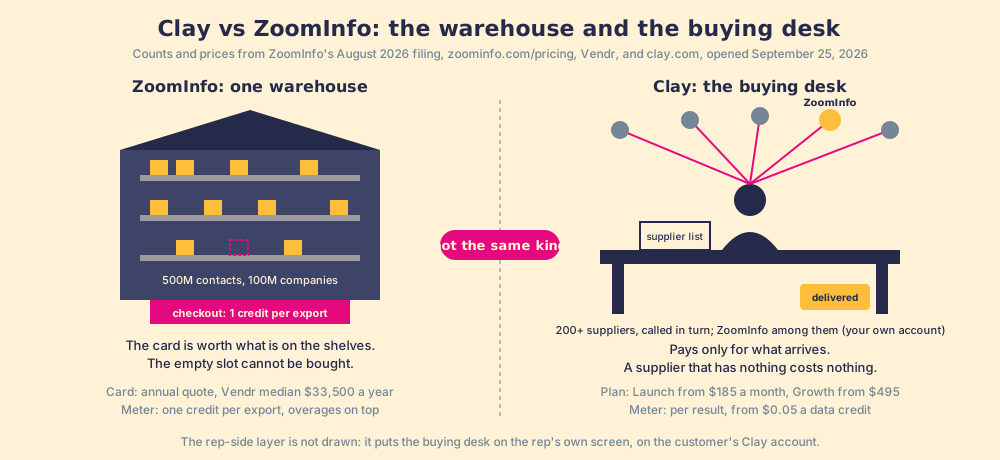
A wholesale warehouse sells you a membership card, and the card is worth exactly what is on the shelves. ZoomInfo is the largest such warehouse in the trade: “more than 100 million companies, 500 million contacts” by its own August 2026 filing (Q2 2026 results), entered on a quote rather than a price tag, and metered at the checkout, where its pricing page says “Each export costs one credit” (zoominfo.com/pricing, opened September 25, 2026). If the mobile number you need is not on the shelf, the card does not help you, and the trade’s usual remedy is a card to a second warehouse. Clay is not a warehouse. Clay is the buying desk: one purchasing agent with 200+ supplier accounts on the phone list (clay.com, September 25, 2026), who calls suppliers in turn until one delivers and pays only for what arrives. ZoomInfo is one of the suppliers on that list. So clay vs zoominfo is a category error the way “warehouse vs buyer” is: the buyer can shop at the warehouse.
Clay vs ZoomInfo, stated once: ZoomInfo is one B2B contact database sold on a quote and metered at one credit per export; Clay is a waterfall that asks 200+ data vendors in turn, ZoomInfo among them on your own account, and charges only per result. Whether you searched zoominfo vs clay, clay or zoominfo, or the bare pair clay zoominfo, the pages that come back set the two side by side as rivals. They are not. The question underneath has arithmetic in it, and in 2026 it has a second layer: the warehouse has told the SEC it is moving to the other side of town.
What is ZoomInfo selling in 2026?
The deepest shelves in the trade, and a card priced by conversation. The pricing page names three sales tiers, ZoomInfo Professional, Copilot Advanced, and Copilot Enterprise, and prints no numbers. Vendr fills the gap: the median buyer pays $33,500 a year across 1,573 purchases, the range runs from $7,213 to $155,820, annual escalators of 5% to 10% are typical, and buyers who do not negotiate credits up front report $10,000 to $50,000 in overage fees over a term (Vendr, ZoomInfo). The card is priced by the year. The checkout is priced by the cart.
The warehouse also relocated this year. On May 5, 2026, ZoomInfo’s board approved its 2026 Restructuring Program: about 600 roles, roughly 20% of headcount (SEC Form 8-K, May 2026). CEO Henry Schuck’s note to staff said the company is “accelerating our move upmarket, and reducing the resources we allocate downmarket,” and that “the industry is moving toward consumption-based pricing.” By the August results, 76% of contract value sat upmarket, net revenue retention was 89%, and 1,891 customers paid $100,000 or more a year. Forrester named it a Leader with the highest current-offering score in its Q1 2026 Wave for B2B sales and marketing data (Q1 2026 results). It has traded as GTM since May 2025 and is public as of September 25, 2026.
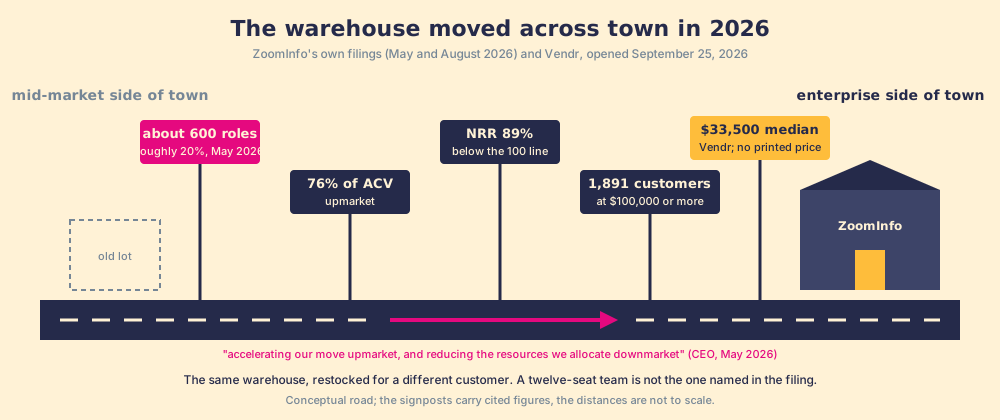
None of that makes ZoomInfo a worse warehouse. It makes it a warehouse that has said, in a filing, which customers it is stocking for, and a twelve-seat team is not the customer described.
What is Clay, if it is not a warehouse?
Clay has no shelves. Its homepage sells “one contract to buy data from 200+ data and AI vendors,” and its rep-prospecting page describes the mechanism: “Clay’s signature data waterfalls check multiple providers to return the most verified emails (lower bounce rate) and phone numbers (higher connect rate)” (clay.com/use-cases/rep-prospecting, September 25, 2026). The request goes to the first supplier; on a miss, to the next; the org pays per delivery.
And ZoomInfo is on the supplier list. Clay’s marketplace lists ZoomInfo as a Clay-built integration that joined on January 15, 2025, data strength marked “Enterprise,” included in all plans, with actions to enrich a company, enrich a contact, enrich up to 25 contacts at once by ZoomInfo ID, and search contacts (clay.com/integrations/data-provider/zoominfo, opened September 25, 2026). Each action is marked “Bring Your Own Account Required,” which is the fair print: the buying desk sends your request through the ZoomInfo membership you already hold, and Clay’s pricing FAQ says that with your own key for a provider “you skip Data Credit costs entirely” (clay.com/pricing, opened September 25, 2026). The buyer can shop at the warehouse, and her fee does not double when she does.
Two different people run the two products. A ZoomInfo seat is operated by the rep. Clay is operated by the builder: “GTM engineers build on Clay,” in Clay’s words, and Clay says it coined that title in 2023 (clay.com/blog/gtm-engineering). The engineer builds the table; the rep is meant to run it; the running needs a Clay tab, and the rep lives in LinkedIn and the CRM. Hold that gap. The end of this page is about it.
Clay vs ZoomInfo, side by side
Not a vendor table with Clay as a row. A table of two kinds of thing.
| ZoomInfo | Clay | |
|---|---|---|
| What you are buying | One database (500M contacts, 100M companies) with intent data, Copilot, and enterprise support | A waterfall across 200+ vendors, ZoomInfo among them on your own account |
| Pricing unit | Annual quote (Vendr median $33,500) plus one credit per export, with overages | Plan (Launch from $185 a month, Growth from $495) plus data credits from $0.05, per result |
| Who operates it | The rep, in the ZoomInfo app or extension | The GTM engineer, who builds tables and waterfalls for reps to run |
| Coverage model | What is on this warehouse’s shelves | Supplier after supplier until one returns a verified email or phone; a miss costs nothing |
| Where the rep works | ZoomInfo’s tab, extension, and Copilot | A Clay table, unless a rep-side layer brings the waterfall to LinkedIn and the CRM |
| What happens after export | Credit consumed; nothing measures whether the buyer moved | Result delivered to the table or CRM; nothing measures whether the buyer moved |
Sources: zoominfo.com/pricing, vendr.com, and clay.com/pricing, opened September 25, 2026. The last row is identical on purpose: neither product knows whether the contact it delivered was ever worked.
What changed in 2026 on both sides?
On the ZoomInfo side, the move across town, above, and a CEO on record that the industry is heading to consumption pricing, which is how the buying desk has charged all along. On the Clay side, the price list was rebuilt. Clay Pricing 3.0, announced March 11, 2026, collapsed three self-serve tiers into two and split the old credit into Data Credits, which buy enrichment from the marketplace, and Actions, which pay for platform work (Clay Pricing 3.0, March 2026). The pricing page as opened today shows Launch from $185 a month ($167 on annual) with 2,500 data credits a month, Growth from $495 ($446 annual) with 6,000 data credits a month and CRM auto-sync, and Enterprise on an annual commitment. Data credits start at $0.05 each. Clay says it cut marketplace costs 50% to 90% on most providers.
The line on that page that matters more than the prices: “If an enrichment returns no result, you’re not charged Data Credits or Actions.” The warehouse charges at the checkout. The buying desk charges when the truck arrives.
Do you still need the ZoomInfo contract?
The arithmetic. Vendr’s median ZoomInfo contract is $33,500 a year, before the $10,000 to $50,000 in overages Vendr’s buyers report and the 5% to 10% escalator. Clay’s Growth plan is $5,940 a year at list, with 72,000 data credits across the year. The platform fee is less than a fifth of the median warehouse card, and the credits are the number you owe yourself an estimate for, because they scale with what your reps source rather than with how many of them hold a card. The seat model has a second cost the quote never shows. The Bridge Group’s 2025 report puts median SDR attrition at 40% a year across 351 companies (Bridge Group, 2025); a card bought in January for a rep who leaves in July keeps costing through December. A per-result meter stops the day the rep stops sourcing.
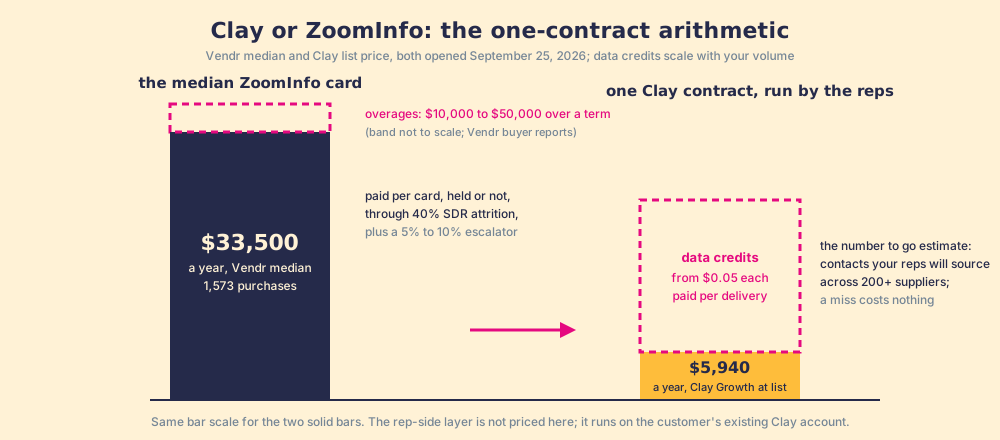
Where the picture breaks. A buying desk with no buyer at it is a phone list; the GTM engineer is a job title and a salary, and a team without one is buying a tool no one will run and calling it a saving. The second edge is the reason this page exists: the Clay contract is only cheaper than the card if reps use it. RevOps sees credits consumed. No one sees whether a rep ever ran the table.
When does ZoomInfo still win?
- The enterprise customer in the filing. A team at $100,000 or more a year that wants one vendor’s intent data, Copilot, a named success manager, and the depth Forrester scored highest in Q1 2026. That is who the warehouse is stocking for, and it is a fair purchase at that size.
- A team with no Clay and no builder. Without a GTM engineer the buying desk is unstaffed. ZoomInfo is a card a rep can use on day one.
- A team whose whole world is on one shelf. If your segment is large US enterprise and ZoomInfo’s coverage of it is near-complete, a second supplier adds little, and per-result pricing loses its edge.
For those teams the recommendation is ZoomInfo, with credits sized up front and the escalator capped. The ZoomInfo competitors page grades the other databases if the fit is wrong.
What happens after the export?
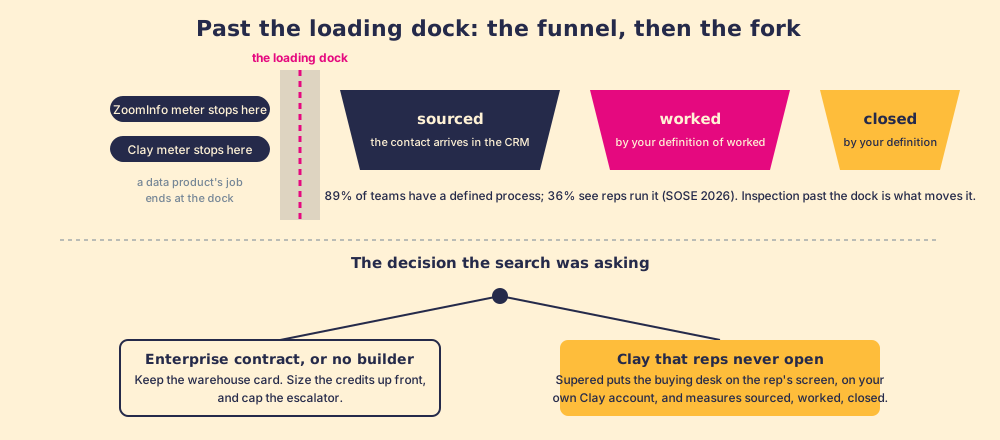
Both meters go dark at the loading dock. The revenue leader’s job starts there. Across 198 sales teams in The State of Sales Enablement, 89% had a defined sales process and 36% saw reps run it as designed, and the teams that inspected adherence consistently hit quota at 6.3 times the rate of those that did not. Sourcing a contact is step one of that process. When step one is the only step measured, the renewal meeting gets the same report each year: a CRM full of contacts, an overage invoice, and no answer to whether the prospecting engine is working.
You can only expect what you inspect. So the layer worth adding after Clay treats the sourced contact as the start of a motion with an expectation attached: was it worked, by your definition of worked; did it advance; did it close, by your definition of closed. Supered is that layer, and it does not bring its own database. It brings Clay’s waterfall, which is every database, routed; that is the reason we chose Clay as our only data provider. A rep on a LinkedIn profile, a Sales Navigator list, a company’s website, or a HubSpot or Salesforce record gets the waterfall in one click and syncs the contact with no Clay login, on the customer’s own Clay account. The next expected action then reaches the rep in the flow of the work, the manager sees sourced, worked, and closed per rep against the standard they set, and the CRM stays the clean record pipeline hygiene depends on. Clay governs the data. Supered governs the motion.
In the same study, quota attainment ran 49% when process guidance reached reps in the flow of work versus 15% when it lived in documents. A contact sourced and then worked to a standard is a buyer who gets a consistent experience, and consistency is what the buyer feels first.
The full reasoning sits in the sales process guide; the sibling comparison, Clay vs Apollo, runs the same argument against the database that bundles a dialer.
Clay or ZoomInfo: the verdict
- ZoomInfo itself. The right purchase for the enterprise customer its filings describe, and for a team with no Clay and no one to build in it. Negotiate at quarter-end, size the credits up front, cap the escalator.
- Clay, run by a builder. The right purchase for a team with a GTM engineer that is done stacking warehouse cards, and wants per-result pricing across 200+ suppliers with its existing ZoomInfo account routed through as one step.
- Clay via Supered. The right purchase for a team that already has Clay and reps who never open it. The rep gets the buying desk on the LinkedIn tab and the CRM record; the manager gets sourced, worked, and closed against the standard they set. The export becomes the first step of a measured process instead of the last thing anyone sees.
So here is what we recommend. Stop comparing the warehouse with the buyer. If you are the customer in the filing, keep the card and read the overage clause twice. If you have Clay, do not sign a second warehouse; the buyer already has that one on her list. Put her on your reps’ screens where they already work, and meter what happens after the truck arrives, because a contact delivered and never worked cost a credit and earned nothing. The demo is where you can watch it run on your own Clay account.
Frequently asked questions
Is Clay a replacement for ZoomInfo?+
How much does ZoomInfo cost compared with Clay?+
What changed at ZoomInfo in 2026?+
When is ZoomInfo the better choice than Clay?+
Can reps use Clay without a Clay login?+
Your process, running itself.