Lusha vs Supered ProspectorOne database by the credit, or every database through Clay.
Lusha sells its own contact database through a Chrome extension, at a posted price: 1 credit for an email, 5 for a phone. Prospector sells no data. It puts the Clay tables your GTM engineer already built in every rep's hands, in Sales Navigator, on company sites and in the CRM record, for $45 per rep per month. If you have no Clay and a few reps who reveal contacts from LinkedIn, buy Lusha. If you run Clay, Clay plus Prospector is the better way for a sales team to prospect: GTM engineers build in Clay, reps never open Clay.
01Supered ProspectorTeams already on Clay who want every rep running the tables from where they prospect, a one-click CRM sync, and each list tracked found, worked and closed. $45 per rep per month, billed annually, from 1 rep.
02LushaOne to five reps with no Clay who reveal contacts from LinkedIn and want a price they can read and buy today. Free plan, then $449.10 to $3,599.10 a year.
03ApolloSmall teams with no Clay who want a database, an extension and sequences in one self-serve plan, from $49 per user per month billed annually.
G2 on 2 October 2026: Lusha 4.3 out of 5 from 1,667 reviews; Supered 4.9 out of 5 from 81 reviews. HubSpot marketplace: Supered 5.0 from 122 reviews.
Status check
What is Lusha selling in October 2026?A database that added a waterfall.
Lusha posts its prices, which most of its rivals do not. On 2 October 2026 its pricing page lists a Free plan with 40 credits a month, Starter at $449.10 a year for 4,800 credits and 1 seat, Professional at $629.10 a year for 7,200 credits and 2 seats, and Premium at $3,599.10 a year for 40,800 credits and 5 seats, with Scale quoted. Monthly billing runs $49.90, $69.90 and $399.90. The meter is the same everywhere: "Reveal verified email address, 1 credit" and "Reveal a phone number, 5 credits" (lusha.com/pricing). The extension that spends those credits has 400,000 users and 4.6 out of 5 from 1.9K ratings on the Chrome Web Store.
Two changes this year move Lusha closer to Clay. Lusha joined Clay's marketplace on 10 March 2026, with "Enrich Person with Lusha" and "Enrich Company with Lusha" each marked "Bring Your Own Account Required" (clay.com). And Lusha built its own Data Waterfall: when its data has no match, the request falls through to third-party providers, and since September it is "available on every paid plan." Lusha sets the order, and a field filled that way "is charged at the enabled provider's own credit rate," which "can be higher than a standard Lusha-only reveal" (Lusha changelog).
One open file matters for European pipelines. In July 2026 Italy's data protection authority fined Lusha €2 million and ordered it to stop processing data on people in Italy; on 2 October 2026 the authority's own page says the decision is temporarily removed under a Court of Rome interim order of 8 September 2026 while Lusha's challenge is heard (Garante). The Lusha review covers it in full.
The decision table
Lusha vs Prospector at a glanceNine lines that decide it.
Lusha
Supered Prospector
Job it is built for
A rep reveals a contact's email or phone from the page they are on, from Lusha's own database, and exports it.
Clay in every rep's hands: the tables your GTM engineer built become a button reps press where they already prospect, and leaders see what each list produced.
Data source
Lusha's database first, then its Data Waterfall on paid plans, with the provider order set by Lusha.
Clay's waterfall across 200+ providers, in the order your GTM engineer sets, on your own Clay account and credits. Lusha can be one step, on your own Lusha account.
Where reps use it
Chrome and Edge extension on LinkedIn and Sales Navigator, company websites, Gmail, and Salesforce, HubSpot and Pipedrive records.
Inside the Supered Chrome extension: LinkedIn profiles, Sales Navigator, company websites, and HubSpot, Salesforce and Pipedrive records. Reps never log into Clay.
CRM sync
Push to Salesforce and HubSpot, set up by a Lusha admin and a CRM admin. A CRM export from the Lusha Workspace costs 1 credit.
One click to HubSpot, Salesforce or Pipedrive, field mapping set once by Ops. Before the push, the rep sees the matching CRM record, who owns it, and whether the person was worked before.
Pricing model
Posted: Free, then $449.10, $629.10 and $3,599.10 a year (1, 2 and 5 seats). 1 credit an email, 5 a phone. Vendr's median buyer pays $15,999 a year.
Published: $45 per rep per month, billed annually ($540 a rep a year), from 1 rep. Enrichment runs on the Clay credits you already buy.
Contract and terms
Monthly or yearly; cancel at any time and credits stay until the end of the billing period. Yearly credits arrive upfront and reset at the end of the year. Over 5 users, talk to sales.
Annual, from a single seat. No free trial yet: it starts with a demo on your own Clay account.
What leaders see afterward
Credit usage at the account level, across users and channels. What happens to the contact next lives in your CRM reports.
Every list found, worked and closed, per rep, with closed outcomes Qualified, Recycled or Disqualified, and no duplicate work across reps.
Security
Trust center: "SOC 2 Type II Certified" and "5 ISO Certifications."
SOC 2 Type II and GDPR (Supered).
G2
4.3 out of 5 from 1,667 reviews.
Supered: 4.9 out of 5 from 81 reviews. Prospector is new and has no reviews of its own yet.
How we graded: by the job, because the two products do different ones. Lane one is a small team with no Clay where a few reps reveal contacts themselves. Lane two is a team on Clay that wants every rep running the tables. Weights in both lanes: contact coverage the rep can reach (35%), where the rep works and the CRM sync (25%), what a leader sees about each list afterwards (20%), price and contract for the team in that lane (20%).
Tool
Lane
Grade
Rank
Why it ranks here
Lusha
A few reps, no Clay
A
1
Easy to start: a free plan, posted prices from one seat, an extension 400,000 people use, and a Data Waterfall on every paid plan. Phones at 5 credits each are the line to watch.
Apollo
A few reps, no Clay
A-
2
Cheaper per phone at list and sequences in the same plan, from $49 per user per month billed annually. A busier tool for a rep who only wants a number.
Supered Prospector
A few reps, no Clay
C
3
Out of scope: Prospector runs on Clay and brings no database of its own.
Supered Prospector
Clay in every rep's hands
A
1
Built for this: your tables as a button in Sales Navigator, on company sites and in the CRM record, a CRM check before the push, found to closed per list, a published price.
Lusha
Clay in every rep's hands
C
2
Its extension runs Lusha's data and Lusha's waterfall only. On Clay, Lusha is best used as one step in your waterfall, on your own Lusha account.
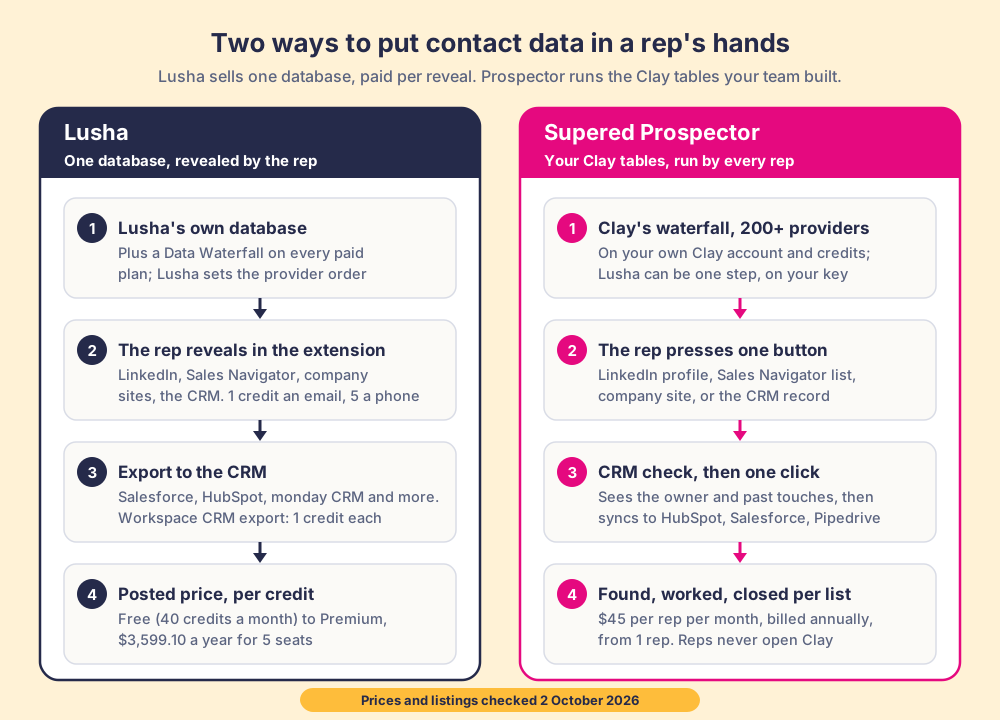
Two paths to the same goal, a contact in the CRM that a rep works. Lusha: its own database plus a Data Waterfall on every paid plan, revealed in the extension at 1 credit an email and 5 a phone, Free (40 credits a month) to Premium at $3,599.10 a year for 5 seats. Prospector: Clay's waterfall across 200+ providers on your own Clay account, one button for the rep, a CRM check, one click to the CRM, $45 per rep per month billed annually. All checked 2 October 2026.
Fair to them first
What is Lusha best at?The fastest start for a rep on LinkedIn.
Lusha is the easiest contact tool on this page to start using. A rep installs the extension, opens a LinkedIn profile, Sales Navigator, a company website or a CRM record, and reveals an email or a phone. Its docs say the extension is available on all plans, works in Chrome and Edge, and runs inside Salesforce, HubSpot and Pipedrive records without leaving the page (Lusha docs). There is no table to build and no one to ask. For a founder or a two-rep team, that is worth a lot.
The pricing is open, too. Lusha prints every self-serve plan, sells a single seat, offers a free plan, and never charges twice for the same data point: re-viewing a contact you already revealed costs 0 credits (Lusha credit reference). It holds 4.3 out of 5 from 1,667 reviews on G2, where buyers praise how easy it is and how quickly a contact lands in the CRM. Its trust center lists SOC 2 Type II and five ISO certifications.
The trade-offs are the ones its reviewers name. The phone is the expensive line: at 5 credits each, Starter's 4,800 yearly credits buy at most 960 phone numbers, and a phone plus an email costs up to 6. G2 reviewers write that credits run out fast at volume and that some contacts come back incomplete. Above five users, the pricing page sends you to sales, and Vendr's median Lusha buyer pays $15,999 a year across 147 purchases. None of that makes Lusha a bad buy. It makes Lusha a tool that fits a few reps well and a 20-rep team on Clay poorly.
Why buyers compare
Why are Lusha customers looking at Clay and Prospector?Credits per rep, when Clay already asks everyone.
The question is rarely whether Lusha works. It is whether paying per reveal, per seat, still makes sense once a GTM engineer is building in Clay.
One database, then Lusha's chosen fallback.Lusha's waterfall asks Lusha first and then the providers Lusha picks, in Lusha's order. A Clay waterfall asks 200+ providers in the order your team sets, and can include Lusha on your own account.
The phone meter.Five credits a phone adds up for a team that calls. Credits on a yearly plan arrive upfront and reset at the end of the year, so a slow quarter is credit you lose.
A seat per rep for a lookup.Many reps only need the contacts for the account or lead in front of them. On Clay, the table runs from that page on credits the team already buys, so reps stop asking for another database seat.
The list after the export.Lusha shows credits spent. Whether the contact was worked and how it ended sits outside the product. Leaders on Clay ask Prospector to show that per list.
Prospector, for teams on Clay
What does Prospector do that a Lusha seat does not?You build it. Reps run it. Everyone sees it work.
Prospector is the rep side of Clay, and it runs inside the Supered Chrome extension. Your GTM engineer builds the tables once, person enrichment, the buying committee for an account, the new-logo list for a campaign, and each becomes a flow a rep picks from a Push menu. A rep on a LinkedIn profile, a company's website or a HubSpot, Salesforce or Pipedrive record presses one button, and your Clay table runs on your own Clay account. In Sales Navigator, reps add leads to a prospect list and push the list to a Clay table. Your logic stays yours: waterfalls, tiers, tags and sequence variables. The engineer stops being the list desk.
Before anything syncs, the rep sees whether the person already has a CRM record, who owns it, and whether they were prospected before, so two reps do not work the same buyer. One more click sends the contact to HubSpot, Salesforce or Pipedrive with the field mapping Ops set once. Reps never log into Clay and do not need a database seat of their own. The plays are the ones a sales team runs every week: research an account, new logos, expansion inside customers, job changers, and adding the economic buyer to a stalled deal before the forecast call.
Then the part a Lusha reveal does not show. A sales leader sees every list found, worked and closed, rep by rep, and every lead ends the way your process says: Qualified, Recycled or Disqualified. When a leader can see what the tables produced, the Clay budget grows. The full loop is on the sourcing use case, and the rep's view is on Prospector for reps.
Prospector costs $45 per rep per month, billed annually, which is $540 a rep a year and $5,400 a year for ten reps, and you can buy it for one rep. It runs on the Clay plan and credits you already pay for. There is no free trial yet. It starts with a demo on your own Clay account, and the details are on the Prospector page.
Choose something else when the job looks like this
No Clay and no one to build in it.Prospector runs only on Clay. Without a GTM engineer, a database a rep can use on day one, Lusha or Apollo, is the faster start.
One to three reps, a few reveals a day.If the whole job is a handful of emails and phones from LinkedIn, Lusha's Free or Starter plan costs less than any Clay setup.
Reps who live in an AI chat.If your reps work inside ChatGPT or Claude, Clay's own MCP brings Clay there, governed by Ops.
Run your Clay table from Sales Navigator.
A demo on your own Clay account. Bring the table your reps ask for most often.
Lusha vs Prospector: which should you choose?Decide by whether you run Clay.
If you have no Clay and a few reps who reveal contacts from LinkedIn, Lusha is the best pick. If you run Clay, Prospector is the best pick: Clay plus Supered is the best way for a sales team to prospect, because GTM engineers build in Clay and reps never open it.
Choose Lusha if
You have no Clay and no builder. A rep installs the extension and reveals a contact in minutes, with a free plan to try it.
You are one to five reps. Posted prices from one seat, monthly or yearly, and Premium covers five seats for $3,599.10 a year.
You mostly need emails. At 1 credit an email, an email-heavy team gets the most out of the meter.
Choose Prospector if
You already run Clay. Every rep runs your tables from Sales Navigator, company sites and the CRM record, with no Clay login.
You want lists you can follow. Found, worked and closed for each list, rep by rep, with no duplicate work.
You are done buying seats for lookups. $45 per rep per month, billed annually, from 1 rep, on the Clay you already pay for.
You do not have to pick a side of the data. If you keep a Lusha account, Clay can call it as one step in the waterfall on your own Lusha key, and Prospector puts that waterfall in front of every rep.
Why trust this page
Why trust a comparison written by Supered?Weigh it, then check the sources.
We sell one of the two products on this page, so weigh what follows. Every Lusha fact links to its source and carries the date we checked it, 2 October 2026, and where Lusha is the better buy we say so in the grades and the verdict. When Lusha changes its prices or what it sells, this page changes with it.
Supered is the #1 sales enablement app on the HubSpot marketplace and a HubSpot Premier Tech Partner, with 6,000+ installs. It holds 5.0 from 122 reviews on the HubSpot marketplace and 4.9 out of 5 from 81 reviews on G2. Those reviews cover Supered as a whole. Prospector is the newest product and runs inside the Supered Chrome extension, so judge it in a demo on your own Clay account.
Switching, or using both
How do you move from Lusha seats to Clay and Prospector?Keep what works, move the front door.
You do not have to drop Lusha on day one. The gentler path is to route it through Clay first, then decide when the plan renews.
Put Lusha inside the waterfall.Clay's Lusha integration runs on your own Lusha account, so one Lusha plan can serve as a step among 200+ providers, for example where your EMEA coverage needs it, instead of a seat per rep.
Turn the tables into buttons.An admin connects Clay inside Supered, and each table or custom workflow becomes a flow reps pick from the Push menu. Start with the Supered Clay template or bring your own tables.
Set the CRM mapping once.Ops maps fields for HubSpot, Salesforce or Pipedrive, and every sync after that is one click.
Watch the lists, then decide at renewal.Yearly Lusha credits reset at the end of the cycle, so plan the switch for the renewal date and spend what you have first.
What else should a Lusha buyer look at?The rest of the shortlist.
If neither Lusha nor Clay plus Prospector fits, these are the names buyers put next to Lusha. Each has a full head-to-head on our blog.
Apollo.One database with an extension and built-in sequences, self-serve from $49 per user per month billed annually (apollo.io, checked 2 October 2026). Cheaper per phone at list. Apollo vs Lusha.
Kaspr.A LinkedIn-first extension with unlimited B2B email credits under a fair-use policy, Starter from $49 per user per month billed annually (kaspr.io, checked 2 October 2026). Owned by Cognism. Kaspr vs Lusha.
Cognism.Sold on a quote with 5 seats included, and the usual pick when most of your buyers are in Europe. Lusha vs Cognism.
ZoomInfo.The largest single database, intent data and AI agents, on a negotiated contract with no published price. Lusha vs ZoomInfo.
Clay, run by a GTM engineer.Not a database: the waterfall across 200+ providers that a builder runs for the team. Prospector is how reps run it themselves. Clay vs Lusha.
For teams on Clay, yes. Prospector brings no database of its own: it runs your Clay tables, Clay's waterfall across 200+ providers, from Sales Navigator, LinkedIn profiles, company websites and HubSpot, Salesforce or Pipedrive records, then syncs to the CRM in one click. For a small team with no Clay, it is not a substitute; Lusha or Apollo is.
How much does Lusha cost compared with Prospector?
On 2 October 2026 Lusha lists a Free plan with 40 credits a month, Starter at $449.10 a year, Professional at $629.10 a year for 2 seats and Premium at $3,599.10 a year for 5 seats, with 1 credit per email and 5 per phone. Vendr's median Lusha buyer pays $15,999 a year. Prospector costs $45 per rep per month, billed annually, from 1 rep, and runs on the Clay plan and credits you already have.
Can I keep my Lusha data and use Prospector?
Yes. Lusha has been in Clay's marketplace since 10 March 2026, and its person and company enrichments run on your own Lusha account. Lusha becomes one step in your Clay waterfall, and Prospector puts that waterfall in front of every rep.
Do reps need a Clay login or a Lusha seat to use Prospector?
Neither. Prospector runs on your company's Clay account and Clay credits, so the team needs Clay, but reps never log into it. They press a button inside the Supered Chrome extension where they already prospect.
Does Prospector scrape LinkedIn?
Prospector works within LinkedIn's terms and does not copy search results in bulk; the contact data comes from Clay's waterfall on the customer's Clay account. In Sales Navigator, reps add leads to a prospect list and push the list to a Clay table.
Which CRMs does Prospector work with?
HubSpot, Salesforce and Pipedrive. Ops sets the field mapping once, reps sync in one click, and before they do, they see the matching CRM record and whether the person was worked before.