Zero. Every day.Your sales expectations. Actually followed.
Sales expectations are the checkable things a rep owes each open deal: a close date that has not passed, an amount after discovery, a recap the day after the meeting. Your team already has them. The trouble is checking them, because a manager can read every record for five reps and not for eight. Supered keeps your sales expectations as rules, checks each open deal against them every night, and lets the rep clear what is left in HubSpot, in Salesforce, or by asking Claude to do the work.
First two figures: The State of Sales Enablement 2026. The third is the target, and the state of Matt Bolian's own board the morning after the example below.
Same rules, wherever reps workHubSpotSalesforceClaudeAny MCP-ready LLMGmailOutlookSalesloftGongLinkedInAny URL
6 min read
What you'll learn: the three kinds of sales expectations, why checking them by hand stops working past five reps, a starter template, and how one prompt in Claude cleared 11 violations
Chapter 01 · The definition
What are sales expectations?The process you can check on a record.
A sales process says how a deal should move. A sales expectation is the piece of it you can verify without asking anyone: the next step is less than nine days old, the amount is filled in past Discovery, the recap went out within a day. If a rep skipping it makes you angry, it is already an expectation. Your team probably has more of them than it has written down.
They come in three kinds. Momentum expectations keep the deal moving. Data expectations keep the record complete enough to forecast from. Process expectations make sure the steps your best reps take happen on time, for the buyer's sake as much as yours.
The usual way
Written in a deck. Checked at the pipeline review.
The expectations go out at kickoff. Once a week a manager scrolls the pipeline, finds the stale close dates, and asks about them one by one. The meeting meant for the buyer turns into a field audit, and anything the manager did not open goes unchecked.
→
With Supered
Written as rules. Checked every night.
Each expectation becomes a Process Rule. A Process Board checks each open deal against each rule and lists what is broken, rep by rep. The rep clears it before the meeting, in the CRM or in Claude. The review starts at zero and goes straight to the buyer.
Chapter 02 · The problem
Why do reps skip sales expectations they already know?
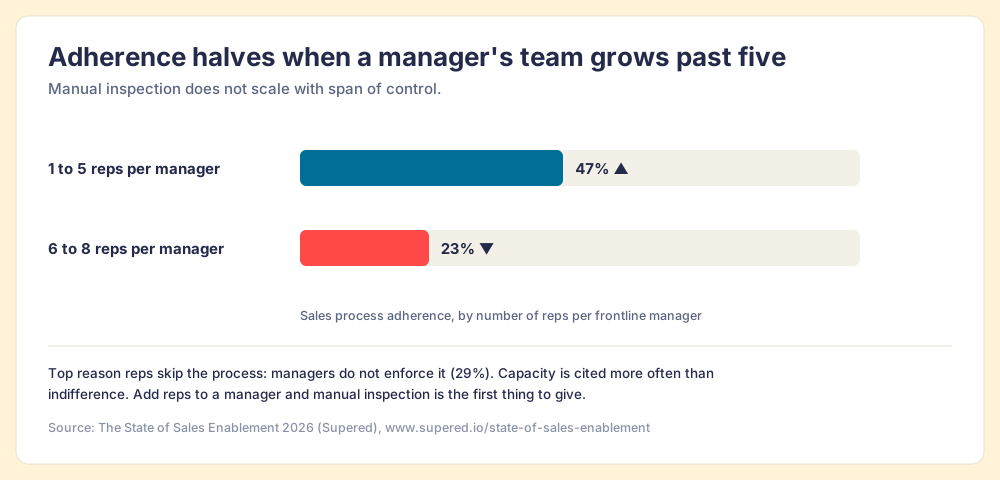
Not because they forgot. In The State of Sales Enablement 2026, the top reason reps skip the process is that managers do not enforce it (29%), and managers cite capacity more often than indifference.
What you can see
The rules exist. Two thirds of teams watch them get skipped.
89% of teams have a defined sales process. 36% see reps follow it as designed. The gap shows up as close dates in the past, deals with no amount, and meetings with no recap.
What it feels like
You became the field auditor.
You hired managers to coach. They spend Friday afternoon opening records and sending "can you update this" messages, and the reps hear the expectations as nagging instead of standards.
Why it is wrong
The system failed the rep.
A good rep should not need someone reading over their shoulder to keep a close date current. When the check depends on a manager's spare hour, the expectation is only as strong as that hour.
Chapter 03 · The math of inspection
Why does checking sales expectations by hand stop working past five reps?
You can only expect what you inspect. Inspection is mandatory. The burden is what breaks. Process adherence is 47% on teams where a manager has one to five reps and 23% where they have six to eight (The State of Sales Enablement 2026). Same managers, same rules, more records than hours.
A smoke detector checks the air every minute of the night, whether or not anyone in the house is awake, and the family does not take it as an insult. Sales expectations need the same kind of check: one that runs whether or not the manager has an hour free.
Today
Expectations checked when a manager has an hour. Fewer hours with each rep you add.
With Supered
Each open deal checked every night. The manager's hour goes to coaching.
How Supered runs sales expectations
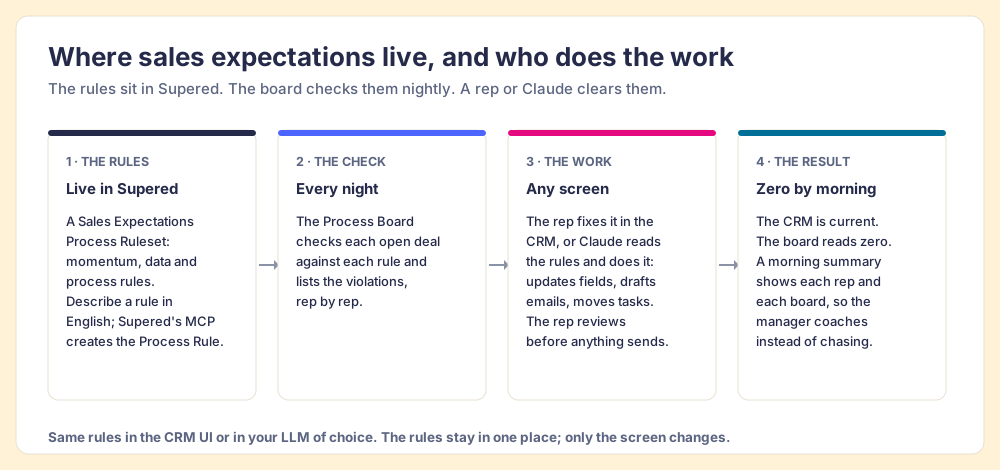
The rules live in Supered. Any screen does the work.
You have probably tried the kickoff deck, the dashboard, the Slack reminder and the Friday audit. When we surveyed 198 revenue leaders for The State of Sales Enablement, they described the same cycle: expectations written well, checked when someone had time, drifting by the next month. Supered closes that cycle with a check that runs on its own and a fix that takes minutes.
01 · THE RULES
Your expectations, written as Process Rules.
Momentum, data and process expectations sit together in one Process Ruleset. Describe a rule in English. Supered's MCP creates the Process Rule. You can read exactly what each rule checks.
02 · THE CHECK
Each open deal, checked every night.
A Process Board lists each deal that breaks a rule, rep by rep. A daily summary goes to Slack, and streaks count the days a rep finishes at zero. The manager does not have to go looking.
03 · THE WORK
Cleared in the CRM, or by Claude.
The rep fixes it in HubSpot or Salesforce, or asks Claude. Claude reads the rules and does the work: updates fields, drafts emails, moves tasks. Same rules in the CRM UI or in your LLM of choice.
Chapter 04 · One night on one board
What does clearing sales expectations with Claude look like?
Matt Bolian, Supered's co-founder, recorded his own board on his own open deals. One rep, one night: we print it as his example and nothing more.
Matt's own example
Zero Board · Sales Expectations
22 rules · his open deals in HubSpot · Supered, HubSpot and Gmail connected to Claude
Late at night
11 violations, and a streak that resets at midnight.
Close dates in the past. No amount past Discovery. Overdue tasks. No pre-call email within 24 hours of the next meeting. No recap sent. No decision maker recorded.
One prompt
"Look at my Zero board and fix all my violations. Draft anything that needs an email."
Claude loaded his Supered rules and found each violation. It filled the amount from the discovery notes, matched close dates to the next meetings on his calendar, and saved recap and pre-call emails with a recommended next step to Gmail drafts.
Next morning
The Slack summary: 0 violations across all boards.
The streak held. Caleb King, on the same team, was at five days.
Time to clear the board~10 minWith Supered and Claude, against about 45 minutes by hand. Matt's example, on his deals.
Claude's HubSpot connector can search and update CRM records, and its Gmail connector can create drafts (HubSpot connector, Gmail connector, both checked 2026-10-01). What neither knows is your rules. Supered supplies them. For the step-by-step setup, read the HubSpot Claude connector workflow.
Chapter 05 · The template
What goes in a sales expectations template?
Thirteen rules to start from, taken from the ones Matt runs on his own deals and grouped the way Supered groups them in a Process Ruleset. The thresholds are his. Change them to fit your cycle, and drop any your team does not care about. A rule your managers would not raise in a one-on-one does not belong on the board.
01 Momentum expectations
The deal keeps moving.
Activity in the last 5 days
Flag an open deal with no logged activity for more than five days.
Fresh next step
Flag a next step that has not been updated in more than nine days.
Close date not in the past
Flag an open deal whose close date has already passed.
Close date set
Flag an open deal with no close date.
Recent LinkedIn touch
Flag a deal with an amount and no LinkedIn contact in 21 days.
02 Data expectations
The record is complete enough to forecast from.
Amount past Discovery
Flag a deal past Discovery with no amount.
Contact associated
Flag a deal with no associated contact.
Company associated
Flag a deal with no associated company.
Deal source
Flag a deal with no original source recorded.
03 Process expectations
The steps your best reps take happen on time.
Recap sent
Flag a completed meeting more than a day old with no recap email.
Pre-call email
Flag an upcoming meeting with no email to the buyer in the 24 hours before it.
Task due today
Flag a task due today that is not started.
No overdue tasks
Flag a task past its due date that is not complete.
Two notes from running it. First, a decision maker rule is worth adding once your team agrees on how to record one; it was one of the violations on Matt's board. Second, expectations and buyer reality are both needed: a deal can satisfy every rule and still be stuck with the buyer, so keep the stage tied to what the buyer has done, and use the board to make sure the rep did their part. For the data side in depth, read CRM hygiene as rules checked every night.
Chapter 06 · The plan
How do you get your team's sales expectations to zero, every day?
Three steps. The first one is a conversation.
01.
Pick the expectations your reps skip most.
On a 30-minute demo we look at your pipeline and choose the six to ten expectations that cost you the most when skipped. Start from the template above. Your best reps probably meet most of these already. Their habits set the standard, so the rules describe what already works on your team.
Input: your pipeline and your one-on-one complaintsOutput: a short list of expectations
02.
Turn them into rules and a board.
Describe each expectation in English and Supered's MCP creates the Process Rule, or we build it with you in the admin. The rules go into a Sales Expectations Process Ruleset, and a Process Board for each team checks open deals against it every night. Typical time to rules live: about two weeks.
Where: HubSpot or SalesforceOutput: a board each rep can see
03.
Reps clear the board. Managers coach.
Reps clear violations in the CRM or ask Claude to do it. The morning summary shows where each board stands. Managers stop asking about close dates and spend the one-on-one on the opportunities where a rep needs help with the buyer.
Surface: the CRM or ClaudeOutput: zero by morning
You keep your CRM. Supered works inside HubSpot and Salesforce and never replaces them.
No new tool for reps to log into. The board sits where they already work, and Claude is optional.
Start with a few rules. Add more once the team reaches zero on a normal day.
Chapter 07 · Two versions of next year
Next year your sales expectations are checked when someone has time. Or they are checked every night.
Both teams have the same expectations written down. One of them knows, every morning, whether they were met.
Checked by hand
The pipeline review stays a field audit.
You hire two more reps and the checking thins out. Close dates drift, recaps go out late or not at all, and the forecast call turns into a round of "is this date real?" The best rep still does it right. The rest do it when asked.
Inspection that shrinks as the team grows
Managers chasing fields instead of coaching
A forecast built on unchecked close dates
Checked every night
The team starts each day at zero.
Each open deal gets checked against the same rules, whatever the team's size. Reps clear their own boards, often with Claude doing the typing. The pipeline review starts with the buyer, because the fields are already right.
Inspection that holds at any team size
Managers coaching from what the board shows
A CRM current enough to forecast from
The success state
A month in, your sales expectations stop being a speech. They are a board at zero.
Reps open the day with nothing to fix, or a short list Claude can clear before the first call. Your managers walk into one-on-ones with the deals that need judgment. The fields are already done. When a new rep starts, the expectations are on their board on day one, so a manager does not have to remember to tell them.
Zero
Violations waiting when the team logs in
Nightly
Each open deal checked against each rule
Any screen
The same rules in HubSpot, Salesforce, or Claude
Coaching
Where the manager's hour goes instead of chasing
Chapter 09 · The questions
Sales expectations, asked plainly.
What sales leaders ask before they put their expectations on a board. Direct answers.
Definitions
What are sales expectations?
Sales expectations are the specific, checkable things a rep owes each open deal: a close date that has not passed, an amount once discovery is done, a recap within a day of a meeting, no task left overdue. They fall into three kinds: momentum expectations (the deal keeps moving), data expectations (the record is complete), and process expectations (the steps your best reps take happen on time).
An expectation without a check is a hope. In Supered, each expectation is a Process Rule, and a Process Board checks every open deal against it.
What is the difference between sales expectations and a sales process?
A sales process describes how a deal should move from first call to signature. Sales expectations are the parts of that process you can check on a record today: is there a next step, is it fresh, did the recap go out. The process is the map; the expectations are the mile markers you can verify without asking the rep.
What goes in a sales expectations template?
Start with three groups. Momentum: no activity in five days, a next step older than nine days, a close date in the past, an open deal with no close date. Data: no amount past Discovery, no contact or company associated, no deal source, no decision maker. Process: no recap within a day of a meeting, no pre-call email before the next one, a task due today, an overdue task. The full starter set is in the template section of this page.
How many sales expectations should a team start with?
Fewer than you think. Pick the expectations your reps skip most often and that cost you the most when skipped, usually six to ten. Matt Bolian, Supered's co-founder, runs 22 rules on his own deals, but he added them over time. A rep who opens a board with forty violations on day one learns to ignore the board.
Inspection
Why inspect sales expectations every day instead of in the weekly pipeline review?
Because a missed expectation is cheapest to fix the day it happens. A recap sent the morning after a meeting lands; one sent a week later is an apology. A daily check also takes the work out of the pipeline review, so the meeting can be about the buyer instead of the fields.
Harkin and colleagues reached a similar result for self-monitoring in general: their 2016 meta-analysis of 138 studies (Psychological Bulletin) found that monitoring progress improves goal attainment, and the effect is larger when progress is physically recorded and reported.
Is inspecting every deal every night micromanagement?
No. Micromanagement is a person standing over a rep. A Process Board is a list the rep can clear on their own, before anyone asks. The rep sees the same violations the manager sees, and can clear them before anyone asks. The manager's time goes to the deals where the rule fired and the rep needs help, which is coaching.
What does "zero" mean on a Process Board?
Zero means no open deal on the board breaks any rule in the Process Ruleset. It is a state you can reach every day, which is why it works as a target: a rep either has violations to clear or does not. The daily summary in Slack shows each board and each rep, and streaks track how many days in a row a rep has finished at zero.
What happens when a rep has a violation?
The deal shows up on the rep's Process Board with the rule it breaks. The rep fixes it in HubSpot or Salesforce, or asks Claude to fix it. When the record no longer breaks the rule, the violation clears on its own. The rep does not have to mark it done.
Claude and other LLMs
How does Claude fix sales expectation violations?
With Supered, HubSpot and Gmail connected, a rep asks Claude to look at their board and fix the violations. Claude loads the rules from Supered, finds each violation, and does the work: fills the amount from the discovery notes, moves a past close date to match the next meeting on the calendar, and drafts the recap and pre-call emails into Gmail drafts for the rep to review. In Matt's own example, 11 violations took about 10 minutes this way, against about 45 by hand.
Does Claude send emails on its own?
In the workflow on this page, no. Claude saves recap and pre-call emails as Gmail drafts, and the rep reads and sends them. Claude's Gmail connector lists a create-draft tool for this. Field updates in the CRM happen directly, and each one is visible in the record history.
Does this work with ChatGPT or other LLMs?
The rules live in Supered, and Supered connects to LLMs through MCP, the open standard for connecting AI applications to outside systems. Claude supports MCP connectors. OpenAI's help center says full MCP support with write actions is in beta for ChatGPT Business, Enterprise and Edu plans, through developer mode. Same rules in the CRM UI or in your LLM of choice.
How do we create the rules? Does AI write them?
Your team decides the rules. Describe a rule in English, for example "flag any open deal past Discovery with no amount," and Supered's MCP creates the Process Rule directly. You can also build rules by hand in the Supered admin. Either way, the rule is yours and you can read exactly what it checks.
Setup and rollout
Does Supered work with HubSpot and Salesforce for sales expectations?
Yes. Process Rules and Process Boards run against HubSpot or Salesforce records. Reps see the same expectations inside the CRM and in Claude, so reps do not have to learn a new place to work.
How long does it take to set up sales expectations in Supered?
Typically about two weeks from the first call to rules live on your team's boards. The slow part is rarely the software. It is agreeing on which expectations matter most, and the template on this page is meant to shorten that conversation.
Do reps need to use Claude?
No. The board works inside HubSpot or Salesforce on its own. Claude is the faster way to clear it for reps who want it. The rules do not change with the screen.
Where do I start?
Book a 30-minute demo. We look at your pipeline, pick the expectations your reps skip most, and show you what your board would look like tonight.
A 30-minute demo: we pick the sales expectations your reps skip most, turn them into rules, and show you what your team's board would look like tonight.