Wiza vs ZoomInfo in 2026: The Bakery and the Warehouse Club
Wiza vs ZoomInfo, checked October 2, 2026: G2 reviewers rate Wiza's contact accuracy higher, ZoomInfo's buyers are bigger, and the price gap is $1,990 a seat against a $33,500 median contract. Who each one fits, and the Clay branch.
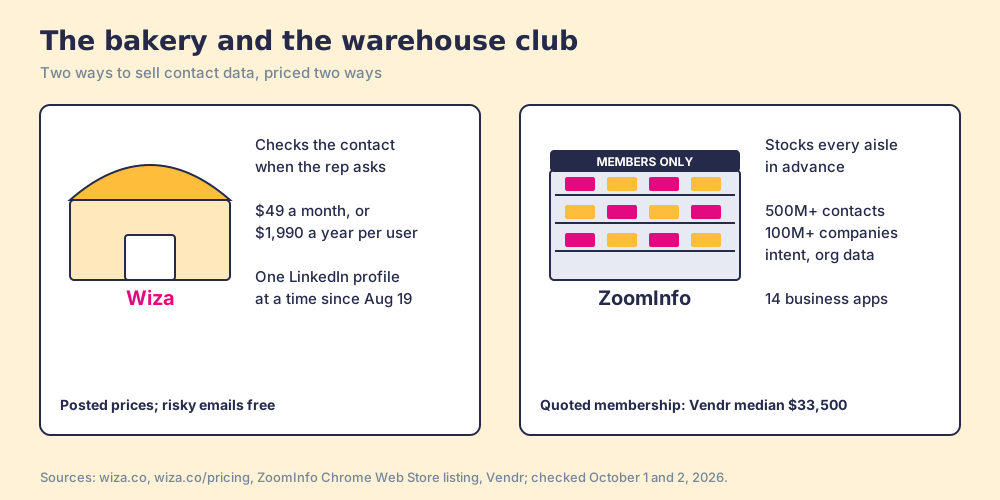
Wiza vs ZoomInfo is a choice between Wiza, a LinkedIn-first contact finder that checks an email or phone when a rep asks for it, sold per user from $49 a month, and ZoomInfo, a full sales data platform with company and intent data sold on quoted annual contracts.
A corner bakery bakes the loaf when you order it. A warehouse club stocks every aisle in advance, sells you a membership at the door, and lets you fill a flatbed cart. Both sell bread. Asking which bread is better tells you little about which one to join.
Wiza vs ZoomInfo is a choice between Wiza, a LinkedIn-first contact finder that checks an email or phone when a rep asks for it, sold per user from $49 a month, and ZoomInfo, a full sales data platform with company and intent data sold on quoted annual contracts. Wiza’s homepage makes the bakery pitch in its own words: “Every other tool pre-loads a database and hopes it hasn’t gone stale. Wiza verifies contact data the moment you request it” (wiza.co, October 2, 2026). ZoomInfo’s store listing makes the warehouse pitch: “500M+ contacts, 100M+ companies,” intent, buying signals, and exports into “Salesforce, HubSpot, Outreach, Salesloft, and 10+ more.” The short answer, by who it fits:
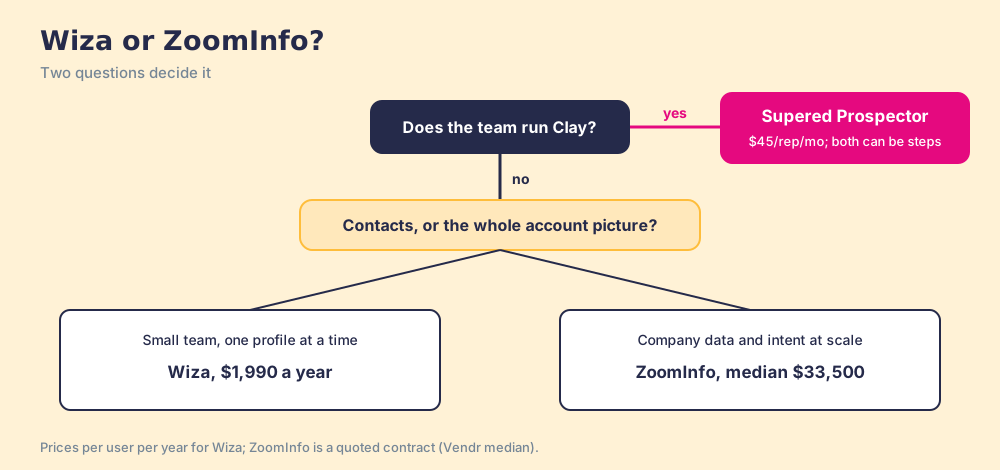
- Supered Prospector. Teams whose RevOps already runs Clay. Reps run the GTM engineer’s tables from LinkedIn, the company site or the CRM record, with Clay’s waterfall across 200+ providers behind them, Wiza and ZoomInfo among the possible steps. $45 per rep per month, billed annually.
- Wiza. Founders, recruiters, agencies and small sales teams working LinkedIn one profile at a time, who want a published price. $1,990 a year per user for unlimited emails and phones inside fair-use limits.
- ZoomInfo. Mid-market and enterprise teams that need company data, intent and org charts in the CRM and can sign a quoted contract (Vendr median $33,500 a year).
How do Wiza and ZoomInfo compare at a glance?
Prices are the plan that includes the job, checked October 1 and 2, 2026. Grades come from the weighted scoring below, on the lens of a five-to-fifty-rep team.
| Rank | Tool | Grade | Best fit | CRM integration | Setup effort | Price (plan with the feature) | Reason to switch |
|---|---|---|---|---|---|---|---|
| 1 | Supered Prospector (on your Clay) | A (44) | Teams that already run Clay | Native in HubSpot, Salesforce, Pipedrive | Live in under a week on your own Clay account | $45 per rep per month, billed annually, plus your Clay plan | 200+ providers behind one click, and lists you can follow to how they ended |
| 2 | ZoomInfo | B+ (28) | Mid-market and enterprise teams that need company and intent data | Native, 14 business apps recognized by the extension | Admin-provisioned | Quoted; Vendr median $33,500 a year | Deepest company data, one vendor for the whole team |
| 3 | Wiza | B- (24) | One to a few reps on LinkedIn, profile by profile | HubSpot, Salesforce, Pipedrive, Zoho, Attio, Outreach, Salesloft | Self-serve in minutes | $990 or $1,990 a year per user; Team plan custom for 3+ | A published price and a contact checked when you ask |
The scoring, so you can argue with it. Each criterion is scored 1 to 5 and multiplied by its weight, for a maximum of 50; the weights and rows match Wiza alternatives so the pages read together.
| Tool | Coverage (x3) | Rep-side delivery (x2) | Price for mid-market (x2) | What the leader sees after (x2) | Bundled outreach (x1) | Total |
|---|---|---|---|---|---|---|
| Supered Prospector | 5 | 5 | 4 | 5 | 1 | 44 |
| ZoomInfo | 4 | 4 | 2 | 1 | 2 | 28 |
| Wiza | 3 | 3 | 3 | 1 | 1 | 24 |
Flip the weights toward one rep’s cost and Wiza passes ZoomInfo easily; flip them toward company data and intent and ZoomInfo pulls further ahead. Prospector scores 1 on outreach on purpose: it has no sequencer, no dialer, and drafts nothing. Its coverage score is Clay’s waterfall coverage, and the credit belongs to Clay.
Why trust this comparison?
I am the vendor of the top row, so the method has to carry the weight. I started RevPartners, a HubSpot partner that did only sales implementations, sold roughly twice as much Sales Hub as any other partner, and reached Elite tier in 13 months. Supered is the #1 sales enablement app on the HubSpot marketplace, rated 5.0 from 122 reviews there and 4.9 out of 5 from 81 on G2 (checked October 1, 2026). Supered has no contact database; Prospector runs on Clay, and both Wiza and ZoomInfo can sit inside a Clay waterfall, so I have a reason to like both and a reason to sell you a third path. The weights are printed, and the accuracy section below favors Wiza because the reviewer data does.
Which is more accurate, Wiza or ZoomInfo?
G2’s head-to-head page, read October 2, 2026, gives Wiza the edge on the data questions (G2, ZoomInfo vs Wiza):
| G2 category (compare page) | Wiza | ZoomInfo |
|---|---|---|
| Contact data accuracy | 8.3 (464 ratings) | 7.7 (4,378 ratings) |
| Company data accuracy | 8.4 | 8.1 |
| Contact data availability | 8.6 | 8.3 |
| Ease of use | 9.0 | 8.8 |
| Ease of setup | 8.7 | 8.9 |
| Quality of support | 8.6 | 8.7 |
| Meets requirements | 8.7 | 8.7 |
Both hold 4.5 stars overall, Wiza from 1,274 reviews on its product page and ZoomInfo, listed as “GTM Workspace - Powered by ZoomInfo,” from 9,170 on October 1. G2’s tags point the same way: ZoomInfo’s most-cited weaknesses are “Outdated Data” (232 mentions) and “Data Inaccuracy” (188); Wiza’s are “Expensive” (157) and “Limited credits” (127). The complaints split along the bakery line: Wiza’s are about the bill, ZoomInfo’s about the bread.
Now the step a careful buyer takes before trusting that table. Look at who is grading.
- Wiza’s reviewers. 74.8% small business, 19.4% mid-market, 5.9% enterprise.
- ZoomInfo’s reviewers. 25.9% small business, 48.2% mid-market, 25.9% enterprise.
Satisfaction is a comparison. Richard Oliver’s model of consumer satisfaction, published in the Journal of Marketing Research in 1980, describes it as the gap between what a buyer expected and what they got (Oliver, 1980). A founder who paid $49 for a month and found most of the emails she wanted grades the bakery against a bakery. A sales operations lead at a large company who signed a five-figure contract grades the warehouse against the promise of complete, current data for every territory, including the hard ones: “Data coverage can be patchy for UK-based contacts and mid-sized companies,” one ZoomInfo reviewer wrote on October 1, 2026, and another that direct-mobile “contact accuracy” “drops noticeably in EMEA, APAC” (Andrea S., August 10, 2026).
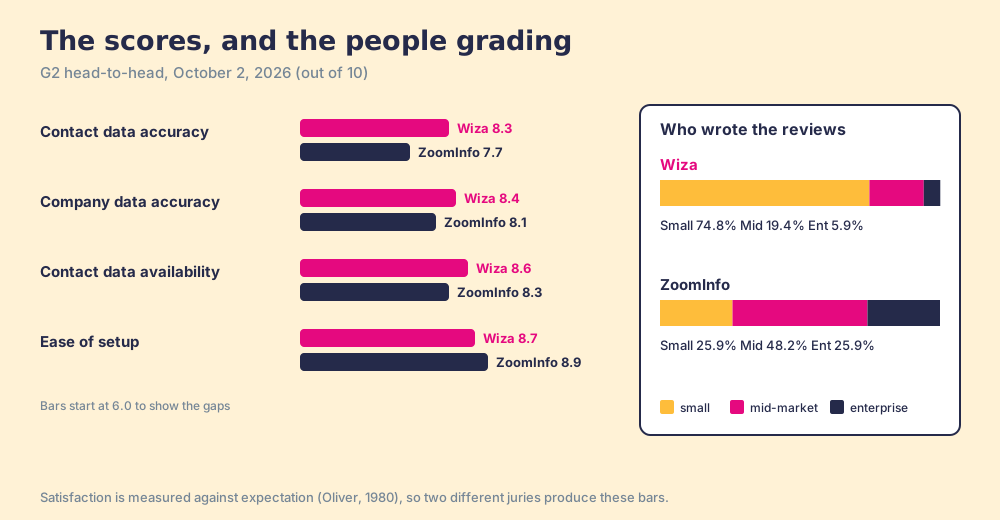
So the accuracy gap is real information about two different promises kept to two different crowds. It does not prove Wiza will find more of your contacts. Neither vendor publishes an independent accuracy audit. The test that settles it takes an afternoon: pull 200 contacts from your own closed-won and target lists, run them through Wiza’s free plan or Starter and ZoomInfo’s 7-day trial (ZoomInfo, free trial), and count bounces and connects, segment by segment.
What changed for Wiza and ZoomInfo in 2026?
Both companies moved this year, in opposite directions.
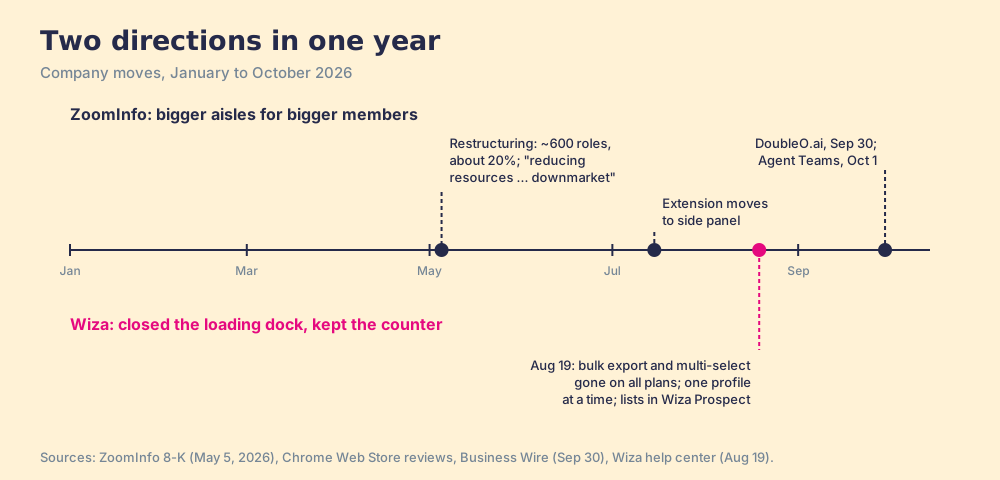
- Wiza’s narrower extension. On August 19, 2026, Wiza’s help center wrote that “LinkedIn has tightened what third-party extensions can do on its platform,” and that “Bulk export and multi-select are gone from LinkedIn, Sales Navigator, and Recruiter search, list, and company pages,” on all accounts and plans (Wiza help). The extension now works one full profile at a time in a side panel, and lists come from Wiza Prospect, its own database. Our Wiza Chrome extension teardown reads the new package.
- ZoomInfo’s move upmarket. ZoomInfo’s board approved a restructuring on May 5, 2026 that cut about 600 roles, roughly 20% of headcount; chief executive Henry Schuck wrote that the company is “simplifying our operations, accelerating our move upmarket, and reducing the resources we allocate downmarket” (ZoomInfo 8-K). Its Q2 results put 76% of annual contract value upmarket.
- ZoomInfo’s side panel and agents. In July its extension moved into Chrome’s side panel, and the ten most recent store reviews after that (July 15 to September 2, 2026) included eight one-star ratings. On September 30 it acquired DoubleO.ai, an agent-orchestration company, and launched Agent Teams on October 1 (Business Wire).
Read together, the warehouse is building bigger aisles for bigger members, and the bakery shut its loading dock and kept the counter. A small team choosing ZoomInfo in late 2026 is buying from a company that says, in a securities filing, that it is spending less on customers like them.
Which is cheaper, Wiza or ZoomInfo?
The bakery posts prices on the wall. From wiza.co/pricing, October 2, 2026: Starter $49 per user per month for 100 emails and 100 phones; annual Email $990 a year with unlimited emails and $0.35 a phone; annual Email + Phone $1,990 a year with unlimited emails and phones; a custom Team plan for three or more users. “Unlimited” runs inside 500 reveals in 24 hours and 2,500 list exports a month. Wiza pricing covers the ladder in full.
The warehouse has no price list. ZoomInfo’s pricing page names tiers (ZoomInfo Professional, Copilot Advanced, Copilot Enterprise) and says “Each export costs one credit,” with no dollar figures. Vendr’s data on 1,574 purchases puts the median contract at $33,500 a year, from $7,220 to $155,730, with buyers saving 22% on average off the first quote (Vendr, ZoomInfo, October 1, 2026). ZoomInfo pricing breaks the contract down.
| Team size, one year | Wiza (list) | ZoomInfo | Clay Growth plus Supered Prospector |
|---|---|---|---|
| 1 rep | $1,990 (Email + Phone annual) | No published price; lowest Vendr contract $7,220 | $6,480 ($5,940 + $540) |
| 3 reps | $5,970 at individual list; Team plan is quoted | Quoted | $7,560 |
| 10 reps | $19,900 at individual list, a ceiling | Vendr median $33,500 | $11,340 |
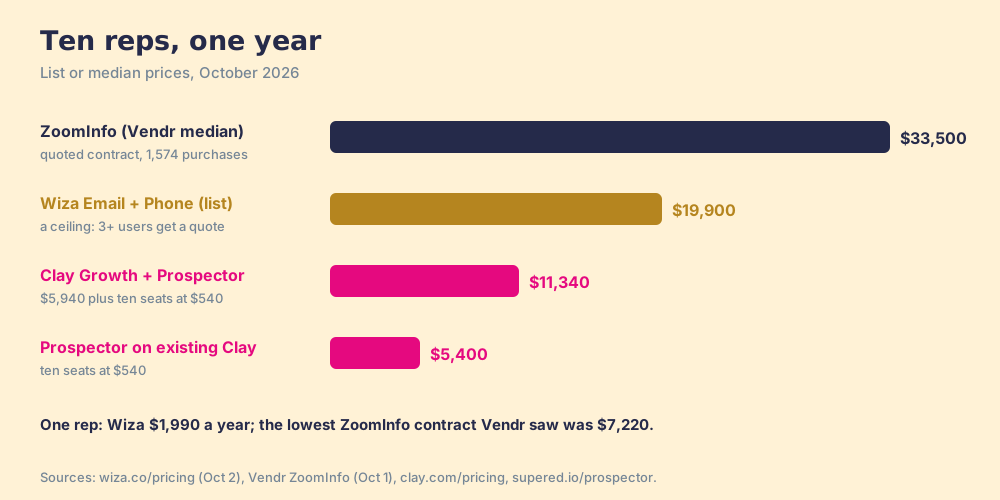
For one to three reps the bakery wins outright, and it is not close. At ten, the gap is $13,600 between Wiza’s ceiling and ZoomInfo’s median, before ZoomInfo’s intent and company data enter the comparison. The membership buys more aisles. Whether you shop them decides whether it is worth it.
What is each one best at?
Fair to both, with proof.
- ZoomInfo, the warehouse. If your problem is account coverage across a large territory, with company data, intent, org charts and exports into 14 business apps from one contract, ZoomInfo is the best pick on this page. Forrester named it a Leader in its Q1 2026 Wave for B2B marketing and sales data providers, with the highest current-offering score, per ZoomInfo’s Q1 results (ZoomInfo Q1 2026). The complaints to plan around are price (“The pricing feels extremely steep compared to platforms like Apollo,” a small-business G2 reviewer wrote on September 17, 2026) and coverage outside North America.
- Wiza, the bakery. If your problem is a person on a LinkedIn profile and a need for their email and phone in the CRM today, at a price you can read, Wiza is the best pick. It charges only for valid emails (“Risky emails are free”), its install asks Chrome for linkedin.com only, and its reviewers rate its contact accuracy higher. The complaint to plan around is volume: since August 19 the extension works one profile at a time, and the 2,500-a-month list cap applies to everything built in Wiza Prospect.
Do you need Wiza or ZoomInfo if your team has Clay?
Send a personal shopper instead. The GTM engineer writes the shopping list in order (try this shop first, then that one, stop when the item is found), and the shopper goes store to store. Clay’s waterfall works that way across 200+ data and AI providers, and it bills only for finds: “If an enrichment returns no result, you’re not charged Data Credits or Actions” (clay.com/pricing, October 2, 2026).
Here the two vendors part ways. The shopper can buy at the bakery with Clay’s own cash: Clay lists “Find Work Email with Wiza” and “Find Phone Number with Wiza,” each payable in “Clay Credits or Bring Your Own Account,” on the Launch plan and up (Clay, Wiza). At the warehouse club, the shopper needs your membership card: Clay marks “Enrich Contact with ZoomInfo” as “Bring Your Own Account Required” (Clay, ZoomInfo). A team mid-contract with ZoomInfo can put it first on the list and let the waterfall try the next provider when ZoomInfo comes back empty; a team without a ZoomInfo contract can still buy Wiza’s lookup by the find.
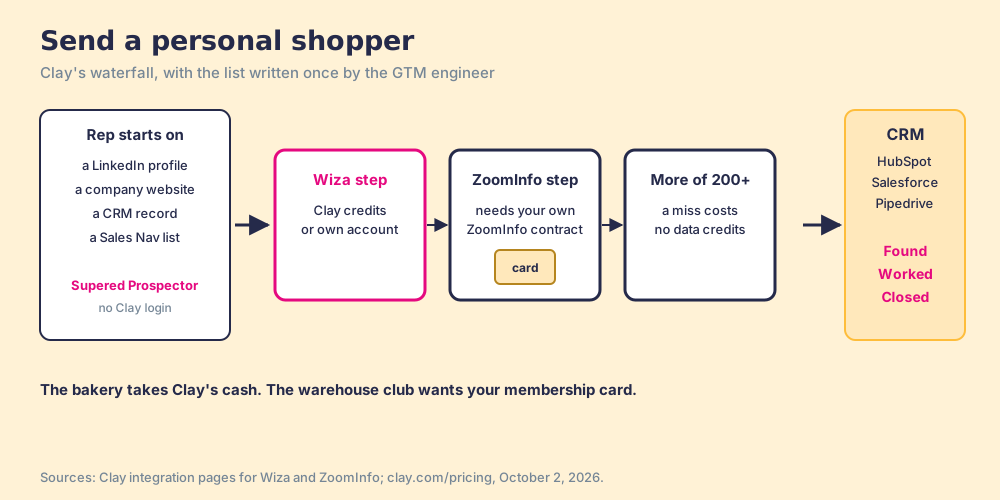
A shopper only helps the people who hand over a list, and reps do not open Clay. Supered starts there. Prospector does not bring its own database. It brings Clay’s waterfall, which is every database, routed, and that is why Clay is not a row in the table at the top. Clay plus Supered is the best way for a sales team to prospect: GTM engineers build in Clay, reps never open Clay. Prospector runs inside the Supered Chrome extension, on your own Clay account.
- A Push menu where the rep sells. On a LinkedIn profile, a company’s website or a HubSpot, Salesforce or Pipedrive record, the rep picks a flow and the GTM engineer’s table runs, then sends to the CRM or your sales engagement tool. From Sales Navigator, reps add leads to a prospect list and push the list to a Clay table.
- Flows built once. Person enrichment, the buying committee you defined, a new-logo campaign, a past champion who changed jobs: the engineer maps each to a table. “Your logic stays yours: waterfalls, tiers, tags, and sequence variables.”
- A check before the push. The rep sees the matching CRM record, its owner, and a flag when the prospect was already worked.
- Found, worked, closed. The leader sees each list found, who is working theirs and who is not, and how each lead ended the way your process says: Qualified, Recycled or Disqualified.
On LinkedIn, in our own words: Prospector works within LinkedIn’s terms and does not copy search results in bulk; the contact data comes from Clay’s waterfall on the customer’s Clay account. Ask every vendor what it reads from a LinkedIn page, ours included. The feature-by-feature version lives on Supered Prospector vs Wiza.
The price, done straight. Prospector is $45 per rep per month, billed annually, from one rep, with implementation included and teams live in under a week (Prospector). If RevOps already pays for Clay, ten reps add $5,400 a year. Buying Clay for this, Clay Growth at its $495 monthly rate is $5,940 a year, so ten reps cost $11,340: about a third of ZoomInfo’s median and $8,560 under ten Wiza seats at list.
Choose something else if:
- No Clay, and no plan to buy it. Prospector runs only on Clay. Pick Wiza or ZoomInfo from the branches below. RevPartners, the Clay Elite Studio Partner I founded (now a Walker Sands company), builds tables for teams that want Clay and need help.
- Intent and org charts are the job. Prospector fetches contacts; it does not replace ZoomInfo’s company and intent data. A team that runs territory planning off ZoomInfo should keep it.
- Outreach in the same tool. Prospector has no sequencer or dialer.
ZoomInfo vs Wiza: which should you choose?
Each branch is earned by the numbers above.
- Wiza. The pick for one to a few reps, a recruiter or an agency working LinkedIn profile by profile. Buy annual, where unlimited lives, plan around 500 reveals a day, and do not buy it for the Sales Navigator export, which left on August 19, 2026.
- ZoomInfo. The pick for a mid-market or enterprise team that needs company data, intent and org charts across the territory, can sign a quoted contract, and will use the aisles it pays for. Bring the Vendr median ($33,500) and the 22% average negotiated saving to the table.
- Supered Prospector. The pick if RevOps already runs Clay. Wiza is a step you can buy by the find, ZoomInfo is a step if you hold the contract, and reps get both from the page they already have open.
The bakery and the warehouse were never competing for the same shopper. A small team buying ZoomInfo pays for aisles it will walk past; a large team buying Wiza seats discovers it needs a dozen more bakeries. And a team that already pays for Clay can send a shopper to both. Wiza alternatives grades the rest of the field, the ZoomInfo Chrome extension page covers ZoomInfo’s side panel in depth, Wiza vs Apollo handles the other common head-to-head, and a Prospector demo shows the shopper at work on your own Clay account.
Frequently asked questions
Is Wiza or ZoomInfo more accurate?+
How much do Wiza and ZoomInfo cost?+
Can Wiza or ZoomInfo export Sales Navigator lists?+
Who should choose Wiza over ZoomInfo?+
Can I use Wiza or ZoomInfo inside Clay?+
Everything we have written on Wiza
More on Wiza
Supered Prospector vs Wiza: the side-by-side- Wiza Alternatives in 2026: The Library Took the Copier Out of the Aisle
- Wiza Pricing in 2026: All You Can Eat, One Plate at a Time
- Wiza Review 2026: A Good Car With the Towbar Taken Off
- Wiza Chrome Extension in 2026: A Doorbell, Not the House
- Wiza vs Apollo in 2026: The Buffet, the Menu, and the Food Hall
Everything we have written on ZoomInfo
More on ZoomInfo
Supered Prospector vs ZoomInfo: the side-by-side- ZoomInfo Competitors in 2026: The Database Was Never the Purchase
- ZoomInfo Pricing in 2026: The Standing Charge, the Meter, and What Neither Can See
- ZoomInfo Reviews 2026: The Equipment Scores 4.5, the Membership Scores 1.8
- ZoomInfo Chrome Extension in 2026: A Free Key Card to a $33,500 Room
- ZoomInfo HubSpot Integration (2026): Setup, Plans, Limits, and What It Reads Back
- ZoomInfo Salesforce Integration in 2026: A Loading Dock With Two Doors
Your Clay waterfall, where reps already work.