Process Documentation: Write It So It Runs
Process documentation is the written record of how work gets done, and most of it is written to be complete rather than used. The history, the craft, the tools, the decay problem, and the discipline of keeping documents connected to live work.
Process documentation is the written record of how work gets done, the steps, owners, decision rules, handoffs, and exceptions behind a team's recurring work, and it earns its keep only when it stays connected to the live work instead of decaying on a shelf.
There is a moment in many an operations leader's life when they decide that this time, finally, the processes will be documented properly. A tool is bought. A heroic quarter of writing follows. The library is beautiful, the kickoff is warm, and eight months later a new hire asks how renewals work and a veteran answers, without malice, "ignore the wiki, I'll show you."
Nobody in that story was lazy, and nothing was written badly. The library failed for two structural reasons that no amount of diligence touches, and this guide is organized around them. Decay: a document is most true the day it is written, and each process change it does not hear about widens the gap between the page and the work. Distance: the documentation lives on a shelf while the work happens somewhere else, and under time pressure, fetching loses to improvising. The conventional wisdom says the cure is better writing, fuller coverage, a more complete library. That is exactly backward. AI has made the writing itself nearly free, which is clarifying: when anyone can generate a competent procedure in a minute, the writing was never the hard part. A document written to be complete and a document written to be used are different objects with different physics, and most teams build the first while believing they are building the second.
That is the thesis of this guide, stated plainly so a reader can argue with it: the value of process documentation is not in its completeness but in whether it gets run, and run correctly, while the work is happening. Hold that one sentence and the rest follows, the history, the vocabulary, the evidence from medicine, the reasons libraries die, the craft of writing a page that survives contact with reality, and the tools that help. This is a long read because the topic earns it. Take it as a textbook chapter on a subject most operators were never formally taught.
Where did process documentation come from?
The instinct is old, and it has a father. Frederick Winslow Taylor's "Principles of Scientific Management" (1911) was the first sustained argument that the one best way to do a task should be discovered, written down, and standardized, taking the method out of the individual worker's head and onto paper where it could be taught and checked. Taylor's most quoted line is also his most misread. He wrote: "In the past the man has been first; in the future the system must be first." Read in isolation it sounds like a war on talent, and Taylor has been beaten with that sentence for a century. The next two sentences correct the record, and they belong on the wall of anyone who documents process: "This in no sense, however, implies that great men are not needed. On the contrary, the first object of any good system must be that of developing first-class men; and under systematic management the best man rises to the top more certainly and more rapidly than ever before" (Taylor, Principles of Scientific Management, 1911, p. 7). The system is not the enemy of talent. It is the floor that lets talent show, the documented standard that makes good people repeatable and lifts the average one to passable. That is the original and still the best argument for writing a process down.
Taylor was as precise about the artifact itself, and the description reads like a specification for every SOP written since. He called it the task idea, and the procedure it produced was a written one, handed to the worker in advance: "The work of every workman is fully planned out by the management at least one day in advance, and each man receives in most cases complete written instructions, describing in detail the task which he is to accomplish, as well as the means to be used in doing the work... This task specifies not only what is to be done but how it is to be done and the exact time allowed for doing it" (Taylor, Principles of Scientific Management, 1911, p. 39). Written down, in detail, in advance, what and how and how long. A century before Confluence, Taylor had already specified the document. What he did not specify, and what no tool has cracked since, is how to keep that document true once the work it describes starts moving.
What Taylor could not have anticipated was that the work he standardized was physical and slow to change: a man shoveling, a lathe cutting metal, a motion that held still long enough to be photographed and codified. Knowledge work moves. The "one best way" to handle a renewal or qualify a deal is rewritten by every pricing change, every new competitor, every product release, which is the seed of the decay problem that the rest of this guide keeps returning to. Taylor solved documentation for a world that stood still. Ours does not.
The next milestone turned Taylor's instinct into a mandate, and a global one. The ISO 9000 family of quality standards, first published in 1987 by the International Organization for Standardization, made documented process a condition of doing business across manufacturing and then far beyond it, into software, healthcare, food, and services. The compact at its heart is three words long: document what you do, do what you document, and an auditor will check, on a recurring schedule, that the two match. By the time ISO 9001 was being held by over a million organizations across more than 170 countries, an entire profession had grown up around producing and maintaining the paperwork, and the certification became a procurement gate: large buyers would not sign with a supplier who could not show the binder. The compliance-documentation era was born here, and it left a mark on how a generation thinks about process. The reward structure pointed at one thing, the existence of a complete, controlled, auditable document, and pointed at it so hard that the daily use of the document became almost beside the point. This is the cautionary tale for anyone who believes the goal is a complete library. A complete library passes the audit. Whether it changes the work is a separate question the audit never asks, and the gap between the two is exactly the territory this guide is mapping.
There is a real and important exception buried in that history, and it is worth naming before it gets caricatured. In some industries the complete document is not paperwork for its own sake, it is the law, and we return to those cases later. For most operational process in most companies, though, the ISO inheritance is a trap: it taught teams to measure documentation by its coverage and its control, the two things easiest to audit, and to ignore its use, the one thing that decides whether it was worth writing.
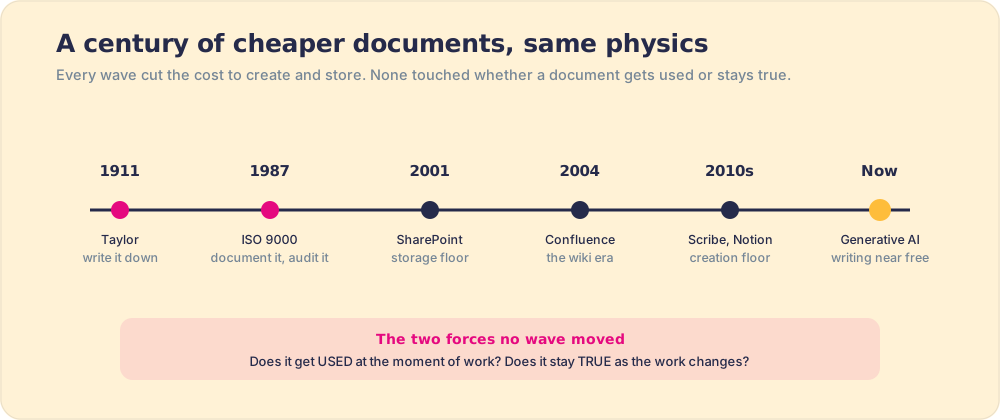
Then the library went digital, and the cost of the document fell through three floors in twenty years. The first floor was storage and distribution: Microsoft SharePoint arrived in 2001, then Atlassian Confluence in 2004, then Notion in the late 2010s, moving the binder onto a wiki so the document was searchable and instantly available to a team scattered across time zones. The binder problem became the wiki problem, which was a real improvement, but a narrow one. The second floor was creation. A wave of capture tools, Scribe and Tango chief among them, let a worker record themselves performing a task once and have a formatted step-by-step guide written automatically, screenshots and all, in the time it took to do the thing. Writing a procedure stopped requiring a writer. The third floor, the one we are standing on now, is generative AI: describe a process to a model in a sentence, or point it at a recording, and a competent draft appears, polished, formatted, and ready to translate into five languages. Read the whole arc, 1911 to this morning, and one fact repeats at every step. Each wave made documentation cheaper to create, easier to store, and faster to distribute, and each was sold as the thing that would finally make documentation work. Not one of them touched the two forces that decide whether documentation works: whether it gets used, and whether it stays true. That is the gap this guide is about, and it is the same gap whether the artifact is a 1911 machinist's instruction card, a 2004 wiki page, or an AI-generated SOP shipped an hour ago. The tools got faster. The physics did not change.
What does SOP mean, and how does the vocabulary fit?
SOP stands for standard operating procedure: the agreed, written way one recurring task gets done, so any qualified person can run it the same way. The discipline's other words nest around it, and keeping them straight saves buying the wrong tool later. Process documentation is the umbrella, everything that records how work happens. A workflow is how a piece of work travels across people and systems, so workflow documentation is the record of the relay, handoffs included. A walkthrough is a procedure delivered inside the software at the moment of use. The SOP is the unit cell of all of it: one task, one trigger, checkable steps, a definition of done.
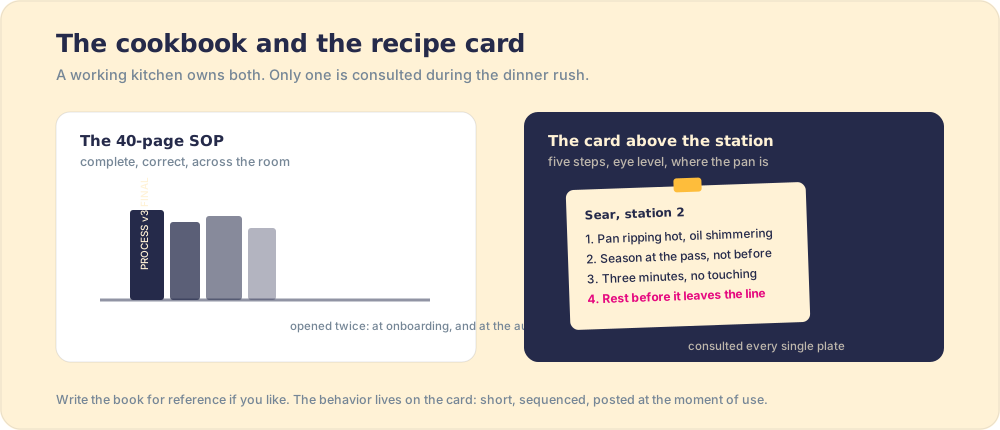
A working kitchen owns these distinctions without naming them. The cookbook on the shelf is complete, correct, and consulted twice a year. The recipe card taped above the station, five steps at eye level where the pan is, gets consulted every single plate. Both are process documentation. Only one was written for the moment of use, and learning to write the card is most of the craft. The cookbook answers "how is this dish made, in full." The card answers "what do I do next, right now, with sauté pans hissing." A reader under pressure needs the second and is handed the first, and that mismatch is the whole problem rendered in one image.
The same distinction has a more technical name worth knowing, because it explains why the cookbook keeps losing. A procedure has two readers across its life: the learner, who reads it once to understand, and the performer, who needs it many times to act. The instinct of most documentation is to serve the learner, because the learner is the one asking questions and the performer is busy and silent. So we write for the person who does not know yet, and we forget the person who knows but cannot recall the step under load. A page that serves both is rare and deliberate. Most pages serve neither, which is how a library can be technically complete and operationally useless at the same time.
Why does the followed document matter more than the complete one?
Medicine ran the decisive experiment, with stakes that make a skipped CRM field look quaint. In 2006, Peter Pronovost and colleagues put a five-item checklist for placing central lines into 103 Michigan ICUs. The items were not new knowledge; any physician could recite them. What changed was placement and inspection: the checklist lived at the bedside, and a nurse was empowered to stop the procedure if a step was skipped. Median bloodstream infections fell from 2.7 per 1,000 catheter-days to zero within three months, and stayed down (Pronovost et al., NEJM 2006). Atul Gawande built The Checklist Manifesto on this finding, and the WHO surgical checklist he helped design repeated it: complications fell from 11 percent to 7 percent when the procedure entered the operating room itself (Haynes et al., NEJM 2009).
Gawande's argument about why the checklist works is the deepest point in the literature, and it is the reason a five-item card beat the collective expertise of trained physicians. The problem is not ignorance; it is that knowledge has outgrown the human ability to apply it reliably under pressure. In his words: "the volume and complexity of what we know has exceeded our individual ability to deliver its benefits correctly, safely, or reliably. Knowledge has both saved us and burdened us" (Gawande, The Checklist Manifesto, 2009). The document is not there to teach the expert something new. It is there to carry the load the expert's memory drops in the moment of action. Hold that and the recipe card stops looking like a beginner's crutch and starts looking like what it is: an instrument that lets a competent person perform reliably when attention is scarce.
Gawande is as exact about what a checklist does for the performer, and the sentence is worth lifting because it doubles as a job description for any procedure that earns its keep. "Checklists seem to provide protection against such failures. They remind us of the minimum necessary steps and make them explicit. They not only offer the possibility of verification but also instill a kind of discipline of higher performance" (Gawande, The Checklist Manifesto, 2009). Three jobs sit inside that sentence, and they map onto the rest of this guide. The minimum necessary steps, not the complete ones, which is the case against the cookbook. Made explicit, which is the case for triggers over goals. And the possibility of verification, which is inspection, the one job no document does for itself and the one almost no team budgets for. A document that does the first two and skips the third is a checklist nobody checks, and a checklist nobody checks is decoration.
Read those studies as a documentation lesson and they say one thing: the knowledge already existed, the documents already existed, and outcomes moved when the procedure reached the moment of the work with someone checking whether it ran. Our own field research found the same shape in revenue teams. Across 198 sales organizations, 89 percent had a defined, documented process; 36 percent saw it followed as designed. The documents were fine. The delivery was the gap.
This pattern has a name and an authority behind it. Stanford's Jeffrey Pfeffer and Robert Sutton called it the knowing-doing gap in their 2000 book of that title, after studying why companies stuffed with knowledge and documentation still fail to act on what they know. Their central question is the one a sales leader is secretly asking when the documented process does not change the field: why does "knowledge of what needs to be done frequently fail to result in action or behavior consistent with that knowledge" (Pfeffer and Sutton, Stanford GSB). They traced the failure to a human reflex so ordinary it is almost invisible: the willingness to let talk stand in for action. Their diagnosis is blunt, and it lands directly on the documentation impulse. "One of the main barriers to turning knowledge into action is the tendency to treat talking about something as equivalent to actually doing something about it," they wrote, and they gave the reflex a name, the smart-talk trap: "Firms that turn knowledge into action avoid the 'smart talk trap.' Executives must use plans, analysis, meetings, and presentations to inspire deeds, not as substitutes for action."
The deeper mechanism they uncovered is the part worth holding onto, because it explains why the trap is so seductive to good, diligent people. In most organizations, Pfeffer and Sutton observed, people get ahead by sounding smart, not by making sure that smart things happen. Talk is rewarded immediately and visibly: a sharp plan, a thorough document, a confident presentation all earn credit the moment they are produced. Action is rewarded late, unevenly, and often by someone else. So a rational, ambitious team will reliably overinvest in the artifact and underinvest in the follow-through, not because anyone is cynical, but because the incentives point that way. A beautiful process library is the smart-talk trap rendered in physical form. It is real work, visible work, expensive work, and finishing it feels exactly like progress. It is also, on its own, a substitute for the harder and less rewarded work of changing what people do at the moment of the deal, which is why a team can close out a documentation project, hold a warm kickoff, and watch the field run exactly as it did before. The document was the talk. The behavior was the doing. Pfeffer and Sutton's finding is that producing the first does almost nothing to produce the second.
Two independent bodies of evidence converge here, and that convergence is the strongest thing this guide can show. The medical studies say outcomes move when the procedure reaches the moment of work with inspection attached. The management research says knowledge does not become action by being written down. Our field data says a defined process and a followed process are different objects separated by 53 points. Three sources, three fields, one finding: writing the document is necessary and nowhere near sufficient. The work that remains after the writing is the work that matters, and it is the work almost nobody budgets for.
What is the mechanism that makes a document go unused?
It is worth slowing down on the machinery, because if you do not understand why a good document goes unused you will keep reaching for the wrong fix, which is almost always "write a better document." The mechanism has three moving parts, and none of them is about discipline.
The first is that a written procedure is, to the brain, a goal, and goals are weak predictors of action. "Run discovery thoroughly" is a goal a rep already holds; nobody opens a deal intending to qualify badly. The psychologist Peter Gollwitzer spent a career on the gap between intention and action and found the missing piece is structural: goals become behavior far more reliably when they are rewritten as implementation intentions, if-then plans binding a specific situation to a specific response. Gollwitzer and Sheeran's meta-analysis of 94 studies put the lift at a medium-to-large effect size of d = 0.65 (Gollwitzer and Sheeran, 2006). A procedure written as a list of goals ("qualify, discover, propose") is written in the form the brain executes worst. A procedure written as triggers ("when the buyer raises price before value is established, ask what the cost of inaction is") is written in the form it executes best. The format is not cosmetic. It decides whether the page becomes behavior.
The second part is the prompt. The behavioral scientist BJ Fogg compresses decades of work into one model: behavior happens when motivation, ability, and a prompt converge at the same instant (B = MAP). A worker can have the motivation to follow the process and the ability to follow it and still not, because the prompt is absent at the moment of need. When the procedure lives in a wiki, the prompt is wherever the worker would have to go to find it, which is to say nowhere, in the second a live decision is in front of them. The friction of retrieval is small, and small frictions reliably beat good intentions. This is why default options dominate human behavior in every domain studied, from retirement enrollment to organ donation. The worker does not decide to skip the document. The document simply is not present when the situation that needs it arrives, so habit fills the vacuum.
The third part is the cost of switching away from the work to fetch the answer, and it is not free. Psychologists who study task interruption find that returning to a complex task after a context switch carries a real reattention cost; the canonical finding from Gloria Mark's research at UC Irvine is that interrupted knowledge work takes meaningful time to resume at full focus. A worker weighing "open the wiki, find the page, read it, come back, remember where I was" against "do what I did last time" is making a rational trade, and last time usually wins. Put the three together and the picture is complete: the document is written as a goal, the prompt is missing, and the retrieval costs more than improvising. A worker who would pass a written quiz on the process will, predictably, not run it. That is not a people failure. It is the system asking a person to do the thing the system made hardest.
Why does the library keep failing?
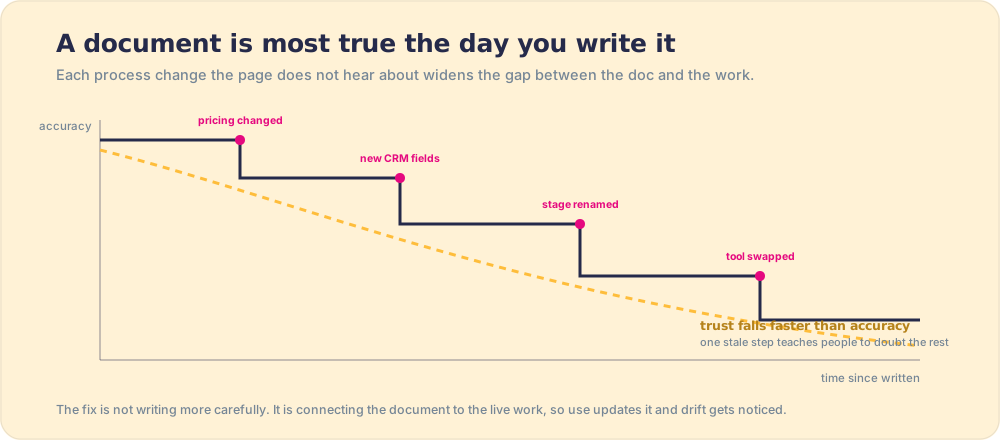
That mechanism explains why a single page goes unused. The library is a larger organism, and it dies of two diseases, both structural. Picture the decay first, because it is the slower and less obvious of the two. The week a procedure page is written, it is a faithful map of the work. Then pricing changes, and the page does not hear about it. A stage gets renamed. A tool gets swapped. A new objection enters the market and the discovery script never catches up. Each unannounced change steps the page's accuracy down, and something worse happens to its readers: trust falls faster than accuracy, because one stale step teaches a reader to doubt every other page in the library. The veteran's "ignore the wiki" is not cynicism. It is pattern recognition. The reader cannot tell which pages are still true, so the rational move is to trust none of them and ask a human, which is precisely the behavior a documentation project was meant to eliminate.
The maintenance problem underneath decay is worse than it first looks, because the cost of keeping a library true does not stay flat, it compounds. Write ten pages and you own ten pages that can fall out of date. Write a thousand, and you own a thousand drift surfaces, each one a small standing bet that someone will notice when the underlying process moves and will find the page and fix it before a reader trusts a stale version. Nobody budgets for that bet. Documentation gets funded as a project, a heroic quarter with a start and an end, when its true shape is a standing tax that scales with the size of the library and never stops being owed. This is why the second year of a documentation effort is almost always worse than the first: the writing energy is spent, the kickoff glow is gone, the process has moved half a dozen times, and no one was ever assigned the unglamorous, permanent job of reconciliation. The library does not fail loudly. It goes out of date one unannounced change at a time, and by the time anyone audits it, the rot is general and the only honest move is to start over, which is how teams end up documenting the same processes three times in five years and calling it bad luck.
Distance is the more expensive disease, and it has a price tag. The McKinsey Global Institute clocked interaction workers spending 19 percent of the week, close to a full day, searching for and gathering information (McKinsey, 2012). That figure counts the searches people attempt. Under real pressure the more common move is not searching at all and running on memory, which is how a documented process goes unfollowed by people who would pass a quiz on it. And the third clock is always ticking: median U.S. employee tenure is under four years (BLS, 2024), so whatever stayed undocumented, usually the handoffs and exceptions, gives notice, works a friendly final two weeks, and walks. Decay erodes the pages that exist; distance keeps people from the pages that are still true; tenure deletes the knowledge that was never written at all. A library faces all three at once.
Underneath the two diseases sit a handful of self-inflicted wounds, the recognizable ways a documentation effort kills itself. Naming them is the fastest diagnostic a leader has, because each one feels, at the time, like diligence:
- The completeness trap. The effort is judged by how much got documented, so the team writes the cookbook and never the card. A 40-page renewal process scores well on coverage and gets read by no one, because completeness serves the learner once and abandons the performer forever. The right metric is use, not coverage.
- No named owner. A page that belongs to everyone belongs to no one, so when the process changes there is no one whose job is to update it. The page decays by default, and decay is the default physics; staying true requires a person, not a hope.
- Documenting the wish, not the work. The page describes how leadership thinks the work should go, not how the best people do it in practice. No performer recognizes a deal or a task it describes, and unrecognized procedures get the adoption all unrecognized things get, which is none. Taylor's instinct was the opposite: study the people who already do it best and write that down.
- Storage mistaken for delivery. The process is "documented" because it sits in the wiki, on the theory that availability equals use. Availability is necessary and nothing close to sufficient, because the prompt is still missing at the moment of work. A document you can find is not a document that reaches you.
- Padding that teaches skimming. The page lists everything a person could do rather than the few steps that break the outcome when skipped. Aviation checklists list what kills, not what is routine, because padding trains the reader to skim and skimming is how the one load-bearing step gets missed.
- No inspection. Nobody ever checks whether the documented process is the one being run, so reps read the absence of inspection, accurately, as permission to improvise. A procedure no one measures is a hope with formatting.
Read down that list and a single pattern connects all six: each substitutes something easy to produce, a long document, a wiki page, a wish, for the harder thing it was meant to stand in for, a procedure a real person runs at the moment of work and someone confirms ran. The craft of documentation, like the craft of a sales process, is refusing those substitutions one at a time.
It helps to watch the diseases work on one real artifact, because the failure modes sound like abstractions until a page collapses under them. Picture the sales wiki most companies own. It opens with a "Sales Process Overview" written eighteen months ago by a RevOps hire who has since left, names a six-stage funnel two of whose stages were renamed in the last CRM cleanup, links to a discovery framework that predates the current pricing, and embeds a competitor battlecard for a competitor that was acquired last spring. None of it is wrong on purpose. It was true once and was never reconciled to a process that kept moving. A new rep opens it in week one, follows the qualification page, and is gently corrected by their manager: "we stopped doing it that way, here is how it works now." The rep learns the real lesson in that exchange, which is not how qualification works but that the wiki cannot be trusted, and they never open it again. Multiply that exchange across every new hire and the library has trained the whole team to route around it. No single page was negligent. The owner was missing, the maintenance tax went unpaid, and decay did the rest. That is a wiki nobody trusts, and it is the default outcome, not the unlucky one.
How do you document a process that gets followed?
The same rules keep surfacing, from operating rooms to revenue teams, and they are small enough to hold in one hand:
- One task, one card. Scope each SOP to a single task with a clear trigger. If the draft wants chapter headings, it is several procedures wearing one title. The full method, with a worked example, is in how to write an SOP.
- Triggers over intentions. "When X happens, do Y" roughly doubles follow-through versus goal statements; Gollwitzer and Sheeran's meta-analysis of 94 studies put the effect at d = 0.65 (2006). Name the moment and the moment does the reminding.
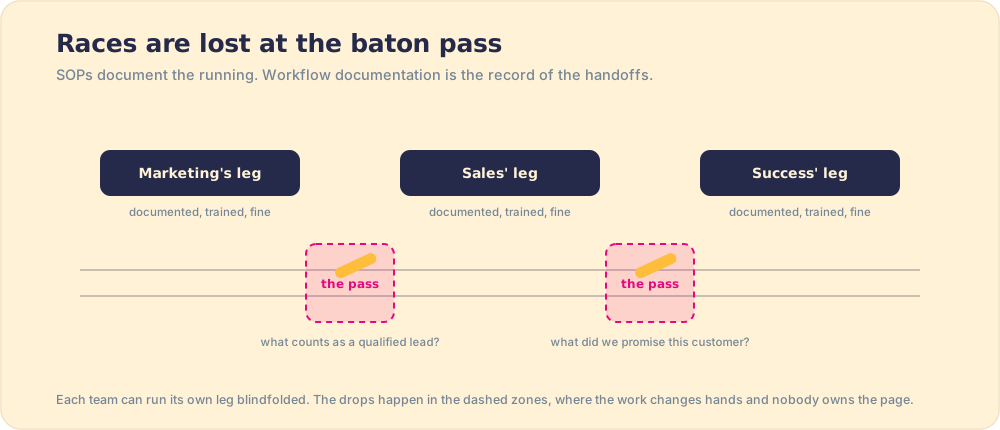
- Handoffs first. Tasks have single owners who eventually write them down. Handoffs have two owners, which rounds to zero, and that is where work breaks between competent teams. Document the baton passes before the running.
- Killer items only. Aviation checklists list what kills when skipped, not everything a pilot does. Padding teaches readers to skim, and skimming is how the one load-bearing step gets missed.
- Placement at the work. The procedure goes where the task happens: the stage, the queue, the tool. A shelf is a decay accelerator with good intentions.
- Inspection, always. You can only expect what you inspect. A procedure nobody measures is a hope with formatting.
It helps to see the craft applied to one real procedure end to end, because the rules sound abstract until a page exists. Take a common one: the handoff from a sales rep to a customer success manager after a deal closes. The cookbook version runs four pages, opens with the philosophy of customer success, lists every field in the CRM, and explains the org chart. It is complete, and a CSM under load on closing day reads none of it. The card version is six lines, and it is built from the rules above.
It names the trigger: when the deal stage moves to Closed Won. It scopes to one task: the handoff, not the onboarding that follows. It writes checkable steps a person can confirm, not goals: the rep posts the signed scope, the named buyer contact, and the one promise made in the sale that is not in the contract; the CSM confirms receipt within one business day; a kickoff is booked before the CSM marks the handoff done. It puts the killer item first, because the step that breaks this handoff every time is the unwritten promise, the thing a rep said in week three of the deal that the buyer is now expecting and the contract never captured. And it lives where the work is, attached to the deal record so it surfaces the instant the stage flips, not filed in a wiki the CSM would have to remember to open. Six lines, one trigger, one owner per step, the dangerous item up top, placed at the work. That is a card. The four-page version was documentation; the card is a procedure that runs.
Notice what the card refuses. It does not teach customer success philosophy, because the performer is not a learner in that moment. It does not list every field, because padding teaches skimming. It does not live in a library, because a library is a decay accelerator with good intentions. The discipline that produced it is small enough to hold in one hand, and it is the same discipline whether the task is a clinical line placement, a preflight check, or a deal handoff. The full method, with the step-by-step build, is in how to write an SOP, and the handoff-specific craft is in workflow documentation.
What tools does process documentation need?
Four jobs hide under the category label, and buying for the wrong one is how teams end up owning two libraries and zero followed processes. Capture, turning performed work into written guides, is solved and cheap: Scribe leads it, Tango trails with a pivot toward automation. Storage was solved a decade ago; you already pay for a wiki, so do not buy it twice. Maintenance, keeping pages true as the process changes, is where most libraries die, and almost nobody sells it directly. And operationalization, moving the document into the work and reporting whether it ran, is the job that changes outcomes: runnable checklists for operations, and for revenue teams, the process surfacing inside the CRM with adherence measured in the flow of work.
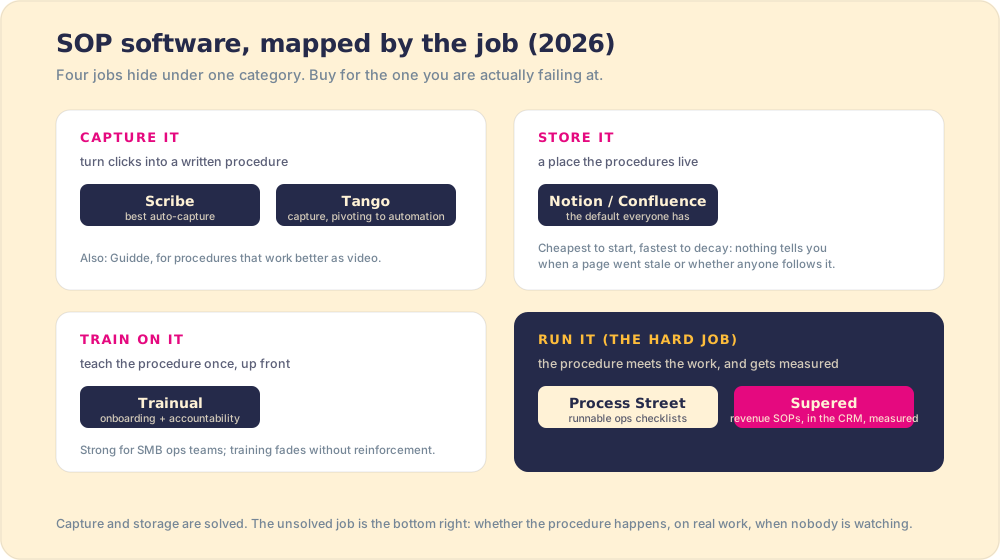
The reason maintenance is the unsold job is worth understanding, because it tells you something about the whole market. Capture and storage are easy to build and easy to demo: a tool either records a workflow or it does not, stores a page or it does not, and the value is visible in the first five minutes. Maintenance is invisible and slow. A tool that keeps a library true earns its keep over months, in the absence of stale pages, which is hard to show in a sales call and hard to price. So the market built what it could sell, the capture tools and the wikis, and left the failing job thin. The same logic explains why operationalization, moving the document into the work and reporting whether it ran, is rare: it requires sitting inside the tool where the work happens, which is harder than storing a page in a library of your own. The jobs that are easy to sell got crowded, and the jobs that decide outcomes stayed open. Buy with that in mind.
The deep dives carry the tool-by-tool verdicts: SOP software sorts the field by job, process documentation software covers the buying logic (a map versus a navigator), interactive walkthrough software handles the in-app guidance layer, and the named comparisons are in Scribe alternatives and Tango alternatives.
One buying error is common enough to call out, because it follows directly from the failure modes above. Teams shop for the most complete feature list, reasoning that more capability is safer. That instinct buys for capture and storage, the two solved and cheap jobs, and leaves the failing job, maintenance and operationalization, untouched. The result is a second beautiful library and zero followed processes. Buy for the job that is failing on your team, which the recommendation section helps you name, and ignore the breadth of the demo. A navigator that gets one route run beats a map that shows every road and is folded in a drawer.
What does AI change about process documentation?
It collapses the cost of the half that was already easy and raises the stakes on the half that was always hard, which is the same pattern AI is producing across every operations category. On the easy side, a model can now draft a competent procedure from a recorded session or a paragraph of description, keep the prose tidy, and translate a page into five languages before lunch. The writing, storing, and formatting of documentation, the part that improved relentlessly from Taylor to Notion, is approaching free. Anyone still treating "we do not have time to write it down" as the bottleneck is fighting a war that ended.
The risk is precise. AI makes it trivial to generate documentation faster than the organization can keep it true, which accelerates decay rather than curing it. A library that grows ten times larger overnight is ten times more surface area to fall out of date, and the reader's trust collapses as fast whether a stale page was written by a person or a model. The cure is not more generation. It is the maintenance loop and the inspection that AI does not provide on its own: a named owner, a signal when the underlying process changes, and a check that the documented procedure is the one being run. Used the other way, AI helps here too. A model that watches the live work can flag when reality has drifted from the page and draft the update, turning maintenance from a quarterly heroic rewrite into a continuous correction. The direction is set; the governance is the open question, and the governance is human.
The deeper continuity is the reassuring part. AI changes what is cheap to produce and changes nothing about what makes documentation work, which is still placement at the moment of use, a trigger rather than a goal, an owner, and an inspection. A principle a 1911 machinist would recognize survives the wiki and the language model intact, because the principle was always about people acting under pressure, and people have not changed. Tools will keep promising to dissolve the problem by making the writing easier. The durable work keeps being the same unglamorous loop: write the card, place it at the work, check that it ran, and keep it true.
Isn't more thorough documentation always better?
The thesis of this guide deserves its strongest objection, stated fairly, because a reader has every right to be skeptical of an argument that sounds like it is against thoroughness. Here is the objection at full strength. Surely a more complete document is strictly better than a thinner one. A complete page can always be skimmed down to its essentials, but a thin page cannot be expanded when an edge case appears, so completeness costs nothing and insures against everything. And whatever effort completeness used to require, AI has now made nearly free, so the old tradeoff between thoroughness and time is gone: you can have the exhaustive version at the price of the sparse one. Both halves of that objection are true. Grant them fully.
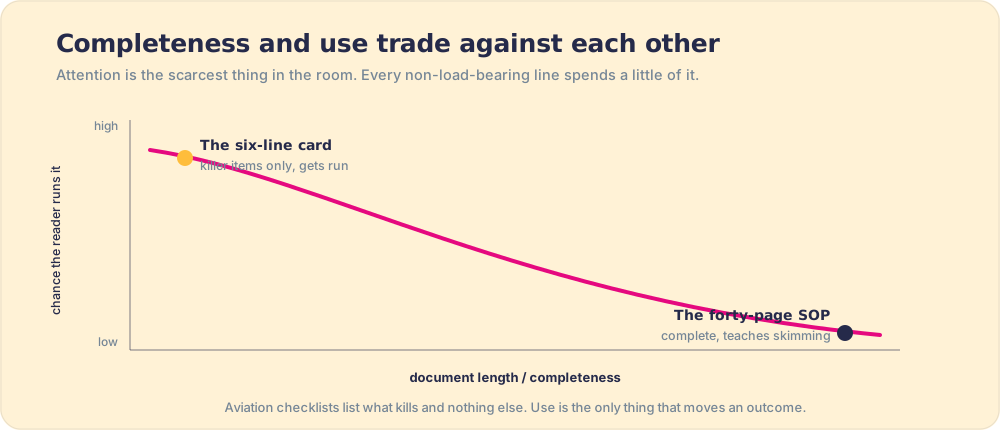
The answer is that completeness and use are not allies, they trade against each other, and that trade is where the trouble lives. A document earns attention from a person under load, and attention is the scarcest thing in the room. A line that is not load-bearing spends a little of it, and the reader pays the toll on the way to the line that matters. This is why aviation checklists, written by people for whom a missed step is fatal, list what kills and nothing else: a complete preflight checklist that included every routine action would train pilots to skim, and skimming is how the one item that grounds the plane gets missed. The forty-page renewal SOP is not safer than the six-line card because it contains more truth. It is more dangerous, because it buries the load-bearing step in true-but-irrelevant context and teaches its reader, page after page, that this document is not worth reading closely. Completeness is the enemy of use, and use is the only thing that moves an outcome. A document optimized to be complete and a document optimized to be run are different objects, and the more complete one is reliably the less followed.
The AI half of the objection, granted in full, makes the case sharper rather than softer. If creation is now free, then the writing was never the constraint, which means the thing teams were proud of producing, the thorough document, was the cheap part all along. What stayed expensive is exactly what AI does not touch: a reader's scarce attention, a process that will not hold still, and the inspection that confirms the page is the one being run. Free creation does not relieve the use-and-decay problem; it floods it, because a library that can be generated ten times faster is ten times more surface area to fall out of date and ten times more material competing for the same fixed attention. The objection assumes the bottleneck was supply of documents. The bottleneck was always demand, the willingness and ability of a person to act on one at the moment it matters, and no amount of cheaper supply fixes a demand problem.
When is the complete document the point?
There is a real exception, and pretending otherwise would be the kind of overreach the Lewis rule warns against, so mark the edge of the picture clearly. In regulated industries the complete document is not a means to better work, it is a legal and safety obligation in its own right, and the rules above do not override it. A pharmaceutical manufacturer running under FDA current Good Manufacturing Practice (cGMP) must keep master production records and batch records complete and contemporaneous, because the document is the legal evidence that the drug was made correctly, and the U.S. regulation is explicit that procedures must be followed and documented to prevent contamination and error (21 CFR Part 211). A device maker under ISO 13485, a lab under ISO 17025, an aircraft operator under its approved maintenance program, a public company under its SOX control narratives, all live in the same world: the audit trail is the deliverable, completeness is mandated, and a missing record is itself the violation regardless of whether the work was done right. For these procedures, write the cookbook, keep it complete, and keep it controlled. The completeness is the job.
Holding both truths at once is what separates a thoughtful operator from a zealot. The complete, controlled, auditable document is correct and required for the regulated, safety-critical, legally-evidenced slice of work. For the vast operational middle, the sales process, the renewal handoff, the onboarding flow, the support escalation, none of which an auditor will ever subpoena, that same instinct is the trap the ISO era left behind, and there the followed card beats the complete binder every time. The error is not in writing thoroughly where thoroughness is the law. The error is importing the compliance reflex into operational work that no regulator cares about, mistaking an audit standard for an effectiveness standard, and producing a beautiful binder for a process whose only real test is whether a busy person runs it. Know which kind of work is in front of you, and write for that.
Where should you start?
Start where the failure is, not where the demo is shiny, and the failure is almost never writing. Three honest diagnoses cover most teams, and each points at a different action. If procedures are not getting written at all, take the free win, because capture is solved: a recording tool or a model will produce the first drafts this week. If procedures exist and nobody trusts them, the disease is decay, and no new tool fixes it; assign a named owner per page and build the loop that updates a page when the process it describes changes, before you buy anything. And if people know the process and still do not run it, stop shopping documentation tools entirely, because the remaining problem is delivery and inspection, and only the operational layer touches it.
That last case is the most common one on a revenue team, and it is the one this whole guide has been circling. The reps could pass a quiz on the process. The document is fine. The gap is that the procedure is not present at the moment of the decision and no one is checking whether it ran. The fix that the evidence keeps pointing at, from the ICU to the operating room to our own field data, is to move the documented process into the flow of work and attach an inspection to it: the right step surfacing inside HubSpot or Salesforce at the stage where it applies, with adherence visible while there is still time to coach. That is the layer we build, and we built it because the 53-point gap between a defined process and a followed one is not a writing problem and never was. Writing the card is the cheap, solved tenth. Getting it run, every time, while the work is happening, is the rest.
Read the whole discipline in order: how to write an SOP for the craft, workflow documentation for the handoffs, SOP software and process documentation software for the tooling, interactive walkthrough software for the guidance layer, and where your sales process should live for the question underneath all of it.
Process documentation FAQ
What is process documentation?+
What does SOP mean?+
How do you document a process?+
Why does process documentation fail?+
What tools should we use for process documentation?+
Why do people not follow documented processes?+
How do you keep process documentation from going out of date?+
Does AI fix process documentation?+
Is more thorough documentation always better?+
When does completeness matter in process documentation?+
Write it so it runs.