Digital Adoption Platform: Usage Is the Odometer, Behavior Is Arrival
A digital adoption platform overlays software with in-app guidance so people learn tools inside the tools. The history, the two markets, why the delivery works, what AI changes, and why the dashboards mostly measure the wrong thing.
A digital adoption platform overlays software with in-app guidance, walkthroughs, tooltips, and help at the decision point, so people learn tools inside the tools; the category splits by whose behavior is being changed, your employees or your customers, and by what gets measured, usage or behavior.
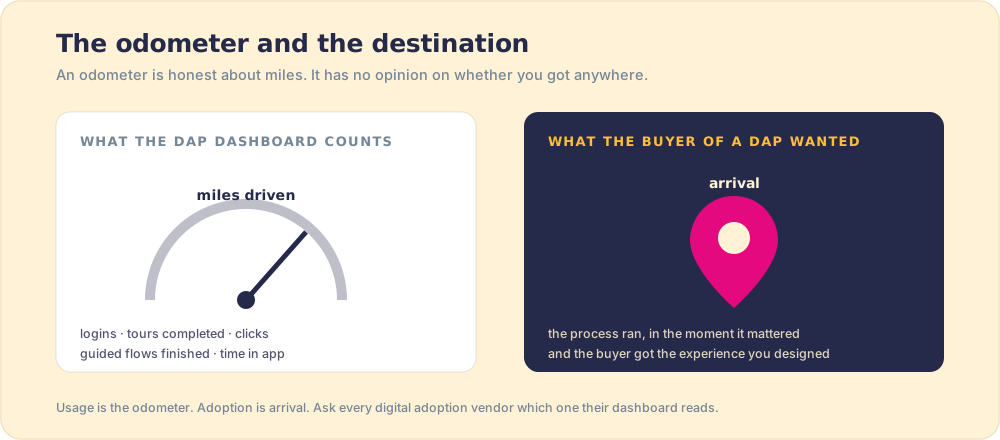
Your car's odometer is a scrupulously honest instrument. It will tell you, to the tenth of a mile, how far the wheels have turned, and it will not venture one syllable about whether you arrived anywhere worth going. Nobody minds, because nobody confuses the odometer for the trip. Then the same people go to work, buy a digital adoption platform, and accept a dashboard of logins, tours completed, and time-in-app as proof of adoption, which is the odometer reading presented as the arrival.
That is the one critique this guide applies to an otherwise genuinely useful category, and it is worth being precise about, because the guidance these platforms deliver works. In-the-moment delivery is the best-evidenced move in all of process tooling, and the evidence is cited below. The gap is in what gets measured afterward, and it decides whether you bought behavior change or bought mileage. Hold one question through every demo: does this dashboard read miles, or arrivals?
The pattern is older than software. In 1987 the economist Robert Solow looked at two decades of computer investment that had not shown up in the national productivity figures and wrote the most quoted sentence in the economics of technology: "You can see the computer age everywhere but in the productivity statistics" (New York Times Book Review, July 12, 1987). Solow's paradox names the exact disease this category was invented to cure and the exact one it keeps misdiagnosing: spend rises, screens light up, and the work does not get better, because buying and using a tool are not the same act as doing the work the tool was meant to change. The MIT economist Erik Brynjolfsson made Solow's quip into a research program, coining the term "productivity paradox" in a 1993 paper and proposing four explanations for the gap, the most durable of which was mismeasurement: we were counting the wrong things, the inputs rather than the output, so the gains we were chasing sat in a part of the picture our instruments never pointed at (Communications of the ACM, December 1993). That diagnosis travels intact into digital adoption thirty years later. Forty years after Solow, the paradox is back wearing AI's clothes. A 2026 study of thousands of executives found most reporting no measurable productivity gain from their AI investment, and economists resurrected Solow by name to explain it (Fortune, February 2026). The odometer keeps spinning. The trip is the thing in doubt.
This guide is the complete treatment of the digital adoption platform: where it came from, the two markets hiding under one label, why its delivery mechanism is genuinely well-evidenced, why its standard metric misleads anyway, the recognizable ways adoption initiatives fail, what AI is doing to all of it, and what a revenue team should buy. It is organized around Solow's gap, restated for software: the category got remarkably good at producing and recording usage, and it never closed the distance between usage and the behavior the buyer was paying for.
Where did digital adoption platforms come from?
The category is young and was born from a real pain. As companies bought more SaaS, the cost moved from licensing the software to getting anyone to use it, and classroom training did not survive contact with a sprawling, ever-changing stack. The scale of that distance is easy to underestimate from the inside. WalkMe's own 2025 research found that executives believed an average of 37 applications were in use across their organizations, while the platform's data put the real number at 625, a 17-fold discrepancy (WalkMe, February 2025). You cannot train a workforce, one classroom at a time, through a stack the leadership cannot even count.
WalkMe, founded in Tel Aviv in 2011, pioneered the overlay answer: a layer on top of any application that puts guidance at the point of use, no integration with the underlying tool required, the guidance painted onto the glass. The timing was not an accident. It tracked the years SaaS went from a procurement curiosity to the default way software was bought, when a single mid-market company's stack went from a handful of installed applications to dozens of browser tabs, each with its own logic and its own learning curve, none of them speaking to the others. Pendo arrived in 2013 from the product side, founded by former Rally and Cisco product managers who wanted to see how users moved through the software they built; Whatfix followed in 2014 out of Bangalore, aimed squarely at the enterprise employee. By the back half of the decade the three had enough company, Spekit, Userlane, Apty, Userpilot, Appcues, Userguiding, that the shape of a market was unmistakable, and Gartner formalized it: it now publishes an annual Market Guide for Digital Adoption Platforms and defines a DAP as software that "overlays employee- and customer-facing applications with in-application guidance to drive adoption, proficiency and engagement" (Gartner Market Guide for Digital Adoption Platforms, 2025). Note the two audiences sitting inside one definition; that crease becomes the next section.
The rise was real and the numbers say so. The DAP market reached 1.042 billion dollars in 2024, up nearly 28 percent year over year, with Gartner projecting 15 to 20 percent growth into 2025 (Nexthink summary of the 2025 Gartner Market Guide). A category does not cross a billion dollars in annual spend on a fad. It crosses it because the pain is genuine and widely felt: every enterprise that bought more software than it could teach found the same hole in the same place, and the overlay filled it. That history matters to a buyer because it tells you the delivery mechanism is proven at scale, not speculative. The thing in question was never whether guidance helps people find the button. It does. The thing in question is the second half, whether finding the button changed the work, and the category's commercial success rode almost entirely on the first half.
Then it consolidated, the way maturing categories do, and the headline event was SAP paying about 1.5 billion dollars for WalkMe, a deal that closed on September 12, 2024 at 14 dollars a share, roughly a 45 percent premium to where WalkMe traded the day terms were agreed (SAP, September 2024). The premium is the tell. SAP did not pay up for a guidance-overlay business it could have built; it paid up for a layer that lifts usage of SAP's own applications, the thing SAP most needs after a customer signs a nine-figure contract and then struggles to get anyone to log into S/4HANA. The pioneer of the independent overlay became the in-house adoption engine of the largest enterprise-software vendor on earth, which is both a vindication of the category and a redefinition of what the flagship product is now for.
The founding insight, underneath all of it, was sound and, notably, behavioral rather than technical. WalkMe co-founder and CEO Dan Adika, marking a decade of the company, put it in one sentence that the rest of this guide will keep returning to: "technology alone doesn't deliver results, people do" (WalkMe State of Digital Adoption 2025). That is the right diagnosis. The category was built on the recognition that the bottleneck is human behavior, not software capability.
Across fifteen years the overlay mechanics got polished. What never got solved, and what the rest of this guide is about, is the measurement: proving the guidance changed the work, not merely that it played. There is an irony in Adika's line, and it is the seam this guide pries open. A category founded on the truth that people, not technology, deliver results went on to measure people almost entirely by their technology usage. The dashboards count logins, tours, and feature reach, which are facts about the software being touched, not facts about the person doing the job differently. The founding insight pointed at behavior. The instrument that shipped pointed at usage. The tension of the category lives in that gap, and it is the same mismeasurement Brynjolfsson fingered in 1993: the output we paid for sits in a part of the picture the gauge was never aimed at.
Which of the two DAP markets are you in?
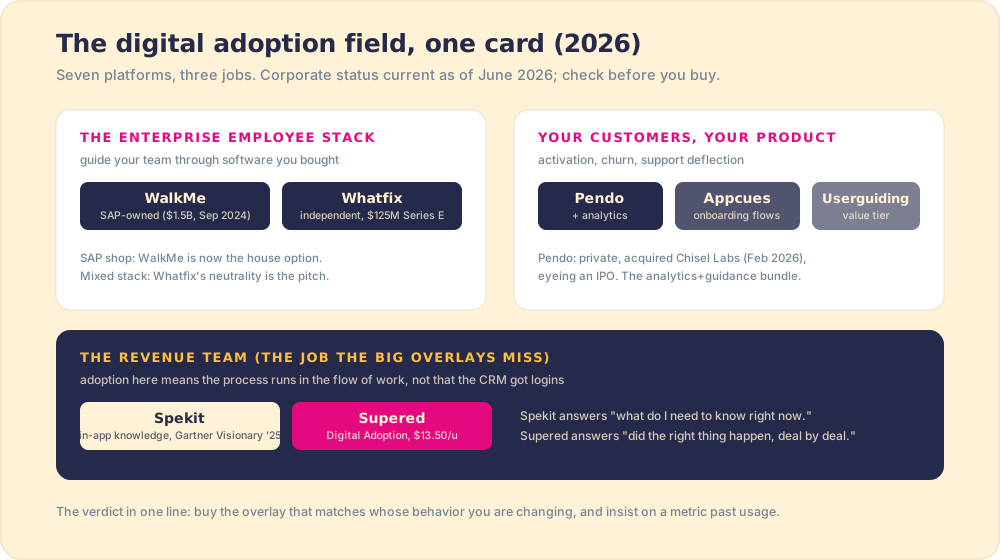
The category's load-bearing fact: digital adoption platform is one label on two markets that barely overlap. Employee-stack overlays (WalkMe, Whatfix) guide your team through software you bought, and are sold to ops and IT. Product-side tools (Pendo, Appcues, Userguiding) guide your customers through software you built, and are sold to product and growth. A tool that tops one list is irrelevant on the other, which is why generic top-ten DAP roundups mislead by construction. Decide the audience first, and half the field excuses itself before a single demo.
The split is not cosmetic; it changes what the tool is for and how its success is judged. Guiding your own customers through a product you control is, at root, a conversion and retention problem: you want a trial user to reach the moment the product proves its worth, and the metric (activation, feature adoption, time-to-value) is a defensible proxy because usage genuinely is the outcome you sell. Guiding your employees through software you bought is a different animal. Here usage is not the outcome; it is a step toward an outcome that happens elsewhere, in a closed deal, a clean ledger, a filled prescription. The customer-facing tool can mostly trust its usage numbers. The employee-facing tool inherits Solow's gap in full, because the thing it cares about, the work getting better, is one layer below anything it can see. Sorting the field by audience is the first cut, and it is also the first place the measurement problem either does or does not bite.
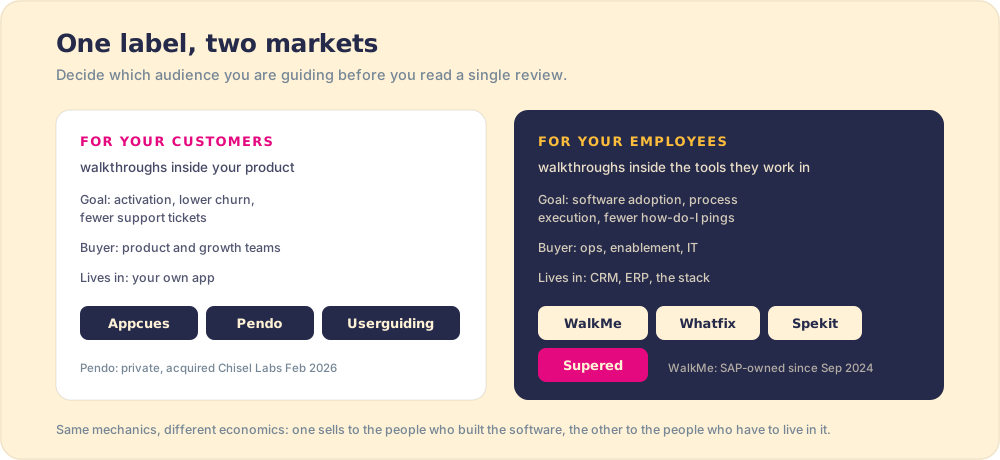
The corporate map matters too, because two of the biggest names changed shape recently, and in this category the owner of a tool is a fact about its future, not its past. WalkMe sold to SAP for $1.5 billion in September 2024 and is now wired progressively into SuccessFactors, Ariba, Concur, and S/4HANA, which makes it the house option inside an SAP estate and a roadmap question outside one; the full reasoning is in WalkMe alternatives. Whatfix stayed independent (a $125M Series E, 700+ customers) and made platform neutrality its pitch, the argument being that an overlay sitting on top of your whole stack should not be owned by one of your stack's vendors. Pendo remains private and acquisitive, Chisel Labs in February 2026, with stated IPO ambitions. The whole field, named and dated, is in best digital adoption platforms.
The acquisition tells you what the incumbents believe the category is for. SAP did not buy WalkMe to sell guidance overlays as a standalone business; it bought a layer that drives usage of SAP's own applications, the thing SAP most needs after a customer signs a nine-figure contract and then struggles to get anyone to log into S/4HANA. The strategic logic confirms the category's center of gravity: the overlay exists to lift adoption of the software underneath it, measured as usage of that software. That is a coherent and valuable job. It is also, precisely, the odometer job, and noticing that is the difference between buying the tool for what it does and buying it for what you hoped it did.
Why does in-app guidance work at all?
Because it removes human memory from the chain, and memory under pressure is a documented disappointment. The training-then-recall model asks a person to absorb knowledge in one room and produce it later in another, with steep decay in between. Hermann Ebbinghaus measured that decay in the 1880s and gave us the forgetting curve: without reinforcement, a learner loses the majority of new information within days. A classroom session followed by a real task a week later is fighting that curve, and losing. The signage model does the opposite. It puts the answer at the fork in the corridor: nobody studies an airport, and tens of millions of strangers a year navigate Heathrow anyway, because the airport never asks anyone to remember the way. It tells them, at the moment they need to turn, where to turn.
The behavioral science is specific about the mechanism, and it is the same mechanism that powers a sales playbook delivered in the flow of work. Binding an action to a concrete situational cue ("when X arises, do Y") lifts follow-through with a medium-to-large effect, d = 0.65 across Gollwitzer and Sheeran's meta-analysis of 94 studies (2006), and a tooltip at the decision point is that cue, manufactured. Peter Gollwitzer called these implementation intentions, and his core finding is that a goal held in the mind ("use the new tool properly") is a far weaker predictor of action than the same goal bound to a triggering situation. The training session hands the rep a goal. The in-app prompt hands them the trigger. That is why one survives contact with a busy day and the other does not. BJ Fogg's behavior model says the same thing from a different angle: behavior occurs when motivation, ability, and a prompt arrive together (B=MAP), and the prompt is the part a manual cannot supply at the right moment. A tooltip is a prompt that shows up exactly when ability and motivation are both already present, which is the rarest and most valuable timing in all of behavior change.
The most famous field result in process work runs on the same engine. Peter Pronovost's bedside checklist took ICU line infections from 2.7 per 1,000 catheter-days to zero in the Michigan Keystone study, paired with someone empowered to verify each step (NEJM, 2006). Notice what the medical version included that the software version usually drops: the verification. The checklist at the bedside was the in-the-moment prompt, and the nurse empowered to stop a doctor who skipped a step was the inspection. Delivery plus inspection moved the outcomes. Neither half worked alone; a checklist nobody enforced would have changed nothing, and an enforcer with nothing to check against would have had no standard to hold. A DAP that ships walkthroughs without behavior measurement has implemented half of the best-evidenced intervention in process science and priced it like both halves. The deeper anatomy of that blind spot is in in-app guidance and interactive walkthrough software: a completed tour is a fact about the tour. Adoption is a fact about the work.
Why do usage metrics mislead?
If the delivery works, why distrust the dashboard that proves people are using it? Because the dashboard measures a proxy, and a proxy holds only as long as nobody steers by it. The economist Charles Goodhart gave us the law that explains the failure: when a measure becomes a target, it ceases to be a good measure. Usage was a fine proxy for adoption right up until adoption teams were paid to raise usage, at which point the number could be moved without the underlying behavior moving at all. A walkthrough auto-launches and counts as engaged. A tour is clicked through to dismiss it. A feature is opened once to satisfy a rollout goal and never again. The proxy detaches from the thing it stood for, and the gauge keeps reading full.
Sit with what a usage metric can and cannot see, because the boundary is the entire argument. A login proves a person authenticated. A completed tour proves a sequence of screens advanced. Time-in-app proves a tab was open. Feature adoption proves a button was pressed. Each of these is a fact about the contact between a human and an interface, and not one of them is a fact about the work being done correctly. The rep can log in, complete the discovery-call walkthrough, open the deal record, and still run a shallow discovery that names no real problem, and every metric on the adoption dashboard will glow green. The instrument was built to detect presence, and we keep asking it to certify performance. It cannot, the way an odometer cannot tell you whether the miles took you toward home or in a circle around the block.
The deeper reason this matters is that the work the software was bought to change almost always happens in a system the overlay cannot reach. A sales process is decided in the buyer's commitments, recorded (or not) in the CRM; an expense process is decided in whether the receipt matched the policy; a clinical process is decided at the bedside. The overlay sits on the glass and watches the clicks. To know whether the behavior changed, you have to inspect the output of the process inside the system of record, which is a categorically different measurement than counting how many times the guidance played. This is the same line our research draws between activity and commitment in a pipeline: capturing what a person did is useful and necessary, and it becomes a lie the moment you let it stand in for whether the right thing happened. The fix is not to stop measuring usage. It is to refuse to let usage be the final word, and to add the one measurement the overlays were never built to take.
But is usage data not genuinely useful?
It is, and the case for it deserves to be made at full strength before anyone hears the rebuttal, because a critique that only ever argues with a weak version of the opposing view is not worth the reader's time. The strongest version runs like this. Usage data is the most honest, granular, real-time signal a software team has ever had about how people really behave inside a product, and it would be a strange kind of progress to throw that away. Before in-app analytics, a product team flew blind: they shipped a feature and learned whether anyone used it from a quarterly survey, an anecdote in a sales call, or a renewal that did or did not happen. Now they can see, the same afternoon, that a feature shipped to wide acclaim is touched by four percent of accounts, or that a redesigned onboarding flow lost half its users at step three. That is real knowledge, arrived at honestly, and it routinely saves teams from building more of something nobody wanted. Usage is also a perfectly good leading indicator in many settings: a user who never logs in will certainly not get value, so a login is a genuine necessary condition even when it is not a sufficient one. And on the product side, as the two-markets section argued, usage often is close enough to the outcome to trust, because the thing you sell is the using.
Grant all of that. The rebuttal is not that usage data is worthless; it is that usage data is necessary and insufficient, and that the category's sin is treating the necessary as if it were the sufficient. A login is a real necessary condition, and a necessary condition mistaken for a goal is exactly the failure Goodhart described: the moment you pay a team to raise the necessary condition, they will raise it without touching the sufficient one, because that is the cheaper path and people, sensibly, take cheaper paths. The fix is not to stop watching usage. It is to keep usage in its proper place, as a diagnostic and a leading indicator, and to refuse to let it be the scoreboard. Watch the odometer; do not write "arrived" in the logbook because the odometer turned. A good revenue dashboard shows both: the usage that tells you whether the tool is being touched, and the adherence that tells you whether the work the tool exists for genuinely happened. The error this guide names is not measuring usage. It is stopping there.
Why do adoption initiatives fail with healthy dashboards?
Because the initiative treated adoption as a navigation problem, and navigation was never the expensive gap. A rep can follow every walkthrough, complete every tour, and still skip discovery on the next opportunity, and the usage dashboard will report the rollout a success while the behavior the software was bought to produce never arrives. This is the pattern under our field data: 89 percent of 198 sales teams had a defined process, 36 percent saw it followed, and every one of those teams' tools showed healthy usage. The gap lived one level below the metrics, in distance, friction, and feedback, the system properties that decide user adoption and its expensive special case, CRM adoption. When a team "fails to adopt," it is nearly always responding rationally to a system that made the right action the harder action, the argument of the sales execution gap.
The phrase "fails to adopt" deserves to be retired, because it locates the failure in the wrong place. It implies a workforce of laggards who could comply and chose not to, and so it points leaders toward the fixes that never work: more training, a sterner mandate, a longer onboarding. The evidence points the other way. WalkMe's 2026 research found employees losing an average of 51 working days a year to technology friction even as AI investment hit record highs (WalkMe, April 2026). People drowning in 51 days of friction are not undisciplined; they are responding sensibly to systems that made the right action the harder one. Non-adoption is a system property, not a character flaw, which is why the durable fix is always to the system: reduce the distance to the right action, deliver it in the flow of the work, and measure whether it happened, rather than exhorting people to try harder against friction the org built.
What are the common digital adoption mistakes?
Adoption initiatives fail in a handful of recognizable ways, and each one feels, at the time, like diligence. Naming them is the fastest diagnostic a leader has, because a stalled rollout is almost always one of these wearing the costume of progress.
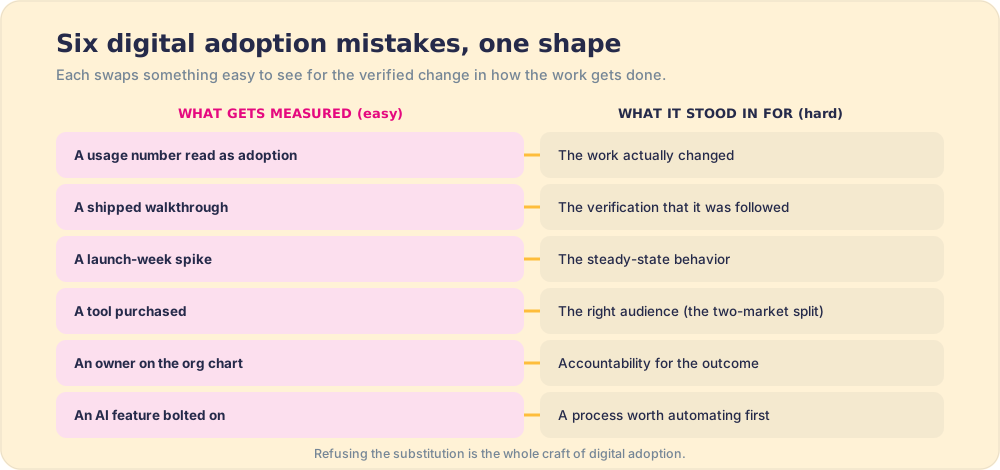
- The usage proxy mistaken for adoption. The central error, and the one that breeds the rest: a dashboard of logins and completed tours read as proof the behavior changed. It produces confident rollout reports and no change in the work, because the metric was a proxy and the proxy was the only thing measured. Reading miles as arrival is the mistake everything below descends from.
- Guidance without verification. Shipping the walkthroughs and skipping the inspection, which is implementing Pronovost's checklist and firing the nurse who was supposed to enforce it. The delivery half is the easy, cheap half; the verification half is what moved the ICU numbers, and an initiative that omits it has bought the lighter half of the intervention at the full price.
- The first-week illusion. Adoption spikes during a rollout because the guidance is novel and the campaign is loud, then decays back to the old habit once attention moves on. Teams celebrate the spike and never measure the steady state, so a temporary lift in usage gets booked as a permanent change in behavior that never set.
- Wrong-audience tooling. Buying a product-side adoption tool to drive an employee process, or an enterprise overlay to onboard customers, because the category's single label hid the two-market split. The tool that tops one list is irrelevant on the other, and the mismatch surfaces as an adoption failure that was a procurement failure in disguise.
- Adoption owned nowhere. A platform bought by IT, configured by an admin, and accountable to no one who owns the business outcome it was meant to move. Usage gets reported up; behavior gets owned by no one, so when the work does not improve there is no one whose number it was.
- AI bolted onto a broken process. Adding an agent or an AI assistant on top of a process the team was not running well, on the theory that automation will fix what discipline could not. It amplifies whatever motion is already there, so a broken process gets executed faster and the dashboard, counting AI usage now too, looks healthier than ever.
Read down the list and one pattern connects all six: each substitutes something easy to see and easy to move, a usage number, a shipped walkthrough, a launch spike, a tool purchased, an owner on the org chart, an AI feature, for the harder thing it was meant to stand in for, a verified change in how the work gets done. The craft of digital adoption is refusing those substitutions, the same discipline a well-run process applies to its stages.
What does the odometer problem look like in practice?
Two worked examples, drawn from the two markets, make the gap concrete, because it is easy to nod at "usage is not behavior" and still buy the dashboard that conflates them.
The CRM rollout that looked like a triumph. A mid-market sales org rolls out an enterprise overlay to drive CRM adoption. Ninety days in, the numbers are excellent: logins up, the new opportunity walkthrough completed by 94 percent of reps, time-in-CRM up by a third. Leadership books it as a win and turns to the next project. Two quarters later, forecast accuracy has not improved, no-decision losses are climbing, and a deal review reveals why: reps are completing the walkthrough and then advancing deals on the activity "demo delivered" rather than any buyer commitment, exactly as they did before the rollout, because nothing ever checked whether the discovery behind the stage was real. The overlay raised the odometer, time spent in the tool, and never touched the arrival, deals that reflect the buyer's true position. The usage dashboard had no way to see the gap, because the gap lived in the quality of the commitment recorded in the stage, one layer below anything the overlay measures. The fix was not more guidance. It was measuring adherence to the commitment inside the CRM, the discipline laid out in CRM adoption and sales process adoption.
The product onboarding that hit its number and lost the user. A SaaS company instruments its new-user onboarding with a product-side adoption tool and sets a target: 80 percent of new accounts complete the setup tour. The campaign works, the target is hit, and activation, defined as tour completion, looks healthy. Retention does not move. A cohort analysis finds that users clicked through the tour to dismiss it and reached the product's actual value moment, the report that made the tool indispensable, at the same low rate as before. The team had optimized the proxy (tour completed) and Goodhart's law collected its toll: the measure became a target and stopped measuring the thing it once tracked. Here the customer-facing tool's usual advantage, that usage genuinely is closer to the outcome, broke down because the chosen usage metric was the wrong one. The fix was to redefine adoption as reaching the value moment, a behavior in the product, rather than completing the tour, a contact with the guidance.
The CS team that changed what counted. A customer-success org had run for two years on an adoption dashboard built from feature reach: a "healthy" account was one where a defined set of features had been touched in the last thirty days, and CSMs were measured on moving accounts into the green. The board looked good and renewals kept slipping anyway, churning accounts that the dashboard had called healthy right up to the cancellation call. The team did one thing: it stopped scoring accounts on features touched and started scoring them on whether the customer had reached a defined outcome the product existed to deliver, the report run, the workflow automated, the integration live and firing. The CSMs' guidance did not change much; what changed was the target they steered toward, and so what changed was where they spent their hours, away from nudging dormant features and toward getting accounts to the outcome that predicted renewal. The lesson is the cleanest of the three: the overlay and the guidance were never the problem, and swapping the vendor would have fixed nothing. The metric was the problem. Point the same machinery at arrivals instead of miles and the behavior of the whole team turns to follow it, which is Goodhart's law finally working for you instead of against you.
All three stories share the same shape, and it is Solow's: spend rose, screens lit up, the gauge read full, and the work did not change, because the gauge was built to read the spend and the screens, never the work. The remedy in each case was the same in principle, measure the arrival the process exists to produce, not the miles the tool logged on the way.
What does AI change about digital adoption?
Two things, and the second is larger than the category usually admits. First, AI makes the guidance itself nearly free. Whatfix now ships an Authoring Agent and a Guidance Agent that generate and contextualize walkthroughs automatically, the company having repositioned around what it calls an AI-native digital adoption platform, and Gartner expects the trend to generalize: it predicts that by 2028, 40 percent of organizations will use generative AI inside their DAPs to automatically surface new workflows to employees (Nexthink summary of the 2025 Gartner Market Guide). When anyone can generate a walkthrough in seconds, the walkthrough stops being the moat, and what remains scarce, knowing whether the guidance changed the work, becomes the only thing worth paying for.
The productivity numbers are already foreshadowing where this goes. Gartner's own research found that the share of digital workers struggling with information access, awareness, or update overload who nonetheless reported productivity gains fell to roughly a quarter in 2024, a sharp decline from 2022 (Nexthink summary of the 2025 Gartner Market Guide). More tools, more guidance, more AI, and the felt productivity is going the wrong way. That is Solow's paradox reading out in real time inside the category built to cure it, and it tells you the cure was never going to be more delivery. It was always going to be measurement of the work.
Second, and more fundamental, AI agents are starting to do the task instead of guiding a human through it. Gartner predicts that 40 percent of enterprise applications will feature task-specific AI agents by the end of 2026, up from less than 5 percent in 2025, and its analyst Anushree Verma frames the trajectory plainly: "AI agents will evolve rapidly, progressing from task and application specific agents to agentic ecosystems" (Gartner, August 2025). When an agent files the expense or updates the CRM, "did the employee finish the walkthrough" stops being a sensible question. The sensible question becomes "did the agent do the right thing, and can we govern it," which is a behavior-and-outcome question, not a usage one.
The category already senses the shift, and the savviest player in it has acted on the sense decisively. Pendo brought Agent Analytics to general availability in 2026 to track agent behavior, usage, and business impact, measuring more than 350 agents and 2.5 million prompts a week across its customers, precisely because feature-adoption metrics cannot see whether an agent did its job. The framing from Pendo CEO and co-founder Todd Olson is the most honest sentence anyone in the category has said about the agent era: "Companies are launching agents faster than ever, but they're relying on a simple thumbs-up or thumbs-down to gauge their success, which is insufficient," and Agent Analytics, he argued, "is the only way to understand if users are getting value from the AI innovation you're delivering" (Pendo, 2025). Read that next to Adika's line about people delivering results, not technology, and the two leaders of the category are saying the same thing from opposite ends of fifteen years: the value lives in whether the behavior was right, and the instrument has to be pointed there. Olson is describing the odometer problem in the language of agents and conceding, in the open, that the old gauge cannot see it.
The discipline is hard, and the market knows it. Gartner warns that more than 40 percent of agentic AI projects could be cancelled by 2027, citing unclear value, rising costs, and weak governance (Gartner, via MES Computing). Governance and unclear value are the agent-era restatement of the odometer problem: a project that cannot prove the behavior improved is a project that will be cancelled when the spend is questioned. The odometer problem does not retire with AI. It moves to the agents, and the teams that measured arrivals instead of miles are the ones ready for it.
It is worth being precise about what changes when an agent does the task, because the shift is structural and it lands hardest on the employee-facing side. When a human did the work, the unit of measurement a DAP could reach for was the tour: did the person complete the walkthrough, a usage fact, with the real behavior left to inspect elsewhere. When an agent does the work, the tour disappears entirely; there is no human to guide, no walkthrough to complete, and the only meaningful question is whether the agent's individual action was correct, the expense coded to the right account, the CRM field set to a value that reflects the buyer's real position, the discovery summarized without inventing a commitment the buyer never made. The unit of inspection moves from a completed sequence of screens to a single judgment, and judgment is exactly the thing a usage gauge was never built to read. Customer-facing platforms feel this less acutely, because when their agent helps a user inside the product, the agent's success and the product's success still point the same way, and usage stays a fair proxy. Employee-facing platforms feel it in full, because the agent's action is one step toward an outcome that lives in the system of record, and a platform sitting on the glass can watch the agent move and still have nothing to say about whether the move was right. The platforms that win the agent era are the ones that can inspect the action against an expected standard, which is the adherence question, recast for a non-human actor.
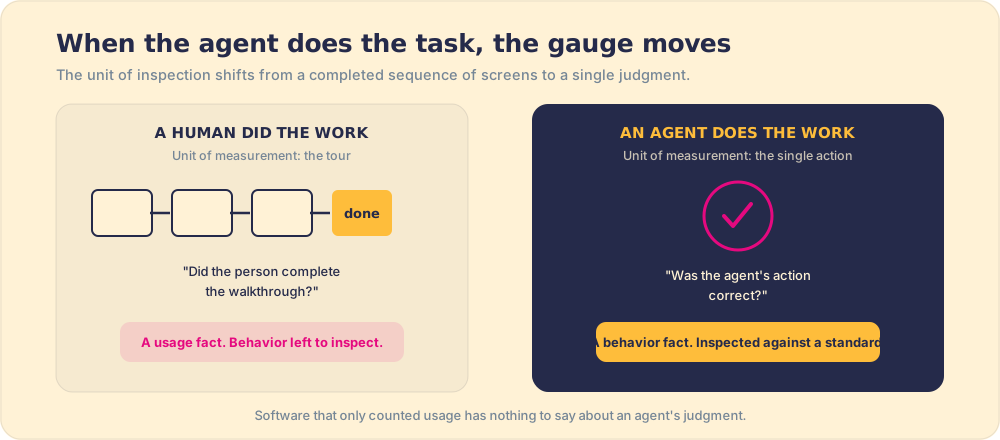
This is also where Dan Adika's founding line comes back with more force than he may have intended. If "technology alone doesn't deliver results, people do," then handing the task to an agent does not dissolve the problem; it relocates it. The question of whether a human followed the process becomes the question of whether the agent followed the process, and you still need a way to inspect, at the level of the individual action, whether the thing was done right. Software that only ever knew how to count usage has nothing to say about an agent's judgment. Software built to verify behavior against an expected standard has exactly the instrument the agent era will require. The principle outlives the actor: get the process right, deliver it where the work happens, inspect whether it ran, and the same discipline that governed a rep will govern the agent that replaces part of the rep's job.
What should a services or internal team buy, then?
Both halves of the evidence, ideally from one platform, and here is where this guide stops being neutral and puts our own offer on the table, priced. Supered's Digital Adoption tier is the guidance half, complete: Step-by-Step Guides (recorded once, editable and branchable afterward, PII auto-blurred in screenshots), Knowledge Cards, in-app pop-up Updates, Knowledge Checks, an AI assistant, and the Sidekick extension surfacing all of it in HubSpot, Salesforce, Gong, Gmail, and any URL. Published at $13.50 per user per month billed yearly, no seat minimum, free trial without a card, in a category that mostly prices by discovery call.
And it carries the upgrade the overlays cannot offer: Process Compliance ($40 per user per month) moves from signage to the process itself running in the system of record, Process Rules, Process Boards, inline record editing, with adherence measured in the flow of work while a manager can still coach the outcome rather than autopsy it. Start on miles; graduate to arrivals, without changing platforms. The numbers stay public on the pricing page, which in this category is itself a differentiator.
Why the two tiers, and not one bundle? Because they answer two genuinely different questions, and a team usually needs to answer the first before it can afford the second. The Digital Adoption tier answers "can a person find and follow the right step in the moment," which is the delivery problem the whole category exists to solve, and which the evidence above says is worth solving on its own. Process Compliance answers the harder question, "did the team's process run where the work is decided, account by account," which is the arrival the usage dashboards cannot see. Take a services firm onboarding a big client: the kickoff, the requirements gathering, the internal handoffs, the milestones the team is meant to run the same way on every account. Buying the first without the second leaves you measuring miles; buying the second without the first leaves you inspecting a process the team was never equipped to run. Paired, they are the two halves of Pronovost's intervention, the prompt at the bedside and the verification that it was followed, which is the combination the field data and the medical data both say is what moves outcomes.
The deeper reason a team that runs a process needs a process-specific layer rather than a stack-wide overlay is structural, not a matter of preference. An enterprise overlay sits on the glass of whatever application is open, which makes it broad and shallow by design: it can guide a person to click the right button in any of 625 apps, and it has no opinion about whether the work those clicks describe was done right. A process layer is narrow and deep: it lives inside the system of record where the work genuinely lives, a services firm's client-onboarding tracker, a support queue, a delivery board, understands what a stage means and what a real commitment looks like, and can therefore measure the one thing the overlay cannot, whether the process produced the behavior the business runs on. Breadth is the overlay's strength and the reason it cannot see arrivals. Depth in the system of record is what lets a tool read them.
The recommendation
Run the evaluation in three cuts, each one eliminating most of the remaining field. The audience first: employees or customers, ruthlessly, before any demo. The stack second: SAP estate means WalkMe is now the house option, mixed estate favors Whatfix's neutrality, your own product points at Pendo or Appcues, and a revenue team in HubSpot or Salesforce fits a sales-specific layer tighter than any enterprise overlay. The metric last and most decisively: ask each finalist what their dashboard says the week after a walkthrough ships, the tour or the work, and refuse the odometer as proof of arrival. The category will happily sell you miles. The teams that get paid measure arrivals.
It is worth holding, one last time, how stubborn Solow's gap has proven, because that stubbornness is the most useful thing a buyer can carry into the room. Forty years of computing, a decade and a half of digital adoption platforms, and now a wave of AI agents have all promised to convert spend into productivity, and the gap between the spend and the gain keeps reappearing under a new name. The reason is the one Adika named and the category half-forgot: technology alone does not deliver results, people do, and now agents do, and the only way to know whether either delivered is to inspect the work itself, not the usage that surrounds it. A tool that measures arrivals is not a nicer version of a tool that measures miles. It is answering a different question, the question Solow was asking in 1987 and the question your CFO will ask about your AI budget in 2027: did the work get better. Buy the tool that can answer it.
Read the category end to end: best digital adoption platforms for the named field, in-app guidance for the science and the blind spot, WalkMe alternatives for the post-SAP decision, interactive walkthrough software for the two-market split, and user adoption plus CRM adoption for the system-design view of why rollouts stall.
Digital adoption platform FAQ
What is a digital adoption platform?+
What does digital adoption mean?+
What are the best digital adoption platforms?+
Why do digital adoption initiatives fail?+
Is a digital adoption platform worth it for a sales team?+
How much does a digital adoption platform cost?+
What is the difference between digital adoption and user adoption?+
Can a digital adoption platform measure behavior, not only usage?+
What is the difference between a customer-facing and an employee-facing DAP?+
How do you measure digital adoption beyond usage?+
Is a digital adoption platform the same as an LMS or training software?+
Stop measuring miles.