Supered vs SeismicPick the one built for the job you have.
Supered vs Seismic is a choice between two jobs. Seismic, which absorbed Highspot when their merger closed on 18 August 2026, is the stronger pick for producing, personalizing and governing sales content at enterprise scale. Supered is the stronger pick when reps have the content and still skip the process: your expectations become rules, checked against open deals in HubSpot, Salesforce or Pipedrive, and fixed on the record the rep already has open. You can also run both.
01SeismicEnterprise marketing and enablement teams that produce and personalize a large volume of buyer-facing content. 58.6% of its G2 reviewers are enterprise.
02SuperedSales leaders with 10+ reps on HubSpot, Salesforce or Pipedrive whose process is written down and still gets skipped. Public price, live in under a week.
03BothTeams keeping Seismic for content who also need the process followed in the CRM. A Supered rule can point the rep to the Seismic asset.
G2 on 1 October 2026: Seismic Enablement Cloud 4.6 out of 5 from 1,805 reviews; Supered 4.9 out of 5 from 81 reviews.
Status check
What changed at Seismic in 2026?Seismic now owns Highspot.
Seismic completed its merger with Highspot on 18 August 2026. The combined company keeps the Seismic name and CEO Rob Tarkoff, serves about 2,500 customers and 3.5 million users, and sells Highspot on as "Highspot by Seismic" (GeekWire, 18 August 2026; highspot.com). On the integration, Tarkoff told GeekWire that "Seismic and Highspot are carefully evaluating our organizations to identify areas of overlap and integrate our company for near and long-term growth."
The US Department of Justice closed its antitrust review on 19 August 2026, concluding that AI-native competitors are growing fast enough to keep pressure on the legacy providers (DOJ). Gartner's First Take of 13 February 2026 called the deal "a defensive consolidation against pricing, CRM overlap and AI threats" and told buyers to keep renewal terms short, secure price protections with exit clauses, and make sure their data can leave (Gartner).
For a Seismic buyer the practical effect is roadmap and bargaining power. Two overlapping product lines now sit in one company, and the strongest alternative you could have named at renewal is now the same vendor.
The decision table
Supered vs Seismic at a glanceSeven lines that decide it.
Seismic
Supered
Job it is built for
Producing, personalizing and governing sales content at enterprise scale, with learning, buyer engagement and analytics around it.
Getting reps to follow your sales process: expectations as rules, checked against open records, cleared in the CRM or in Claude.
CRM integration
Native apps, including a HubSpot CRM app with "AI-guided content recommendations for each stage of the deal" and sharing from inside HubSpot.
Native: HubSpot and Salesforce. Rules run against your CRM records with no middleware.
Where reps see it
The Seismic app, plus content panels inside the CRM and other tools.
A sidebar on the HubSpot, Salesforce or Pipedrive record, any web app through the Chrome or Edge extension, and Claude through Supered's MCP.
Setup effort
G2 Ease of Setup 8.2, Ease of Admin 8.1. Reviewers describe content migration as time-intensive.
Live in under a week, sometimes in a day. G2 Ease of Setup 8.9, Ease of Admin 9.3.
Pricing
No public price. Vendr median $31,950 a year across 415 purchases (range $8,993 to $179,008).
Process Compliance $40 per user per month yearly ($45 monthly), 5-user minimum, includes Digital Adoption ($13.50 / $15).
Who reviews it on G2
58.6% enterprise, 31.4% mid-market.
72.6% small business, 27.4% mid-market.
Reason to pick it
You produce a large volume of buyer-facing content and need it personalized, on brand and tracked.
Reps have the content and skip the steps, and you want to see who followed the process without opening each record.
How we graded: for the job most people typing "Supered vs Seismic" are weighing, getting reps to follow the process inside the CRM. Weights: rules checked against CRM records (35%), guidance where reps already work (25%), a manager view of who followed it (20%), setup and price for a 10 to 50 rep team (20%). We also grade the opposite lane, content at enterprise scale, so you can flip the lens.
Tool
Lane
Grade
Rank
Why it ranks here
Supered
Process followed in the CRM
A
1
Built for this job: rules on records, a board per rep, fixes in the CRM or Claude, a public price.
Seismic
Process followed in the CRM
C+
2
Recommends content by deal stage inside the CRM; we found no published per-rule check of open records.
Seismic
Content at enterprise scale
A
1
4.6 from 1,805 G2 reviews, LiveDocs automation, governance and, since August, Highspot too.
Supered
Content at enterprise scale
C
2
Cards, guides and action plans built for the moment of work, with no document automation.
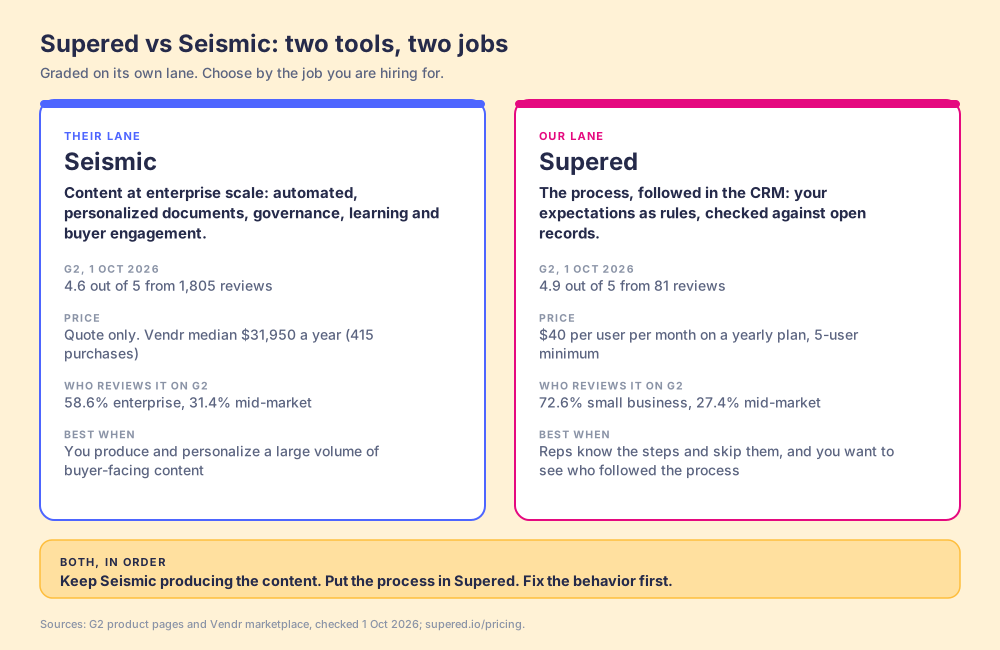
Two tools, two jobs. Seismic: 4.6 from 1,805 G2 reviews, Vendr median $31,950 a year across 415 purchases, reviewers 58.6% enterprise and 31.4% mid-market. Supered: 4.9 from 81 reviews, $40 per user per month yearly with a 5-user minimum, reviewers 72.6% small business and 27.4% mid-market. All checked 1 October 2026.
Fair to them first
What is Seismic best at?Making the right document, at volume.
Seismic's strength is production. Its LiveDocs automation lets an enablement team build a template once and have the platform "pull in dynamic content for more robust, personalized LiveDocs" from the CRM and other data sources (Seismic Exchange), so a rep opens a proposal deck already filled with the buyer's industry and numbers. Its HubSpot app gives reps "AI-guided content recommendations for each stage of the deal" and lets them share content without leaving HubSpot (Seismic Exchange).
The reviews back it. Seismic Enablement Cloud holds 4.6 out of 5 from 1,805 G2 reviews, with support rated 9.1, and reviewers single out the central repository as a "single source of truth," easy sharing and document tracking (G2). After the merger it is also the largest company in the category, with about 2,500 customers.
Seismic is a publishing house. It sets the type, prints a version for each reader, and can tell you how long that reader spent on chapter three. A publisher cannot tell you whether your rep called the reader back the next morning.
Why buyers compare
Why do teams compare Seismic with Supered?The documents ship and the follow-up still slips.
Seismic's G2 complaints are specific, and they map to the criteria a buyer weighs before a renewal.
Admin weight.Seismic scores 8.2 for ease of setup and 8.1 for ease of admin on G2, the lowest of the four tools on our compare pages. One reviewer called the "initial setup and content migration process" "time-intensive" and said it "required significant planning" (G2).
Price against effort.Vendr puts the median Seismic contract at $31,950 a year across 415 purchases, with deals up to $179,008. One G2 reviewer: "Given its current price point, it would be reasonable to expect a higher degree of operational efficiency."
A roadmap in motion.With two product lines under one roof, Gartner's advice applies to any Seismic renewal: short terms, price protection, a clean way out for your data.
Content that lands while the process slips.The State of Sales Enablement 2026 found that 89% of teams have a defined sales process and 36% see reps follow it, a 53-point gap. A sharper proposal deck does not close it, because the gap sits in what reps do between documents: the recap, the next step, the field before the stage moves.
Supered, for the process job
What does Supered do that Seismic does not?It checks the steps between the documents.
Supered starts from your expectations. A next step older than a week, no decision maker past Discovery, no recap within a day of a meeting: each becomes a Process Rule, grouped into a Process Ruleset. A Process Board checks each open deal in HubSpot, Salesforce or Pipedrive against the rules and lists what is broken, rep by rep. The rep sees the list in a sidebar on the record, fixes it there, and the violation clears when the record no longer breaks the rule.
The rules also travel to Claude. Matt Bolian, Supered's co-founder, ran it on his own pipeline: a board with 22 rules showed 11 violations late one night, including past close dates, no amount after Discovery and no recap sent. One prompt in Claude, with Supered, HubSpot and Gmail connected, cleared the board: fields updated from context, recap and pre-call emails saved as drafts. He puts it at about 10 minutes, against about 45 by hand. It is one example from his own deals, not an average (sales expectations, Supered for Claude).
To keep the publishing picture: Seismic prints the book, and Supered checks whether the rep took the next step after it arrived. Supered still carries content built for the moment of work (knowledge cards, step-by-step guides, action plans), and a rule can point the rep to the Seismic asset, so the library stays where it is.
Process Compliance costs $40 per user per month on a yearly plan ($45 monthly), with a 5-user minimum, and includes Digital Adoption. For 25 reps on the yearly plan that is $12,000 a year. Vendr's $31,950 Seismic median spans deals of many sizes and modules, so use it to size the conversation; your own quote will differ. Full plans are on Supered pricing.
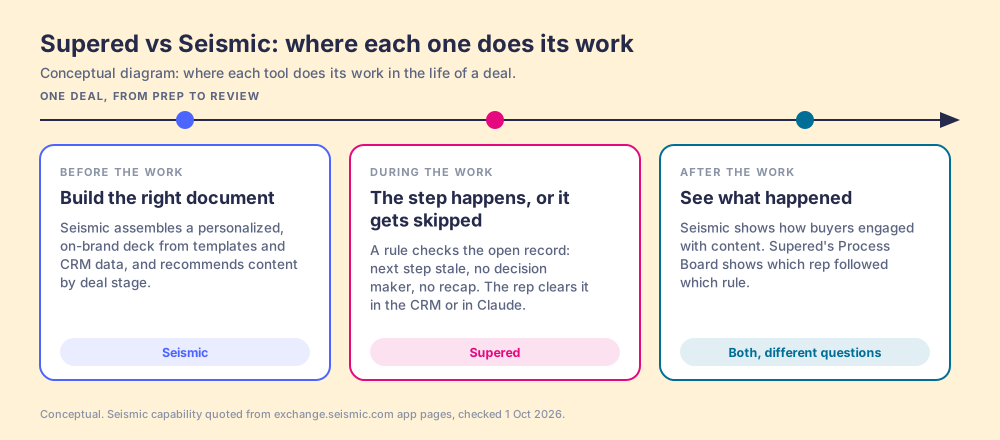
Conceptual. Seismic helps before the work, when the rep needs the right document. Supered acts during the work, when the next step happens or gets skipped. Afterwards each answers a different question: how buyers engaged with content, and which rep followed which rule.
Choose something else when the job looks like this
Content production at scale.Personalized decks and proposals built from templates and CRM data are Seismic's core, and Supered does not generate documents.
Enterprise governance and procurement.58.6% of Seismic's G2 reviewers are enterprise. Supered's are 72.6% small business and 27.4% mid-market.
Field or mobile-first teams.Supered has no mobile app. It fits teams of 10 or more who work at a computer.
See your own process as rules.
A 30-minute demo: we take three expectations your reps skip, turn them into rules, and show the board for your pipeline.
Supered vs Seismic: which should you choose?Decide by the job, then by the price.
If your problem is producing and governing buyer-facing content at enterprise scale, Seismic is the best pick. We are the best pick if your problem is reps who have the content and skip the process.
Choose Seismic for
High content volume. Many products, segments and regions, each needing its own on-brand version.
Enterprise governance. Approval flows, version control and the procurement weight of a category leader.
Buyer engagement analytics. Which buyer opened what, and for how long.
Choose Supered for
Steps reps skip. Recaps, next steps, amounts and close dates checked against each open record, with a board per rep.
HubSpot, Salesforce or Pipedrive as home base. Guidance on the record, in any web app, and in Claude, with nothing new for reps to log into.
A published price and a short setup. $40 per user per month yearly, live in under a week.
Both, in order. Keep Seismic for the documents and add Supered for the process. Get the behavior right first; AI and content compound it from there.
Why trust this page
Why trust a comparison written by Supered?Weigh it, then check the sources.
We sell one of the two products on this page, so weigh what follows. Each competitor number links to its source and carries the date we checked it, 1 October 2026. If Seismic ships a rules engine that checks open records, this page changes.
Supered started inside RevPartners, the HubSpot partner Matt Bolian founded, which sold roughly twice as much Sales Hub as any other partner and reached HubSpot's Elite tier in 13 months. Supered is the #1 sales enablement app on the HubSpot marketplace and a HubSpot Premier Tech Partner, with 6,000+ installs. On G2 it holds 4.9 out of 5 from 81 reviews; on the HubSpot marketplace, 5.0 from 122 reviews (both checked 1 October 2026).
"I use Supered to drive adoption and behavior change inside HubSpot, and it effectively solves the gap between designing a great system and people actually using it properly."
"It ensures reps follow the right steps every time, which has improved data quality, consistency, and overall efficiency across the team."
Reviews quoted verbatim from our wall of love, which links each one to its source.
The questions
Supered vs Seismic, asked plainly.
Is Supered a Seismic alternative?
For one job, yes. If you bought Seismic mainly to get reps following the sales process inside the CRM, Supered does that job directly: your expectations become rules, checked against open deals in HubSpot, Salesforce or Pipedrive. If you bought Seismic to produce and govern content at scale, Supered is an addition to it.
Did Seismic buy Highspot?
The two companies merged. The deal closed on 18 August 2026 and the combined company operates as Seismic under CEO Rob Tarkoff, with about 2,500 customers and 3.5 million users. The Highspot product continues as Highspot by Seismic, and the US Department of Justice closed its review on 19 August 2026.
Can Supered and Seismic run together?
Yes. Seismic produces and governs the content; Supered checks whether reps followed the process. A Supered rule or card can point the rep to the Seismic asset they need at that step, so nothing in the library has to move.
How much does Seismic cost compared with Supered?
Seismic does not publish prices. Vendr's marketplace data puts the median Seismic contract at $31,950 a year across 415 purchases, with a range of $8,993 to $179,008 (checked 1 October 2026). Supered publishes its price: Process Compliance is $40 per user per month on a yearly plan, $45 monthly, with a 5-user minimum.
Does Supered work with HubSpot and Salesforce?
Yes. Supered integrates natively with HubSpot, Salesforce and Pipedrive, and its Chrome and Edge extension shows cards and rules in any web app reps use. Supered has no mobile app, so it fits teams who work at a computer.
How long does Supered take to set up?
Teams typically go live in under a week, sometimes in a day. The slow part is agreeing which expectations matter most, so start with the handful your reps skip most often and add rules from there.