ZoomInfo vs HubSpot in 2026: Does HubSpot's Own Data Replace a ZoomInfo Contract?
HubSpot now owns Clearbit, enriches for free, and runs a prospecting agent.
It still has one hatch for an outside data source, and ZoomInfo took a key to it in July. ZoomInfo vs HubSpot, job by job, checked October 2, 2026.
ZoomInfo vs HubSpot is the question of whether HubSpot's own data, its free enrichment, buyer intent, and prospecting agent, can replace a ZoomInfo contract, and in 2026 it replaces the enrichment half while still borrowing an outside source to find new people.
A kitchen can be beautifully run and still have nothing in the fridge. ZoomInfo vs HubSpot is the question of whether HubSpot’s own data, its free enrichment, buyer intent, and prospecting agent, can replace a ZoomInfo contract, and in 2026 it replaces the enrichment half while still borrowing an outside source to find new people. The short answer, by who it fits:
- Supered Prospector. HubSpot teams whose RevOps already runs Clay. Clay’s waterfall across 200+ providers, run by reps from the HubSpot record or the LinkedIn profile. $45 per rep per month, billed annually.
- ZoomInfo. Teams that cold-call net-new people at volume and live on direct dials. No list price; Vendr’s median contract is $33,500 a year.
- HubSpot’s own data. Teams whose gap is firmographics on inbound leads. Enrichment uses no HubSpot Credits on Starter and up.
How do ZoomInfo and HubSpot compare at a glance?
Prices and features were opened on October 2, 2026 unless marked. Grades use the weights below, for a ten-to-fifty-rep team already on HubSpot.
| Rank | Option | Grade | Best fit | CRM integration | Setup effort | Price (plan with the job) | Reason to switch |
|---|---|---|---|---|---|---|---|
| 1 | Supered Prospector (on your Clay) | A | HubSpot teams that already run Clay | Native in HubSpot, Salesforce, Pipedrive; one-click sync | Admin connects Clay in Supered; Ops picks or builds the tables | $45/rep/mo billed annually, from 1 rep, plus your Clay plan | 200+ providers behind one click on the HubSpot record |
| 2 | ZoomInfo | B+ | Phone-first outbound to net-new people | ZoomInfo HubSpot Connector and Enrich; Breeze agent connector | Super Admin on both sides; mapping and import rules | Quote only; Vendr median $33,500/yr | The deepest single database for cold calls |
| 3 | HubSpot’s own data | B | Inbound teams enriching records they hold | Built in | Super Admin turns on settings | Enrichment: no credits. Intent: 10 credits a company a month. Agent: 100 credits a recommended lead | Free polish on records you already own |
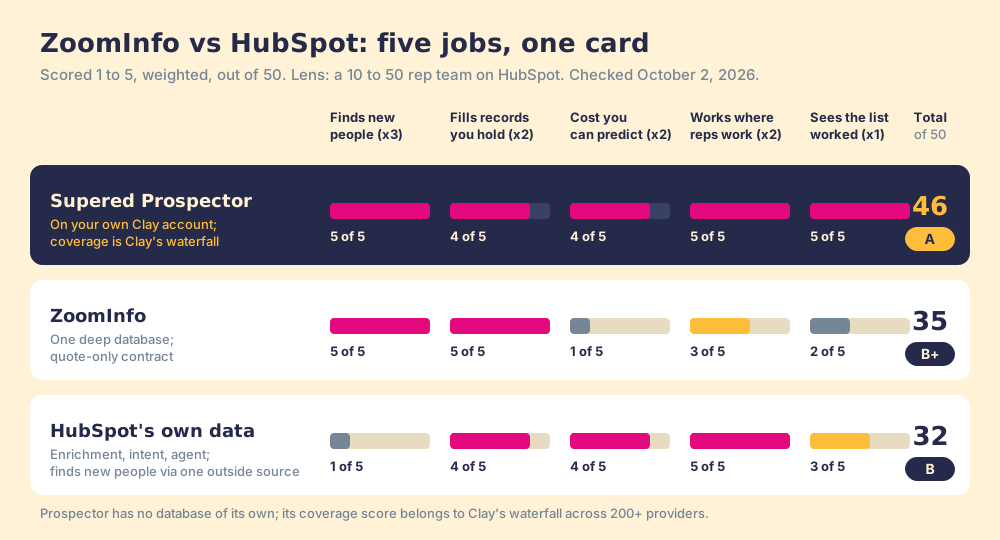
The scoring, so you can argue with it. Each job is scored 1 to 5 and multiplied by its weight, for a maximum of 50.
| Option | Finds new people with email and phone (x3) | Fills records you hold (x2) | Cost you can predict (x2) | Works where reps work (x2) | Manager sees the list worked (x1) | Total |
|---|---|---|---|---|---|---|
| Supered Prospector | 5 | 4 | 4 | 5 | 5 | 46 |
| ZoomInfo | 5 | 5 | 1 | 3 | 2 | 35 |
| HubSpot’s own data | 1 | 4 | 4 | 5 | 3 | 32 |
Weight the first job at 1 and HubSpot’s own data passes ZoomInfo, because enrichment of records you already own is free. Weight it at 5 and ZoomInfo pulls ahead of HubSpot by a wide margin. Prospector’s coverage score is Clay’s waterfall coverage: Prospector has no database of its own.
Why trust this comparison?
I founded RevPartners, a HubSpot partner that did only sales implementations, sold roughly twice as much Sales Hub as any other partner, and reached Elite tier in 13 months. I have set up the prospecting stack inside a great many HubSpot portals and watched which half of a ZoomInfo contract got used. Supered grew out of that work; it is the #1 sales enablement app on the HubSpot marketplace, rated 5.0 from 122 reviews there and 4.9 from 81 on G2, checked October 1, 2026. We sell Prospector, so it ranks first here only for teams that already run Clay, and the weights are printed so you can move them.
What can HubSpot’s own data do in 2026?
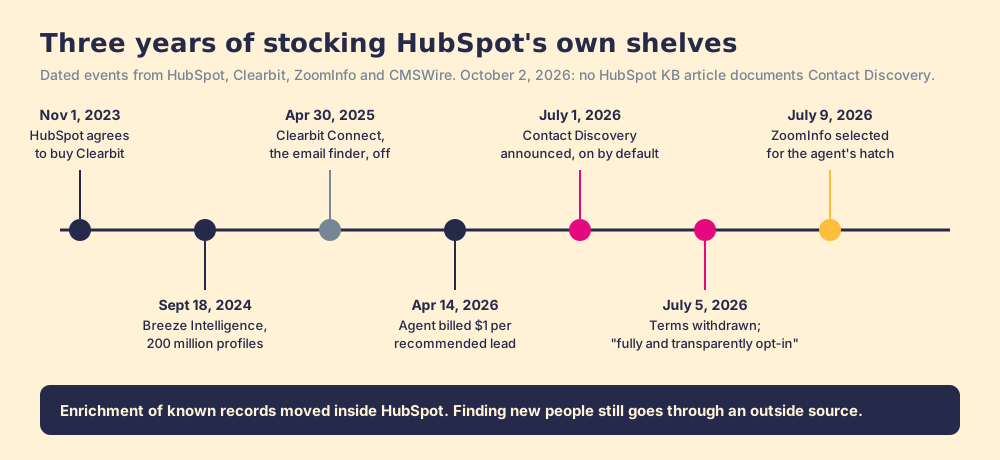
Stand in the kitchen and take stock. HubSpot has spent three years stocking its own shelves, mostly with Clearbit. HubSpot agreed to buy Clearbit on November 1, 2023, describing data drawn from “250+ public and private data sources” (HubSpot), relaunched it as Breeze Intelligence on September 18, 2024 on “a dataset of over 200 million company and buyer profiles,” and switched off Clearbit Connect, the free email finder, on April 30, 2025. Today’s credit meters are on the Clearbit pricing page, and Clearbit against ZoomInfo, data set to data set, is on ZoomInfo vs Clearbit. Breeze Intelligence vs ZoomInfo used to be a fair fight on enrichment. HubSpot kept these pieces:
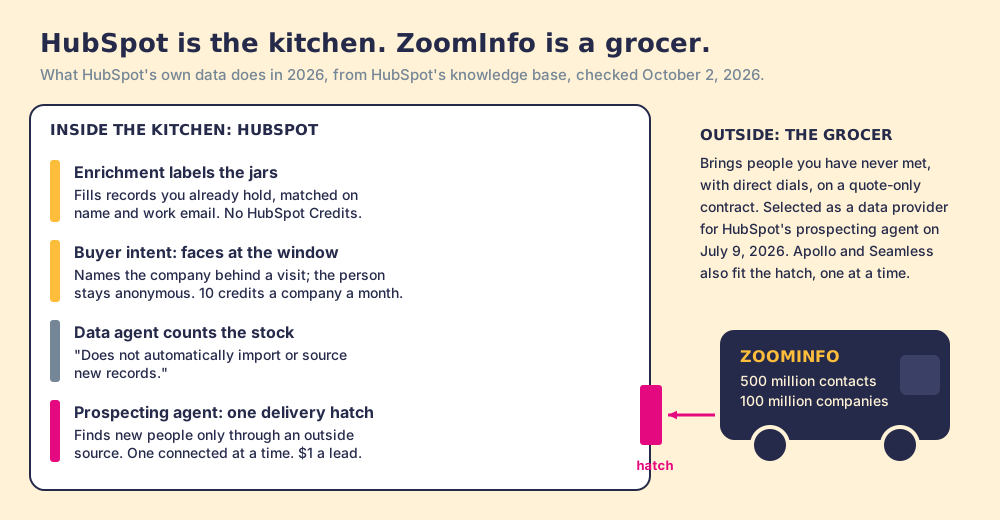
- Enrichment, the jar labels. HubSpot’s knowledge base, updated July 10, 2026, says “Data enrichment does not consume HubSpot Credits” and that the data comes from “HubSpot’s commercial dataset, third-party providers, and publicly available information.” Contacts are matched on “first name, last name, and work email address” (HubSpot KB). It labels the jars already on your shelf.
- Buyer intent, the faces at the window. It identifies the company behind a website visit through an IP-address lookup, and the person stays anonymous. Tracking a company costs 10 credits a month.
- The data agent, the inventory clerk. HubSpot’s product page says it “does not automatically import or source new records” (HubSpot).
- The prospecting agent, the delivery hatch. It can find contacts and draft outreach, but to find new people it needs an outside supplier. HubSpot’s setup article, updated September 30, 2026: “you can connect a data source to find new contacts,” and “only one external data source can be connected at a time.” ZoomInfo, Apollo and Seamless are among the options, and each asks for your login with that vendor (HubSpot KB). Each recommended lead costs 100 credits, $1.
All four work on the records already in the kitchen, or open a hatch for someone else’s van.
A team whose gap is the labels can stop paying ZoomInfo for labels. The KB match rule settles it: HubSpot enriches a contact you can already email. If your inbound forms bring in work emails and you want industry, size, and title filled in, HubSpot does that job and paying ZoomInfo to do it again is a second invoice for the same shelf.
Can HubSpot find new contacts without ZoomInfo?
Not on its own yet, and the reason is a story worth knowing before your renewal call.
HubSpot tried to stock the fridge from its customers. A community post announced Contact Discovery for July 1, 2026: “Find, verify, and add net-new contacts without ever leaving HubSpot,” built on a shared dataset of “business card” details (name, job title, company, work email) contributed by customers’ enrichment (HubSpot Community). Participation was on by default. Customers objected that their hard-won lists would feed their competitors. On July 5, chief product officer Duncan Lennox wrote, “We will not move forward with the terms of service changes we communicated on July 1, 2026,” and promised that any future enrichment using customer data “will be fully and transparently opt-in” (CMSWire, July 6, 2026). On October 2, 2026, I found no HubSpot knowledge-base article for Contact Discovery, and the descriptions I could find list no phone numbers.
Four days later, on July 9, ZoomInfo’s chief marketing officer announced that “ZoomInfo was selected as a third-party data provider for HubSpot’s Breeze Prospecting Agent” (ZoomInfo). The kitchen went back to the grocer.
ZoomInfo’s own HubSpot vs ZoomInfo page makes the point more bluntly than I would. Henry Schuck’s page, dated May 22, 2026, says “HubSpot does not maintain a B2B contact database of its own” and calls the two “typically deployed together” (ZoomInfo). Grant the case its force: for the job of reaching strangers by phone, it holds. It overreaches on enrichment. HubSpot’s KB names its own commercial dataset, and enrichment of known records is the part of a ZoomInfo contract a HubSpot team can now cancel.
What does ZoomInfo still do that HubSpot cannot?
The grocer’s van. ZoomInfo’s August 5, 2026 earnings release counts “more than 100 million companies, 500 million contacts” (SEC filing), and its HubSpot pieces include a connector, Enrich for HubSpot, a Chrome extension that matches the side pane to HubSpot records, and now the agent connector. Where your reps dial people who have never filled in a form, that van is the reason the shelf has anything on it, and the HubSpot ZoomInfo pairing earns its invoice. The setup, plans, and the eight HubSpot objects the connector reads back hourly are covered on the ZoomInfo HubSpot integration page.
The price of the van is the weak spot. ZoomInfo publishes no list prices. Vendr’s median buyer pays $33,500 a year across 1,574 purchases, saving 22% on average, in a range from $7,220 to $155,730 (Vendr). The same Q2 filing shows net revenue retention of 89%, which means the average customer spent about 11% less than a year earlier. In May, chief executive Henry Schuck told staff the company was “reducing the resources we allocate downmarket,” alongside a cut of about 600 roles. On September 30 ZoomInfo bought DoubleO.ai, and on October 1 it launched Agent Teams built on it.
The users rate the data well and the contract less well. G2 gives ZoomInfo’s GTM Workspace 4.5 from 9,170 reviews, against 4.4 from 14,347 for HubSpot Sales Hub, both checked October 1, 2026. The full venue-by-venue picture is in the ZoomInfo reviews page.
What does each option cost a ten-rep HubSpot team?
One year, ten reps, the HubSpot plan you already pay for left out of every row.
| Option | What you pay for the data job | Source |
|---|---|---|
| HubSpot enrichment | $0 extra; “does not consume HubSpot Credits” | HubSpot KB, July 10, 2026 |
| HubSpot prospecting agent | 100 credits ($1) per recommended lead; 1,000 leads = $1,000 at pay-as-you-go | HubSpot catalog and company news |
| ZoomInfo | Quote; median $33,500 a year | Vendr, 1,574 purchases |
| Apollo Basic (a cheaper outside source) | $49 per seat a month, annual: $5,880 | apollo.io/pricing |
| Clay Growth plus Supered Prospector | $5,940 + $5,400 = $11,340 | clay.com/pricing; Prospector |
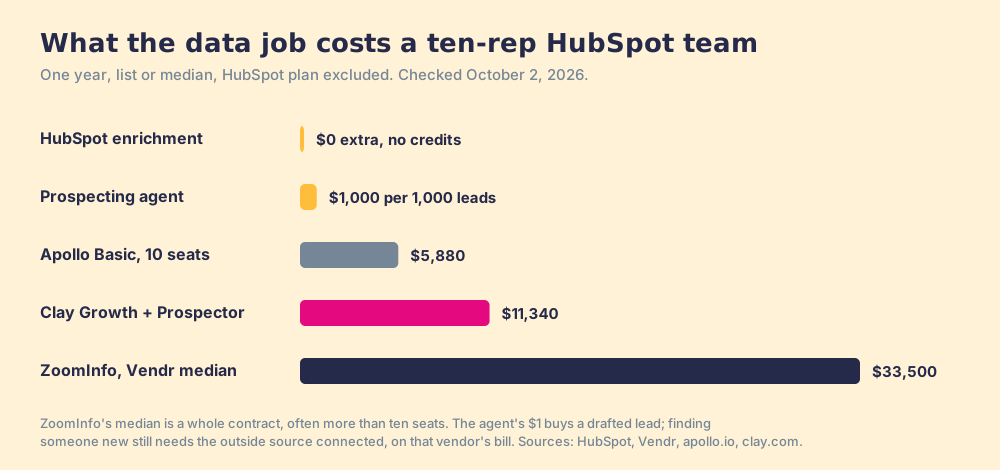
Two cautions keep the table fair. The agent’s $1 buys a recommended lead with drafted outreach, and to find someone new it still needs the outside source connected, with that vendor’s own bill. And ZoomInfo’s median is a whole contract, often for more than ten seats, so treat it as the typical check size.
What should a HubSpot team with Clay do?
Walk out of the kitchen and into the market. Clay’s marketplace sells data from 200+ providers, and its waterfall asks one after another until one returns a verified email or phone; its pricing page says “If an enrichment returns no result, you’re not charged Data Credits or Actions” (clay.com/pricing). ZoomInfo is one of the stalls: Clay’s integrations directory lists it, on your own ZoomInfo account. A market beats one grocer for the plain reason that a miss at one stall sends you to the next.
Supered does not bring its own database. It brings Clay’s waterfall, which is every database, routed, and that is why we chose Clay as our only data provider. Clay plus Supered is the best way for a sales team to prospect: GTM engineers build in Clay, reps never open Clay. Prospector runs inside the Supered Chrome extension, on your Clay account.
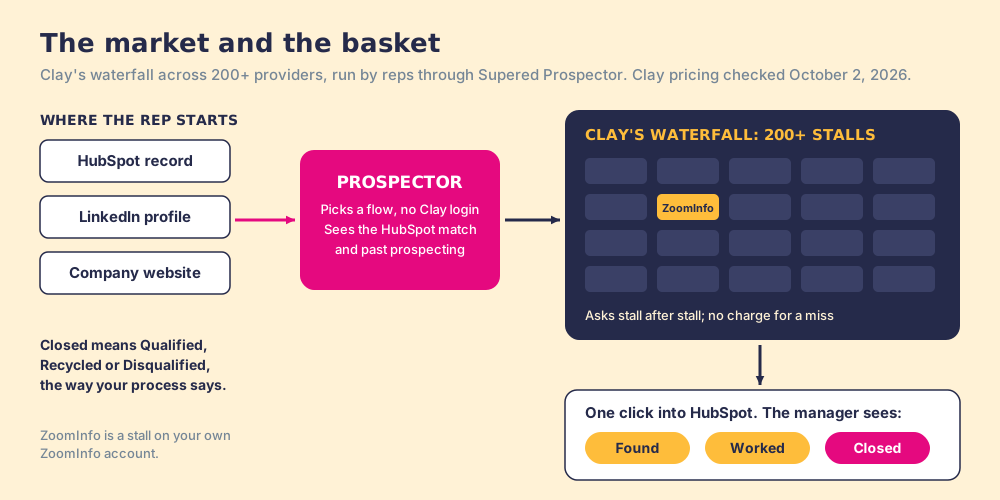
What changes for each person in a HubSpot team:
- The GTM engineer. Flows built once in Clay, each a table with a destination (the HubSpot record, or a sequence), picked by reps from a Push menu. Your waterfalls, tiers and sequence variables stay yours.
- The rep. The table as a button inside the HubSpot record, on a LinkedIn profile, or on a company website. On a profile the rep sees the matching HubSpot record and whether the prospect was already worked, before the push.
- The manager. Found, Worked, Closed: who is working their list, who is not, and how each lead ended, Qualified, Recycled or Disqualified, the way your process says, so coaching starts from what is converting.
Prospector works within LinkedIn’s terms and does not copy search results in bulk; the contact data comes from Clay’s waterfall on the customer’s Clay account.
The price, done straight. Prospector is $45 per rep per month, billed annually, from one rep (Prospector). If RevOps already pays for Clay, ten reps add $5,400 a year. Buying Clay Growth for this at its $495 monthly rate adds $5,940, so $11,340, about a third of ZoomInfo’s median contract. On a cold start Apollo Basic is cheaper at $5,880, and it is one database.
Choose something else if:
- No Clay, and no plan to buy it. Prospector runs only on Clay. RevPartners, a Clay Elite Studio Partner I founded, builds tables for teams that want help, or pick from the branches below.
- A dialer and sequencer in the same tool. Prospector has neither; keep HubSpot Sequences or your sales engagement tool.
- A field or phone-first mobile team. Supered runs at the computer and has no mobile product.
ZoomInfo vs HubSpot: which should you choose?
- HubSpot’s own data. Choose it if your pipeline starts with inbound forms and your gap is firmographics on people who gave you a work email. Turn on enrichment, watch the intent credits, and cancel the part of a ZoomInfo contract that only labeled jars.
- ZoomInfo. Choose it if your reps cold-call strangers at volume and its direct dials book the meetings. Plug it into the agent’s hatch if you want drafted outreach, and negotiate toward Vendr’s 22% average saving with a notice date on the calendar.
- Neither, if you already have Clay. Choose Supered Prospector. The coverage question is answered by a waterfall across 200+ providers that can include ZoomInfo on your own account, the rep works from the HubSpot record, and the manager sees each list become pipeline.
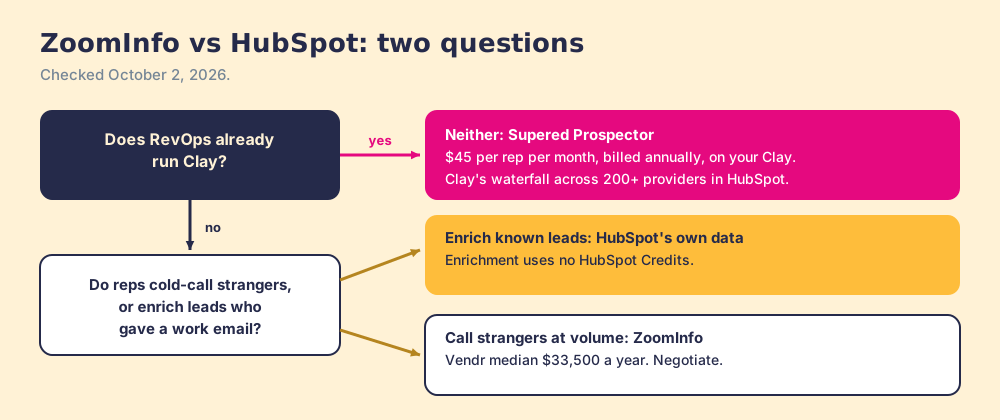
My recommendation follows from the hatch. HubSpot has become an excellent kitchen and a capable label-maker, and it still opens one hatch for one outside supplier when you need people you have never met; after July it opens for the same grocer you were thinking of cancelling. So cancel the labels, keep the van only if your reps live on cold calls, and if RevOps already runs Clay, stop renting one grocer at a time. The HubSpot prospecting agent review shows what the agent does with the contacts once they arrive, and where a rep-built list still wins.
Frequently asked questions
Can HubSpot replace ZoomInfo?+
Does HubSpot have its own contact database?+
Is ZoomInfo or HubSpot cheaper for a ten-rep team?+
Does ZoomInfo integrate with HubSpot's prospecting agent?+
Should a HubSpot team renew ZoomInfo in 2026?+
Is ZoomInfo or HubSpot rated higher on G2?+
Everything we have written on ZoomInfo
More on ZoomInfo
Supered Prospector vs ZoomInfo: the side-by-side- ZoomInfo Competitors in 2026: The Database Was Never the Purchase
- ZoomInfo Pricing in 2026: The Standing Charge, the Meter, and What Neither Can See
- ZoomInfo Reviews 2026: The Equipment Scores 4.5, the Membership Scores 1.8
- ZoomInfo Chrome Extension in 2026: A Free Key Card to a $33,500 Room
- ZoomInfo HubSpot Integration (2026): Setup, Plans, Limits, and What It Reads Back
- ZoomInfo Salesforce Integration in 2026: A Loading Dock With Two Doors
- Apollo vs ZoomInfo in 2026: Two Tailors, Walking in Opposite Directions
- Clay vs ZoomInfo: The Warehouse and the Buying Desk
- Cognism vs ZoomInfo in 2026: Two Good Maps, Each Tested on Its Own Streets
- Kaspr vs ZoomInfo in 2026: A Bike Off the Shop Floor or a Company Car Lease
Your Clay waterfall, where reps already work.