Apollo vs Salesloft in 2026: A Warehouse With a Belt, or a Belt With No Warehouse
Apollo sells contact data with a sequencer bolted on.
Salesloft sells the cadence, deals and forecast, and no data at all. Apollo vs Salesloft, graded on the same jobs with prices and G2 scores checked October 2, 2026, plus the stack Clay teams run.
Apollo vs Salesloft is a choice between Apollo.io, a per-seat platform that bundles a 240-million-contact database with sequences and a dialer, and Salesloft, a quote-priced sales engagement platform for cadences, deals and forecasting that ships no contact database of its own.
A warehouse with a short conveyor belt bolted to the loading door, or a long, well-engineered belt with no warehouse behind it. Apollo vs Salesloft is a choice between Apollo.io, a per-seat platform that bundles a 240-million-contact database with sequences and a dialer, and Salesloft, a quote-priced sales engagement platform for cadences, deals and forecasting that ships no contact database of its own. The short answer, by who it fits:
- A Clay team: Supered Prospector feeding Salesloft. Teams whose RevOps runs Clay and whose reps run cadences in Salesloft. Clay’s waterfall across 200+ providers, run by reps, into the belt they already use. Prospector is $45 per rep per month, billed annually.
- Apollo. One to twenty reps without Clay who want data, sequences and a dialer in one seat. From $49 a seat a month, annual.
- Salesloft. Mid-market teams that already have data and want cadences, deal management and a forecast in one platform. Quote only; Vendr’s median is $30,740 a year.
How do Apollo and Salesloft compare at a glance?
Prices and ratings were opened on October 2, 2026 unless marked. Grades use the weights below, for a ten-to-fifty-rep outbound team.
| Rank | Option | Grade | Best fit | CRM integration | Setup effort | Price (plan with the job) | Reason to switch |
|---|---|---|---|---|---|---|---|
| 1 | Clay team: Prospector + Salesloft | A | Teams that run Clay and Salesloft | Prospector native in HubSpot, Salesforce, Pipedrive; Salesloft keeps its own CRM sync | Ops builds the Clay tables and the cadence action once | Prospector $45/rep/mo annual + Clay plan + Salesloft quote | 200+ providers feeding the cadence you already run |
| 2 | Apollo | A- | 1 to 20 reps wanting data plus outreach | HubSpot, Salesforce, Outreach, Salesloft integrations | Self-serve in minutes | Basic $49, Professional $79, Organization $119/seat/mo annual | Data and sequences under one published price |
| 3 | Salesloft | B | Mid-market teams with data already | CRM sync; G2 reviewers praise Salesforce, flag HubSpot | Sales-led rollout; Ops owns cadences | Quote; Vendr median $30,740/yr | Cadences, deals and forecast in one platform |
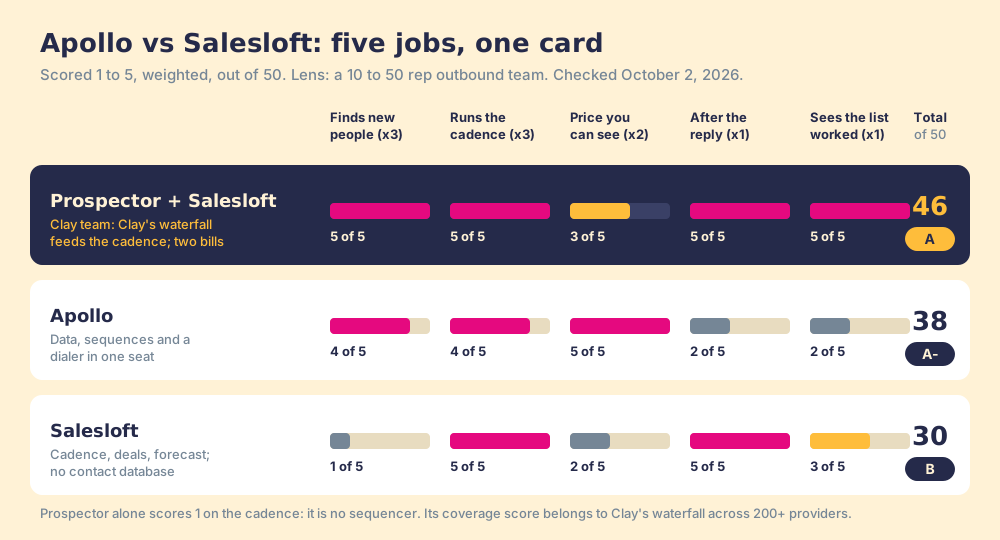
The scoring, so you can move it. Each job is scored 1 to 5, multiplied by its weight, maximum 50.
| Option | Finds new people (x3) | Runs the cadence (x3) | Price you can see (x2) | After the reply: deals, forecast (x1) | Manager sees the list worked (x1) | Total |
|---|---|---|---|---|---|---|
| Prospector + Salesloft | 5 | 5 | 3 | 5 | 5 | 46 |
| Apollo | 4 | 4 | 5 | 2 | 2 | 38 |
| Salesloft | 1 | 5 | 2 | 5 | 3 | 30 |
Weight the cadence at 5 and data at 1 and Salesloft passes Apollo. Weight price higher and Apollo’s lead grows. Prospector on its own would score 1 on the cadence, on purpose: it is no sequencer, and the stack row only works because Salesloft runs the belt.
Why trust this comparison?
I founded RevPartners, a HubSpot partner that did only sales implementations and reached Elite tier in 13 months, and I have watched Apollo and Salesloft both get wired into a great many CRMs, often in the same portal. Supered is the #1 sales enablement app on the HubSpot marketplace, rated 5.0 from 122 reviews there and 4.9 from 81 on G2, checked October 1, 2026. Supered’s core product runs alongside Salesloft, in the same browser, and Prospector competes with Apollo’s data seat for teams on Clay. The weights are printed so you can disagree with them.
Why do teams compare Apollo and Salesloft?
Because each one is missing the other’s half, and the buyer feels the gap from the side they stand on.
Stand in Apollo’s warehouse first. The shelves are deep: Apollo’s pricing page says “240M contacts & 30M companies,” and the plan data behind it gives a Basic seat 30,000 credits a year at 1 credit an email and 8 a phone number (apollo.io/pricing). The belt bolted to the door is short. Basic and Free cap daily email sends at 250, Professional lifts the cap, the US dialer burns 2 credits a minute, and credits “are pooled across your entire team,” “reset at the start of each new billing cycle and do not roll over if unused.” Apollo’s reviewers are mostly small crews: 67.0% of its G2 reviews come from small businesses (G2, Apollo.io vs Salesloft).
Now walk Salesloft’s floor. The belt is long and well built: Salesloft’s platform lists Cadence, Conversation Intelligence, Deals, Rhythm, Clari Forecast, Inspect, Analytics and AI Agents. There is no warehouse. Apollo’s own comparison, dated July 13, 2026, says Salesloft “does not include a built-in B2B prospecting database” (Apollo), and Salesloft’s pricing page lists no data product. Its reviewers are mid-sized crews: 56.4% of its G2 reviews come from mid-market companies.
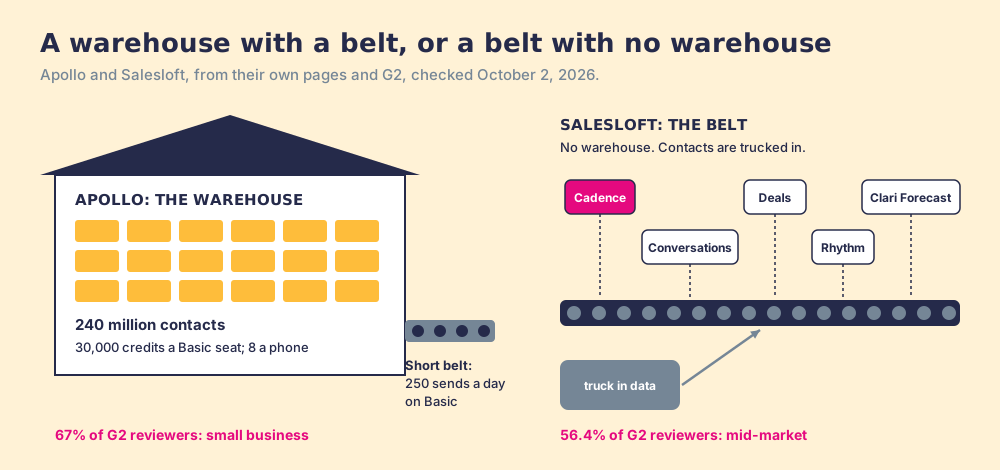
Salesloft vs Apollo is therefore rarely a straight swap. A five-rep team on Apollo outgrows the belt; a forty-rep team on Salesloft needs a truck of contacts every week. The question to ask before the demo is which half is broken for you.
How do Apollo and Salesloft rate on G2?
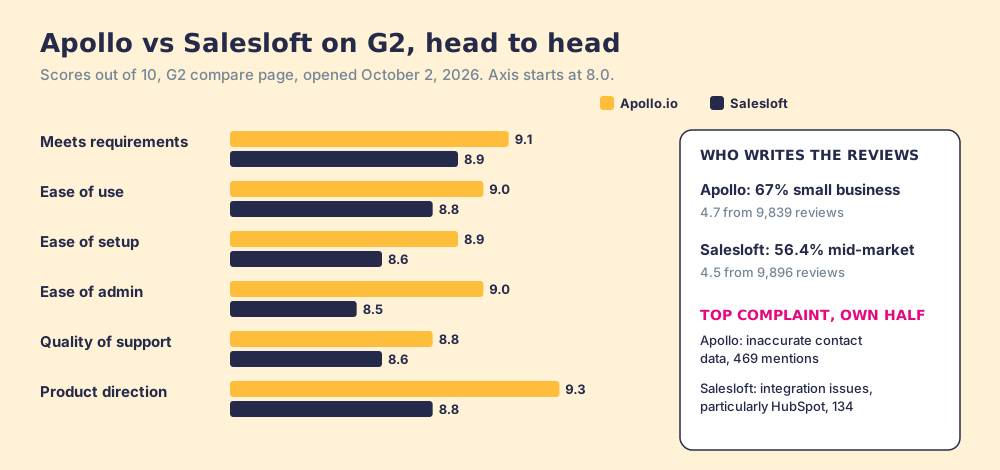
G2’s head-to-head, opened October 2, 2026, puts Apollo ahead on every shared score, by margins that are small on the job and wider on the admin.
| G2 score (out of 10) | Apollo.io | Salesloft |
|---|---|---|
| Meets requirements | 9.1 | 8.9 |
| Ease of use | 9.0 | 8.8 |
| Ease of setup | 8.9 | 8.6 |
| Ease of admin | 9.0 | 8.5 |
| Quality of support | 8.8 | 8.6 |
| Product direction | 9.3 | 8.8 |
The star ratings sit close: Apollo 4.7 from 9,839 reviews, Salesloft 4.5 from 9,896. The complaint tags tell you more than the stars. Salesloft’s G2 page lists “Call tracking and customizable cadences” as a praise tag 338 times and “Integration issues, particularly HubSpot” as a complaint 134 times (G2, Salesloft). Apollo’s complaints center on the shelves: “Inaccurate contact data and email information” 469 times (the Apollo reviews page has the rest). Each tool is criticized for the half it is supposed to be good at, which is the strongest sign you are comparing different jobs.
How much does Salesloft cost compared with Apollo?
Apollo shows you the price before you talk to anyone. Salesloft’s pricing page is a form headed “Talk to sales.”
| Apollo | Salesloft | |
|---|---|---|
| Published price | Basic $49, Professional $79, Organization $119 per seat a month, annual (min 3 seats on Organization) | None |
| What buyers report | Vendr median $19,000 a year, 101 purchases | Vendr median $30,740 a year, 708 purchases, about 18% average savings |
| Per-seat bands | List, above | Essentials $60 to $85, Advanced $100 to $130, Premier $130 to $170 per user a month (Vendr) |
| Meter on top | Credits: 8 per phone, pooled, expire each cycle | Add-ons such as Conversations, Rhythm and Deals, 10% to 40% on top (Vendr) |
Vendr’s Salesloft page also records a range from $5,160 to $146,683 a year and annual escalators of 5% to 8% (Vendr); the Apollo median comes from Vendr’s Apollo page. Our full breakdown of the Apollo ladder is on the Apollo pricing page.
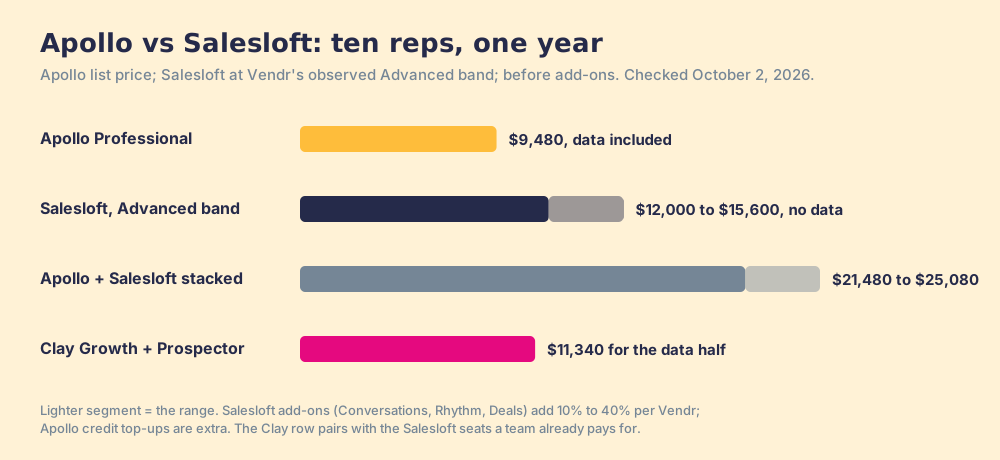
Run it for ten reps, one year, our arithmetic on those figures. Apollo Professional at list is $9,480. Salesloft at Vendr’s Advanced band is $12,000 to $15,600 before add-ons, and it still needs contacts from somewhere. A team that buys both, the common mid-market stack, pays $21,480 to $25,080 for the pair before Salesloft add-ons and before Apollo credit top-ups.
What changed at Apollo and Salesloft in 2026?
Both vendors are moving toward each other’s half.
- Salesloft. Clari and Salesloft merged on December 3, 2025. On September 2, 2026 Salesloft said it “moves forward as one company” serving “more than 4,000 organizations,” with Clari Forecast keeping the Clari name and the rest of Clari folded in (GlobeNewswire). The login menu on salesloft.com now lists five products: Salesloft, Clari Forecast, Conversations, Drift and Groove. The merger story and its overlaps are covered on the Salesloft alternatives page, and the conversation-intelligence side in Gong vs Salesloft.
- Apollo. On February 3, 2026 Apollo named Matt Curl chief executive and said it was “approaching $200M in annual recurring revenue and nearly 100,000 paying customers.” In March it bought Pocus to “continue to expand upmarket,” and on September 30 it launched what it calls an AI GTM System. Apollo is building a longer belt; Salesloft is building a bigger control room. Neither is building the other’s warehouse.
As of October 2, 2026, Apollo is independent, and Salesloft operates as one company with Clari under the Salesloft name.
What do Clay teams run instead of Apollo?
Keep the belt and replace the warehouse. Clay’s marketplace sells data from 200+ providers, and its waterfall asks one after another until one returns a verified email or phone; its pricing page says “If an enrichment returns no result, you’re not charged Data Credits or Actions” (clay.com/pricing). Apollo can be one of the suppliers: Clay lists Apollo.io as a data provider on your own Apollo account. And Clay’s Salesloft integration includes an action to “add a person to a SalesLoft cadence directly from Clay,” on the Launch plan and up, with your own Salesloft account (Clay).
Supered does not bring its own database. It brings Clay’s waterfall, which is every database, routed; we chose Clay as our only data provider for that reason. Clay plus Supered is the best way for a sales team to prospect: GTM engineers build in Clay, reps never open Clay. Prospector runs inside the Supered Chrome extension, on your Clay account, and it is the loading dock between the supplier yard and the belt.
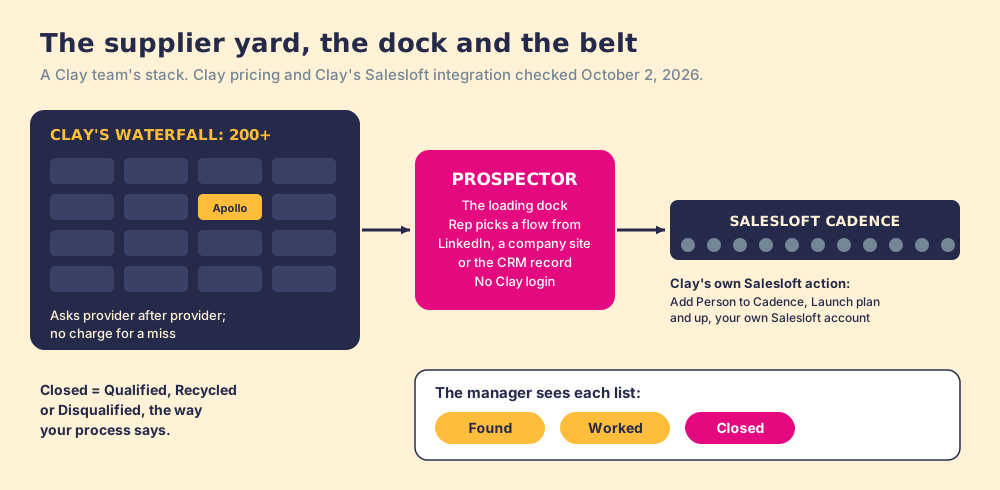
What each person gets:
- The GTM engineer. Named flows built once, each a Clay table with a destination (the CRM record, or a sequence), picked by reps from a Push menu. Your waterfalls, tiers and sequence variables stay yours.
- The rep. The table as a button on a LinkedIn profile, a company website, or a HubSpot, Salesforce or Pipedrive record, with the matching CRM record and any past prospecting shown before the push, so two reps do not work the same account.
- The manager. Found, Worked, Closed: who is working their list and who is not, and how each lead ended, Qualified, Recycled or Disqualified, the way your process says.
Prospector works within LinkedIn’s terms and does not copy search results in bulk; the contact data comes from Clay’s waterfall on the customer’s Clay account.
The price, done straight. Prospector is $45 per rep per month, billed annually, from one rep (Prospector). Ten reps add $5,400 a year if RevOps already pays for Clay; with Clay Growth at its $495 monthly rate the data half is $11,340, against $9,480 for ten Apollo Professional seats at list. Apollo is cheaper on a cold start by $1,860. The case for the yard is coverage and one contract, and it is strongest for the team that already owns Clay. Which cadence actions your flows end in is set up by your GTM engineer; bring your Salesloft setup to the demo.
Choose something else if:
- No Clay, and no plan to buy it. Prospector runs only on Clay. RevPartners, a Clay Elite Studio Partner I founded, builds tables for teams that want help; otherwise pick a branch below.
- One tool for one small crew. Apollo’s warehouse and belt in one seat is simpler for five reps than Clay plus a sequencer.
- A field or mobile-first team. Supered runs at the computer and has no mobile product.
Apollo or Salesloft: which should you choose?
- Apollo. Choose Apollo if you run one to twenty reps without Clay and want the data, the sequences and the dialer under one published price. Size the credit pool before the seats, since phones cost 8 credits and unused credits expire, and set per-user caps on day one.
- Salesloft. Choose Salesloft if you run a mid-market team that already has contact data and wants cadences, deal management and a Clari forecast in one platform. Get the add-ons into the first quote, since Vendr sees them adding 10% to 40%, and ask how the HubSpot sync behaves if HubSpot is your CRM.
- Neither Apollo nor a second database, if you already have Clay. Keep Salesloft for the belt and choose Supered Prospector for the dock. Clay’s waterfall across 200+ providers fills the cadence, and you see each list become pipeline.
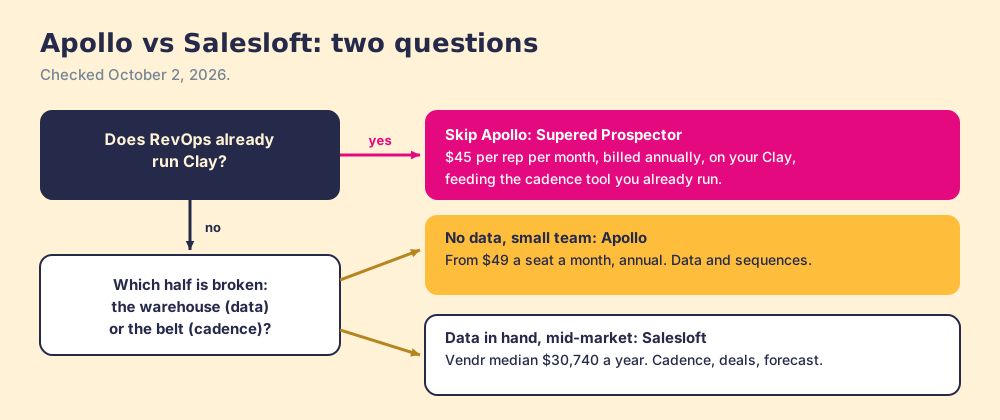
What I would do follows from the warehouse and the belt. A small team should buy Apollo and enjoy having both halves in one place, until the belt is too short. A mid-market team on Salesloft should stop treating the data contract as part of the Salesloft decision, because Salesloft never sold one; buy the belt for the belt. And a team that already owns Clay is paying for the biggest supplier yard in the market and trucking in a second warehouse beside it. Apollo vs Outreach runs the same test against the other big belt, where the meter has moved from data to AI.
Frequently asked questions
Is Apollo or Salesloft better?+
Does Salesloft have a contact database like Apollo?+
How much does Salesloft cost compared with Apollo?+
Can you use Apollo and Salesloft together?+
What happened to Salesloft and Clari?+
Do I need Apollo if my team has Clay and Salesloft?+
Everything we have written on Apollo
More on Apollo
Supered Prospector vs Apollo: the side-by-side- Apollo Alternatives in 2026: Read the Credit Meter Before the Price Tag
- Apollo Pricing in 2026: The Seat Is the Room Rate, the Credit Is the Minibar
- Apollo Reviews 2026: A Starter Home, Rated by the People Who Just Moved In
- Apollo Chrome Extension in 2026: The Nozzle Is Free, the Pump Is Metered
- Apollo HubSpot Integration (2026): What Syncs, the Six-Hour Window, and the Duplicates It Mirrors
- Apollo Salesforce Integration: The Mail Room, the Clerk, and the Six-Hour Clock
Everything we have written on Salesloft
More on Salesloft
Your Clay waterfall, where reps already work.