Apollo Pricing in 2026: The Seat Is the Room Rate, the Credit Is the Minibar
Apollo pricing in 2026, read from the page itself: $49 to $119 a seat, a credit meter that charges 8 per phone, a page that still carries two pricing models at once, a $19,000 Vendr median, and the arithmetic on whether you need the contract at all.
Apollo pricing in 2026 is a seat fee of $49, $79, or $119 per user per month on annual billing plus a unified credit meter that charges 1 credit per verified email and 8 per phone number, and Vendr's data on 101 purchases puts the median contract at $19,000 a year.
The rate card at a hotel desk tells the truth about one number. The room is $49 a night, and the room is, in fact, $49 a night. What the stay costs is decided by the small refrigerator under the television, because nothing inside it is priced like the room. Apollo’s pricing page, opened September 25, 2026, carries the same two price lists. The large type says $49, $79, and $119 a seat per month on annual billing. Lower down, under “What are Apollo credits?”, sits the minibar: 1 credit for a verified email, 8 for a phone number, 1 to 8 to enrich a record, 1 per AI research run, 2 a minute on the US dialer (apollo.io/pricing). The room rate is what gets budgeted. The minibar is what gets paid.
Apollo pricing in 2026 is a seat fee of $49, $79, or $119 per user per month on annual billing plus a unified credit meter that charges 1 credit per verified email and 8 per phone number, and Vendr’s data on 101 purchases puts the median contract at $19,000 a year (Vendr, Apollo, page last updated February 2026). Whether you searched for Apollo io pricing, Apollo pricing plans, or the plain Apollo.io cost, the seat prices are the part the other guides have already copied out. They skip three things: the phone number decides your bill, the page is carrying two pricing models at once, and for a team that already has Clay, Apollo is a line item inside a contract you already hold.
| Apollo pricing at a glance (September 25, 2026) | What the page and Vendr say |
|---|---|
| Free | $0, 900 credits per seat per year |
| Basic | $49 per seat per month annual ($65 monthly), 30,000 credits a year |
| Professional | $79 annual ($99 monthly), 48,000 credits a year |
| Organization | $119 annual ($149 monthly), 3-seat minimum, 72,000 credits a year |
| Credit rates | Email 1, phone 8, enrichment 1 to 8, AI research 1 per run, US dialer 2 per minute |
| Median contract | $19,000 a year (Vendr, 101 purchases, range $4,284 to $45,000, 30% average savings) |
How much does Apollo cost in 2026?
Start with the rate card, which is published, unlike most of the category’s.
- The four plans. Free carries 900 credits per seat per year. Basic is $49 per seat per month on annual billing with 30,000 credits a year granted upfront; Professional is $79 with 48,000; Organization is $119 with 72,000 and a 3-seat minimum, so the smallest Organization contract is $4,284 a year, the floor of Vendr’s range. Annual billing is marked “SAVE 24%” against monthly rates of $65, $99, and $149.
- The add-ons. Inbound and the Advanced Dialer (international, parallel, and power dialing) list at $119 per team per month each, marked “Introductory pricing.” SSO sits on Organization only.
- The contract. Vendr’s median buyer pays $19,000 a year, inside a range of $4,284 to $45,000, and saves 30% on average. Monthly billing runs 20% to 30% above annual, onboarding runs $2,000 to $5,000 when charged, and renewal clauses commonly carry 5% to 10% annual increases.
- The company. Apollo is independent. It appointed Matt Curl chief executive on February 3, 2026, with founder Tim Zheng as chairman, and said it is “approaching $200M in annual recurring revenue and nearly 100,000 paying customers,” having “grown more than 5x since its Series D” of August 2023 (PR Newswire, February 2026). It is in litigation with ZoomInfo, having filed counterclaims in January 2026 (Apollo).
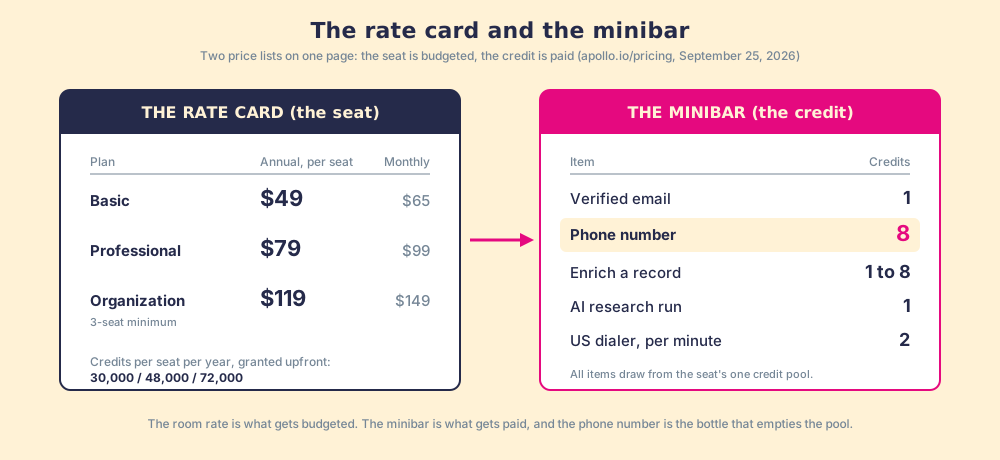
Do the division on the median. At the $79 seat, $19,000 a year is about twenty seats, and Vendr’s own example for ten Professional users lands at $9,500 to $12,000 against a list total of $9,480. So the median buyer is either a twenty-seat team paying list or a ten-seat team paying twice it, and the second reading is the one this page explains.
Why is the phone number the price that matters?
Because it costs eight of the thing the seat comes with, and the seat comes with a fixed number of the thing.
A Basic seat’s 30,000 credits a year are 2,500 a month, and 2,500 credits buy 312 phone numbers if the rep spends nothing on email, enrichment, or dialer minutes. Professional’s 4,000 a month buy 500. Organization’s 6,000 buy 750. Now put a real rep in the room. The Bridge Group’s 2025 SDR report, 351 companies, gives a median of 44 dials a day (Bridge Group, 2025). Our Apollo alternatives page ran the supposition, reused here with credit: one new mobile per dial is 352 credits a day, and a Basic seat’s monthly share runs out on the seventh working day of twenty, Professional’s on the eleventh, Organization’s on the seventeenth. The real number sits below that line, because reps redial numbers they hold, and above it, because none of those credits bought an email or a dialer minute.
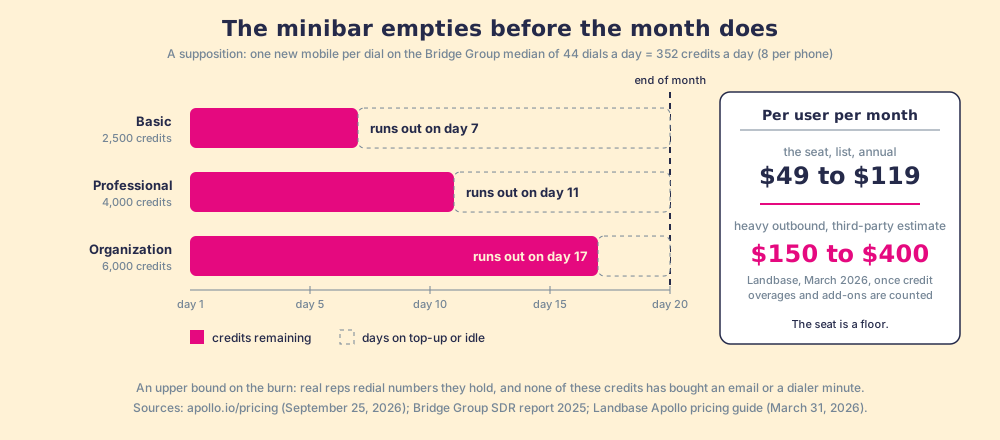
People who are not us have measured the gap between the rate card and the receipt. Landbase’s Apollo pricing guide (March 31, 2026) reports that “third-party sources estimate that teams doing heavy outbound should budget $150 to $400 per user per month once credit overages and add-ons are factored in,” and its example for ten Organization users adds $6,000 to $12,000 of estimated overages to a $14,280 seat bill (Landbase). Those overages are estimates, labeled as such; the direction is not in doubt, since Vendr’s $19,000 median spread over ten seats is about $158 a seat a month. The seat is a floor. Per-result pricing is the fairest meter there is, and this is no complaint against it. It is only that a comparison of Apollo pricing plans by seat price compares room rates, and the minibar writes the invoice.
What does the migration from legacy pricing mean for you?
Anyone who shopped in a French supermarket in January 2002 remembers the shelf tags. For a few months each price was printed twice, francs above and euros below, and shoppers learned to read the tag they were paying in and ignore the other. Apollo’s pricing page is in those few months. The rendered page shows the unified model: one credit pool per seat, email 1, phone 8, “Trial plans include 100 credits.” The page’s static HTML, what a crawler fetches before the scripts run, still ships the older FAQ: trial plans “include 50 credits, 5 mobile credits,” the platform “provides you with unlimited email addresses for every contact.” One page, two tags. The page names the seam itself: “Some features shown on this page are only available with our new credit system… We’re gradually rolling out the new credit system to existing customers.”
Vendr’s page is printed in francs. Its tier text still gives Basic “unlimited email credits, 900 mobile credits per year per user,” Professional 1,200 mobile credits, and Organization “unlimited email and mobile credits,” and its overage ($0.50 to $1.00 per mobile credit) is a legacy price, one credit to one phone. Cite Vendr for what buyers pay. Cite apollo.io for what a credit buys.
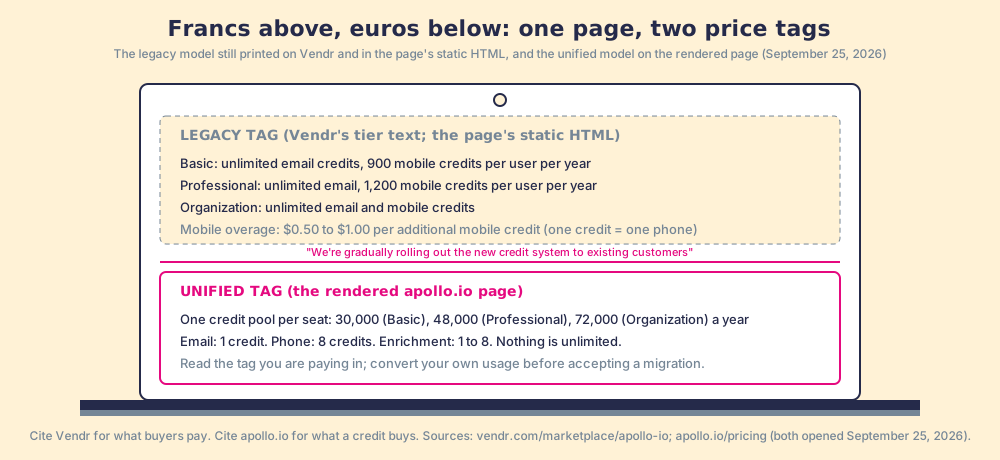
Now convert the two tags, because the conversion is what matters at your renewal.
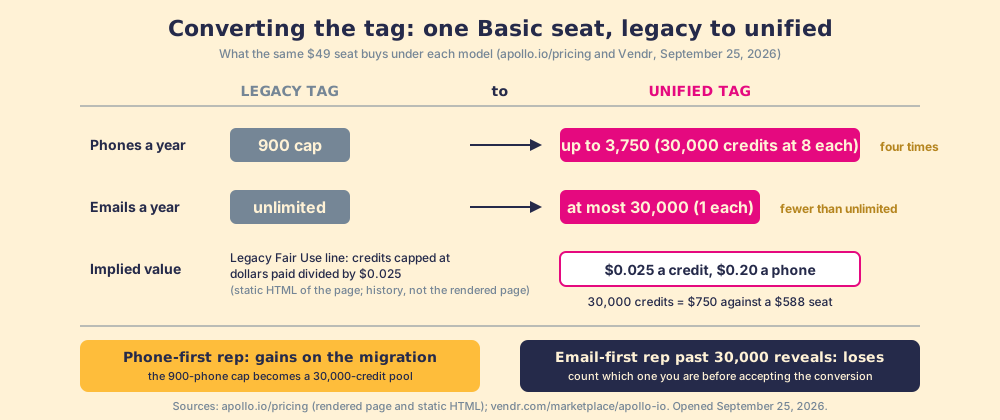
- Email stopped being free. Under the legacy tag, a Basic seat revealed unlimited emails against a cap of 900 phones. Under the unified tag it has 30,000 credits for everything: 3,750 phones if spent purely on phones, four times the old cap, or 30,000 email reveals, which is fewer than unlimited. A phone-first rep gains; an email-first rep who revealed more than 30,000 addresses a year loses. Count which one you are before you accept the migration.
- Organization lost “unlimited.” Vendr’s legacy text gives Organization unlimited credits; the rendered page gives it 72,000 a seat. The older HTML explains what “unlimited” meant: a Fair Use Policy capping paying accounts at “the lesser of $ Paid / $0.025 or 1 Million credits per account per year,” which prices a credit at $0.025 by Apollo’s own arithmetic, a phone at $0.20, and a Basic seat’s 30,000 credits at $750 against a $588 seat. Treat it as history, and ask in writing what a top-up costs on the unified system.
- The migration is a renewal event. Cancellations take effect at the end of the term and downgrades are not refunded mid-term, per Apollo’s page; Landbase reads the public terms as requiring 30 days’ written notice. A move from francs to euros mid-contract is the moment to renegotiate the credit allocation, not to accept a conversion someone else calculated.
How do you negotiate Apollo pricing?
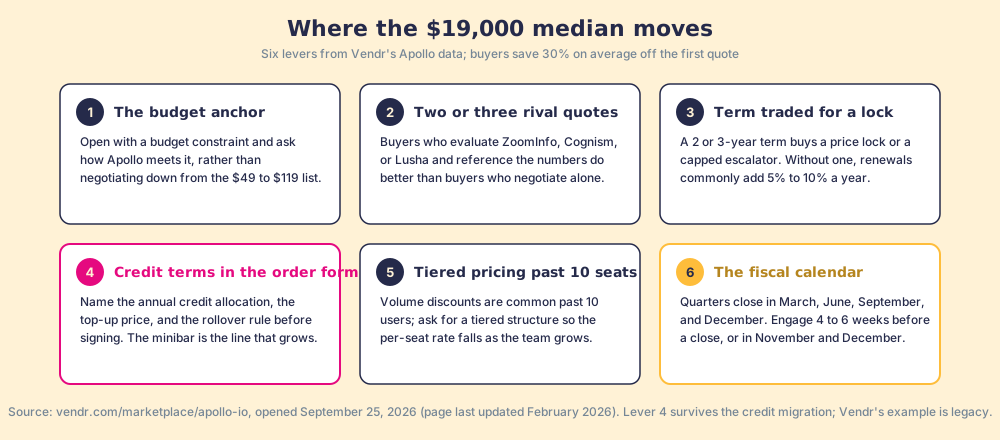
The levers stack. Vendr’s buyers save 30% on average, on a sale that runs 2 to 6 weeks for small teams and 4 to 12 for mid-market.
- A budget anchor. Open with a budget constraint and ask how Apollo meets it, rather than negotiating down from $79.
- Two or three competing quotes. Apollo prices against ZoomInfo, Cognism, and Lusha, and buyers who evaluate two or three alternatives do better than those who negotiate alone. We graded that field on the Apollo alternatives page and in Apollo vs ZoomInfo.
- A multi-year term traded for a lock. The term buys a price lock or a capped escalator. Without one, the renewal clause commonly adds 5% to 10% a year.
- Credit terms in the order form. Vendr’s example is legacy (push 1,200 mobile credits to 1,500 or 2,000), but the move survives the migration: name the allocation, the top-up price, and the rollover rule before signing, because the minibar is the line that grows.
- Tiered pricing past 10 seats. Volume discounts are common past 10 users; ask for a tiered structure so the per-seat rate falls as the team grows.
- The fiscal calendar. Apollo’s quarters close in March, June, September, and December. Buyers who engage 4 to 6 weeks before a quarter-end “often achieve better pricing than those who negotiate mid-quarter.”
Do you need the Apollo contract at all if your reps can use Clay?
Look at what Apollo is, physically, to Clay. Clay’s marketplace lists Apollo.io as a “Clay-built Integration,” “Included in All Plans,” with actions to enrich a person or company and add a contact to an Apollo sequence, each marked “Bring Your Own Account Required” (clay.com/integrations/data-provider/apollo-io, opened September 25, 2026). Clay’s pricing page adds the fair print: with your own key for a provider, “you skip Data Credit costs entirely” (clay.com/pricing, opened September 25, 2026). Apollo is a bottle in the minibar of a much larger hotel, and Clay lets you bring your own.
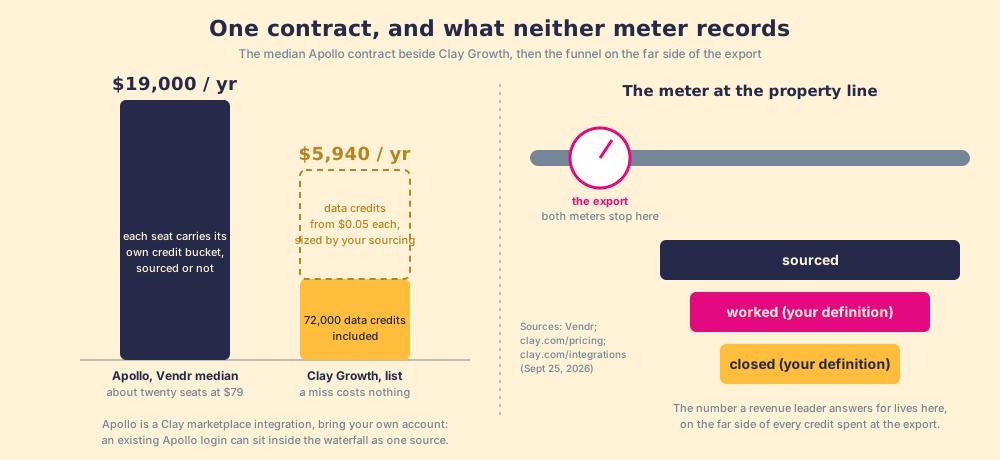
Clay is not a database. It is a waterfall across 200+ data and AI vendors (clay.com, September 25, 2026) that asks provider after provider until one returns a verified email or phone, and “If an enrichment returns no result, you’re not charged Data Credits or Actions.” Supered does not bring its own database. It brings Clay’s waterfall, which is every database, routed, and that is the reason we chose Clay as our only data provider; the longer version is in Clay vs Apollo and what Clay is. The arithmetic: Vendr’s median Apollo contract is $19,000 a year, twenty seats at $79, each carrying its own credit bucket whether or not the rep sources anything. Clay Growth lists at $495 a month, $5,940 a year, with 6,000 data credits a month (72,000 a year) and CRM auto-sync; data credits start at $0.05 each, and a miss costs nothing. The Clay platform fee is less than a third of the median Apollo contract, and the credits scale with what your reps source, so that number is the estimate you owe yourself.
Two edges, so the picture does not overreach. A Clay account needs a builder; Clay’s own copy says “GTM engineers build on Clay,” and that person is real overhead. And Supered’s sourcing is only for teams that have Clay; if you do not, the recommendation is Apollo, sized by credits. Apollo’s own Waterfall Enrichment, on every paid plan, chains a handful of partners inside Apollo’s credits: a wider minibar, still priced by one hotel.
What happens to the credit after the export?
Picture the water meter at the edge of a property. The utility reads it faithfully and bills for each gallon that crossed the line, with no idea whether the water reached the garden or soaked into the driveway. Apollo’s meter sits at that line: export credits are consumed “whenever you export a contact outside of Apollo,” and after that the meter is dark. Clay’s meter sits there too, at the result. The number a revenue leader is paid on lives on the far side of both: was the contact worked, by your definition of worked; did it advance; did it close, by your definition of closed.
That far side is where the money goes missing, and the finding is ours. Across 198 sales teams in The State of Sales Enablement, 89% had a defined sales process and 36% saw reps run it as designed, and the teams that inspected adherence consistently hit quota at 6.3 times the rate of those that did not. Sourcing a contact is step one of that process, and each credit priced above is spent there. If step one is the only step measured, the renewal meeting gets the same report each year: a CRM full of contacts, a credit balance draining, and no answer to “is the prospecting engine working?”
You can only expect what you inspect. So the layer to pay for after Clay is the one that treats the sourced contact as the start of a motion with an expectation attached. Supered is that layer. A rep on a LinkedIn profile, a Sales Navigator list, a company’s website, or a HubSpot or Salesforce record gets Clay’s waterfall in one click and syncs the contact with no Clay login, on the customer’s own Clay account. Then the next expected action reaches the rep in the flow of the work, the way a sales cadence is meant to, and the manager sees sourced, worked, and closed per rep against the standard they set, so coaching starts from the signal. Clay governs the data. Supered governs the motion. In the same study, quota attainment ran 49% when guidance reached reps in the flow of work versus 15% when it lived in documents (the sales process guide has the full reasoning).
What we recommend
Three ways forward.
- Apollo, sized by the minibar. The right purchase for a team with no Clay account and no builder that wants data, sequences, and a dialer at one published price. Multiply your phone-first reps’ monthly reveals by 8, compare that to 2,500, 4,000, or 6,000 credits a month, and negotiate the allocation and the top-up price before the seat count. Take the 30% Vendr’s buyers take, cap the escalator, and if you are being migrated, convert your own usage.
- Clay, run by a builder, with Apollo inside it. The right purchase for a team with a GTM engineer that is tired of paying twenty seats’ worth of credits for the sourcing five reps do. Route the existing Apollo account through the waterfall and pay per result.
- Clay via Supered. The right purchase for a team that already has Clay and reps who never open it. The rep gets the waterfall where they work; the manager gets sourced, worked, and closed against the standard they set; and the credit spent at the export finally has a number on the far side of the meter.
So here is what we recommend. Read the credit menu before the rate card, because the rate card was never the price. If you have no builder, buy Apollo and negotiate the minibar. If you have Clay, do not sign the twenty-seat contract; Apollo’s bottle is already on Clay’s shelf. Put the waterfall in your reps’ hands where they already work, and meter what happens after the export, since a contact revealed and never worked cost eight credits and earned nothing. The demo is where you can watch that meter run on your own Clay account.
Frequently asked questions
How much does Apollo cost in 2026?+
How do Apollo credits work?+
What is the difference between Apollo's legacy pricing and the new credit system?+
What is the real Apollo.io cost per user?+
How do you negotiate Apollo pricing?+
Is Apollo cheaper than running Clay?+
Your process, running itself.