Apollo vs Kaspr in 2026: The Same $49 at the Door, Two Very Different Clubs
Apollo and Kaspr charge the same $49 and $79 a seat a month.
What the price buys does not match: a phone costs about 16 cents on Apollo and 49 on Kaspr, an email costs nothing on Kaspr. Apollo vs Kaspr priced on October 2, 2026, rep by rep.
Apollo vs Kaspr is a choice between two prospecting tools with identical list prices: Apollo, a database with sequences that meters emails and phones from one credit pool, and Kaspr, a Cognism-owned LinkedIn extension with unlimited B2B emails and a monthly phone allowance.
Apollo vs Kaspr is a choice between two prospecting tools with identical list prices: Apollo, a database with sequences that meters emails and phones from one credit pool, and Kaspr, a Cognism-owned LinkedIn extension with unlimited B2B emails and a monthly phone allowance. Apollo’s own comparison, dated August 12, 2026, says it plainly: “Both platforms offer free tiers and paid plans starting at $49/user/month (annual billing)” (apollo.io). The short answer, by who it fits:
- Supered Prospector. Teams whose RevOps already runs Clay. The GTM engineer’s Clay tables, Apollo’s step among 200+ providers if you bring an Apollo account, run by reps from Sales Navigator, a company site, or the CRM record. $45 per rep per month, billed annually.
- Apollo. Five to fifty reps, mostly selling into the US, who call a lot and want data, sequences and a dialer in one tool. From $49 per seat per month on annual billing.
- Kaspr. One to a dozen LinkedIn-first reps who email more than they call, especially into Europe. From $49 per user per month on annual billing.
Two clubs on the same street charge $49 at the door. One is a climbing gym: one wall, built around LinkedIn, unlimited climbs on the easy routes and 100 hard routes a month. The other is a full gym with a points card: a pool, classes, a weights room, and 30,000 points a year, where an easy session costs 1 point and a hard one costs 8. Same fee. Whether you overpaid depends entirely on what you came to do.
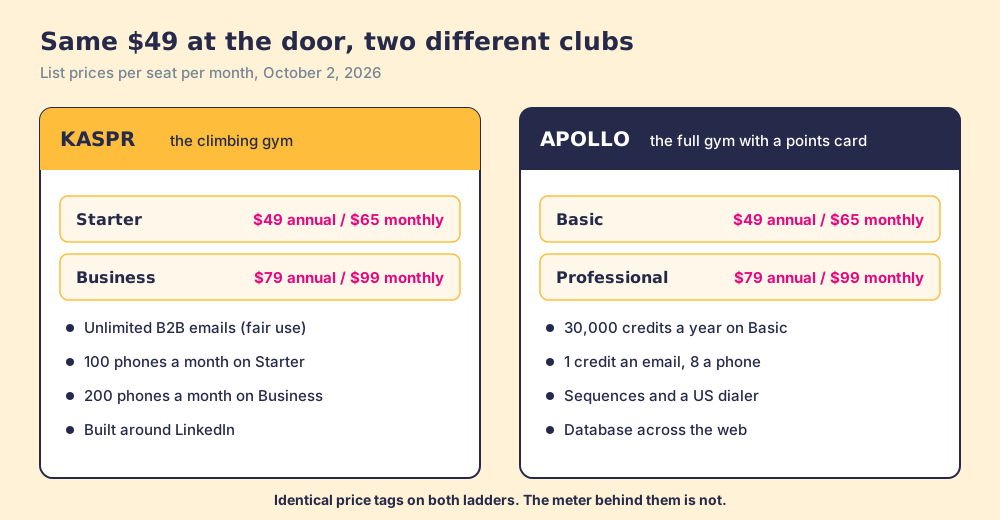
How do Apollo and Kaspr compare at a glance?
Prices are the plan that includes the job, read from apollo.io/pricing (and the pricing data the page loads) and kaspr.io/pricing on October 2, 2026. Grades come from the weighted scoring below, on the lens of a five-to-fifty-rep sales team.
| Rank | Tool | Grade | Best fit | CRM integration | Setup effort | Price (plan with the feature) | Reason to switch |
|---|---|---|---|---|---|---|---|
| 1 | Supered Prospector (on your Clay) | A | Teams that already have Clay | Native in HubSpot, Salesforce and Pipedrive; one-click sync | Live in under a week; admin connects Clay inside Supered | $45/rep/mo billed annually, from 1 rep, plus your Clay plan | 200+ providers behind one button, Apollo’s step included if you bring an account |
| 2 | Apollo | A- | US-heavy teams wanting data plus outreach | CRM integrations from Basic; Salesforce, HubSpot, Outreach, Salesloft | Self-serve in minutes; G2 ease of setup 8.9 | Basic $49/seat/mo annual ($65 monthly); Professional $79 ($99); Organization $119, annual, 3 seats min | About 16 cents a phone, sequences and a dialer in the same seat |
| 3 | Kaspr | B- | Email-heavy LinkedIn reps, European lists | HubSpot, Salesforce, Pipedrive, Zoho, Lemlist, Brevo | Self-serve in minutes; G2 ease of setup 9.0 | Starter $49/user/mo annual ($65 monthly); Business $79 ($99) | Unlimited B2B emails, Sales Navigator from Starter, a simpler tool |
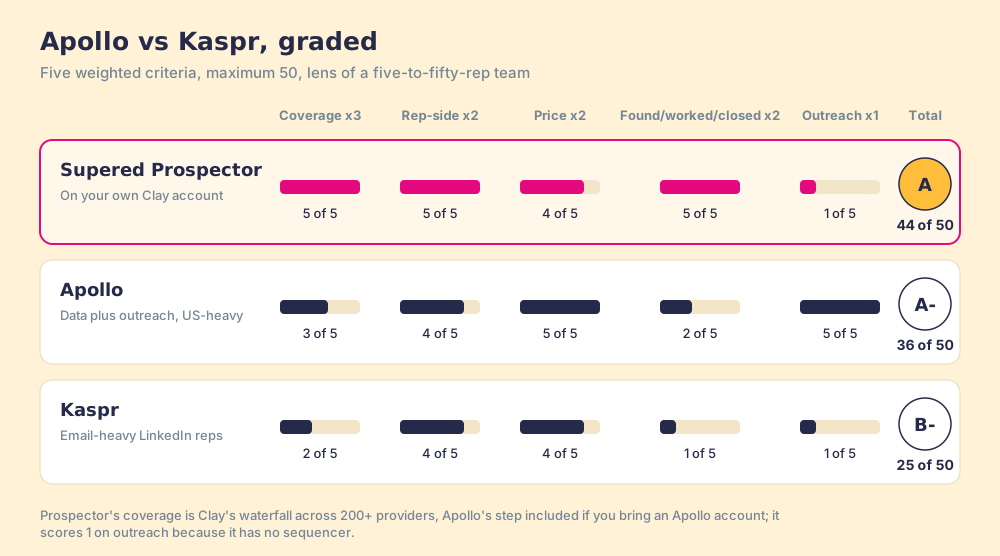
The scoring, so you can argue with it. Each criterion is scored 1 to 5 and multiplied by its weight, for a maximum of 50. The rows match Apollo vs Lusha and the Kaspr alternatives page.
| Tool | Coverage (x3) | Rep-side delivery (x2) | Price for the job (x2) | Found, worked, closed visibility (x2) | Bundled outreach (x1) | Total |
|---|---|---|---|---|---|---|
| Supered Prospector | 5 | 5 | 4 | 5 | 1 | 44 |
| Apollo | 3 | 4 | 5 | 2 | 5 | 36 |
| Kaspr | 2 | 4 | 4 | 1 | 1 | 25 |
Flip the weights toward European email coverage and simplicity and the gap closes; flip them toward calling volume and Apollo pulls further ahead. Prospector scores 1 on outreach on purpose: it has no sequencer and drafts nothing. Its coverage score belongs to Clay, because Prospector has no database of its own.
Why trust this comparison?
Supered is my company, so weigh that first. Before it, I started RevPartners, a HubSpot partner that did only sales implementations, sold roughly twice as much Sales Hub as any other partner, and reached Elite tier in 13 months. I have watched teams buy Apollo for the data and end up living in its sequences, and others buy Kaspr seats for reps who never touched the phone allowance. Supered holds 4.9 out of 5 from 81 reviews on G2 (October 1, 2026). The disclosure that matters: Apollo is a step in Clay’s marketplace and Kaspr is not, so Prospector can route through one of these two. The price section favors Kaspr for any rep who mostly emails, because the arithmetic does.
Why do teams compare Apollo and Kaspr?
Because they look like the same purchase. Both sell a Chrome extension that reveals emails and phones, both start at $49, and their reviewers are the same kind of buyer. On G2, Apollo holds 4.7 from 9,823 reviews and Kaspr 4.4 from 837; 67.0% of Apollo’s reviewers and 69.2% of Kaspr’s are small businesses. Kaspr leads on ease of use, 9.2 to 9.0, and ease of setup, 9.0 to 8.9; Apollo leads on quality of support, 8.8 to 8.6, and on meets requirements, 9.1 to 8.6 (G2, Apollo.io vs Kaspr, read October 2, 2026). In the Chrome Web Store, Apollo’s extension has 1,000,000 users and Kaspr’s 100,000, both rated 4.7.
The difference is what each club was built around. Apollo calls itself “an AI sales platform that unifies data, intelligence, and execution into one connected GTM system.” Kaspr’s about page says “Kaspr is a prospecting tool for individual contributors and SMBs” and “Kaspr is part of Cognism” (kaspr.io/about-us, October 2, 2026). One sells a building; the other sells a wall.
- The Apollo complaint. The meter and the bulk. Apollo’s credits are “pooled across your entire team,” and “Unused credits expire at the end of each billing cycle and do not carry over,” purchased add-ons included (apollo.io/pricing, October 2, 2026). A team that buys annual gets the whole year up front and loses what it does not use.
- The Kaspr complaint. The phone allowance. A sales director on G2, April 2026: “It might be better if it had more phone numbers.” A mid-market account manager, December 2025: “the credit system depletes rapidly when engaging in high volume sourcing.”
Which is cheaper, Apollo or Kaspr?
Start with the fee, since it is the same. Apollo Basic is $49 per seat per month billed annually or $65 monthly, with 30,000 credits per seat per year granted up front; Professional is $79 or $99 with 48,000; Organization is $119, annual only, with a three-seat minimum and 72,000. Apollo’s pricing data sets the rates: an email (a “lead credit”) costs 1 credit and a direct dial costs 8. Kaspr Starter is $49 annually or $65 monthly with “Unlimited B2B email credits,” under a fair-use limit of 10,000 credits per account per month in its terms, and 100 phones a month; Business is $79 or $99 with 200 phones and 200 direct emails a month (kaspr.io/pricing, October 2, 2026).
| Plan, one seat a year | Price | Phones if all credits go to phones | Per phone | Emails |
|---|---|---|---|---|
| Apollo Basic | $588 | 3,750 | about 16 cents | 1 credit each, from the same pool |
| Kaspr Starter | $588 | 1,200 | about 49 cents | B2B emails unmetered (fair use) |
| Apollo Professional | $948 | 6,000 | about 16 cents | 1 credit each, from the same pool |
| Kaspr Business | $948 | 2,400 | about 40 cents | B2B emails unmetered, plus 2,400 direct emails |
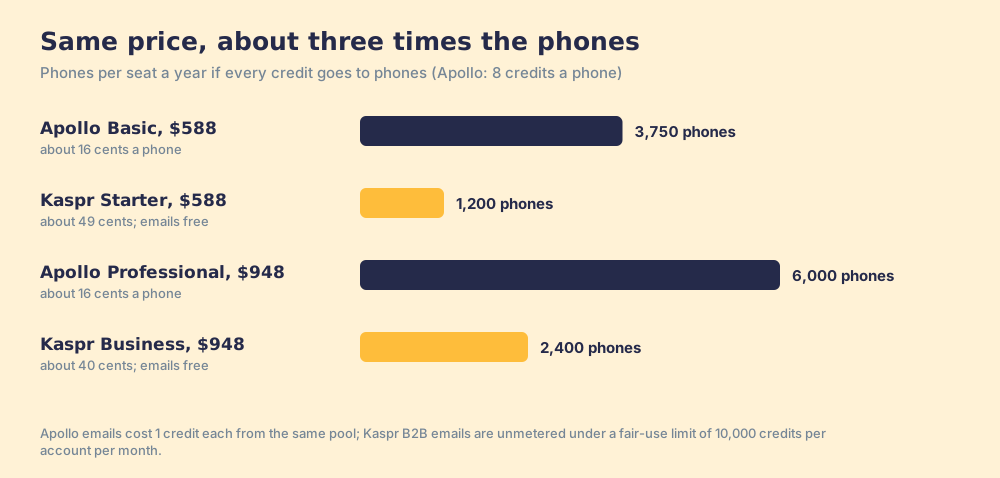
On phones alone, Apollo gives about three times as many for the same money. But an email on Apollo comes out of the same pool, and on Kaspr it does not. So the fair way to compare is to walk real reps through a month.
- The light user. 100 phones and 400 emails a month is 1,200 Apollo credits, 14,400 a year, half of Basic’s 30,000. Kaspr Starter covers the same month. Both cost $588. A tie.
- The emailer. 50 phones and 3,000 emails a month is 3,400 Apollo credits, 40,800 a year, past Basic, so Professional at $948. Kaspr Starter covers it for $588 if the account stays under the fair-use line. Kaspr is $360 a year cheaper.
- The caller. 400 phones and 200 emails a month is 3,400 Apollo credits, 40,800 a year, inside Professional at $948. Kaspr Business at $948 covers 200 of the 400 phones; the other 200 a month mean add-on packs, which renew by default (the Kaspr pricing page prices them). Apollo is cheaper.
- The team of ten. Ten Apollo Professional seats and ten Kaspr Business seats both cost $9,480 a year at list. Vendr’s median Apollo buyer pays $19,000 a year across 101 purchases, a range of $4,284 to $45,000, with 30% average savings (Vendr, Apollo, last updated February 2026, read October 2, 2026); Vendr publishes no Kaspr contract data.
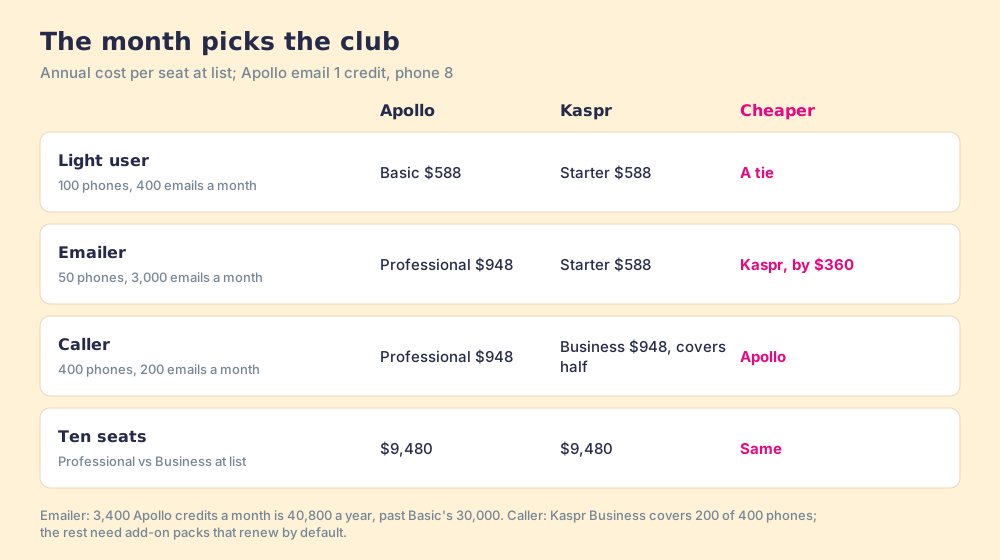
The rule falls out of the arithmetic. Count your reps’ calls before you count anything else. A team that calls lives more cheaply in the full gym; a team that emails from LinkedIn lives more cheaply on the wall. The fuller Apollo ladder is on the Apollo pricing page.
Which has better data, Apollo or Kaspr?
Both make large claims, and neither publishes an independent audit. Apollo says “240M+ people and 30M+ companies.” Kaspr’s data page says “200 million + European B2B contacts” from “120+ verified data sources,” and Apollo’s own Kaspr comparison reports Kaspr claiming “500M+ verified phone numbers and email addresses sourced from 150+ data providers.” Kaspr also says it shares data with its owner: “Kaspr is part of Cognism, which has one of the largest cell phone databases in the US. We share information between our data sets” (kaspr.io/kaspr-vs-apollo, October 2, 2026). How much is shared, neither Kaspr nor Cognism says; Cognism vs Kaspr sets their two accounts side by side.
The one outside test I can find is an email-only benchmark of 500 contacts with known addresses, run in May 2026 by b2b-email-finder.com, an anonymous review site that ranks a different tool first, so read it as one data point. Apollo found 88.2% of the emails at 81.3% accuracy; Kaspr found 61.3% at 80.1%. Apollo returned catch-all addresses, the kind a server accepts whether or not the person exists, 18.7% of the time. And: “No single tool exceeded 89% coverage,” while a three-tool waterfall reached 94.2% with accuracy above 87% (b2b-email-finder.com, published June 8, 2026).
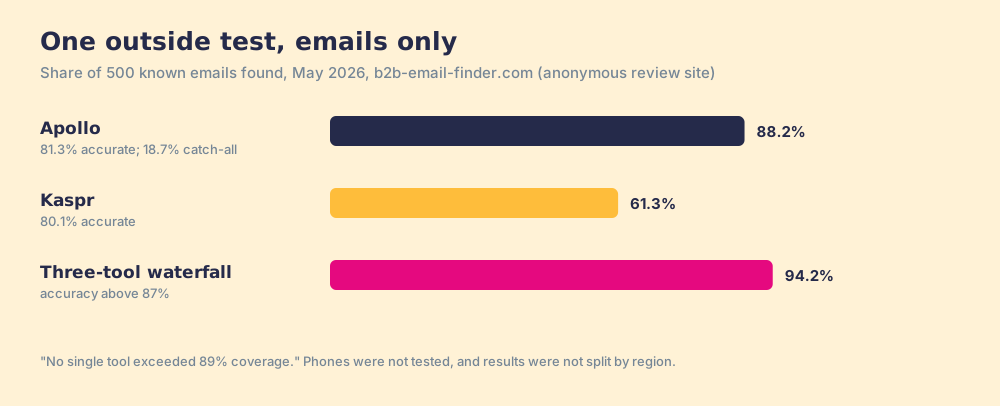
Two cautions keep the gap in proportion. The test covered emails, where Kaspr already charges nothing, and said nothing about phones, which is what Kaspr’s buyers pay for. And it was not split by region; Kaspr sells Europe first, while Cognism’s own page says “Apollo.io does not state which regions its database covers.” The cheap way to settle it is your own list: start on both free plans (Apollo Free grants 900 credits a seat a year; Kaspr Free 5 phones and 15 B2B emails a month), then run 200 contacts from your territory through a monthly seat of each.
What do you get besides contact data?
Past the contact data, the clubs stop looking alike. Apollo’s Basic seat includes, by its own pricing data, unlimited sequences, CRM integrations, waterfall enrichment, a deliverability suite with email warmup, CSV and API enrichment, and a US dialer (credits apply); Professional adds 4,000 minutes of call recording with AI insights, unlimited lead scoring and agents. Kaspr’s seat includes the extension on LinkedIn, Sales Navigator and Recruiter Lite, a lead list, team usage reports, and integrations that hand contacts on: HubSpot, Salesforce, Pipedrive and Zoho; Lemlist and Brevo for email; Aircall and Ringover for calls; Zapier from Starter.
| What comes with the $49 seat | Apollo Basic | Kaspr Starter |
|---|---|---|
| Emails | 1 credit each from 30,000 a year | Unmetered B2B (fair use) |
| Phones | 8 credits each | 100 a month |
| Sequences | Unlimited | None; hands off to Lemlist or Brevo |
| Dialer | US dialer, credits apply | None; hands off to Aircall or Ringover |
| LinkedIn coverage | Chrome extension across the web | LinkedIn, Sales Navigator, Recruiter Lite |
| Clay | Bring Your Own Account step | No Clay page |
Apollo kept building in 2026. It acquired Pocus in March, named a new CFO and CPO, became “Flagship Data Partner for Hunter, Salesforce’s New Outbound Sales Agent” in September, and launched an “AI GTM System” on September 30, saying it now serves “more than 5 million users.” Kaspr’s 2026 newsroom has less in it; its last large event was a regulator’s, a €240,000 CNIL fine in December 2024 over LinkedIn contact collection (CNIL). A news search on October 2, 2026 found no acquisition of either company. Apollo vs ZoomInfo covers Apollo against its bigger rival.
Apollo vs Kaspr for a team on Clay
For a team that already pays for Clay, neither club is the answer for data. Clay is closer to a citywide pass than to a third gym: “200+ providers in one place,” a waterfall that asks one provider after another until a verified email or phone comes back, and a rule neither Apollo nor Kaspr offers across vendors. “If an enrichment returns no result, you’re not charged Data Credits or Actions” (clay.com/pricing, October 2, 2026). That 94.2% from the benchmark’s three-tool waterfall is the same idea at a small scale.
The two sit in different places on that pass. Apollo is a listed step: Clay’s Apollo.io integration marks its actions “Bring Your Own Account Required” (Clay, Apollo.io integration, October 2, 2026). Kaspr is not; its Clay URL returned a 404 the same day. So a Clay team can keep an Apollo account as one step, and run its sequences there too, while a Kaspr seat stays a separate meter. Clay vs Apollo covers that pairing.
Clay names the gap in its own copy: “GTM engineers build on Clay.” The tables live with the GTM engineer and the reps live in Sales Navigator and the CRM, so they keep asking for Apollo or Kaspr seats to build their own lists. Clay plus Supered is the best way for a sales team to prospect: GTM engineers build in Clay, reps never open Clay. Supered Prospector runs inside the Supered Chrome extension on the team’s own Clay account.
- The GTM engineer’s table as a button. The GTM engineer builds named flows once, such as person enrichment or a buying committee, and reps pick one from a Push menu in Sales Navigator, on a company’s website, or in a HubSpot, Salesforce or Pipedrive record. Each flow can end in your CRM or your sales engagement tool. Start from the Supered Clay template or bring your own tables.
- Sales Navigator lists into Clay. Reps add Navigator leads to a prospect list and push the list to a Clay table. Prospector works within LinkedIn’s terms and does not copy search results in bulk; the contact data comes from Clay’s waterfall on the customer’s Clay account. Ask every vendor what it reads from LinkedIn, ours included.
- A check before the push. The rep sees the matching CRM record, who owns it, and a flag when the prospect was already worked, so two reps do not chase the same person.
- Found, worked, closed. The leader sees every list found from the team’s tables, who is working their list and who is not, and how each lead ended: Qualified, Recycled, or Disqualified, the way your process says.
The price, done straight. Prospector is $45 per rep per month, billed annually, from one rep, on your own Clay account and credits (Prospector). Ten Prospector seats cost $5,400 a year. If you are buying Clay for this, Growth at its $495 monthly rate is $5,940 a year, so Clay plus ten seats is $11,340, $1,860 more than ten Apollo Professional or ten Kaspr Business seats at $9,480. The phones come out of your Clay data credits, roughly six credits for an email plus a phone on our reading of Clay’s calculator, about 50 cents a contact on Growth, against about 18 cents for an Apollo email plus phone at Basic’s rate; the supposition is explained on the Clay pricing page. The case for the pass is coverage, a miss that costs nothing, and a leader who can follow the list, and it is strongest for the team already paying for Clay. The head-to-head with Kaspr is on Prospector vs Kaspr.
Choose something else if:
- No Clay, and no plan to buy it. Prospector runs only on Clay. Pick Apollo or Kaspr from the branches below. If you want Clay built for you, RevPartners, the company I founded, is a Clay Elite Studio Partner that builds and tunes the tables.
- Data and sequences in one cheap seat. If you want one tool that finds and sends for $49, Apollo does both and Prospector does not send.
- A solo rep on a card. Kaspr Starter or Apollo Basic is a simpler purchase than a Clay plan plus a seat.
- A field or mobile-first team. Supered runs at the computer and has no mobile product.
Kaspr vs Apollo: which should you choose?
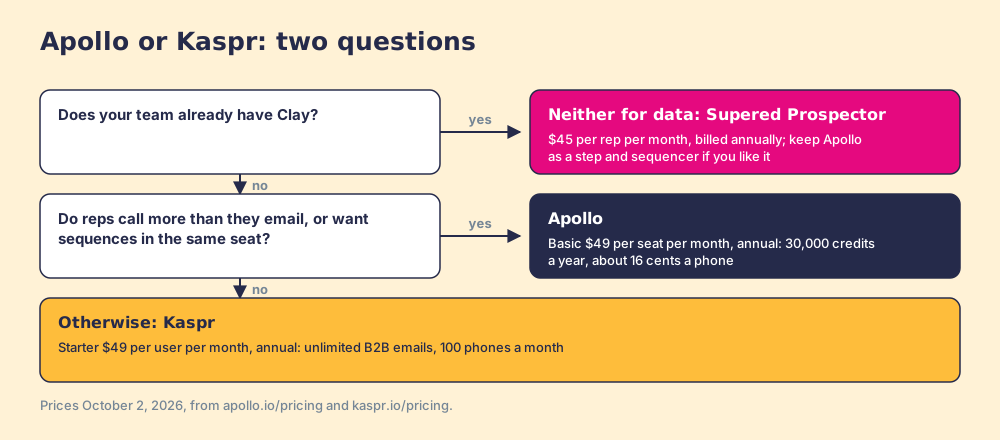
Back to the two clubs. Same fee at the door; choose by what you came to do.
- Apollo. Choose Apollo if your reps call a lot, sell mostly into the US, and want sequences and a dialer in the same seat. Basic is $588 a seat a year for 3,750 phones’ worth of credits, about 16 cents a phone. Buy monthly first if you are unsure, since annual credits arrive up front and expire unused.
- Kaspr. Choose Kaspr if your reps work LinkedIn all day, email far more than they call, and sell into Europe. Starter is $588 a seat a year for 1,200 phones with B2B emails unmetered. Ask whether the 10,000-credit fair-use limit is per user or per account, and get the rollover rule in writing.
- Neither: Supered Prospector. Choose neither for data if your RevOps already runs Clay. Keep Apollo as a step and a sequencer if you like it, let reps run the GTM engineer’s tables from the screen they are on with no Clay login, and see every list found, worked and closed. $45 per rep per month, billed annually, on your own Clay account.
If Kaspr is still on your list, Kaspr vs Lusha prices a phone on two LinkedIn extensions, Kaspr vs ZoomInfo shows the step to an enterprise contract, and Kaspr vs Waalaxy separates finding from sending. If you already have Clay, book a Prospector demo and bring the account.
Frequently asked questions
Is Apollo or Kaspr cheaper?+
Which has better data, Apollo or Kaspr?+
Does Kaspr have sequences like Apollo?+
Do Apollo credits roll over?+
Can I use Apollo or Kaspr inside Clay?+
Do I need Apollo or Kaspr if my team has Clay?+
Everything we have written on Apollo
More on Apollo
Supered Prospector vs Apollo: the side-by-side- Apollo Alternatives in 2026: Read the Credit Meter Before the Price Tag
- Apollo Pricing in 2026: The Seat Is the Room Rate, the Credit Is the Minibar
- Apollo Reviews 2026: A Starter Home, Rated by the People Who Just Moved In
- Apollo Chrome Extension in 2026: The Nozzle Is Free, the Pump Is Metered
- Apollo HubSpot Integration (2026): What Syncs, the Six-Hour Window, and the Duplicates It Mirrors
- Apollo Salesforce Integration: The Mail Room, the Clerk, and the Six-Hour Clock
Everything we have written on Kaspr
More on Kaspr
Supered Prospector vs Kaspr: the side-by-side- Kaspr Alternatives in 2026: Bottomless Bread, Wine by the Glass, and One Kitchen
- Kaspr Pricing in 2026: Four Meters on One House
- The Kaspr Chrome Extension in 2026: A Hotel Minibar With Three Price Tags
- Cognism vs Kaspr in 2026: One Owner, a Flagship, and the Outlet Round the Corner
- Kaspr vs Lusha in 2026: Unlimited Texts or a Prepaid Card
- Kaspr vs Waalaxy in 2026: The Phone Book and the Postman
Your Clay waterfall, where reps already work.