Clay vs Apollo: You Are Comparing a Phone Book With the Operator
Clay vs Apollo is a category error. Apollo is one database with a dialer bolted on; Clay is the waterfall across 200+ vendors, and Apollo is on its shelf. The real question is whether you still need the database contract.
Clay vs Apollo compares two different kinds of thing: Apollo is one B2B contact database with a sequencer and dialer bundled in, sold by the seat and metered by the credit; Clay is a waterfall that asks 200+ data vendors in turn, Apollo among them, and charges only per result.
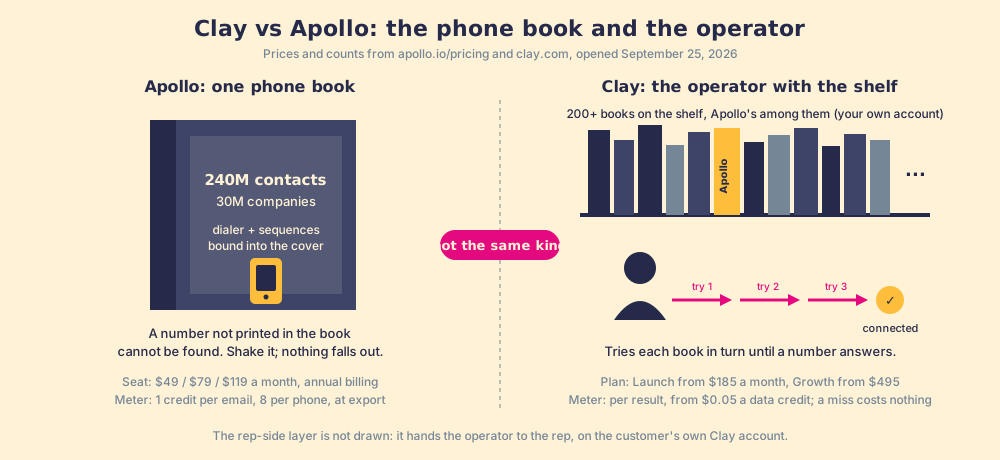
The thickest phone book in the country is still a phone book. If the number you want is not printed in it, you can hold it upside down and shake it and nothing falls out. Apollo’s pricing page, opened September 25, 2026, describes a book of 240 million contacts and 30 million companies with a dialer and a sequencer bound into the cover, sold at $49, $79, and $119 a seat per month and metered at 1 credit per email and 8 per phone (apollo.io/pricing). Clay is not a phone book. Clay is the switchboard operator with 200+ phone books on the shelf behind her (clay.com, September 25, 2026), who tries them one after another until a number answers and charges only for the calls that connect. One of the books on her shelf is Apollo’s. So clay vs apollo is a category error the way “phone book vs operator” is: the operator can use the book.
Clay vs Apollo, stated once: Apollo is one B2B contact database with a sequencer and dialer bundled in, sold by the seat and metered by the credit; Clay is a waterfall that asks 200+ data vendors in turn, Apollo among them, and charges only per result. Whether you typed apollo vs clay, clay or apollo, or the bare pair clay apollo into the search bar, the pages that come back line the two up as rivals. They are not. The question underneath the search has arithmetic in it: if your reps could run Clay from where they already work, would you still sign the database contract at all?
What is Apollo selling?
A phone book with a phone attached. Apollo’s page lists Free, Basic at $49, Professional at $79, and Organization at $119 per seat per month on annual billing ($65, $99, and $149 monthly). The seat is the cover price. The credits are the reading: a verified email is 1 credit, a phone number is 8, a minute on the US dialer is 2. Some features, the page says, “are only available with our new credit system.”
Apollo is having a good year. On February 3, 2026, it appointed Matt Curl chief executive, with founder Tim Zheng as chairman, and said it is “approaching $200M in annual recurring revenue and nearly 100,000 paying customers,” having “grown more than 5x since its Series D” (PR Newswire, February 2026); that Series D was August 2023, not 2026. On January 21, 2026, it filed counterclaims in its litigation with ZoomInfo, alleging that ZoomInfo is “acquiring competitors to reduce market choice” (Apollo, January 2026); allegations, not findings, and the two biggest phone books are in court with each other. Apollo is independent as of September 25, 2026.
Vendr adds the number the seat price hides: the median Apollo buyer pays $19,000 a year across 101 purchases, saving 30% off the first quote, with annual escalators of 5% to 10% in the renewal (Vendr, Apollo). At the $79 seat, $19,000 is about twenty seats. The rest is credits.
What is Clay, if it is not a database?
Clay has no shelves of its own. Its homepage sells “one contract to buy data from 200+ data and AI vendors,” and its rep-prospecting page describes the mechanism: “Clay’s signature data waterfalls check multiple providers to return the most verified emails (lower bounce rate) and phone numbers (higher connect rate)” (clay.com/use-cases/rep-prospecting, September 25, 2026). A request goes to the first provider; if that one misses, to the next; the org pays per result.
The part the feature tables leave out is that Apollo is one of the providers. Clay’s marketplace lists Apollo.io as a Clay-built integration, “Included in All Plans,” with actions to enrich a person, enrich a company, and add a contact to an Apollo sequence (clay.com/integrations/data-provider/apollo-io, opened September 25, 2026). Each action carries the label “Bring Your Own Account Required,” which is the fair print: Clay routes the request through the Apollo account you already pay for, and its pricing FAQ says that with your own key for a provider “you skip Data Credit costs entirely” (clay.com/pricing, opened September 25, 2026). The operator can use your Apollo book, and she does not charge you twice for it.
Two different people run the two products. Apollo is operated by the rep: log in, search, reveal, sequence, dial. Clay is operated by the builder; its copy says “GTM engineers build on Clay” and “build centralized workflows for any rep to run” (clay.com/blog/gtm-engineering). The running requires a Clay tab, and the rep lives in LinkedIn and the CRM, so the running tends not to happen. Hold that gap; the end of this page is about it.
Clay vs Apollo, side by side
This is not a vendor table with Clay as a row. It is a table of two kinds of thing.
| Apollo | Clay | |
|---|---|---|
| What you are buying | One database (240M contacts, 30M companies) with sequences and a dialer bundled | A waterfall across 200+ vendors, Apollo among them on your own account |
| Pricing unit | Seat ($49 / $79 / $119 a month, annual) plus credits (1 per email, 8 per phone) | Plan (Launch from $185 a month, Growth from $495) plus data credits from $0.05, per result |
| Who operates it | The rep, in the Apollo app or extension | The GTM engineer, who builds tables and waterfalls for reps to run |
| Coverage model | What is printed in this one book | Provider after provider until one returns a verified email or phone; a miss costs nothing |
| Where the rep works | Apollo’s tab, extension, and dialer | A Clay table, unless a rep-side layer brings the waterfall to LinkedIn and the CRM |
| What happens after export | Credit consumed; a sequence can run; nothing measures whether the buyer moved | Result delivered to the table or CRM; nothing measures whether the buyer moved |
Sources: apollo.io/pricing and clay.com/pricing, opened September 25, 2026. Apollo also lists a feature it calls Waterfall Enrichment, which chains a handful of partners inside Apollo’s credits: a wider book, and not 200+ providers at per-result prices.
The last row is the same in both columns on purpose. Neither product knows whether the contact it found was ever worked. That is the edge of what a data product is.
What changed in 2026 on both sides?
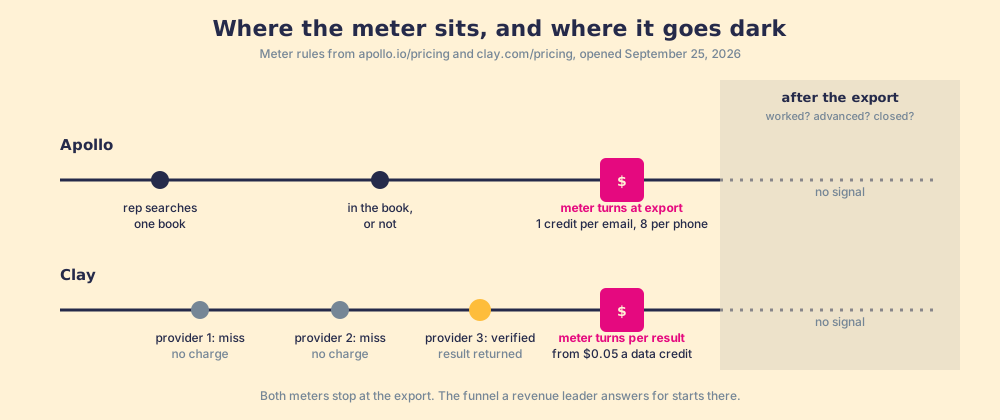
On the Apollo side, the meter moved: the unified credit model turned email from unlimited into one credit each, and Vendr’s page still describes the old shape. On the Clay side, the price list was rebuilt. Clay Pricing 3.0, announced March 11, 2026, collapsed three self-serve tiers into two and split the old credit into Data Credits, which buy enrichment from the marketplace, and Actions, which pay for platform operations (Clay Pricing 3.0, March 2026). The pricing page as opened today shows Launch from $185 a month ($167 on annual) with 2,500 data credits a month, Growth from $495 ($446 annual) with 6,000 data credits a month and CRM auto-sync, and Enterprise on an annual commitment. Data credits start at $0.05 each. Clay says it cut marketplace costs 50% to 90% on most providers.
One line on that page carries more weight than the prices: “If an enrichment returns no result, you’re not charged Data Credits or Actions.” A phone book charges you for opening it. The operator charges you when someone picks up.
Do you still need the database contract?
The arithmetic underneath the search. Vendr’s median Apollo contract is $19,000 a year. Clay’s Growth plan is $5,940 a year at list, with 72,000 data credits across the year. The platform fee is less than a third of the median Apollo contract, and the credits are the number you owe yourself an estimate for, because they scale with what your reps source rather than with how many of them have a login. Put the Bridge Group’s median SDR in the picture: 44 dials a day and $3.78 million in raw pipeline sourced a year, across 351 companies (Bridge Group, 2025). On Apollo, at 8 credits a phone, that rep draws down a fixed bucket whether the numbers were in the book or not. On Clay, the same rep pays per number that comes back.
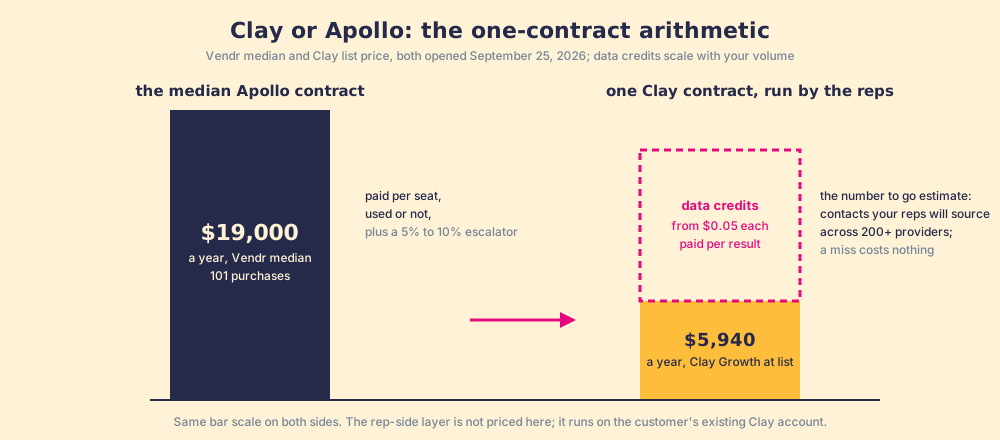
The picture has an edge, and this is where it breaks. A Clay account with no one to build in it is an operator with no phone books plugged in; the builder is a job title, and that person is real cost. The second edge is the reason this page exists: the Clay contract is only cheaper if reps use it. RevOps sees credits consumed. No one sees whether a rep ever ran the table.
When does Apollo still win?
- A team with no Clay and no builder. Clay with no one to build in it is a workshop with the lights off. Apollo is a phone book a rep can open on day one, and its G2 score of 4.7 from 9,690 reviews on its own pricing page is the highest in its field.
- A team that wants the bundle. Sequences, a dialer, and data under one login at a published price is Apollo’s lane, and no aggregation layer competes with it there.
- A small team that sources heavily per seat. If three reps burn credits all day, a fixed bucket per seat can be the cheaper meter. Do the sums with your own dial counts first.
For that team the recommendation is Apollo, sized by credits before seats, negotiated at the 30% Vendr’s buyers get. The Apollo alternatives page grades the other databases if the fit is wrong.
What happens after either one finds the contact?
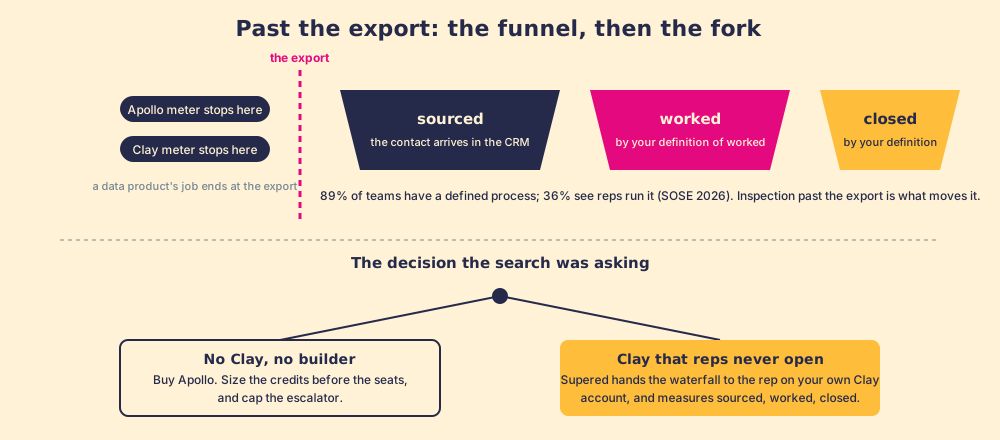
Both meters go dark at the export. The revenue leader’s job starts there. Across 198 sales teams in The State of Sales Enablement, 89% had a defined sales process and 36% saw reps run it as designed, and the teams that inspected adherence consistently hit quota at 6.3 times the rate of those that did not. Sourcing a contact is step one of that process. When step one is the only step measured, the renewal meeting gets the same report each year: a CRM full of contacts, a credit balance draining, and no answer to “is the prospecting engine working?”
You can only expect what you inspect. So the layer worth adding after Clay treats the sourced contact as the start of a motion with an expectation attached: was it worked, by your definition of worked; did it advance; did it close, by your definition of closed. Supered is that layer, and it does not bring its own database. It brings Clay’s waterfall, which is every database, routed; that is the reason we chose Clay as our only data provider. A rep on a LinkedIn profile, a Sales Navigator list, a company’s website, or a HubSpot or Salesforce record gets the waterfall in one click and syncs the contact with no Clay login, on the customer’s own Clay account. Then the next expected action reaches the rep in the flow of the work, the way a sales cadence is meant to, and the manager sees sourced, worked, and closed per rep against the standard they set. Clay governs the data. Supered governs the motion.
In the same study, quota attainment ran 49% when process guidance reached reps in the flow of work versus 15% when it lived in documents. A contact sourced and then worked to a standard is a buyer who gets a consistent experience, and consistency is what the buyer feels first.
The full reasoning sits in the sales process guide; the sibling comparison, Clay vs ZoomInfo, runs the same argument against the thickest book of all.
Clay or Apollo: the verdict
- Apollo itself. The right purchase for a team with no Clay account, no one to build in one, and a wish for data, sequences, and a dialer under one published price. Size the credits before the seats, and cap the escalator.
- Clay, run by a builder. The right purchase for a team with a GTM engineer that is tired of buying a second book when the first one misses, and wants per-result pricing across 200+ providers with its existing Apollo account routed through as one step.
- Clay via Supered. The right purchase for a team that already has Clay and reps who never open it. The rep gets the operator on the LinkedIn tab and the CRM record; the manager gets sourced, worked, and closed against the standard they set. The export becomes the first step of a measured process instead of the last thing anyone sees.
So here is what we recommend. Stop comparing the book with the operator. If you have no builder, buy the book and read the credit meter before the seat price. If you have Clay, do not sign a second database; the operator already has that book on her shelf. Put her in your reps’ hands where they already work, and meter what happens after the call connects, because a contact found and never worked cost a credit and earned nothing. The demo is where you can watch it run on your own Clay account.
Frequently asked questions
Is Clay a replacement for Apollo?+
Which is cheaper, Clay or Apollo?+
Can reps use Clay without learning it?+
When is Apollo the better choice than Clay?+
What happens to the contact after Clay or Apollo finds it?+
Your process, running itself.