Apollo Reviews 2026: A Starter Home, Rated by the People Who Just Moved In
Apollo reviews, checked October 2, 2026: G2 4.7 from 9,839 against Trustpilot 3.1 from 1,333, what the credit and data complaints say, the 2018 exposure and the LinkedIn ban, prices, and who should buy Apollo.io.
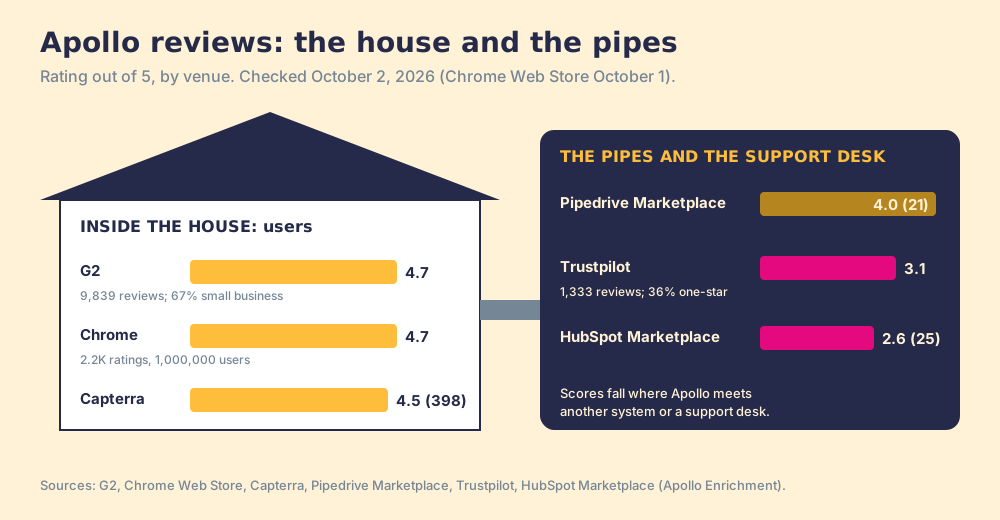
Apollo reviews, gathered on October 2, 2026, rate Apollo.io 4.7 out of 5 from 9,839 users on G2, where two in three reviewers work at small businesses, and 3.1 from 1,333 on Trustpilot, where credits, data quality and support draw the complaints.
A starter home gets glowing reviews in its first year. The rooms are all there, the price was fair, and you moved in the same weekend you signed. The complaints come later, and they come from growth: the second child, the home office, the water bill that doubled when the household did. Apollo reviews in 2026 read like that. The people who moved in this year love it, and the families who outgrew it write the critical ones. The quick answer, checked October 2, 2026:
- Apollo itself. The best first home for a small team that wants contact data, a dialer and sequences in one seat, with posted prices from $49 a month.
- Supered Prospector. The pick for a sales team that already pays for Clay: reps run Clay’s waterfall across 200+ vendors from where they sell. $45 per rep per month, billed annually.
- ZoomInfo. The step up for enterprise teams buying breadth and intent data on annual paper.
Apollo reviews, gathered on October 2, 2026, rate Apollo.io 4.7 out of 5 from 9,839 users on G2, where two in three reviewers work at small businesses, and 3.1 from 1,333 on Trustpilot, where credits, data quality and support draw the complaints. This Apollo io review reads both, then does the arithmetic the reviewers keep hinting at.
What do Apollo reviews say, venue by venue?
| Where | Who is reviewing | Rating | Reviews | Checked |
|---|---|---|---|---|
| G2 | Users; 67% small business | 4.7 of 5 | 9,839 | October 2, 2026 |
| Chrome Web Store | Installed users (1,000,000) | 4.7 of 5 | 2.2K ratings | October 1, 2026 |
| Capterra | Verified users | 4.5 of 5 | 398 | October 2, 2026 |
| Pipedrive Marketplace | Pipedrive admins | 4.0 of 5 | 21 | October 2, 2026 |
| Trustpilot | Anyone: customers, ex-customers, people in the data | 3.1 of 5 | 1,333 | October 2, 2026 |
| HubSpot Marketplace (“Apollo Enrichment”) | HubSpot admins | 2.6 of 5 | 25 | October 2, 2026 |
Sources: G2, Chrome Web Store, Capterra, Pipedrive Marketplace, Trustpilot, HubSpot Marketplace. The small-business share is from G2’s Apollo-vs-Lusha comparison, October 1.
The ratings fall in a pattern. Where users judge Apollo as a place to work, it scores 4.5 to 4.7. Where admins judge it as plumbing into another system, the scores drop, to 4.0 on Pipedrive’s marketplace and 2.6 on HubSpot’s. The inside of the house is well liked. The pipes to the street draw the complaints.
Is Apollo.io legit?
As a company, yes. In February 2026 Apollo named Matt Curl chief executive, with founder Tim Zheng staying on as chairman, and said it was “approaching $200M in annual recurring revenue and nearly 100,000 paying customers” (PR Newswire, February 3, 2026). It bought the revenue-intelligence startup Pocus in March and launched what it calls an AI GTM System on September 30. It is independent and posts its prices.
One detail from the same day is useful for any Apollo.io review. Apollo describes the size of its database three ways in three places: “240M contacts & 30M companies” on its pricing page (September 25), “210M contacts and 35M accounts” on its Chrome Web Store listing (October 1), and “275M+ B2B contacts and 73M+ company records” on its Pipedrive Marketplace listing (October 2). None of that makes Apollo less legitimate. It does tell you how much weight to give any one number a data vendor prints about itself, including the April 2026 Tolly report Apollo commissioned, which tested 384 target contacts.
What do Apollo reviews say about the data?
The reviewers praise the data and complain about it in the same breath. G2’s largest praise tags on October 2 were “Ease of use and seamless CRM integration” (1,587 reviews) and “Robust search and filtering capabilities” (1,321). Its largest complaint tags were missing features and customization (559), “Inaccurate contact data and email information” (469), a steep learning curve (458) and outdated data needing manual checks (412). On Capterra, Abhishek Y., a database executive, wrote in July 2026: “Some contact information is outdated and credit runs out quickly with heavy usage.”
Apollo’s own planning numbers explain the split better than any review. The credit calculator behind its pricing page assumes an email match rate of 0.88 and a phone match rate of 0.81 (Apollo’s plan data, October 2, 2026). By Apollo’s own arithmetic, 12 of 100 email lookups and 19 of 100 phone lookups come back empty, before the question of whether the found ones still work.
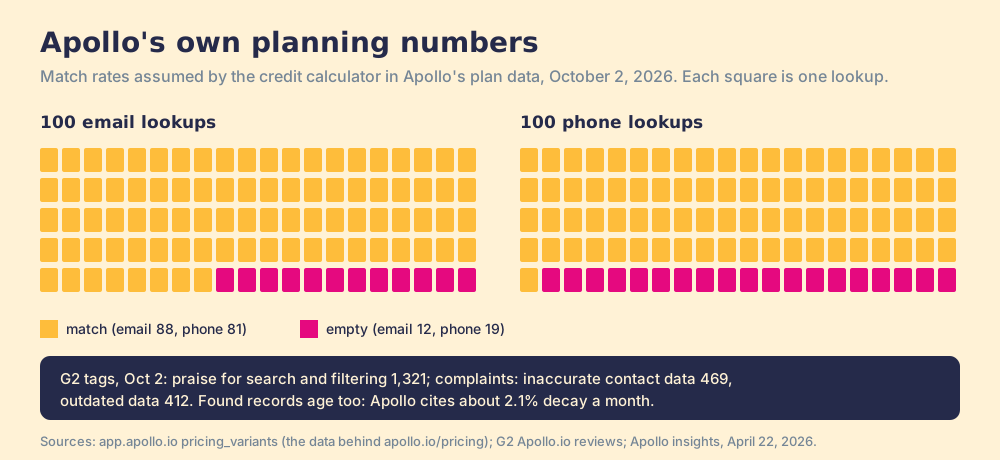
A house with one well is a good house until a dry summer. A single database is the same: it answers from its own sources, and the contacts its sources never reached, or reached two jobs ago, come back empty or wrong. Apollo itself cites research that B2B data decays about 2.1% a month, “roughly 22.5% annually” (Apollo, April 22, 2026). Apollo has added a feature it calls Waterfall Enrichment on paid plans, which asks partner sources when its own data misses, and the waterfall enrichment guide explains why that design finds more.
Why do Apollo reviews complain about credits?
Because the meter runs per lookup, the allowance resets, and a phone costs eight times an email. Apollo’s plan data on October 2, 2026:
| Plan | Price per seat per month | Credits per seat per year | Phones per seat per year at 8 credits |
|---|---|---|---|
| Free | $0 | 900 | 112 |
| Basic | $49 annual ($65 monthly) | 30,000 | 3,750 |
| Professional | $79 annual ($99 monthly) | 48,000 | 6,000 |
| Organization | $119, annual only, 3-seat minimum | 72,000 | 9,000 |
Apollo’s pricing FAQ adds the clause that produces the complaints: credits are “pooled across your entire team and granted upfront,” and “Unused credits expire at the end of each billing cycle and do not carry over. This applies to both plan-included credits and purchased add-on credits” (Apollo pricing, October 1, 2026). Pooled credits help a team share a busy month. They also let one heavy user drain the household tank, and whatever is left at the end of the cycle is gone.
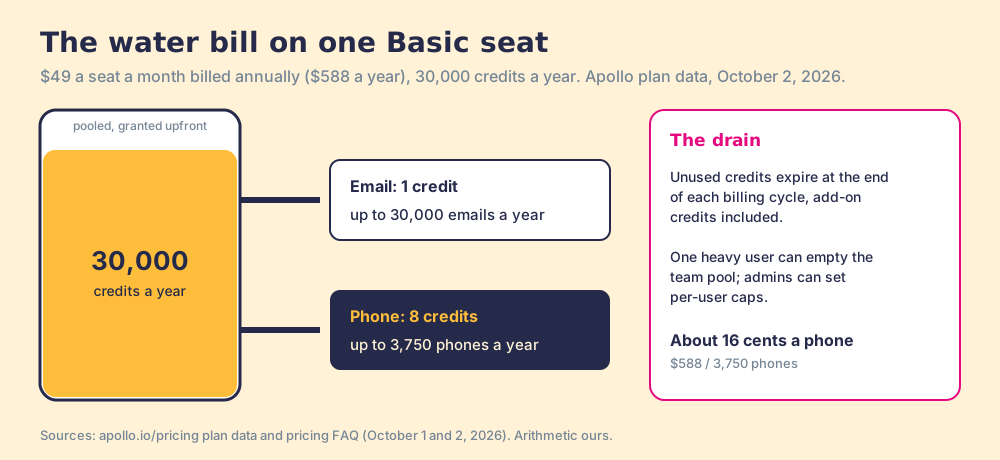
On a per-phone basis Apollo is cheap: $588 a year for a Basic seat over 3,750 phones is about 16 cents a number. The complaints are about predictability. “Unclear pricing, forced waterfall verification, slow email access, and excessive credit consumption even for email-only exports,” Rafay A. wrote on Capterra in January 2026. A team that dials all day, a household that grew, runs through 3,750 phones faster than the calendar runs through a year. The Apollo pricing breakdown works through the burn-down for a full dialing team.
Has Apollo had a data breach or legal trouble?
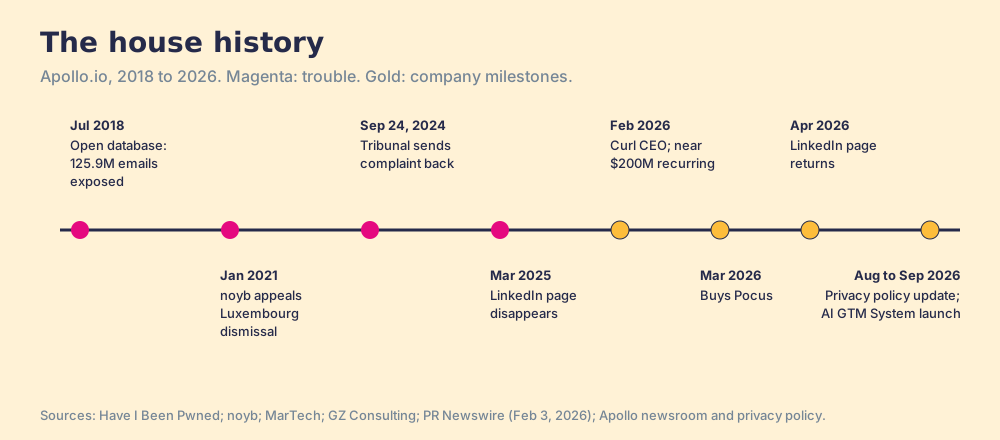
Three entries in the file, in order.
- The 2018 exposure. In July 2018 Apollo left a database publicly accessible without a password. Have I Been Pwned recorded 125.9 million exposed email addresses with names, phone numbers, job titles and employers; Apollo said passwords, social security numbers and financial data were not included (Have I Been Pwned).
- The Luxembourg complaint. A Luxembourg resident asked Apollo and RocketReach to show and erase his data. The regulator dismissed his complaints because neither company had an EU presence; noyb appealed in January 2021, and on September 24, 2024 an administrative tribunal sent the case back to the regulator, which has not ruled (noyb).
- The LinkedIn page. Apollo’s LinkedIn company page vanished in March 2025 (MarTech) and returned in April 2026, with Curl saying Apollo’s communication with LinkedIn “was direct, consistent, and focused on getting to the right long-term outcome” (GZ Consulting).
If you are in Apollo’s database and want out, the privacy policy (effective August 10, 2026) names its sources, publicly accessible websites, professional directories, third-party data providers and customer submissions, and points to a removal form at apollo.io/privacy-policy/remove. Apollo keeps your email on a suppression list so you are not added back.
Why trust this Apollo review?
I built RevPartners, a HubSpot partner that did only sales implementations and reached Elite tier in 13 months. Supered grew out of it and is the #1 sales enablement app on the HubSpot marketplace, rated 5.0 from 122 reviews there and 4.9 from 81 on G2, checked October 1, 2026. We make Supered Prospector, which competes with Apollo for sales teams on Clay, and it ranks first below for that job only. The ratings above carry dates and links, and the scores show their weights.
How does Apollo compare with the alternatives?
The lens is a sales team of ten to fifty reps that wants contact data reps will use where they already sell, and a leader who can see which lists turn into pipeline. Each tool scores 1 to 5 on five criteria, weighted: coverage of the contact you need (x3), rep-side delivery (x2), price structure (x2), what the leader sees after the export (x2) and bundled outreach (x1), out of 50. The scores match the Apollo alternatives ranking.
| Rank | Tool | Grade | Score | Best fit | CRM integration | Setup effort | Pricing | Reason to switch from Apollo |
|---|---|---|---|---|---|---|---|---|
| ref | Apollo | A- | 36 | Small teams wanting data, dialer and sequences in one seat | Native (HubSpot, Salesforce, Pipedrive) | A day | $49 per seat per month, billed annually | Stay if the bundle is the reason you bought it |
| 1 | Supered Prospector | A | 44 | Sales teams that already pay for Clay | Native (HubSpot, Salesforce, Pipedrive) | Under a week on an existing Clay account | $45 per rep per month, billed annually, plus your Clay plan | 200+ vendors behind each lookup, no Apollo seat per rep, lists followed to closed |
| 2 | Lusha | B+ | 29 | LinkedIn-first reps on a low commitment | Native (HubSpot, Salesforce, Pipedrive) | Minutes | Free to $3,599.10 a year | A simpler extension and a free start |
| 3 | ZoomInfo | B | 28 | Enterprise teams buying breadth and intent | Native (Salesforce, HubSpot, Dynamics) | Weeks, with a contract cycle | Quote only; Vendr median $33,500 a year | The deepest single database, on annual paper |
Apollo’s 36 is coverage 3, rep-side delivery 4, price 5, what the leader sees 2, outreach 5. The price 5 and outreach 5 are earned: posted prices, cheap phones, and sequences and a dialer in the same seat. The coverage 3 is the one-well ceiling. Prospector’s coverage 5 belongs to Clay’s waterfall, and its outreach score is 1 because it has no dialer and no sequencer.
Where does Supered Prospector fit?
Clay plus Supered is the best way for a sales team to prospect: GTM engineers build in Clay, reps never open Clay. Prospector holds no database of its own. It runs inside the Supered Chrome extension, on the team’s own Clay account, and turns the tables the GTM engineer built into a button on the page where the rep is working. We chose Clay as our only data provider because Clay is the waterfall across 200+ data and AI vendors, asking provider after provider until one returns a verified email or phone, and its pricing page says “If an enrichment returns no result, you’re not charged Data Credits or Actions” (clay.com/pricing).
Back to the house. Apollo is a good starter home with one well. Clay’s waterfall is the town water main, with the GTM engineer choosing which reservoirs feed it and in what order, and Apollo can be one of them: Clay’s integrations directory lists Apollo.io among its data providers (Clay).
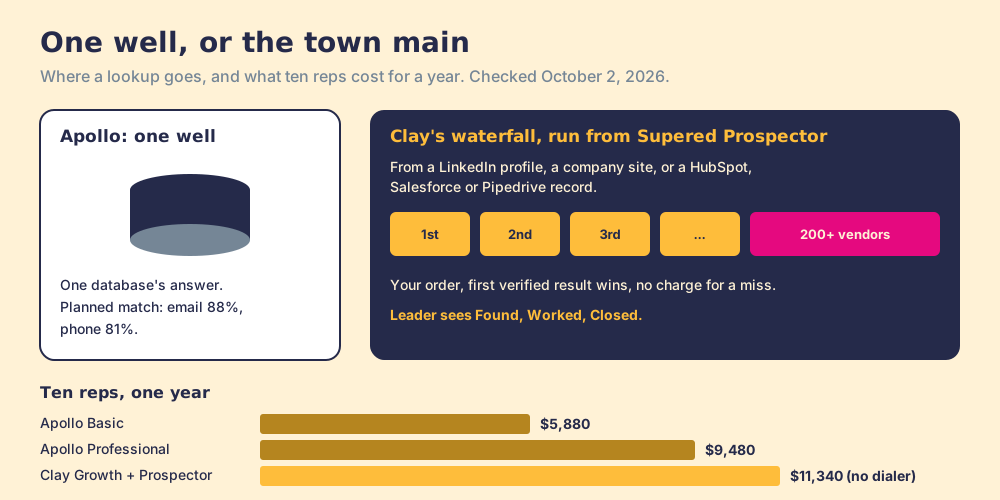
What each person around the table gets:
- The GTM engineer. No more list desk. Named flows built once, each a Clay table with a destination, picked by reps from a Push menu; your waterfalls and tiers stay yours.
- The rep. The table as a button on a LinkedIn profile, a company website, or a HubSpot, Salesforce or Pipedrive record, with the record owner and any past prospecting shown before the push.
- The leader. Found, Worked, Closed: who is working their list and who is not, and how each lead ended, Qualified, Recycled or Disqualified, the way your process says.
Prospector works within LinkedIn’s terms and does not copy search results in bulk; the contact data comes from Clay’s waterfall on the customer’s Clay account.
The cost, side by side for ten reps, one year. Apollo Basic lists at $5,880 and Professional at $9,480. Clay Growth lists at $495 a month, $5,940 a year, plus Prospector at $45 per rep per month billed annually, $5,400 for ten (Prospector), so $11,340. Apollo is cheaper on a cold start. The difference buys every vendor behind each lookup and lists you can follow to closed; it does not buy a dialer or a sequencer, so keep yours.
Choose something else if you have no Clay account: Prospector runs on the customer’s Clay account and does nothing without one, and someone has to build the tables. RevPartners, a Clay Elite Studio Partner I founded, builds them for teams that want help. Choose Apollo, too, if one person sources, sequences and dials from the same screen and the bundle is the point.
Which should you choose?
- Apollo. The pick for a small team without Clay that wants data, a dialer and sequences in one seat. Start on Basic, watch the phone burn in month one, and give one person the job of the credit pool.
- Supered Prospector. The pick for a team that already pays for Clay. A Prospector demo runs on your own Clay account.
- ZoomInfo. The pick for enterprise teams buying breadth and intent on annual paper; the ZoomInfo review covers what its users and its contract reviewers say.
- The removal form. The pick if you found yourself in Apollo’s database.
What I would do rests on what the reviews say. Apollo’s users like living in it, 9,839 of them on G2, and at about 16 cents a phone it costs about a third of Lusha’s 44 to 47 cents (Apollo vs Lusha). The complaints arrive with growth: a credit pool that drains faster than planned and expires on schedule, a well that comes up dry on 19 of 100 phone lookups by Apollo’s own calculator, and pipes to HubSpot and Pipedrive that admins rate far below the house itself. For a founder or a five-person team, buy Apollo and enjoy it. For a team that already pays for Clay, stop buying a second well one seat at a time and connect reps to the main. The Apollo Pipedrive integration guide shows what one of those pipes carries, and what it leaves behind.
Frequently asked questions
Is Apollo.io legit?+
What are the most common complaints in Apollo reviews?+
Is Apollo's data accurate?+
Has Apollo.io had a data breach?+
How much does Apollo cost?+
Is there a better option than Apollo for a team that already has Clay?+
Everything we have written on Apollo
More on Apollo
Supered Prospector vs Apollo: the side-by-side- Apollo Alternatives in 2026: Read the Credit Meter Before the Price Tag
- Apollo Pricing in 2026: The Seat Is the Room Rate, the Credit Is the Minibar
- Apollo Chrome Extension in 2026: The Nozzle Is Free, the Pump Is Metered
- Apollo HubSpot Integration (2026): What Syncs, the Six-Hour Window, and the Duplicates It Mirrors
- Apollo Salesforce Integration: The Mail Room, the Clerk, and the Six-Hour Clock
- Apollo Pipedrive Integration (2026): It Shares the Rolodex, Not the Deal Board
- Apollo vs Kaspr in 2026: The Same $49 at the Door, Two Very Different Clubs
- Apollo vs LeadIQ in 2026: The House, the Delivery Van, and the Market
- Apollo vs LinkedIn Sales Navigator in 2026: A Map, a Phone Book, and the Gap Between Them
- Apollo vs Lusha in 2026: Why the Eight-Ticket Phone Is the Cheaper Ride
Your Clay waterfall, where reps already work.