Wiza vs Apollo in 2026: The Buffet, the Menu, and the Food Hall
Since August 19, 2026, Wiza's help center says bulk export is gone from Sales Navigator. Wiza vs Apollo is now two databases and two pricing models: the break-even between them, G2 scores, and the branch for teams on Clay.
Wiza vs Apollo is a choice between Wiza, a contact finder sold as a flat yearly plan with unlimited reveals inside fair-use caps, and Apollo.io, a credit-metered platform that bundles data with sequences and a dialer.
A restaurant that sells all-you-can-eat has to put the rule somewhere, or the kitchen goes broke. It puts it on the plate: one plate at a time, a set number of trips, no takeaway boxes past a limit. A restaurant with a printed menu needs no such rule. It charges by the dish and brings the kitchen with it. Wiza vs Apollo is a choice between Wiza, a contact finder sold as a flat yearly plan with unlimited reveals inside fair-use caps, and Apollo.io, a credit-metered platform that bundles data with sequences and a dialer. Since August 2026 neither extension bulk-exports Sales Navigator results. The short answer, by who it fits:
- Supered Prospector. Teams whose RevOps already runs Clay. Reps run the tables your GTM engineer built, Clay’s waterfall across 200+ providers behind them (a Wiza step among them), from Sales Navigator, the company site, or the CRM, and never open Clay. $45 per rep per month, billed annually.
- Apollo. Five to fifty reps without Clay who want data, sequences, and a dialer under one published price. From $49 a seat a month, annual.
- Wiza. One heavy prospector, recruiter, or agency researcher pulling more than about 45 new email-and-phone contacts a working day. $1,990 a year per user for Email + Phone.
The pages ranking for this search still describe the old fight. Apollo’s own comparison (July 31, 2026) and a guide modified on October 1 both frame Wiza as the tool that pulls emails from Sales Navigator lists. On August 19, 2026, Wiza’s help center said “LinkedIn has tightened what third-party extensions can do on its platform,” and the bulk export was gone. The comparison that remains is a buffet against a menu.
How do Wiza and Apollo compare at a glance?
Prices are the plan that includes the job, opened on wiza.co/pricing and apollo.io/pricing on October 2, 2026. Grades come from the weighted scoring below, on the lens of a five-to-fifty-rep team.
| Rank | Tool | Grade | Best fit | CRM integration | Setup effort | Price (plan with the feature) | Reason to switch |
|---|---|---|---|---|---|---|---|
| 1 | Supered Prospector (on your Clay) | A | Teams that already run Clay | Native in HubSpot, Salesforce, and Pipedrive; one-click sync | Admin connects Clay inside Supered; your GTM engineer builds the flows or starts from the Supered Clay template | $45/rep/mo billed annually, from 1 rep, plus your Clay plan | 200+ providers behind one click, and every list visible from found to worked to closed |
| 2 | Apollo | A- | 5 to 50 reps wanting data plus outreach | HubSpot, Salesforce, Outreach, Salesloft | Self-serve in minutes | Basic $49, Professional $79, Organization $119/seat/mo annual (3-seat minimum on Organization) | Cheaper below about 45 contacts a rep a day, plus sequences and a dialer |
| 3 | Wiza | B | One heavy prospector, recruiter, or agency | HubSpot, Salesforce, Pipedrive, Zoho, Attio, Outreach, Salesloft | Self-serve in minutes | Email $990/yr, Email + Phone $1,990/yr per user; Team Plan (3+ users) custom | A flat price for heavy one-by-one volume |
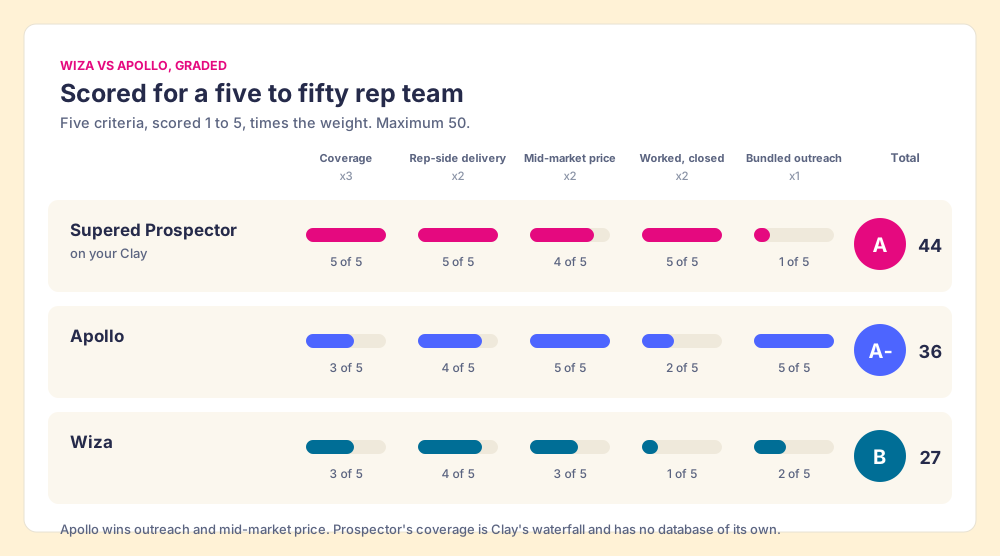
The scoring, so you can argue with it. Each criterion is scored 1 to 5 and multiplied by its weight, for a maximum of 50. The weights and the Apollo and Prospector rows match the Apollo vs Lusha comparison and the Apollo alternatives page, so the pages read together.
| Tool | Coverage (x3) | Rep-side delivery (x2) | Price for mid-market (x2) | Worked and closed visibility (x2) | Bundled outreach (x1) | Total |
|---|---|---|---|---|---|---|
| Supered Prospector | 5 | 5 | 4 | 5 | 1 | 44 |
| Apollo | 3 | 4 | 5 | 2 | 5 | 36 |
| Wiza | 3 | 4 | 3 | 1 | 2 | 27 |
Flip the weights toward one rep’s raw volume and Wiza climbs past Apollo. Wiza scores 3 on mid-market price because its posted prices sit under the heading “Individual Plans” and its Team Plan for three or more users is “Custom pricing”, so a ten-rep team cannot price it from the page. Prospector scores 1 on outreach on purpose: it has no sequencer and no dialer, and it drafts nothing. Its coverage score is Clay’s waterfall coverage, and the credit belongs to Clay.
Why trust this comparison?
You should not, unless the vendor shows its work, and I am the vendor. Supered is my company. Before it, I started RevPartners, a HubSpot partner that did only sales implementations, sold roughly twice as much Sales Hub as any other partner, and reached Elite tier in 13 months, so I have set up the prospecting stack in a great many CRMs and watched which tools reps still opened in week three. Supered is the #1 sales enablement app on the HubSpot marketplace with a 5.0 rating from 122 reviews there, and it holds 4.9 out of 5 from 81 reviews on G2 (checked October 1, 2026). The disclosure that matters: Prospector runs on Clay, and Clay sells a Wiza step, so I have a reason to like Wiza and a reason to sell you a third path. The weights are printed so you can flip them, and the price section favors Wiza at high volume because the arithmetic does.
What changed for Wiza and Apollo on LinkedIn in 2026?
For years the two tools answered different questions. Apollo was a database with an extension attached. Wiza was the extension that turned a Sales Navigator search into a spreadsheet. The testimonial still on Wiza’s pricing page says it plainly: “their one-click export from LI Sales Nav saves me hours every week.”
Then three things happened, in order.
- Apollo’s removal and return. Around March 6, 2025, Apollo’s company page vanished from LinkedIn; MarTech reported the company was “actively working with LinkedIn to understand the nature of our brand page restriction” (MarTech). In April 2026 GZ Consulting reported Apollo was back, quoting chief executive Matt Curl: “our communication with LinkedIn over time was direct, consistent, and focused on getting to the right long-term outcome” (GZ Consulting).
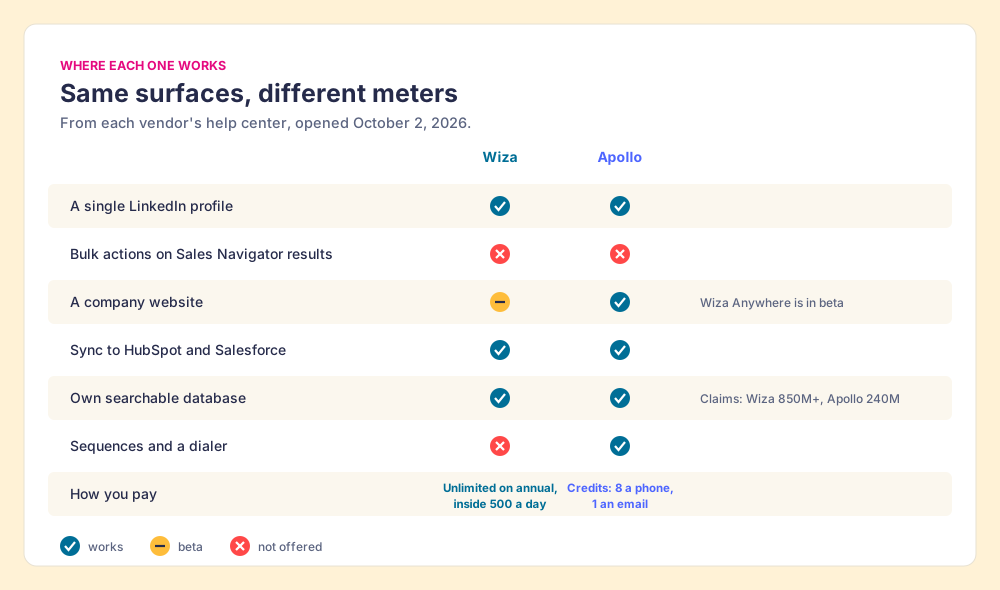
- Apollo’s narrow lane on Sales Navigator. Apollo’s help center, updated September 25, 2026, under the heading “Suggested, Not Selectable”: “You can’t select leads or take bulk prospecting actions from the extension on the search results page.”
- Wiza’s August change. Wiza’s help center, updated August 19, 2026: “Bulk export and multi-select are gone from LinkedIn, Sales Navigator, and Recruiter search, list, and company pages.” It “applies to all accounts and plans.” The extension now opens in a side panel on one full profile at a time (“Wiza does not read previews”), and “to build lists, use Wiza Prospect, CSV upload, or CRM import” (Wiza help).
The rules behind all three sit in LinkedIn’s User Agreement, section 8.2 (effective November 3, 2025), which bars software, “browser plugins and add-ons,” that “scrape or copy the Services, including profiles,” and in LinkedIn’s help page on prohibited software, which warns members who use such tools that “they risk having their accounts restricted or shut down” (LinkedIn Help). Wiza’s own fair-use article says its rate limits “also protect your LinkedIn account from being flagged for suspicious activity.” Neither vendor claims LinkedIn’s approval, and Wiza’s footer says it is “not affiliated, associated, authorized, endorsed by, or in any way officially connected with Microsoft or LinkedIn.”
For what a rep can still do with a Navigator list without breaking those rules, see exporting Sales Navigator leads and the Sales Navigator Chrome extension guide.
Some of the old picture lingers. The Chrome Web Store listing, version 0.3.57, updated the same August 19, still says “Bulk export leads from searches” and still shows 4.2 out of 5 from 140 ratings, against the 4.8 badge on Wiza’s pricing page. Wiza’s export-credits article, updated August 21, still lists Sales Navigator searches among the things that spend credits.
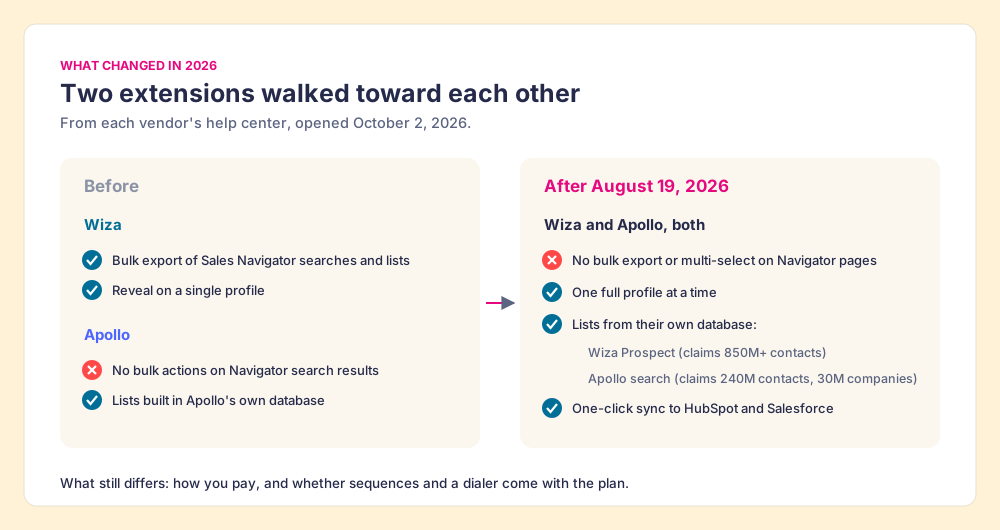
So the two tools have walked toward each other. Both now offer a database to search (Wiza claims “850M+ contacts” and says it “verifies contact data the moment you request it”; Apollo claims 240 million contacts and 30 million companies), a profile-side panel on LinkedIn, a company-website mode (Wiza Anywhere is in beta), and a sync to the CRM. What still separates them is how you pay, and what comes with the meal.
Which is cheaper, Wiza or Apollo?
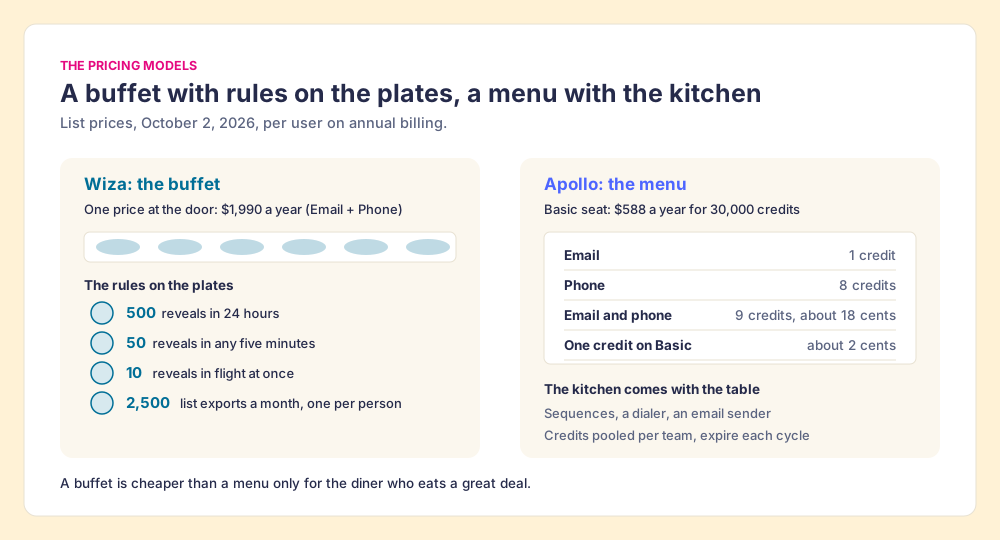
Back to the restaurant. Wiza is the buffet: one price at the door, eat what you like. The rules are on the plates. Apollo is the menu: each dish has a price in credits, a phone number costs 8 and an email costs 1, and the kitchen (sequences, a dialer, an email sender) comes with the table.
The buffet’s price at the door, from wiza.co/pricing on October 2, 2026:
| Wiza plan | Price | What you get |
|---|---|---|
| Free | $0 | 20 valid emails, 5 phone numbers |
| Starter (monthly) | $49 per user per month | 100 valid emails and 100 phones a month; $0.15 per extra email, $0.35 per extra phone |
| Email (monthly) | $99 per user per month | 500 valid emails a month; $0.35 per phone |
| Email + Phone (monthly) | $199 per user per month | 500 valid emails and 500 phones a month, same overage rates |
| Email (annual) | $990 per user per year ($83 a month) | Unlimited email reveals; $0.35 per phone; 2,500 exports a month |
| Email + Phone (annual) | $1,990 per user per year ($166 a month) | Unlimited email and phone reveals; 2,500 exports a month |
| Team Plan | Custom, 3+ users, billed annually | Unlimited emails and phones, API, Wiza Prospect, CSV import |
The plate rules, from Wiza’s help center:
- A daily ceiling. “500 contact reveals in 24 hours” and “50 contact reveals in 5 minutes or less,” which “cannot be modified.”
- A queue limit. “A maximum of 10 active reveals at one time per user.”
- A takeaway-box limit. List exports from Wiza Prospect or a CSV carry “a hard cap of 2,500 export credits per month,” one per person in the list, deducted “regardless of the verification process,” so a person with no email found still costs a box. People you exported before are not charged again.
- A fair monthly meter. On monthly plans, “1 email credit = 1 valid email” and “1 phone credit = 1 contact enriched with phone number(s),” so you pay for finds, and credits reset on your billing date.
The menu, from Apollo’s plan data on October 2, 2026: Basic $49 a seat a month annual ($65 monthly) with 30,000 credits a year, Professional $79 ($99) with 48,000, Organization $119, annual only, three-seat minimum, with 72,000. A phone is 8 credits, an email 1. Apollo’s FAQ says credits are pooled across the team, granted upfront, and expire unused at the end of each billing cycle. At Basic’s list price a credit costs about 2 cents, so an email plus a phone costs about 18 cents.
Now the arithmetic, worked in the open so you can redo it with your own numbers. A buffet is cheaper than a menu only for the diner who eats a great deal. Divide Wiza’s $1,990 by Apollo’s 18 cents and the two cost the same at about 11,300 email-and-phone contacts a year: about 940 a month, or 45 for each of 250 working days. For phones alone the line sits near 1,060 a month. A rep who fills Wiza’s full 2,500 list exports every month pays about 7 cents a contact.
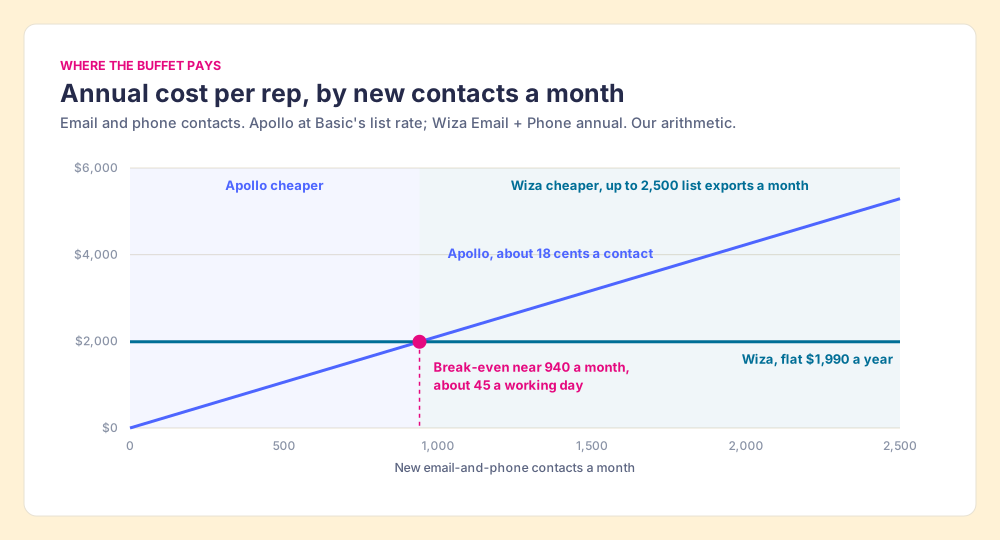
Forty-five new contacts a day is a heavy plate. The Bridge Group’s 2025 survey of 351 companies puts the median SDR at 44 phone activities a day (Bridge Group). To make Wiza’s buffet pay, a rep would need a brand-new contact, email and phone, for roughly every dial, every working day, and most dials go to people already on the list. That is a recruiter’s day, or an agency researcher’s, more than a sales rep’s. The email-only plan sets the bar higher still: $990 against Apollo’s 2-cent email breaks even near 200 new emails a working day.
Three things keep the buffet from looking better than it is, and a fair page says them:
- Monthly billing. On monthly plans the menu wins at every volume: Wiza’s $199 Email + Phone plan works out to about 40 cents a contact (50 cents past the allowance), Apollo Basic at $65 to about 23 cents.
- Team pricing. Ten reps at Wiza’s individual list price would be $19,900 a year on Email + Phone, against $5,880 for ten Apollo Basic seats or $9,480 on Professional. Wiza’s Team Plan is quoted, so the real number for a team may differ.
- A found number versus a connecting one. Neither vendor publishes an independent accuracy audit. Apollo’s own pricing calculator assumes an 88% email and 81% phone match rate, and Wiza’s pitch is real-time verification at the moment of request. A 200-contact sample from your own list, run through both trials, settles it faster than any page.
For the full ladders, see Wiza pricing and Apollo pricing; for Apollo against another LinkedIn-first finder, Apollo vs LeadIQ.
What is each one best at?
Fair to both first, with proof. G2’s head-to-head (October 2, 2026) shows Apollo at 4.7 out of 5 from 9,788 reviews and Wiza at 4.5 from 1,251 (1,274 on Wiza’s own product page). Ease of use is level at 9.0. Apollo leads on ease of setup (8.9 to 8.7), ease of admin (9.0 to 8.8), quality of support (8.8 to 8.6), meets requirements (9.1 to 8.7), and product direction (9.3 to 8.8) (G2, Apollo.io vs Wiza). Both draw their largest reviewer group from small business.
- Apollo, the kitchen. Data, sequences, a dialer, and Gmail and Salesforce extensions under one login, a free tier, published seats, and 1,000,000 Chrome users. If your job is a five-to-fifty-rep outbound team that wants the data and the outreach in one tool, Apollo is the best pick on this page. The complaint to plan around is the meter: credits expire each cycle, and one Chrome reviewer’s support thread ran to “24 messages later. Still no straight answer.”
- Wiza, the buffet. A flat price for the person whose day is reveals, a CRM match in the side panel (“the Wiza Extension checks for matching records in your connected CRM”), and contact actions for HubSpot, Salesforce, Pipedrive, Zoho CRM, Attio, Outreach, and Salesloft. If your job is one recruiter or researcher pulling hundreds of contacts a day, Wiza is the best pick. The fair complaint is the one a June 2026 Chrome reviewer made: “Data quality seems to be OK, not significantly better than a number of other competitors.”
Apollo for the team that runs outbound from inside one tool. Wiza for the single heavy user who needs the contact and nothing else.
Do you need Wiza or Apollo if your team has Clay?
Walk out of both restaurants and into the food hall. Clay is one ticket, “Buy data from 200+ providers in one place,” and its waterfall goes stall to stall until one returns a verified email or phone: Clay’s “signature data waterfalls check multiple providers to return the most verified emails (lower bounce rate) and phone numbers (higher connect rate)” (clay.com). Clay’s pricing page adds the rule a single restaurant cannot offer across kitchens: “If an enrichment returns no result, you’re not charged Data Credits or Actions” (clay.com/pricing).
Wiza already runs a stall in this hall. Clay lists five Wiza actions, work email, personal email, phone number among them, each payable in “Clay Credits or Bring Your Own Account” (Clay, Wiza). Apollo’s actions in Clay read “Bring Your Own Account Required” (Clay, Apollo). So a Clay team can serve Wiza’s phone lookup as one step of a waterfall without a Wiza contract, and only pays when a step finds something.
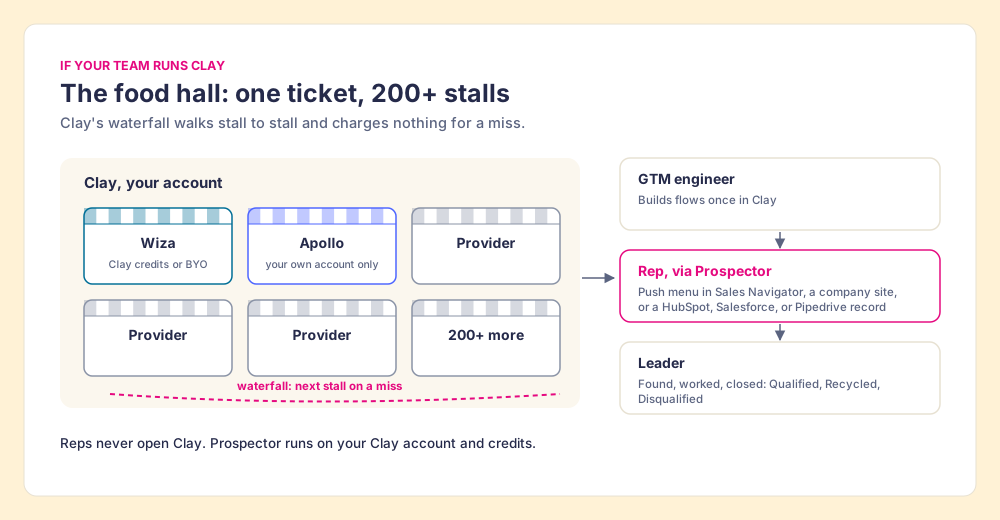
A food hall only feeds the people who walk in, and reps do not walk into Clay. My analogy stops working there, and Supered starts. Clay says as much: “GTM engineers build on Clay.” Clay plus Supered is the best way for a sales team to prospect: GTM engineers build in Clay, reps never open Clay. Prospector runs inside the Supered Chrome extension on your own Clay account.
- Flows built once. Your GTM engineer names flows (person enrichment, buying committee, a sequence load) and maps each to a Clay table and a destination. Your logic stays yours: waterfalls, tiers, tags, and sequence variables. Start from the Supered Clay template or bring your own tables.
- A Push menu where the rep sells. On a Sales Navigator lead, a company website, or a HubSpot, Salesforce, or Pipedrive record, the rep picks the flow and the table runs, then sends to the CRM or your sales engagement tool. From Navigator, reps add leads to a prospect list and push the list to a Clay table.
- A check before the push. The rep sees who owns the record and whether a teammate already prospected the person, so there is no duplicate work across reps.
- Found, worked, closed. The leader sees every list found, who is working theirs, and how each lead ended the way your process says: Qualified, Recycled, or Disqualified, which is how the Clay budget grows.
On LinkedIn’s terms, in our own words: Prospector works within LinkedIn’s terms and does not copy search results in bulk; the contact data comes from Clay’s waterfall on the customer’s Clay account. Ask any vendor what its extension reads, ours included.
Prospector does not bring its own database. It brings Clay’s waterfall, which is every database, routed, and that is why Clay is not a row in the table at the top: Clay is the row that contains the other rows.
The price, done straight. Prospector is $45 per rep per month, billed annually, from one rep, on your own Clay account and credits (Prospector). If RevOps already pays for Clay, ten reps add $5,400 a year. If you are buying Clay for this, Clay Growth at its $495 monthly rate is $5,940 a year, so Clay plus Prospector is $11,340 for ten reps. Ten Apollo Basic seats cost $5,880 and ten Professional seats $9,480, so on a cold start Apollo is cheaper. Skip the extra seats when the Clay is already paid for; buy Apollo when it is not and you want the kitchen.
Choose something else if:
- No Clay, and no plan to buy it. Prospector runs only on Clay. Pick Apollo or Wiza from the branches below.
- Outreach in the same tool. Prospector has no sequencer and no dialer. Apollo bundles both.
- One recruiter at hundreds of contacts a day. Wiza’s $1,990 flat plan is the simpler purchase for a single heavy user.
- A field or mobile-first team. Supered runs at the computer and has no mobile product.
Apollo vs Wiza: which should you choose?
Apollo, Wiza, or the food hall, each earned by the numbers above.
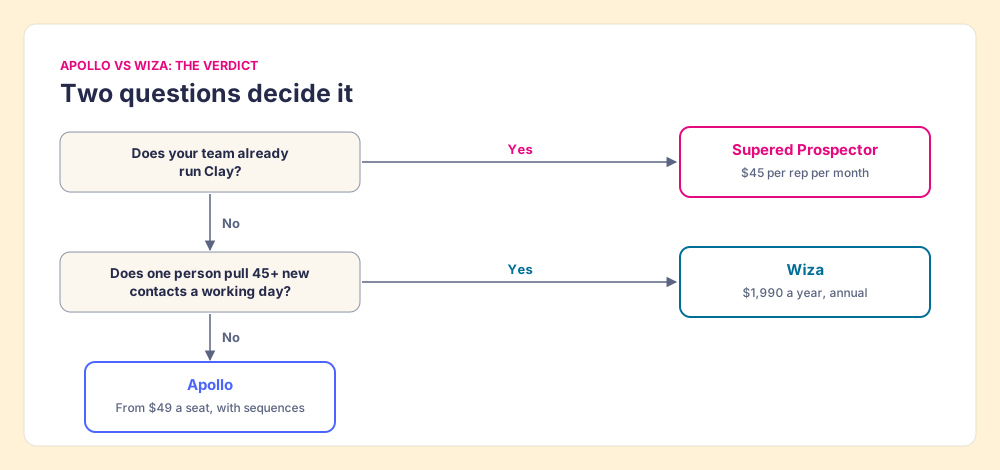
- Apollo. Choose Apollo if you run five to fifty reps without Clay, your reps pull fewer than about 45 new contacts a working day, and you want sequences and a dialer in the same plan. It holds 4.7 on G2 from 9,788 reviews and scores at or above Wiza in all seven head-to-head categories. Size the credit pool before the seats, since unused credits expire each cycle.
- Wiza. Choose Wiza if one person’s job is reveals: a recruiter, an agency researcher, or a founder building a list from scratch at hundreds of contacts a day. Buy annual, where unlimited lives, and plan around 500 reveals a day and 2,500 list exports a month. Do not buy it for the Sales Navigator bulk export; that left on August 19, 2026.
- The food hall: Supered Prospector. Choose neither if your RevOps already runs Clay. Wiza is already a step in your waterfall, your GTM engineer’s tables become buttons for every rep, and you see each list found, worked, and closed. $45 per rep per month, billed annually, on your own Clay account.
If you came here to choose a Sales Navigator exporter, that choice was made for you in August: both tools now work one profile at a time, and the lists come from their own databases. What is left is a buffet and a menu, and for most sales teams the menu is cheaper and comes with the kitchen. If your team runs Clay, buying either restaurant means paying twice for a stall you can already reach. The Wiza alternatives page ranks the rest of the field, the Clay Chrome extension guide shows how reps run Clay tables from the page they are on, and the sourcing use case shows a Navigator lead becoming a worked, closed list.
Frequently asked questions
Is Wiza or Apollo better for a sales team?+
Can Wiza still export Sales Navigator lists?+
Which is cheaper, Wiza or Apollo?+
Is Wiza really unlimited?+
Is Wiza or Apollo safer to use on LinkedIn?+
Do I need Wiza or Apollo if my team has Clay?+
Your process, running itself.