Lusha vs Cognism in 2026: The Corner Shop and the Cash-and-Carry
Lusha posts its prices and sells one seat; Cognism sells five seats at a time and quotes the rest. Lusha vs Cognism, checked October 2, 2026: what a credit buys, the price floor of each, Europe, Do Not Call screening, the regulator files on both, and the Clay route.
Lusha vs Cognism is a choice between a self-serve contact database that posts its prices and charges 1 credit per email and 5 per phone, and a sales-led European database that sells five seats at a time, counts a whole contact as one credit, and screens 15 Do Not Call lists.
Lusha vs Cognism is a choice between a self-serve contact database that posts its prices and charges 1 credit per email and 5 per phone, and a sales-led European database that sells five seats at a time, counts a whole contact as one credit, and screens 15 Do Not Call lists. Checked October 2, 2026, the short answer by who it fits:
- Supered Prospector. Teams whose RevOps already runs Clay. The GTM engineer’s tables, with Lusha’s step among 200+ providers if you bring a Lusha account, run by reps from Sales Navigator, a company site, or the CRM record. $45 per rep per month, billed annually.
- Lusha. One to five reps, mostly selling into North America, who want a posted price and a card payment. From $449.10 a year.
- Cognism. Five or more reps with a European pipeline who live on the phone and need numbers screened against national Do Not Call registries. Quote only; Vendr’s median contract is $32,750 a year.
A corner shop and a cash-and-carry both sell you groceries. At the corner shop the prices are on the shelf, you buy one tin, and you pay for each item at the till. At the cash-and-carry you need a membership card, you buy by the pallet, the prices are at the trade desk, and once you are in, the trolley is yours to fill. Neither is the cheaper shop. It depends on how much you eat, and where you live. Lusha is the corner shop. Cognism is the cash-and-carry. Most of what follows is working out which kind of household you are.
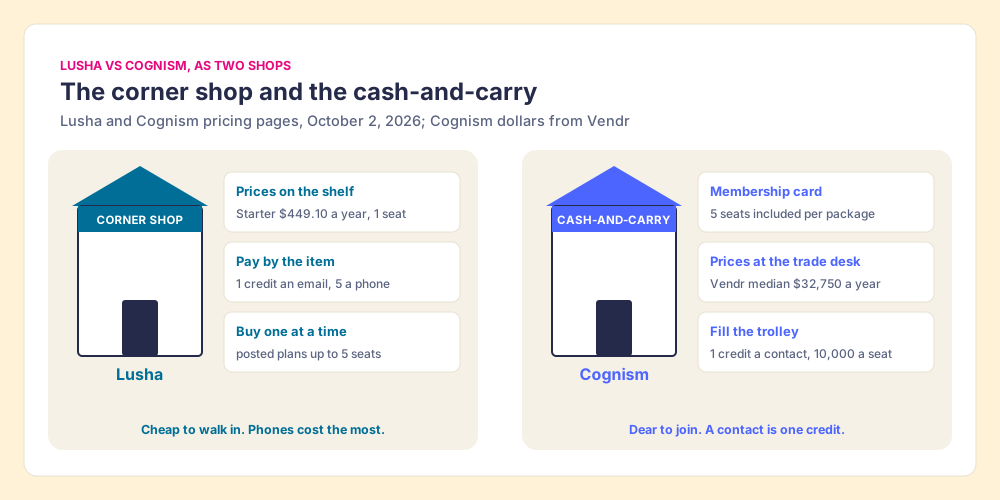
How do Lusha and Cognism compare at a glance?
Prices are the plan that includes the job, opened on lusha.com/pricing and cognism.com/pricing on October 2, 2026; the Cognism dollar figures are Vendr’s, read October 1. Grades come from the weighted scoring below, on the lens of a five-to-fifty-rep sales team.
| Rank | Tool | Grade | Best fit | CRM integration | Setup effort | Price (plan with the feature) | Reason to switch |
|---|---|---|---|---|---|---|---|
| 1 | Supered Prospector (on your Clay) | A | Teams that already have Clay | Native in HubSpot, Salesforce and Pipedrive; one-click sync | Admin connects Clay inside Supered; the GTM engineer builds or picks the tables | $45/rep/mo billed annually, from 1 rep, plus your Clay plan | 200+ providers behind one button, and each list followed from found to closed |
| 2 | Lusha | B+ | Small and US-heavy teams, self-serve buyers | HubSpot, Salesforce, Pipedrive and more, from the Free plan | Self-serve in minutes; G2 ease of setup 9.0 | Starter $449.10/yr (1 seat), Pro $629.10/yr (2), Premium $3,599.10/yr (5) | Posted prices, one seat at a time, a step inside Clay’s waterfall |
| 3 | Cognism | B | Europe-heavy, phone-first teams of 5+ | HubSpot (2-way sync), Salesforce, Outreach, Salesloft | Sales-led onboarding; G2 ease of setup 9.0 | Quote only, 5 seats per package; Vendr median $32,750/yr | One credit per contact, phone-verified mobiles on Pro, 15 DNC lists |
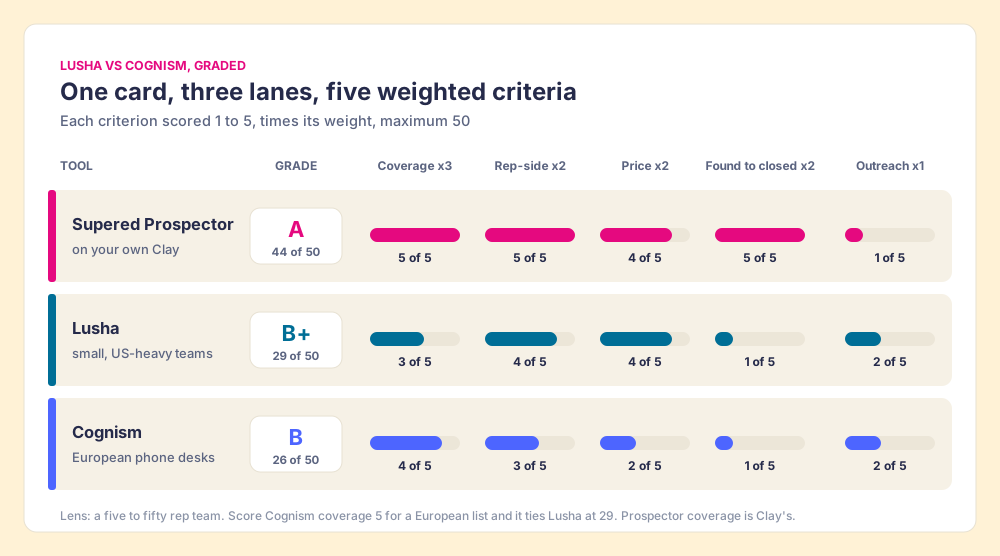
The scoring, so you can argue with it. Each criterion is scored 1 to 5 and multiplied by its weight, for a maximum of 50. The rows are the same ones on the Cognism alternatives page and the Kaspr vs Lusha page, so the pages read together.
| Tool | Coverage (x3) | Rep-side delivery (x2) | Price for the job (x2) | Found, worked, closed visibility (x2) | Bundled outreach (x1) | Total |
|---|---|---|---|---|---|---|
| Supered Prospector | 5 | 5 | 4 | 5 | 1 | 44 |
| Lusha | 3 | 4 | 4 | 1 | 2 | 29 |
| Cognism | 4 | 3 | 2 | 1 | 2 | 26 |
The lens decides more than the data here. Score Cognism’s coverage a 5 for a list that is mostly European and it climbs to 29, level with Lusha; add Do Not Call screening as a sixth criterion and Cognism moves ahead. On a US list the order above holds. Prospector scores 1 on outreach on purpose: it has no sequencer and drafts nothing, and its coverage score belongs to Clay.
Why trust this comparison?
You should not, unless the vendor shows its work, and I am a vendor. Supered is my company. Before it, I started RevPartners, a HubSpot partner that did only sales implementations, sold roughly twice as much Sales Hub as any other partner, and reached Elite tier in 13 months, so I have sat in a lot of rooms where a sales leader chose between a self-serve extension and a sales-led database and then lived with it. Supered holds 4.9 out of 5 from 81 reviews on G2 and 5.0 from 122 on the HubSpot App Marketplace (October 1, 2026). The disclosure that matters: Prospector runs on Clay, and Clay’s waterfall can include Lusha but not Cognism. That gives me a reason to lean toward Lusha, so I have leaned the other way where the evidence allows, and the Europe and phone sections favor Cognism because the evidence does.
Why do teams compare Lusha and Cognism?
Because they are the two names a European-facing sales team hears first, and from a distance they look like the same product. Both sell emails and phone numbers through a Chrome extension and a web app, both push into HubSpot and Salesforce, and G2 rates them within a fifth of a star: Cognism 4.5 from 1,355 reviews, Lusha 4.3 from 1,665 (G2, Cognism vs Lusha, read October 2, 2026).
The detail on that page shows two different customers. Ease of use tilts to Lusha, 9.2 to 9.0. Quality of support tilts hard to Cognism, 9.1 to 8.1, and so does product direction, 9.2 to 8.3. Contact data accuracy is close, 7.8 to 7.6. And the buyers differ: 53.4% of Cognism’s reviewers are mid-market and 21.0% enterprise, while Lusha’s largest group is mid-market at 46.8% with 39.6% small business. The extensions tell the same story from the other end. Lusha’s has 400,000 users and a 4.6 from 1.9K ratings; Cognism’s newer Sales Intelligence Extension has 4,000 users and a 4.3 from 11 ratings, beside an older listing with 40,000 users (Chrome Web Store, October 1 and 2, 2026). One shop has a lot of walk-in customers. The other has fewer members who each buy more.
The complaints, in reviewers’ words, are the shop complaints you would expect.
- The Lusha basket that fills too fast. A mid-market reviewer, September 2026: “Credit pricing, with add-ons and extra credits price is becoming really high, no discounts.” A founder, May 2026: “Sometimes, I am not able to find contact details for about 20% of the contacts.”
- The Cognism shelf that thins past Europe. A mid-market reviewer, July 2026: “Coverage also thins out noticeably outside Europe; searching for contacts in APAC or more niche industries yields way fewer verified phone numbers.” An SDR, May 2026: “credits run out fast if you’re doing high-volume outreach.”
(G2 review text read through page summaries, October 1, 2026.) Lusha’s buyers mostly complain about the price per item. Cognism’s mostly complain about what is not on the shelf.
How much does Cognism cost compared with Lusha?
Start with the shelf, because only one of them has prices on it.
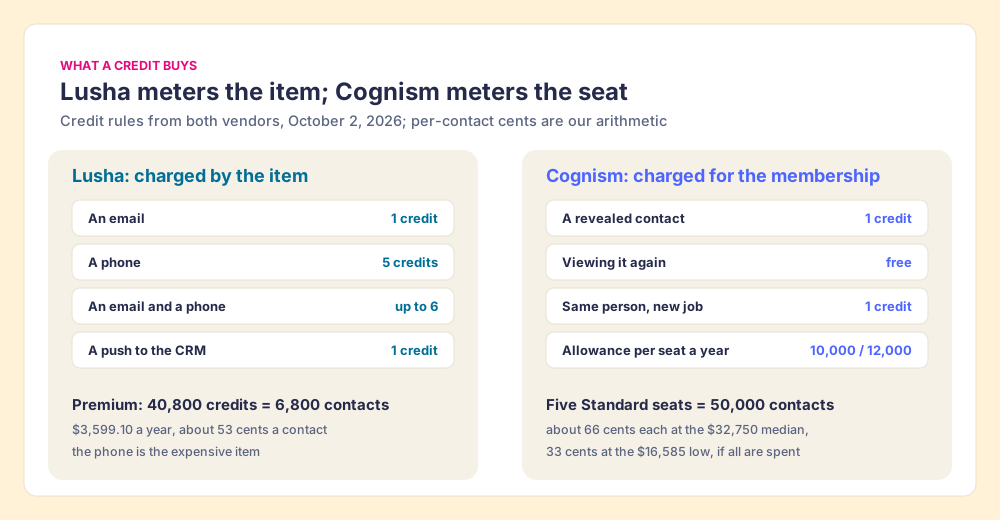
Lusha’s pricing page on October 2, 2026: Free at 40 credits a month; Starter $449.10 a year for 4,800 credits and 1 seat ($49.90 on monthly billing for 400 credits); Pro $629.10 a year for 7,200 credits and 2 seats; Premium $3,599.10 a year for 40,800 credits and 5 seats. Its FAQ prices the items: “Reveal verified email address, 1 credit. Reveal a phone number, 5 credits.” Past 5 users, Lusha sends you to sales, and features such as per-user credit caps and Do Not Call tables sit on its Scale plans.
Cognism’s pricing page the same day shows two packages, Standard and Pro, each with “5 seats included,” and no dollar figure on either. The page explains the unit: “1 credit = 1 revealed contact,” “No charge for viewing previously revealed contacts,” and a credit “is only used again if that contact changes jobs.” Cognism’s own comparison pages put the allowance at 10,000 credits per user a year on Standard and 12,000 on Pro. For a price you go to the trade desk, or to Vendr, where the median Cognism buyer pays $32,750 a year across 94 purchases, in a range from $16,585 to $88,449 (Vendr, Cognism, read October 1, 2026; the page returned a 404 on October 2). Vendr’s median Lusha buyer pays $15,999 across 147 purchases, range $6,000 to $70,403 (Vendr, Lusha, October 2, 2026).
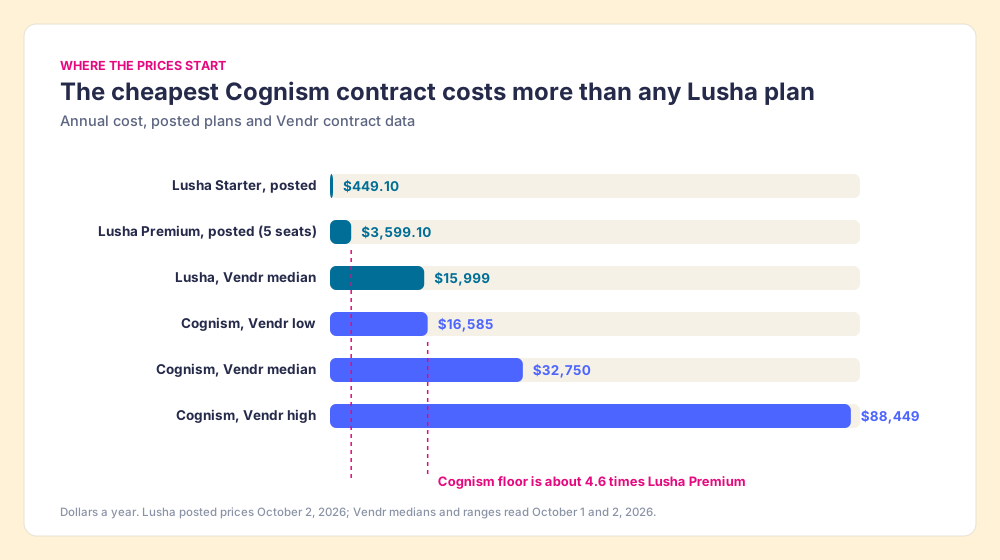
The floors are the first fact a buyer should know. The cheapest Cognism contract on Vendr, $16,585, is about 4.6 times Lusha’s most expensive posted plan. Lusha’s median contract is about half of Cognism’s, $16,751 less. A three-rep team can be on Lusha this afternoon for under $3,600. That same team is below the size Cognism packages for.
The unit is the second fact, and it runs the other way. On Lusha a phone is the expensive item: 5 credits, and “up to 6” for an email plus a phone, per its credit guide. On Cognism one credit buys the whole contact. Do the arithmetic, which is mine and labelled as such. Lusha Premium’s 40,800 credits buy 6,800 email-plus-phone contacts, about 53 cents each. A five-seat Cognism Standard package holds 50,000 contact credits a year; if it cost the Vendr median and the team spent every credit, a contact would cost about 66 cents, and at the Vendr low about 33 cents. Vendr does not say how many seats those contracts carry, so treat the Cognism figures as a range, not a quote.
The catch is the phrase “spent every credit.” The Bridge Group’s 2025 SDR report, from 351 B2B companies, puts the median SDR at 44 phone activities a day, about 11,000 a year over 250 working days (Bridge Group, 2025). To use 10,000 Cognism credits, a rep would need a brand-new contact for nearly every dial, and a sequence calls the same person more than once. So at the cash-and-carry you pay for the membership, and the trolley space is a ceiling you rarely reach. At the corner shop you pay for what you carry out, which is cheaper until you carry out a lot of phones. The full ladders are on the Lusha pricing page and the Cognism pricing page.
Is Cognism or Lusha better for phone numbers and Europe?
Cognism, and the reason sits in the phone more than the email.
Cognism sells “phone-verified mobile numbers” and, on Pro, on-demand verification and premium mobile coverage (cognism.com/pricing). Its compliance page says it scrubs data “against 15 major Do Not Call and TPS lists,” naming registries in the UK, the US, Australia, New Zealand, Germany, France, Ireland, Spain, Portugal, Croatia, Sweden and Belgium, and that it keeps the data it collects inside the European Economic Area. Lusha’s Do Not Call documentation is shorter: the supported tables are “UK (TPS & CTPS)” and “USA,” and “This feature is available on Scale plans only.” Cognism’s own comparison page makes the same point about Lusha, and Lusha’s documentation confirms it. A rep cold-calling Madrid or Munich from a Lusha Starter seat gets no registry check from Lusha at all.
The satisfaction gap in Europe is wide. On G2’s Europe grid for sales intelligence, Autumn 2026, as Cognism’s newsroom published it, Cognism scored 100 for satisfaction and 88 overall from 759 European reviews; Lusha scored 48 and 58 from 264 (Cognism newsroom, September 8, 2026). A vendor publishing a grid it tops is not neutral, but the reviews are G2’s.
Lusha is not weak in Europe; it is second. When Clay added Lusha to its marketplace on March 10, 2026, the pitch was “Add Lusha as a step in your existing contact enrichment waterfall for better EMEA match rates” (Clay changelog), and since September 23, 2026 Lusha’s own Data Waterfall, which falls back to third-party providers when Lusha misses a field, runs on every paid plan (Lusha changelog). For a US list, the evidence that Cognism is better thins out, and Cognism’s own reviewers say coverage “thins out noticeably outside Europe.” The test is cheap on one side and not the other: run 200 contacts from your own target list through Lusha’s Free and Starter plans, and ask Cognism for a trial on the same 200 before you sign.
Are Lusha and Cognism GDPR compliant?
Both say so. Both also have a file with a regulator or a court, and none of the six third-party and vendor comparison pages I read on Google’s first page for this search on October 2, 2026 mentions any of them.
- Lusha and Italy. On July 27, 2026 Italy’s data protection authority, the Garante, announced a €2 million fine on Lusha Systems Inc., a ban on processing data about people in Italy, and an order to delete it; ANSA’s report of the decision says the authority found data collected by “scraping from social networks and purchasing from other data brokers” (ANSA, July 27, 2026). On October 2, 2026 the Garante’s page says the decision has been temporarily removed under an interim order of the Court of Rome dated September 8, 2026, with Lusha’s opposition pending (Garante). The full story is on the Lusha review.
- Cognism and France, through Kaspr. Cognism has owned Kaspr since 2022. In December 2024 France’s CNIL fined Kaspr €240,000 for a Chrome extension that collected the contact details of LinkedIn users, including people who had limited their details to first- and second-degree connections, into a database of “about 160 million contacts” (CNIL, December 2024). The fine was against Kaspr, not Cognism’s own database.
- Cognism in the US. Cognism settled Kis v. Cognism, a class action alleging it showed people’s contact profiles to free-trial users in breach of right-of-publicity laws in seven states. Cognism “denies that it did anything wrong,” and the settlement paid claimants from $22.50 to $150 depending on state (settlement FAQ).
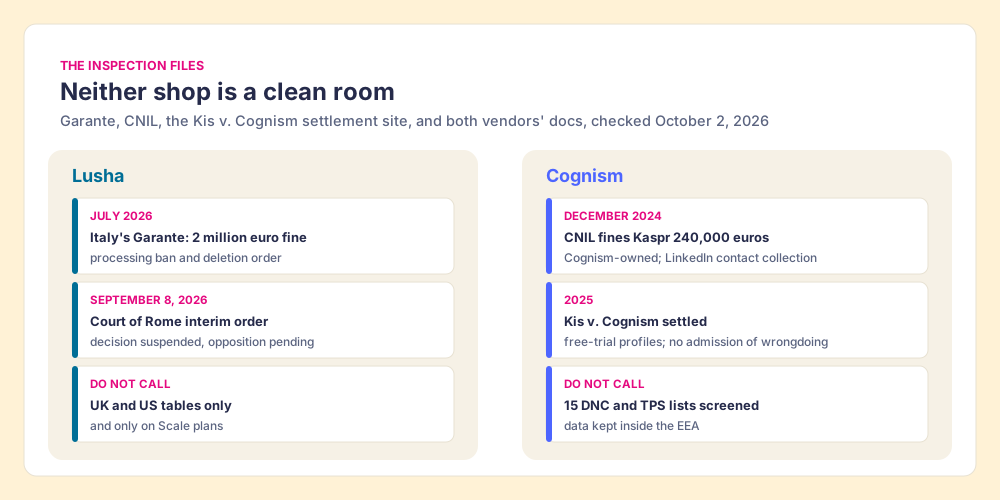
Here the shop picture needs its edge marked. A health inspector’s notice on one shop says something about that shop’s kitchen. A privacy regulator’s theory about how a contact database is built says something about the trade, and it reaches every vendor that keeps profiles of Europeans fresh, ours included through Clay’s providers. Cognism’s screening is the stronger practice on paper, and its files concern its trial program and its subsidiary. Lusha’s file concerns the core database and is open. Neither shop is a clean room. Ask both, in writing, where the data on people in your top three countries comes from and what happens to records you exported if a regulator’s order is restored.
Lusha vs Cognism for a team on Clay
Here the two shops stop being the only places to buy groceries. Clay is closer to the wholesale market both of them stock from: “Buy data from 200+ providers in one place,” with a waterfall that asks one provider after another until a verified email or phone comes back (clay.com, October 2, 2026), and a rule neither shop offers: “If an enrichment returns no result, you’re not charged Data Credits or Actions” (clay.com/pricing).
The two vendors sit in different places on that market. Lusha has a stall. Clay’s Lusha page shows “Joined in Mar 10, 2026,” with “Enrich Person with Lusha” marked “Bring Your Own Account Required” (Clay, Lusha integration, October 2, 2026). Cognism does not; clay.com/integrations/data-provider/cognism returned a 404 the same day, and Cognism’s own Cognism vs Clay page says Clay’s list of providers “doesn’t include industry leaders ZoomInfo or Cognism.” So a Clay team that likes Lusha’s European hit rate keeps a Lusha account and adds it as one step among 200+. A team that needs Cognism’s Do Not Call screening on European mobiles keeps a separate contract and a separate meter, which is a fair choice for a phone-first EMEA desk.
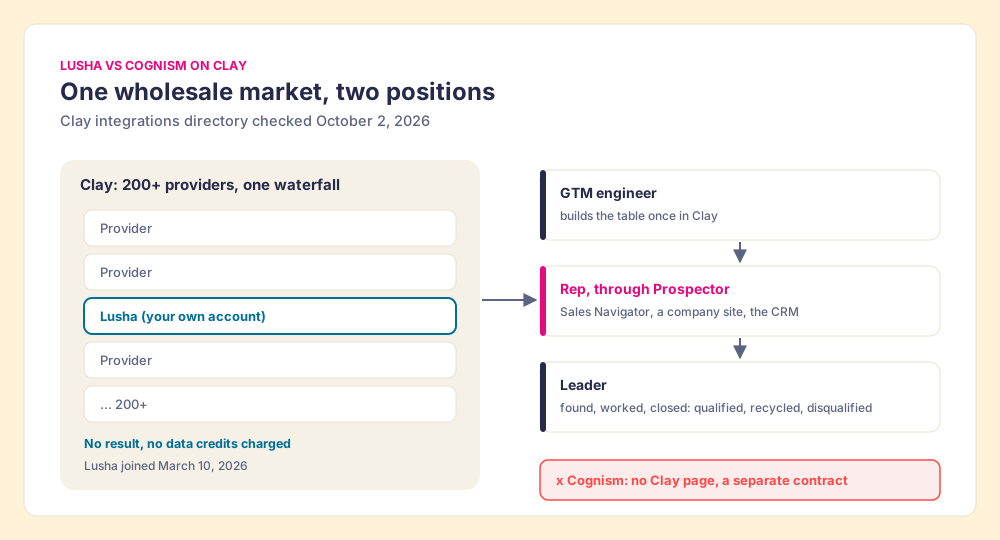
The market has one problem, and Clay names it in its own copy: “GTM engineers build on Clay.” The tables live in the GTM engineer’s workshop. The reps live in Sales Navigator and the CRM, and they keep asking for Lusha or Cognism seats because a button in the browser is the only way they know to get a number. Clay plus Supered is the best way for a sales team to prospect: GTM engineers build in Clay, reps never open Clay. Prospector runs inside the Supered Chrome extension on the team’s own Clay account.
- The GTM engineer’s table as a button. The GTM engineer builds named flows once (person enrichment, buying committee) and reps pick one from a Push menu in Sales Navigator, on a company’s website, or in a HubSpot, Salesforce or Pipedrive record. The waterfalls, tiers and tags stay the GTM engineer’s. Start from the Supered Clay template or bring your own tables. The GTM engineer stops being the list desk.
- Sales Navigator lists into Clay. Reps add Navigator leads to a prospect list and push the list to a Clay table. Prospector works within LinkedIn’s terms and does not copy search results in bulk; the contact data comes from Clay’s waterfall on the customer’s Clay account. Ask every vendor what it reads on LinkedIn, ours included.
- A check before the push. The rep sees the matching CRM record, who owns it, and a flag when the prospect was already worked, so two reps do not chase the same person.
- Found, worked, closed. The leader sees every list found from the team’s tables, who is working their list and who is not, and how each lead ended: Qualified, Recycled, or Disqualified, the way your process says. That view is also how the Clay budget grows.
The price, done straight. Prospector is $45 per rep per month, billed annually, from one rep, on your own Clay account and Clay credits (Prospector). Ten Prospector seats cost $5,400 a year. The phones come out of your Clay data credits, which on our reading of Clay’s calculator run roughly six credits for an email plus a phone, about 50 cents a contact on Growth, a supposition explained on the Clay pricing page. If you are buying Clay for this, Growth at its $495 monthly rate is $5,940 a year, so Clay plus ten Prospector seats is $11,340. That is more than three Lusha Premium plans ($10,797.30 for 15 seats) and well under the Cognism Vendr median of $32,750. The case for the market over either shop is coverage across providers, a miss that costs nothing, the rep’s own screen, and a leader who can follow the list. It is strongest for the team that already pays for Clay: skip the extra seats and get more out of the Clay you already have.
Choose something else if:
- No Clay, and no plan to buy it. Prospector runs only on Clay. Pick Lusha or Cognism from the branches below. If you want Clay built for you, RevPartners, the company I founded, is a Clay Elite Studio Partner that builds and tunes the tables.
- A European phone desk that needs registry screening. Cognism’s 15 Do Not Call and TPS lists and phone-verified mobiles are the job; keep Cognism, with or without Clay beside it.
- Outreach in the same tool. Prospector has no sequencer and no dialer; it sends to the one you run.
- A field or mobile-first team. Supered runs at the computer and has no mobile product.
Who owns Lusha and Cognism?
Lusha is independent, with Lusha Systems Inc. of Boston on its pricing page. It bought Novacy, a sales-conversation analytics startup, in January 2025, and cut about 8% of its staff in December 2025 (Calcalist). Cognism is private and based in London, run by CEO Dominic Allon, and owns Kaspr, so a Kaspr seat is the ground floor of the Cognism building; Kaspr vs Lusha compares the two self-serve extensions. A web search on October 2, 2026 found no acquisition or new funding for either company, and Cognism’s newsroom shows none.
Cognism vs Lusha: which should you choose?
Back to the two shops. Count the household before you pick the shop.
- Lusha. Choose Lusha if you are one to five reps, selling mostly into North America, and want to pay by card for a posted plan this week. Budget phones at 5 credits each, and if you call Europe, know that Lusha’s Do Not Call tables cover only the UK and the US and only on Scale. Ask about Italy in writing.
- Cognism. Choose Cognism if you are five reps or more, your pipeline is mostly European, and your reps live on the phone. One credit per contact, phone-verified mobiles on Pro, and 15 registries screened are worth the membership. Negotiate against Vendr’s $32,750 median and its buyers’ 26% average savings, and get the seat count and the credit allowance in the order form.
- Neither: Supered Prospector. Choose neither if your RevOps already runs Clay. Lusha can be a step in your waterfall, the rep runs the GTM engineer’s table from the screen they are on with no Clay login, and you see every list found, worked and closed. $45 per rep per month, billed annually, on your own Clay account.
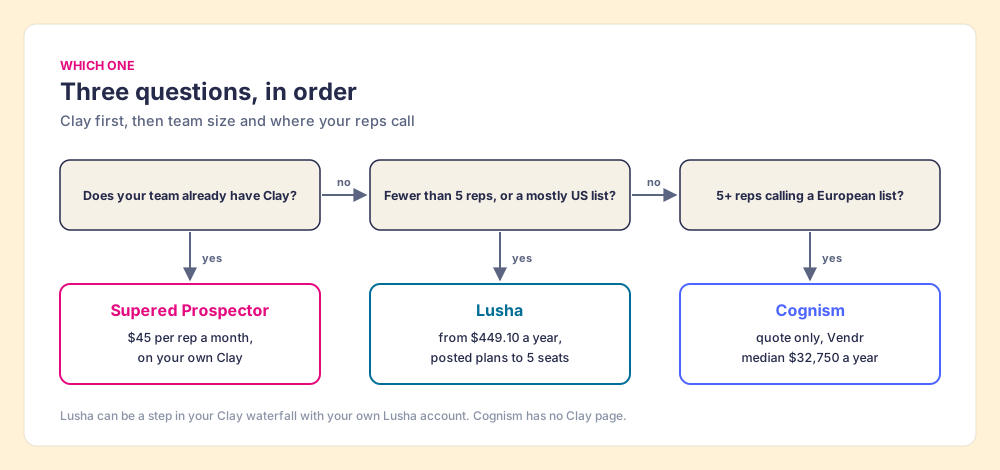
If you do not have Clay, the right shop is the one that fits your household, and the price floors above settle most of it before the data does. If you do have Clay, a third contract is one more membership at a market you already shop in. The Clay Chrome extension guide shows what reps can run from the browser today, the sourcing use case shows a rep-built list becoming pipeline, and Clay vs Cognism takes the European-data question one step further.
Frequently asked questions
Is Lusha or Cognism better?+
How much does Cognism cost compared with Lusha?+
Does Lusha or Cognism have better data in Europe?+
Are Lusha and Cognism GDPR compliant?+
Can I use Lusha or Cognism inside Clay?+
Do I need Lusha or Cognism if my team has Clay?+
Your process, running itself.