Lusha vs Seamless in 2026: The Price Tag and the Showroom
Lusha prints its prices and lets you cancel from settings.
Seamless quotes by form and renews for a year unless you give 60 days' notice and meet your rep. Lusha vs Seamless checked on October 2, 2026: the meters, the data, the exit, and when to choose neither.
Lusha vs Seamless is a choice between Lusha, a LinkedIn-first contact database with posted prices that charges per data point revealed, and Seamless (formerly Seamless.AI), a real-time contact search sold by quote on annual contracts that charges per contact researched.
One shop puts a price tag on every shelf and a returns desk by the door. The other is a showroom with no stickers, where a salesperson asks what you need before naming a number and the financing renews unless you give notice. Lusha vs Seamless is a choice between Lusha, a LinkedIn-first contact database with posted prices that charges per data point revealed, and Seamless (formerly Seamless.AI), a real-time contact search sold by quote on annual contracts that charges per contact researched. Both earn the same score for data accuracy from G2 reviewers. What separates them is how you buy, and how you leave. The short answer, by who it fits:
- Supered Prospector. Teams whose RevOps already runs Clay. Clay’s waterfall across 200+ providers, Lusha’s step included, run by reps from LinkedIn, a company site or the CRM record. $45 per rep per month, billed annually, on your own Clay account.
- Lusha. One to five LinkedIn-first reps who want a posted price and a one-click reveal. From $449.10 a year; Premium is $3,599.10 for 5 seats.
- Seamless. Small-business teams that want one credit to cover a whole contact and emailing, calling and tasks in the same tool, and will negotiate an annual contract. Price by quote only.
Lusha vs Seamless at a glance: how do they compare?
Prices come from lusha.com/pricing and seamless.ai/pricing, opened on October 2, 2026. Grades come from the weighted scoring below, on the lens of a ten-to-fifty-rep team.
| Rank | Tool | Grade | Best fit | CRM integration | Setup effort | Price (plan with the feature) | Reason to switch |
|---|---|---|---|---|---|---|---|
| 1 | Supered Prospector (on your Clay) | A | Teams that already have Clay | HubSpot, Salesforce and Pipedrive; one-click sync | Admin connects Clay inside Supered; Ops builds or picks the tables | $45/rep/mo billed annually, from 1 rep, plus your Clay plan | 200+ providers behind one click, and each list seen from found to closed |
| 2 | Lusha | B+ | 1 to 5 LinkedIn-first reps | HubSpot and Salesforce from the Free plan | Self-serve in minutes; G2 ease of setup 9.0 | Starter $449.10/yr (1 seat), Pro $629.10/yr (2 seats), Premium $3,599.10/yr (5 seats) | A posted price, cancel from settings, a phone at about 44 cents |
| 3 | Seamless | C+ | Small-business teams wanting data plus Connect in one contract | Salesforce, HubSpot and Dynamics, per Seamless | Sales-led; annual contract | Quote only; Vendr median $8,350 a year, seat count not published | One credit per researched contact, credits returned for invalid emails |
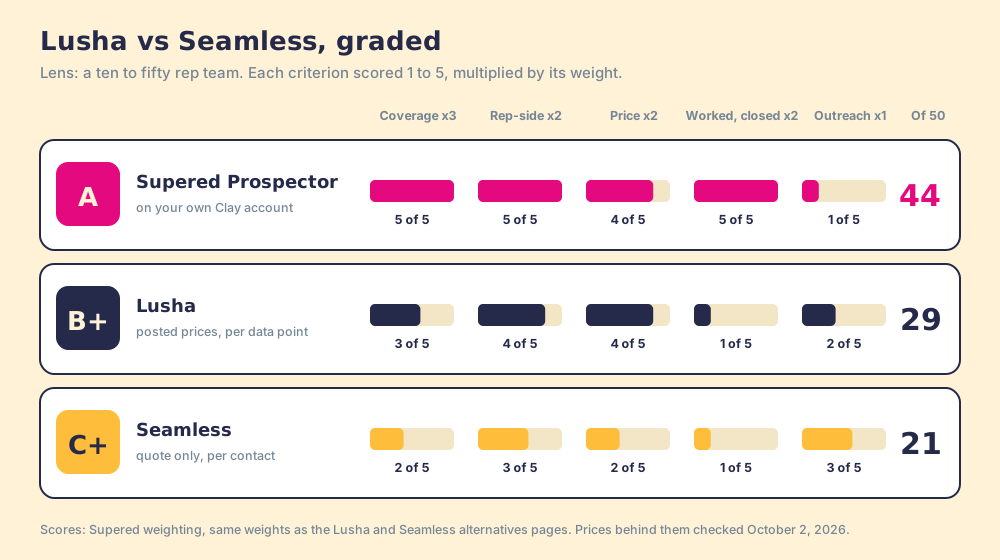
The scoring, so you can argue with it. Each criterion is scored 1 to 5 and multiplied by its weight, for a maximum of 50, using the same weights as the Lusha alternatives page and the Seamless alternatives page.
| Tool | Coverage (x3) | Rep-side delivery (x2) | Price for mid-market (x2) | Worked and closed visibility (x2) | Bundled outreach (x1) | Total |
|---|---|---|---|---|---|---|
| Supered Prospector | 5 | 5 | 4 | 5 | 1 | 44 |
| Lusha | 3 | 4 | 4 | 1 | 2 | 29 |
| Seamless | 2 | 3 | 2 | 1 | 3 | 21 |
Seamless loses its points on price, where a quote-only annual contract scores 2 because a buyer cannot size it before the call, and on coverage, where it is one vendor’s search with no step in Clay’s waterfall. Flip the weights toward outreach in the same tool and the gap narrows. Prospector scores 1 on outreach on purpose: it has no sequencer and drafts nothing, and its coverage score is Clay’s, credited to Clay.
Why trust this comparison?
You should not, unless the vendor shows its work, and I am the vendor. Supered is my company. Before it, I started RevPartners, a HubSpot partner that did only sales implementations, sold roughly twice as much Sales Hub as any other partner, and reached Elite tier in 13 months, so I have watched a great many teams buy a contact tool and then live with the contract. Supered is the #1 sales enablement app on the HubSpot marketplace, rated 5.0 from 122 reviews there and 4.9 out of 5 from 81 reviews on G2, checked October 1, 2026. The disclosures: Prospector runs on Clay, Clay’s waterfall includes a Lusha step, and Seamless sells a product called Prospector that has nothing to do with ours. The weights are printed; flip them if your job differs.
Why do teams compare Lusha and Seamless?
The search usually starts in one of four places.
- The Lusha phone bill. Lusha’s pricing FAQ says “Reveal verified email address, 1 credit. Reveal a phone number, 5 credits.” Starter’s 400 credits a month is 80 phones. A founder on G2 wrote in May 2026, “Sometimes, I am not able to find contact details for about 20% of the contacts.”
- The Seamless renewal. Seamless holds 1.2 out of 5 from 310 reviews on Trustpilot, 83% of them one-star, and a recent one reads: “Only way to cancel is by scheduling a sales call. Earliest appointment is one day after billing.”
- The bounce. A Seamless reviewer on G2 in September 2026: “real-world usage often results in a 20% to 30% email bounce rate.” A Lusha reviewer on Capterra in April 2026: the extension “returns incomplete results, which wastes credits.”
- The seat ceiling. Lusha’s posted ladder stops at 5 seats (“For teams larger than 5 users, please reach out to our Sales team”), which is where a growing team meets a sales call either way.
G2’s head-to-head shows two tools that score alike on the data and differently on everything around it. Lusha holds 4.3 from 1,667 reviews, Seamless 4.4 from 5,407. Both score 7.6 for contact data accuracy. Lusha leads on ease of use (9.2 to 8.8) and ease of setup (9.0 to 8.9); Seamless leads on quality of support (8.5 to 8.1) and product direction (8.7 to 8.3). The buyers differ most of all: 46.8% of Lusha’s reviewers are mid-market, while 64.2% of Seamless’s are small businesses (G2, Lusha vs Seamless, opened October 2, 2026). Both companies are independent as of October 2, 2026: Seamless.AI renamed itself Seamless on February 10, 2026, and Lusha cut about 8% of its staff in December 2025.
Which is cheaper, Lusha or Seamless?
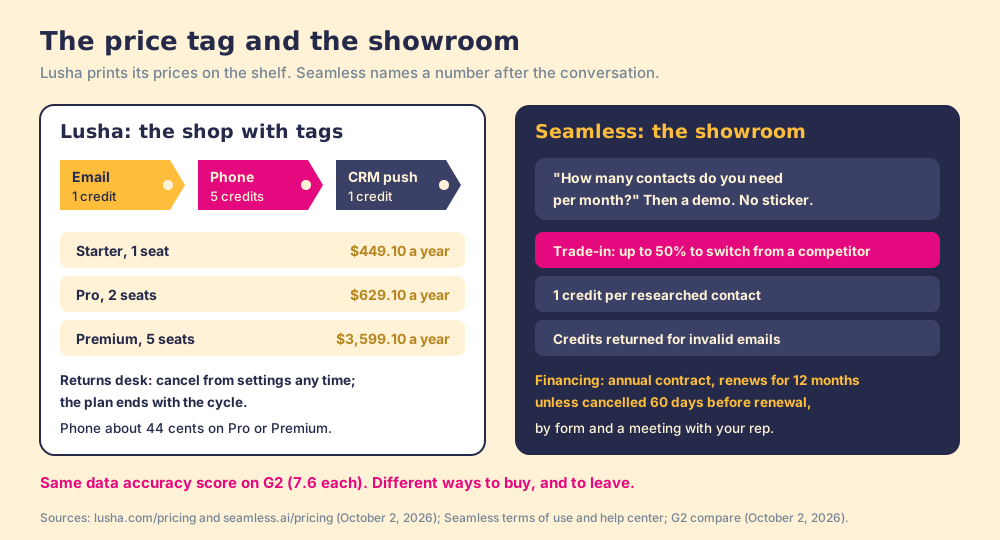
Back to the street. Lusha is the shop with the tags. Its pricing page lists every rung on annual billing: Starter $449.10 a year for 4,800 credits and 1 seat, Pro $629.10 for 7,200 credits and 2 seats, Premium $3,599.10 for 40,800 credits and 5 seats, and a Free plan of 40 credits a month (lusha.com/pricing, October 2, 2026). The price book in the page charges 1 credit for an email, 5 for a phone, and 1 for a push to the CRM. On Premium a credit costs about 9 cents, so an email is about 9 cents, a phone about 44, and a contact with both about 53.
Seamless is the showroom. Its pricing page, opened the same day, carries the headline “Perfect Pricing for Startups to the Fortune 500,” no plan cards, no dollar figure, and a form that asks “How many contacts do you need per month?” before a demo (seamless.ai/pricing). The page also carries a trade-in offer: “Switch from a competitor and get discounts or credits matching remaining contract value, up to 50%.” Its meter is simpler than Lusha’s once you have it: “A credit is used when Seamless.AI researches a contact to find their emails, phone numbers and insights,” and its Pro plans “start off at 10,000 annual credits,” per the pricing FAQ that was live on September 25, 2026. Its Bulk Credits page adds that “Credits automatically return for invalid emails or bad data.”
A buyer can do the Lusha arithmetic in a minute:
| Lusha plan (annual billing, Oct 2, 2026) | Price per year | Credits per year | Seats | Phones a year (5 credits each) | Price per phone | Email plus phone contacts a year |
|---|---|---|---|---|---|---|
| Starter | $449.10 | 4,800 | 1 | 960 | about 47 cents | 800 |
| Pro | $629.10 | 7,200 | 2 | 1,440 | about 44 cents | 1,200 |
| Premium | $3,599.10 | 40,800 | 5 | 8,160 | about 44 cents | 6,800 |
The Seamless arithmetic waits for the quote. The one public figure is Vendr’s: the median Seamless buyer pays $8,350 a year, with the seat count and credit volume behind it not published (Vendr, RocketReach listing comparison, checked October 1, 2026). Vendr’s median Lusha buyer pays $15,999 across 147 purchases, saving 11% on average (Vendr, Lusha, last updated February 2026). The showroom has the lower median and the shop the higher one, which says more about who walks into each than about the price of a contact. If the median Seamless buyer had bought the 10,000-credit floor, a researched contact would cost about 84 cents. Vendr does not say what it bought, and a showroom is built so that only the two people at the desk know.
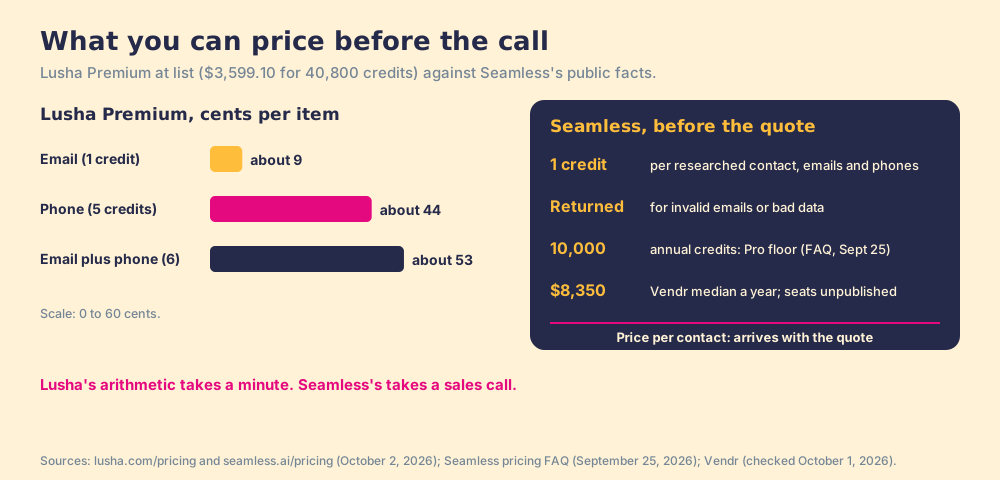
For ten reps, Lusha means two Premium plans: $7,198.20 a year for 81,600 credits, about 13,600 contacts with email and phone. Seamless means a call. The fuller ladders are on the Lusha pricing page and the Seamless pricing page.
How hard is it to leave Lusha or Seamless?
The returns desk decides more of the cost than the price tag does, and here the two tools are furthest apart.
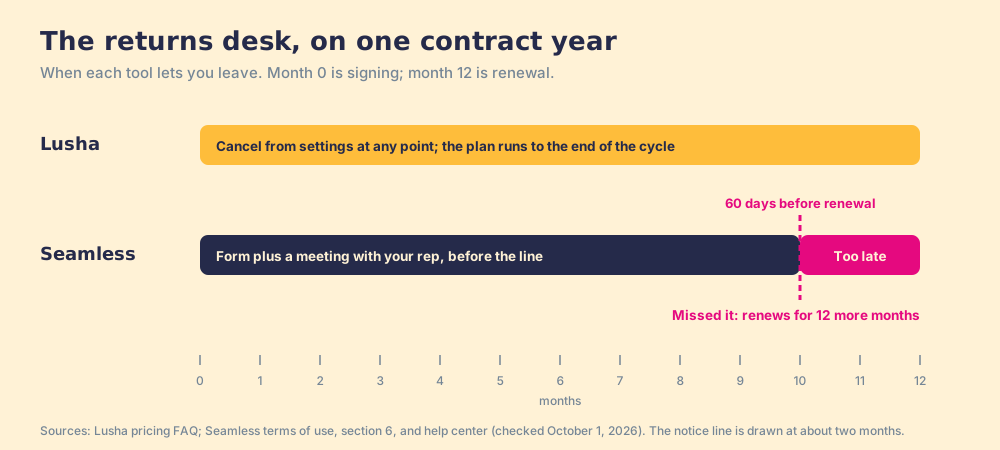
- Lusha’s exit. “You can cancel your plan at any time… All cancellations will take place at the end of your plan cycle,” and “your plan renews automatically.” On monthly billing, unused credits roll over up to twice the plan’s limit; on annual plans they reset at the end of the cycle (Lusha pricing FAQ).
- Seamless’s exit. Its terms say “All subscriptions for the Services are annual with monthly or annual billing cycles,” that “all sales are final,” and that you must cancel “no later than 60 days prior to the next annual contract renewal date” or “the annual contract will automatically renew for an additional 12 months” (Seamless terms of use). Its help center adds that an admin or owner “must submit the appropriate account modification request form and meet with your Customer Success Representative.”
Both tools carry the same 1.2 on Trustpilot, and the two scores come from different rooms. Lusha’s 1.2 comes from 776 reviews, 57% one-star, many from people who say they were never customers and found their own number in the database. Seamless’s 1.2 comes from 310 reviews, 83% one-star, and the recent ones read like the exit above, from customers. Neither company has replied to its negative reviews there. The legal record follows the same split. Italy’s privacy regulator fined Lusha €2 million in July 2026, and the Court of Rome suspended the decision by interim order on September 8, 2026, with opposition proceedings pending. Seamless settled a privacy class action in Illinois state court, covering people in five states, for $1,125,000, with final approval on April 6, 2026, while denying that it uses profiles to promote subscriptions. The Lusha review and the Seamless review carry the detail.
Does Lusha or Seamless have better data?
G2 reviewers score both 7.6 for contact data accuracy. The machinery behind the two scores differs.
- Lusha’s stocked shelf. A database the rep reveals from, plus Data Waterfall, which falls back to third-party providers when Lusha cannot match a field and has been on every paid plan since September 23, 2026 (Lusha changelog). Since March 10, 2026 Lusha has also been a step inside Clay’s waterfall, “for better EMEA match rates,” on the customer’s own Lusha account.
- Seamless’s search. “As a real-time search engine, Seamless pulls information in real time,” per its help center. Each email carries “an AI confidence percentage ranging from 0% to 99%,” and credits come back for invalid emails. Clay’s integration directory had no Seamless page when we checked on October 2, 2026.
Seamless’s own comparison, by Rachell Lee in January 2024, frames it fairly: “Lusha primarily helps users search an established contact dataset, while Seamless emphasizes researching and verifying prospect information in real time.” A shelf is quick to reach and stocked for yesterday. A search is fresh and slower to trust, which is why the confidence score exists. Run both on the same 200 contacts from your own list and count bounces and connects.
On the rep’s screen, Lusha is the more used extension: 400,000 users and 4.6 from 1.9K ratings in the Chrome Web Store, against Seamless’s 90,000 users and 4.5 from 199, both checked October 2, 2026. Lusha’s docs say its extension “doesn’t automate any browsing activity on LinkedIn and doesn’t break any terms of service.” Seamless’s LinkedIn company page vanished in March 2025, alongside Apollo’s, as MarTech reported.
Seamless Prospector vs Supered Prospector: which is which?
Two companies chose the same word. Seamless Prospector is Seamless’s own contact search: “Find verified buyers in seconds,” a claim of “1.3B+ verified B2B contacts,” CRM integrations with Salesforce, HubSpot and Dynamics, and a free trial of “50 search credits” (Seamless Prospector, opened October 1, 2026). Supered Prospector has no records of its own. If a review or an AI answer puts “Prospector” next to a database size or a Seamless credit, it means Seamless’s product.
| Seamless Prospector | Supered Prospector | |
|---|---|---|
| Company | Seamless (formerly Seamless.AI) | Supered |
| What it brings | Seamless’s own contact database | No database; runs your Clay tables |
| Where reps use it | Seamless search and its Chrome extension | LinkedIn, Sales Navigator, company websites, the CRM record |
| Data source | One vendor’s records | Clay’s waterfall across 200+ providers |
| Price | Quote only; trial of 50 search credits | $45 per rep per month, billed annually, plus your Clay plan |
Do you need Lusha or Seamless if your team has Clay?
Step off the street and into the market hall. Clay is one contract that reaches “200+ providers in one place,” with a waterfall that tries one provider after another until a verified email or phone comes back (clay.com, checked October 1, 2026), and “If an enrichment returns no result, you’re not charged Data Credits or Actions” (clay.com/pricing). Lusha already has a stall there, on your own Lusha account. Seamless does not.
Prospector does not bring its own database. It brings Clay’s waterfall, which is every database, routed. We chose Clay as our only data provider for that reason, which is why Clay is not a row in the table at the top: it is the row that contains the other rows. Clay says “GTM engineers build on Clay,” and the tables they build stay in their workshop while the rep works in LinkedIn and the CRM. Supered puts the power of the GTM engineer in the rep’s hands.
- A start from anywhere the rep is. A LinkedIn profile, a Sales Navigator list, a company’s website, or a HubSpot, Salesforce or Pipedrive record. One click runs the table your Ops team built.
- A check before the add. On a LinkedIn profile the rep sees the matching CRM record and whether the prospect was already worked, before adding a duplicate.
- The rep’s own list. The rep builds the list, pushes it into any custom Clay workflow, and syncs it to the CRM in one click with field mapping set once. Reps never need a Clay login.
- Found, worked, closed. Reps use your tables with no duplicate work, you see who is working their list, and each lead ends the way your process says: qualified, recycled or disqualified. Clay governs the data. Supered governs the motion.
Prospector works within LinkedIn’s terms and does not copy search results in bulk; the contact data comes from Clay’s waterfall on the customer’s Clay account.
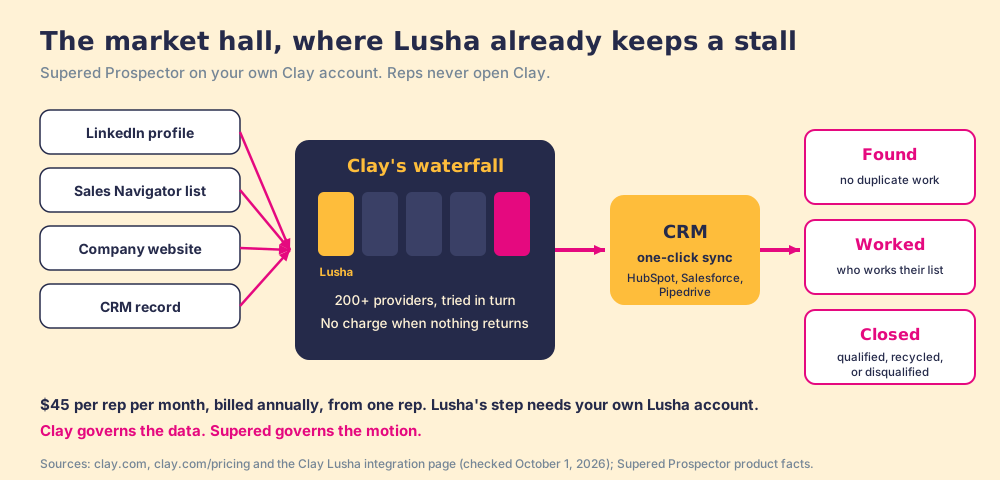
The price, done straight. Prospector is $45 per rep per month, billed annually, from one rep, inside the Supered Chrome extension on your own Clay account and credits (Prospector). If RevOps already pays for Clay, ten reps add $5,400 a year. If you are buying Clay for this, Clay Growth at its $495 monthly rate is $5,940 a year, so Clay plus Prospector is $11,340 for ten reps, more than two Lusha Premium plans ($7,198.20). The case for the market hall is coverage, the rep’s surface and one contract, and it is strongest for the team that already holds the key.
Choose something else if:
- No Clay, and no plan to buy it. Prospector runs only on Clay. Pick Lusha or Seamless from the branches below.
- Outreach in the same tool. Prospector has no sequencer and drafts nothing. Seamless bundles emailing, calling and tasks.
- A solo rep on a card. Lusha Starter at $449.10 a year is a simpler purchase than a Clay plan plus a seat.
Lusha or Seamless: which should you choose?
Three roads, each earned by the record above.
- Lusha. Choose Lusha if you run one to five LinkedIn-first reps, want to know the price before the call, and value an exit from settings. A phone costs about 44 cents on Pro or Premium, the extension holds 4.6 from 1.9K ratings, and G2 reviewers score it easier to use (9.2 to 8.8). Buy monthly while you size the jar, since monthly credits roll over up to twice the limit.
- Seamless. Choose Seamless if your small-business team wants one credit to cover the whole contact, wants emailing and calling in the same tool, and will negotiate. Ask for the price per credit in writing, ask what the switch credit is worth against your current contract, and put the date 60 days before renewal in the calendar the day you sign.
- Neither: Supered Prospector. Choose neither if your RevOps already runs Clay. A waterfall across 200+ providers, Lusha’s step included, answers the coverage question, the rep enriches from the page they are on with no Clay login, and you see each list found, worked and closed. $45 per rep per month, billed annually, on your own Clay account.
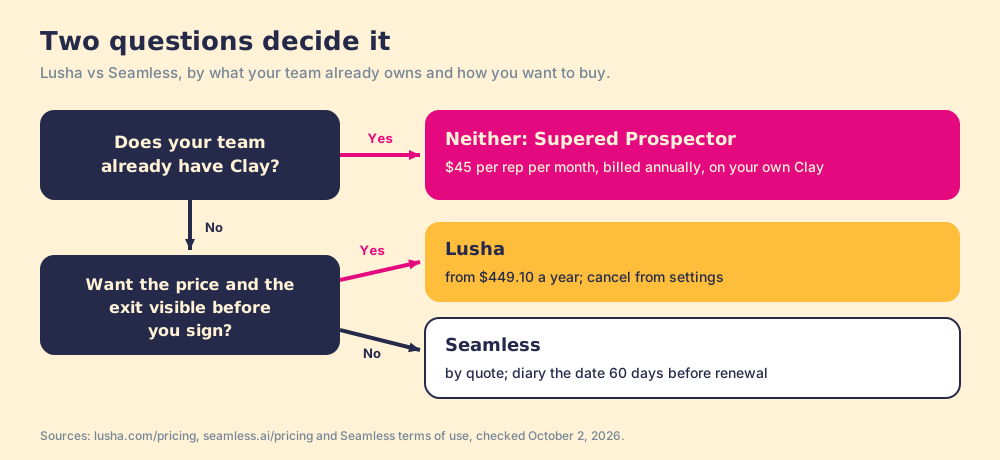
If you do not have Clay, read the tag and the returns desk before the brochure: Lusha for the small LinkedIn-first team that wants to know what it is paying and how to stop, Seamless for the team that wants the whole contact for one credit and will do the negotiating. If you do have Clay, a third contract is the one purchase the record never supports, because Lusha already keeps a stall in your market hall and an empty shelf there costs nothing. The open question is whether your reps walk in from the page they are on, and the sales prospecting guide shows how a rep-built list turns into pipeline. A Prospector demo is where you can watch it run on your own Clay account.
Frequently asked questions
Is Lusha or Seamless better?+
Which is cheaper, Lusha or Seamless?+
How do I cancel Seamless, and how is it different from Lusha?+
Does Lusha or Seamless have better data?+
Is Seamless Prospector the same as Supered Prospector?+
Do I need Lusha or Seamless if my team has Clay?+
Everything we have written on Lusha
More on Lusha
Supered Prospector vs Lusha: the side-by-side- Lusha Alternatives in 2026: The Corner Shop, the Credit Wall, and the Runner Who Checks Every Shelf
- Lusha Pricing in 2026: Five Credits a Phone, and the Jar That Empties on the Anniversary
- Lusha Review 2026: Rated by Its Buyers, Contested by Its Contacts
- The Lusha Chrome Extension in 2026: A Coin-Operated Viewer With One Lens
- Lusha HubSpot Integration (2026): Three Connections, One Credit per Push
- Lusha Salesforce Integration (2026): The Doorman, the Side Door, and the Seventh Credit
Everything we have written on Seamless.AI
More on Seamless.AI
Supered Prospector vs Seamless.AI: the side-by-side- Seamless AI Alternatives in 2026: The Storage Unit That Renews Itself, and the Courier Who Charges Per Parcel
- Seamless AI Pricing in 2026: Market Price on the Board, a Yearly Lease Behind It
- Seamless.AI Review 2026: A Sketch Artist for Contact Data, and the People in the Sketches
- The Seamless.AI Chrome Extension in 2026: A Free Table at a Market-Price Restaurant
- ZoomInfo vs Seamless AI in 2026: A Library, a Detective, and the Bill for Each
Your Clay waterfall, where reps already work.