Kaspr vs Lusha in 2026: Unlimited Texts or a Prepaid Card
Kaspr and Lusha charge almost the same for a phone number, about 49 and 47 cents at list. The difference is what an email costs and when your credits vanish. Kaspr vs Lusha priced from both pages on October 2, 2026, with the credit map that picks your plan.
Kaspr vs Lusha is a choice between two LinkedIn contact extensions that price a phone almost identically, Kaspr owned by Cognism with unlimited B2B emails and a monthly phone allowance, Lusha independent with one credit pool where an email costs 1 credit and a phone costs 5.
Kaspr vs Lusha is a choice between two LinkedIn contact extensions that price a phone almost identically, Kaspr owned by Cognism with unlimited B2B emails and a monthly phone allowance, Lusha independent with one credit pool where an email costs 1 credit and a phone costs 5. At list on October 2, 2026, a Kaspr phone costs about 49 cents and a Lusha phone about 47. The short answer, by who it fits:
- Supered Prospector. Teams whose RevOps already runs Clay. The GTM engineer’s Clay tables, Lusha’s step among 200+ providers, run by reps from Sales Navigator, a company site, or the CRM record. $45 per rep per month, billed annually.
- Kaspr. One to a dozen LinkedIn-first reps who reveal more emails than phones, especially in Europe. From $49 a user a month on annual billing.
- Lusha. The light user whose month fits in 400 credits, and the team that wants a vendor outside the Cognism group with a path into mid-market. From $449.10 a year.
Think of two mobile phone plans. Kaspr is the contract with unlimited texts and a fixed bundle of minutes. Send all the B2B emails you like, and you get 100 calls’ worth of phone numbers a month on Starter. Lusha is the prepaid card, with one balance where a text costs 1 unit, a call costs 5, and the card does not care which you spend it on. The per-minute price is nearly the same. Which plan is cheaper depends entirely on how much you text.
How do Kaspr and Lusha compare at a glance?
Prices are the plan that includes the job, opened on kaspr.io/pricing and lusha.com/pricing on October 2, 2026. Grades come from the weighted scoring below, on the lens of a five-to-fifty-rep sales team.
| Rank | Tool | Grade | Best fit | CRM integration | Setup effort | Price (plan with the feature) | Reason to switch |
|---|---|---|---|---|---|---|---|
| 1 | Supered Prospector (on your Clay) | A | Teams that already have Clay | Native in HubSpot, Salesforce and Pipedrive; one-click sync | Admin connects Clay inside Supered; the GTM engineer builds or picks the tables | $45/rep/mo billed annually, from 1 rep, plus your Clay plan | 200+ providers behind one button, and each list followed from found to closed |
| 2 | Lusha | B+ | Light users, and teams heading into mid-market | HubSpot, Salesforce, Pipedrive and more from the Free plan | Self-serve in minutes; G2 ease of setup 9.0 | Starter $449.10/yr (1 seat), Pro $629.10/yr (2 seats), Premium $3,599.10/yr (5 seats) | A step inside Clay’s waterfall, Data Waterfall on every paid plan, a posted ladder to 5 seats |
| 3 | Kaspr | B- | Email-heavy LinkedIn reps, European lists | HubSpot, Salesforce, Pipedrive, Zoho, Lemlist, Brevo | Self-serve in minutes; G2 ease of setup 9.0 | Starter $49/user/mo annual ($65 monthly); Business $79 ($99) | Unlimited B2B emails, the lowest price per phone on Business, Sales Navigator from Starter |
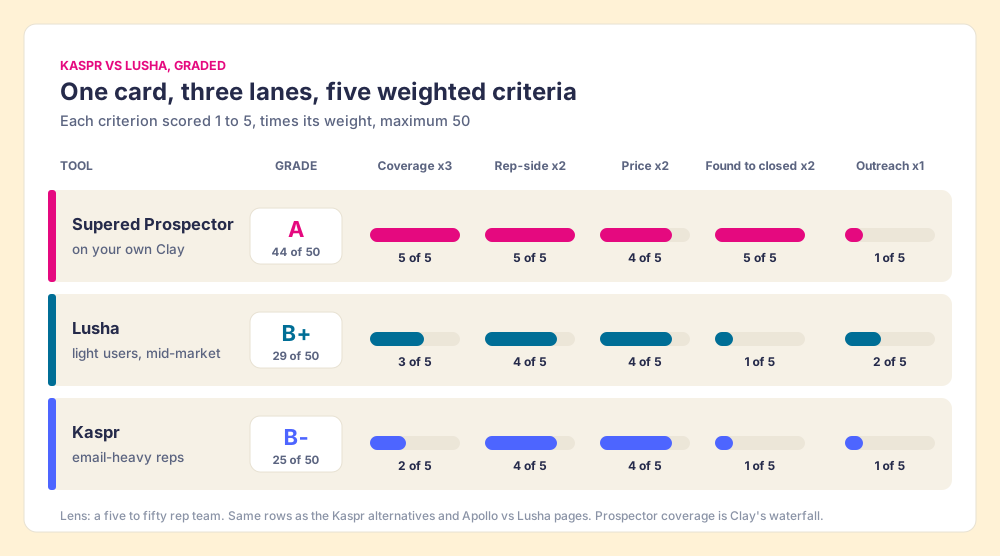
The scoring, so you can argue with it. Each criterion is scored 1 to 5 and multiplied by its weight, for a maximum of 50. The rows are the same ones on the Kaspr alternatives page and the Apollo vs Lusha page, so the pages read together.
| Tool | Coverage (x3) | Rep-side delivery (x2) | Price for the job (x2) | Found, worked, closed visibility (x2) | Bundled outreach (x1) | Total |
|---|---|---|---|---|---|---|
| Supered Prospector | 5 | 5 | 4 | 5 | 1 | 44 |
| Lusha | 3 | 4 | 4 | 1 | 2 | 29 |
| Kaspr | 2 | 4 | 4 | 1 | 1 | 25 |
Kaspr loses its points on coverage, and the evidence is thin but consistent: the one public benchmark below puts Kaspr’s email coverage under Lusha’s, and Kaspr’s own reviewers complain about landlines. Flip the weights toward email volume per dollar and Kaspr is first of the two. Prospector scores 1 on outreach on purpose: it has no sequencer and drafts nothing. Its coverage score belongs to Clay.
Why trust this comparison?
You should not, unless the vendor shows its work, and I am a vendor. Supered is my company. Before it, I started RevPartners, a HubSpot partner that did only sales implementations, sold roughly twice as much Sales Hub as any other partner, and reached Elite tier in 13 months, so I have watched reps at client after client choose between extensions and seen which ones they still used after week three. Supered holds 4.9 out of 5 from 81 reviews on G2 and 5.0 from 122 on the HubSpot App Marketplace (October 1, 2026). The disclosure that matters: Prospector runs on Clay, and Clay’s waterfall can include Lusha, so I have a reason to like one vendor on this page more than the other. The grades show their weights, and the price section favors Kaspr for any rep who reveals emails, because the arithmetic does.
Why do teams compare Kaspr and Lusha?
The two extensions look alike in the Chrome Web Store, and the store numbers are close. Kaspr: 100,000 users, 4.7 from 1.2K ratings, last updated June 15, 2026. Lusha: 400,000 users, 4.6 from 1.9K ratings, last updated September 2, 2026 (Chrome Web Store, October 2, 2026). G2’s head-to-head is closer still: Kaspr 4.4 from 837 reviews, Lusha 4.3 from 1,665, with ease of use tied at 9.2, ease of setup tied at 9.0, and quality of support 8.6 to 8.1 in Kaspr’s favor (G2, Kaspr vs Lusha, read October 2, 2026).
Where they part is who buys them. On that same G2 page 69.1% of Kaspr’s reviewers are small businesses and 23.7% mid-market; Lusha’s are 39.6% small business and 46.8% mid-market. Same product shape, different customers.
And the complaints, in reviewers’ words, are the same complaint seen from two meters.
- The Kaspr phone that is a landline. A small-business reviewer, July 2025: “Sometimes the phone number data isn’t available or only includes landlines.” A mid-market account manager, December 2025: “the credit system depletes rapidly when engaging in high volume sourcing.”
- The Lusha credit that buys nothing. A customer success manager, December 2025, on Lusha feeling “limiting for high-volume outbound teams, particularly when an ‘unverified’ number still uses up a credit.” A founder, May 2026: “Sometimes, I am not able to find contact details for about 20% of the contacts.”
(G2 review snippets read via a page summary, October 1, 2026.) One meter runs out of minutes, the other runs out of balance, and both sometimes hand you a number that does not ring the person.
Which is cheaper, Kaspr or Lusha?
Start with the minutes, since the phone is the thing reps buy these tools for.
Kaspr Starter is $49 per user per month billed annually, or $65 monthly, and includes 100 phone credits a month, 1,200 a year, plus “Unlimited B2B email credits” (kaspr.io/pricing, October 2, 2026). A year is $588, so a phone costs about 49 cents. Business is $79 annually or $99 monthly for 200 phones and 200 direct (personal) emails a month; $948 a year, about 40 cents a phone.
Lusha Starter is $449.10 a year billed yearly ($37.45 a month) for 4,800 credits, or $49.90 a month for 400 credits on monthly billing. Its FAQ prices the reveal: “Reveal verified email address, 1 credit. Reveal a phone number, 5 credits” (lusha.com/pricing, October 2, 2026). Spend all 4,800 on phones and you get 960, about 47 cents each. Premium, $3,599.10 a year for 40,800 credits and 5 seats, works out to about 44 cents a phone.
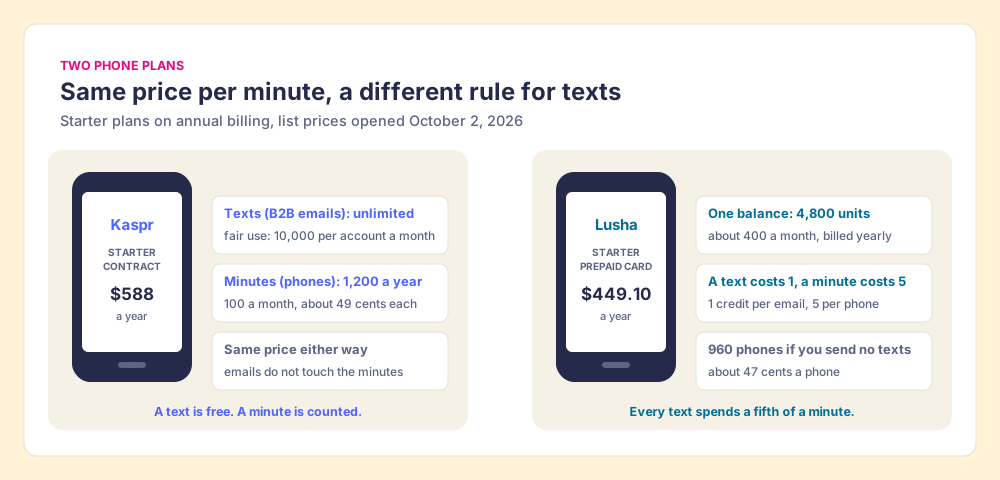
Two cents apart. The phone is a wash. The email decides it.
On Lusha, each email a rep reveals is a fifth of a phone gone. On Kaspr, it is free until the fair-use line. So the fair way to compare the two Starter plans is to ask what a rep’s month looks like, and draw it.
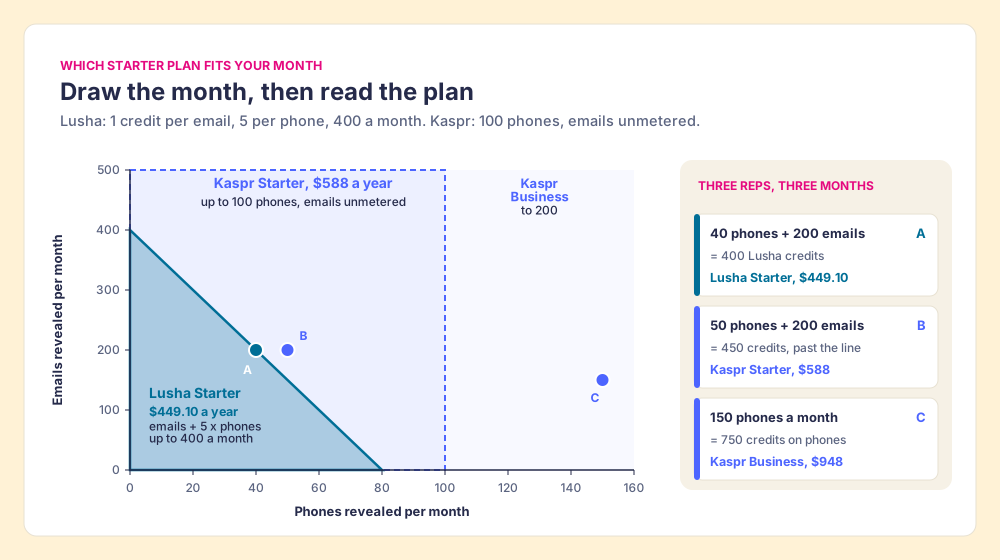
Three reps, three months:
- The light user. 40 phones and 200 emails a month is exactly 400 Lusha credits. Lusha Starter covers it for $449.10 a year, $138.90 less than Kaspr Starter.
- The email-heavy rep. 50 phones and 200 emails is 450 credits, 5,400 a year, past Lusha Starter. The next Lusha rung is Pro at $629.10 for 7,200 credits (2 seats). Kaspr Starter covers the same month for $588.
- The caller. 150 phones a month is 750 Lusha credits on phones alone, 9,000 a year, past Pro. Kaspr Business covers 200 phones a month for $948 a year, and the emails still cost nothing.
Then a team. Five reps who each reveal 200 B2B emails a month spend 12,000 Lusha credits a year on email. Lusha Premium’s 40,800 credits leave 28,800, which is 5,760 phones for $3,599.10, about 62 cents each. Five Kaspr Starter seats cost $2,940 for 6,000 phones with the same emails included, about 49 cents. Five Kaspr Business seats cost $4,740 for 12,000 phones and 12,000 direct emails, about 40 cents. With no emails at all, Lusha Premium’s 8,160 phones cost about 44 cents, and the gap narrows to a few cents.
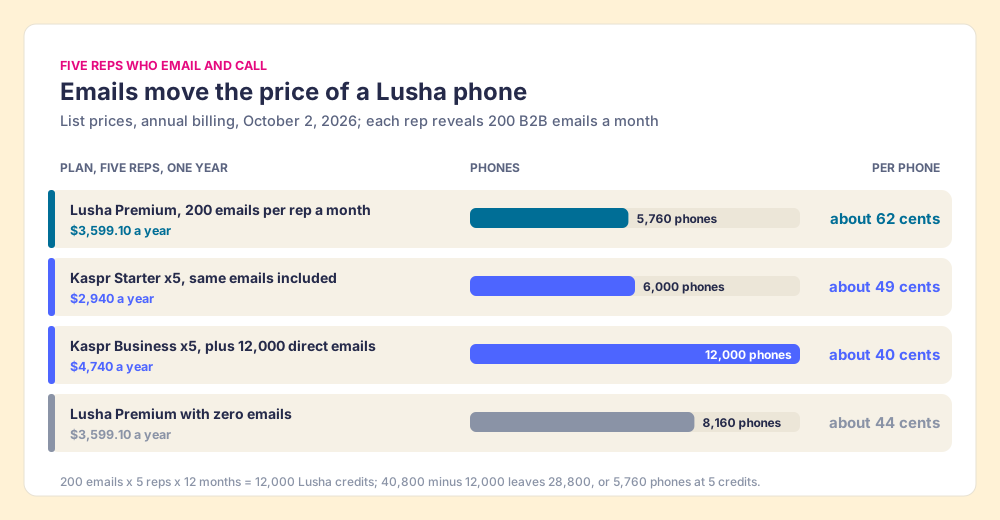
So for a team that both emails and calls, Kaspr is the cheaper plan on list price, at every size the two posted ladders cover. Contracts do not follow list prices once a team grows: Vendr’s median Lusha buyer pays $15,999 a year across 147 purchases, in a range from $6,000 to $70,403 (Vendr, Lusha, last updated February 2026); Vendr’s Kaspr page publishes no contract data (October 2, 2026), so there is no like-for-like median to set against it. The fuller ladders, monthly billing included, are on the Lusha pricing page and the Kaspr pricing page.
What does the fine print say about credits?
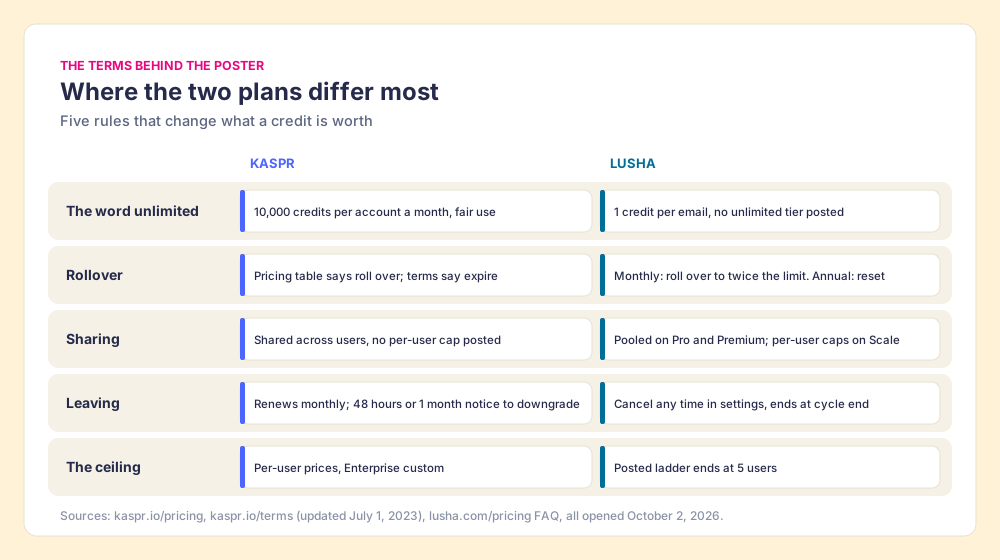
A phone contract has two prices: the one on the poster and the one in the terms. Kaspr and Lusha differ more in the second than the first.
- The word “unlimited.” Kaspr’s terms (last updated July 1, 2023) say unlimited credits “must be used reasonably by the User, and that a maximum limit of 10,000 credits per account per month applies. Any use of Unlimited Credits through APIs or robots is considered as abusive” (kaspr.io/terms, October 2, 2026). The terms do not say whether “account” means one user or the company’s whole workspace. For a single rep 10,000 emails a month is far beyond need; for a 25-rep team sharing one account it would be 400 each. Ask Kaspr which it means.
- Rollover. Lusha’s FAQ says that on monthly plans “your unused credits will roll over and accumulate up to twice the credit limit”; on annual plans “Any unused credits will be reset at the end of the annual cycle.” Kaspr’s pricing table says “Unused monthly credits roll over to the next month,” and its terms say “Credits expire at the end of the current Subscription period and cannot be carried over to the next Subscription.” On an annual Kaspr plan the two read together: monthly credits roll inside the year and expire at its end. On a monthly Kaspr plan they disagree. Lusha rewards the monthly buyer; Kaspr’s rule favors the annual one.
- Sharing. Kaspr says “All users in your account can use the available credits collectively, without restrictions per user.” Lusha: Pro and Premium pool credits across their 2 and 5 seats, and “Can I limit credit usage per user? Yes, this feature is available in our Scale plans.” Neither gives a manager a posted per-rep cap below their top tier.
- Leaving. Lusha lets you cancel “at any time” from account settings, effective at the end of the plan cycle. Kaspr: “Our subscriptions automatically renew monthly,” and a downgrade needs notice “At least 48 (forty-eight) hours before the end of the monthly Subscription; 1 (one) month before the end of the annual Subscription.”
- The ceiling. Lusha says “For teams larger than 5 users, please reach out to our Sales team.” Kaspr posts per-user prices with no stated cap, and lists Enterprise as custom, with intent data and SSO.
Is Lusha’s or Kaspr’s data better?
Neither publishes an independent audit, and both make large claims. Kaspr’s data page promises “Unlock 200 million + European B2B contacts,” “Powered by 120+ verified data sources and providers” (kaspr.io/our-data, October 1, 2026). Lusha’s Chrome Web Store listing advertises its own accuracy figures, and since September 23, 2026 its changelog says “Data Waterfall was previously limited to Pro plans and above. It is now available on every paid plan” (Lusha changelog), meaning Lusha falls back to third-party providers when its own data misses a field. Both vendors already run a small waterfall behind the counter. Kaspr says 120+ sources; Lusha says it asks other providers.
The one outside test I can find is an email-only benchmark of 500 contacts with known addresses, run in May 2026 by b2b-email-finder.com, an anonymous review site that ranks a different tool first, so read it as one data point. Lusha found 69.8% of the emails with 86.1% accuracy; Kaspr found 61.3% with 80.1% accuracy. The finding that matters more than the gap: “No single tool exceeded 89% coverage,” while a three-tool waterfall reached 94.2% (b2b-email-finder.com, published June 8, 2026). Lusha ahead by about eight points, and both of them missing three or four emails in ten.
Geography tilts it further. Kaspr is a Paris company (KASPR SAS, per its terms) that sells its European coverage first. Clay added Lusha to its marketplace in March 2026 with the line “Add Lusha as a step in your existing contact enrichment waterfall for better EMEA match rates” (Clay changelog). Both are bets on Europe. The practical test is cheap. Start on both free plans, small as they are (Lusha Free is 40 credits a month, Kaspr Free 5 phones and 15 emails), then buy one monthly Starter of each and run the same 200 contacts from your own target list through both. Count the numbers that ring the right person, and ignore the ones that ring a switchboard.
Who owns Kaspr and Lusha, and why does it matter?
Kaspr’s about page says “Kaspr is part of Cognism,” “We joined Cognism in 2022,” “50K+ Companies using Kaspr,” and “Kaspr is a prospecting tool for individual contributors and SMBs” (kaspr.io/about-us, October 1, 2026). Cognism sells quote-only, with a Vendr median contract of $32,750 a year across 94 purchases. So Kaspr is the ground floor of a building whose upper floors are Cognism, and the natural upgrade for a team that outgrows Kaspr is upstairs. That is a fine path if you want it, and worth knowing before you negotiate, since you are talking to one owner either way. Lusha vs Cognism covers the upstairs.
Lusha is independent, with Lusha Systems Inc. of Boston on its pricing page footer. It cut about 8% of staff in December 2025 (Calcalist), became a Clay marketplace step on March 10, 2026, and opened Data Waterfall to every paid plan on September 23, 2026. A web search on October 2, 2026 found no acquisition or new funding for either company. For a fuller read of Lusha on its own, see the Lusha review.
Lusha vs Kaspr for a team on Clay
Here the two plans stop being the only choice. Clay is not a third phone plan. It is closer to the network the plans resell minutes from, with one contract, “200+ providers in one place,” and a waterfall that asks one provider after another until a verified email or phone comes back (clay.com, October 2, 2026). “Clay’s signature data waterfalls check multiple providers to return the most verified emails (lower bounce rate) and phone numbers (higher connect rate).” And it carries a rule neither extension offers across vendors. “If an enrichment returns no result, you’re not charged Data Credits or Actions” (clay.com/pricing).
The two vendors sit in different places on that network. Lusha is a listed step. Clay’s Lusha page shows “Joined in Mar 10, 2026,” with “Enrich Person with Lusha” marked “Bring Your Own Account Required” (Clay, Lusha integration, October 2, 2026). Kaspr is not on it; clay.com/integrations/data-provider/kaspr returned a 404 on the same day. So a Clay team that likes Lusha’s European hit rate can keep a Lusha account and add it as one step among 200+. A team that likes Kaspr keeps a separate extension, a separate contract, and a separate meter.
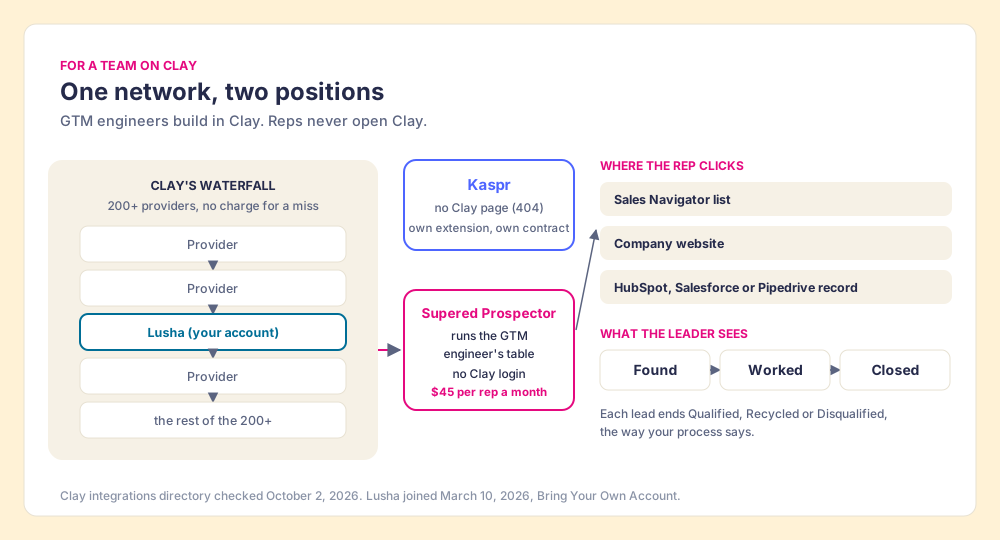
The network has one problem, and Clay names it in its own copy, “GTM engineers build on Clay.” The tables live in the GTM engineer’s workshop. The reps live in Sales Navigator and the CRM, and they keep asking for Kaspr or Lusha seats because a button in the browser is the only way they know to get a number. Clay plus Supered is the best way for a sales team to prospect: GTM engineers build in Clay, reps never open Clay. Prospector runs inside the Supered Chrome extension on the team’s own Clay account.
- The GTM engineer’s table as a button. The GTM engineer builds named flows once (person enrichment, buying committee) and reps pick one from a Push menu in Sales Navigator, on a company’s website, or in a HubSpot, Salesforce or Pipedrive record. The waterfalls, tiers and tags stay the GTM engineer’s. Start from the Supered Clay template or bring your own tables. The GTM engineer stops being the list desk.
- Sales Navigator lists into Clay. Reps add Navigator leads to a prospect list and push the list to a Clay table. Prospector works within LinkedIn’s terms and does not copy search results in bulk; the contact data comes from Clay’s waterfall on the customer’s Clay account. Ask every vendor what it reads on LinkedIn, ours included.
- A check before the push. The rep sees the matching CRM record, who owns it, and a flag when the prospect was already worked, so two reps do not chase the same person.
- Found, worked, closed. The leader sees every list found from the team’s tables, who is working their list and who is not, and how each lead ended: Qualified, Recycled, or Disqualified, the way your process says. That view is also how the Clay budget grows.
The price, done straight. Prospector is $45 per rep per month, billed annually, from one rep, on your own Clay account and Clay credits (Prospector). Ten Prospector seats cost $5,400 a year; ten Kaspr Starter seats cost $5,880. That compares seats only: the phones on Clay come out of your Clay data credits, which on our reading of Clay’s calculator run roughly six credits for an email plus a phone, about 50 cents a contact on Growth, a supposition explained on the Clay pricing page. If you are buying Clay for this, Growth at its $495 monthly rate is $5,940 a year, so Clay plus ten Prospector seats is $11,340, more than ten Kaspr Starter seats. The case for the network is coverage, a miss that costs nothing, the rep’s own screen, and a leader who can follow the list. It is strongest for the team that already pays for Clay: skip the extra seats and get more out of the Clay you already have.
Choose something else if:
- No Clay, and no plan to buy it. Prospector runs only on Clay. Pick Kaspr or Lusha from the branches below. If you want Clay built for you, RevPartners, the company I founded, is a Clay Elite Studio Partner that builds and tunes the tables.
- A solo rep on a card. Kaspr Starter or Lusha Starter is a simpler purchase than a Clay plan plus a seat.
- Outreach in the same tool. Prospector has no sequencer and no dialer; it sends to the one you run.
- A field or mobile-first team. Supered runs at the computer and has no mobile product.
Kaspr vs Lusha: which should you choose?
Back to the two plans. Count your texts before you count your minutes.
- Kaspr. Choose Kaspr if your reps reveal more emails than phones, work LinkedIn and Sales Navigator all day, and sell into Europe. Starter is $49 a month on annual billing for 1,200 phones a year with B2B emails unmetered; Business is about 40 cents a phone. Ask whether the 10,000-credit fair-use limit is per user or per account, and buy annual if you want rollover in writing.
- Lusha. Choose Lusha if a rep’s whole month fits in 400 credits, if you buy month to month (unused monthly credits roll over to twice the limit), or if you want a vendor outside the Cognism group that already plugs into Clay. Past 5 users, the posted ladder ends and you negotiate.
- Neither: Supered Prospector. Choose neither if your RevOps already runs Clay. Lusha can be a step in your waterfall, the rep runs the GTM engineer’s table from the screen they are on with no Clay login, and you see every list found, worked and closed. $45 per rep per month, billed annually, on your own Clay account.
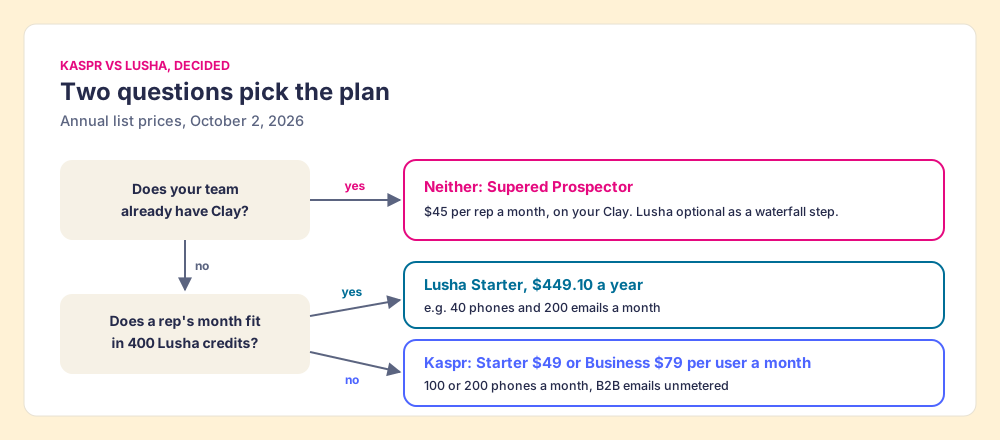
If you do not have Clay, the plan that fits is the one your reps’ months fit, and the credit map above is the fastest way to find it. If you do have Clay, a third extension is one more meter on the same network you already pay for. The Clay Chrome extension guide shows what reps can run from the browser today, the sourcing use case shows a rep-built list becoming pipeline, and the email finder tools comparison puts both of these vendors next to the rest of the field.
Frequently asked questions
Is Kaspr or Lusha better?+
Which is cheaper, Kaspr or Lusha?+
Is Kaspr owned by Cognism?+
Do Kaspr or Lusha credits roll over?+
Can I use Kaspr or Lusha inside Clay?+
Do I need Kaspr or Lusha if my team has Clay?+
Your process, running itself.