Lusha Pricing in 2026: Five Credits a Phone, and the Jar That Empties on the Anniversary
Lusha's prices render only in a browser, so here they are as captured: five plans, one credit per email, five per phone, the monthly-versus-yearly ladder, the Vendr median, and when a per-seat plan beats a platform fee.
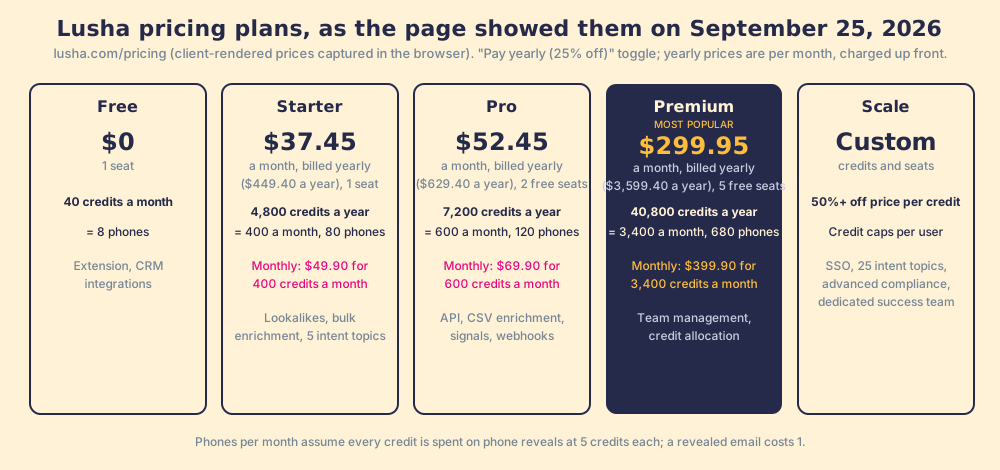
Lusha pricing in 2026 is a five-plan credit ladder: Free (40 credits a month), Starter ($37.45 a month billed yearly for 4,800 credits a year), Pro ($52.45, 7,200), Premium ($299.95, 40,800) and a custom Scale plan, with one credit per email and five per phone.
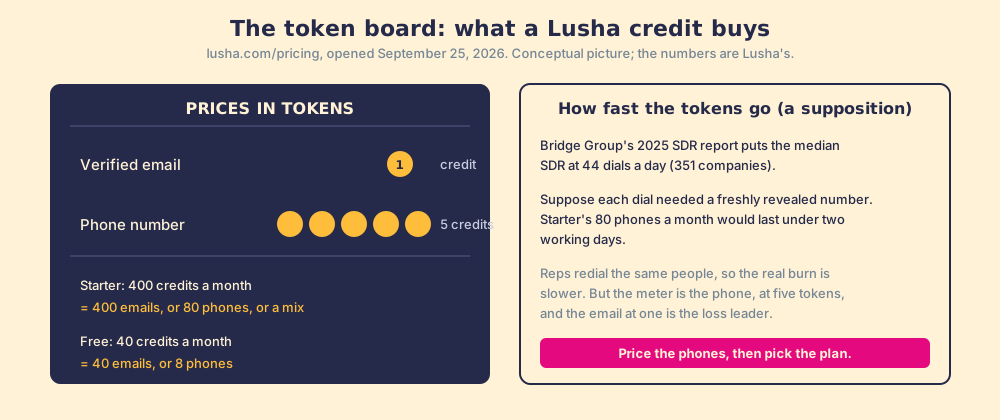
An arcade never sells you a game. It sells you tokens, at the counter, in a roll, and the prices are posted on the machines in a currency you no longer think of as money. The racing game you came for costs five. The claw machine costs one, and no one came for the claw machine. By the time the roll is gone you have played a great deal of claw. Lusha’s pricing page, opened in a browser on September 25, 2026 because its prices do not render any other way, is a token board: “Reveal verified email address, 1 credit. Reveal a phone number, 5 credits” (lusha.com/pricing). The email is the claw machine. The phone is the game you came for.
Lusha pricing in 2026 is a five-plan credit ladder: Free (40 credits a month), Starter ($37.45 a month billed yearly for 4,800 credits a year), Pro ($52.45, 7,200), Premium ($299.95, 40,800) and a custom Scale plan, with one credit per email and five per phone. Vendr’s marketplace listing for Lusha puts the median contract at $15,999 a year across 147 purchases, with buyers saving 11% on average, in a range from $6,000 to $70,403 (Vendr, Lusha, last updated February 2026). The rest of this page does the token arithmetic the board leaves to you, shows where the yearly price moved between July and September, says plainly when Lusha’s per-seat plan beats a platform fee like Cognism’s, and ends with the one path where you can buy the same Lusha data per result instead of per seat.
| Lusha pricing at a glance (September 25, 2026) | Yearly billing (shown per month) | Monthly billing | Credits | Seats |
|---|---|---|---|---|
| Free | $0 | $0 | 40 a month | 1 |
| Starter | $37.45 ($449.40 a year) | $49.90 | 4,800 a year / 400 a month | 1 |
| Pro | $52.45 ($629.40 a year) | $69.90 | 7,200 a year / 600 a month | 2 free |
| Premium (“Most popular”) | $299.95 ($3,599.40 a year) | $399.90 | 40,800 a year / 3,400 a month | 5 free |
| Scale | Custom | Custom | Custom, “50%+ off price per credit” | Custom |
Credit rates: 1 per email, 5 per phone (Lusha FAQ). Vendr median contract: $15,999 a year, 147 purchases, 11% average savings.
How much does Lusha cost in 2026?
If you searched “Lusha cost” or “Lusha pricing plans,” the numbers above are the answer and they carry one caveat: they are what the page rendered in a browser on the date given. Secondary pricing guides print stale copies. Vendr’s own tier text, for instance, still describes a Pro plan at “$29 to $49 per user per month” with “480 to 1,200+ credits per year” and a Free tier of about 5 credits a month, none of which matches the page today, so cite Lusha for the mechanics and Vendr for what buyers pay.
- The five plans. Free gives 40 credits a month and the extension. Starter adds lookalikes, bulk enrichment, an AI assistant, and 5 buying-intent topics. Pro adds 2 free seats, API access, CSV enrichment, signals, and webhooks. Premium, marked most popular, adds 5 free seats, team management, and credit allocation. Scale is custom, with “50%+ off price per credit,” SSO, 25 intent topics, and per-user credit caps. The FAQ sends teams larger than 5 users to sales.
- The two bills. The yearly price is a per-month figure charged up front: Starter $449.40, Pro $629.40, Premium $3,599.40. Monthly billing runs $49.90, $69.90, and $399.90, and the toggle labels the gap “25% off.”
- The credits behind the price. Yearly plans grant the year’s credits at once: 4,800, 7,200, 40,800. Monthly plans grant 400, 600, or 3,400 a month.
- What buyers pay. Vendr’s median of $15,999 sits far above any self-serve list price, which tells you the median buyer is on Scale. Its listing describes Scale as starting around $10,000 to $25,000 a year for 20 or more seats, and notes renewal escalators of 5% to 10%.
Corporate status, checked the same day: Lusha Systems Inc. lists a Boston address in its page footer, is independent and venture-backed, and in December 2025 cut about 8% of its staff, roughly 24 people, in a restructuring it described as a shift of resources to new growth engines (Calcalist). On March 10, 2026 it joined Clay’s marketplace as an enrichment step, which matters later on this page (Clay changelog). No 2026 acquisition or funding round turned up.
How do Lusha credits work, and where is the trap?
The rate is posted in plain sight: five credits a phone. The trap is the roll. The plan sells you a count of tokens, and the count only means something once you know which machine you will be playing.
Do the Starter arithmetic. 400 credits a month is 400 emails, or 80 phones, or some mix, and the Free plan’s 40 credits is 8 phones. The Bridge Group’s 2025 SDR report, 351 companies, puts the median SDR at 44 dials a day (Bridge Group, 2025). Suppose, for the sake of the arithmetic, that each dial needed a freshly revealed number: Starter’s 80 phones would be gone before the end of the second working day. Reps redial the same people, so the real burn is slower, but the direction is the point. A plan described as “400 credits” is, for a phone-first rep, an 80-phone plan, and the 400 is the claw machine talking.
Now the two jars, because the second half of the trap is where the unused tokens go. Lusha’s FAQ describes two rules. On a monthly plan, “your unused credits will roll over and accumulate up to twice the credit limit according to your plan,” so a 400-credit month can hold at most 800. On an annual plan, “you will get all your credits up front. Any unused credits will be reset at the end of the annual cycle.” The annual jar is cheaper per credit by the 25% the toggle advertises, and it is emptied by the vendor on the anniversary. Which jar is right is a forecasting question, and the person who can answer it is the one who knows how many phones the team revealed last quarter, per rep. If no one knows that number, the monthly jar is the cheaper mistake.
How does Lusha pricing change between monthly and yearly billing?
The yearly column is the one the page leads with, and it moved. Secondary sources recorded the yearly prices in July 2026 as Starter $37.45, Pro $45.45 and Premium $259.95 a month. On September 25 the page shows Starter $37.45, Pro $52.45 and Premium $299.95, against monthly prices of $49.90, $69.90 and $399.90. So Pro and Premium rose between July and September while Starter held, and the monthly column sits above all of them as the anchor that makes the yearly number read as a bargain.
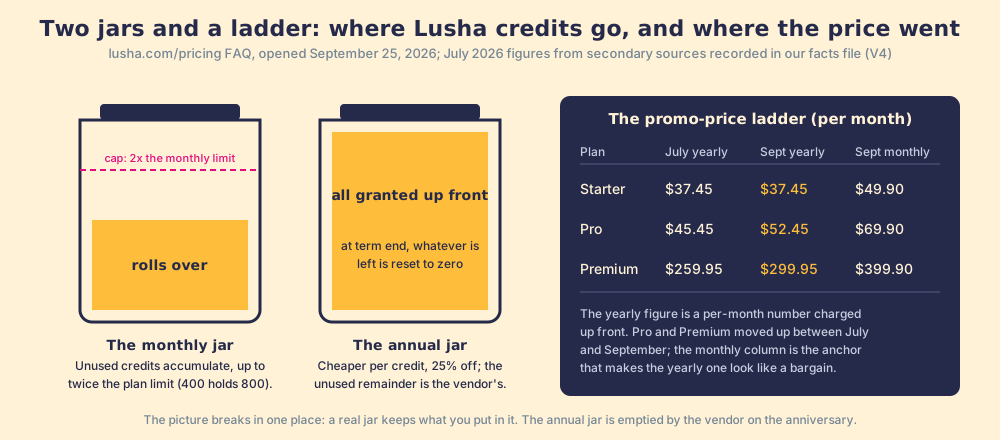
None of this is sharp practice; a promotional yearly price beside a higher monthly one is how self-serve software is sold, and the 25% is real if you use the credits. The teach is narrower: the yearly figure is a per-month number you pay twelve times at once, for a jar that resets, so the discount is a discount on the credits you spend. Vendr’s listing gives Scale buyers the contract-side version: overage rates “often higher than the effective per-credit cost in your base plan,” renewal clauses with 5% to 10% annual increases, and the advice to fix the overage rate and a rollover term before signing.
When does Lusha’s per-seat simplicity beat a platform fee?
A season ticket and a turnstile are both fair ways to pay for the same stadium. The season ticket is a flat number for a seat, and it is the better deal for the person who goes to every match. The turnstile charges per visit and is the better deal for the person who does not know how often they will come. A platform fee is a season ticket with a stadium hire on top; Lusha’s ladder is a rack of season tickets in five sizes, with tokens for the concessions.
Be fair to the ladder first. Vendr’s Cognism listing, opened the same day, carries a buyer note reporting a 30% cut to Cognism’s Diamond price won by naming Lusha as the incumbent, and another reporting 32% off a new Cognism purchase with Lusha as the alternative. Vendr’s Lusha page prints its own 10-user comparison: Lusha at about $10,000 to $20,000 a year, Cognism at about $15,000 to $35,000 with no self-serve tier. And the two Vendr medians are $15,999 for Lusha on 147 purchases and $32,750 for Cognism on 94, with the floor of Cognism’s range, $16,585, sitting above four Lusha Premium plans laid end to end. On G2’s Europe Regional Grid for Autumn 2026, as published by Cognism, Lusha scored 58 on 264 European reviews to Cognism’s 88 on 759, so the gap in price is matched by a gap in European satisfaction, and a buyer choosing between them is choosing a lane before a price (Cognism newsroom, September 2026).
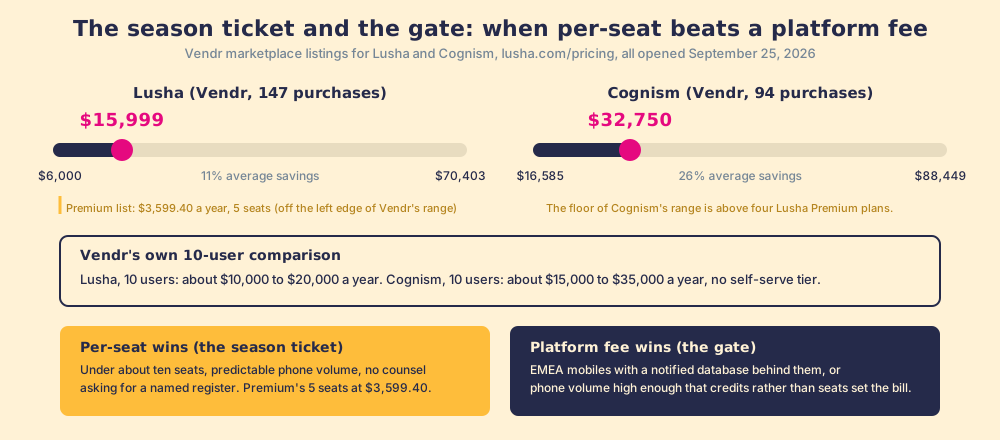
So the branch, plainly. The per-seat ladder wins when the team is under about ten seats, the phone volume is predictable enough to size the jar, and no counsel is asking for a named Do Not Call register behind each mobile: five seats on Premium at $3,599.40 a year is a price a founder can put on a card, and Lusha’s own FAQ says the plan cancels from account settings at the end of the cycle. The platform fee wins when the reps dial EMEA and the DPO wants Cognism’s notified database, or when phone volume is high enough that credits rather than seats set the bill, at which point you are a Scale buyer, the list price is gone, and the Vendr median is your budget. Vendr’s 11% average savings on Lusha against Cognism’s 26% is the price of simplicity: a published ladder leaves less room to haggle. The Cognism pricing page decodes the other side of that branch; Apollo’s published seats, at $49 to $119 with 8 credits per phone, are the third lane.
What happens after the reveal, and what does one contract cost?
Look at what all five plans have in common. The meter sits at the reveal: five tokens, the number appears, the counter moves. After that, Lusha records nothing, which is fair, because its job ends there. Yours does not. Across 198 sales teams in The State of Sales Enablement, 89% had a defined sales process and 36% saw reps run it as designed, and the teams that inspected adherence consistently hit quota at 6.3 times the rate of those that did not. A phone revealed for five credits and never dialed costs the same as one that closed. You can only expect what you inspect, and in prospecting the reveal is the one step that comes with a receipt.
There is a second way to buy the same Lusha data, and it changes both the price and what gets counted. Since March 10, 2026, Lusha has been an enrichment step inside Clay: “Add Lusha as a step in your existing contact enrichment waterfall for better EMEA match rates,” Clay’s changelog says, alongside Lusha lookalikes and signals. Clay’s waterfall asks provider after provider across 200+ vendors under one contract (clay.com, September 25, 2026), its Growth plan lists at $495 a month, or $5,940 a year, and its pricing page states the rule that turns tokens into a meter that only runs when the machine pays out: “If an enrichment returns no result, you’re not charged Data Credits or Actions” (clay.com/pricing). A Lusha seat charges five for the phone whether Lusha had it or not, once the reveal is made; in the waterfall, Lusha is one step, and the step that misses costs nothing.
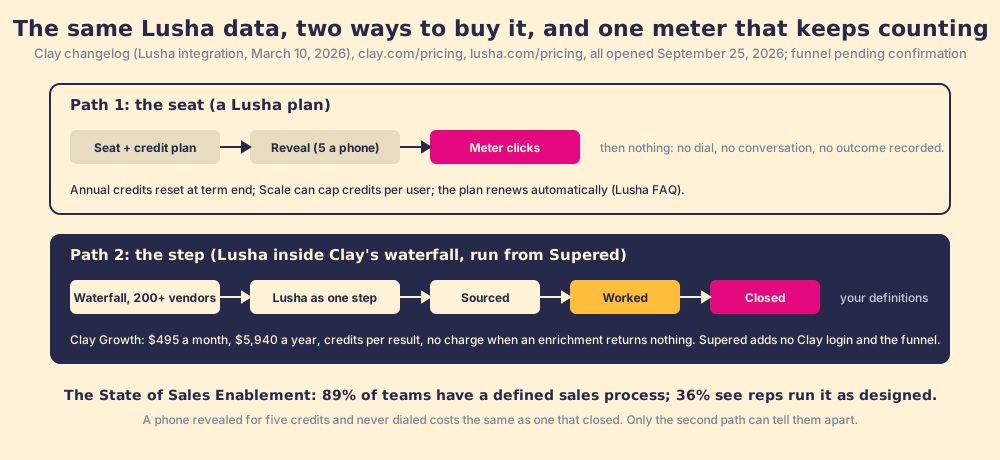
Supered does not bring its own database. It brings Clay’s waterfall, which is every database, routed, and since March that includes Lusha’s. A rep on a LinkedIn profile, a Sales Navigator list, a company’s website, or a HubSpot or Salesforce record gets the waterfall in one click and syncs the contact with no Clay login; the next expected action reaches them in the flow of the work, the way a sales cadence is meant to; and the manager sees sourced, worked, and closed per rep, by the team’s own definitions, against the standard they set. Clay governs the data. Supered governs the motion. Two cautions so the picture does not overreach: this path exists only for a team that already has Clay, and someone on that team, the GTM engineer Clay says builds on Clay, has to build the waterfall and decide where Lusha sits in it. Price that person in. If you are not a Clay customer, the season ticket on the ladder above is a fine purchase.
What we recommend
Three ways forward, and our view on each.
- A season ticket on the ladder. If you are under about ten seats, phone-first, and can size the jar from last quarter’s reveals, buy Premium yearly for the 5 free seats and 40,800 credits at $3,599.40, and treat it as an 8,160-phone plan. If you cannot size the jar, buy monthly at $399.90 and let the rollover hold up to twice a month’s credits while you learn the number.
- The gate, with the terms fixed. If you are past ten seats or need the compliance register behind each mobile, you are a Scale buyer or a Cognism buyer, the list price is gone, and the contract terms to fix before signing are the per-user credit cap, the overage rate, and the escalator. Budget from the Vendr median; the ladder no longer applies.
- Lusha as a step in the waterfall. If you already have Clay, put Lusha in the waterfall where its EMEA coverage earns its place, pay per result, pay nothing for a miss, and run it from Supered so the phone that came out of the machine is the first step of a process someone inspects. The token board always posted the price of a phone. It could never tell you whether anyone called it, and that is the number the season costs. Book a demo and bring your Clay account; what is Clay explains the waterfall first, and the sales process guide explains why the meter after the reveal is the one that moves the number.
Frequently asked questions
How much does Lusha cost in 2026?+
How do Lusha credits work?+
What are the Lusha pricing plans?+
Is Lusha cheaper than Cognism or Apollo?+
Can you negotiate Lusha pricing?+
Is there a way to use Lusha's data without a Lusha seat?+
Your process, running itself.