LinkedIn Sales Navigator vs Cognism in 2026: A Telescope, a Radio, and Whether You Need Both
Sales Navigator finds the person and Cognism finds the phone, and Cognism's own page says teams use both. What each does, prices checked October 2, 2026, the ten-rep stack math, and the Clay route through Supered Prospector.
LinkedIn Sales Navigator vs Cognism is a comparison of two tools that do different halves of prospecting: Sales Navigator finds the right people and tells you when to reach out, and Cognism supplies the verified email and phone-verified mobile to reach them, strongest in Europe.
LinkedIn Sales Navigator vs Cognism is a comparison of two tools that do different halves of prospecting: Sales Navigator finds the right people and tells you when to reach out, and Cognism supplies the verified email and phone-verified mobile to reach them, strongest in Europe. The short answer, by job:
- LinkedIn Sales Navigator, for finding the person. Search, alerts, and InMail on LinkedIn’s own data; Core from US$1,079.88 a seat a year.
- Cognism, for reaching that person in Europe. Phone-verified mobiles with Do Not Call screening; quote only, Vendr median $32,750 a year.
- Supered Prospector, for teams that already have Clay. Clay’s waterfall across 200+ providers, run from the Navigator lead, at $45 per rep per month.
The most useful sentence on this whole topic sits on Cognism’s own comparison page, under the heading “Can I use Cognism and LinkedIn Sales Nav together?” The answer it prints is “Yes. Many organisations use Cognism alongside LinkedIn Sales Navigator,” with Navigator “used for account discovery and profile-based research within LinkedIn” and Cognism used to attach verified contact data (cognism.com, opened October 2, 2026). The vendor that wants your money says buy both. So the question worth answering is which second tool belongs next to the Navigator seat you already pay for, and what the pair costs.
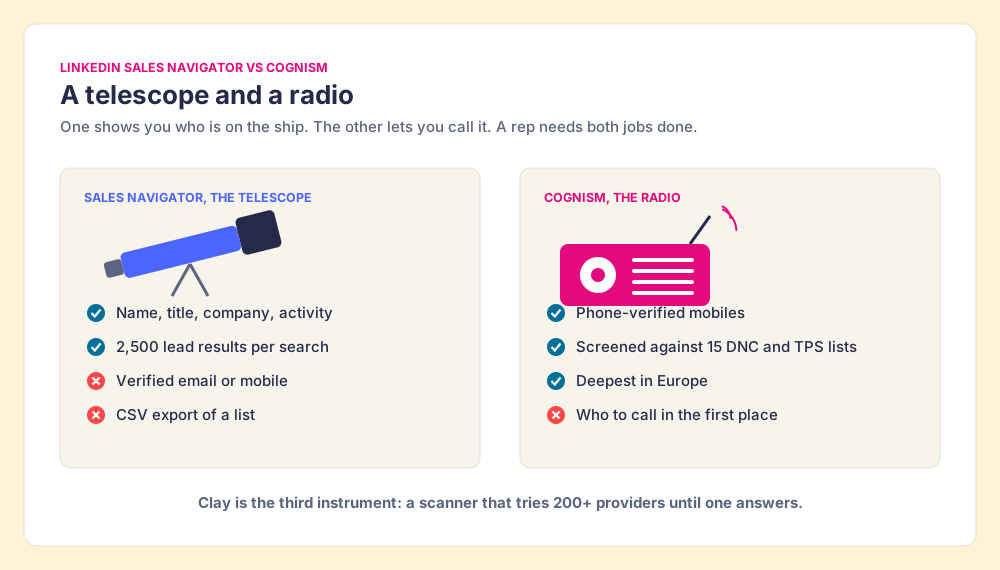
A ship’s lookout carries two instruments. The telescope shows the vessel on the horizon: its name on the bow, its flag, who is standing on deck. It cannot hail anyone. The radio can hail, if you know the frequency, and it has no idea which ship is worth calling. Sales Navigator is the telescope. It shows the person, the title, the company they work for, and it never hands you a number. Cognism is a radio with a good book of frequencies, best for European waters. Asking which one to buy is asking whether the lookout needs eyes or a voice. The lookout needs both, and the buying decision is about the radio.
LinkedIn Sales Navigator vs Cognism at a glance: the decision table
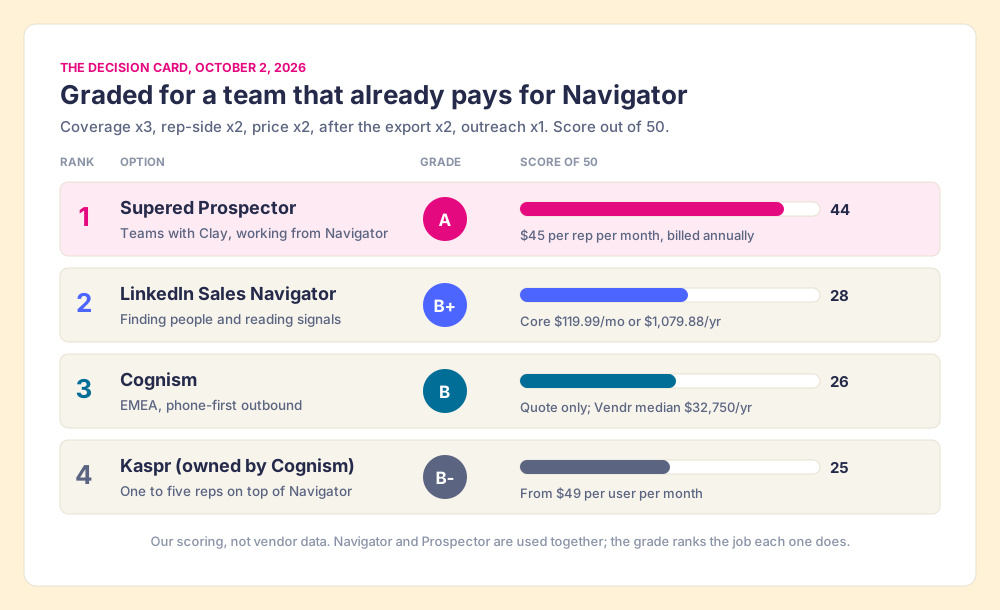
The grades use the same five weights as the Cognism vs ZoomInfo page and the Sales Navigator alternatives page, on the lens of a team of ten to fifty reps that already pays for Navigator: coverage of the email and phone you need (30%), rep-side delivery where reps already work (20%), price structure (20%), what happens to the contact after it leaves the tool (20%), and bundled outreach (10%). Prices come from pages opened October 1 and 2, 2026. The grades are our scoring, not vendor data.
| Rank | Option | Grade (score of 50) | Best fit | CRM integration | Setup effort | Pricing | Reason to choose |
|---|---|---|---|---|---|---|---|
| 1 | Supered Prospector | A (44) | Teams with Clay, prospecting from Navigator | Native HubSpot, Salesforce, Pipedrive; one-click sync | RevOps connects Clay once; reps need no Clay login | $45 per rep per month, billed annually, plus your Clay plan | Clay’s waterfall across 200+ providers on the Navigator lead, and you see which lists get worked |
| 2 | LinkedIn Sales Navigator | B+ (28) | Finding people and reading buying signals | CRM Sync and Embedded Profiles on Advanced Plus only | Self-serve on Core and Advanced; Advanced Plus by quote | Core US$1,079.88, Advanced US$1,799.88 per seat per year | LinkedIn’s own profiles, 50+ filters, alerts, 50 InMails a month |
| 3 | Cognism | B (26) | EMEA, phone-first outbound | Native Salesforce and HubSpot (two-way HubSpot sync launched 2026) | Sales-led quote; Standard or Pro, 5 seats included | Quote only; Vendr median $32,750 a year | Phone-verified mobiles, 15 DNC and TPS lists, top G2 Score in Europe |
| 4 | Kaspr (owned by Cognism) | B- (25) | One to five reps on top of Navigator | HubSpot, Salesforce and Pipedrive integrations | Install the extension, pay by card | From $49 per user per month, billed annually | Cognism’s data family at a self-serve price, built to sit on Navigator |
| Tool | Coverage (x3) | Rep-side (x2) | Price (x2) | After the export (x2) | Outreach (x1) | Weighted total |
|---|---|---|---|---|---|---|
| Supered Prospector | 5 | 5 | 4 | 5 | 1 | 44 |
| LinkedIn Sales Navigator | 1 | 5 | 4 | 2 | 3 | 28 |
| Cognism | 4 | 3 | 2 | 1 | 2 | 26 |
| Kaspr | 2 | 4 | 4 | 1 | 1 | 25 |
Navigator scores 1 on coverage because the column asks for the email and phone, and it supplies neither; it scores 5 on rep-side because it is where the rep already sits. Prospector scores 1 on outreach because it drafts and sends nothing. A ranking like this one is slightly unfair to Navigator by design: Prospector and Kaspr both run on top of a Navigator seat, so the top row assumes the second row. Read the table as two jobs, finding and reaching, with Navigator holding the first job alone.
Why do teams compare Cognism and Sales Navigator?
Because a Navigator seat runs out of road at the profile, and Cognism sells the next stretch. The reviews say so in plain words, on both sides.
- No way out of Navigator. “I don’t like the inability to download lead lists to CSV or to CRMs without a third-party add-on,” a mid-market owner wrote on G2 on February 10, 2026. A reviewer in IT services filed a review on April 22 under the heading “The Walled Garden Problem”: “LinkedIn makes it notoriously difficult to move your data off their platform” (G2, Sales Navigator).
- The Navigator price, for what it returns. “It is priced way too high, especially now that tons of other alternatives are on the market,” a small-business co-founder wrote on May 9, 2026. Sales Navigator holds 4.4 out of 5 from 2,211 G2 reviews (October 1, 2026).
- Cognism’s coverage away from Europe. “Coverage also thins out noticeably outside Europe; searching for contacts in APAC or more niche industries yields way fewer verified phone numbers,” a mid-market Cognism reviewer wrote on July 24, 2026 (G2, Cognism).
- Cognism’s batch size and credits. An enterprise SDR named the “restriction on saving and downloading contacts in smaller batches, such as the 25-contact limit” on July 31, 2026, and a mid-market SDR wrote on May 7 that “credits run out fast if you’re doing high-volume outreach.” Cognism holds 4.5 out of 5 from 1,370 G2 reviews (October 1, 2026).
Turn those four complaints into buying criteria and they become four questions. Do your reps need a phone number or only a name? Where do your buyers live? How many contacts does a rep move from Navigator in a week? And once the contact lands in the CRM, can you tell whether anyone worked it? Navigator answers none of them, because they are not its questions. Cognism answers the first two well, for Europe.
Why trust this comparison?
I started RevPartners, a HubSpot partner that did only sales implementations, sold roughly twice as much Sales Hub as any other partner, and reached Elite tier in 13 months. I have watched a great many reps copy a name out of Navigator, open a second tab to hunt for a phone, and type both into a CRM by hand. Supered grew out of that work and is the #1 sales enablement app on the HubSpot marketplace, rated 5.0 from 122 reviews there and 4.9 out of 5 from 81 reviews on G2 (October 1, 2026).
The disclosure matters. We sell Supered Prospector, which works on Sales Navigator and competes with Cognism for the second job. We gain nothing if you drop Navigator; our product assumes you keep it. We do gain if you conclude your second tool should be Clay. The weights are printed above so you can change them.
What is the difference between LinkedIn Sales Navigator and Cognism?
One is a search engine over a social network, and the other is a contact database. Start with what each does best, because each is best at something real.
Sales Navigator is LinkedIn’s paid search and alert layer, “trusted by 1.5M+ sellers” by LinkedIn’s count. It offers “50+ advanced search filters,” lead and account lists, alerts on saved leads and accounts, and 50 InMails a month on all three plans (LinkedIn compare plans, checked October 2, 2026). Its data is the profile people keep about themselves. Its limits are as specific:
- A capped search. You can view “up to 2,500 lead results across 100 pages” per search (LinkedIn Help).
- No file export. LinkedIn “currently doesn’t offer the option to export account and lead information from Sales Navigator into a CSV or XLS file” (LinkedIn Help, checked October 1, 2026).
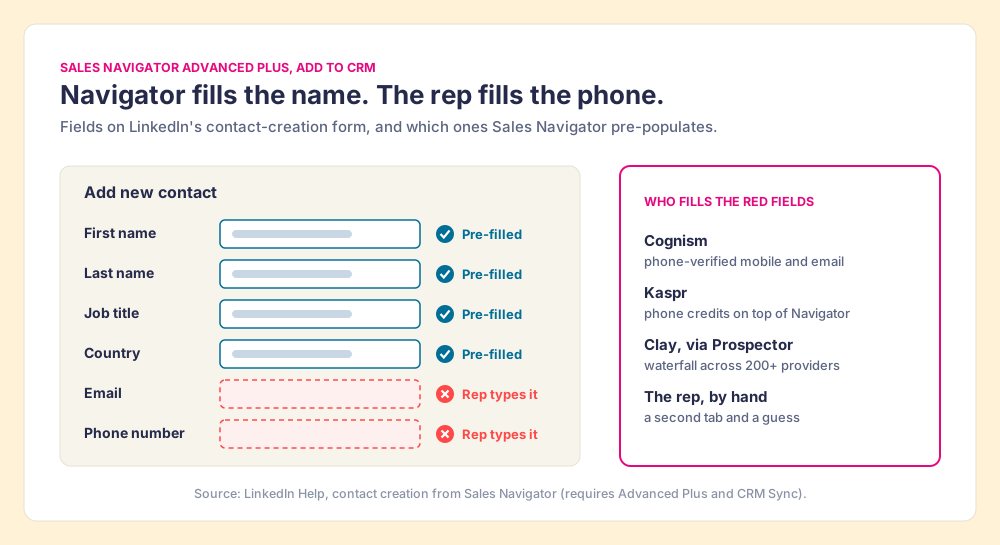
- A CRM link only at the top tier. CRM Sync and lead creation sit on Advanced Plus, and the lead-creation form lists first and last name as required, with email and phone optional, so the rep still types the number (LinkedIn Help). HubSpot’s integration also needs a Sales Hub Professional or Enterprise seat, and HubSpot says “It is not possible to import contacts from LinkedIn using the integration” (HubSpot Knowledge Base). The full walk-through is on the HubSpot LinkedIn integration page and the Salesforce LinkedIn integration page.
Cognism is a B2B contact database, private and London-based, with no acquisition or funding round announced in 2026 as of October 1 (Cognism newsroom). Its strength is the phone. Its compliance page describes manually phone-verified mobiles (Cognism’s Diamond Data), numbers scrubbed against “15 major Do Not Call and TPS lists,” data it says it “generally” keeps “inside the European Economic Area,” and ISO 27001, ISO 27701 and SOC 2 Type II certificates (cognism.com/compliance). Intent comes from Bombora. It also owns Kaspr, bought in 2022, which describes itself as “a prospecting tool for individual contributors and SMBs” (kaspr.io). Cognism sells the radio twice: once as a quoted contract for teams, once as a card-swipe extension for one rep.
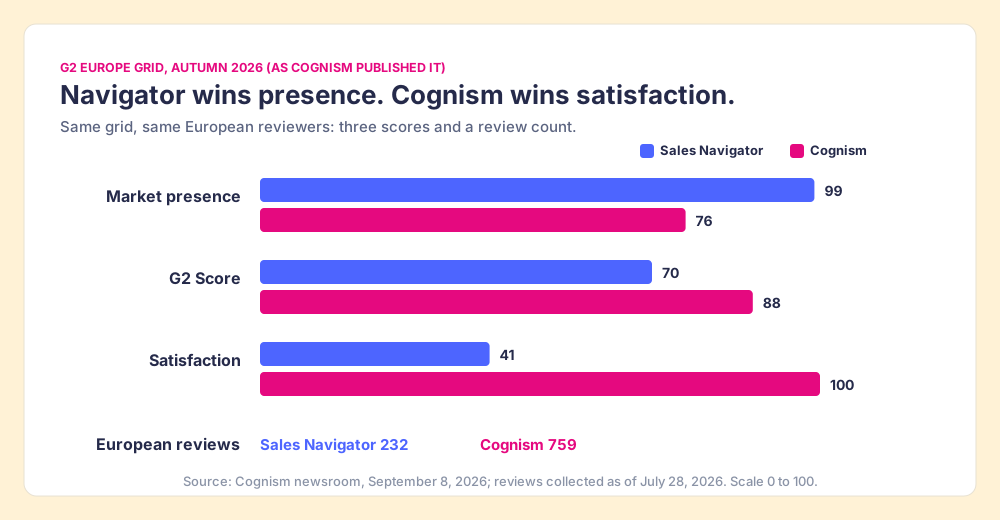
The cleanest evidence of the split sits in one place. G2’s Europe Regional Grid for Sales Intelligence, Autumn 2026, as Cognism published it, scored both products on the same European reviewers. Sales Navigator posted a Market Presence of 99, the highest of the products in Cognism’s table, a Satisfaction score of 41, and a G2 Score of 70 on 232 reviews. Cognism posted Market Presence 76, Satisfaction 100, and a G2 Score of 88 on 759 reviews (Cognism newsroom, September 8, 2026). The publisher is an interested party, so read the gap for its shape: the telescope has the widest reach on the grid, and the European reviewers grading a sales intelligence tool were happier with the radio.
How much do Sales Navigator and Cognism cost?
Navigator publishes a price and Cognism does not, and the two bills never replace each other. LinkedIn lists Core “starts at US$119.99 per month/license or US$1,079.88 per year/license” and Advanced “starts at US$159.99 per month/license or US$1,799.88 per year/license,” with Advanced Plus “customized” and quoted (LinkedIn, checked October 2, 2026). For the European teams that buy Cognism, the same page lists Core at £94.99 a month or £959.88 a year and €120.99 or €1,088.88, and Advanced at £130.00 or £1,499.88. More on the plans sits on the Sales Navigator pricing page.
Cognism’s pricing page sells two packages, Standard and Pro, each marked “5 seats included,” with no dollar figure and “1 credit = 1 revealed contact” (cognism.com/pricing, checked October 2, 2026). Cognism’s own comparison pages put Standard at 10,000 credits per user a year and Pro at 12,000. Vendr shows the median buyer paying $32,750 a year across 94 purchases, with a range from $16,585 to $88,449 and 26% average savings off the first quote (Vendr, Cognism, opened October 1, 2026). The breakdown lives on the Cognism pricing page.
Navigator is a discount lever in a Cognism negotiation, and so is any other database. One Vendr buyer note reads “We secured a 44% discount for a 1yr agreement because we made it competitive with our ZoomInfo renewal.” Bring a second quote even if you know which tool you want.
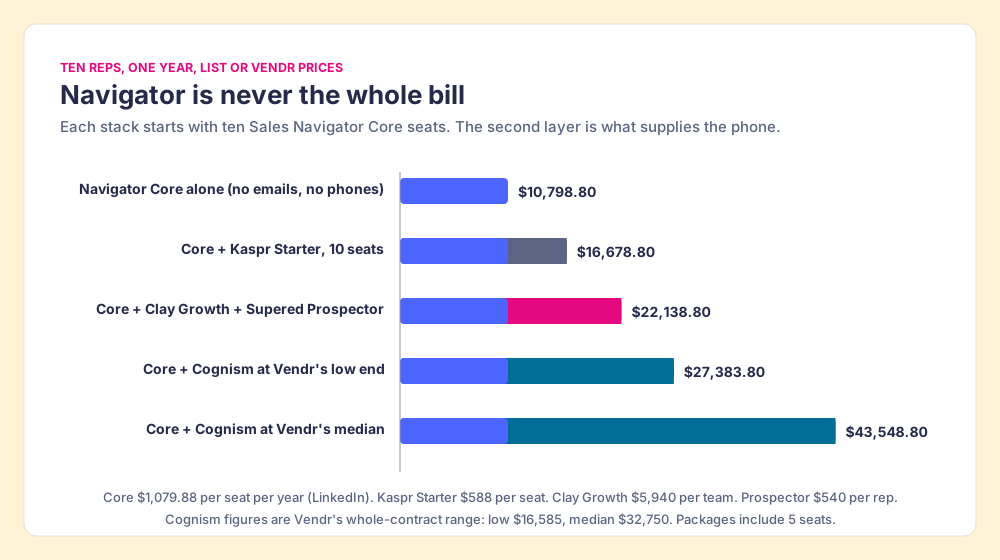
So price the pair. For ten reps on list or Vendr prices, a year looks like this:
| Ten-rep stack, one year | Cost | What the second layer adds |
|---|---|---|
| Navigator Core alone | $10,798.80 | Nothing: names and profiles, no emails or phones |
| Core + Kaspr Starter (10 x $588) | $16,678.80 | 100 phone credits a month per rep |
| Core + Clay Growth ($5,940) + Supered Prospector (10 x $540) | $22,138.80 | Clay’s waterfall across 200+ providers, one-click CRM sync |
| Core + Cognism at Vendr’s low end ($16,585) | $27,383.80 | Phone-verified mobiles, DNC screening |
| Core + Cognism at Vendr’s median ($32,750) | $43,548.80 | The same, at the typical contract size |
The Cognism rows carry a caveat. Vendr’s figures are whole contracts of unknown seat count, so a ten-rep Cognism quote can land anywhere in the range. The Clay row prices Clay Growth’s monthly list rate and only the plan’s included credits.
Can you use Cognism and Sales Navigator together?
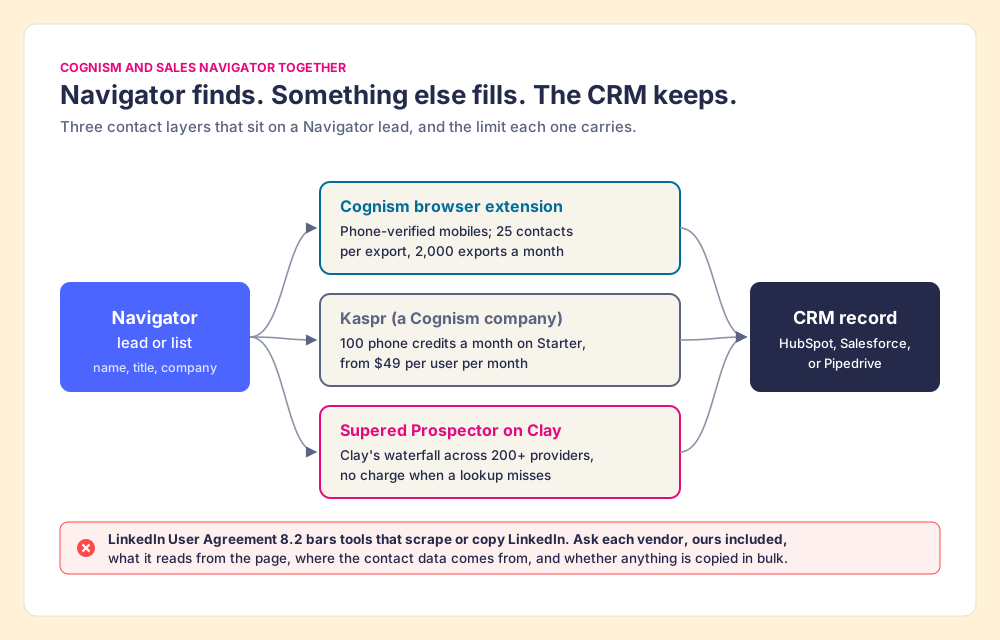
Yes, and it is the pairing Cognism designs for. Its help center has an article titled “Using the Cognism Browser Extension over Sales Navigator,” updated April 10, 2026: open a lead or account page in Navigator, the Cognism panel opens, and it shows “Email addresses, Mobile phone numbers, Job title and seniority,” with an Export button that sends the contact to your CRM (Cognism Help). Cognism’s own playbook for list work says the extension “will auto-load all contacts that are visible on your screen” (cognism.com). The details of that extension, both of its Chrome Web Store listings, and its install steps are on the Cognism Chrome extension page.
Three limits shape how the pair works in practice:
- The batch. Cognism’s fair-usage article sets an “Export view limit per End User: 25 individual records at a time” and a “Monthly export limit per End User: 2,000 individual records” (Cognism Help). A 2,500-result Navigator search moves 25 contacts per export.
- The second seat. Cognism does not replace the Navigator seat; the extension needs Navigator open to read the lead. You pay both.
- The small-team version. Kaspr, the Cognism company, sells the same move from $49 per user per month on annual billing, with 100 phone credits a month on Starter and “Use Kaspr on top of Sales Navigator” on the plan card (kaspr.io/pricing, October 1, 2026). Its Chrome Web Store listing showed 100,000 users and a 4.7 rating on October 1, 2026. The Kaspr alternatives page prices it in full.
Then the question no vendor’s comparison page raises. LinkedIn’s User Agreement, section 8.2, has members agree not to use “crawlers, browser plugins and add-ons or any other technology” to “scrape or copy the Services, including profiles and other data from the Services” (LinkedIn User Agreement, effective November 3, 2025). LinkedIn’s help page on prohibited software says members who use such tools “risk having their accounts restricted or shut down” (LinkedIn Help). This page does not rule on any single vendor. The fair test for any tool that runs on a Navigator page, ours included, is three questions: what does it read from the page, where does the contact data come from, and does anything get copied in bulk. Our answer for Prospector: it works within LinkedIn’s terms and does not copy search results in bulk, and the contact data comes from Clay’s waterfall on your own Clay account. The Sales Navigator export guide walks through why the CSV scrapers fail that test.
Where does Clay fit, and what does Supered Prospector do on Sales Navigator?
For a team that already has Clay, the second instrument does not have to be one database at all, which is why Supered Prospector ranks first in the table. A name collision first, so the wrong product does not get bought: Cognism calls its own web app Prospector. Supered Prospector is a different product, from Supered, and it has no database of its own. It brings Clay’s waterfall, which is every database, routed. We chose Clay as our only data provider for that reason.
Go back to the ship. Cognism is a radio with an excellent book of European frequencies. Clay is a scanner. It tries one frequency, and when that one is silent it tries the next, through “200+ providers in one place” in Clay’s words, and its pricing page says “If an enrichment returns no result, you’re not charged Data Credits or Actions” (clay.com; clay.com/pricing, checked October 1, 2026). The picture has one edge worth knowing before you buy. Cognism is not on the scanner: Clay has no Cognism integration page (it returned a 404 on October 1, 2026). For European match rates inside Clay, Clay added Lusha in March 2026 as a step “for better EMEA match rates,” run on your own Lusha account (Clay changelog).
Prospector puts the scanner in the lookout’s hand. It runs inside the Supered Chrome extension, and what a rep does with it on Navigator:
- The team’s Clay table, as a button on the Navigator lead or list. RevOps connects Clay inside Supered once. A rep presses the button and the table runs; reps need no Clay login. Any custom Clay workflow works, and a whole Navigator list can go to a Clay workflow in one push.
- The CRM check before the add. On a LinkedIn profile the rep sees the matching CRM record and whether the prospect was already worked, so two reps do not chase the same buyer.
- The buying committee, on your terms. The lookup follows the titles, departments, and seniority your team sets.
- One click into the CRM. The contact syncs to HubSpot, Salesforce, or Pipedrive with the email and phone attached, and the team’s process applies to the prospects reps work.
- The list, followed to the close. A leader sees which sourced lists got worked and which closed, and coaches from the lists that convert.
The same button works away from Navigator: on a LinkedIn profile, on a company’s website, and inside a HubSpot, Salesforce or Pipedrive record. Prospector costs $45 per rep per month, billed annually, from one rep, on its own plan (Prospector). It runs on your Clay account and your Clay credits. With Clay Growth, ten reps come to $11,340 a year before Navigator, or $22,138.80 with ten Core seats, the third row of the stack table. The whole rep loop is on the sourcing use case, and the Clay Chrome extension page covers what Clay’s own extensions do and do not do.
Choose something else if any of these is true:
- No Clay, and no builder for it. Clay needs someone to set up the tables and the waterfall. Without that person, one database is simpler: Cognism for Europe, Kaspr for a small team.
- Phone-verified European mobiles with DNC screening as the core job. Cognism is not in Clay. Keep Cognism next to Navigator.
- Outreach written for you. Prospector drafts and sends nothing; it hands the contact to your CRM and sequencer.
For the history of this exact product shape, the Exportly alternatives page covers the Clay extension that came before.
Cognism vs Sales Navigator: which should you choose?
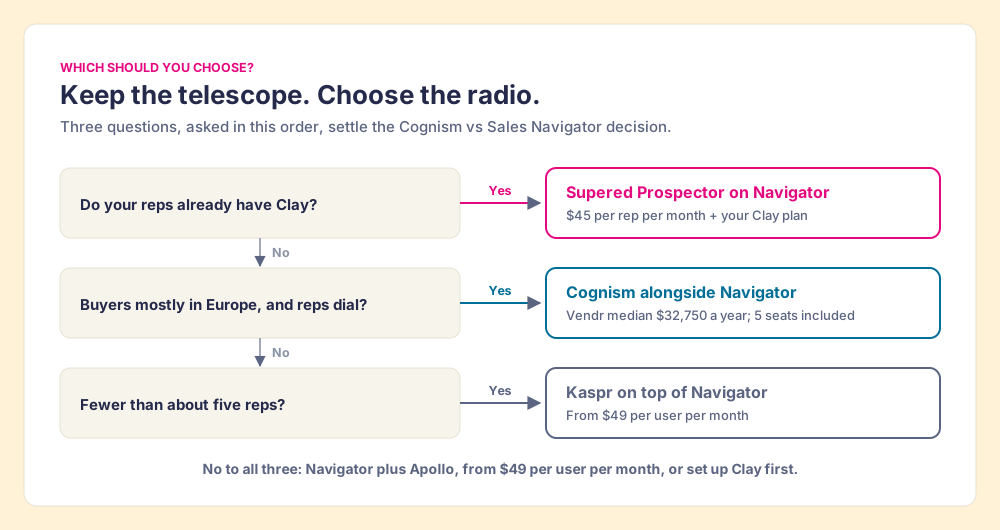
Keep the telescope. On a cognism vs linkedin sales navigator shortlist, Navigator is the tool almost every team keeps, because nothing else shows LinkedIn’s own profiles and job changes, and the decision that matters is the radio. If your problem is finding the right people, Sales Navigator is the best pick. If your problem is phoning them in Europe, Cognism is the best pick. If your reps already have Clay, Supered Prospector on Navigator is the best pick, because the radio becomes a scanner across 200+ providers.
- LinkedIn Sales Navigator, the finder. Keep it for search, alerts, and InMail. Core at US$1,079.88 a seat a year covers a rep who searches and sends InMail; pay for Advanced Plus only if you want CRM Sync, and know that it creates the record without the phone.
- Cognism alongside Navigator, the European specialist. Choose it if your buyers sit mostly in the UK and Europe and your reps dial: phone-verified mobiles, 15 DNC and TPS lists, a G2 Score of 88 in Europe. Budget near the $32,750 median with a five-seat floor, plan around 25 contacts per export, and bring a competing quote.
- Kaspr on Navigator, the one-rep radio. Cognism’s data family at self-serve prices, from $49 per user per month, for one to five reps.
- Supered Prospector on Navigator, for Clay teams. Choose it if Clay is already in the building: the Navigator lead or list runs your Clay table, the contact lands in HubSpot, Salesforce, or Pipedrive in one click, and you see which lists turn into pipeline. $22,138.80 a year for ten reps with Core and Clay Growth.
A lookout with good eyes and no voice watches a lot of ships go by. Buy the radio that matches your waters, and if Clay is already aboard, let it scan. For the next decision in this set, the Sales Navigator alternatives page asks whether the telescope itself is worth its price, and Cognism vs ZoomInfo compares the two big radios head to head.
Frequently asked questions
Is Cognism better than LinkedIn Sales Navigator?+
How much do Sales Navigator and Cognism cost?+
Can you use Cognism with Sales Navigator?+
Does Sales Navigator give you email addresses and phone numbers?+
Is Cognism in Clay?+
What is Supered Prospector, and is it the same as Cognism Prospector?+
Your process, running itself.