Cognism Pricing in 2026: The Platform Fee Is the Price, the Seats Are the Meter
Cognism publishes no prices, so this is the quote decoded from Cognism's own pricing page and 94 Vendr contracts: the platform fee, the per-seat meter, the tier renames, the compliance premium, and the one-contract arithmetic.
Cognism pricing in 2026 is quote-only: a platform fee plus per-seat licences in two packages, Standard and Pro, with 5 seats included, one credit per revealed contact, and a Vendr median contract of $32,750 a year across 94 purchases.
Book a banquet hall and the invoice has two lines. The first is the hire of the room, and it is the same number whether five people sit down or forty. The second is the per-head, and it moves. A buyer who wants a cheaper wedding argues about the wrong line for an hour, because the per-head is the one printed in big type, and it is the hire that decides the bill. Cognism’s quote is a banquet hall. The buyer notes on Vendr’s Cognism listing, opened September 25, 2026, say so in the buyers’ own words: one team got the platform fee removed and the per-user price cut 20% by writing growth into the term; another had the fee waived outright by buying 40 Diamond seats; a third complains that the order forms do not show unit prices, list prices, or line-item discounts (Vendr, Cognism).
Cognism pricing in 2026 is quote-only: a platform fee plus per-seat licences sold in two Sales Prospecting packages, Standard and Pro, each with 5 seats included and metered at one credit per revealed contact (10,000 credits per user a year on Standard, 12,000 on Pro), with a Vendr median contract of $32,750 a year across 94 purchases. The rest of this page decodes the quote from Cognism’s own pricing page and those 94 contracts, names the renaming habit that stops you comparing this year’s number to last year’s, says plainly what the compliance premium buys, and finishes with the arithmetic against one contract on Clay for the teams that already have it.
| Cognism pricing at a glance (September 25, 2026) | What the sources say |
|---|---|
| Model | Quote-only; a platform fee plus per-seat licences, annual (Vendr buyer notes) |
| Packages | Sales Prospecting: Standard and Pro, “5 seats included” on each (cognism.com/pricing) |
| Add-ons | CRM Enrichment (also standalone); Data-as-a-Service by volume; API access requires a prospecting seat |
| Credits | 1 credit = 1 revealed contact; re-viewing is free; a credit is spent again only on a job change |
| Credit allocation | 10,000 per user a year on Standard, 12,000 on Pro (cognism.com/cognism-vs-clay) |
| Median contract | $32,750 a year, 94 purchases, 26% average savings (Vendr) |
| Range | $16,585 to $88,449 a year (Vendr) |
| Ratings on the page | 4.5/5 on G2, 4.7/5 on Capterra, “Trusted by 4000+ companies worldwide” |
How much does Cognism cost in 2026?
Searches for “how much does Cognism cost,” “Cognism cost,” and “Cognism pricing plans” all land on the same page, and no number appears on it (cognism.com/pricing). What appears is the shape of the bill, and the shape is the useful part.
- The hire. The platform fee. It is not named on the pricing page, but Vendr’s buyers name it in their notes, and two of them describe getting it removed: one by building 40% seat growth into a renewal, one by buying 40 Diamond-edition users on a new purchase. A fee that can be waived at 40 seats is a fee designed to be paid at 5.
- The per-head. Each package says “5 seats included,” and each seat “includes an allocation of credits as part of the subscription.” Cognism’s comparison page against Clay puts the allocation at 10,000 credits per user a year on Standard and 12,000 on Pro (cognism.com/cognism-vs-clay). Seats past the five are the line that moves, and one buyer note reports a 20% cut to the per-user price.
- The meals. Credits, at one per revealed contact, spent once. “Once a contact has been redeemed, your team can continue using that record throughout the contract. A credit is only used again if that contact changes jobs” (pricing FAQ). More can be bought at any point.
- The room next door. CRM Enrichment is an add-on or a standalone product, with maintenance included once a record is enriched. Data-as-a-Service is priced on records and delivery method, and API access requires a prospecting seat.
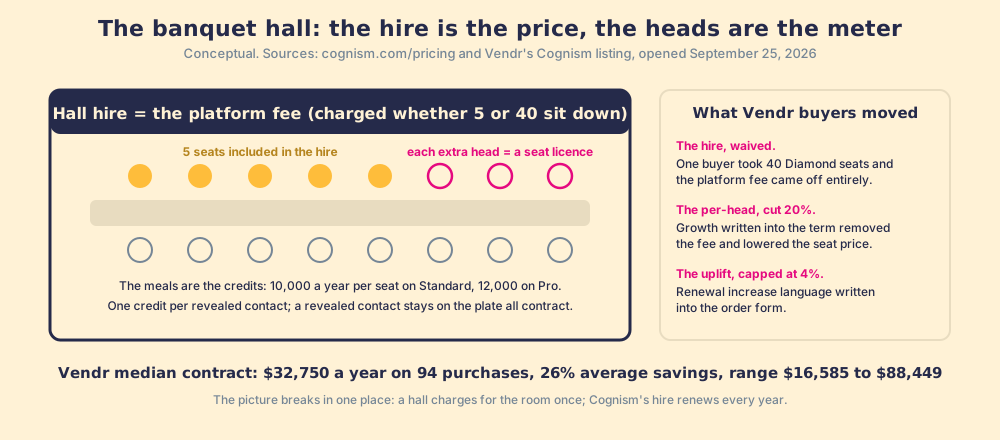
Now the arithmetic that tells you which line to argue about. The Bridge Group’s 2025 SDR report, 351 companies, puts the median SDR at 112 activities a day, 44 of them phone (Bridge Group, 2025). Call it 250 working days and a rep dials about 11,000 times a year. A Standard seat carries 10,000 credits, and a credit buys a contact; the fourth call to the same director costs nothing. A rep would have to reveal a brand-new person for nearly every dial of the year before the credits ran short. The credits are the line printed in big type. The seats decide the bill, and the hire above the seats decides it more.
Corporate status, since a pricing page is wrong the day its vendor is bought: Cognism is private, London-based, led by CEO Dominic Allon, and has owned Kaspr since April 2022 (Cognism newsroom). No 2026 acquisition or funding round turned up in the news check for this page.
Why does Cognism pricing keep renaming its tiers?
Picture a restaurant with two dishes and three menus. The dishes never change: one plate with the verified mobiles, the intent data and the verification on demand, one plate without. The names change every couple of years. The first menu called them Platinum and Diamond. The second called them Grow and Elevate. The menu on the counter today calls them Standard and Pro. Vendr’s listing, on the day this page was written, still shows five product names side by side (Platinum, Diamond, Grow, Elevate, and Prospector), and Cognism’s own comparison page against Clay says intent topics are “included in the Elevate package” on the same day its pricing page sells Pro.
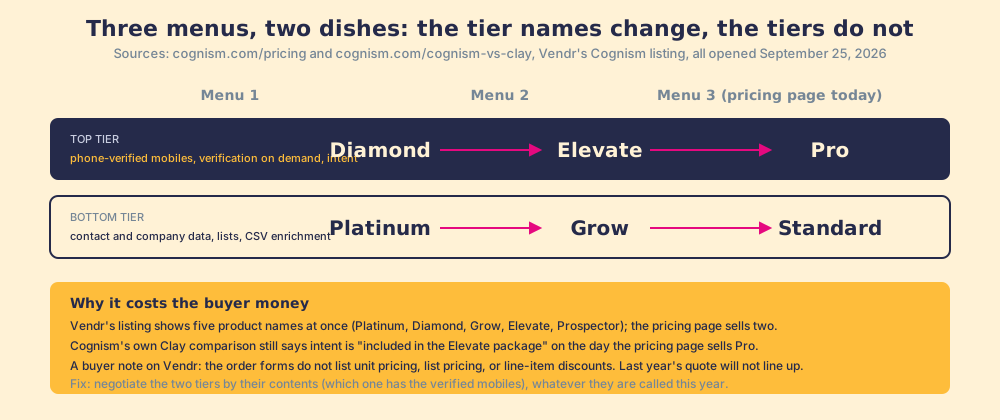
The renames are ordinary product marketing. They cost you money in one specific way: they break the comparison. A renewal quote for “Pro” cannot be laid beside a 2024 order form for “Diamond” line by line, and one Vendr buyer says the order forms do not list unit pricing, list pricing, or line-item discounts, so the team had to request an itemised quote. A number you cannot see is a number you cannot argue with. The fix is dull and it works: write your own line items (seats, allocation per seat, platform fee, add-ons, uplift), fill them in from the old order form, and make the new quote fill the same boxes, whatever the tiers are called this year.
What does the compliance premium in Cognism pricing cover?
Be fair to the top tier first, because the premium buys something real. Cognism’s compliance page, opened September 25, 2026, describes data collected under legitimate interest (GDPR Article 6.1(f)), business contacts notified of their inclusion “within GDPR timeframes,” a phone database scrubbed against “15 major Do Not Call and TPS lists” across twelve named countries (the UK’s TPS and CTPS, the US, Australia, New Zealand, Germany, France, Ireland, Spain, Portugal, Croatia, Sweden and Belgium), data kept inside the European Economic Area by default, registration as a data broker in California, and ISO 27001, ISO 27701 and SOC 2 Type II certification. Diamond Data is the set of mobiles a person at Cognism phone-verified. On G2’s Europe Regional Grid for Autumn 2026, Cognism scored 88 on 759 European reviews, the highest in the category (Cognism newsroom, September 2026). If your reps dial Frankfurt and your DPO wants a supplier who can name the registers, this is the tier to buy.
Then read the same page to the bottom, where it draws the boundary of the premium in its own words. Under Cognism’s services “each party acts as an independent controller.” A customer’s use of the data “is usually done outside of Cognism’s control and visibility,” and Cognism “would recommend customers seek legal advice prior processing and using the data.” On its Clay comparison page, contacts flagged on a national Do Not Call list “can be surfaced or suppressed at the administrator’s discretion.” The switch that decides whether a flagged number can be dialed sits on your side of the fence, inside Cognism itself.
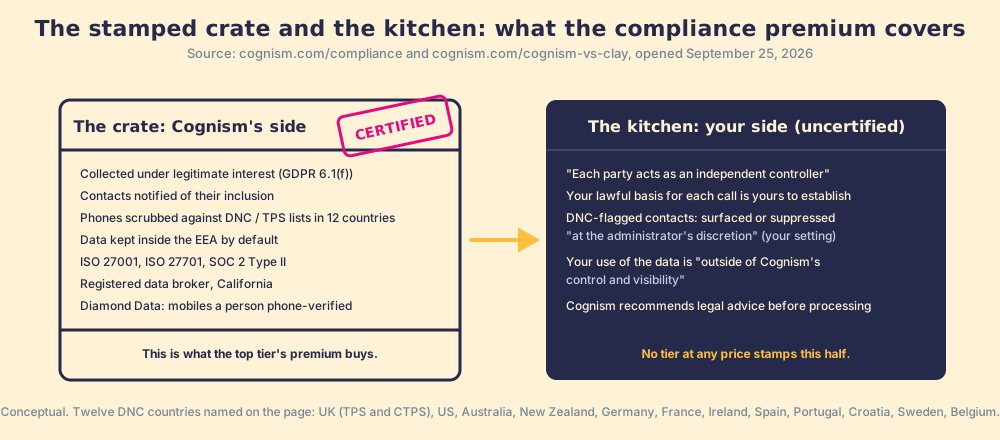
A crate of vegetables arrives at a restaurant with a certificate stapled to the lid. The certificate says which farm, which standard, which inspector. It is worth paying more for that crate. It says nothing about whether the kitchen washed its hands, and the health inspector who visits the restaurant does not ask to see the farm’s paperwork. Cognism’s premium is the certificate on the crate. It is real, it is the best in Europe by G2’s count, and it stops at the lid.
How much can you negotiate off a Cognism quote?
Vendr’s headline is 26% average savings across 94 purchases, but the buyer notes underneath it are more useful than the average, because they name the lever each buyer pulled.
- A competing quote. The most-reported lever. Buyers naming Apollo, ZoomInfo, or Lusha report 25% to 44% off, and one reports Cognism price-matching after mentioning ZoomInfo run in tandem. Cognism pushes back hardest on EMEA, where its data is strongest, so bring the alternative that covers your geography.
- Growth written into the term. The lever that moves the hire. One buyer removed the platform fee and cut the per-user price 20% by committing to seat growth; another waived the fee entirely at 40 Diamond seats.
- End of quarter. Notes tie 19% to 29% to a quarter-end signature, and one 44% discount to a signing made competitive with a ZoomInfo renewal.
- Free credits. Blocks of 25,000 credits on one deal and 10,000 bulk credits on another. Credits are the cheapest thing for Cognism to give, so ask for them after the price is settled.
- Protections. Uplift capped at 4% in one note and 3% in another, auto-renew removed, quarterly payment, extra licences at a set discount, admin seats free, three months free on a new purchase.
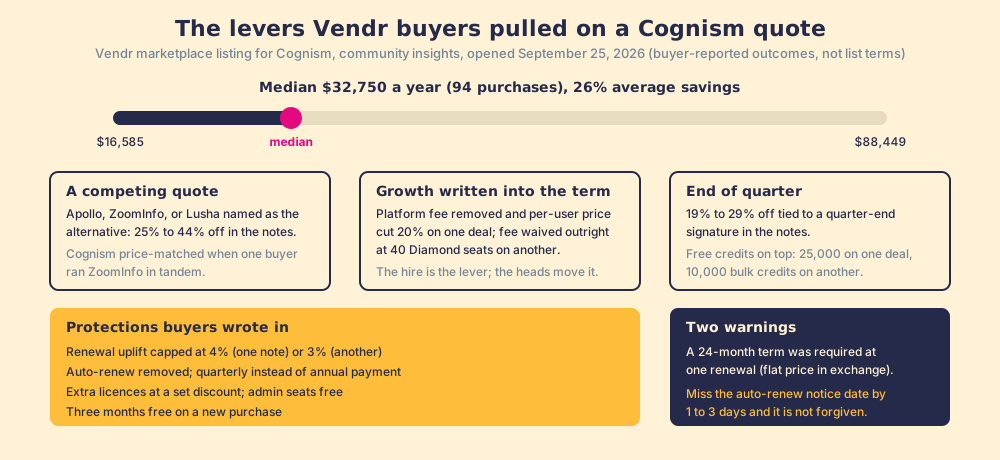
Two cautions from the same page: one buyer was told at renewal that a 24-month term was now required, with a flat price in exchange, and one warns that missing the auto-renew notice date by one to three days is not forgiven. Put the notice date in three calendars.
What does one contract cost against Clay via Supered?
Everything above is about paying less for the hall. This section is about whether you need the hall, and it applies only to a team that already has Clay. If you are not a Clay customer, skip to the recommendation; Supered’s sourcing runs on the customer’s own Clay account and on nothing else.
Supered does not bring its own database. It brings Clay’s waterfall, which is every database, routed. “One contract to buy data from 200+ data and AI vendors” is Clay’s line on its homepage (clay.com, September 25, 2026), and its pricing page adds the two rules that change the arithmetic: “Data Credits start at $0.05 each,” and “If an enrichment returns no result, you’re not charged Data Credits or Actions” (clay.com/pricing). The Growth plan, with CRM sync built in, lists at $495 a month, or $5,940 a year, with 6,000 data credits a month included. Set that beside Cognism’s Vendr median of $32,750 and the Clay platform fee is under a fifth of it. The credits are the number you owe yourself an estimate for, because they scale with what your reps source, and a contact no rep sources costs nothing. A Cognism seat costs the same whether the rep opens the tool or not.
Grant Cognism’s own objection its full weight: Clay’s provider list “doesn’t include industry leaders ZoomInfo or Cognism” (its Clay comparison page), so a Diamond Data mobile is bought from Cognism or not at all, and a team routing EU contacts has to vet each provider it routes them to. That vetting is the GTM engineer’s work. Price that person in.
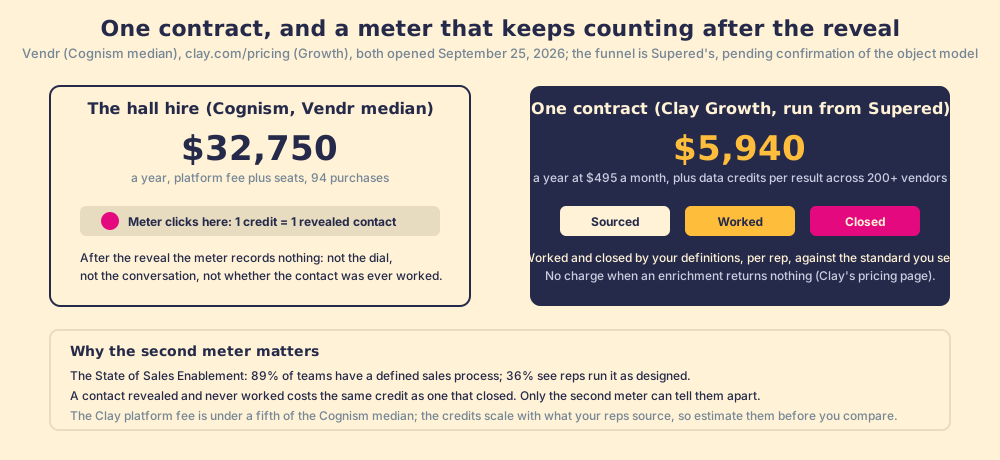
The second meter is the part no data vendor prices. Cognism’s clicks at the reveal: “one credit is used each time a contact record is revealed.” After that it records nothing, which is fair, because Cognism’s job ends there. A revenue leader’s job starts there. Across 198 sales teams in The State of Sales Enablement, 89% had a defined sales process and 36% saw reps run it as designed, and the teams that inspected adherence consistently hit quota at 6.3 times the rate of those that did not. A revealed contact that no rep ever dials costs the same credit as one that closed. You can only expect what you inspect, and the reveal is the one step in prospecting that comes with a receipt.
Supered is the layer that keeps counting. A rep on a LinkedIn profile, a Sales Navigator list, a company’s website, or a HubSpot or Salesforce record gets Clay’s waterfall in one click and syncs the contact with no Clay login; from there the next expected action reaches them in the flow of the work, the way a sales cadence is meant to, and the manager sees sourced, worked, and closed per rep, by the team’s own definitions, against the standard they set. Clay governs the data. Supered governs the motion. The record the kitchen inspector wants, who was called, when, and what happened, is the same record, because it is the process itself.
What we recommend
Three ways forward, and our view on each.
- The hall, with the hire argued down. If your reps dial Europe, you are not a Clay customer, and your counsel wants a supplier who can name the registers, buy Cognism’s Pro tier and negotiate it the way the 94 buyers did: a competing quote on the table, growth written into the term so the platform fee comes off, the uplift capped in writing, auto-renew removed. Write your own line items so next year’s “Pro” can be laid beside this year’s.
- A cheaper crate. If your reps dial the US, you are paying for a certificate on contacts that never needed one. Apollo’s published seats start at $49 on annual billing, and the graded field is in the Cognism alternatives page.
- No hall at all. If you already have Clay, do not sign another database. Put the waterfall in your reps’ hands where they already work, price the GTM engineer who vets the EU providers, and measure what happens to every contact they pull. The premium was always for the crate. The kitchen was always yours, and a meter that keeps counting after the reveal is the only receipt for it. Book a demo and bring your Clay account; what is Clay explains the waterfall first, and the sales process guide explains why the second meter is the one that moves the number.
Frequently asked questions
How much does Cognism cost in 2026?+
What are the Cognism pricing plans?+
How do Cognism credits work?+
How much can you negotiate off a Cognism quote?+
Is Cognism worth the price?+
Is there a cheaper way to get the same coverage?+
Your process, running itself.