Clay vs Cognism in 2026: The Rail Line Is Not in the Travel Agent's System
Clay vs Cognism compares a waterfall across 200+ providers with one database built for Europe. Cognism is not in Clay's marketplace, and Cognism's own page gets half of that wrong. The prices, the compliance question, and the API step a GTM engineer can build.
Clay vs Cognism compares two different kinds of thing: Cognism is one B2B contact database, strongest in Europe, sold by quote with a credit per revealed contact; Clay is a waterfall that asks 200+ data providers in turn and charges only when one returns a result.
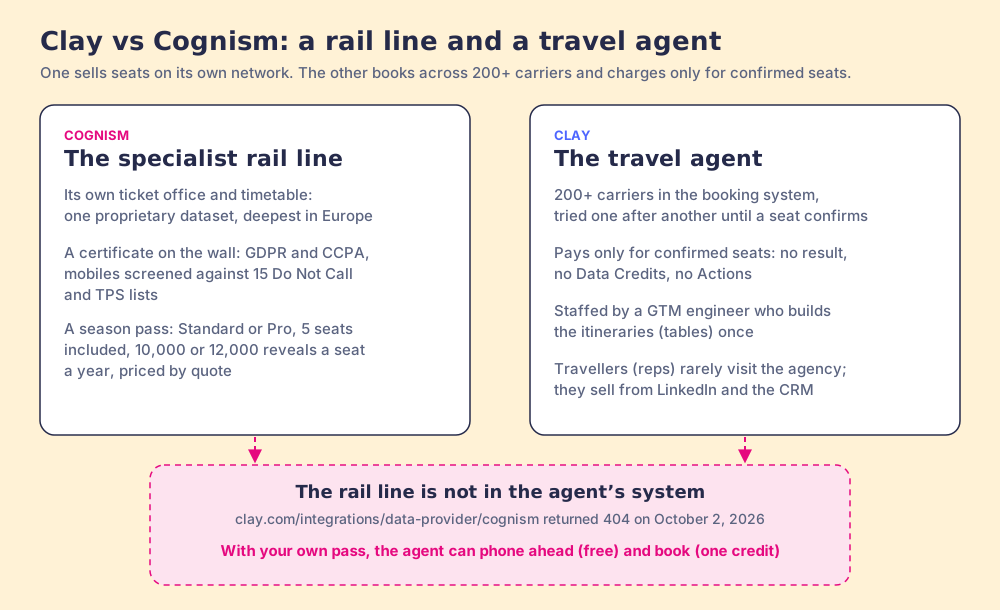
A rail company sells you a seat on its own trains. It owns the track, prints the timetable, and hangs a safety certificate in the ticket office, and if your destination is on its network the journey is excellent. A travel agent owns no trains. She has 200 carriers in her booking system, tries one after another until a seat confirms, and charges you only for the booking that comes through. Clay vs Cognism is that pair. Clay vs Cognism compares two different kinds of thing: Cognism is one B2B contact database, strongest in Europe, sold by quote with a credit per revealed contact; Clay is a waterfall that asks 200+ data providers in turn and charges only when one returns a result.
The short answer, by who it fits:
- Supered Prospector, on your Clay. Teams whose RevOps already runs Clay. Reps run the tables the GTM engineer built from Sales Navigator, a company site, or the CRM, and never open Clay. $45 per rep per month, billed annually.
- Cognism. Teams whose reps call mobiles in the UK and Europe today and have no one to build in Clay. Phone-verified mobiles, Do Not Call screening, usable on day one. Quote only; Vendr median $32,750 a year.
- Clay, run by a GTM engineer. Teams with a builder and a mixed or US-heavy list who want 200+ providers behind one contract. From $495 a month on Growth.
One fact the ranking pages leave out, and it changes the shape of the decision. The rail line is not in the travel agent’s system. Clay’s integration page for Cognism returned a 404 when I opened it on October 2, 2026. Cognism’s own comparison page says Clay’s provider list “doesn’t include industry leaders ZoomInfo or Cognism” (cognism.com/cognism-vs-clay, opened October 2, 2026). Half of that sentence is true. The other half has been out of date since January 15, 2025, the day ZoomInfo joined Clay’s marketplace. And there is a side door into the system for anyone holding their own Cognism pass, which the last third of this page walks through.
How do Clay and Cognism compare at a glance?
Prices are the plan that includes the job, opened on clay.com/pricing, cognism.com/pricing and vendr.com on October 2, 2026. Grades come from the weighted scoring below, on the lens of a team of five to fifty reps.
| Rank | Tool | Grade | Best fit | CRM integration | Setup effort | Price (plan with the feature) | Reason to switch |
|---|---|---|---|---|---|---|---|
| 1 | Supered Prospector (on your Clay) | A | Teams that already run Clay | Native in HubSpot, Salesforce and Pipedrive; one-click sync | Admin connects Clay inside Supered; the GTM engineer builds flows or starts from the Supered Clay template | $45/rep/mo billed annually, from 1 rep, plus your Clay plan | Reps run the Clay tables where they sell, and every list shows found, worked, closed |
| 2 | Clay, run by a GTM engineer | B+ | Teams with a builder and a mixed or US-heavy list | CRM auto-sync on Growth; HTTP API to anything else | A builder sets up tables and waterfalls; G2 ease of setup 7.7 | Growth $495/mo ($446 annual), 6,000 data credits/mo | 200+ providers behind one contract, nothing charged for a miss |
| 3 | Cognism | B | Reps calling UK and European mobiles, no builder | Native HubSpot and Salesforce sync; CRM Enrichment add-on | A rep can use it on day one; G2 ease of setup 9.0 | Standard or Pro, 5 seats included, by quote; Vendr median $32,750/yr | Phone-verified European mobiles with the compliance paperwork attached |
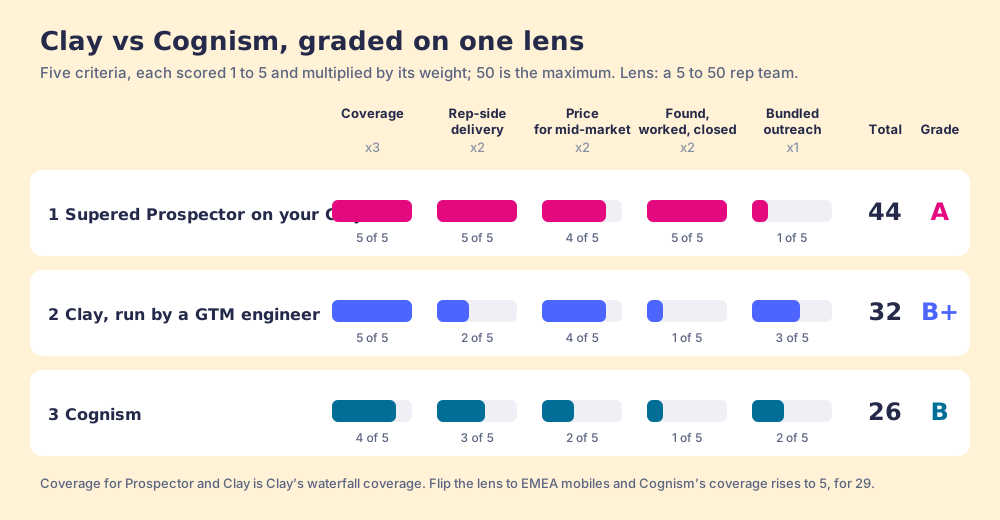
The scoring, so you can argue with it. Each criterion is scored 1 to 5 and multiplied by its weight, for a maximum of 50. The weights, and the Prospector and Cognism rows, match Cognism vs Apollo and the Cognism alternatives page, so the pages read together.
| Tool | Coverage (x3) | Rep-side delivery (x2) | Price for mid-market (x2) | Found, worked, closed (x2) | Bundled outreach (x1) | Total |
|---|---|---|---|---|---|---|
| Supered Prospector | 5 | 5 | 4 | 5 | 1 | 44 |
| Clay, run by a GTM engineer | 5 | 2 | 4 | 1 | 3 | 32 |
| Cognism | 4 | 3 | 2 | 1 | 2 | 26 |
Clay scores 2 on rep-side delivery because a Clay table is built for the person who builds it; “GTM engineers build on Clay” is Clay’s own line (clay.com). It scores 3 on outreach because Launch and above include Clay’s own email sequencer. Prospector scores 1 on outreach on purpose: it has no sequencer and no dialer, and it drafts nothing. Its coverage score is Clay’s waterfall coverage, and that credit belongs to Clay.
Why do teams leave Cognism, or give up on Clay?
The complaints run in opposite directions, which is the first clue that these are two different purchases.
- Cognism’s price and meter. “Cognism is quite expensive for what it is; the price is pretty high compared to some competitors,” wrote Troy D., a senior business development executive at a small business (G2, August 14, 2026). Maxime S., at a mid-market company, put the limit differently: “Export credit limits feel a bit strict when you’re trying to build larger target account lists at scale” (G2, July 24, 2026).
- Cognism outside Europe. The same reviewer, in an earlier capture of that review: “Coverage also thins out noticeably outside Europe” (G2, Cognism reviews, captured October 1, 2026).
- Clay’s learning curve. “The learning curve is steeper than the marketing suggests,” wrote Brauny N. (G2, August 26, 2026), and Rajat S.: “Clay can be hard to learn at first” (G2, August 29, 2026) (G2, Clay reviews).
- Clay’s ease scores. On G2’s head-to-head, Clay scores 7.7 for ease of setup and 7.8 for ease of use against Cognism’s 9.0 and 9.0; support is level at 9.0 and 9.1 (G2, Clay vs Cognism, October 2, 2026).
People leave Cognism over the bill and the edges of the map. People give up on Clay over the building. A team that already pays a GTM engineer has solved the second problem, which makes the first one optional.
Why trust this comparison?
You should not, unless the vendor shows its work, and I am the vendor. Supered is my company. Before it, I started RevPartners, a HubSpot partner that did only sales implementations, sold roughly twice as much Sales Hub as any other partner, and reached Elite tier in 13 months, so I have set up the prospecting stack in a great many CRMs and watched which tools reps still opened a month later. Supered is the #1 sales enablement app on the HubSpot marketplace, with a 5.0 rating from 122 reviews there, and it holds 4.9 out of 5 from 81 reviews on G2 (checked October 1, 2026). The disclosure that matters here: Prospector runs on Clay, so I have a reason to prefer Clay. The weights are printed so you can flip them, and the section on European mobiles says Cognism wins that job because the evidence says so.
What is Cognism selling in 2026?
A seat on one well-run network. Cognism’s pricing page sells two Sales Prospecting packages, Standard and Pro, each “5 seats included,” with no dollar figures and two buttons, “Talk to sales” and “Talk to an expert.” The meter is the credit: “1 credit = 1 revealed contact,” shared “across the prospecting platform, Enrich, and API without extra cost,” and a contact once redeemed stays yours for the contract, “only used again if that contact changes jobs” (cognism.com/pricing, opened October 2, 2026). Its comparison page sets the allowance at 10,000 credits per user a year on Standard and 12,000 on Pro. Pro adds premium mobile data, on-demand verification, and intent. Standard now lists “MCP & API access,” marked New, which matters later on this page.
The price arrives by quote. Vendr’s buyer data shows a median of $32,750 a year across 94 purchases, a range of $16,585 to $88,449, and buyers saving 26% on average off the first quote (Vendr, Cognism, opened October 2, 2026). The full ladder, and how to negotiate it, is on Cognism pricing.
The certificate on the wall is real, and it is the strongest thing Cognism sells. Its compliance page says its practices “adhere to GDPR and CCPA guidelines,” that it notifies business contacts “of their inclusion in our database within GDPR timeframes,” and that it scrubs against “15 major Do Not Call and TPS lists,” with ISO 27001, ISO 27701 and SOC 2 Type II (cognism.com/compliance, opened September 25, 2026). Its Diamond Data mobiles are phone-verified by people. On G2, Cognism holds 4.5 out of 5 from 1,370 reviews (October 2, 2026).
Corporate status, checked October 2, 2026: Cognism is private and London-based, run by chief executive Dominic Allon, refreshed its brand as “Fluent in Data” in April 2026, and has owned Kaspr since 2022. A web search today found no acquisition or funding round since.
What is Clay, if it is not a database?
Clay has no trains. Its site sells “Buy data from 200+ providers in one place,” and the mechanism is the waterfall: “Clay’s signature data waterfalls check multiple providers to return the most verified emails (lower bounce rate) and phone numbers (higher connect rate)” (clay.com/use-cases/rep-prospecting). A request goes to the first provider in the order the builder set; on a miss, to the next. The pricing page adds the rule a single rail line cannot offer across carriers: “If an enrichment returns no result, you’re not charged Data Credits or Actions” (clay.com/pricing, opened October 2, 2026).
The prices, from the same page today. Free, $0, with 100 data credits a month. Launch, from $185 a month ($167 on annual billing), adds phone enrichment, signals, and Clay’s sequencer. Growth, from $495 a month ($446 annual), with 6,000 data credits a month (72,000 a year), adds CRM auto-sync, “Integrate with any HTTP API,” and webhooks. Enterprise is custom. Clay holds 4.6 out of 5 from 234 reviews on G2 (October 2, 2026). The deeper breakdown is on Clay pricing.
Clay is operated by the builder. The travellers she books for are reps who spend their day in LinkedIn and the CRM, not in her office. Hold that gap.
Is Cognism in Clay’s waterfall?
No, and the details are more useful than the answer. I opened the Clay integration page for each provider a European-selling team would ask about, on October 2, 2026:
- ZoomInfo. Listed. “Clay-built Integration,” joined January 15, 2025, every action marked “Bring Your Own Account Required” (Clay, ZoomInfo).
- Lusha. Listed. Clay-built, joined March 10, 2026; contact enrichment needs your own Lusha account.
- Datagma. Listed, with “EMEA” among its data strengths, and a “Find Mobile Number” action payable in Clay credits or on your own account (Clay, Datagma).
- Dropcontact. Listed. Clay-built, joined July 1, 2023, Clay credits or your own account.
- Cognism. Not listed. The integration page returns 404.
- Kaspr, which Cognism owns. Not listed. 404.
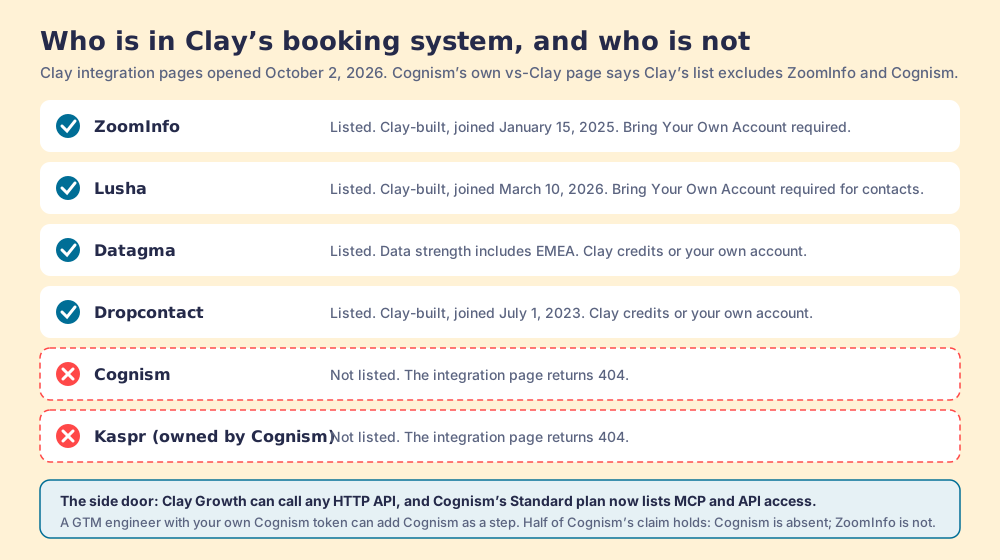
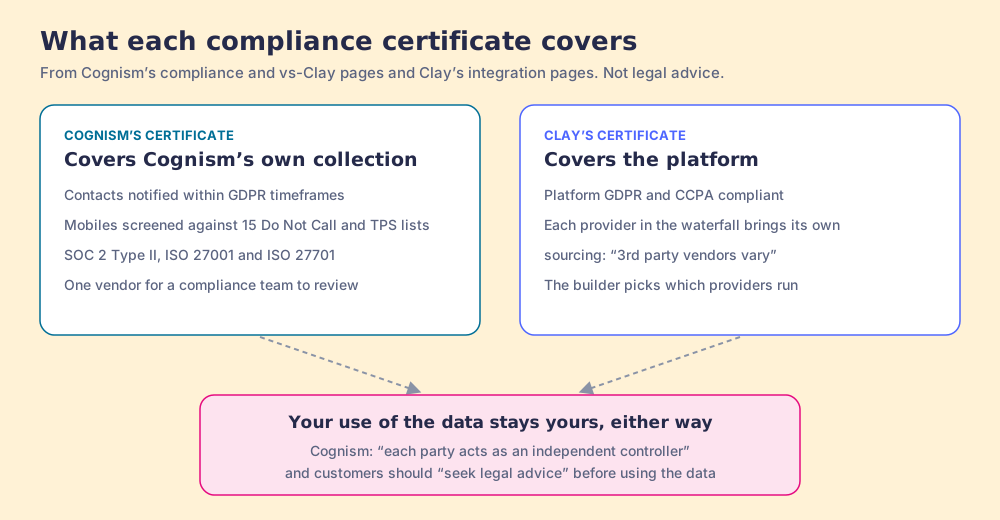
So Cognism’s line, that Clay’s list “doesn’t include industry leaders ZoomInfo or Cognism,” is right about itself and wrong about ZoomInfo. That matters for the argument Cognism builds on it. Its page says a waterfall pulling from many providers carries “compliance exposure, particularly in Europe,” and summarizes Clay’s position in one table cell: “Platform is GDPR & CCPA compliant & maintains DNC lists. 3rd party vendors vary.” That cell is fair. Each provider in a waterfall has its own sourcing, and the builder chooses which ones run. The conclusion does not follow as far as Cognism takes it, though, because Cognism’s own compliance page says that “each party acts as an independent controller of the personal data” and recommends that customers “seek legal advice prior processing and using the data.” The certificate on the rail line’s wall covers the rail line. Your use of the ticket is still yours, whichever way you booked it.
Can you add Cognism to a Clay table anyway?
Yes, through the side door, if you hold your own Cognism pass. Three published facts line up.
- Clay’s HTTP API step. Clay University: “HTTP API lets you send or retrieve data from any tool or database using an API endpoint, even when Clay doesn’t offer a native integration,” with the advice to “set up conditional run formulas to only execute HTTP API when required data is present” (Clay University, HTTP API). It sits on Growth and above. With your own key, Clay’s pricing FAQ says, “each run will count as one Action, but no Data Credit will be used.”
- Cognism’s free preview. Cognism’s API FAQ, updated July 28, 2026: “Search and Enrich API requests return preview data only and do not consume Credits.” The Enrich API takes an email or a LinkedIn URL and returns, per field, true or false for whether Cognism holds it (Cognism, Enrich and Redeem APIs).
- Cognism’s one-credit redeem. “One credit is charged per contact” on the Redeem API, which takes 1 to 20 IDs per request, and “subsequent redemptions of the same contact do not consume additional Credits” (Cognism API FAQ).
Put those together and the travel agent can phone the rail line before she books. The marketplace providers in your waterfall try for the mobile first, and a miss costs nothing. If the mobile column is still empty, an HTTP step calls Cognism’s Enrich and asks whether a mobile exists, for free. Only when Enrich reports a mobile does a second step redeem the contact, for one Cognism credit, written to the same row and synced to the CRM by the flow the builder already owns.
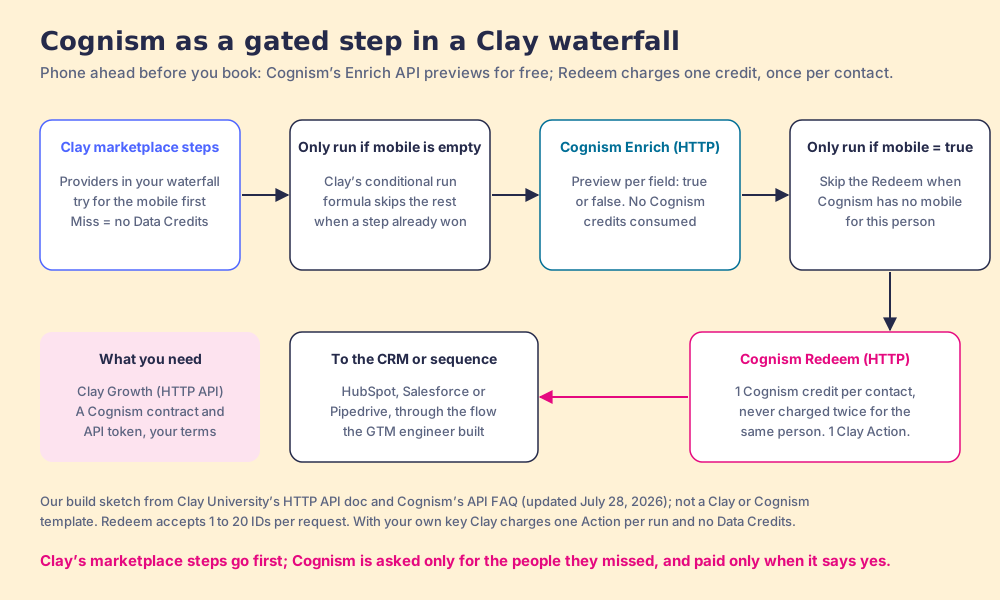
My picture breaks in one place, and it is the place to be careful. A travel agent phoning a rail line is ordinary commerce. Calling a data vendor’s API from another platform is governed by the contract you signed with that vendor, and by its data-processing terms. Read yours, or ask your Cognism account manager, before the builder wires it up. Cognism’s pricing page lists API access on Standard and says credits work across the platform and API “without extra cost,” which is encouraging; it is not the same as written permission for your use case.
The payoff, for the team that clears that check, is the best of both purchases. Cognism stops being the place reps go and becomes the step the waterfall reaches for when European mobiles miss. You pay its credit only on a confirmed yes, and the reps never learn a second tool.
Clay or Cognism: what does each cost a year?
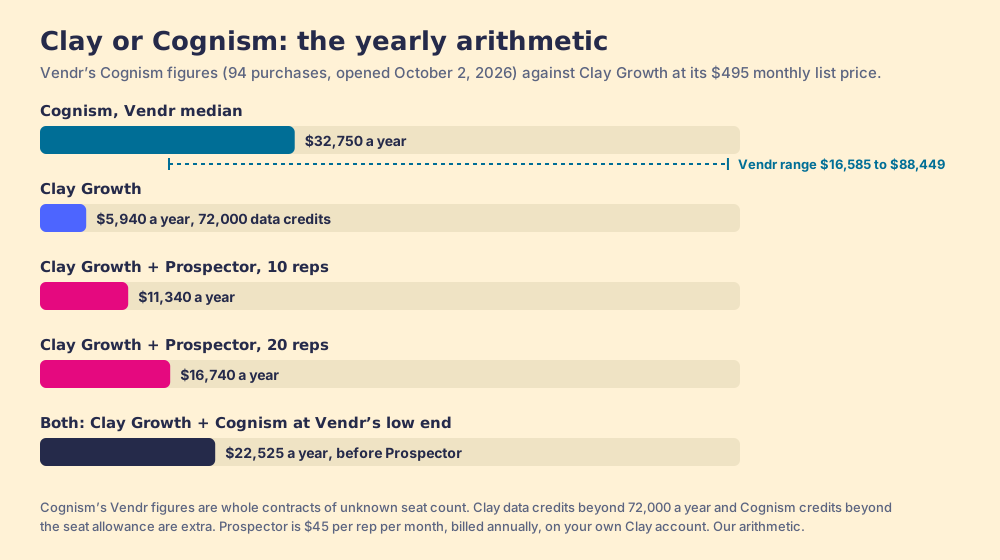
The arithmetic, worked in the open, at October 2, 2026 prices.
| Setup | Yearly cost | What it buys |
|---|---|---|
| Cognism, Vendr median | $32,750 (range $16,585 to $88,449) | Standard or Pro, 5 seats included, 10,000 or 12,000 reveals a seat |
| Clay Growth at $495 a month | $5,940 | 72,000 data credits, HTTP API, CRM auto-sync |
| Clay Growth plus Prospector, 10 reps | $11,340 | The above, run by 10 reps from where they sell |
| Clay Growth plus Prospector, 20 reps | $16,740 | The same for 20 reps |
| Clay Growth plus Cognism at Vendr’s low end | $22,525 | Both, before Prospector, with Cognism as a gated step |
Clay’s platform fee is less than a fifth of the Cognism median. Clay plus Prospector for ten reps is about a third of it, and for twenty reps about half. Two corrections: Vendr’s Cognism figures are whole contracts of unknown seat count, and Clay’s data credits beyond 72,000 a year cost extra. In the other direction, a team keeping Cognism for European mobiles while Clay covers the rest is paying $22,525 at Vendr’s low end, which is still under the Cognism median on its own.
When is Cognism the better choice than Clay?
Fair to Cognism, with the evidence. If your problem is reps dialing mobiles in Germany, the UK, and France this week, with no one on the team who builds in Clay, Cognism is the best pick on this page, and the reasons are specific.
- European mobiles, verified by people. Diamond Data is phone-verified, and a European reviewer’s main complaint is what happens outside Europe, which is a compliment to what happens inside it.
- The paperwork, in one place. Contact notification within GDPR timeframes, Do Not Call and TPS screening across 15 lists, SOC 2 Type II and two ISO certificates. A compliance team can review one vendor instead of a waterfall’s worth.
- Day one for a rep. G2 ease of setup 9.0 against Clay’s 7.7. A rep installs the extension and works.
- No builder required. Without a GTM engineer, Clay is a travel agency with an empty desk.
For that team the recommendation is Cognism. Buy Standard unless the mobile data on Pro is the reason you came, and negotiate: Vendr’s buyers average 26% off the first quote. Lusha vs Cognism and Cognism vs ZoomInfo cover the two databases it is most often weighed against.
Do you still need Cognism if your team has Clay?
Usually not for the whole team, and sometimes yes for one step. Run a 200-contact sample of your European targets through your Clay waterfall first. If the mobiles come back, you have your answer and kept $32,750. If they miss, the gated Cognism step above puts Cognism’s mobiles inside the table for a credit apiece, and you buy a smaller Cognism contract for the step instead of seats for every rep.
What a Clay team lacks is rarely data. It is reps who run the tables. Clay plus Supered is the best way for a sales team to prospect: GTM engineers build in Clay, reps never open Clay. Prospector runs inside the Supered Chrome extension on your own Clay account.
- Flows built once. The GTM engineer names flows (person enrichment, buying committee, a sequence load) and maps each to a Clay table and a destination. Your logic stays yours: waterfalls, tiers, tags, and sequence variables, including a gated Cognism step if you build one, since Prospector runs any custom Clay workflow. Start from the Supered Clay template or bring your own tables. The builder stops being the list desk (Prospector for GTM engineers).
- A Push menu where the rep sells. On a Sales Navigator lead, a company website, or a HubSpot, Salesforce or Pipedrive record, the rep picks a flow and the table runs, then sends to the CRM or your sales engagement tool. From Navigator, reps add leads to a prospect list and push the list to a Clay table.
- A check before the push. The rep sees who owns the record and whether a teammate already prospected the person, so there is no duplicate work across reps.
- Plays the rep can run alone. Research an account and pull the buying committee you defined; find the rest of the team at an existing customer; add the economic buyer and two peers to a stalled deal before the forecast call.
- Found, worked, closed. The leader sees every list found, who is working theirs, and how each lead ended the way your process says: Qualified, Recycled, or Disqualified, which is how the Clay budget grows.
On LinkedIn’s terms, in our own words: Prospector works within LinkedIn’s terms and does not copy search results in bulk; the contact data comes from Clay’s waterfall on the customer’s Clay account. Ask any vendor what its extension reads on a LinkedIn page, ours included.
Prospector does not bring its own database. It brings Clay’s waterfall, which is every database, routed, and that is why Clay sits in this comparison as one side and not as a vendor row: Clay is the row that contains the other rows. Prospector costs $45 per rep per month, billed annually, from one rep (Prospector). Skip the extra seats; get more out of the Clay you already pay for.
Choose something else if:
- No Clay, and no plan to buy it. Prospector runs only on Clay. Cognism, or a per-seat database, is the simpler buy.
- No builder, and no budget for one. If you want Clay and have no GTM engineer, RevPartners, the company I founded and now a Walker Sands company, is a Clay Elite Studio Partner that builds and tunes tables with you; otherwise Cognism is usable without one.
- Outreach in the same tool. Prospector has no sequencer and no dialer.
- A field or mobile-first team. Supered runs at the computer and has no mobile product.
Cognism vs Clay: which should you choose?
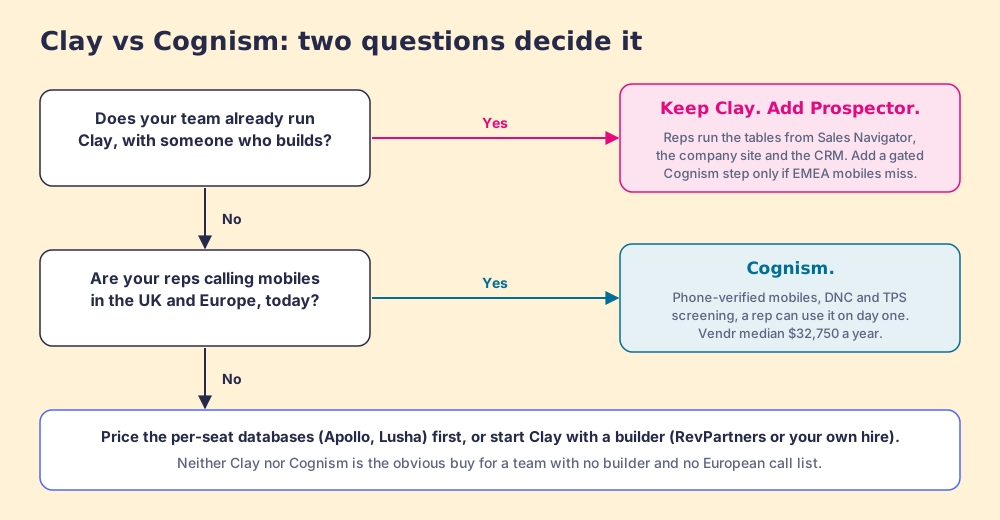
Two questions decide it: does your team already run Clay with someone who builds, and are your reps calling European mobiles today.
- Supered Prospector on your Clay. The pick for a team that already runs Clay. Reps get the GTM engineer’s tables as a button in Sales Navigator, on company sites and in HubSpot, Salesforce or Pipedrive; the leader sees found, worked, and closed. Add a gated Cognism step only if a sample shows European mobiles missing. $45 per rep per month, billed annually.
- Cognism. The pick for a team calling UK and European mobiles now, with no builder, that wants one vendor’s compliance paperwork. Vendr median $32,750 a year; negotiate from the first quote.
- Clay, run by a GTM engineer. The pick for a team with a builder and a mixed or US-heavy list that wants 200+ providers behind one contract, from $495 a month. Add Prospector when you want reps running it.
If you came to this search to pick a winner between two rivals, the better question to bring home is who in your team will book the trip. A rail line is the right purchase when the whole journey runs on its track and the traveller can walk up to the window. A travel agent is the right purchase when the journeys are many and varied and somebody sits at the desk. And when the agent cannot reach the line you need, she can still phone it, as long as you carry the pass. The Clay Chrome extension guide shows how reps run Clay tables from the page they are on, the sourcing use case follows a Navigator lead into a worked, closed list, and Clay vs ZoomInfo runs the same question against the one database Clay already routes.
Frequently asked questions
Is Clay better than Cognism?+
Does Clay integrate with Cognism?+
Is Cognism more GDPR compliant than Clay?+
How much does Cognism cost compared with Clay?+
Can reps use Clay without logging into Clay?+
Your process, running itself.