Kaspr Pricing in 2026: Four Meters on One House
Kaspr pricing checked on October 2, 2026: four plans, four credit meters, an export meter that charges every time, add-on packs that renew by themselves, and the four-pack rule for choosing Starter or Business.
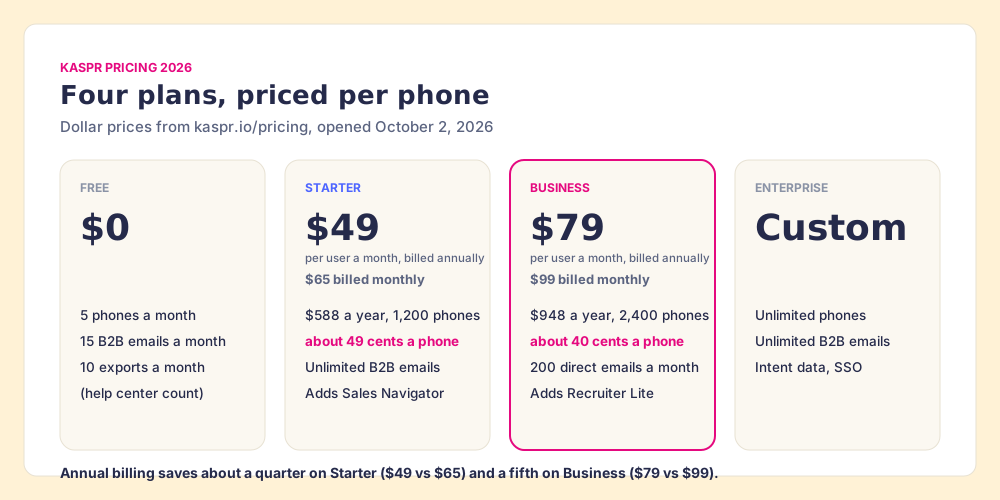
Kaspr pricing in 2026 is four plans, Free at $0, Starter at $49 per user per month billed annually ($65 monthly), Business at $79 ($99 monthly) and a custom Enterprise plan, each metered by four credit types: B2B email, phone, direct email and export.
A house has more than one meter. The water meter by the curb, the gas meter on the side wall, the electric meter by the back door, and in some towns a fourth one under the stairs that gets read only when the bill arrives. Each runs on its own rule. You can live a whole year knowing only the electric meter, right up to the month the fourth one sends the biggest bill.
Kaspr pricing in 2026 is four plans, Free at $0, Starter at $49 per user per month billed annually ($65 monthly), Business at $79 ($99 monthly) and a custom Enterprise plan, each metered by four credit types: B2B email, phone, direct email and export (kaspr.io/pricing, opened October 2, 2026). The quick answer, three ways:
- Kaspr Starter, $49 a month billed annually. An email-first rep who prospects on LinkedIn and Sales Navigator and needs about 100 phone numbers a month.
- Kaspr Business, $79 a month billed annually. Any rep who would otherwise buy four or more phone top-ups a year. The upgrade is the cheapest phone credit Kaspr sells in small amounts.
- Supered Prospector, $45 a rep a month on your own Clay account. A team that already pays for Clay and wants reps to run the GTM engineer’s tables from LinkedIn, the company site or the CRM, without buying another seat.
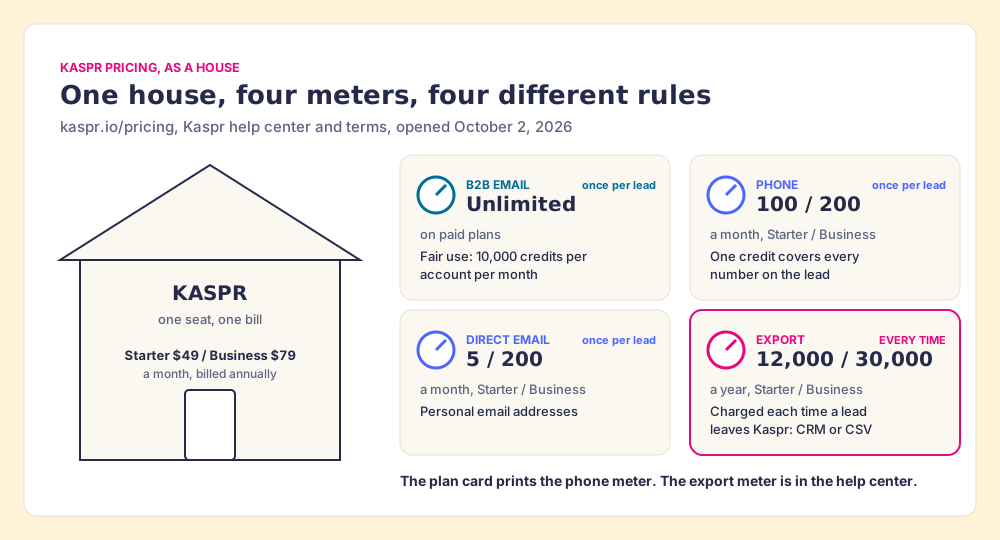
Most Kaspr pricing guides read the phone meter and stop. The phone meter is where the plan card puts its big number, and it is fair to start there. The two meters that change a team’s bill sit further down: the export meter, which runs every time a contact crosses into your CRM, and the add-on packs, which keep arriving after the busy month that made you buy them. Both are in Kaspr’s own help center and terms. Neither is on the plan card.
How much does Kaspr cost in 2026?
The pricing page shows euros, sterling and dollars, and a toggle between annual and monthly billing. The dollar figures, captured on October 2, 2026, match the capture our Kaspr alternatives page made a day earlier, so nothing moved overnight.
| Kaspr pricing (Oct 2, 2026) | Free | Starter | Business | Enterprise |
|---|---|---|---|---|
| Billed annually, per user per month | $0 | $49 (EUR 45, GBP 39) | $79 (EUR 79, GBP 69) | Custom |
| Billed monthly | $0 | $65 (EUR 59, GBP 51) | $99 (EUR 99, GBP 85) | Custom |
| One seat for a year | $0 | $588 annual, $780 monthly | $948 annual, $1,188 monthly | Custom |
| Phone credits | 5 a month | 100 a month, 1,200 a year | 200 a month, 2,400 a year | Unlimited |
| B2B email credits | 15 a month | Unlimited (fair use) | Unlimited (fair use) | Unlimited |
| Direct (personal) email credits | 5 a month | 5 a month, 60 a year | 200 a month, 2,400 a year | Custom |
| Exports | 10 a month (help center) | Up to 12,000 a year | Up to 30,000 a year | Custom |
| LinkedIn surfaces | Profiles, groups, events | Adds Sales Navigator | Adds Recruiter Lite | Same |
| Team controls | Personal credits | Shared credits, usage reports | Per-member credit limits, 2 admin seats | SSO, intent data |
Annual billing saves about a quarter on Starter ($49 against $65) and a fifth on Business ($79 against $99). Kaspr’s help center says “save up to 25% on annual plans,” which is the Starter number. Divide a seat’s year by its phones and the unit price appears: Starter is $588 for 1,200 phones, about 49 cents a phone, and Business is $948 for 2,400, about 40 cents, with B2B emails thrown in.
How do Kaspr credits work?
Kaspr credits are four separate currencies, and the help center defines them in one line each: B2B email credits reveal a work email, phone credits reveal a phone number, direct email credits reveal a personal email, and export credits move a contact “outside of the Kaspr platform, for instance into your CRM or to a CSV file” (Kaspr help, What are credits?). The rules that decide the bill sit in the same article.
- One phone credit per lead. “Regardless of the number of phone numbers associated with a lead, it will always cost 1 Phone Credit per lead.” Three numbers on one profile cost one credit. The same article warns that a phone credit may return “company landlines” alongside mobiles.
- One reveal, kept for good. Phone, B2B email and direct email credits “can only be spent once on a lead profile.” Open the same lead next week and the number is still there, free.
- A shared pool on paid plans. Starter credits are shared, “without restrictions per user.” Business adds custom member permissions to cap each rep. Free-plan credits are personal and cannot be pooled.
- A setting that spends for you. The extension’s Automatic discovery setting pre-selects all three reveal types. Kaspr’s own help article walks a user through deselecting them “so you can ensure you’re only spending credits on the contact data you’re looking for” (Kaspr help, saving credits). A G2 reviewer met the default before the article: Kaspr “automatically draws a credit whenever you are looking at a lead” (Luis Antonio M., Sales AE, January 2026).
The B2B email meter reads “unlimited” on paid plans, and Kaspr’s terms put a floor under the word. Unlimited credits “must be used reasonably by the User, and that a maximum limit of 10,000 credits per account per month applies,” and use “through APIs or robots is considered as abusive” (kaspr.io/terms, last updated July 1, 2023). The terms define an account by its login, so read the cap as per user: 10,000 a month is about 500 work emails a working day, which no person clicking through LinkedIn will reach.
What is a Kaspr export credit, and why does it charge every time?
The fourth meter works on a different rule from the other three. A reveal is a museum ticket: you pay once at the door for that lead, and you can walk back in to look at the number as often as you like. An export is a toll bridge between Kaspr and your CRM. You pay each time you cross, in either car, and the toll booth does not care that you crossed yesterday.
Kaspr’s help center says it in its own words: “Export Credits are spent every time you export your lead’s profile outside the Kaspr platform,” and “Each time you export a lead, it will cost one Export Credit. Please make sure you only export once if you’d like to save those credits.”
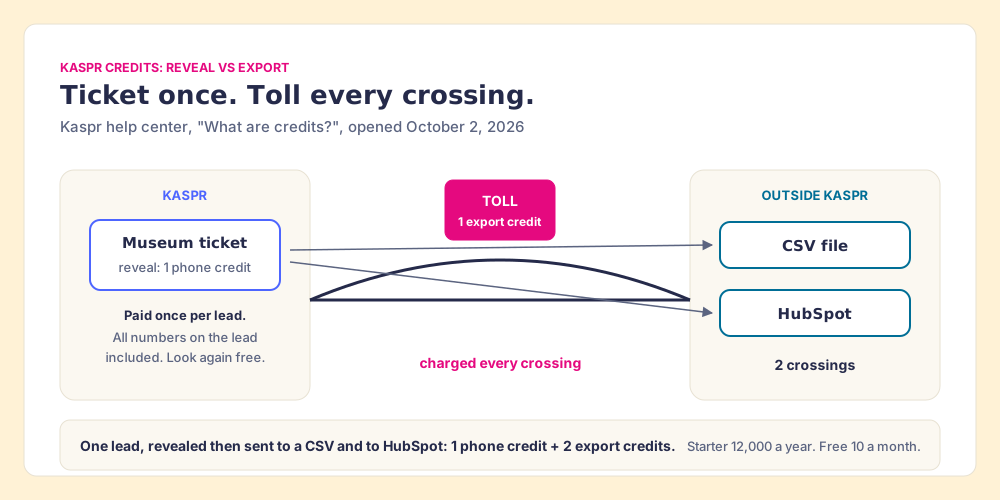
For a single rep on Starter, the bridge is wide. Twelve thousand exports a year is 1,000 a month against 100 phones, and the help center’s monthly Starter plan says the same: “1,000 Export Credits per month per license.” A rep who reveals a lead and pushes it to HubSpot once will run out of phones long before tolls.
Three situations make the toll the bill:
- The free plan. Ten export credits a month, per the help center, “which means you can only export 10 contact profiles.” A free user can reveal more contacts than they can move.
- The double crossing. A rep exports a list to a CSV to clean it, then exports the same leads to the CRM. A second sync after a field-mapping fix is the third crossing. Each one is a credit.
- Bulk enrichment. CSV enrichment and workflows push hundreds of rows at a time, and the help center warns “you may not be able to export a Bulk Enrichment file if you have run out” of export credits. Export top-ups start at $52 for 500 on the monthly view, about 10 cents each.
Is Kaspr Business worth it over Starter?
The answer comes from a rule of thumb the plan card does not print, and it is arithmetic, so anyone can check it.
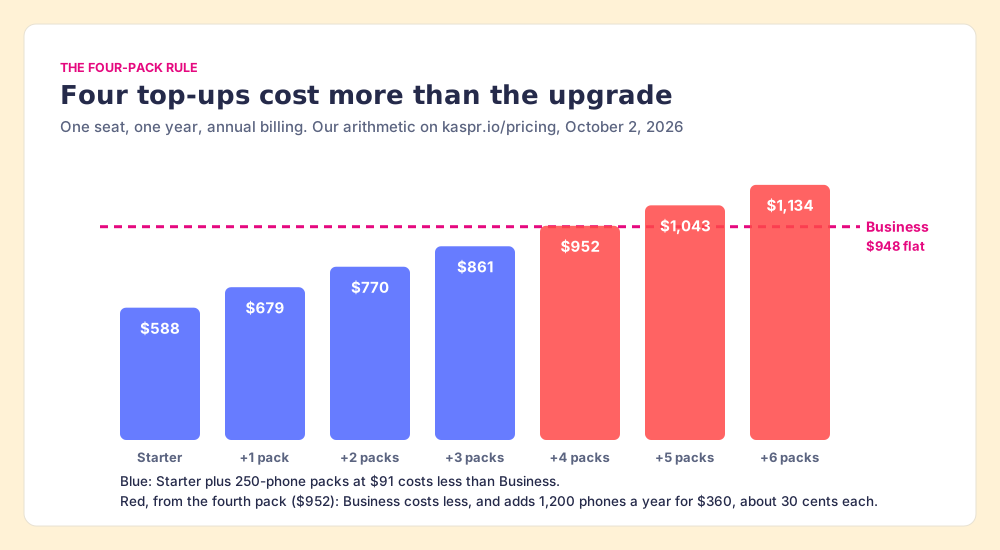
Business costs $948 a seat a year on annual billing and Starter $588. The gap is $360. For that $360 a Business seat gets 1,200 more phone credits a year (2,400 against 1,200), 2,340 more direct emails (2,400 against 60), 18,000 more exports and Recruiter Lite. Count only the phones and the upgrade is $360 for 1,200, 30 cents a phone.
Now price the top-up instead. Kaspr’s smallest phone pack is 250 credits for $91 on the monthly view, 36 cents each, and the annual view sells 2,500 for $901 at the same rate (kaspr.io/pricing, add-on table). Four monthly packs cost $364, four dollars more than the whole upgrade. That gives the four-pack rule: a Starter rep who would buy a phone top-up in four or more months of the year belongs on Business. Below that, stay on Starter and top up in the months that need it.
The rule assumes the rep reads the help center’s other warning, because a top-up does not stay a one-off.
Do Kaspr add-on credits renew automatically?
Yes, and it is the meter that costs teams the most for the least. Think of a newsagent. You ask for an extra paper during a busy week, and the paper keeps arriving every week after, because the newsagent wrote it into your standing order. You pay for the ones you never open.
Kaspr’s help center on add-ons: “Keep in mind that they are automatically renewed, and any unused credits within the billing period won’t roll over” (Kaspr help, add-on credits). The terms say the same in contract language: at renewal “the number of additional Credits previously billed will be maintained, by default, and billed as part of the upcoming Subscription,” and “Additional Credits not used during a Subscription are lost.”
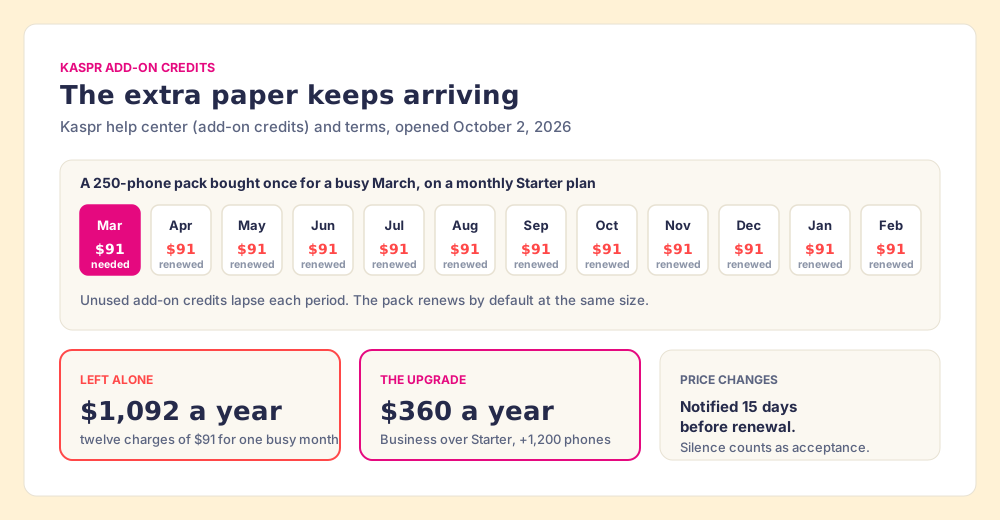
Walk it forward. A rep on monthly Starter buys one 250-phone pack in March for a trade-show list. The pack stays on the account. By February the pack has billed twelve times, $1,092, for phones the rep needed once. Two more clauses sit in the same terms. Kaspr can revise prices, notified “15 days before the renewal,” and “Silence on the part of the Subscriber within 15 days of notification of the price revision of the Subscription shall constitute acceptance of the change.” And downgrading or cancelling needs notice: 48 hours before the end of a monthly subscription, one month before the end of an annual one, or “the Subscription will be automatically renewed.”
The rollover question has two answers on Kaspr’s own pages, and both are true. The plan comparison and the help center list “Credit rollover” on paid plans, so unused monthly plan credits carry to the next month. The terms say subscription credits “expire at the end of the current Subscription period,” with an exception for “certain types of PREMIUM Subscriptions.” Read together: plan credits roll month to month inside a subscription term, add-on credits do not roll at all, and everything resets at renewal unless your plan is one of the exceptions. Ask which one yours is before you prepay a year.
One small fact-check while the table is open. The dollar add-on row for 2,500 phones prints $644 and “$0.31” per credit. The division gives about 26 cents, and the euro row prints EUR 0.25. Trust the total.
What does the Kaspr free plan include?
The Kaspr free plan is a fair trial and a thin plan, and Kaspr’s two pages describe it differently. The pricing page lists 15 B2B email credits, 5 phone credits and 5 direct email credits a month. The help center lists 5 phones, 5 direct emails, “10 Export Credits per month” and “Unlimited B2B Emails (after inviting three colleagues with gold invitations!)” (Kaspr FAQs). To sign up you need a verified business email and “at least 20 connections on your LinkedIn account.”
Five phones a month answers one question: does Kaspr find the numbers for the people you sell to? Test it on twenty names you already have numbers for and count the matches, mobiles and landlines separately. That is a better use of the free plan than prospecting with it.
What does the Kaspr Chrome extension cost?
The Kaspr Chrome extension is the product. It is free to install and runs on every plan, Free included, on LinkedIn profiles, groups and events, and pushes to HubSpot, Salesforce, Pipedrive and other CRMs. On October 2, 2026 the Chrome Web Store listing showed 100,000 users and a 4.7 out of 5 rating from 1.2K ratings, version 2.0.20 updated June 15, 2026. The plan decides where it works: inside Sales Navigator from Starter, inside LinkedIn Recruiter Lite from Business. A team whose reps live in Sales Navigator cannot stay on Free.
Why do teams leave Kaspr?
Fair first. Kaspr held a 4.4 out of 5 from 838 reviews on G2 on October 2, 2026 (G2, Kaspr reviews), and it publishes every self-serve price, which is rarer in this category than it should be. It is part of Cognism, which acquired it in April 2022; we found no 2026 acquisition or funding news for either. The complaints cluster where the meters are:
- The phone pour. “The credit system depletes rapidly when engaging in high volume sourcing” (Dev S., Sr. Account Manager, Mid-Market, G2, December 2025). The Bridge Group’s 2025 SDR report puts the median SDR at 44 dials a day (Bridge Group, 2025). If every dial needed a new number, Starter’s 100 would last under three working days and Business’s 200 under five. Reps redial, so the real burn is slower, but the direction holds.
- The bridge to the CRM. “Every batch of contacts must be exported and uploaded manually” (Stefan L., International Trade Manager, Mid-Market, G2, June 2026). Each batch is a crossing, and each crossing is a toll.
- One kitchen. Kaspr’s data page leads with “200 million + European B2B contacts” (kaspr.io/our-data). When it misses a phone or returns a landline, the rep has no second source inside the same click.
Why trust this breakdown?
We sell no contact data. Supered has no database, on purpose; Prospector runs on Clay, the only data provider we use. I started RevPartners, a HubSpot partner that did only sales implementations, sold roughly twice as much Sales Hub as any other partner and reached Elite tier in 13 months, and Supered came out of that work. Supered is the #1 sales enablement app on the HubSpot marketplace, 5.0 from 122 reviews there and 4.9 out of 5 from 81 reviews on G2, checked October 1, 2026. We make Supered Prospector, which is why it appears below, after Kaspr’s prices and with the cases where it is the wrong buy.
Which Kaspr plan, or which alternative, fits your team?
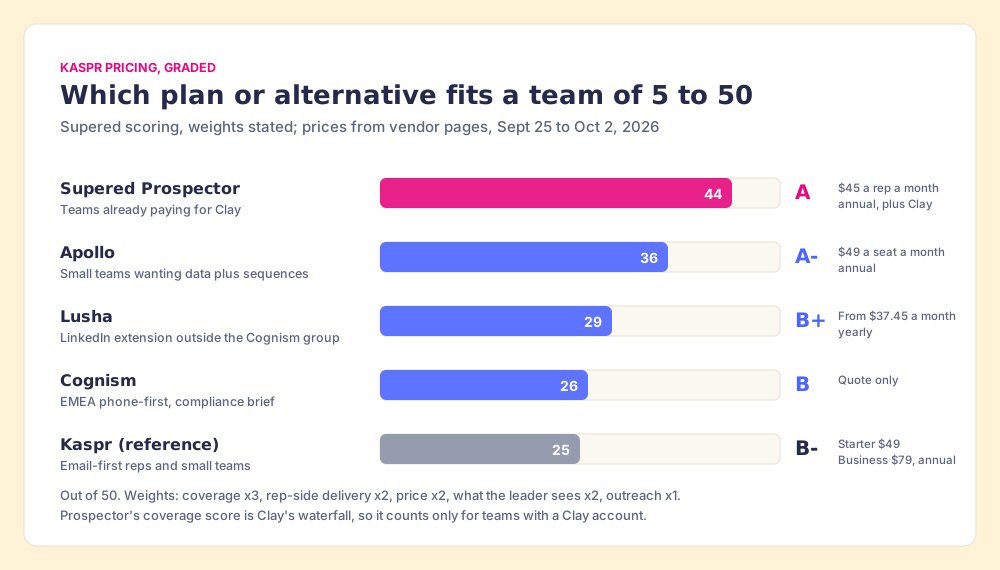
The grades use the five weights from the Kaspr alternatives page, out of 50: coverage of the contact you need (x3), delivery where the rep already works (x2), price structure for a mid-market team (x2), what the leader sees after the export (x2), and bundled outreach (x1). The weights serve a team of five to fifty reps building its own lists. Reweight for one founder on a card and Kaspr climbs into the top two.
| Rank | Option | Grade | Best fit | CRM integration | Setup effort | Pricing (plan with the feature) | Reason to switch |
|---|---|---|---|---|---|---|---|
| 1 | Supered Prospector | A (44) | Teams already paying for Clay | Native: HubSpot, Salesforce, Pipedrive | Demo, then live on your own Clay account | $45 a rep a month billed annually, plus your Clay plan | Clay’s waterfall across 200+ vendors from the rep’s own screen; see each list found, worked and closed |
| 2 | Apollo | A- (36) | Small teams wanting data plus sequences | Native: HubSpot, Salesforce | A day | $49 a seat a month billed annually (Sept 25, 2026) | Sequencer and dialer in the same seat |
| 3 | Lusha | B+ (29) | Like-for-like LinkedIn extension outside the Cognism group | Native: HubSpot, Salesforce | Minutes | Starter $37.45 a month billed yearly (Sept 25, 2026) | A credit pool that spends on email or phone |
| 4 | Cognism | B (26) | EMEA phone-first teams with a compliance brief | Native | Weeks | Quote only; Vendr median $32,750 a year | Phone-verified mobiles; same owner as Kaspr |
| ref | Kaspr | B- (25) | Email-first reps and small teams on LinkedIn | Native: HubSpot, Salesforce, Pipedrive, Zoho | Minutes | Starter $49, Business $79, billed annually | The reference: published prices, unlimited work emails |
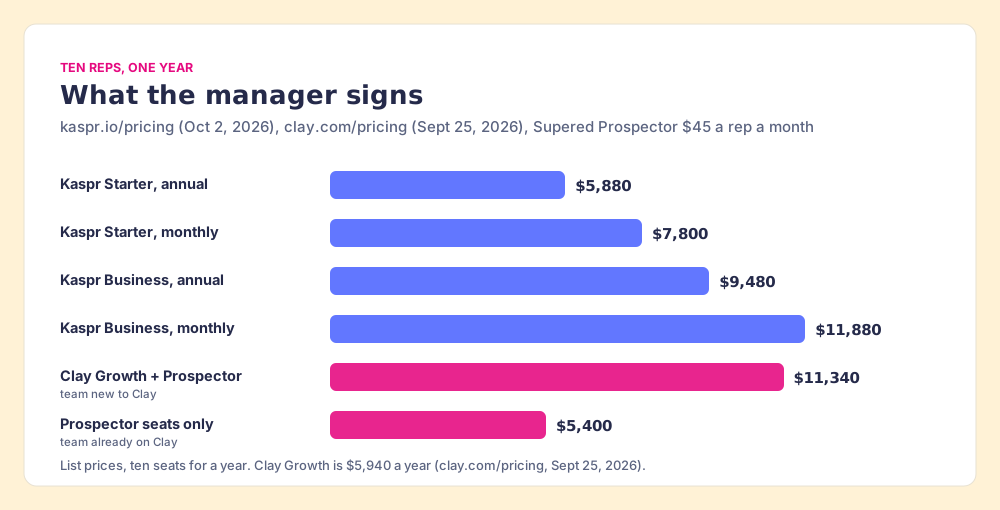
Ten reps, one year, on list prices: Kaspr Starter is $5,880 on annual billing and $7,800 monthly; Kaspr Business is $9,480 annual and $11,880 monthly.
For the Apollo and Lusha ladders, Lusha pricing and Kaspr vs Lusha work the same arithmetic; for Kaspr’s parent, Cognism pricing shows the platform fee.
How does Supered Prospector compare to Kaspr pricing?
Kaspr is one kitchen with a long supplier list; its data page says “120+ verified data sources and providers.” When the dish is not on the menu, the rep has nowhere else to order inside the same click, and the company signs a second contract to fill the gap.
Clay works the other way. A waterfall is a list of instructions a GTM engineer writes down: ask this provider first, then that one, and stop when a verified email or phone comes back, across 200+ data and AI vendors under one contract (clay.com, September 25, 2026). And Clay prints a rule Kaspr’s terms do not: “If an enrichment returns no result, you’re not charged Data Credits or Actions” (clay.com/pricing). Prospector does not bring its own database. It brings Clay’s waterfall, which is every database, routed. We chose Clay as our only data provider for that reason.
Clay plus Supered is the best way for a sales team to prospect: GTM engineers build in Clay, reps never open Clay. Prospector runs inside the Supered Chrome extension on the team’s own Clay account, and each person in the motion gets something different.
- The GTM engineer. You built the tables, and you have become the list desk. With Prospector you build named flows once, each mapped to a Clay table or function, and reps pick them from a Push menu. Your waterfalls, tiers, tags and sequence variables stay yours. Start from the Supered Clay template or bring your own tables.
- The rep. Your team’s table becomes a button in Sales Navigator, on a company’s website and in the HubSpot, Salesforce or Pipedrive record. Reps add Sales Navigator leads to a prospect list and push the list to a Clay table. Before pushing, they see who owns the record and whether it was prospected before, so two reps do not work the same person. Prospector works within LinkedIn’s terms and does not copy search results in bulk; the contact data comes from Clay’s waterfall on the customer’s Clay account.
- The leader. Found, worked, closed. Found: reps use your tables, no duplicate work. Worked: see who is working their list, and who is not. Closed: every lead ends the way your process says, Qualified, Recycled or Disqualified. That view is how the Clay budget grows.
The plays follow from there: research an account and pull the buying committee you defined, load a new-logo sequence from any lead, find the rest of the team at a customer, push a past champion who changed jobs, or add the economic buyer and two peers to a stalled deal before the forecast call.
The arithmetic, since a Kaspr seat is cheap. Prospector is $45 per rep per month billed annually, $540 a year, from one rep (Prospector). That is $48 a year less than a Kaspr Starter seat, but Prospector needs a Clay plan underneath. Clay’s Growth plan lists at $495 a month, $5,940 a year, so ten reps on Clay Growth plus Prospector come to $11,340, against $5,880 for ten Kaspr Starter seats and $9,480 for ten on Business (the Clay pricing page shows the credit math). A team that already pays for Clay pays only the $540 per rep, $5,400 for ten. Skip the extra seats. Get more out of the Clay you already pay for.
Choose something else if you do not have Clay. Prospector runs on the customer’s Clay account and does nothing without one. If you want Clay and someone to build the tables, RevPartners, the company I founded, is a Clay Elite Studio Partner that does that work; any good Clay agency can. Choose something else, too, if you are one or two email-first reps living on LinkedIn: Kaspr Starter’s unlimited work emails at $49 a seat are hard to match, and the Clay Chrome extension guide explains when a Clay front end is worth it and when it is not.
What we recommend
The ways forward, by the meter that runs your bill:
- Kaspr Starter on annual billing. One to five reps, email-first, under 100 new phones a month in most months. Turn off Automatic discovery on day one, export each lead once, and top up in the busy months.
- Kaspr Business on annual billing. Any rep who would buy a phone top-up in four or more months of the year, or who needs Recruiter Lite or 200 personal emails a month. The upgrade is 30 cents a phone.
- Kaspr monthly. Only to test coverage before you prepay. Remove every add-on before the period ends, and calendar the 48-hour notice.
- Supered Prospector. A team already paying for Clay whose reps should run the GTM engineer’s tables from Sales Navigator, the company site and the CRM, and whose leader wants each list followed from found to closed.
What we recommend: if you do not have Clay, Kaspr is a fair price, and Business is the plan most phone-using reps should be on, because the four-pack rule makes the upgrade cheaper than the top-ups. Read the export and add-on lines before you sign, since those two meters, not the phone meter on the card, are where Kaspr bills grow. If you do have Clay, do not add another single-database seat. Put the waterfall your GTM engineer already built behind a button on the rep’s screen, and see which lists turn into deals. The sourcing use case shows how teams set that up, and a Prospector demo runs it on your own Clay account.
Frequently asked questions
How much does Kaspr cost in 2026?+
How do Kaspr credits work?+
What does the Kaspr free plan include?+
How much does the Kaspr Chrome extension cost?+
Is Kaspr Business worth it over Starter?+
Is there a cheaper option if my team already pays for Clay?+
Your process, running itself.