Is RocketReach Legit? A 2026 Review From the Three Chairs Around It
Is RocketReach legit? Yes, and the answer changes with who is asking. Checked October 2, 2026: G2 4.4 against Trustpilot 1.2, the accuracy fine print, renewal complaints, the $1.6 million Illinois settlement, how to get off it, and who should buy.
Is RocketReach legit? Yes: RocketReach is a real, independent contact-data company with posted prices and a product buyers rate 4.4 out of 5 on G2, and the answer shifts with whether you buy it, use it to reach someone, or are listed in it.
In 1887 R.L. Polk & Co. printed a city directory of Baltimore. Directories like it, the Library of Congress explains, gave “specific information on a locality’s residents and addresses,” and often their occupation, and they were updated often, at least once a year (Library of Congress). Merchants bought them to find customers. The people listed in them had not asked to be. The directory was a legitimate business, and whether it was a good thing depended entirely on which side of the page you stood.
RocketReach is that directory for the working world, 700 million professionals and 60 million companies by its own count (rocketreach.co/pricing, checked October 2, 2026). So “is RocketReach legit” gets typed by three different people. The buyer wants to know whether the data works and the billing is fair. The job seeker, whose Reddit thread “Ethics of Rocketreach: To use or not to use?” sits second on Google for this query, wants to know whether it is all right to use. And the person inside the directory asks Google’s own follow-ups: why does RocketReach have my details, and can I get myself off it. The quick answer, checked October 2, 2026:
- RocketReach itself. A legitimate, fairly priced buy for one to five people who find a handful of contacts a day. $399 to $1,699 a seat a year.
- Supered Prospector. The pick for a sales team that already pays for Clay: reps run Clay’s waterfall across 200+ vendors from where they sell, without a seat in a second database. $45 per rep per month, billed annually.
- Apollo. The non-Clay switch when the team wants calls and sequences in the same seat as the data.
Is RocketReach legit? Yes: RocketReach is a real, independent contact-data company with posted prices and a product buyers rate 4.4 out of 5 on G2, and the answer shifts with whether you buy it, use it to reach someone, or are listed in it.
Is RocketReach legit?
As a company and a product, yes. Amit Shanbhag and Andrew Tso founded RocketReach in 2015, and Brighton Park Capital took a majority stake in August 2020 (Cascadia Capital). It is still independent: in February 2026 it shipped AI email sequences and expanded intent data (PR Newswire, February 17, 2026), and a news search on October 2 found no acquisition or funding round this year. It posts every self-serve price, gives a free account 5 lookups with no card, and refunds a lookup that finds nothing verified.
The RocketReach reviews, gathered on one day:
| Where | Who is reviewing | Rating | Reviews | Checked |
|---|---|---|---|---|
| G2 | Verified buyers and users | 4.4 of 5 | 1,385 | October 2, 2026 |
| Chrome Web Store | Installed users (300,000) | 4.2 of 5 | 459 ratings | October 2, 2026 |
| Capterra | Verified buyers and users | 4.1 of 5 | 140 | October 2, 2026 |
| Trustpilot | Anyone: customers and people in the database | 1.2 of 5 | 1,110 | October 2, 2026 |
Sources: G2, Chrome Web Store, Capterra, Trustpilot.
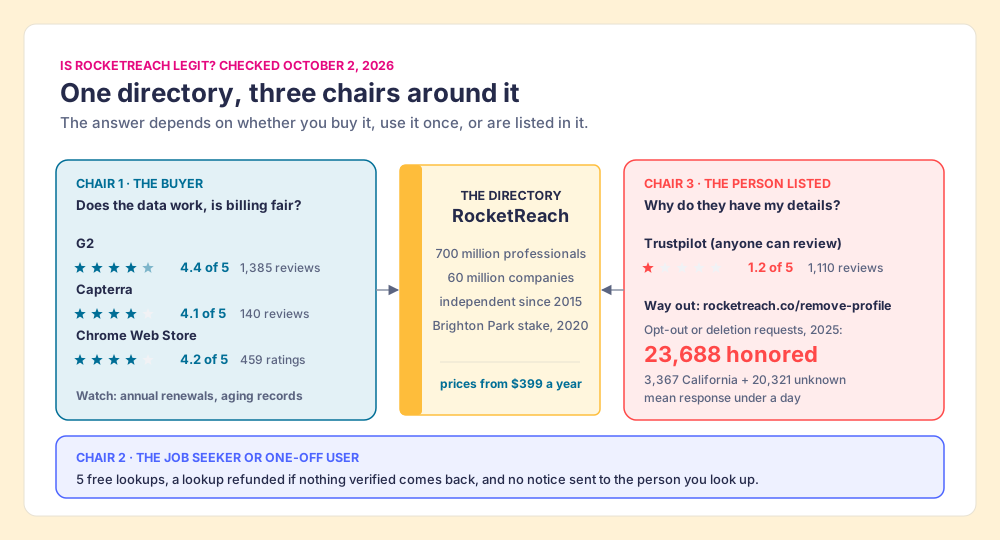
One more detail from the same day. The pricing page says RocketReach is “Trusted by over 30 million users.” Its accuracy article says “over 26 million users.” Its own Chrome listing says “13 million users.” Three official pages, three numbers, same day. None of that makes the company less legitimate. It does tell you how much weight to put on any single number a data vendor prints about itself, including its accuracy figure.
What do RocketReach reviews say about the data?
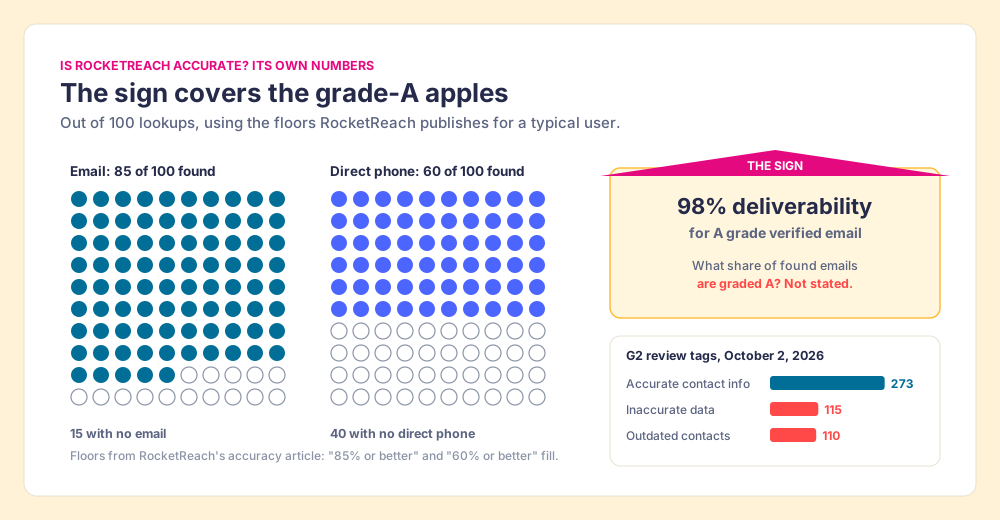
The buyers mostly like it, and they disagree about the one thing that matters most. G2 tags its reviews by theme. On October 2, the largest praise tag was “Accurate and direct contact information,” in 273 reviews. The largest complaint tags were “Inaccurate data” in 115 and “Outdated contacts” in 110, with “Missing Emails” in 69. Both camps are telling the truth about their own lists. On Capterra, Ilaria L. wrote in February 2026 that “sometimes the information is not up to date,” and Saige K. wrote that her company has “a limit with the amount of contacts that we can export so I often reach my limit” (Capterra, April 2025).
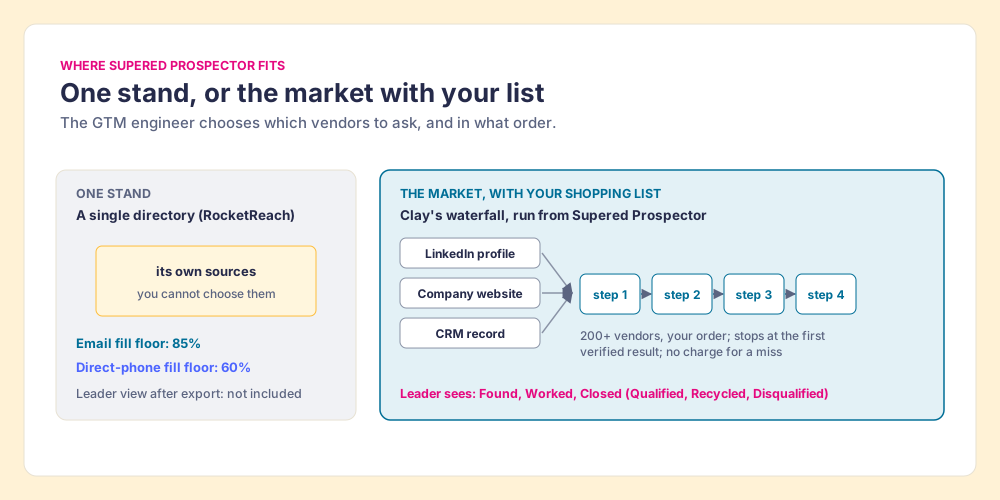
RocketReach’s own numbers explain the split better than any single review. Its pricing page promises “98% accuracy.” Its knowledge base article on accuracy narrows it: “98% deliverability for A grade verified email address” (RocketReach knowledge base). The same article says “a typical user experiences 85% or better fill rate for email addresses and a 60% or better fill rate for direct phone numbers.”
A fruit stand can put “98% perfect” on the sign over the grade-A apples, and the sign can be true. It does not tell you how many of the apples in your bag were grade A, or how many bags came home with no apples at all. Read RocketReach’s numbers the same way. Out of 100 people you look up, the article’s own floors leave about 15 with no email and 40 with no direct phone. Of the emails it does find, 98% deliver if they carry an A grade, and the article does not say what share do.
None of this is unusual for a single database. A contact record starts aging the day it is verified, and any one vendor misses the people its sources never reached. The fix the category has settled on is asking a second source when the first comes back empty, which the waterfall enrichment guide walks through. RocketReach says it draws on “more than a dozen sources” behind the one answer it returns, and you cannot choose which.
Why do RocketReach reviews on Trustpilot mention renewals?
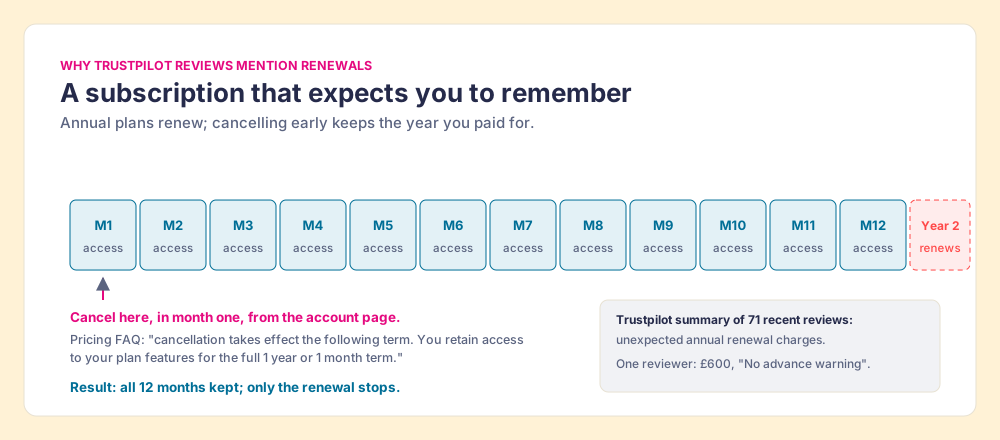
RocketReach’s Trustpilot score of 1.2 comes from two groups, and the first group paid. Trustpilot’s own summary of 71 recent reviews says “Customers frequently experienced unexpected charges for annual subscriptions due to automatic renewals.” One reviewer wrote on August 31, 2026 that an annual plan was “automatically renewed by RocketReach at a cost of £600. No advance warning so I could cancel.” Another, who otherwise liked the product, wrote on August 15: “The service for the most part works well. The price you get from Apollo is better.”
The terms are on the pricing page, in the FAQ, and they read the same today as in September: “you can cancel anytime through your accounts page. Since you prepay for a year or month, cancellation takes effect the following term. You retain access to your plan features for the full 1 year or 1 month term.” The renewals are by the contract. The complaints are about the absence of a reminder before the card is charged.
A magazine that renews itself is not a scam. It is a subscription that expects you to remember. The practical reading of RocketReach’s own FAQ is kind to the careful buyer: because cancelling keeps your access for the term you already paid, you can cancel on the day you subscribe and lose nothing but the renewal.
Why does RocketReach have my details?
The second Trustpilot group never bought anything. “Scam company that scraped my professional information, and the parts they could not get they guessed wrong and published it,” one wrote on August 21, 2026. Another, on August 10, complained of RocketReach “correctly guessing my otherwise unlisted email.” A third quoted a Google alert that read “You shared some Google Account data with RocketReach,” from a company the reviewer had never heard of.
All three experiences match what RocketReach says in its privacy policy, updated September 30, 2026 (RocketReach privacy policy). The directory is filled from four pipes:
- Web scanning. “Our search technology scans the web and collects publicly available information from third party websites, such as, social media sites, corporate websites and public records.”
- Inference. “Our technology may also infer Personal Data about you by making assumptions based on publicly available information, such as inferring professional email addresses based on common formats used at a particular company.” That is the guessed email, right or wrong.
- Bought data. Third parties “such as people directories, data brokers, corporate information directories, business partners, affiliates, advertising networks.”
- Connected email accounts. Customers who opt in share “address book information, email header, contact information, email signature blocks” by connecting a Google or Microsoft account. Your details can arrive because someone you emailed connected their inbox.
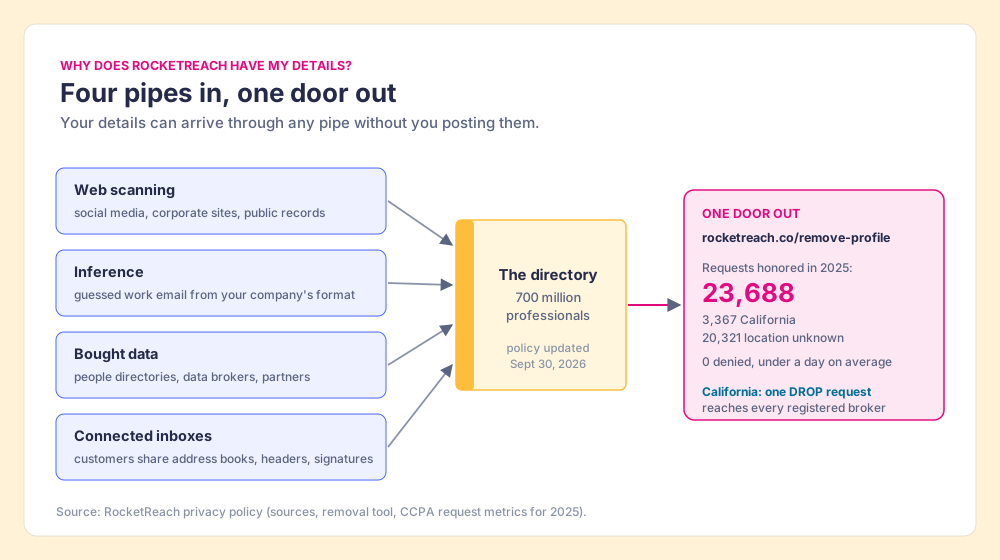
Getting off RocketReach is easier than the angriest reviews suggest. The removal form at rocketreach.co/remove-profile doubles as its Do Not Sell or Share tool. The privacy policy publishes the 2025 counts California law requires: 3,367 opt-out or deletion requests from California residents and 20,321 from people whose location it could not determine, every one complied with, mean response under a day. RocketReach says it treats both kinds of request the same way, “by removing the consumer’s personal information from our database.” Californians have a second road: RocketReach LLC is on the state’s 2026 data broker registry (CPPA registry, updated July 29, 2026), so one request through the state’s DROP system reaches it along with more than 600 other brokers (CalPrivacy, DROP). The policy also carries a Texas data broker notice.
The job seeker’s question, “will someone know if I look them up on RocketReach,” has a narrower answer. Nothing in the privacy policy or the privacy FAQ describes notifying a person when they are looked up, and the FAQ says customer and user data “is kept private and segregated from our main email database.” The person finds out when your email arrives. Whether that is welcome depends on the email.
Has RocketReach been sued or fined?
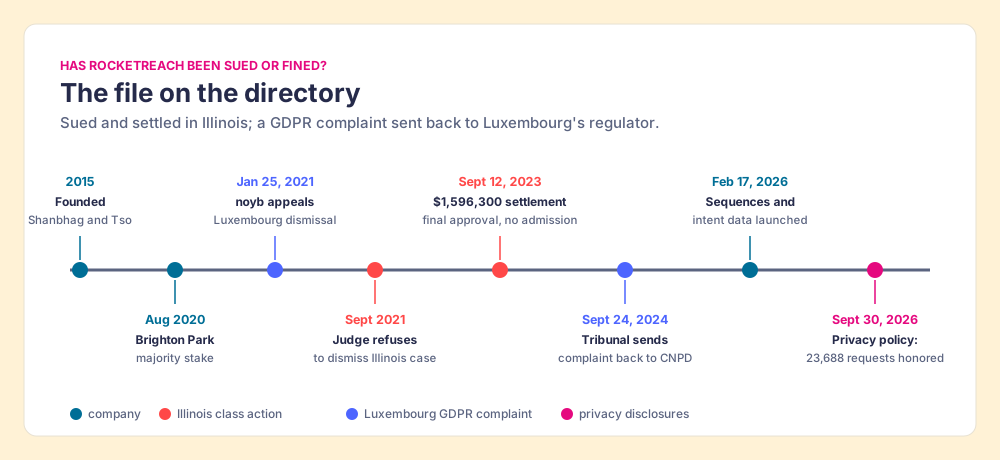
Sued, yes, and it settled. In Krause v. RocketReach, LLC (No. 21-cv-01938, N.D. Ill.), an Illinois woman who had never been a customer claimed RocketReach used people’s names, employers, job titles and social links to advertise its paid plans, in breach of the Illinois Right of Publicity Act. Judge Elaine Bucklo refused to dismiss the case in September 2021, writing that RocketReach “misses the point” by treating inclusion in a directory as the same thing as using a name to sell subscriptions (Top Class Actions, September 27, 2021). The settlement created a $1,596,300 fund for Illinois residents whose names appeared next to a “+Phone Plan” link between April 12, 2020 and April 11, 2023, with estimated payments of $146 to $243 a claim (class notice). It received final approval on September 12, 2023, and RocketReach admitted no wrongdoing (Top Class Actions).
Fined, no, though one European file is still open. A Luxembourg resident complained to his national regulator, the CNPD, that RocketReach and Apollo were processing his data. The CNPD agreed GDPR applied and dismissed the complaints anyway, because neither company had a representative in the EU, which noyb points out “is by itself a violation of the GDPR.” noyb appealed in January 2021, and on September 24, 2024 Luxembourg’s administrative tribunal held that the CNPD “illegally/wrongfully decided to not pursue the handling of the complaint” and sent it back (noyb). No decision on the remanded complaint has been published.
For a buyer, the line that matters most is in RocketReach’s privacy FAQ: “RocketReach is not responsible for the individual usage of the data once found” (RocketReach privacy FAQ). The directory sells you the address. What you send to it is yours. That settles “is RocketReach safe” for a buyer: the product is, and the use you make of what it finds is your responsibility. RocketReach gives you one tool for that, a setting that filters people in the EU out of search results, and the same FAQ points you to the GDPR guidelines for the rest. None of this is peculiar to RocketReach. Apollo (as Zenleads, Inc.), ZoomInfo, Lusha and Clay Labs sit on the same California registry, and the Lusha review found a larger European ruling against Lusha, since suspended by a Rome court.
Here the directory picture needs its edge marked. A printed directory recorded where a household lived. RocketReach’s inference engine writes down what it expects your email to be, and sometimes it is wrong. A wrong line in a phone book cost someone a misdelivered letter. A wrong line in a sales database costs a bounce, a call to the wrong person, and a name on Trustpilot.
Why trust this RocketReach review?
I built RevPartners, a HubSpot partner that did only sales implementations, sold roughly twice as much Sales Hub as any other partner, and made Elite tier in 13 months. Supered grew out of that work and is the #1 sales enablement app on the HubSpot marketplace, rated 5.0 from 122 reviews there and 4.9 from 81 on G2, checked October 1, 2026. We make Supered Prospector, which competes with RocketReach for sales teams on Clay, and it ranks first below for that job only. The ratings above carry dates and links, and the scores below show their weights.
How does RocketReach compare with the alternatives?
The lens is a sales team of ten to fifty reps that wants contact data reps will use where they already sell, and a leader who can see which lists turn into pipeline. Each tool scores 1 to 5 on five criteria, weighted: coverage of the contact you need (x3), rep-side delivery (x2), price structure (x2), what the leader sees after the export (x2), and bundled outreach (x1), out of 50. The scores match the RocketReach alternatives page and the RocketReach pricing breakdown. Legal history is not scored; it is reported above for you to weigh.
| Rank | Tool | Grade | Score | Best fit | CRM integration | Setup effort | Pricing | Reason to switch from RocketReach |
|---|---|---|---|---|---|---|---|---|
| ref | RocketReach | B- | 23 | One to five people finding a few contacts a day | Native from Pro (HubSpot, Salesforce, Outreach, Salesloft, Bullhorn) | Minutes | $399 to $1,699 a seat a year; teams from $6,000 | Stay if 3,600 exports a seat a year covers the work |
| 1 | Supered Prospector | A | 44 | Sales teams that already pay for Clay | Native (HubSpot, Salesforce, Pipedrive) | Under a week on an existing Clay account | $45 per rep per month, billed annually, plus your Clay plan | 200+ vendors behind each lookup, no Clay login for reps, lists followed to closed |
| 2 | Apollo | A- | 36 | Small teams wanting data, dialer and sequences in one seat | Native (HubSpot, Salesforce) | A day | $49 per seat per month, billed annually | 30,000 credits a seat a year, outreach included |
| 3 | Lusha | B+ | 29 | LinkedIn-first reps on a low commitment | Native (HubSpot, Salesforce, Pipedrive) | Minutes | Free to $3,599.10 a year | A free tier and the simplest start |
RocketReach’s 23 is coverage 2, rep-side delivery 3, price 4, what the leader sees 1, outreach 1. The price 4 is earned: posted, refunded on a miss, and cheap per export on Ultimate. The coverage 2 is the one-database ceiling the G2 complaint tags describe. Prospector’s coverage 5 belongs to Clay’s waterfall, and its outreach score is 1 because it has no dialer and no sequencer.
Where does Supered Prospector fit?
Clay plus Supered is the best way for a sales team to prospect: GTM engineers build in Clay, reps never open Clay. Prospector carries no directory of its own. It runs inside the Supered Chrome extension, on the team’s own Clay account, and turns the tables the GTM engineer already built into a button on the page where the rep is working. We picked Clay as our only data provider because Clay is the waterfall across 200+ data and AI vendors, checking provider after provider until one returns a verified email or phone (clay.com), and its pricing page states that “If an enrichment returns no result, you’re not charged Data Credits or Actions” (clay.com/pricing).
Back to the fruit stand. A single directory is one stand with one sign. Clay’s waterfall is the whole market, and the GTM engineer writes the shopping list: which stalls to visit, in what order, and which to skip. A team uneasy about any one provider’s provenance takes it off the list.
What each of the three people around the table gets:
- The GTM engineer. No more acting as the list desk. Build named flows once, each one a Clay table or function with a destination, and reps pick them from a Push menu. Waterfalls, tiers, tags and sequence variables stay yours. Start from the Supered Clay template or bring your own tables.
- The rep. The table as a button on a LinkedIn profile, a company website, or a HubSpot, Salesforce or Pipedrive record. Sales Navigator leads go onto a prospect list, and the list goes to a Clay table. Before pushing, the rep sees who owns the record and whether a teammate prospected it before, so two reps do not work the same person. Plays cover research with the buying committee you defined, new logos, expansion, job changers and stalled deals.
- The leader. Found, Worked, Closed: which lists reps found, who is working theirs and who is not, and how each lead ended the way your process says, Qualified, Recycled or Disqualified. That view is how the Clay budget grows.
Prospector works within LinkedIn’s terms and does not copy search results in bulk; the contact data comes from Clay’s waterfall on the customer’s Clay account. Clay Labs is a registered California data broker too, so put the provenance questions in this review to Clay and to each provider in your waterfall.
The cost, side by side for ten reps. Ten RocketReach Pro seats list at $8,990 a year, and RocketReach’s team plans start at $6,000. Clay Growth lists at $495 a month, $5,940 a year (Clay pricing), and Prospector adds $45 per rep per month billed annually, $5,400 for ten (Prospector), so $11,340. RocketReach is cheaper on list price for the same headcount. The difference buys every vendor behind each lookup, control over which vendors, no second database seat per rep, and lists you can follow to closed.
Choose something else if you have no Clay account: Prospector runs on the customer’s Clay account and does nothing without one, and someone has to build the tables. RevPartners, a Clay Elite Studio Partner I founded, builds and tunes them for teams that want help. Choose something else, too, if you are one person finding a few emails a week: RocketReach Essentials at $399 a year is hard to undercut for that. The sourcing use case shows the setup, and the Clay Chrome extension guide explains why reps rarely run Clay tables without one.
Which should you choose?
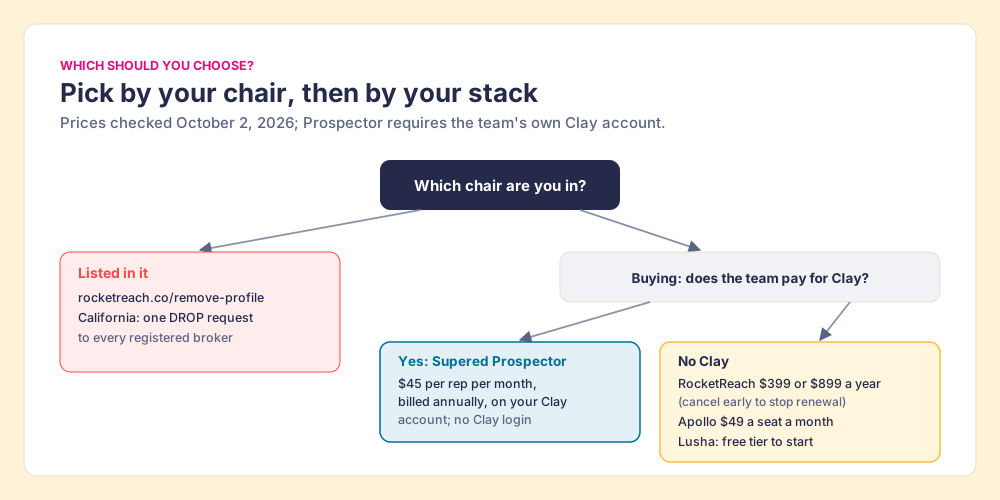
- RocketReach Essentials or Pro. The pick for one to five people finding a few contacts a day who want a posted price. Pro at $899 a year adds phones and the HubSpot and Salesforce integrations. Cancel in month one if you do not want year two.
- RocketReach for a job search. A legitimate way to find a hiring manager’s work email, and your lookup is not announced to them. Keep the message short and relevant, and expect up to about one lookup in seven to come back without an email.
- Apollo. The pick when phones are most of the work and sequences belong in the same seat; the Apollo alternatives page covers its limits.
- Supered Prospector. The pick when the team already pays for Clay and wants every vendor behind each lookup and a view of which lists got worked and closed.
- The removal form. The pick if you are reading this because you found yourself in the directory.
What I would do rests on what turned up here. RocketReach is legitimate in each sense a buyer means: a real company, a working product rated 4.4 by 1,385 buyers, posted prices, refunded misses. Its weak spots are the ordinary ones of a single directory, a meter on exports and records that age, plus a renewal that relies on your memory. The harder questions, why it has a name and what you may lawfully do with it, travel with any directory you buy. For a founder or a small team without Clay, buy Pro, put the renewal date in your calendar, and use the EU filter if Europe is in your territory. For a sales team that already pays for Clay, stop adding a second directory one seat at a time: let the GTM engineer choose the vendors, let reps run the waterfall from the page they are on, and watch each list to closed. A Prospector demo shows it on your own Clay account, and the RocketReach vs ZoomInfo comparison covers the step up to an enterprise directory.
Frequently asked questions
Is RocketReach legit?+
Is RocketReach safe to use?+
Why does RocketReach have my details?+
How do I get myself off RocketReach?+
Will someone know if I look them up on RocketReach?+
Is there a better option than RocketReach for a sales team on Clay?+
Your process, running itself.