RocketReach Pricing in 2026: Unlimited Talk and Text, a Metered Hotspot
RocketReach pricing checked on October 1, 2026: three seats from $399 a year, unlimited lookups with a fair-use limit, an export meter that every CRM sync draws on, a monthly price that costs up to twice as much, and the ten-rep arithmetic.
RocketReach pricing in 2026 is three self-serve seats, Essentials at $399 a year, Pro at $899 and Ultimate at $1,699 on annual billing, metered by exports (1,200, 3,600 or 20,000 a year), with custom team plans that start at $6,000 a year.
A phone contract has one word in large type, and the word is UNLIMITED. Calls, unlimited. Texts, unlimited. Then, in the smaller line below, the hotspot allowance, after which the laptop you tethered to the phone slows to a crawl. The large word is true. The small line is the price.
RocketReach pricing in 2026 is three self-serve seats, Essentials at $399 a year, Pro at $899 and Ultimate at $1,699 on annual billing, metered by exports (1,200, 3,600 or 20,000 a year), with custom team plans that start at $6,000 a year (rocketreach.co/pricing, opened October 1, 2026). The large word on the plan cards is “Unlimited.” The small line is the export count, and an export, by RocketReach’s own definition, is any contact that leaves RocketReach for your CRM.
The quick answer, three ways:
- RocketReach Essentials, $399 a year. One person who sends email and never dials, working from CSVs. About five exports a working day.
- RocketReach Pro, $899 a year. The plan most small sales teams should buy: phones, 3,600 exports, and native HubSpot and Salesforce integrations.
- Supered Prospector, $540 a rep a year on your own Clay account. A team that already pays for Clay, where reps build lists from LinkedIn, a company site or the CRM record and the waterfall asks 200+ vendors instead of one.
How much does RocketReach cost in 2026?
The table below is the page as it rendered today on the annual toggle, plus the monthly column captured on September 25, 2026, the last time the toggle was clicked in a browser. RocketReach’s prices load in JavaScript, which is why the secondary guides disagree; the guides we checked in September carried an older ladder of $27, $69 and $142 a month, the figures many buyers still remember as RocketReach pricing 2025, and the Essentials and Pro numbers in it are stale.
| RocketReach pricing (Oct 1, 2026) | Essentials | Pro | Ultimate | Team |
|---|---|---|---|---|
| Annual billing, per month | $33 | $75 | $142 | Custom |
| Billed annually | $399 | $899 | $1,699 | ”Plans start at $6K annually” |
| Monthly billing (Sept 25 capture) | $69 | $119 | $209 | n/a |
| Lookup type | Email and phone | Email and phone | Email and phone | |
| Lookups, annual billing | Unlimited (fair use 10,000 a month) | Unlimited | Unlimited | Pooled credits |
| Lookups, monthly billing | 100 a month | 250 a month | 1,000 a month | n/a |
| Exports | 1,200 a year | 3,600 a year | 20,000 a year | Custom |
| CRM integrations | None listed | HubSpot, Salesforce, Outreach, Salesloft, Bullhorn | Same, plus Salesforce custom mapping | Same |
| Extras | MCP and API access, 500 emails a day | Technographics, org charts, Autopilot 10 jobs | Intent data, healthcare data, Autopilot 25 jobs | Company exports, account manager |
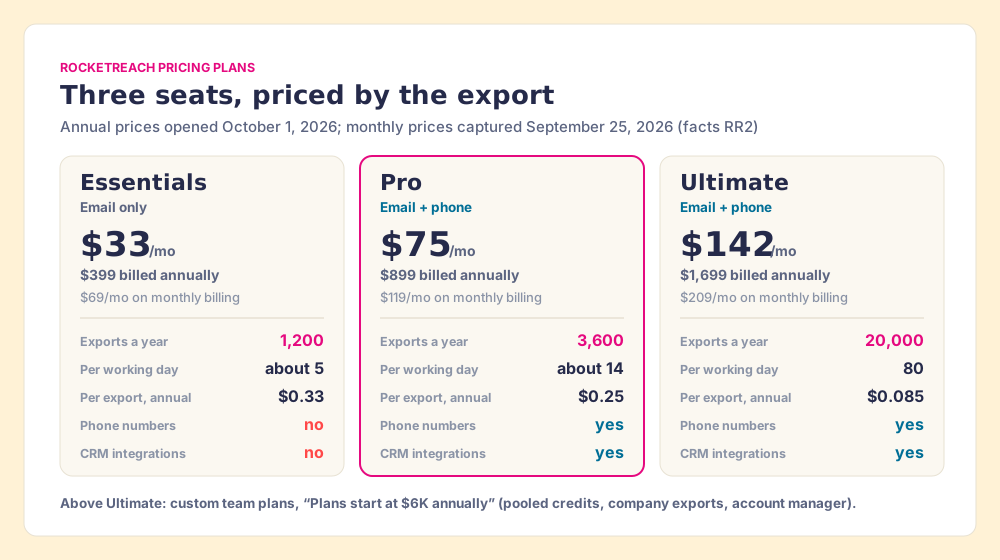
One thing changed in a week. “MCP & API access” now appears on all three plan cards; the September 25 capture showed API access only on Ultimate. API lookups draw on the export allowance, as the next section shows. The page’s other claims are RocketReach’s own: “700 million professionals and 60 million companies,” verified “with 98% accuracy,” and “Trusted by over 30 million users and 95% of the S&P 500.”
What does “unlimited” mean on RocketReach, and what counts as an export?
The phone contract maps onto RocketReach line for line. Its Unlimited Credits FAQ defines the two meters in one paragraph: “A lookup pulls the contact data of the person and stores it within the RocketReach platform. An export allows you to download the data in CSV format or move the data to a third-party system such as Salesforce, Zapier, SalesLoft, etc.”
In the phone’s terms, lookups are the talk and text and exports are the hotspot, and the FAQ lists what draws on the hotspot: “API lookups, bulk lookups, downloading your data in a CSV file, uploading a list, and exporting your data to a CRM.”
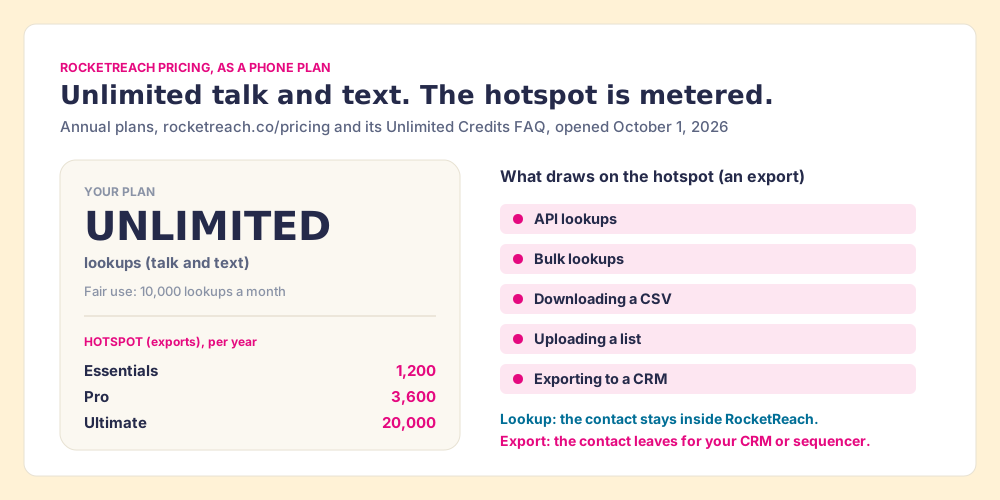
Walk it forward with a sales team. A rep who finds a prospect and reads the email off the screen has used a lookup, which is free. The moment that contact needs to live in HubSpot, so a sequence can run, so a manager can see it, so the next rep does not call the same person, it is an export. A contact a salesperson works is, by definition, a contact that left RocketReach. So for a sales team the unlimited meter prices the browsing, and the export meter prices the work.
One difference runs in RocketReach’s favor. A carrier does not refund the megabytes that failed to load. RocketReach does: “A lookup is used if we find and verify email or phone, otherwise it is refunded.” A miss costs nothing. That is a better rule than most of the category, and it is in writing.
So the plan to compare is the export count, divided by working days. At 250 working days, Essentials gives about five exports a day, Pro about fourteen, and Ultimate 80. The Bridge Group’s 2025 SDR report, 351 companies, puts the median SDR at 44 dials a day (Bridge Group, 2025). Reps redial the same people, so an SDR does not need 44 fresh contacts a day, but a full-time SDR building lists will outgrow fourteen a day well before the year is out, and that is the moment the page sends you to “Talk to Sales.”
Is RocketReach cheaper on monthly or annual billing?
Annual, by a lot, and the monthly plan has a second catch. The toggle advertises “Save 50%” on annual billing. Twelve months on the monthly plan cost $828 for Essentials, $1,428 for Pro and $2,508 for Ultimate, against $399, $899 and $1,699 annual. That is a 52% saving on Essentials, 37% on Pro and 32% on Ultimate. The badge is true of the cheapest plan.
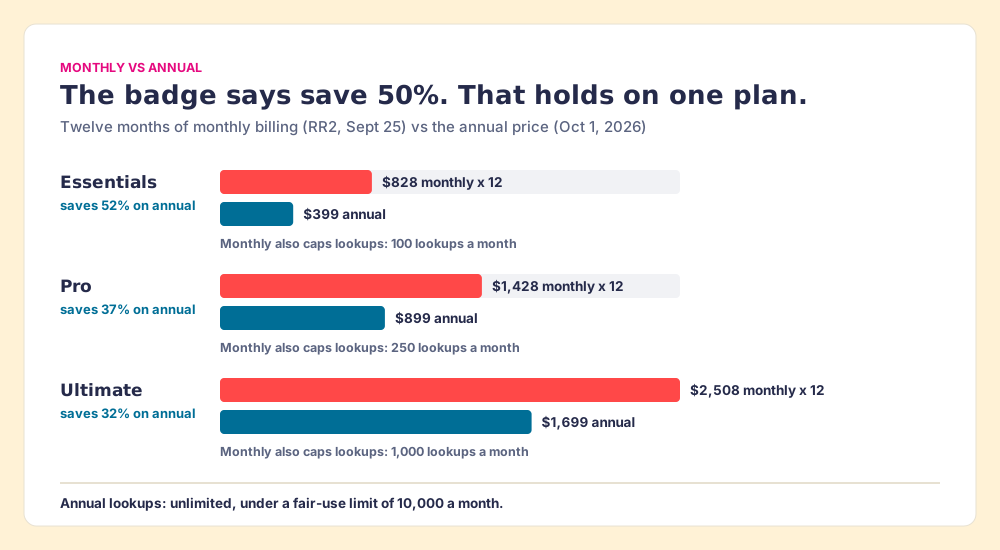
The second catch sits in the compare grid. On monthly billing, lookups stop being unlimited: 100 a month on Essentials, 250 on Pro, 1,000 on Ultimate, the same numbers as the monthly export allowance. The month-to-month buyer pays roughly double and loses the large word on the card. Per export, monthly Essentials costs $0.69 and annual Essentials $0.33.
The reason to pay monthly anyway is the exit. The FAQ says “Since you prepay for a year or month, cancellation takes effect the following term,” so an annual plan is a year of commitment. For a founder testing whether outbound works at all, one month at $119 on Pro is a cheaper experiment than $899 up front. For anyone who already knows they will prospect all year, the monthly column is a tax on indecision.
Why do teams leave RocketReach?
Fair first. On G2, RocketReach held a 4.4 out of 5 from 1,385 reviews on October 1, 2026 (G2, RocketReach reviews), which is a respectable score for a tool that individuals pay for on a card. Reviewers like the speed. One long-time user names the feature that keeps her: “the ability to use a company URL or a person’s linked in profile to generate a search” (Joanna G., G2). To the buyer asking “is RocketReach legit,” the record says yes: a 2015 company with a published price list, refunded misses, and cancellation from the account page.
The complaints cluster in three places, and each one is a buying criterion in disguise.
- Price for the smallest buyers. “The pricing can be a bit steep for a small business like mine” (Carl F., Owner, G2, April 2026). The fix is the annual toggle; the monthly price is where small buyers get hurt.
- Meter confusion. “I’m sometimes not clear how many lookups I get to do” (Stefan L., G2, April 2026). With unlimited lookups on one billing cycle, capped lookups on the other, and a separate export count, the confusion is earned. Size the plan by exports and ignore the large word.
- Coverage on the hard contacts. “It sometimes feels like RocketReach has just had a good guess” (Patrick S., G2, April 2026). A single database has the contacts it has. When it misses, the refund returns a credit, and a credit is not a phone number.
The last one is the reason a growing team looks past one database, and it is the reason the next sections exist.
Why should you trust this breakdown?
We sell no contact data. Supered has no database of its own, on purpose, and Prospector runs on Clay, the only data provider we use. So we have no stake in whether you buy RocketReach, Apollo or ZoomInfo; our stake is in what your reps do with the contact once they have it.
Supered started inside RevPartners, the HubSpot partner I founded, which sold roughly twice as much Sales Hub as any other partner and reached HubSpot’s Elite tier in 13 months. Today Supered is the #1 sales enablement app on the HubSpot marketplace, with 6,000 installs and a 5.0 rating from 122 reviews there, and on G2 it held a 4.9 out of 5 from 81 reviews on October 1, 2026 (G2, Supered reviews). Every RocketReach number on this page links to the page it came from, with the date it was opened.
Which RocketReach plan, or which alternative, fits your team?
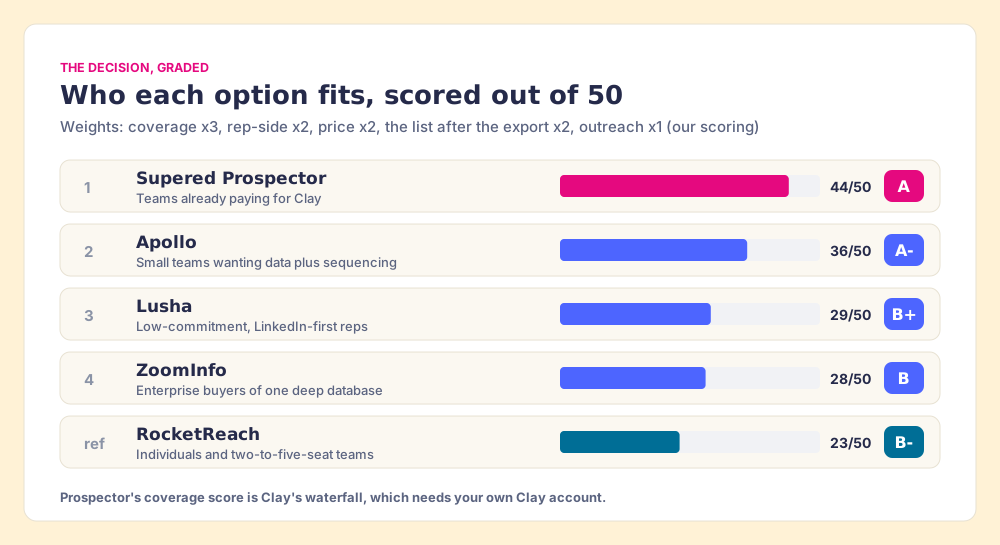
The grades use the same five weights as our RocketReach alternatives page: coverage of the contact you need (x3), delivery where the rep already works (x2), price structure for a mid-market team (x2), what happens to the list after the export (x2), and bundled outreach (x1), out of 50. The weights serve one job, a team of five to fifty reps building its own lists. Flip the lens to “one person, lowest price” and RocketReach Essentials wins outright.
| Rank | Option | Grade | Best fit | CRM integration | Setup effort | Pricing (plan with the feature) | Reason to switch |
|---|---|---|---|---|---|---|---|
| 1 | Supered Prospector | A (44) | Teams already paying for Clay | Native: HubSpot, Salesforce, Pipedrive | Demo, then live on your own Clay account | $45 a rep a month, billed annually, plus your Clay plan | Clay’s waterfall across 200+ vendors from the rep’s own screen; see which lists get worked and close |
| 2 | Apollo | A- (36) | Small teams wanting data plus sequencing | Native | Self-serve | Basic $49 a seat a month, annual, 30,000 credits a year | Credits instead of exports; outreach in the same seat |
| 3 | Lusha | B+ (29) | Low-commitment, LinkedIn-first reps | API and webhooks from Pro | Self-serve | Starter $37.45 a month billed yearly, 4,800 credits | Free tier of 40 credits a month; easiest start |
| 4 | ZoomInfo | B (28) | Enterprise buyers of one deep database | Native | Sales-led contract | Vendr median $33,500 a year | Depth and intent data, at enterprise prices |
| ref | RocketReach Pro | B- (23) | Individuals and two-to-five-seat teams | Native from Pro | Self-serve, minutes | $899 a seat a year | The reference: published, refunded misses, metered by the export |
What does RocketReach cost for a team of ten?
Seat prices hide the number a manager signs. Ten reps on annual list prices: Essentials $3,990, Pro $8,990, Ultimate $16,990. The team plan floor is $6,000 a year, which buys you a sales conversation rather than a price; between six and seven Pro seats’ worth of money. Vendr’s RocketReach listing puts the median contract at $6,750 a year, in a range from $1,800 to $13,340, and carries one buyer note: three enterprise users for $6,750, “$690 in savings” against buying online. That is $2,250 a seat.
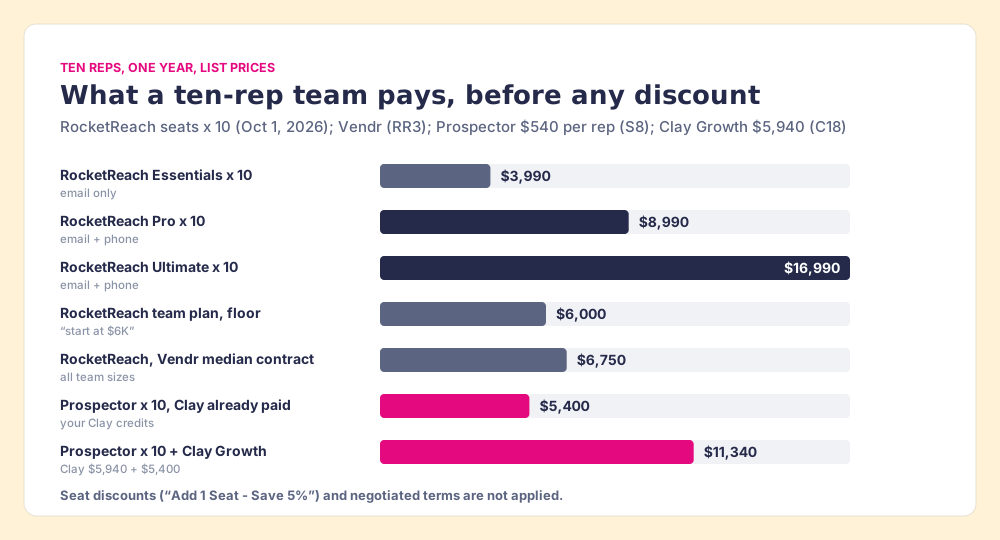
Read the bottom two bars carefully, because they cut both ways. If you do not have Clay, Clay Growth plus Prospector for ten reps is $11,340, more than ten Pro seats at $8,990, and Clay’s 72,000 data credits a year cover roughly 12,000 email-and-phone contacts at about six credits each (our arithmetic from Clay’s calculator), against 36,000 RocketReach Pro exports. On export count alone, RocketReach is the better buy. If you already pay for Clay, the comparison is Prospector’s $540 a rep against Pro’s $899, about 40% less, and the contacts come from every provider in the waterfall instead of one.
How does Supered Prospector compare to RocketReach pricing?
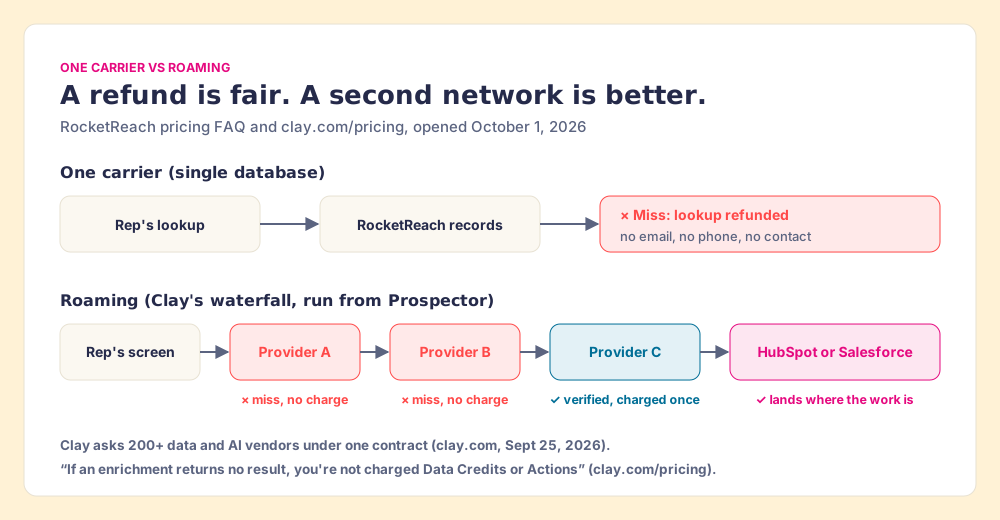
Prospector does not bring its own database. It brings Clay’s waterfall, which is every database, routed. Clay’s homepage counts 200+ data and AI vendors under one contract (clay.com, September 25, 2026), and its waterfall asks provider after provider until one returns a verified email or phone. Clay’s pricing page, re-opened today, states the rule that matters for a buyer comparing meters: “If an enrichment returns no result, you’re not charged Data Credits or Actions” (clay.com/pricing). RocketReach refunds a miss. Clay charges nothing for a miss and then asks the next source.
Go back to the phone. RocketReach is one carrier with a fair, published contract. Clay is roaming: when the home network has no signal, the call goes out on whichever network does, and you pay only for the calls that connect. What Clay has lacked is a handset the reps carry. Clay is the GTM engineer’s workshop; Prospector puts what the GTM engineer built in the rep’s hands.
- Where the rep already is. A LinkedIn profile, a Sales Navigator list, a company’s website, or a HubSpot, Salesforce or Pipedrive record. One click runs the waterfall; reps never log in to Clay.
- Before the duplicate. On a LinkedIn profile, the rep sees whether the person already has a matching record in the CRM, and whether the prospect was already worked in the past.
- The GTM engineer’s work, on a button. Any custom Clay workflow runs from Prospector, a whole list can be pushed into a Clay workflow, and the buying-committee lookup is tuned by title, department and seniority for your team.
- After the list. The contact lands in the CRM with the team’s process applied to it, and the manager sees which lists get worked and which ones close, then coaches from what is converting.
Prospector is $45 per rep per month, billed annually, from one user, on its own plan separate from Supered’s process products (Prospector, Supered pricing). It runs on your Clay account and your Clay credits. Clay governs the data. Supered governs the motion.
Choose something else if any of these is true:
- No Clay account. Prospector needs one. If you are one person or a five-seat team without Clay, RocketReach Pro on annual billing is a fair, simple purchase.
- No waterfall builder. Someone on the team decides which providers sit in which order. If that person does not exist, a single database with a published price is less work.
- Outreach in the same seat. If you want the data, the sequencer and the dialer from one vendor, Apollo’s pricing bundles them.
How does RocketReach pricing compare with ZoomInfo, Apollo and Lusha?
- ZoomInfo vs RocketReach. Different weight classes. ZoomInfo publishes no list prices, and Vendr’s median ZoomInfo contract is $33,500 a year on 1,573 purchases, about five times RocketReach’s $6,750 median. ZoomInfo sells depth, intent data and an enterprise contract with an escalator; RocketReach sells a published seat. ZoomInfo pricing decodes the contract.
- Apollo. The closest in shape. Basic is $49 a seat a month on annual billing with 30,000 credits a year, at 1 credit per email and 8 per phone, so a Basic seat at $588 a year buys up to 30,000 emails or 3,750 phones, against Pro’s 3,600 exports at $899. Apollo meters the reveal and bundles outreach; RocketReach meters the departure. Apollo pricing walks the credit meter.
- Lusha vs RocketReach. Lusha’s Starter is $37.45 a month billed yearly for 4,800 credits, at 1 credit per email and 5 per phone, so 960 phones a year; RocketReach Essentials gives 1,200 exports of email only for $399. For a phone-first rep, RocketReach Pro’s 3,600 exports with phones at $899 is the cheaper phone. Lusha pricing has the credit ladder.
- Clay itself. Not a RocketReach competitor in the same sense; it is the layer that routes across the vendors above. Launch starts at $185 a month and Growth at $495, with Data Credits from $0.05. Clay pricing does that arithmetic in full.
What we recommend
Three ways forward, and our view on each.
- One seat, email only. Buy Essentials annually at $399. It is one of the cheapest published price lists in contact data, a miss costs nothing, and five exports a day is plenty for one person writing careful emails.
- A small team that dials. Buy Pro annually at $899 a seat, size it by exports (about fourteen a working day each), and do not pay the monthly price for longer than one test month. When the team outgrows Pro, price Ultimate seats against the $6,000 team floor and bring the Vendr median ($6,750) to the call.
- A team with Clay. Skip the second database. Run Clay’s waterfall from where reps already work with Supered Prospector, at $540 a rep a year against Pro’s $899, and see the lists turn into pipeline. The sourcing use case shows the rep’s side of it.
The large word on a phone contract was never the price. The hotspot was. On RocketReach the hotspot is the export, and for a sales team the export is the job, so price the export, then ask what happens to the contact once it lands in your CRM. RocketReach alternatives grades the field on that second question, row by row.
Frequently asked questions
How much does RocketReach cost in 2026?+
Is RocketReach free?+
What is the difference between a lookup and an export on RocketReach?+
Is RocketReach legit?+
ZoomInfo vs RocketReach: which costs less?+
Is there a cheaper way to get contact data if my team already has Clay?+
Your process, running itself.