LeadIQ Pricing in 2026: A $15 Sticker, a $26,400 Median, and a Phone That Costs Ten Credits
LeadIQ pricing checked October 2, 2026, in a real browser: Pro starts at $20 a month for 200 credits, not the $200 search results repeat, tops out near $2,612 a year for five users, and the median contract is $26,400.
LeadIQ pricing in 2026 is three plans: Free (1 user, 50 credits a month), Pro from $20 a month for 200 credits ($15 billed annually) to $290.25 for 6,750, shared by up to 5 users, and a custom Enterprise quote; an email costs 1 credit, a phone number 10.
A café prints its sandwich prices in the window and keeps a separate folder for the private room upstairs. Both are true. They describe different meals, and a person who books the room for twelve at window prices is in for a conversation.
LeadIQ pricing in 2026 is three plans: Free (1 user, 50 credits a month), Pro from $20 a month for 200 credits ($15 billed annually) to $290.25 for 6,750, shared by up to 5 users, and a custom Enterprise quote; an email costs 1 credit, a phone number 10 (leadiq.com/pricing, rendered in a browser October 2, 2026). That first Pro figure is not the one you will find in search results, which say about $200 a month. And neither the window price nor the search-result price is what a typical contract costs: Vendr’s median LeadIQ contract is $26,400 a year (Vendr).
The quick answer, three ways:
- LeadIQ Pro, annual, at the top step. An SDR pod of five or fewer that dials: about $2,612 a year for 6,750 credits a month, shared, at about 35 cents per email-and-phone contact.
- Apollo Basic. A small team that wants data and sequencing in one seat: $49 a seat a month billed annually, about 18 cents per email-and-phone contact.
- Supered Prospector, $540 a rep a year on your own Clay account. A team that already pays for Clay, where the GTM engineer builds the tables and reps run them from LinkedIn, a company site or the CRM record without opening Clay.
How much does LeadIQ cost in 2026?
The LeadIQ plans are three cards and one slider. The cards are fixed; the slider prices Pro by how many credits the team needs a month, in 53 steps from 200 to 6,750. Annual billing, the page’s default view, takes 25% off.
| LeadIQ pricing (Oct 2, 2026) | Free | Pro | Enterprise |
|---|---|---|---|
| Price | $0 | $20.00 to $290.25 a month on monthly billing; $15.00 to $217.69 a month billed annually | Custom, “Annual plan only” |
| Credits | 50 a month | 200 to 6,750 a month (2,400 to 81,000 a year on annual) | Custom |
| Users | 1 | ”Up to 5 users”, “5 users included” | Custom |
| Chrome extension, exporting, job-change tracking, CRM integrations, CRM and webform enrichment, API, MCP | Yes | Yes | Yes |
| Database search | Limited access | Limited access | Full |
| Enterprise only | CSV file enrichment, custom CRM field mappings, Salesforce duplicate detection, governance controls, team analytics, SSO |
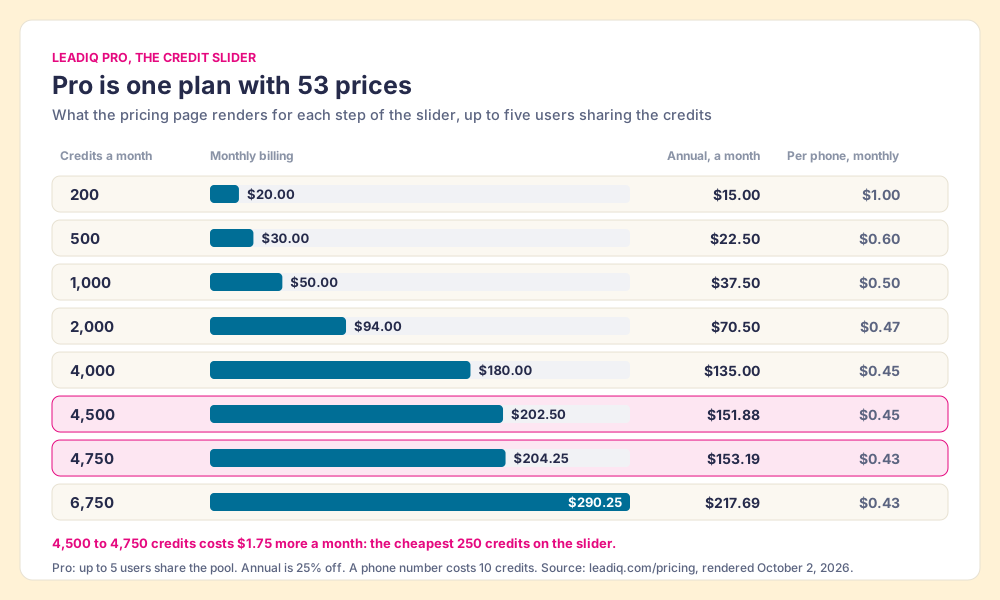
One oddity on the slider is worth money. Most steps add credits at four to five cents each, but going from 4,500 credits to 4,750 adds $1.75 a month for 250 credits, under a cent apiece. A team sitting at 4,500 should take the next step. And a name clash to clear up before it confuses anyone: LeadIQ sells a product called “Prospector,” its own prospecting tool. Supered Prospector, which appears later on this page, is a different product from a different company.
Why do search results say LeadIQ Pro costs $200?
Because the page’s source code says so, and the page’s own script says otherwise.
LeadIQ’s pricing page ships with the Pro card reading “$200 /month credits.” A script then runs the slider and writes the real figure over it: with the slider at 200 credits, $20.00 a month, “5 users included.” We fetched the raw HTML and rendered the same URL in Chromium on October 2, 2026, and read both. The roundups that summarize LeadIQ’s price from the raw page repeat the placeholder: AddToCRM gives Pro as “approximately $200/mo,” SalesIntel as “Starts ~$200+/month,” and both sit in Google’s AI Overview for “leadiq pricing” today. Our own capture of the page from October 1 recorded the figure as ambiguous and declined to print it.
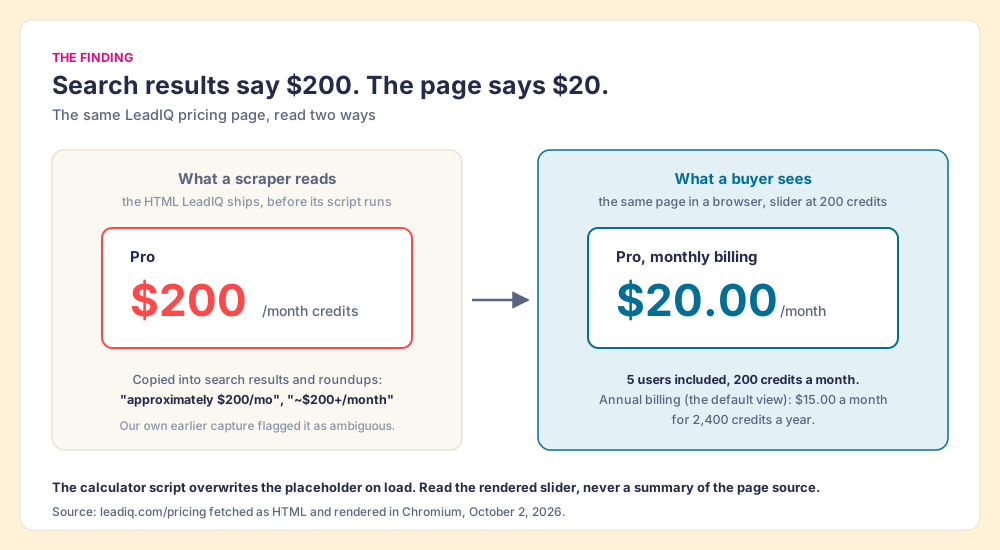
We cannot see LeadIQ’s checkout without buying, so treat the rendered $20 as the price LeadIQ publishes and confirm it in the cart. The lesson travels beyond LeadIQ. Pricing pages built on calculators show a crawler one number and a buyer another, and the crawler’s number is the one that spreads.
What does a LeadIQ credit buy?
An arcade sells tokens at one price and charges a different number of them per game. Skee-ball takes one. The claw machine with the prize you came for takes ten. The token price tells you little until you know which game you are playing.
LeadIQ moved every product onto one pool of Universal Credits in August 2025 (LeadIQ blog). Its help center lists the games: “Unlock an email, 1 UC. Export a company, 3 UC. Unlock a phone number, 10 UCs (mobile or work)” (LeadIQ help center, Understanding Universal Credits).
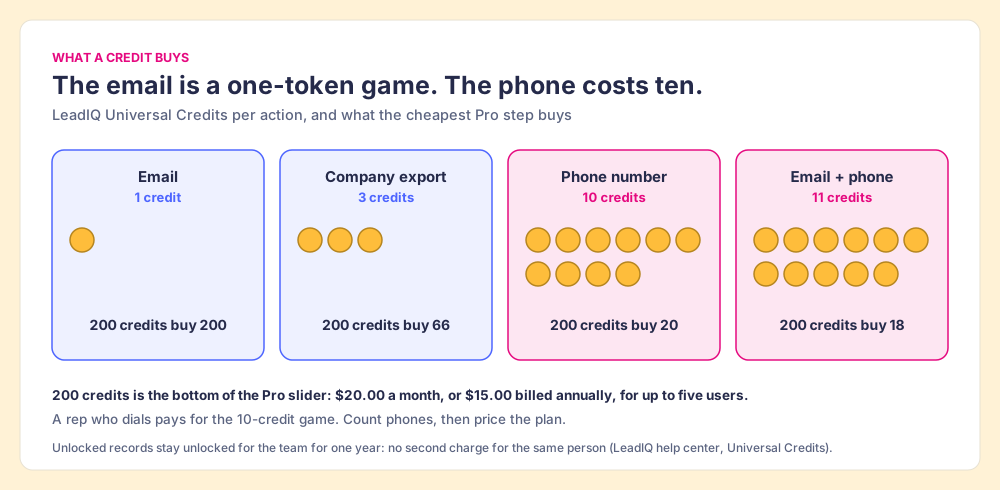
So the plan to compare is phones, not credits. At the top step of Pro, 6,750 credits a month is 675 phone numbers for the whole pod, or 135 per rep if five people share it, about six new numbers a working day. The Bridge Group’s 2025 report on 351 companies puts the median SDR at 44 dials a day (Bridge Group, 2025). Reps redial the same people, so 44 dials do not need 44 new numbers, but a pod building fresh lists every week will press against six a day.
Two rules soften the meter, and both favor the buyer.
- Records under management. Once anyone on the team reveals a contact or exports a company, “You will not be charged again for that same record for one year,” and the rule “applies at the team level, not just the individual user” (same help article). Two reps chasing the same VP pay once.
- Shared pool by default. Credits sit in one team pool unless an admin allocates them per rep, so the heavy dialer can draw on the light one’s share.
What the help center does not say plainly for Universal Credits is whether unused credits carry over. Its article for legacy plans says credits are “refreshed on the first day of your billing cycle” (LeadIQ help center), and third-party breakdowns read that as no rollover. Get the answer in writing before you buy an annual pool.
What do teams pay for LeadIQ, compared with the list price?
Ten times the window price, on the median. Vendr, which negotiates software contracts for buyers, reports that the “Median buyer pays $26,400 per year,” “Based on data from 112 purchases, with buyers saving 22% on average,” with a low of $5,201 and a high of $66,780 (Vendr’s LeadIQ page, last updated February 2026, opened October 2, 2026).
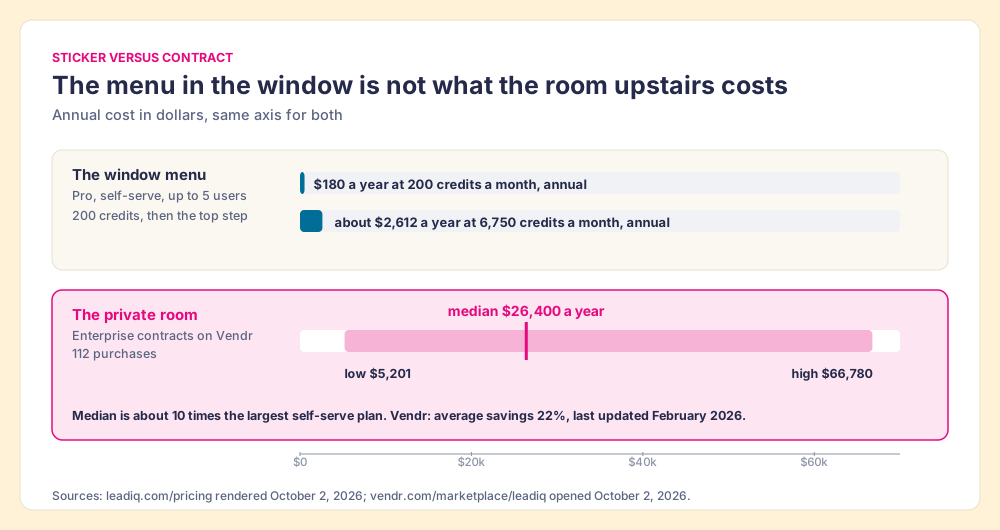
The gap is not a trick. It comes from two lines on the pricing page: Pro stops at five users and 6,750 credits a month, and the features a sales leader running a team of twenty asks for (Salesforce duplicate detection, custom field mappings into the CRM and the sequencer, team analytics, governance controls, SSO) are Enterprise only. Any team past the window lands upstairs. Vendr’s low figure, $5,201, is already about twice the largest self-serve plan.
So bring two anchors to the LeadIQ Enterprise call: Vendr’s median and its 22% average saving, and the per-contact math below.
How does LeadIQ’s price per contact compare?
LeadIQ is one of the cheapest names in contact data at the top of its slider and one of the dearest at the bottom. On list prices, per contact with both an email and a phone (11 LeadIQ credits):
| Price per email-and-phone contact | Plan | Per contact |
|---|---|---|
| Apollo Basic | $588 a year, 30,000 credits at 9 per contact | about $0.18 |
| RocketReach Pro | $899 a year, 3,600 exports | $0.25 |
| Clay, entry Data Credit rate | about six credits at $0.05 (our estimate) | about $0.30 |
| LeadIQ Pro, 6,750 credits, annual | $217.69 a month | about $0.35 |
| UpLead Plus, annual | $1,788 a year, 4,800 credits | about $0.37 |
| LeadIQ Pro, 6,750 credits, monthly | $290.25 a month | about $0.47 |
| Lusha Starter | $449.40 a year, 4,800 credits at 6 per contact | about $0.56 |
| LeadIQ Pro, 200 credits, annual | $15.00 a month | about $0.83 |
| LeadIQ Pro, 200 credits, monthly | $20.00 a month | $1.10 |
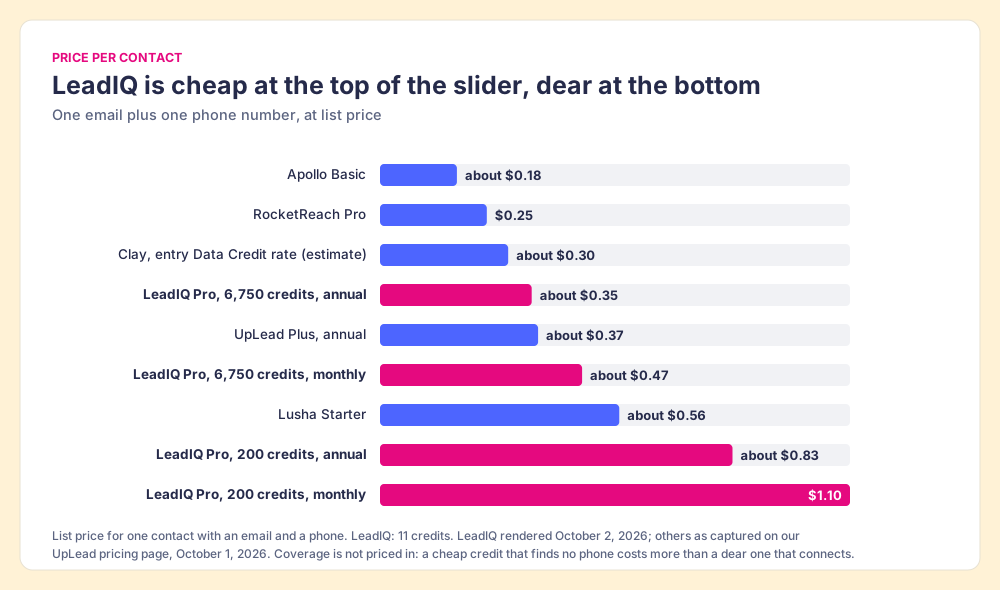
The non-LeadIQ rows come from each vendor’s pricing page as captured on our UpLead pricing breakdown on October 1, 2026: apollo.io/pricing, rocketreach.co/pricing, lusha.com/pricing and clay.com/pricing. Two cautions. A list price ignores coverage: a cheap credit that returns no phone number is the dearest credit of all. And an email-only rep pays 1 LeadIQ credit, which drops the 200-credit tier to 10 cents an email and reorders the table.
Why do teams leave LeadIQ?
Fair first. LeadIQ holds a 4.2 out of 5 on G2 from 1,186 reviews (October 2, 2026, G2). Its Chrome extension listed 30,000 users and a 4.0 rating from 57 reviews on October 1, 2026. Its job-change tracking for past champions is included on every plan, Free too, which is unusual, and its MCP server puts LeadIQ data inside Claude for teams that prospect there (leadiq.com/leadiq-mcp). For an SDR pod of five that lives in Salesforce and Outreach, LeadIQ is a sound purchase.
The G2 complaints gather around the meter, and each one is a buying criterion:
- Credit cost. “Credits are way too expensive” (Christopher K., Small Business, June 2026); “I wish I had more credits for a more competitive price” (Megan J., Business Development Representative, Mid-Market, November 2025).
- Phone allowance. “The basic plan is restrictive due to its insufficient mobile credits” (Brent H., Sales Development Representative, Mid-Market, October 2024). At 10 credits a number, the phone is where a pool drains.
- One database. When LeadIQ has no number for the person, the rep has none either, and a second contract follows. Clay lists LeadIQ as one provider in its directory, joined September 1, 2024, with its company enrichment on a bring-your-own-account basis (clay.com/integrations).
The third point is the one a bigger LeadIQ plan cannot fix, and it is why the rest of this page looks at Clay.
Why should you trust this breakdown?
We sell no contact data. Supered has no database of its own, on purpose; Prospector runs on Clay, our only data provider, so we gain nothing from whether you buy LeadIQ, Apollo or Lusha.
Supered started inside RevPartners, the HubSpot partner I founded, which sold roughly twice as much Sales Hub as any other partner and reached HubSpot’s Elite tier in 13 months. Supered is the #1 sales enablement app on the HubSpot marketplace, with 6,000+ installs of the Supered extension and a 5.0 rating from 122 reviews there, and on G2 it held a 4.9 out of 5 from 81 reviews on October 1, 2026 (G2, Supered reviews). Each LeadIQ figure on this page links to the page it came from, opened October 2, 2026, and the $20 figure comes from rendering LeadIQ’s page, not from a summary of it.
Which LeadIQ plan, or which alternative, fits your team?
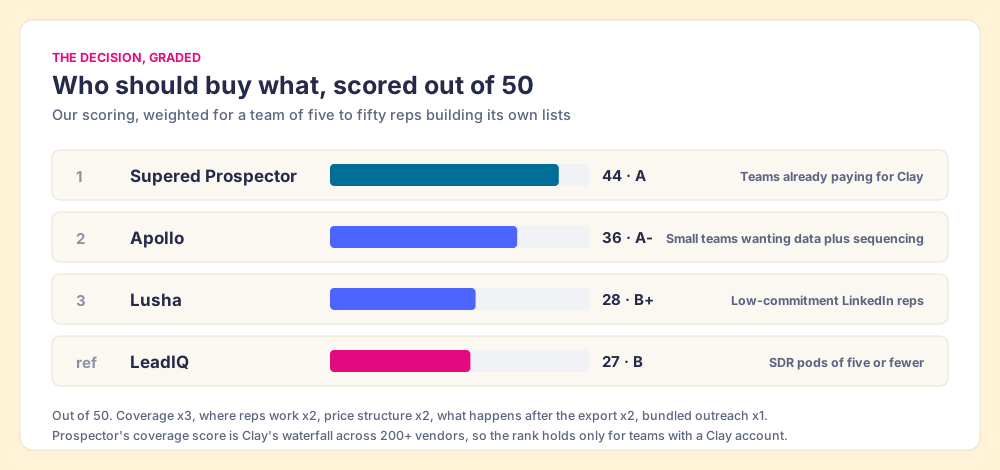
The grades use the five weights from our RocketReach pricing and UpLead pricing pages: coverage of the contact you need (x3), delivery where the rep already works (x2), price structure for a mid-market team (x2), what happens to the list after the export (x2), and bundled outreach (x1), out of 50. The weights serve one job, a team of five to fifty reps building its own lists. Flip the lens to “five SDRs who want a cheap pool and job-change alerts” and LeadIQ moves up.
| Rank | Option | Grade | Best fit | CRM integration | Setup effort | Pricing (plan with the feature) | Reason to switch |
|---|---|---|---|---|---|---|---|
| 1 | Supered Prospector | A (44) | Teams already paying for Clay | Native: HubSpot, Salesforce, Pipedrive | Demo, then live on your own Clay account | $45 a rep a month, billed annually, plus your Clay plan | Clay’s waterfall across 200+ vendors from the rep’s own screen; see which lists get worked and closed |
| 2 | Apollo | A- (36) | Small teams wanting data plus sequencing | Native | Self-serve | Basic $49 a seat a month, annual | About 18 cents per email-and-phone contact; outreach in the same seat |
| 3 | Lusha | B+ (28) | Low-commitment LinkedIn reps | API and webhooks from Pro | Self-serve | Starter $37.45 a month billed yearly | Free tier; the easiest start |
| ref | LeadIQ | B (27) | SDR pods of five or fewer | Native on every plan; duplicate detection and custom field mapping on Enterprise | Self-serve, free plan | Pro from $15 a month annual for 5 users | The reference: cheap pool at the top step, job-change tracking included |
What does LeadIQ cost for a team of ten?
The cheap plan stops at five chairs. A five-rep pod on the top Pro step, billed annually, pays about $2,612 a year for 81,000 credits, roughly 7,360 email-and-phone contacts between them. Five Apollo Basic seats list at $2,940. Five Prospector seats cost $2,700 on a Clay account the team already has.
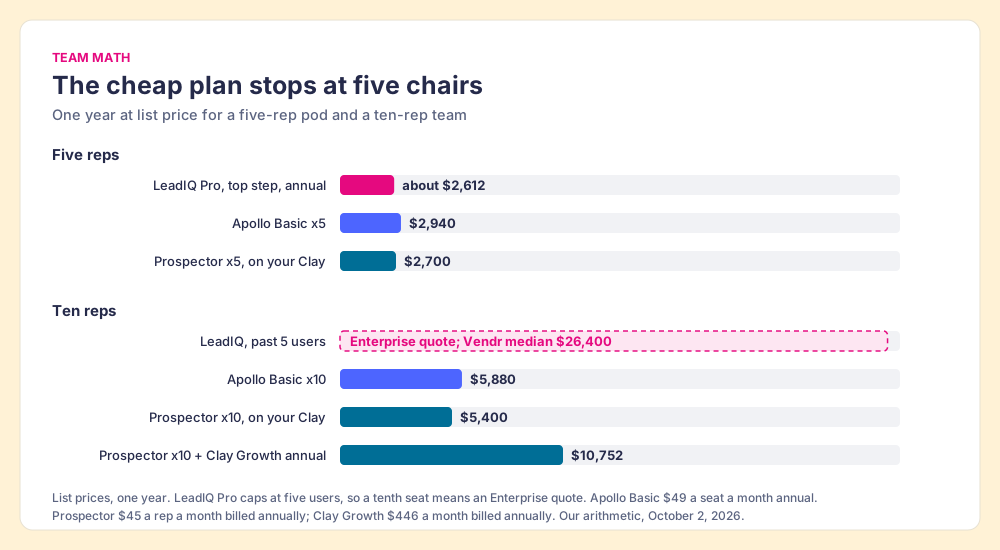
Ten reps cannot buy Pro, because Pro is “Up to 5 users.” The tenth seat is an Enterprise conversation, and the median Enterprise buyer pays $26,400. Read the Prospector bar both ways, too. Without Clay, Clay Growth billed annually ($446 a month, $5,352 a year) plus ten Prospector seats is $10,752, and Clay’s 6,000 Data Credits a month cover roughly a thousand email-and-phone contacts at about six credits each, which is our arithmetic, not Clay’s promise. With Clay already paid for, the comparison is $5,400 against a LeadIQ quote.
How does Supered Prospector compare to LeadIQ pricing?
Back to the arcade. LeadIQ is one good machine with fair tokens, and when its claw comes up empty for a phone number, the rep walks away with nothing. Clay is the boardwalk: its waterfall asks provider after provider until one returns a verified email or phone, across “200+ providers in one place” (clay.com, October 2, 2026), and “If an enrichment returns no result, you’re not charged” (clay.com/pricing). LeadIQ can be one of the machines on that boardwalk, through your own LeadIQ account.
The boardwalk has had one weakness. The GTM engineer built it, and reps rarely walk down it, so the GTM engineer turns into the list desk: reps Slack for every list and wait. Clay plus Supered is the best way for a sales team to prospect: GTM engineers build in Clay, reps never open Clay. Prospector runs inside the Supered Chrome extension on the team’s own Clay account, and every rep gets the GTM engineer’s table as a button:
- Where the rep already is. A LinkedIn profile, a company’s website, or a HubSpot, Salesforce or Pipedrive record. From Sales Navigator, reps add leads to a prospect list and push the list to a Clay table. Prospector works within LinkedIn’s terms and does not copy search results in bulk; the contact data comes from Clay’s waterfall on the customer’s Clay account.
- Flows built once. The GTM engineer names flows (person enrichment, the buying committee) and maps each one to a Clay table and a destination; the rep picks one from a Push menu, and waterfalls, tiers, tags and sequence variables stay the engineer’s logic.
- A check before the duplicate. Before pushing, the rep sees who owns the record and whether the prospect was worked before, so there is no duplicate work across reps. LeadIQ sells Salesforce duplicate detection on Enterprise; here it is part of the rep’s screen.
- Found, worked, closed. The leader sees every list found, who is working theirs and who is not, and how each lead ends the way the process says: Qualified, Recycled or Disqualified. LeadIQ’s team analytics are Enterprise only. Seeing lists turn into pipeline is how the Clay budget grows.
Prospector is $45 per rep per month, billed annually, from one user, on its own plan separate from Supered’s process products (Prospector, Supered pricing). Start with the Supered Clay template or bring your own tables. Skip the extra seats and get more out of the Clay you already pay for. The sourcing use case walks the rep’s side, the Clay Chrome extension guide covers how teams put Clay on LinkedIn today, and Clay pricing breaks down the plan underneath.
Choose something else if any of these is true:
- No Clay account. Prospector needs one. A pod of five without Clay gets a cheap, shared pool from LeadIQ Pro at the top step, and RevPartners, the Clay Elite Studio Partner I founded, builds Clay tables for teams that want to start.
- Job-change alerts as the main job. LeadIQ includes champion tracking on every plan; our job change tracking guide compares the ways to run that play.
- Outreach from the same vendor. If you want data, sequencing and a dialer in one seat, Apollo’s pricing bundles them, and Apollo vs LeadIQ sets the two side by side.
What are the best LeadIQ alternatives?
The LeadIQ cost question usually ends in a comparison. The short version, by job:
- Apollo, for data plus sequencing. Basic at $49 a seat a month annual with 30,000 credits a year, about 18 cents per email-and-phone contact; Apollo pricing walks the meter.
- Lusha, for the lightest start. A free tier and Starter at $37.45 a month billed yearly, with menu pricing that makes dialed contacts dearer; Lusha pricing has the ladder.
- Kaspr, Wiza and ContactOut, for LinkedIn-first reps. Each is priced on its own page: Kaspr pricing, Wiza pricing and ContactOut pricing.
- RocketReach and UpLead, for simple meters. RocketReach pricing charges per export with phones; UpLead pricing charges one credit per whole contact.
LeadIQ alternatives grades the full field on the same weights as this page.
What we recommend
Three ways forward, and our view on each.
- A pod of five or fewer, without Clay. Buy LeadIQ Pro on annual billing at the step that covers your phones, not your emails: count dials, divide by ten credits, and take 4,750 credits over 4,500. Confirm the slider price in the cart and the rollover rule in writing.
- A team past five reps. You are buying Enterprise whatever the window says. Bring Vendr’s $26,400 median and its 22% average saving to the call, and price ten Apollo Basic seats at $5,880 beside it.
- A team with Clay. Do not add a second database seat for every rep. Put the Clay tables your GTM engineer already built in front of the reps with Supered Prospector, at $540 a rep a year, and LeadIQ can still sit in the waterfall on your own account.
The window menu was true, and so was the room upstairs; the search-result price was neither. Read the rendered page, count phones instead of credits, and ask what happens to each contact after it lands in the CRM. That last question is the one our Apollo vs LeadIQ comparison picks up.
Frequently asked questions
How much does LeadIQ cost in 2026?+
Is LeadIQ Pro $200 a month?+
What does a LeadIQ credit buy?+
How much does LeadIQ cost for a team of ten?+
Does LeadIQ have a free plan or a free trial?+
What are the best LeadIQ alternatives?+
Your process, running itself.