LeadIQ Alternatives in 2026: Five Seats, One Bucket, and the Sixth Rep
LeadIQ is a good capture tool with a five-user ceiling on self-serve and, by its own FAQ, one bucket in a data waterfall. The LeadIQ alternatives graded, LeadIQ pricing per phone, and LeadIQ vs ZoomInfo.
LeadIQ alternatives are the prospecting tools teams weigh against LeadIQ, the Chrome extension that captures emails and mobiles into the CRM: single databases like Apollo, ZoomInfo and Lusha, or Clay's waterfall across 200+ vendors run from Supered Prospector.
LeadIQ alternatives come up for one of three reasons: the sixth rep, the missing phone number, or a sales leader who wants to know what happened to the list after it was captured. The short answer, graded in full below:
- Supered Prospector. For teams that already have Clay: Clay’s waterfall across 200+ vendors, run from a LinkedIn profile, a Sales Navigator list, a company website or the CRM record, at $45 per rep per month billed annually.
- Apollo. For a team that wants data, sequences and a dialer in one plan, from $49 a seat a month billed annually. LeadIQ has no sequencer or dialer.
- ZoomInfo. For North American enterprise depth and intent data, quote-only, with a Vendr median of $33,500 a year.
LeadIQ alternatives are the prospecting tools teams weigh against LeadIQ, the Chrome extension that captures emails and mobiles into the CRM. They are either other single databases (Apollo, ZoomInfo, Lusha, Cognism, Kaspr) or Clay’s waterfall across 200+ data and AI vendors (clay.com, September 25, 2026), which a rep can run from Supered Prospector on the team’s own Clay account.
LeadIQ is good at its job. Two points the other LeadIQ lists skip come from its own pricing page: the self-serve plan seats five, and the sixth rep moves the team onto an annual-only quote; and its FAQ describes LeadIQ as one bucket in a waterfall. One naming note before we start: LeadIQ’s navigation labels its prospecting hub “Prospector.” Supered Prospector is a different product from a different company, and every “Prospector” below means ours.
Why do teams look for LeadIQ alternatives?
LeadIQ held 4.2 out of 5 from 1,186 reviews on G2 on October 2, 2026 (G2, LeadIQ reviews). The praise is consistent (one-click capture from LinkedIn, the CRM sync, ownership visible before you push), and so are the complaints. Four of them, in reviewers’ words.
- Emails that bounce. “The only downside that comes to mind is that some of the email addresses extracted by LeadIQ are not correct,” a head of partnerships wrote on September 29, 2026. A project manager in February 2026 went further: after upgrading, contacts that had sat behind the paywall “came up as empty or wrong.”
- An extension that misbehaves. “Chrome extension fails critically very often, forcing us to reset Google Chrome completely,” an account development rep at an enterprise wrote in January 2026. On the Chrome Web Store the LeadIQ extension rates 4.0 from 57 ratings with 30,000 users, lower than Apollo’s 4.7 or Lusha’s 4.6 on the same store.
- No sequencer and no dialer. “LeadIQ does not have a built-in sequencing or dialer function (it relies on integrations like Outreach or Salesloft),” a senior BDR manager wrote in November 2025. For a team on Outreach that is the design. For a team without one, it is a second contract.
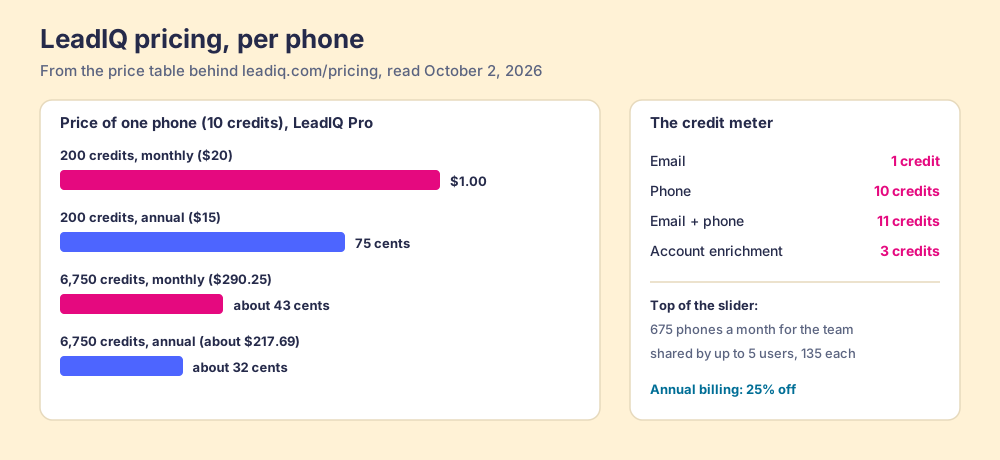
- The phone meter. LeadIQ charges 1 credit for an email and 10 for a phone number (leadiq.com/pricing). A rep whose day is the phone spends the month’s credits ten times faster than one who emails.
Why trust this comparison?
I started RevPartners, a HubSpot partner that did only sales implementations, sold roughly twice as much Sales Hub as any other partner, and reached Elite tier in 13 months. Supered came out of that work and is the #1 sales enablement app on the HubSpot marketplace. That is also the disclosure: we make Supered Prospector, and it sits first on this page for teams that have Clay. Supered holds 4.9 out of 5 from 81 reviews on G2 and 5.0 from 122 on the HubSpot App Marketplace (October 1, 2026). The grading below states its weights so you can flip them, and the flip for a five-person SDR team on Outreach puts LeadIQ near the top.
The LeadIQ alternatives, graded
The lens is a mid-market or SMB team, ten to fifty reps, that needs contact data reps will use where they already work and a leader who can see which lists turn into pipeline. Each criterion is scored 1 to 5 and multiplied by its weight, for a maximum of 50. The per-vendor scores match the Kaspr alternatives page and the Apollo alternatives page, so the pages read together.
| Criterion | Weight | What it rewards |
|---|---|---|
| Coverage of the contact you need | 30% (x3) | Verified emails and mobiles when the first source misses |
| Rep-side delivery | 20% (x2) | Works on the profile, the company site, the CRM record; no new tab or login |
| Price structure for mid-market | 20% (x2) | Published, per-result or per-seat, no platform fee, no cliff |
| What the leader sees after the export | 20% (x2) | Which sourced lists were worked and which closed, by your definitions |
| Bundled outreach | 10% (x1) | Sequencing, dialer, drafting in the same plan |
| Rank | Tool | Grade | Score | Best fit | CRM integration | Setup effort | Pricing (plan with the feature) | Reason to switch from LeadIQ |
|---|---|---|---|---|---|---|---|---|
| ref | LeadIQ | B | 27 | SDR teams of five or fewer capturing into a sequencer | Native (Salesforce, HubSpot, plus Outreach, Salesloft, Gong) | Minutes | Pro $15 to $217.69 a month billed annually, up to 5 users | Stay if capture into Outreach or Salesloft is the job |
| 1 | Supered Prospector | A | 44 | Teams that already have Clay | Native (HubSpot, Salesforce, Pipedrive) | Under a week on an existing Clay account | $45 per rep per month, billed annually, plus your Clay plan | 200+ vendors per lookup, no seat ceiling, lists you can follow to closed |
| 2 | Apollo | A- | 36 | Teams wanting data plus outreach in one | Native (HubSpot, Salesforce) | A day | $49 / $79 per seat per month, billed annually | Sequencer and dialer in the plan |
| 3 | ZoomInfo | B+ | 28 | North American enterprise depth and intent | Native (HubSpot, Salesforce, Dynamics) | Weeks | Quote only; Vendr median $33,500 a year | US depth and intent, for teams with the seats for a platform fee |
| 4 | Lusha | B+ | 28 | Like-for-like LinkedIn extension with a posted price | Native (HubSpot, Salesforce) | Minutes | From $37.45 a month, billed yearly | Posted ladder past five seats |
| 5 | Cognism | B | 26 | EMEA, phone-first, compliance-led outbound | Native | Weeks | Quote only, 5 seats included; Vendr median $32,750 | Phone-verified mobiles where LeadIQ reports 70% |
| 6 | Kaspr | B- | 25 | Email-first individuals on LinkedIn | Native (HubSpot, Salesforce, Pipedrive, Zoho) | Minutes | $49 per user per month, billed annually | Unlimited B2B emails |
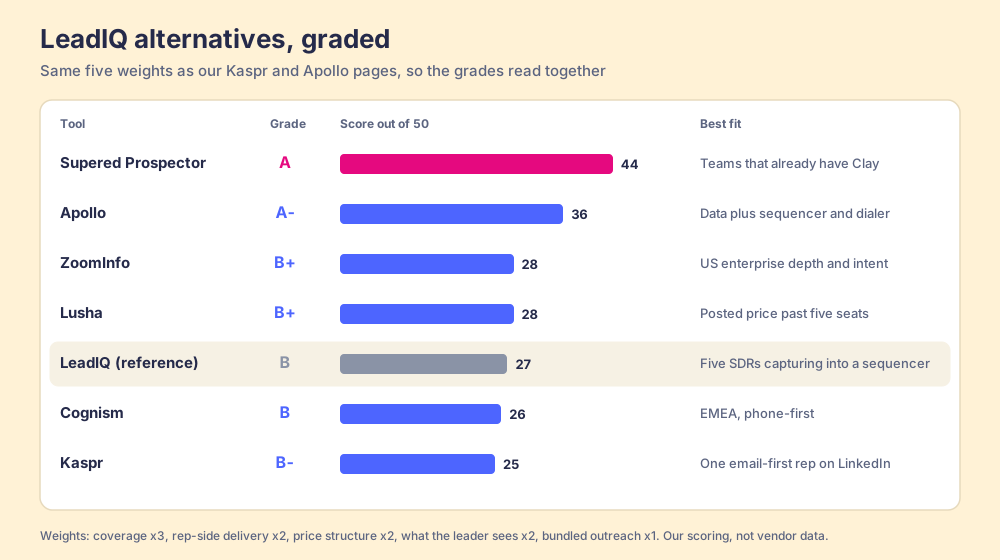
LeadIQ’s 27 breaks down as coverage 3, rep-side delivery 4, price 3, what the leader sees 1, outreach 2. The rep-side 4 is earned: the extension shows “if records exist, who owns them” in the CRM and sales engagement tool, and pushes to Salesforce, HubSpot, Outreach, Salesloft and Gong (LeadIQ Chrome extension). The coverage 3 comes from LeadIQ’s own numbers, below. The price 3 is a cheap, published Pro plan with a wall at five users. Prospector’s coverage score is Clay’s waterfall coverage, credited to Clay, and its outreach score is the lowest on the card on purpose: it has no sequencer, dialer or drafting. If outreach in the same plan decides it for you, Apollo wins this page.
Corporate status, checked October 2, 2026. LeadIQ is independent and private, founded in 2015 by Mei Siauw; Clay’s dossier lists $41.5 million raised, the latest a $30 million Series B in March 2021 led by Cathay Innovation (Clay dossier, March 7, 2025). A news search found no acquisition. Its 2026 product moves point toward AI: a public MCP server for Claude (LeadIQ MCP) and Lando, “the AI agent that lives inside your LeadIQ extension,” announced March 4, 2026 (LeadIQ blog). Kaspr is part of Cognism, since April 2022. ZoomInfo is public (Nasdaq: GTM). Apollo and Lusha are independent.
What does LeadIQ cost in 2026?
LeadIQ pricing moved to “Universal Credits” on August 20, 2025: one pool for prospecting, enrichment, champion tracking and AI writing (LeadIQ blog). The pricing page shows three plans and a slider, and the Pro price lives in the slider’s own price table in the page code, which is what the card displays as you drag it. Read October 2, 2026:
| Plan | Users | Credits a month | Billed monthly | Billed annually (25% off) |
|---|---|---|---|---|
| Free | 1 | 50 | $0 | $0 |
| Pro, bottom of the slider | Up to 5 | 200 | $20 | $15 |
| Pro, top of the slider | Up to 5 | 6,750 | $290.25 | about $217.69 |
| Enterprise | Custom | Custom | Annual plan only | Quote; Vendr median $26,400 a year |
An email is 1 credit, a phone number 10, both 11, and an account enrichment 3. Enterprise adds what a larger team asks for: team analytics, Salesforce duplicate detection, CSV enrichment, custom field mappings and SSO. The LeadIQ pricing page walks the slider step by step.
Put a phone at 10 credits and the unit price appears. At the bottom of the slider, $20 a month buys 20 phones, a dollar each; annual billing makes it 75 cents. At the top, 6,750 credits is 675 phones a month for the whole team, about 43 cents each on monthly billing and about 32 cents on annual. For five reps, that is 135 phones each a month. The Bridge Group’s 2025 SDR report, across 351 companies, puts the median SDR at 44 dials a day (Bridge Group, 2025); reps redial, so not every dial needs a new number, but a phone-heavy rep reaches 135 fresh numbers in a few weeks.
What happens when you hire the sixth rep?
LeadIQ Pro is a family car. Five seats, a low sticker, and you pay for fuel (credits) as you drive. It is a good car. The pricing page says “Up to 5 users,” and the slider’s label reads “5 users included” at every step.
The sixth rep does not fit, and there is no seventh seat to buy. The next vehicle is the bus: Enterprise, “Annual plan only,” price on request. Vendr has the fare. “Median buyer pays $26,400 per year,” across 112 purchases, in a range from $5,201 to $66,780, with buyers saving 22% on average (Vendr, LeadIQ). The car at its most expensive costs about $2,612 a year on annual billing. The median bus costs ten times that.
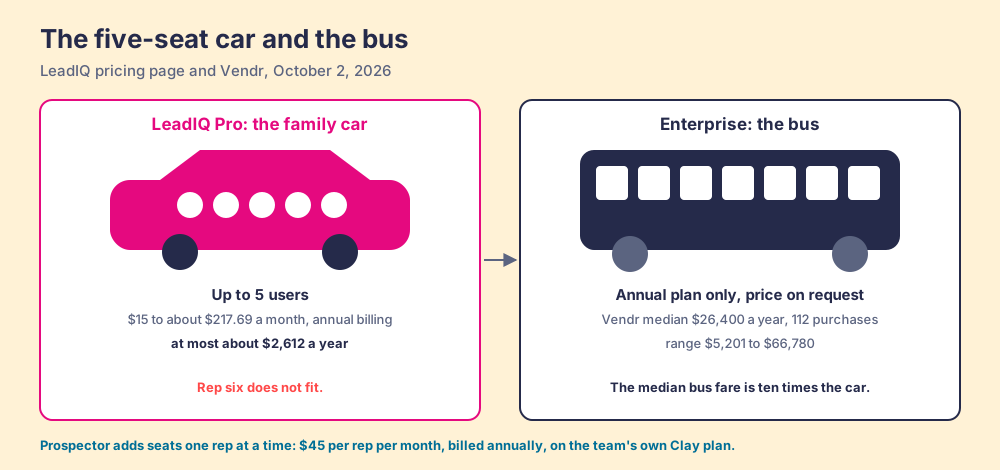
No knock on LeadIQ: Enterprise brings duplicate detection and analytics a ten-rep team wants. A growing team should price the bus before it buys the car. One limit: Vendr’s median covers whatever those 112 buyers bought, seats and credits unknown, so it is a fare range, not a quote.
Is LeadIQ one bucket in a waterfall?
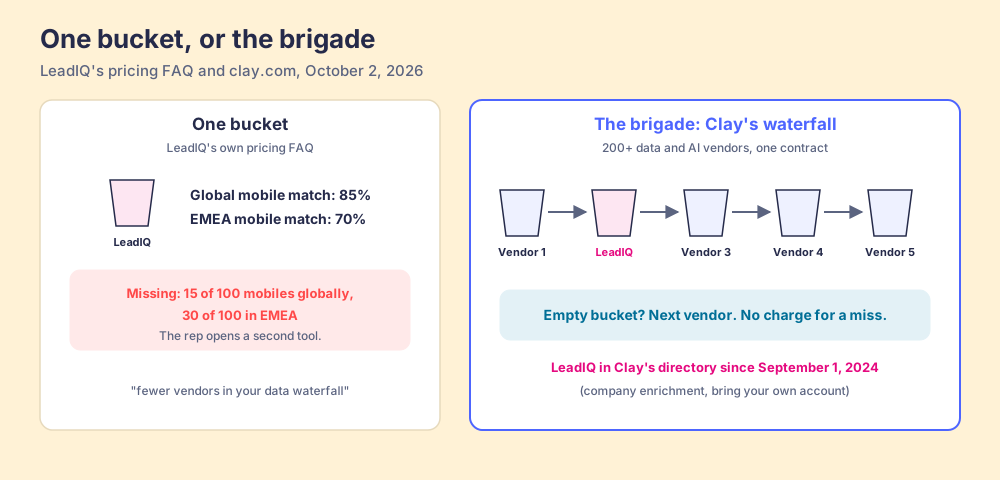
By its own account, yes. The FAQ on LeadIQ’s pricing page reads: “LeadIQ has an 85% global match rate, with 70% in EMEA and climbing. That means fewer vendors in your data waterfall and more direct conversations with decision-makers.” The same FAQ describes “a live dataset of 750 million plus professional profiles, refreshed every month.”
Read that as a buyer and two facts follow. LeadIQ expects to be one vendor in a waterfall, ahead of others. And it tells you, in its own words, what share of mobiles it does not return: 15 of every 100 globally and 30 of every 100 in EMEA. A team that buys only LeadIQ has a bucket brigade with one bucket. When it comes back empty, the rep opens a second tool, and the company signs a second contract.
Clay is the brigade. A waterfall is a list of instructions the GTM engineer writes once: ask this provider first, then that one, stop when a verified email or phone comes back. “Clay’s signature data waterfalls check multiple providers to return the most verified emails (lower bounce rate) and phone numbers (higher connect rate),” across 200+ data and AI vendors under one contract (Clay, rep prospecting, September 25, 2026). “If an enrichment returns no result, you’re not charged Data Credits or Actions” (clay.com/pricing, October 2, 2026). LeadIQ joined Clay’s integration directory on September 1, 2024, with company enrichment on a bring-your-own-account basis (Clay, LeadIQ). If your team already pays LeadIQ, it can be one of the buckets.
What does the LeadIQ Chrome extension do, and where does it stop?
The LeadIQ Chrome extension is where reps meet LeadIQ day to day. Its store listing, checked October 2, 2026, shows 30,000 users, 4.0 from 57 ratings, version 26.9.1 updated October 1, 2026 (Chrome Web Store). In LeadIQ’s words, it does four jobs.
- Contact lookup. “Identify contact data for your key buyers,” from a database the listing puts at “over 600 million contacts across the US, EMEA, and APAC.”
- One-click capture. “Capture and sync that data directly to your CRM and Sales Engagement tools with one click,” including custom lead lists.
- A CRM snapshot. “Seeing if records exist, who owns them, and other vital insights,” before the rep pushes.
- AI drafting. Scribe, “our AI sales email writer,” inside Outreach, Salesloft or Gmail, and now Lando, the agent, inside the same extension.
Where it stops is the edge of the bucket. The lookup asks one database. The capture ends at the CRM or the sequencer. And the team view LeadIQ sells, on its prospecting hub page, tracks “Leads captured, Connection rates, Email deliverability, Integration usage” (LeadIQ Prospecting Hub). Those are the numbers at the dock: how many fish came off the boat and how fresh they were. None of them follows the fish to the table. One enterprise reviewer’s wish, in September 2026, was “to be able to export multiple pages in SalesNav at the same time”; before you buy any extension for that, LeadIQ or ours, ask what it reads from LinkedIn and how. LinkedIn’s help center says it does not permit “browser plug-ins, or browser extensions that scrape, modify the appearance of, or automate activity on LinkedIn’s website” (LinkedIn Help).
LeadIQ vs ZoomInfo: which one fits?
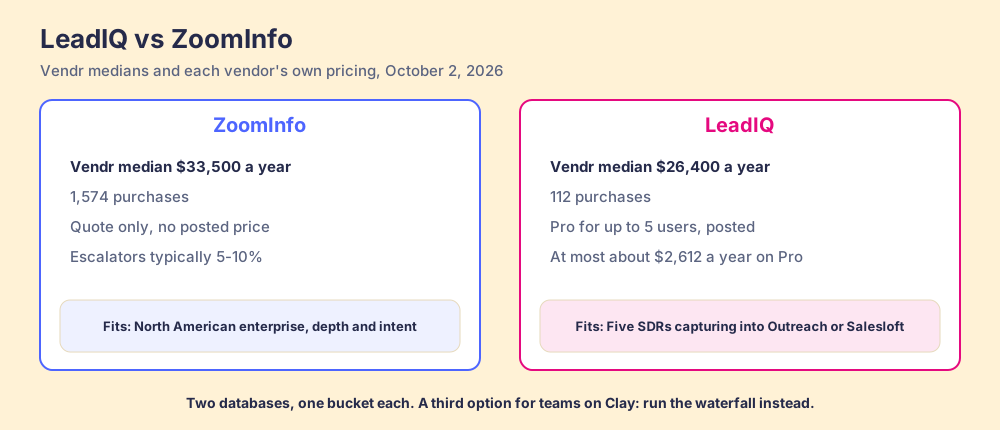
LeadIQ vs ZoomInfo is a capture tool against a warehouse. ZoomInfo is quote-only and sells depth and intent; Vendr puts its median buyer at $33,500 a year across 1,574 purchases, with escalators “typically 5-10%” (Vendr, ZoomInfo, October 2, 2026). LeadIQ’s median is $26,400 across 112, and it publishes a self-serve plan for teams of five or fewer.
- The five-SDR team on Outreach or Salesloft. LeadIQ. Pro at the top of the slider is about $2,612 a year on annual billing, and the capture-to-sequencer flow is its home ground.
- The North American enterprise team buying intent and org charts. ZoomInfo, with the seats to make a platform fee sensible and a cap on the escalator.
- The EMEA phone-first team. Neither by default. LeadIQ reports 70% mobile match in EMEA; the Cognism alternatives page grades the regional specialist.
Both are one database. A team choosing between them because the first one missed too many numbers is choosing which single bucket to carry.
The other LeadIQ competitors, one at a time
- Apollo. The pick when the missing sequencer and dialer are the reason you are leaving. Seats from $49 a month billed annually ($65 monthly), Professional at $79, a phone at 8 credits and an email at 1, G2 4.7 from 9,690 reviews (apollo.io/pricing, October 2, 2026). Its calculator assumes an 88% email and 81% phone match rate. Apollo vs LeadIQ runs the two side by side.
- Lusha. The like-for-like extension with a posted ladder past five seats: Starter from $37.45 a month billed yearly, 1 credit per email and 5 per phone (lusha.com/pricing, September 25, 2026), G2 4.3 from 1,667 reviews. Since March 10, 2026, Lusha has also been a bring-your-own-account step inside Clay.
- Cognism. EMEA, phone-verified mobiles, Do Not Call screening, 5 seats included in quote-only packages, Vendr median $32,750 across 94 purchases (Vendr, Cognism). G2 4.5 from 1,370 reviews.
- Kaspr. Cognism’s LinkedIn extension: $49 a user a month billed annually, unlimited B2B emails, 100 phones a month (kaspr.io/pricing, October 1, 2026).
Where does Supered Prospector fit?
Clay plus Supered is the best way for a sales team to prospect: GTM engineers build in Clay, and reps never open Clay. Prospector runs inside the Supered Chrome extension, on the team’s own Clay account. It does not bring its own database. It brings Clay’s waterfall, which is every database, routed, and that is why we chose Clay as our only data provider and why Clay is not a row in the tables above. Clay is the row that contains the other rows.
It helps to name the three people LeadIQ serves one at a time.
- The GTM engineer. Today the list desk: reps Slack them for every list. With Prospector, they build named flows once in Clay (person enrichment, buying committee), each mapped to a table and a destination, and their logic stays theirs: waterfalls, tiers, tags and sequence variables. Start from the Supered Clay template or bring your own tables.
- The rep. Gets the table as a button on a LinkedIn profile, in Sales Navigator, on a company’s website with company research alongside, or in the HubSpot, Salesforce or Pipedrive record. Before pushing, the rep sees the matching CRM record, who owns it, and whether the prospect was already worked, so no two reps work the same person. From Sales Navigator, reps add leads to a prospect list and push the list into a Clay table. Then they pick a flow from the Push menu, the table runs, and the result goes to the CRM or your sales engagement tool.
- The leader. Sees every list three ways. Found: reps use your tables, no duplicate work. Worked: who is working their list, and who isn’t. Closed: no lead left hanging, every lead ends the way your process says, Qualified, Recycled or Disqualified. When the VP sees it too, the Clay budget grows.
LeadIQ’s Champion Tracking deserves its own line, because it is a real strength. The equivalent play on Clay is the job-changers play: a past champion changes jobs, and the rep pushes them and their new team into a sequence from the profile they are on. Job change tracking compares the ways to run it.
Prospector works within LinkedIn’s terms and does not copy search results in bulk; the contact data comes from Clay’s waterfall on the customer’s Clay account.
The arithmetic. Clay’s Growth plan is $446 a month on annual billing, 72,000 data credits a year, CRM sync included (clay.com/pricing, October 2, 2026). Prospector is $45 per rep per month billed annually, from one rep (Prospector). Ten reps: $5,352 for Clay and $5,400 for Prospector, $10,752 a year, against a LeadIQ Enterprise median of $26,400 for a team that size. Five reps: $8,052, where LeadIQ Pro at the top of the slider is about $2,612. LeadIQ wins the five-seat sticker. Skip the extra seats past five: get more out of the Clay you already pay for.
Choose something else if you do not have Clay. Prospector does nothing without a Clay account, and a team that has never built a waterfall needs someone to build it. RevPartners, a Clay Elite Studio Partner and the company I founded, builds and tunes Clay tables for teams that want help; so do other Clay partners. Choose something else, too, if you are five SDRs on Outreach and happy with the capture flow: LeadIQ Pro is inexpensive, and the car fits.
What happens to the list after the capture?
Go back to the dock. LeadIQ’s team view counts leads captured, connection rates and deliverability; Apollo, Lusha and Kaspr meter at the reveal. Each number is about the catch. The vendors’ job ends when the contact lands in the CRM. A sales leader’s starts there.
The Bridge Group’s 2025 report shows how much work follows a sourced contact: a median of 112 activities a day, 44 of them phone, and $3.78 million in raw pipeline sourced per SDR a year, which the report calls “not forecast or closed-won revenue.” A captured list is a promise of work. Whether the work happened, and which lists produced the deals, is the question the renewal meeting asks.
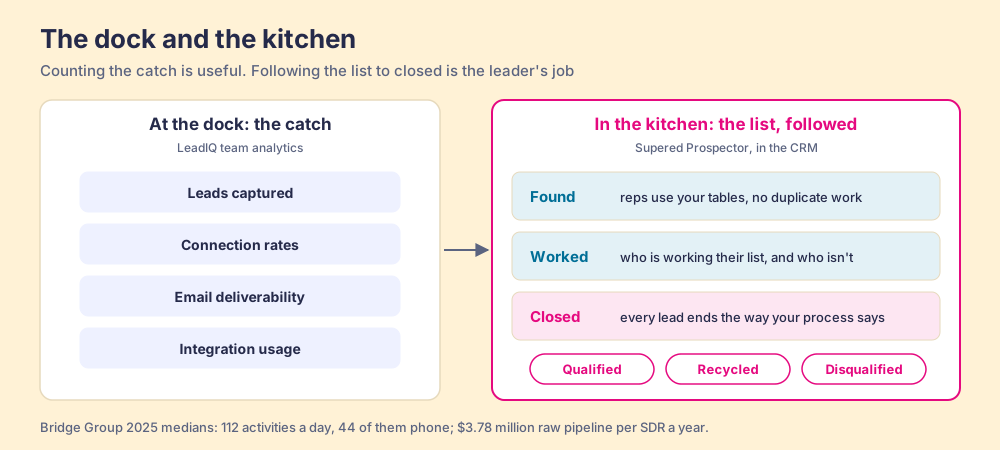
A rep-built list that lands in the CRM with the team’s process attached gets worked. The rep sees the next step in the flow of the work, and the manager watches the list become pipeline and coaches from what is converting. The sales prospecting tools page lays out the full stack around it, and the sourcing use case shows the rep’s view.
Which LeadIQ alternative should you choose?
The choice resolves once you name the job and count the seats.
- LeadIQ itself. Five or fewer SDRs capturing into Outreach, Salesloft or Salesforce. Buy annual.
- Apollo. You are leaving for the sequencer and dialer. A phone costs 8 credits.
- ZoomInfo, Cognism, Lusha, Kaspr. US enterprise depth; EMEA phones; a posted ladder past five seats; one email-first rep.
- Supered Prospector. The team has Clay, and you want the waterfall in every rep’s hands with every list followed to closed.
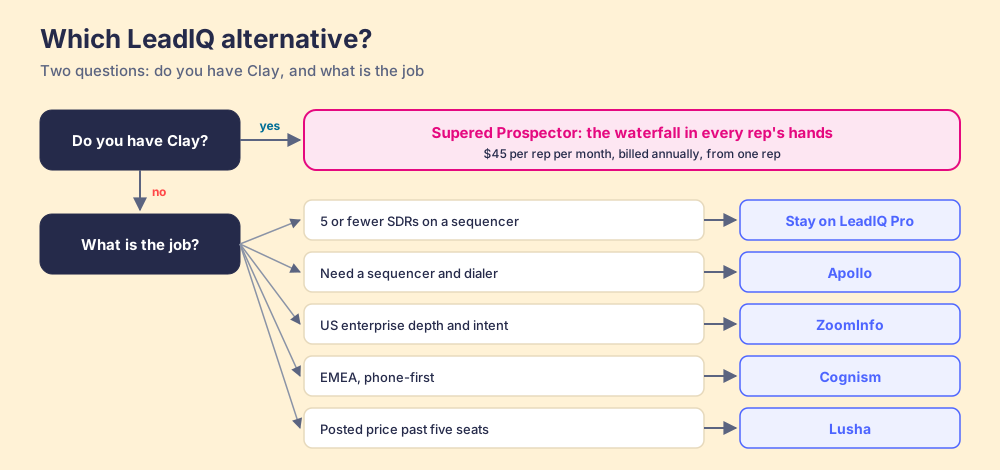
What we recommend depends on two facts about your team. If you do not have Clay and you are five SDRs on a sequencer, keep the car: LeadIQ Pro is good value, and switching will not buy you a better bucket. If you do not have Clay and you are about to hire the sixth rep, price the bus against Apollo and Lusha before you sign an annual Enterprise quote. If you have Clay, LeadIQ’s own FAQ already told you where it belongs: in the waterfall, as one bucket among 200+. Put that waterfall in your reps’ hands from the profile, the company site and the CRM record, add seats one rep at a time, and follow each list from found to closed. The Clay Chrome extension guide shows what reps see, and a Prospector demo on your own Clay account shows the lists your team builds this month.
Frequently asked questions
What are the best LeadIQ alternatives in 2026?+
How much does LeadIQ cost in 2026?+
Is LeadIQ worth it? A short LeadIQ review+
LeadIQ vs ZoomInfo: which is better?+
Who owns LeadIQ?+
Do I need a Clay account to use Supered Prospector?+
Your process, running itself.