LeadIQ Review 2026: A Fine Faucet, and the Question of the Water
LeadIQ reviewers love the capture and fault the data, and the split explains the whole product.
A LeadIQ review checked October 2, 2026: ratings on five sites, what the complaints trace to, GDPR, pricing, and who should buy it.
This LeadIQ review grades LeadIQ, the San Francisco company whose Chrome extension captures prospects from LinkedIn into the CRM and sequencer, on two questions: is the capture worth paying for, and is the data good enough to trust.
A good kitchen faucet is a pleasure. It swings where you want it, the handle falls under your hand, the spray comes on with a tap of the wrist, and in a year you stop noticing it. None of that tells you anything about the water. If the town supply runs brown in August, the faucet delivers brown water beautifully.
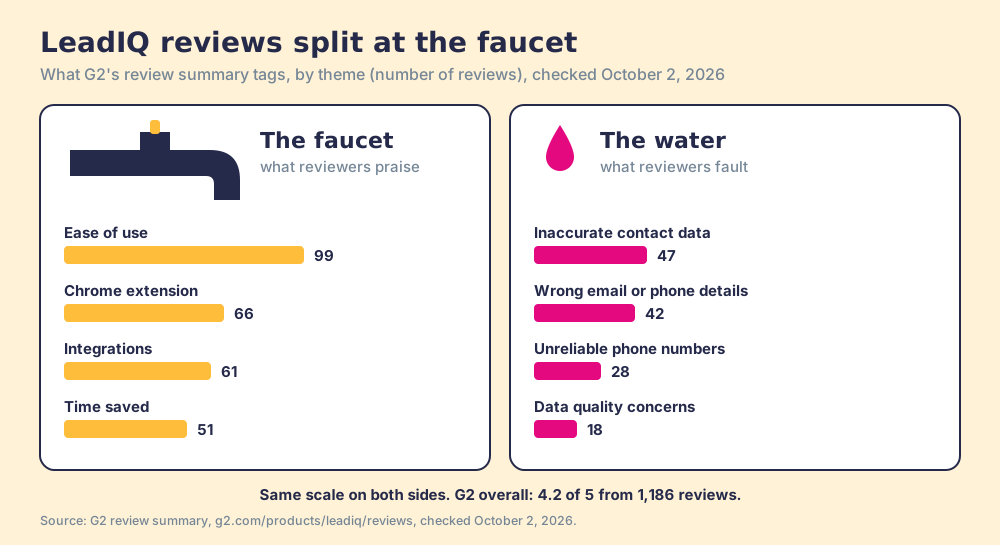
Read LeadIQ’s reviews with that in mind and they sort themselves. G2’s review summary, checked October 2, 2026, tags 99 reviews for ease of use, 66 for the Chrome extension and 61 for integrations. It tags 47 for inaccurate contact data, 42 for wrong email and phone details and 28 for unreliable phone numbers (G2, LeadIQ reviews). Reviewers praise the faucet and blame the water. The quick answer, checked October 2, 2026:
- LeadIQ itself. A good buy for up to five SDRs who capture from LinkedIn into Outreach, Salesloft or Salesforce and want a low posted price. Free to about $2,612 a year on Pro.
- Supered Prospector. The pick for a team that already pays for Clay: reps run Clay’s waterfall across 200+ vendors from where they sell, with LeadIQ as one optional step. $45 per rep per month, billed annually.
- Apollo. The non-Clay switch when the team wants a sequencer and a dialer in the same seat as the data.
This LeadIQ review grades LeadIQ, the San Francisco company whose Chrome extension captures prospects from LinkedIn into the CRM and sequencer, on two questions, whether the capture is worth paying for and whether the data is good enough to trust. The first answer is yes. The second depends on how much of your day is the phone.
What do LeadIQ reviews say?
The praise is specific, and it is about speed. “One-click capture allow my BDRs to instantly grab verified contact information,” a senior BDR manager wrote on G2 in November 2025. A mid-market BDR in the same month: “one click instead of jumping around multiple platforms.” On Capterra, a CEO put it in eleven words: “LeadIQ plus LinkedIn Sales Navigator are the no-compromises solution for list building” (Capterra, LeadIQ). Capterra’s ease-of-use score is 4.6 out of 5.
The complaints are specific too, and they cluster in four places.
- Contact details that turn out wrong. “Sometimes the contact information is wrong,” a mid-market user wrote in May 2026. A head of partnerships in September 2026: “some of the email addresses extracted by LeadIQ are not correct.” An enterprise project manager in February 2026 found that once he paid, contacts that had sat behind the paywall “came up as empty or wrong.”
- Phones above all. “Phone numbers are awful,” a TrustRadius reviewer wrote, and TrustRadius scores LeadIQ 6.1 out of 10 from 77 ratings (TrustRadius). LeadIQ prices a phone at 10 credits and an email at 1, so the field that draws the most complaints is also the one that costs the most.
- The web app away from LinkedIn. “Prospecting inside of the LeadIQ platform is difficult and not very intuitive,” a pipeline program manager wrote in April 2026.
- The new AI. “I don’t think their new AI capability called Lando is working super well,” a senior SDR wrote in May 2026, two months after LeadIQ announced Lando in beta.
One review on TrustRadius explains a share of LeadIQ’s buyers in one sentence. “We have LeadIQ because it’s part of a package deal w/ Gong.” A tool that arrives bundled gets reviewed by people who did not choose it, and that tends to pull a score down.
Why do LeadIQ’s ratings differ by site?
Because each site hears from a different chair. LeadIQ on five of them, all checked October 2, 2026:
| Where | Who is reviewing | Rating | Reviews | What stands out |
|---|---|---|---|---|
| G2 | Verified users | 4.2 of 5 | 1,186 | LeadIQ’s own extension page still shows 4.3 |
| Capterra | Verified users | 4.4 of 5 | 25 | Ease of use 4.6, value for money 4.6 |
| TrustRadius | Verified users | 6.1 of 10 | 77 | ”Phone numbers are awful” |
| Chrome Web Store | Installed users | 4.0 of 5 | 57 ratings (30,000 users) | Version 26.9.1, October 1, 2026 |
| Trustpilot | Anyone | 2.3 of 5 | 6, all one-star | People who found themselves in the database |
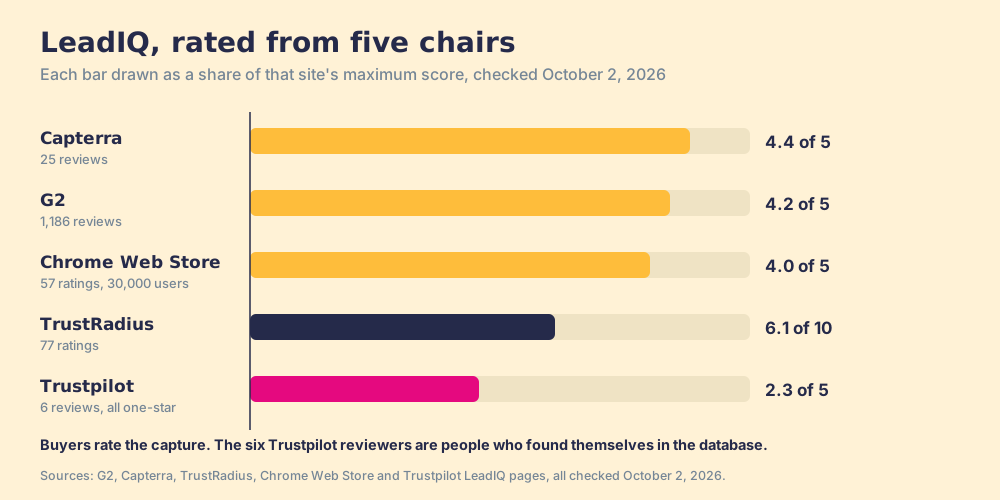
Two details in that table change how you read it. LeadIQ’s Chrome extension page advertises “4.3/5” on G2 (LeadIQ Chrome extension); G2 itself showed 4.2 on the day we checked, a small drift that tells you vendor pages lag the source. And Capterra lists a “starting price” of $75 per user per month for a “Starter plan.” LeadIQ’s own pricing page has no Starter plan: it lists Free, Pro and Enterprise (leadiq.com/pricing). Review sites cache prices. Read prices on the vendor’s page.
The Trustpilot page holds only six reviews, which is too few to score a company on. What they say is still useful, because it comes from the other side of the pipe. One reviewer wrote in October 2025 that he was getting sales calls because LeadIQ “has attached my phone number to someone who happens to have the same name.” Another, in September 2024: “You receive an e-mail out of the blue telling you that your personal data has been collected and is going to be used by an unknown Californian company.”
Is LeadIQ GDPR compliant, and where does its data come from?
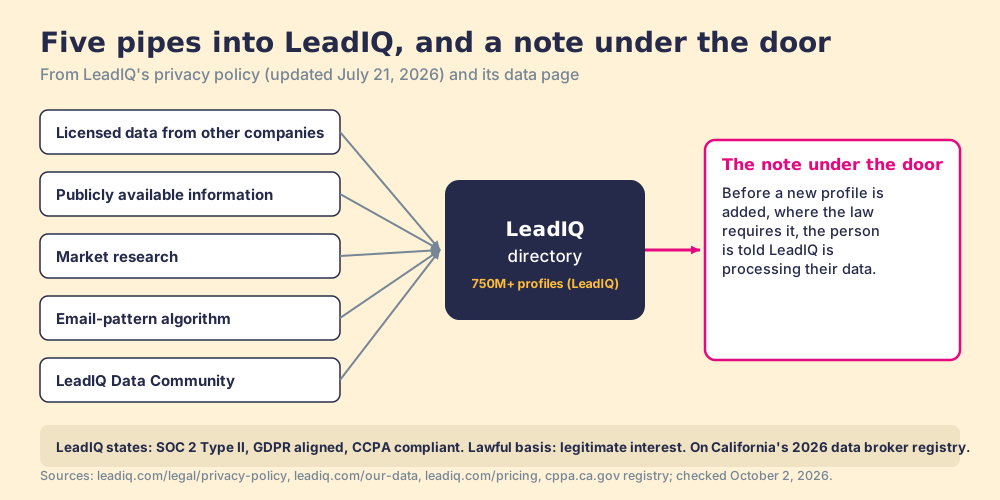
That second Trustpilot reviewer had received a letter LeadIQ says it sends on purpose. Its privacy policy, updated July 21, 2026, reads: “Before new contact information is added as a profile in the Directory Database, and if applicable by law, that contact will be informed about the processing of their personal information by LeadIQ” (LeadIQ privacy policy). A new neighbor sometimes slips a note under your door to say he has moved in next door and knows your name. Some people find that polite. Some find it unsettling to learn they had a neighbor at all. Under GDPR, the note is the point: a company that collects your data from someone other than you is expected to tell you.
The policy lists where the directory comes from: information licensed from other companies, publicly available information, market research, a “proprietary algorithm leveraging public information to identify corporate email patterns,” and contributions from the LeadIQ Data Community. LeadIQ’s data page adds that “each search kicks off a fresh verification check,” and states SOC 2 Type II, GDPR alignment and CCPA compliance (LeadIQ, our data). Its GDPR FAQ names legitimate interest as the lawful basis and says LeadIQ processes only “contact information that would typically be found on a business card” (LeadIQ GDPR FAQ).
The neighbor picture has an edge worth marking. A note under the door is a courtesy; a lawful basis is a legal argument, and regulators can disagree with a vendor’s. Italy’s data protection authority fined Lusha €2 million in July 2026 on the theory that keeping profiles fresh is “monitoring” under GDPR, and a Rome court suspended that order in September (the Lusha review has the file). A search on October 2, 2026 found no regulator decision against LeadIQ. LeadIQ, Inc is on California’s 2026 data broker registry (CPPA registry, updated July 29, 2026), like most of its peers. If your pipeline is heavy in the EU, ask every vendor the same written question, ours included.
How accurate is LeadIQ’s data?
LeadIQ publishes its own answer. The FAQ on its pricing page reads, “LeadIQ has an 85% global match rate, with 70% in EMEA and climbing. That means fewer vendors in your data waterfall…” It describes “a live dataset of 750 million plus professional profiles, refreshed every month,” and says verified phone “Accuracy is greater than 90%.” Those are LeadIQ’s numbers, unaudited.
Take them at face value and the arithmetic is plain. A match rate of 85% leaves 15 of every 100 mobiles missing worldwide and 30 of every 100 in EMEA. An accuracy figure above 90% leaves up to one dialed number in ten wrong. LeadIQ’s help center sorts emails into “Verified,” “Verified Likely,” which it describes as a “best guess,” and “Unverified,” so the rep can see which water came through the filter (LeadIQ help, verification symbols).
None of that makes LeadIQ worse than its peers. Any single database has a miss rate, and LeadIQ is unusual in printing its own. The FAQ sentence matters for a second reason: LeadIQ expects to sit in a waterfall, ahead of other vendors. It joined Clay’s integration directory on September 1, 2024, with company enrichment on a bring-your-own-account basis (Clay, LeadIQ). The LeadIQ alternatives page works that bucket arithmetic in full.
Is LeadIQ worth the price?
For a small team, yes. LeadIQ Pro is shared by up to five users and priced by a credit slider, from $20 a month for 200 credits on monthly billing, up to $290.25 for 6,750, and 25% less billed annually, which puts the top step near $2,612 a year. Free gives 1 user 50 credits a month. Enterprise is a quote, “Annual plan only,” and Vendr puts the median LeadIQ contract at $26,400 a year across 112 purchases (Vendr, LeadIQ). Capterra’s reviewers score value for money 4.6 out of 5, the same as ease of use.
The phone is where the price bites. At 10 credits each, the bottom of the slider buys 20 phones a month for the team, and the top buys 675, about 135 each for five reps. “I wish I had more credits for a more competitive price,” a mid-market BDR wrote on G2. The LeadIQ pricing page walks every step of the slider, and Apollo vs LeadIQ prices a phone on each.
Why trust this LeadIQ review?
I started RevPartners, a HubSpot partner that did only sales implementations, sold roughly twice as much Sales Hub as any other partner, and reached Elite tier in 13 months. Supered came out of that work and is the #1 sales enablement app on the HubSpot marketplace, rated 5.0 from 122 reviews there and 4.9 from 81 on G2 (both checked October 1, 2026). The disclosure: we make Supered Prospector, which competes with LeadIQ for teams on Clay, and it ranks first below for that job only. One naming note: LeadIQ calls its own prospecting hub “Prospector.” Supered Prospector is a different product from a different company.
How does LeadIQ compare with the alternatives?
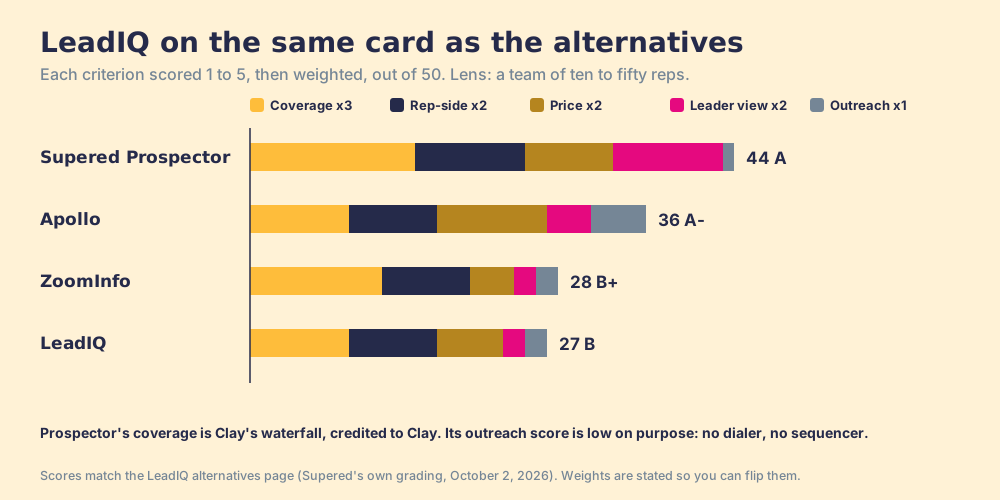
The lens is a team of ten to fifty reps that wants contact data reps will use where they already sell, and a leader who can see which lists turn into pipeline. Each tool is scored 1 to 5 on five criteria and weighted: coverage of the contact you need (x3), rep-side delivery (x2), price structure (x2), what the leader sees after the export (x2), and bundled outreach (x1), out of 50. The scores match the LeadIQ alternatives page.
| Rank | Tool | Grade | Score | Best fit | CRM integration | Setup effort | Pricing | Reason to switch from LeadIQ |
|---|---|---|---|---|---|---|---|---|
| ref | LeadIQ | B | 27 | Up to five SDRs capturing into a sequencer | Native (Salesforce, HubSpot, plus Outreach, Salesloft, Gong) | Minutes | Free; Pro $15 to about $217.69 a month billed annually | Stay if capture into a sequencer is the job |
| 1 | Supered Prospector | A | 44 | Teams that already pay for Clay | Native (HubSpot, Salesforce, Pipedrive) | Under a week on an existing Clay account | $45 per rep per month, billed annually, plus your Clay plan | 200+ vendors per lookup, no five-seat wall, lists followed to closed |
| 2 | Apollo | A- | 36 | Teams wanting data, sequences and a dialer in one plan | Native (HubSpot, Salesforce) | A day | $49 / $79 per seat per month, billed annually | A sequencer and dialer LeadIQ does not have |
| 3 | ZoomInfo | B+ | 28 | North American enterprise depth and intent | Native (HubSpot, Salesforce, Dynamics) | Weeks | Quote only; Vendr median $33,500 a year | Depth and intent, for teams with the seats for a platform fee |
LeadIQ’s 27 is coverage 3, rep-side delivery 4, price 3, what the leader sees 1, outreach 2. The rep-side 4 is the faucet, and it is earned, because the extension shows CRM and sales-stack sync status before the rep pushes. The coverage 3 is the water, by LeadIQ’s own match rates. Prospector’s coverage score is Clay’s waterfall, credited to Clay, and its outreach score is low on purpose: it has no dialer and no sequencer.
Where does Supered Prospector fit?
Clay plus Supered is the best way for a sales team to prospect: GTM engineers build in Clay, reps never open Clay. Prospector runs inside the Supered Chrome extension, on the team’s own Clay account. It does not bring its own database. It brings Clay’s waterfall, which is every database, routed, and that is why we chose Clay as our only data provider. Back at the sink, a single database is one reservoir; Clay is plumbing to 200+ of them (clay.com, checked October 2, 2026), with a rule the GTM engineer writes once: try this source first, then the next, stop at the first verified email or phone. “If an enrichment returns no result, you’re not charged Data Credits or Actions” (clay.com/pricing).
What the three people around it get:
- The GTM engineer. Builds named flows once, each a Clay table or function with a destination, and stops being the list desk. Waterfalls, tiers, tags and sequence variables stay theirs. Start from the Supered Clay template or bring your own tables.
- The rep. The table as a button on a LinkedIn profile, a company website or a HubSpot, Salesforce or Pipedrive record. Before pushing, the rep sees the matching CRM record, who owns it and whether the prospect was worked before.
- The leader. Found, Worked, Closed, meaning which lists reps found, who is working theirs, and how each lead ended the way your process says, Qualified, Recycled or Disqualified. The manager watches the list become pipeline and coaches from what is converting.
Prospector works within LinkedIn’s terms and does not copy search results in bulk; the contact data comes from Clay’s waterfall on the customer’s Clay account.
On price, Clay Growth lists at $495 a month, or $5,940 a year, and Prospector is $45 per rep per month billed annually, from one rep (Prospector). Ten reps come to $11,340 a year. Five reps on LeadIQ Pro at the top of the slider cost about $2,612, so for a team of five LeadIQ wins on price. The comparison changes at the sixth rep, where LeadIQ’s next step is an Enterprise quote with a $26,400 median.
Choose something else if you do not have Clay. Prospector does nothing without a Clay account, and someone has to build the tables; RevPartners, a Clay Elite Studio Partner that I founded, builds and tunes them, and so do other Clay partners. Choose something else, too, if you are five SDRs on Outreach and the capture flow is the whole job. LeadIQ is a fine faucet at a fair price. The sourcing use case shows how teams on Clay set Prospector up.
Which should you choose?
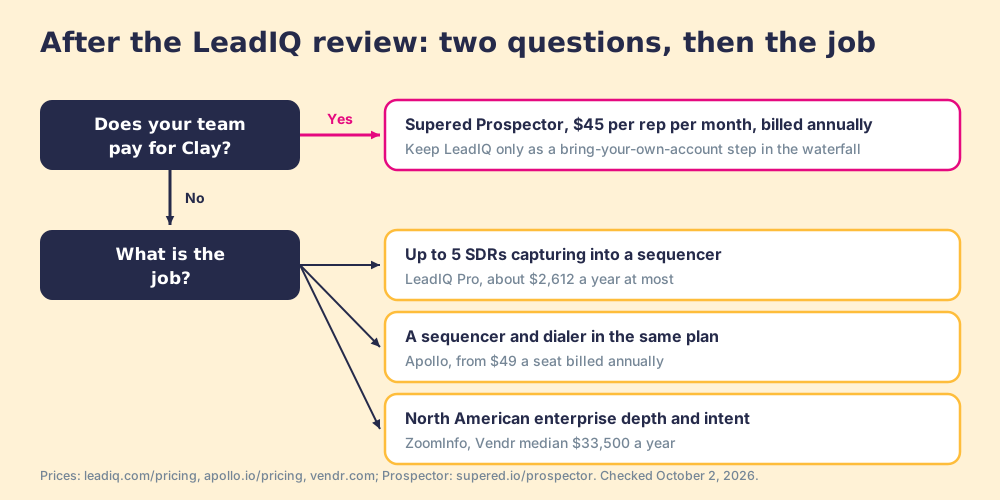
- LeadIQ, kept. The pick for up to five SDRs who capture from LinkedIn into a sequencer, email more than they call, and value a cheap, posted plan. Buy annual.
- Apollo. The pick when the missing sequencer and dialer are why you are reading LeadIQ reviews. The Apollo alternatives page grades it in its own lane.
- ZoomInfo. The pick for North American enterprise depth and intent, with the seats to justify a platform fee.
- Supered Prospector. The pick when the team already pays for Clay and wants every source behind each lookup, control over which sources, and a view of which lists got worked and closed.
My recommendation rests on the split this review found. LeadIQ’s reviewers are right about the faucet. The capture is fast, the sync is clean and the extension shows ownership before a rep pushes. They are also right about the water, and LeadIQ’s own FAQ tells you how much of it is missing. If your problem is reps copying contacts by hand into Outreach, buy the faucet. If your problem is the 15 mobiles in 100 that never arrive, a nicer faucet on the same pipe will not fix it. Run more sources behind one button, let reps use it where they sell, and follow each list to closed. The LeadIQ Chrome extension page shows what reps see day to day, and a Prospector demo on your own Clay account shows the other way.
Frequently asked questions
Is LeadIQ a good company?+
What is LeadIQ used for?+
Is LeadIQ GDPR compliant?+
Where is LeadIQ based?+
How much does LeadIQ cost?+
Is there a better option than LeadIQ for a team on Clay?+
Everything we have written on LeadIQ
More on LeadIQ
Supered Prospector vs LeadIQ: the side-by-side- LeadIQ Alternatives in 2026: Five Seats, One Bucket, and the Sixth Rep
- LeadIQ Pricing in 2026: A $15 Sticker, a $26,400 Median, and a Phone That Costs Ten Credits
- The LeadIQ Chrome Extension in 2026: A Toll Road With a One-Year Pass, and One Town at the End of It
- Apollo vs LeadIQ in 2026: The House, the Delivery Van, and the Market
- ZoomInfo vs LeadIQ in 2026: The Superstore and the Tool Belt
Your Clay waterfall, where reps already work.