UpLead Pricing in 2026: One Coin, One Contact, and a Free Week That Defaults to a Year
UpLead pricing checked on October 1, 2026: a 7-day trial that switches to an annual plan if you do nothing, Essentials and Plus from $74 a month, what one credit buys, the price per contact against Apollo, RocketReach and Lusha, and ten-rep team math.
UpLead pricing in 2026 is four plans: a 7-day trial with 5 credits, Essentials at $99 a month ($74 billed annually), Plus at $199 ($149 billed annually), and a custom Professional team plan, where one credit buys one whole contact with email and mobile direct dial.
A vending machine is the most candid shop in the building. One coin, one slot, one sandwich, and the sandwich comes whole: you do not pay extra for the lettuce. The price is on the glass. The catch, when there is one, is on the side panel, in the small print about refunds and the machine down the hall.
UpLead pricing in 2026 is four plans: a 7-day trial with 5 credits, Essentials at $99 a month ($74 billed annually), Plus at $199 ($149 billed annually), and a custom Professional team plan, where one credit buys one whole contact with email and mobile direct dial (uplead.com/pricing, opened October 1, 2026). That last clause is the reason UpLead’s price list is easier to read than most in contact data. The price you need, though, sits in three places the plan cards do not show: what the free trial turns into, who can use a seat, and what a contact costs next to the competitors.
The quick answer, three ways:
- UpLead Essentials, monthly at $99. One person testing outbound who wants a clean meter and the right to leave after a month.
- UpLead Plus, annual at $1,788. One heavy user who is sure about the year: about 19 contacts a working day at about 37 cents each.
- Supered Prospector, $540 a rep a year on your own Clay account. A team that already pays for Clay, where reps build lists from LinkedIn, a company site or the CRM record and the waterfall asks 200+ vendors instead of one.
How much does UpLead cost in 2026?
UpLead publishes both billing cycles in its page source, so the table below needed no clicking and no guessing. The numbers come from the pricing page or its plan comparison, opened today.
| UpLead pricing (Oct 1, 2026) | Free trial | Essentials | Plus | Professional |
|---|---|---|---|---|
| Monthly billing | $0 for 7 days | $99 a month | $199 a month | n/a |
| Annual billing, per month | n/a | $74 | $149 | Custom, “Annual Billing Only” |
| Billed for the year | n/a | $888 | $1,788 | Custom |
| Credits | 5 | 170 a month, or 2,040 a year | 400 a month, or 4,800 a year | Custom |
| Price per contact | free | $0.58 monthly, $0.44 annual | $0.50 monthly, $0.37 annual | Quoted |
| Extra credits | n/a | $0.60 each | $0.50 each | Custom |
| Seats | 1 user | 1 user | 1 user | Team account, custom seats |
| CRM integration | No | Yes: Salesforce, HubSpot, Pipedrive, Zoho, Dynamics 365 and more | Yes | Bi-directional CRM sync |
| Adds | Chrome extension | Company news (annual card) | Enrichment, technographics, advanced filters, suppression lists | Intent data, full API, team management, success manager |
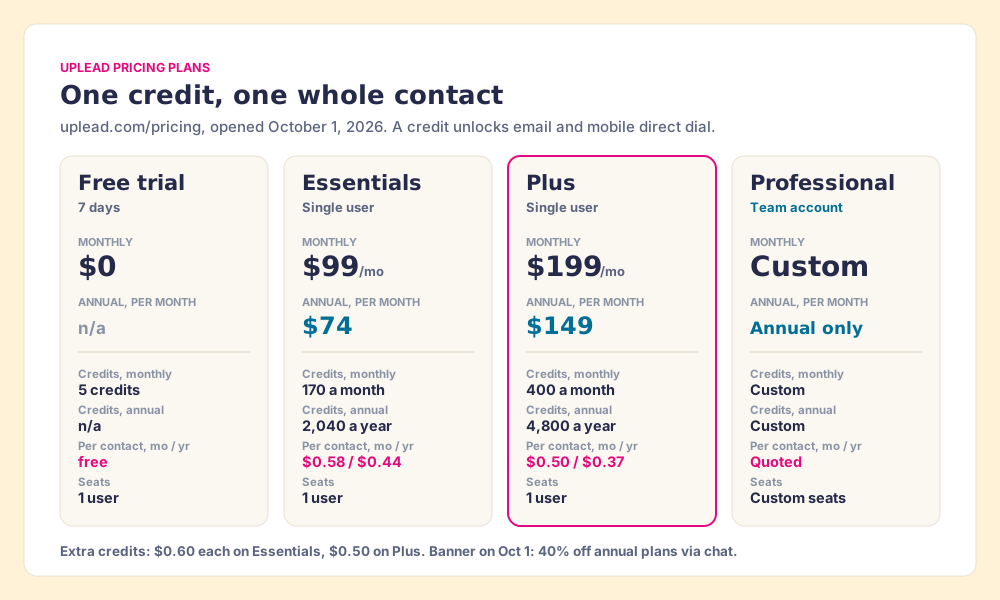
Two items on the page deserve a line each. A banner across the top read “Black Friday, 40% OFF Annual Plans, Chat to get the discount” on October 1, with no terms published. If it applied to Plus annual in full, $1,788 would drop to about $1,073, but that is our arithmetic on an unpublished offer, so ask for it in writing before you count on it. And UpLead names one of its own features “Prospector,” as in the “Prospector Pro API.” That is UpLead’s search product. Supered Prospector, which appears later on this page, is a different product from a different company.
What does one UpLead credit buy?
A whole contact. The pricing page puts it in one sentence: “A credit unlocks a contact for download or CRM export and gives you access to their email and mobile direct dial. One credit = one contact.” The vending machine, in UpLead’s own words: one coin, one sandwich, everything inside.
Most of UpLead’s competitors run a menu instead, priced by the ingredient. Lusha charges 1 credit to reveal an email and 5 for a phone, so 6 for a rep who wants both (lusha.com/pricing). Apollo charges 1 credit per email and 8 per phone, so 9 for both (apollo.io/pricing, captured September 25, 2026). A rep who dials burns through a menu-priced plan at six or nine times the rate the credit count suggests.
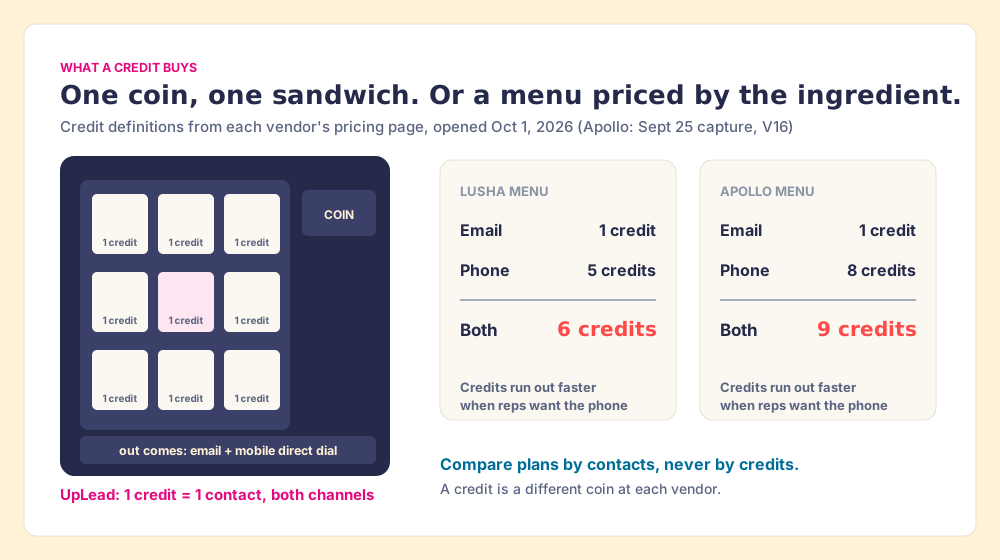
So the plan to compare is contacts, divided by working days. Across 250 working days, Essentials annual gives about eight contacts a day and Plus annual about nineteen. The Bridge Group’s 2025 SDR report, 351 companies, puts the median SDR at 44 dials a day (Bridge Group, 2025). Reps redial the same people, so a dialer does not need 44 new contacts a day, but a full-time SDR building fresh lists will press against nineteen well before the year is out. That is when the extra-credit price of 50 or 60 cents starts to matter.
The machine also refunds some coins. For bulk enrichment, UpLead’s help center says “Credits are deducted upfront based on the number of rows processed. If a contact is not matched, the credit is refunded after the process is complete” (UpLead help center). On verification, UpLead checks each email at the moment of download, and its own bounce article is unusually frank about the limits of the 95% accuracy figure on the plan cards: “Even when a provider claims “95% accuracy”, that may refer to the state of verification at a point in time, but addresses can become invalid afterwards” (UpLead help center). A sandwich can be fresh at the machine and stale by Friday.
What happens when the UpLead free trial ends?
A gym’s free week is a fine offer until you read what happens on day eight. UpLead’s free trial is 7 days and 5 credits. Its help article on switching plans says what follows if you do nothing: “Forgetting to update your plan will result in an automatic switch to the Essentials Annual Plan” (UpLead help center).
The Essentials Annual Plan is $74 a month billed annually. Twelve times $74 is $888, the price of the year a forgetful trial user signs up for by not clicking anything.
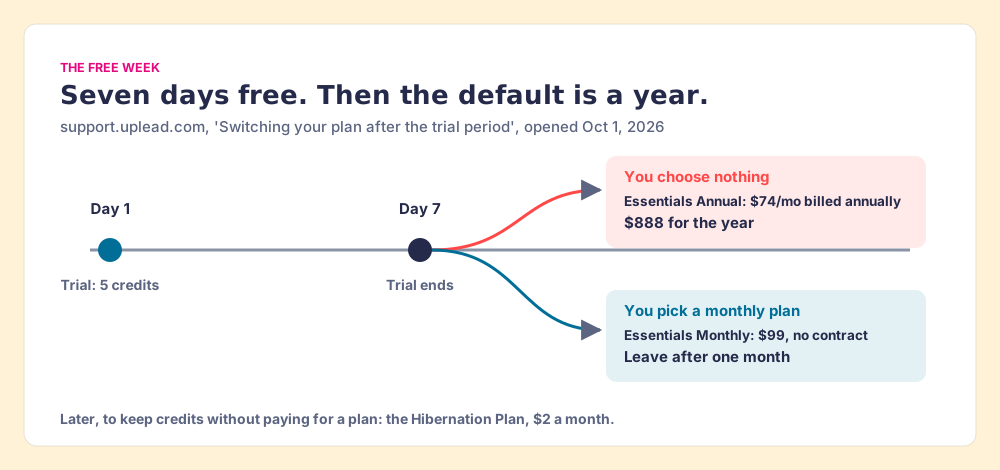
Fair to UpLead: the default is written down in its own help center, and the alternative is one click away. The FAQ on the pricing page says “Our monthly plans have no contract or long-term commitment.” The gym analogy has an edge, too: an annual Essentials plan is not a bad buy for someone who will prospect all year. It is a bad buy for someone who signed up to find out whether they will. One G2 reviewer in February 2026 wrote that the billing “doesn’t explain if they will charge me monthly” (Eduardo G., Small Business, G2). The help article answers the question; the trial screen is where buyers look for it.
The free UpLead trial is worth taking for what it is, five contacts to test the data against people you already know. Choose the monthly plan on day one, before the five run out.
Is UpLead cheaper on monthly or annual billing?
Annual, by about a quarter, on both self-serve plans. Twelve months of Essentials on monthly billing cost $1,188 against $888 annual, a saving of $300 (25%). Twelve months of Plus cost $2,388 against $1,788, a saving of $600 (25%). The credits match exactly: 170 a month is 2,040 a year, and 400 a month is 4,800. The annual buyer gets the same contacts for three quarters of the price and gives up the exit.
The exit has three doors, and UpLead documents all of them:
- Downgrade. Takes effect at the end of the billing period, and “Any remaining credits from your current plan will roll over to your new plan based on its terms” (UpLead help center).
- Hibernation. $2 a month keeps unused credits, saved searches and past downloads while you search nothing new, which is $24 a year for a seasonal prospector.
- Closing. “You will immediately lose access to all of your unused credits, saved searches, uploaded files, and previously downloaded lists” (UpLead help center). Pause first; close only when the credits are spent.
How does UpLead’s price per contact compare?
UpLead’s meter is the simplest in this group. It is not the cheapest. On list prices, per contact with both an email and a phone:
| Price per email-and-phone contact (list, Oct 1, 2026) | Annual plan | Per contact |
|---|---|---|
| Apollo Basic | $588 a year, 30,000 credits at 9 per contact | about $0.18 |
| RocketReach Pro | $899 a year, 3,600 exports | $0.25 |
| Clay, entry Data Credit rate | about six credits at $0.05 (our estimate) | about $0.30 |
| UpLead Plus | $1,788 a year, 4,800 credits | about $0.37 |
| UpLead Essentials | $888 a year, 2,040 credits | about $0.44 |
| UpLead Plus, monthly | $199 a month, 400 credits | about $0.50 |
| Lusha Starter | $449.40 a year, 4,800 credits at 6 per contact | about $0.56 |
| UpLead Essentials, monthly | $99 a month, 170 credits | about $0.58 |
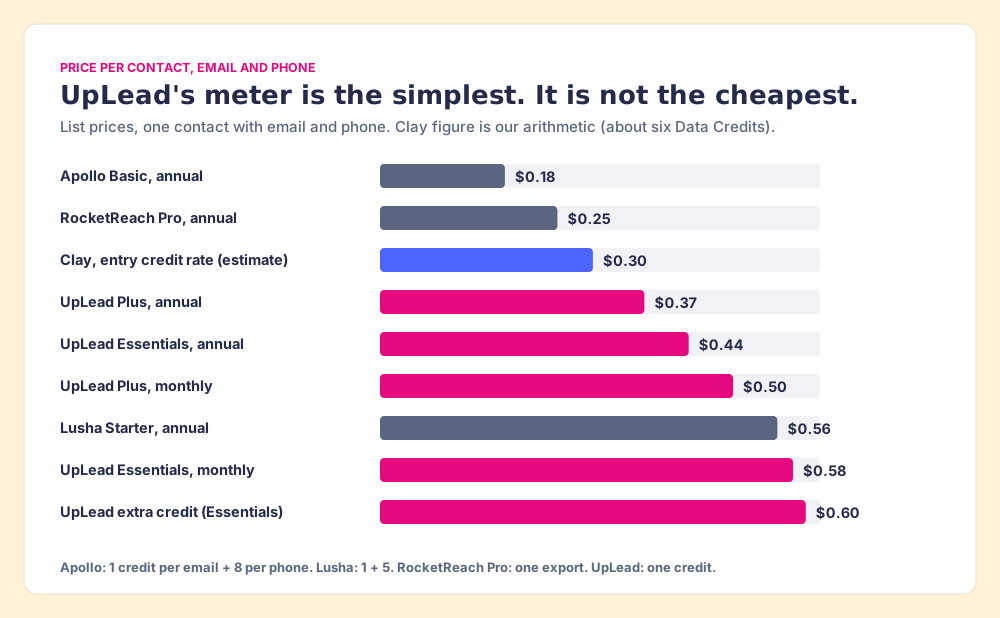
Two cautions keep this table from overreaching. List prices per contact ignore coverage: a cheap credit that returns no phone number costs more than a dear one that connects. And the Apollo and Lusha figures assume a rep wants the phone every time; an email-only rep pays 1 credit on either and the order flips. Sources: Apollo’s pricing page (Basic $49 a seat a month annual, 30,000 credits a year), RocketReach’s pricing page (rocketreach.co/pricing, Pro $899 billed annually), Lusha’s (Starter $37.45 a month billed yearly, 4,800 credits), and Clay’s (clay.com/pricing, Data Credits from $0.05).
Why do teams leave UpLead?
Fair first. On G2, UpLead held a 4.7 out of 5 from 831 reviews on October 1, 2026 (G2, UpLead reviews), one of the higher scores in contact data, and its pricing page quotes buyers who came from bigger names: “ZoomInfo was too expensive and Apollo just wasn’t providing current and relative data” (Mike Giuffrida, Kyber Security). For one person who wants verified contacts without a sales call, UpLead is a sound purchase.
The complaints on G2 gather in three places, and each one is a buying criterion:
- Price for the smallest buyers. “I find the pricing of UpLead to be a concern” (Stephen A., Founder, December 2025). The monthly price per contact is the highest UpLead charges; the trial default is the annual one.
- A short test. The trial’s “only 5 credits” (Nachiket K., Small Business, December 2025) is a thin sample for judging data quality on your market.
- Coverage on hard contacts. “There were invalid emails” (Gerard A., Small Business, January 2026), and a Business Development Manager found some companies’ email data “hasn’t been updated” (Chuck B., November 2025). One database has the contacts it has.
The third complaint is the one a growing team cannot fix with a bigger plan, and it is why the rest of this page looks past UpLead.
Why should you trust this breakdown?
We sell no contact data. Supered has no database of its own, on purpose; Prospector runs on Clay, our only data provider. So we gain nothing from whether you buy UpLead, Apollo or RocketReach. Our stake is what reps do with a contact once it lands in the CRM.
Supered started inside RevPartners, the HubSpot partner I founded, which sold roughly twice as much Sales Hub as any other partner and reached HubSpot’s Elite tier in 13 months. Supered is the #1 sales enablement app on the HubSpot marketplace, with 6,000+ installs and a 5.0 rating from 122 reviews there, and on G2 it held a 4.9 out of 5 from 81 reviews on October 1, 2026 (G2, Supered reviews). Each UpLead figure on this page links to the page it came from, opened today.
Which UpLead plan, or which alternative, fits your team?
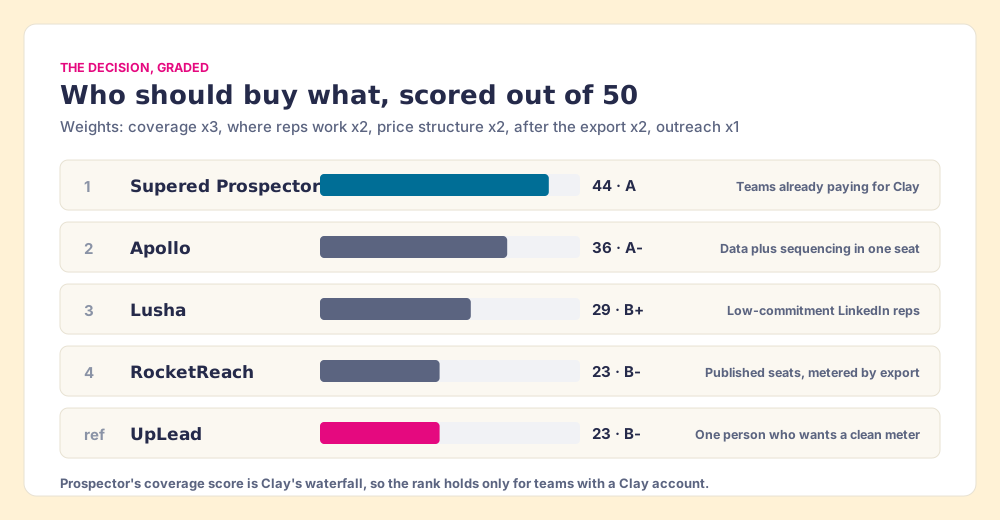
The grades use the five weights from our RocketReach pricing and Kaspr alternatives pages: coverage of the contact you need (x3), delivery where the rep already works (x2), price structure for a mid-market team (x2), what happens to the list after the export (x2), and bundled outreach (x1), out of 50. The weights serve one job, a team of five to fifty reps building its own lists. Flip the lens to “one person, cleanest meter” and UpLead moves to the top.
| Rank | Option | Grade | Best fit | CRM integration | Setup effort | Pricing (plan with the feature) | Reason to switch |
|---|---|---|---|---|---|---|---|
| 1 | Supered Prospector | A (44) | Teams already paying for Clay | Native: HubSpot, Salesforce, Pipedrive | Demo, then live on your own Clay account | $45 a rep a month, billed annually, plus your Clay plan | Clay’s waterfall across 200+ vendors from the rep’s own screen; see which lists get worked and close |
| 2 | Apollo | A- (36) | Small teams wanting data plus sequencing | Native | Self-serve | Basic $49 a seat a month, annual | About 18 cents per email-and-phone contact; outreach in the same seat |
| 3 | Lusha | B+ (29) | Low-commitment LinkedIn reps | API and webhooks from Pro | Self-serve | Starter $37.45 a month billed yearly | Free tier of 40 credits a month; easiest start |
| 4 | RocketReach | B- (23) | Two-to-five-seat teams that dial | Native from Pro | Self-serve | Pro $899 a seat a year | 25 cents per export with phones; misses refunded |
| ref | UpLead | B- (23) | One person who wants a clean meter | Native from Essentials | Self-serve, minutes | Essentials $74 a month annual or $99 monthly | The reference: one credit, one whole contact |
What does UpLead cost for a team of ten?
More than the seat price suggests, because Essentials and Plus are not team plans. UpLead’s plan comparison is plain: “Free, Essentials, and Plus are Single User accounts. Professional is a team account with seat management functionality.” Ten reps on ten separate annual accounts list at $8,880 on Essentials (20,400 contacts a year between them) or $17,880 on Plus (48,000), with no shared pool, no admin view and no way to move credits from the rep who hoards them to the rep who runs out. The account that does those things, Professional, is custom-quoted and annual only.
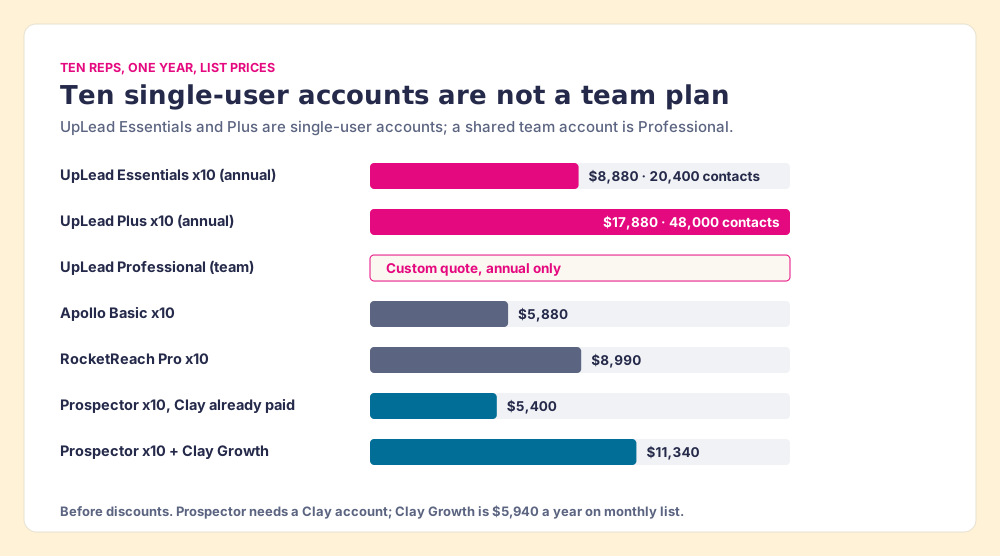
Read the Prospector bars both ways. Without Clay, Clay Growth plus Prospector for ten reps is $11,340, more than ten Essentials accounts, and Clay’s 72,000 Data Credits a year cover roughly 12,000 email-and-phone contacts at about six credits each (our arithmetic from Clay’s calculator), fewer than UpLead Essentials’ 20,400. On contact count alone, UpLead Essentials wins that comparison. With Clay already paid for, the comparison is $540 a rep against $888, about 39% less, and the contacts come from every provider in the waterfall. Vendr publishes no median contract for UpLead, so bring the ten-account list price to the Professional conversation as your anchor.
How does Supered Prospector compare to UpLead pricing?
Go back down the hall. UpLead is one good machine with its price on the glass, and when the slot for the contact you need is empty, it refunds the coin. Clay is the corridor: its waterfall asks provider after provider until one returns a verified email or phone, across 200+ data and AI vendors under one contract (clay.com, September 25, 2026), and “If an enrichment returns no result, you’re not charged Data Credits or Actions” (clay.com/pricing). A refund returns the coin. A corridor returns the sandwich.
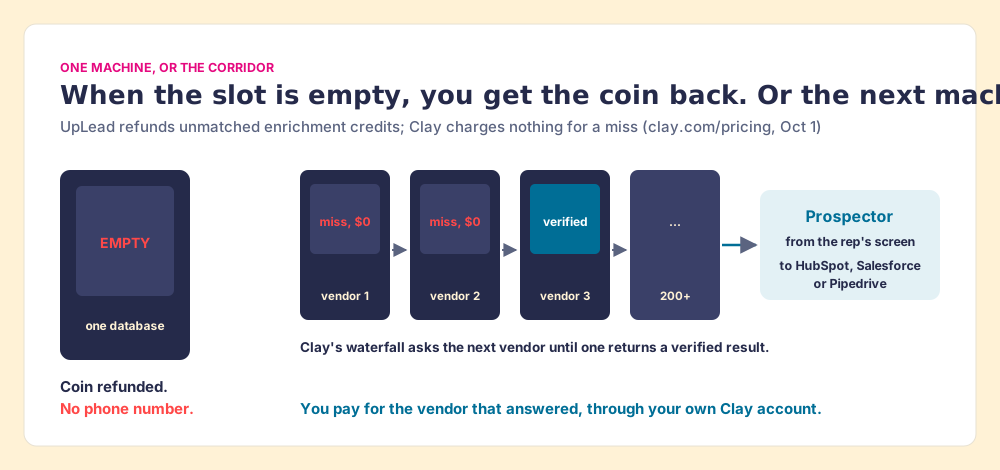
The corridor has had one weakness. It was built for the GTM engineer, who designs the tables, and reps rarely walk down it. Prospector puts what the GTM engineer built in the rep’s hands, where the rep already works:
- Where the rep already is. A LinkedIn profile, a Sales Navigator list, a company’s website, or a HubSpot, Salesforce or Pipedrive record. One click runs the waterfall, and reps never log in to Clay.
- A check before the duplicate. On a LinkedIn profile, the rep sees whether the person already has a matching record in the CRM and whether the prospect was worked in the past.
- The GTM engineer’s tables, on a button. Any custom Clay workflow runs from Prospector, a whole list can go into a Clay workflow, and the buying-committee lookup is tuned by title, department and seniority.
- The list after the export. The contact lands in the CRM with the team’s process applied, and the manager sees which lists get worked and which ones close, then coaches from what is converting.
Prospector is $45 per rep per month, billed annually, from one user, on its own plan separate from Supered’s process products (Prospector, Supered pricing). It runs on your Clay account and your Clay credits. Clay governs the data. Supered governs the motion. The sourcing use case walks the rep’s side, and the Clay Chrome extension guide covers how teams put Clay on LinkedIn today.
Choose something else if any of these is true:
- No Clay account. Prospector needs one. One person or a three-seat team without Clay is better served by UpLead on a monthly plan or RocketReach Pro.
- No waterfall owner. Someone decides which providers sit in which order. If no one on the team owns that, a single database with a published price is less work.
- Outreach from the same vendor. If you want data, sequencing and a dialer in one seat, Apollo’s pricing bundles them.
What are the best UpLead alternatives and competitors?
The UpLead competitors below all sell contacts; the useful question is which one fits the job.
- Apollo, for data plus sequencing. Basic is $49 a seat a month on annual billing with 30,000 credits a year, which is about 3,333 email-and-phone contacts at 9 credits each, against 2,040 on UpLead Essentials for $888. Apollo is the cheapest per contact here and bundles outreach; it meters the phone separately. Apollo pricing walks the credit meter.
- RocketReach, for a small team that dials. Pro is $899 a seat a year for 3,600 exports with phones, 25 cents each, and it refunds a lookup that finds nothing verified. RocketReach pricing explains its export meter.
- Lusha, for the lightest start. A free tier of 40 credits a month and Starter at $37.45 a month billed yearly; the menu pricing (6 credits for email and phone) makes it dearer per dialed contact. Lusha pricing has the ladder.
- ContactOut and Hunter, for narrower jobs. ContactOut is built around LinkedIn email and phone lookups and Hunter around finding emails by domain; neither is priced on this page, and our ContactOut alternatives and Hunter.io alternatives pages compare them.
- ZoomInfo, for one deep database at enterprise prices. It publishes no list prices; ZoomInfo pricing decodes the contract, and Lusha vs ZoomInfo sets the two ends of the market side by side.
For teams that bought an Exportly-style extension to get Clay onto LinkedIn, Exportly alternatives covers that path.
What we recommend
Three ways forward, and our view on each.
- One person, testing. Take the UpLead free trial, switch it to Essentials Monthly on day one, and judge the data on 170 real contacts at $99. If it holds up for three months, move to annual and save a quarter.
- One person, all year, heavy use. Plus annual at $1,788 gives about nineteen contacts a working day at about 37 cents each. Ask about the 40% banner before you pay, and use the Hibernation Plan, not account closure, in a slow month.
- A team, especially one with Clay. Do not buy ten single-user accounts. Without Clay, price UpLead Professional against Apollo Basic at $5,880 for ten seats and RocketReach Pro at $8,990. With Clay, skip a second database and run Clay’s waterfall from where reps already work with Supered Prospector, at $540 a rep a year.
A vending machine is the most candid shop in the building, and UpLead is close to the most candid price list in contact data: one coin, one whole contact, every rule written down. Read the side panel anyway, set the trial to monthly, and count contacts instead of credits. Then ask what happens to the contact once it reaches your CRM, which is the question our RocketReach alternatives page grades the whole field on. For the full graded field, see UpLead alternatives.
Frequently asked questions
How much does UpLead cost in 2026?+
What does one UpLead credit buy?+
Does the UpLead free trial turn into a paid plan?+
Can a team share one UpLead plan?+
What are the best UpLead alternatives?+
Do UpLead credits roll over or get refunded?+
Your process, running itself.