UpLead Alternatives in 2026: One Good Library, and the Interlibrary Loan
UpLead alternatives graded for a mid-market team, priced per contact and per ten reps, with a look at who writes the lists that rank for this search and why none of them mention Clay.
UpLead alternatives are the contact-data tools teams weigh against UpLead's one-credit-one-contact database: other single databases such as Apollo, ZoomInfo, Lusha and RocketReach, or Clay's waterfall across 200+ vendors run from Supered Prospector.
UpLead alternatives come up for one of two reasons: the reps cannot find the contacts they need in UpLead’s database, or the team has outgrown a single-user plan. The short answer, graded in full below:
- Supered Prospector. For teams that already pay for Clay: Clay’s waterfall across 200+ vendors, run from LinkedIn, a company website or the CRM record, at $45 per rep per month billed annually.
- Apollo. For a small team that wants data and sequencing in one seat, at about 18 cents per email-and-phone contact on Basic.
- RocketReach. For a two-to-five-seat team that dials, at 25 cents an export with phones on Pro.
UpLead alternatives are the contact-data tools teams weigh against UpLead’s one-credit-one-contact database: other single databases such as Apollo, ZoomInfo, Lusha and RocketReach, or Clay’s waterfall across 200+ vendors (clay.com, September 25, 2026) run from Supered Prospector. One naming note before we start: UpLead sells a search product it also calls “Prospector.” Supered Prospector is a different product from a different company.
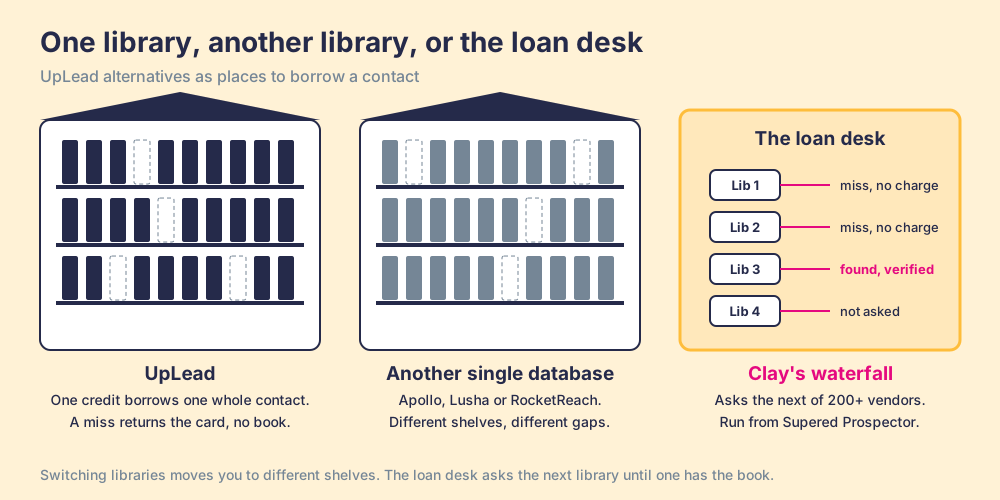
A good town library has a simple rule at the desk. One card, one book, and the book comes whole. UpLead runs its library that way: “A credit unlocks a contact for download or CRM export and gives you access to their email and mobile direct dial. One credit = one contact” (uplead.com/pricing, opened October 2, 2026). When the book you asked for is not on the shelf, the librarian hands your card back; UpLead refunds the credit when an enrichment row finds no match (UpLead help center). Fair, and you still go home without the book.
Switching to a different library moves you to a different set of shelves. It does not give you more of them. The other choice is the interlibrary loan, where the librarian phones the next library, and the next, until one has the book.
Why do teams look for UpLead alternatives?
Fair to UpLead first. On G2 it held 4.7 out of 5 from 831 reviews on October 2, 2026 (G2, UpLead reviews), one of the higher scores in contact data, and its price list is among the clearest in the category. The UpLead pricing breakdown works through it plan by plan. The complaints on G2 gather in a few places, and each one maps to a reason to switch:
- Coverage on the hard contacts. “There were invalid emails” (Gerard A., Small Business, January 2026), and a Business Development Manager found some companies’ email data “hasn’t been updated” (Chuck B., November 2025). A single library owns the books it owns.
- Seats built for one person. UpLead’s plan comparison says “Free, Essentials, and Plus are Single User accounts. Professional is a team account with seat management functionality.” A team on Essentials or Plus is ten separate accounts with ten separate credit pools.
- A trial that defaults to a year. UpLead’s help center says “Forgetting to update your plan will result in an automatic switch to the Essentials Annual Plan” (UpLead help center), which is $888 for the year. One reviewer wrote that the billing “doesn’t explain if they will charge me monthly” (Eduardo G., February 2026).
- Price at the smallest size. “I find the pricing of UpLead to be a concern” (Stephen A., Founder, December 2025). The monthly Essentials plan is $99 for 170 contacts, about $0.58 each.
The first complaint is the one a bigger UpLead plan cannot fix. The second and third are fixable by asking for a Professional quote and picking the monthly plan on day one.
Who writes the UpLead alternatives lists?
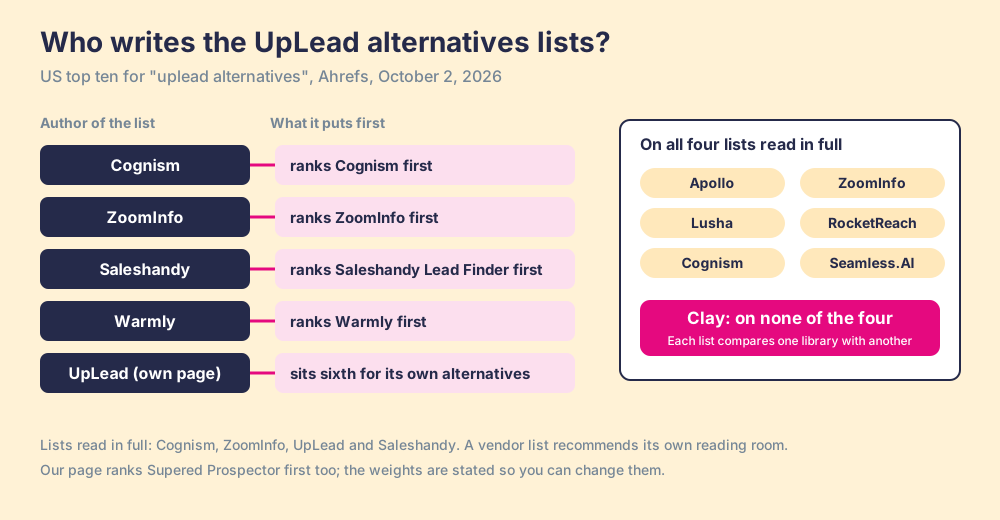
Before you trust any ranking for this search, including ours, check who wrote it. We pulled the US top ten for “uplead alternatives” from Ahrefs on October 2, 2026 and opened the vendor pages in it. Cognism’s list puts Cognism first (Cognism, updated July 29, 2026). ZoomInfo’s puts ZoomInfo first (ZoomInfo Pipeline, updated May 22, 2026). Saleshandy’s puts Saleshandy Lead Finder first and calls it “the best overall UpLead alternative.” Warmly’s list opens with “#1: Warmly.” UpLead’s own competitors page ranks sixth for its own alternatives and closes by explaining where “UpLead pulls ahead.”
None of that is a scandal. A library will recommend its own reading room. It does explain the oddest gap in this search: across the four vendor lists we read end to end (Cognism, ZoomInfo, UpLead and Saleshandy), six names appear on all four (Apollo, ZoomInfo, Lusha, RocketReach, Cognism and Seamless.AI), and Clay appears on none. Each list compares one library with another. None mentions the loan desk, because no database vendor sells it.
We are a vendor too, and Supered Prospector sits first on this page. The difference we can offer is a stated method you can reweight, and a disclosure: we sell no contact data at all.
Why trust this comparison?
I started RevPartners, a HubSpot partner that did only sales implementations, sold roughly twice as much Sales Hub as any other partner, and reached HubSpot’s Elite tier in 13 months. Supered came out of that work. It is the #1 sales enablement app on the HubSpot marketplace with 6,000+ installs, and it held 4.9 out of 5 from 81 reviews on G2 on October 1, 2026. Supered has no database of its own; Prospector runs on Clay, our only data provider, so we gain nothing from which library you pick. Each vendor figure below links to the page it came from, with the date we opened it.
The UpLead alternatives, graded
The weights sit below so you can change them. The lens is a mid-market or SMB team, five to fifty reps, that needs contacts reps will use where they already work, and a leader who can see which lists turn into pipeline. Each criterion scores 1 to 5, times its weight, for a maximum of 50. The per-vendor scores match our Kaspr alternatives and ContactOut alternatives pages, so the three read together. Reweight for “one person, cleanest meter” and UpLead moves into the top three.
| Criterion | Weight | What it rewards |
|---|---|---|
| Coverage of the contact you need | x3 | Verified emails and mobiles when the first source misses |
| Rep-side delivery | x2 | Works on the profile, the company site, the CRM record; no new tab or login |
| Price structure for mid-market | x2 | Published, per result or per seat, no platform fee |
| What the leader sees after the export | x2 | Which sourced lists were worked and which closed |
| Bundled outreach | x1 | Sequencing, dialer, drafting in the same plan |
| Rank | Tool | Grade | Score | Best fit | CRM integration | Setup effort | Pricing (plan with the feature) | Reason to switch from UpLead |
|---|---|---|---|---|---|---|---|---|
| ref | UpLead | B- | 23 | One person who wants the cleanest meter | Native from Essentials | Minutes | $74 a month annual or $99 monthly (Essentials) | Stay if one database covers your market |
| 1 | Supered Prospector | A | 44 | Teams already paying for Clay | Native: HubSpot, Salesforce, Pipedrive | Under a week on an existing Clay account | $45 per rep per month, billed annually, plus your Clay plan | 200+ vendors per lookup, from any page the rep is on |
| 2 | Apollo | A- | 36 | Small teams wanting data plus sequencing | Native | A day | Basic $49 a seat a month, annual | About 18 cents per email-and-phone contact; outreach included |
| 3 | Lusha | B+ | 29 | Low-commitment LinkedIn reps | Native; API from Pro | Minutes | Starter $449.10 a year | Free tier of 40 credits a month |
| 4 | ZoomInfo | B | 28 | North American enterprise depth | Native | Weeks | Quote only; Vendr median $33,500 | Depth and intent, at a platform price |
| 5 | ContactOut | B | 28 | One LinkedIn-heavy rep | Native: HubSpot, Salesforce | Minutes | Email + Phone $948 a year | About 13 cents an export |
| 6 | Hunter | B | 28 | Email-only, domain-first teams | Native: HubSpot, Salesforce, Pipedrive | Minutes | Growth $1,248 a year, unlimited users | Shared pool for the whole team; no phones |
| 7 | Cognism | B | 26 | EMEA teams that dial | Native | Weeks | Quote only; Vendr median $32,750 | Phone-verified mobiles; owns Kaspr |
| 8 | Kaspr | B- | 25 | Email-first LinkedIn reps | Native | Minutes | Starter $49, Business $79 a month, annual | Unlimited B2B emails, phones by the month |
| 9 | RocketReach | B- | 23 | Two-to-five-seat teams that dial | Native from Pro | Minutes | Pro $899 a seat a year | 25 cents an export with phones |
| 10 | Seamless.AI | C+ | 21 | High-volume real-time search | Listed | Days | No published price | Volume, with a 60-day cancellation window |
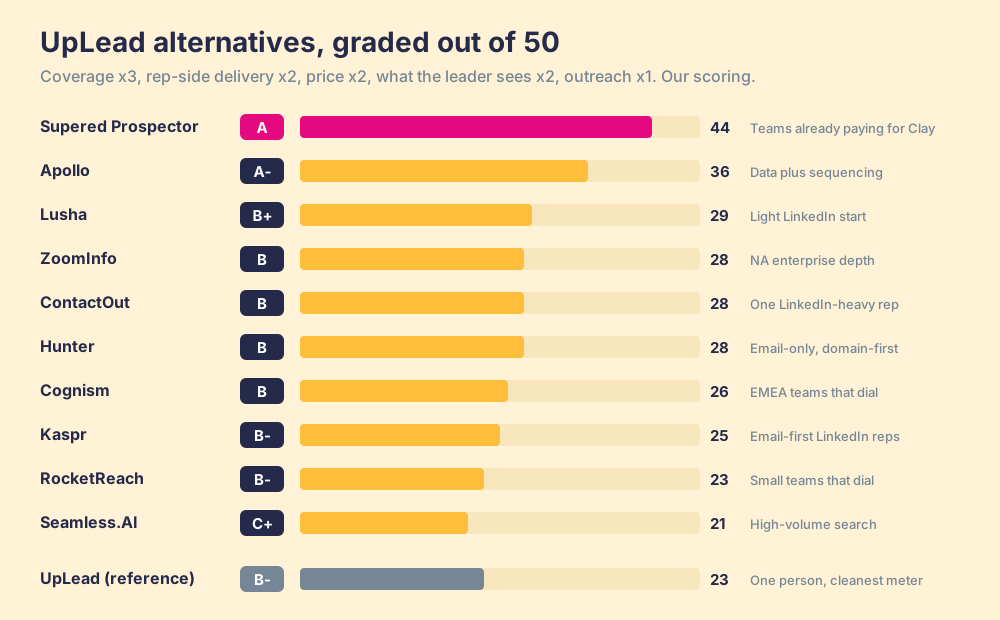
UpLead’s 23 breaks down as coverage 2, rep-side delivery 3, price 4, what the leader sees 1, outreach 1. The price 4 is earned: published plans, monthly or annual, and the simplest meter on this page. The coverage 2 is the one-database ceiling the reviewers describe. Prospector’s coverage score belongs to Clay’s waterfall, and its outreach score is the lowest on the card on purpose, since it has no sequencer or dialer. If outreach in the same seat decides it for you, Apollo wins this page.
Corporate status, checked October 2, 2026. UpLead is independent, with no acquisition, funding round or rebrand found. Cognism has owned Kaspr since April 2022. ZoomInfo is public and in May 2026 approved a restructuring of about 600 roles, “accelerating our move upmarket, and reducing the resources we allocate downmarket” (SEC Form 8-K). Apollo, Lusha, ContactOut, Hunter, RocketReach and Seamless.AI are independent.
Which UpLead alternative is cheaper per contact?
Count contacts, never credits. A credit is a different coin at each vendor: UpLead charges 1 for a whole contact, Lusha 1 for an email and 5 for a phone (lusha.com/pricing), Apollo 1 and 8 (apollo.io/pricing, September 25, 2026). On list prices, per contact with an email and a phone:
| Tool and plan (list price) | What you pay | Per contact |
|---|---|---|
| ContactOut Email + Phone, yearly | $948 a year, 7,200 exports, 1 user | about $0.13 |
| Apollo Basic, annual | $588 a year, 30,000 credits at 9 per contact | about $0.18 |
| RocketReach Pro, annual | $899 a year, 3,600 exports | $0.25 |
| Clay, entry Data Credit rate | about six credits at $0.05 (our estimate) | about $0.30 |
| UpLead Plus, annual | $1,788 a year, 4,800 credits | about $0.37 |
| Kaspr Business, annual | $948 a year, 2,400 phones, emails unlimited | about $0.40 a phone |
| UpLead Essentials, annual | $888 a year, 2,040 credits | about $0.44 |
| Lusha Starter, annual | $449.10 a year, 4,800 credits at 6 per contact | about $0.56 |
| UpLead Essentials, monthly | $99 a month, 170 credits | about $0.58 |
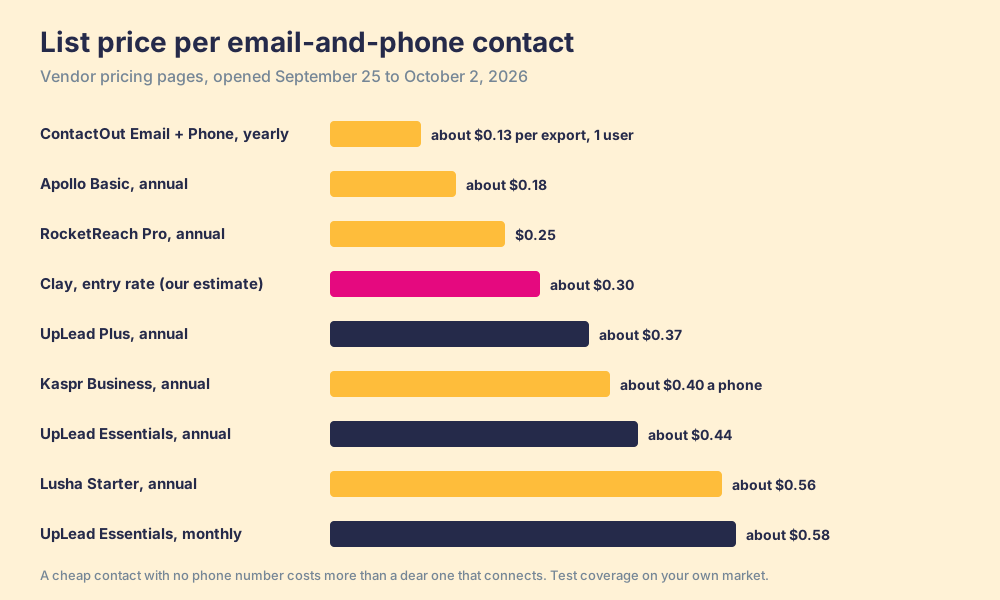
Two cautions keep this table in its lane. ContactOut’s “unlimited” plan runs under a fair-use cap of 1,000 phone credits per account per month and allows one user per company on that plan (ContactOut terms), so its 13 cents is a one-rep price. And a cheap contact with no phone number costs more than a dear one that connects. The Bridge Group’s 2025 SDR report, 351 companies, puts the median SDR at 44 dials a day (Bridge Group, 2025); a rep who dials pays for the gaps in calls that never ring.
UpLead vs Apollo, and UpLead vs ZoomInfo
The two head-to-heads that bring most readers here resolve on different questions.
- UpLead vs Apollo. Apollo Basic is $49 a seat a month on annual billing with 30,000 credits a year and a sequencer in the seat; Apollo held 4.7 from 9,690 reviews on G2 on September 25, 2026. Its meter is the catch: a phone costs 8 credits, so 30,000 credits is about 3,333 email-and-phone contacts, against 2,040 on UpLead Essentials for $888. Apollo wins on price per contact and on outreach; UpLead wins on a meter a rep cannot misread. Our Apollo alternatives page grades Apollo in its own lane.
- UpLead vs ZoomInfo. ZoomInfo publishes no prices. Vendr puts its median contract at $33,500 a year across 1,574 purchases (Vendr, ZoomInfo, opened October 1, 2026), against $8,880 for ten UpLead Essentials accounts. ZoomInfo is the deeper library for North American enterprise accounts and intent data, and it has told investors it is moving upmarket. A five-to-twenty-rep team buying its first contact database is the customer ZoomInfo said it is spending less on.
Where does Supered Prospector fit among UpLead alternatives?
Back at the library desk. Each of the UpLead competitors above is one building with its own shelves. Clay is the loan desk: its waterfall is a list of instructions the GTM engineer writes down, ask this provider first, then that one, stop when a verified email or phone comes back. “Clay’s signature data waterfalls check multiple providers to return the most verified emails (lower bounce rate) and phone numbers (higher connect rate)” (Clay, rep prospecting, September 25, 2026), and “If an enrichment returns no result, you’re not charged Data Credits or Actions” (clay.com/pricing). A refunded credit returns the card. The loan desk returns the book.
The loan desk has one limit. Some libraries in Clay’s network lend only to their own members: Clay’s Lusha and ZoomInfo steps are marked “Bring Your Own Account Required,” so those two need your own contract with them. ContactOut and Hunter sit in Clay’s marketplace too, and ContactOut’s lookups run on Clay credits.
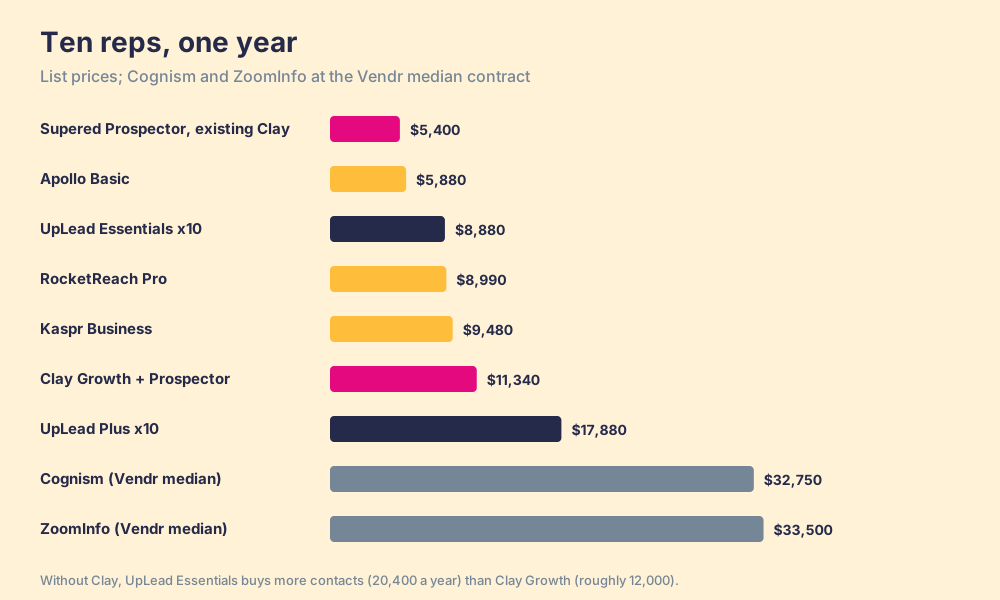
The arithmetic both ways, since “one contract” is a slogan until it carries numbers. Prospector is $45 per rep per month, billed annually, from one user (Prospector). On a Clay account the team already pays for, ten reps cost $5,400 a year against $8,880 for ten UpLead Essentials accounts. Without Clay, Growth at $495 a month adds $5,940, for $11,340, and its 72,000 Data Credits a year cover roughly 12,000 email-and-phone contacts at about six credits each (our reading of Clay’s calculator, shown on the Clay pricing page), fewer than the 20,400 in ten Essentials accounts. On contact count alone, without Clay, UpLead wins.
What a rep gets from Prospector, on the team’s own Clay account and with no Clay login:
- Lookups from the page the rep is on. A LinkedIn profile, a Sales Navigator list, a company’s website with company research alongside, or a HubSpot, Salesforce or Pipedrive record. The Sales Navigator export guide covers that list-building path.
- A check before the duplicate. On a LinkedIn profile, the rep sees whether the person already has a matching CRM record and whether the prospect was worked in the past.
- The GTM engineer’s tables on a button. Any custom Clay workflow runs from Prospector, a whole list can go into a Clay workflow, and the buying-committee lookup is tuned by title, department and seniority.
- Lists the leader can follow. The contact lands in the CRM with the team’s process applied, and the manager sees which lists get worked and which ones close, then coaches from what is converting.
Prospector works within LinkedIn’s terms and does not copy search results in bulk; the contact data comes from Clay’s waterfall on the customer’s Clay account. Clay governs the data. Supered governs the motion.
Choose something else in these cases:
- No Clay account. Prospector needs one. A one-to-three-seat team without Clay is better served by UpLead on a monthly plan, RocketReach Pro or Apollo Basic.
- No waterfall owner. Someone has to decide which providers sit in which order; Clay says plainly that “GTM engineers build on Clay.” Without that person, one database with a published price is less work.
- Outreach from the same vendor. If data, sequencing and a dialer must share one seat, Apollo is the better buy.
Which UpLead alternative should you choose?
The choice resolves once you name the job. The ways forward, and our view on each:
- UpLead itself. The pick for one person who wants the cleanest meter in contact data and whose market UpLead covers. Switch the trial to monthly on day one, and move to annual after three good months to save a quarter.
- Apollo. The pick when the job is data plus sequencing in one seat on a published price. Size the credits before the seats: a phone costs 8.
- RocketReach or ContactOut. The picks for a small team that dials (RocketReach Pro at 25 cents an export) or one LinkedIn-heavy rep (ContactOut at about 13 cents an export, within its fair-use cap).
- ZoomInfo or Cognism. The picks for North American enterprise depth or EMEA phone coverage, for teams with the seats to justify a quote-only contract around $33,000 a year at the Vendr median.
- Supered Prospector. The pick when the team already pays for Clay and the problem is the book that was not on the shelf.
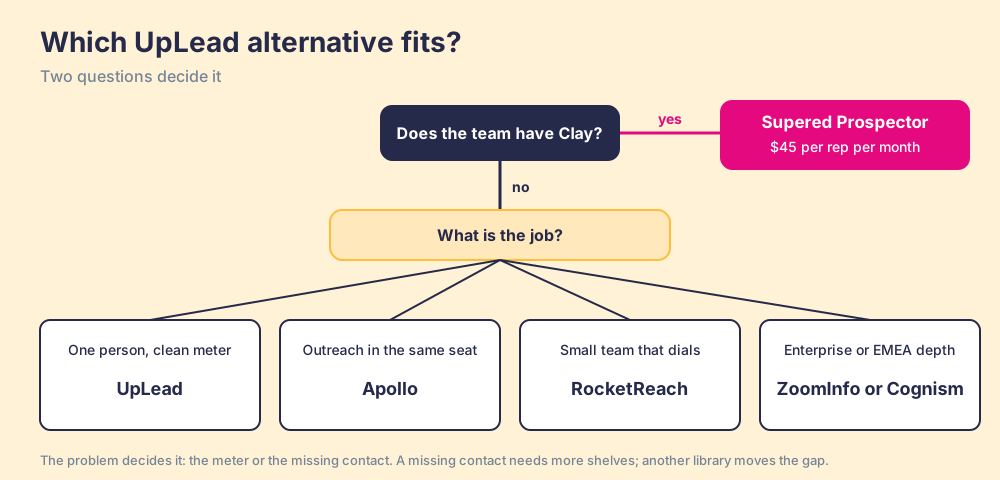
What we recommend turns on one fact about your stack. If you do not have Clay and UpLead covers your market, stay: one card, one whole contact, every rule written down, and no list on this page beats that meter for a single rep. If you do not have Clay and the missing contacts are the problem, a second single database moves you to a different set of shelves with different gaps; Apollo and RocketReach are the cheapest places to test that on list price. If you have Clay, skip the second library card. Put the loan desk in your reps’ hands where they already work, pay nothing for the lookups that come back empty, and follow each list they build to closed. A Prospector demo on your own Clay account shows the loan desk working on your own market, and our Kaspr alternatives page runs the same math on the LinkedIn extensions.
Frequently asked questions
What are the best UpLead alternatives in 2026?+
Is there a cheaper alternative to UpLead?+
UpLead vs ZoomInfo: which is better for a small team?+
UpLead vs Apollo: which should I pick?+
Do I need a Clay account to use Supered Prospector?+
Has UpLead been acquired?+
Your process, running itself.