Hunter.io Alternatives in 2026: The Library That Cannot Dial
Hunter is the best index of work emails on the public web, and that is also its ceiling. The Hunter.io alternatives graded for a sales team, with Hunter pricing worked out per email and per phone.
Hunter.io alternatives are the tools sales teams weigh against Hunter, the public-web email finder: email-and-phone finders like Findymail and Prospeo, all-in-one Apollo, or Clay's waterfall across 200+ vendors run from Supered Prospector.
Hunter.io alternatives get searched for one of two reasons. A rep picked up the phone and found the contact record had no number on it, or the team grew and the prospects stopped living on the public web. The short answer, graded in full below:
- Supered Prospector. For teams that already have Clay: Clay’s waterfall across 200+ vendors, Hunter included, run from a LinkedIn profile, a Sales Navigator list, a company website, or the CRM record, at $45 per rep per month billed annually.
- Apollo. For a team that wants emails, phones, sequences, and a dialer in one plan, from $49 a seat billed annually.
- Findymail. The like-for-like email finder that adds phones and checks catch-all domains, $99 a month for the whole team.
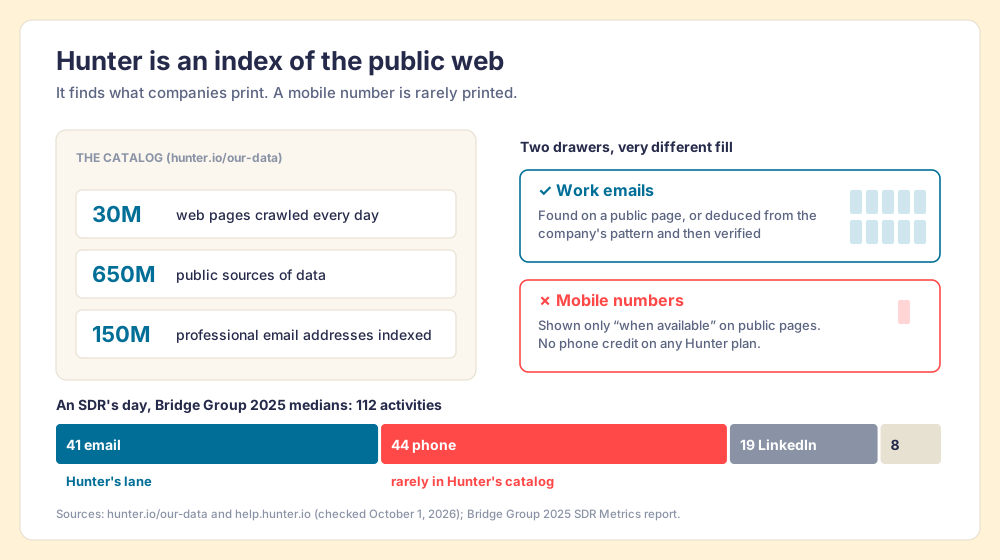
A good reference library will find you any book that has been printed. Ask it for a letter that was never published and the librarian, however brilliant, comes back with a polite shrug. Hunter is that library for business contact data. Its own data page says it crawls 30 million web pages a day, draws on 650 million public sources, and indexes 150 million professional email addresses (hunter.io/our-data, October 1, 2026). Work emails are printed all over the public web: in press releases, conference agendas, author bios, support pages. Direct mobile numbers almost never are. That one fact explains Hunter’s best feature and its ceiling at the same time.
Hunter.io alternatives are the tools a sales team weighs against Hunter. They are single databases that add phones and outreach (Apollo, Snov.io, Findymail, Prospeo, FullEnrich), or Clay’s waterfall across 200+ data and AI vendors (clay.com, September 25, 2026), which a rep can run from Supered Prospector on the team’s own Clay account. The second option changes the shape of the decision. Hunter has been an integration inside Clay since October 1, 2022 (Clay, Hunter integration), so a team with Clay does not replace Hunter. It puts Hunter on a list of libraries and asks the next one when the first comes back empty.
Why do sales teams look for Hunter.io alternatives?
Hunter holds a 4.4 out of 5 on G2 from 657 reviews (checked October 1, 2026), and its Chrome extension has 600,000 users and a 4.7 from 12.5K ratings on the Chrome Web Store. People like it. The reasons they leave repeat in the reviews (G2, Hunter reviews), and three of them account for most of the searches.
- The missing phone. “It doesn’t provide the phone numbers for prospects, so I have to switch to other prospecting tools like Apollo or ZoomInfo,” a mid-market technical recruiter wrote in September 2026. The Bridge Group’s 2025 SDR report, 351 companies, puts the median SDR at 112 activities a day, 44 of them phone and 41 email (Bridge Group, 2025). Hunter is built for the 41. For an SDR team, the bigger half of the day needs another source.
- Thin shelves at small companies. “Hunter occasionally provides incomplete results or fails to return any information for certain domains,” a business development reviewer wrote in December 2025, and named newer and smaller companies as the usual gap. A library indexes what has been printed, and a twelve-person startup has printed little.
- The credit pool at campaign scale. “The credit system can feel limiting, especially when working on larger prospecting campaigns,” a small-business seller wrote in February 2026. Hunter’s credits are shared across unlimited users, which is generous for three people and tight for thirty.
The three have one thing in common. None says the emails were wrong. Each complaint is about what the library does not hold.
Why trust this comparison?
I started RevPartners, a HubSpot partner that did only sales implementations, sold roughly twice as much Sales Hub as any other partner, and reached Elite tier in 13 months. Supered came out of that work and is the #1 sales enablement app on the HubSpot marketplace, rated 5.0 from 122 reviews there and 4.9 out of 5 from 81 reviews on G2 (both checked October 1, 2026). That is also the disclosure. We make Supered Prospector, and it sits first on this page for teams that have Clay. The grading below states its weights, and for an email-only founder without Clay, Hunter wins on price and the page says so.
The Hunter.io alternatives, graded
A ranking that hides its math is an advertisement. The lens is a mid-market or SMB sales team, ten to fifty reps, who email and dial, and a leader who wants to know which lists turn into pipeline. Each criterion is scored 1 to 5 and multiplied by its weight, for a maximum of 50; the scores for Prospector, Apollo, and FullEnrich are the ones used on the Kaspr alternatives page and the Clearbit alternatives page, so the pages read together.
| Criterion | Weight | What it rewards |
|---|---|---|
| Coverage of the contact you need | 30% (x3) | Verified emails and mobiles, including when the first source misses |
| Rep-side delivery | 20% (x2) | Works on the profile, the company site, the CRM record; no new tab or login |
| Price structure for mid-market | 20% (x2) | Published prices, per-result or per-team, no platform fee |
| What the leader sees after the export | 20% (x2) | Which sourced lists were worked and which closed |
| Bundled outreach | 10% (x1) | Sequences, dialer, or drafting in the same plan |
| Rank | Tool | Grade | Score | Best fit | CRM integration | Setup effort | Pricing (plan with the feature) | Reason to switch from Hunter |
|---|---|---|---|---|---|---|---|---|
| ref | Hunter | B+ | 28 | Email-first teams and founders who send from their own inbox | Native (HubSpot, Salesforce, Pipedrive, Zoho) | Minutes | $34 to $209 a month billed yearly, unlimited users | Stay if your reps do not dial |
| 1 | Supered Prospector | A | 44 | Teams that already have Clay | Native (HubSpot, Salesforce, Pipedrive) | Under a week on an existing Clay account | $45 per rep per month billed annually, plus your Clay plan | Hunter plus every other vendor per lookup, from any page, lists you follow to closed |
| 2 | Apollo | A- | 36 | Teams wanting data, phones, and outreach in one tool | Native (HubSpot, Salesforce) | A day | $49 a seat a month billed annually, phone 8 credits | Phones, sequences, and a dialer in the plan |
| 3 | Snov.io | B+ | 30 | Small teams that want a cheap finder plus outreach | Native two-way (HubSpot, Pipedrive) | A day | Starter $39 a month, unlimited seats | Outreach and LinkedIn automation at Hunter’s price |
| 4 | Findymail | B+ | 29 | Like-for-like finder that adds phones | Native (HubSpot, Salesforce, Pipedrive, Clay) | Minutes | Starter $99 a month for the team | Phones at 10 credits, catch-all checks, bounce refund |
| 5 | Prospeo | B+ | 29 | Email and mobile finder for outbound volume | HubSpot and Salesforce on Growth | Minutes | $37 a user a month billed yearly, CRM sync from $74 | Mobiles at 10 credits and a lead database |
| 6 | FullEnrich | B | 27 | A small waterfall without Clay | HubSpot, API | Minutes | Pro $55 a month, unlimited users | 25+ sources per lookup, pay only on a find |
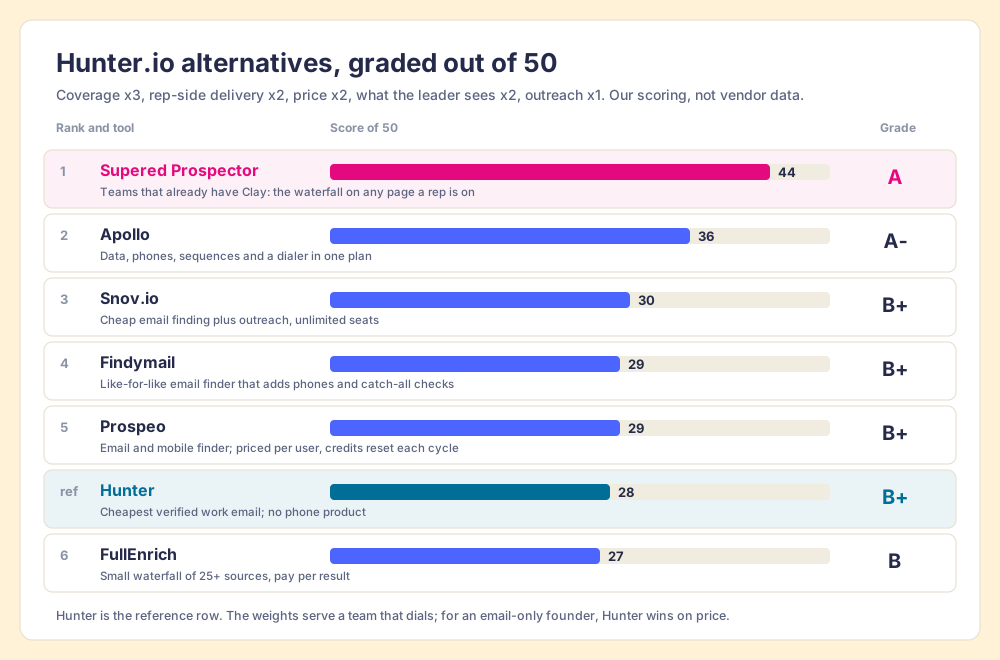
Hunter’s 28 breaks down as coverage 2, rep-side delivery 3, price 5, what the leader sees 1, outreach 4. The price 5 is the easiest score on the card: published plans, unlimited users, misses free, and about a cent an email on Growth. Outreach earns a 4 because Hunter ships Sequences with 3 to 20 connected inboxes by plan. The coverage 2 is the empty phone drawer, plus the reviewers’ gaps at small companies. Rep-side gets a 3 because the extension is built for the company website you are visiting, not the LinkedIn profile or the CRM record. Findymail and Prospeo tie at 29; Findymail ranks ahead on price structure (one team pool, credits roll over up to twice the plan) and Prospeo would rank ahead for a team that wants a lead database to search.
Corporate status, checked October 1, 2026. Hunter is independent (Hunter Web Services, Inc.), with no acquisition, funding round, or rebrand found. Apollo is independent and launched what it calls an “AI GTM System” on September 30, 2026 (Apollo newsroom). Snov.io, Findymail, and Prospeo are independent, with no 2026 acquisitions found. FullEnrich raised a €1.9M seed in February 2025 and is independent. Clay is independent; NYT reported in January 2026 that its employees sold shares at a $5B valuation.
What does Hunter.io cost in 2026?
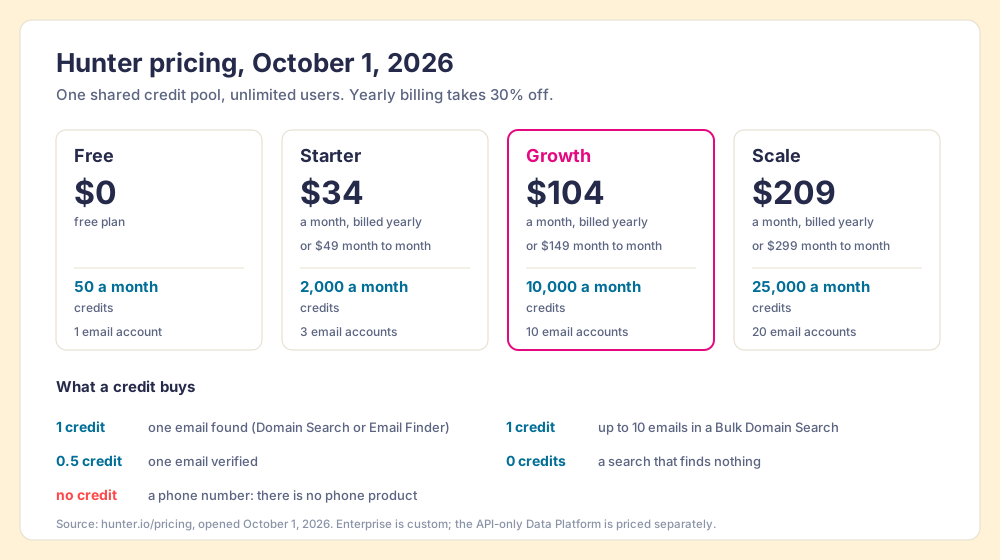
Hunter.io pricing is short and public. The pricing page, captured October 1, 2026 (hunter.io/pricing), with the yearly toggle saving 30%:
| Plan | Billed yearly | Billed monthly | Credits | Connected inboxes |
|---|---|---|---|---|
| Free | $0 | $0 | 50 a month | 1 |
| Starter | $34 a month ($408 a year) | $49 | 2,000 a month (24,000 a year) | 3 |
| Growth | $104 a month ($1,248 a year) | $149 | 10,000 a month (120,000 a year) | 10 |
| Scale | $209 a month ($2,508 a year) | $299 | 25,000 a month (300,000 a year) | 20 |
| Enterprise | Custom | Custom | Custom | Custom |
The credit rules, verbatim from the page’s FAQ, are the part that matters.
- The find. “1 credit = 1 email found via Domain Search, Email Finder, or Bulk Email Finder,” and “1 credit = up to 10 emails found via Bulk Domain Search.”
- The check. “0.5 credit = 1 email verified via Email Verifier or Bulk Email Verifier.”
- The miss. “If no emails are found, no credits are used.” Repeat searches in the same billing period count once.
- The pool. “Everyone added will share the same pool of credits included in your plan.” Users are unlimited on every plan, Free included.
So the unit price is low. Starter billed yearly is $408 for 24,000 credits, about 1.7 cents an email. Growth is $1,248 for 120,000 credits, about a cent. Scale is $2,508 for 300,000, under a cent. A ten-rep team on Growth gets 12,000 email credits per rep per year for $1,248 in total, which no tool on this page matches for email alone. One thing has no line on the page at all: a phone number.
How does Hunter find an email it has never seen?
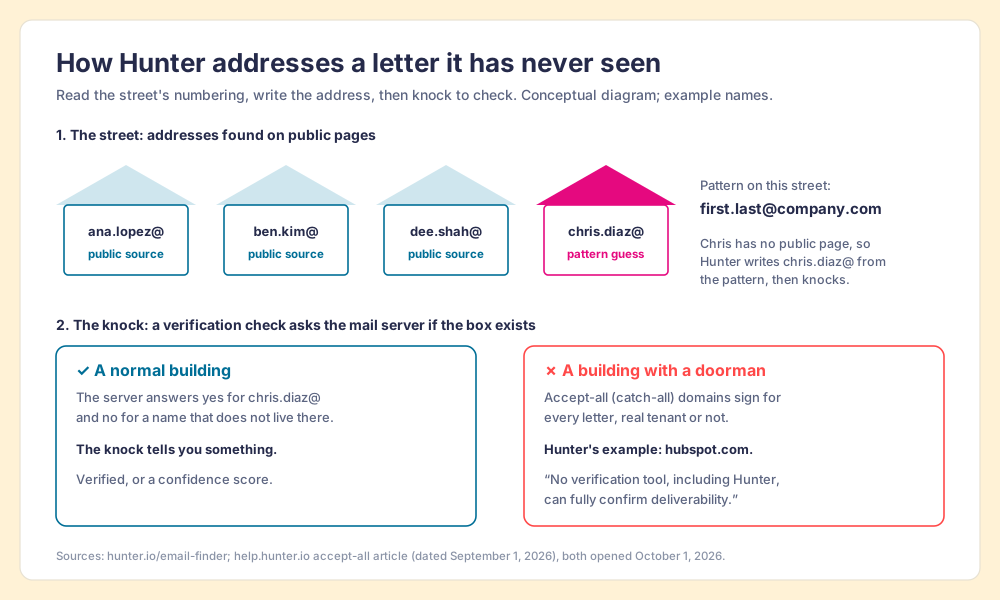
The Email Finder is the clever part, and it is worth understanding before you replace it. In Hunter’s words: “First, the Email Finder will search for a match in our extensive database of email addresses found publicly on the web. If there is no likely match, the Email Finder considers the likely permutations of the person’s name on that domain and uses various data points to deduce the most likely email address. In both cases, the email addresses go through an email verification” (hunter.io/email-finder).
Suppose a postman starts on a new street. He sees Ana Lopez at ana.lopez@ and Ben Kim at ben.kim@, and when a letter arrives for Chris Diaz, who has never published anything, he writes chris.diaz@ on it without being told. Then he knocks. A verification check asks the company’s mail server whether that mailbox exists, and the server says yes or no. Hunter labels the result Verified or gives it a confidence score, and its data page says the Email Finder indicates “if the result is a guess or if it has public sources.”
Most buildings answer the knock. Some have a doorman who signs for every letter, real tenant or not. Those are accept-all, or catch-all, domains, and Hunter is candid about them: “no verification tool, including Hunter, can fully confirm deliverability on these domains,” and its example is hubspot.com (Hunter help center, article dated September 1, 2026). For a HubSpot partner that is a funny line to read. It also explains the market below. Findymail sells its catch-all verification as the reason to switch, with a refund if bounces pass 5% (findymail.com/pricing).
The pattern trick has a mirror image, and it is the reason phones are missing. A mailbox address follows a rule the company sets, so it can be deduced. A mobile number follows no rule at all. It belongs to the person, it moves with them from job to job, and no rule on the street gives it away. Hunter’s help center says a lead carries a phone number “when available” and that the Domain Search returns phone numbers “only for personal emails.” Hunter did not forget to fill that drawer. An index of the public web can only hold what someone published.
Where does Supered Prospector fit?
Each alternative above is a bigger or differently stocked library. Apollo, Prospeo, and Findymail add the phone drawer, each from its own collection. When the book you need is not on their shelves either, the rep opens a second account, and the company signs a second contract.
Clay works like an interlibrary loan desk. A waterfall is a list of instructions the GTM engineer writes once: ask this provider first, then that one, stop when a verified email or phone comes back. Clay’s waterfall page names Hunter, Prospeo, Snov, Apollo, and Lusha among its work-email providers (clay.com/waterfall-enrichment, September 25, 2026), and “Clay’s signature data waterfalls check multiple providers to return the most verified emails (lower bounce rate) and phone numbers (higher connect rate)” across 200+ vendors under one contract (Clay, rep prospecting). The loan desk also has a rule the single library cannot offer: “If an enrichment returns no result, you’re not charged Data Credits or Actions” (clay.com/pricing, October 1, 2026). The library that came back empty costs nothing, and the request goes to the next.
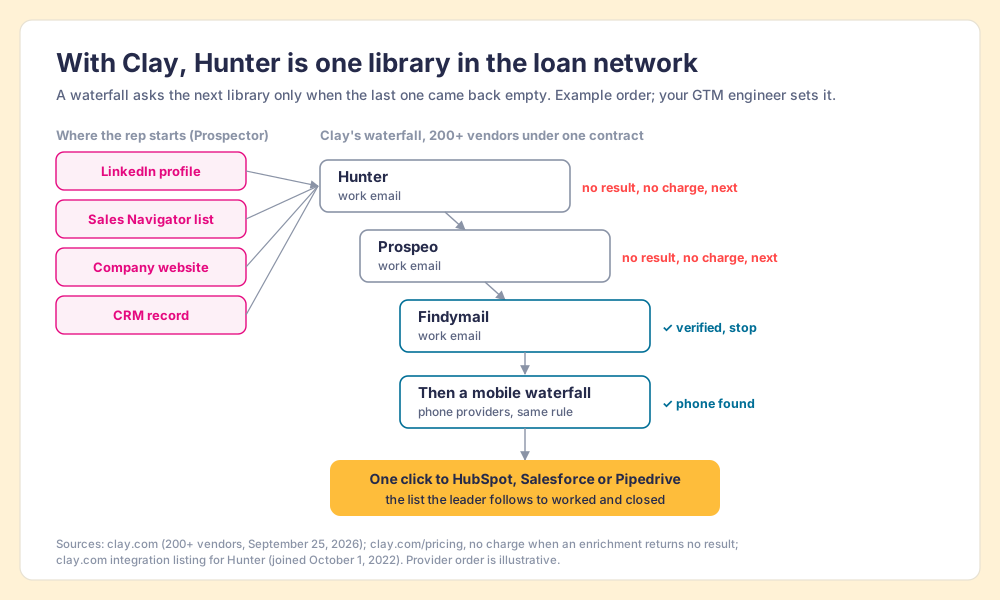
Prospector does not bring its own database. It brings Clay’s waterfall, which is every database, routed, and Hunter is one of the shelves. We chose Clay as our only data provider for that reason, which is why Clay is not a row in the tables above. Clay governs the data. Supered governs the motion.
What a rep gets from Prospector, on the team’s own Clay account and with no Clay login:
- A start wherever the prospect is. A LinkedIn profile, a Sales Navigator list, a company’s website with company research alongside, or the HubSpot, Salesforce, or Pipedrive record already open. Hunter’s extension starts from the website; Prospector also starts from the person.
- Rep-built lists, filled by the loan desk. The rep picks the people, the waterfall fills each email and phone, and a buying-committee lookup tuned by the team’s titles, departments, and seniority finds the rest of the committee.
- A duplicate check before the first email. On a LinkedIn profile the rep sees the matching CRM record and whether someone already worked this prospect, so two reps do not email the same person.
- One click into the CRM or a Clay workflow. Ops maps the fields once. After that a contact syncs in one click, and a whole list can be pushed into any custom Clay workflow.
- A list the manager can follow. The team’s process applies to worked prospects, so the manager sees which sourced lists got worked and which closed, and coaches from what converts.
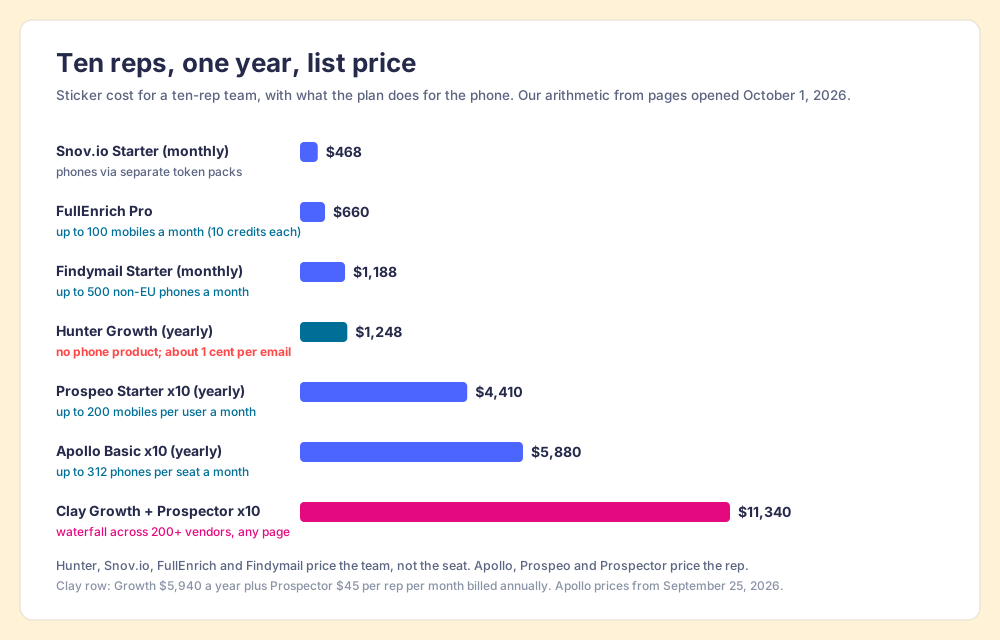
The arithmetic, because Hunter is cheaper than any slogan about “one contract.” Clay’s Growth plan lists at $495 a month, $5,940 a year, with 6,000 data credits a month and CRM sync (clay.com/pricing). Prospector is $45 per rep per month, billed annually, from one rep (Prospector). For ten reps that is $11,340 a year, against $1,248 for Hunter Growth. On email alone, Hunter wins by a mile. On our reading of Clay’s pricing calculator, a work email plus a phone costs roughly six data credits, about 30 cents at the entry rate, a supposition since Clay does not publish the calculator’s rates (the Clay pricing page shows the working). The extra money buys the phone drawer, every other library on the list, and a sourced list you can follow past the export.
Choose something else if you do not have Clay. Prospector runs on the customer’s Clay account and does nothing without one, and someone has to build the waterfall; Clay’s own homepage says “GTM engineers build on Clay.” Choose something else, too, if your reps send email and never dial. A $1,248 Hunter Growth plan for the whole team is the best deal in this category, and nothing on this page improves on it for that job. Sourcing on Clay explains the full rep loop for teams that do dial.
The other Hunter.io competitors, one at a time
- Apollo. The alternative teams graduate to when the job includes the phone and the outreach. Basic is $49 a seat a month billed annually with 30,000 credits a seat a year; an email costs 1 credit and a phone 8, so a Basic seat that spent everything on phones would get about 312 a month (apollo.io/pricing, September 25, 2026). G2 4.7 from 9,690 reviews on that date. One database, and a seat price, so ten reps cost $5,880 a year. The Apollo Chrome extension page covers the LinkedIn side.
- Snov.io. The closest to Hunter in spirit: an email finder with outreach attached, unlimited seats, and Starter at $39 a month on monthly billing with 1,000 credits, 25% off on annual (snov.io/pricing). Phones sit behind “a separate subscription” of enrichment tokens, priced per operation. G2 4.5 from 501 reviews (October 1, 2026). Pick it if you want sequences and LinkedIn automation at Hunter’s price.
- Findymail. The like-for-like swap for a team that dials. Starter is $99 a month for 5,000 finder credits plus 5,000 verifier credits, “1 email = 1 credit OR 1 phone = 10 credits,” charged only on verified results, with credits shared across the team and rolling over up to twice the plan (findymail.com/pricing). Its mobile finder is “Non-EU only.” G2 4.9 from 57 reviews (October 1, 2026). Spend every credit on phones and that is 500 a month, about 20 cents each.
- Prospeo. An email and mobile finder with a searchable lead database. Starter is $37 a user a month billed yearly ($441 a year) with 2,000 credits a month; “One credit gives you one verified business email, while a direct mobile number costs 10 credits,” and credits “do not roll over.” HubSpot and Salesforce sync starts on Growth at $74 a user billed yearly (prospeo.io/pricing). G2 4.6 from 849 reviews (October 1, 2026). Priced per user, so ten reps on Starter are $4,410 a year.
- FullEnrich. A small waterfall of 25+ sources without Clay, Pro at $55 a month for 1,000 credits, a work email at 1 and a mobile at 10, unlimited users (fullenrich.com/pricing, October 1, 2026). It is a loan desk with a short list of libraries, and a good one for a team that wants the waterfall idea without building it.
Two notes on lists you will see elsewhere. RocketReach, Lusha, and ZoomInfo appear on most Hunter alternatives lists; they are graded on the RocketReach alternatives page and the Kaspr alternatives page, and nothing about them changes when the starting point is Hunter. And if the search that brought you here was “find this person’s email from LinkedIn,” the LinkedIn email finder extensions page and the ContactOut alternatives page are closer to that job.
Which Hunter.io alternative should you choose?
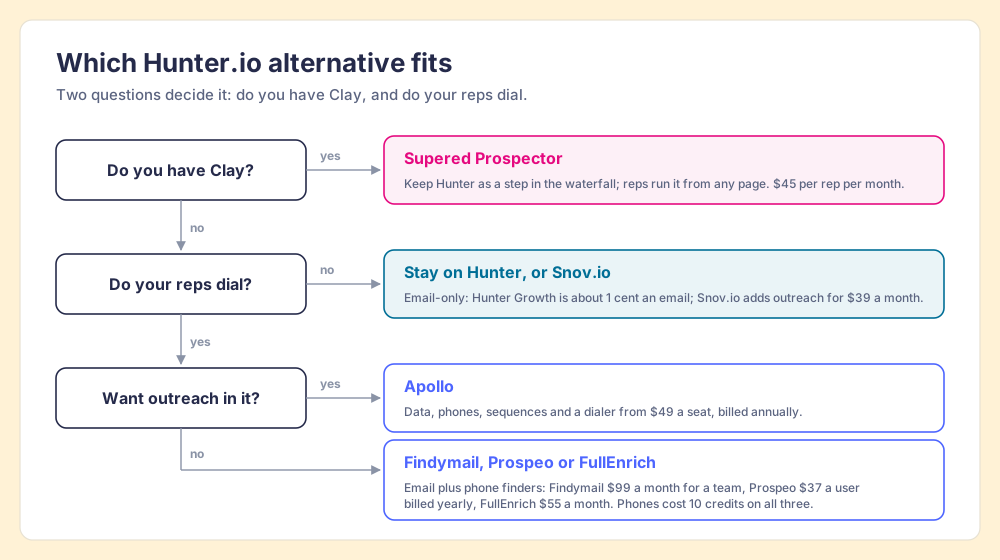
The choice resolves on two questions: do you have Clay, and do your reps dial. The ways forward:
- Hunter itself. The pick when the team emails and does not dial. Growth billed yearly is $1,248 for 120,000 credits shared across all users, about a cent an email, and the verification is careful about what it cannot confirm.
- Snov.io. The pick for the same email-first team that wants LinkedIn automation and outreach in the tool, at $39 a month.
- Findymail, Prospeo, or FullEnrich. The pick when reps dial and already have a sequencer. All three price a phone at 10 credits; Findymail prices the team, Prospeo the user, and FullEnrich asks 25+ sources per lookup.
- Apollo. The pick when the job is data, phones, sequences, and a dialer in one tool with a posted price, and one database is enough.
- Supered Prospector. The pick when the team already has Clay, and you want Hunter and every other library asked in turn from the page the rep is on, with the list landing in HubSpot, Salesforce, or Pipedrive.
What we recommend follows from what Hunter is. If your reps only email, keep Hunter. It is the cheapest careful library on the web, and switching to a pricier one buys shelves you will not read. If your reps dial and you do not have Clay, add a phone source before you replace anything, and look at Findymail first, since it prices the team the way Hunter does. If you have Clay, stop choosing between libraries. Put the loan desk in your reps’ hands on the page they are already on, let Hunter answer first when it can and the next vendor answer when it cannot, and follow each list into the CRM and on to closed. Hunter does its job well; the trouble starts when a team asks it for letters that were never printed. The Clay Chrome extension page shows what it looks like when the rep can ask the whole network instead. Teams leaving Exportly for the same reason will find the same loop on the Exportly alternatives page.
Frequently asked questions
What are the best Hunter.io alternatives in 2026?+
How much does Hunter.io cost in 2026?+
Does Hunter.io find phone numbers?+
Is Hunter.io accurate?+
Is Hunter.io the same as Salesforce's Hunter agent?+
Do I need a Clay account to use Supered Prospector?+
Your process, running itself.