Clearbit Pricing in 2026: The Meter Moved Into HubSpot, and Half of It Was Switched Off
Clearbit has no price list in 2026.
Its enrichment ships inside HubSpot without credits, its visitor reveal costs 10 HubSpot Credits a company, and the email finder is gone. What each Clearbit job costs now, checked October 2, 2026.
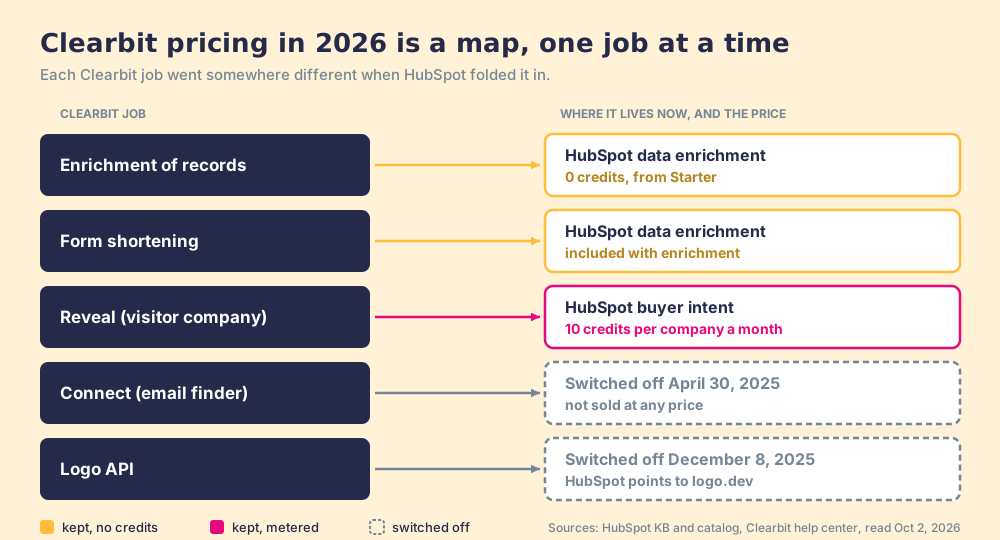
Clearbit pricing in 2026 is HubSpot pricing: Clearbit is no longer sold to new buyers, its enrichment ships inside HubSpot from Starter without using credits, and its visitor reveal runs as buyer intent at 10 HubSpot Credits per tracked company.
A city sometimes pulls a parking meter out of the curb and forgets the sign beside it. The sign still lists the rate. Drivers read it, dig for coins, and look for a slot that is no longer there.
Clearbit pricing in 2026 is HubSpot pricing: Clearbit is no longer sold to new buyers, its enrichment ships inside HubSpot from Starter without using credits, and its visitor reveal runs as buyer intent at 10 HubSpot Credits per tracked company. The pages that rank for this search are the sign. One prints a per-record credit meter that HubSpot’s own knowledge base says is gone. The short answer, by the job you want:
- HubSpot data enrichment. For company fields, job fields, and shorter forms. $0 extra on any Starter edition or higher; Sales Hub Starter showed $7 a seat a month on annual billing today.
- HubSpot buyer intent. For the old Clearbit Reveal, naming the companies on your website. 10 credits, or $0.10, per tracked company per month.
- Supered Prospector on Clay. For the job Clearbit Connect did, a verified email and phone for the person on a rep’s screen. $45 a rep a month, billed annually, on your own Clay account.
How much does Clearbit cost in 2026?
Start with the storefront. On October 2, 2026, clearbit.com reads “Clearbit has joined HubSpot!” above a customer login and no way to buy, and clearbit.com/pricing returns a redirect to the homepage. HubSpot bought Clearbit in a deal that closed December 4, 2023, launched Breeze Intelligence on September 18, 2024, and switched off Clearbit’s free tools on April 30, 2025; the Clearbit alternatives page walks that timeline date by date, so this page sticks to the bill.
Clearbit was four or five products sold under one name, and each went somewhere different. So the price question only has an answer per job.
| Clearbit job | What it was | Where it lives now | What it costs now (October 2, 2026) |
|---|---|---|---|
| Enrichment of records | Company and person fields written into the CRM | HubSpot data enrichment | $0 extra from any Starter edition; “does not consume HubSpot Credits” |
| Form shortening | Hide fields Clearbit could fill | HubSpot data enrichment | Included with enrichment |
| Reveal (visitor company) | Name the company behind a website visit | HubSpot buyer intent | 10 credits ($0.10) per tracked company per month |
| Custom intent signals | (new in HubSpot) | Intent, powered by the data agent | 50 credits ($0.50) per company per signal per month |
| Connect (email finder) | Gmail and web sidebar, 10 free lookups a month | Switched off April 30, 2025 | Not sold at any price |
| Logo API | Free company logos by domain | Switched off December 8, 2025 | HubSpot points to logo.dev |
| Existing Clearbit contracts | Annual plans, Salesforce and HubSpot connectors | Clearbit customer login | Quoted privately at renewal |
Sources for the rows: HubSpot’s data enrichment article (last updated July 10, 2026), its buyer intent article (September 1, 2026), the HubSpot Product and Services Catalog, and Clearbit’s free-tools notice (last updated October 9, 2025), all read October 2, 2026.
One thing the HubSpot catalog no longer contains is either brand. I searched the full Product and Services Catalog today for “Clearbit” and “Breeze Intelligence” and found neither. The catalog lists “enriched data” as part of the Core Seat and meters intent by the company. The name you searched for has left the price list entirely.
Why do Clearbit pricing pages still say enrichment costs credits?
Because they were written before the meter came out, and their authors have not walked back to the curb. The Breeze Intelligence pricing pages I opened today still describe a per-record credit meter.
Cognism’s Clearbit pricing article ranks fourth for this search and appears in Google’s AI Overview. It was last updated April 15, 2026, and it says Breeze Intelligence “starts at $45/mo for an annual commitment, or $50/mo if you choose the monthly” for “100 Breeze Intelligence credits,” and that “One credit is used for each record enriched, whether individually or in bulk” (Cognism, read October 2, 2026). Another page in the top ten carries the title “Clearbit Pricing: $75/mo Minimum + Tiers” (Ahrefs SERP snapshot, September 15, 2026).
HubSpot’s knowledge base says the opposite in eight words: “Data enrichment does not consume HubSpot Credits.” That line sits in the article HubSpot last updated on July 10, 2026, which lists enrichment on Starter, Professional, and Enterprise editions of Marketing, Sales, Service, Data, and Content Hub. When a vendor’s own documentation and a competitor’s blog disagree about the vendor’s price, the vendor wins, and the date tells you why they disagree.
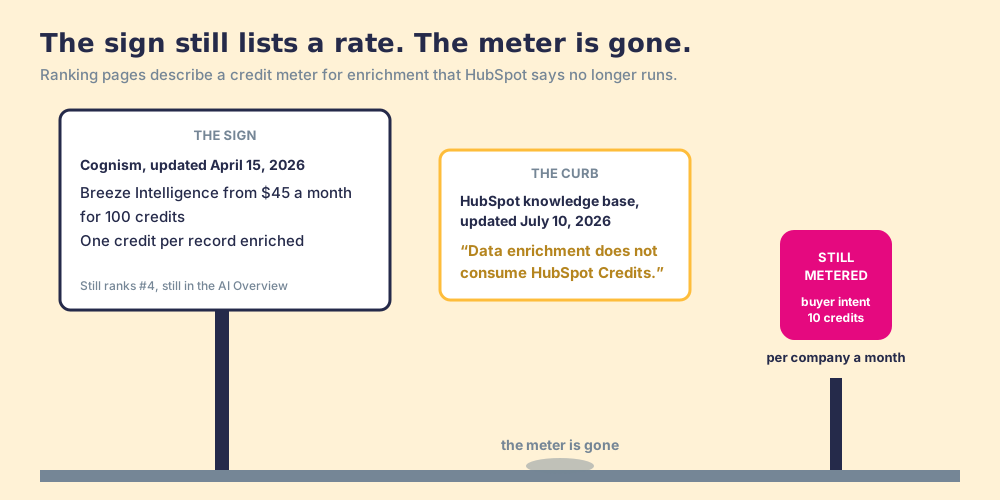
The image has a limit. A missing meter does not mean free parking everywhere. HubSpot removed the charge for enrichment and kept charges on the newer jobs around it: buyer intent, custom signals, smart properties, and the agents. Those meters are new, and they are where a Clearbit-shaped bill turns up now.
What do HubSpot Credits cost, and which Clearbit jobs use them?
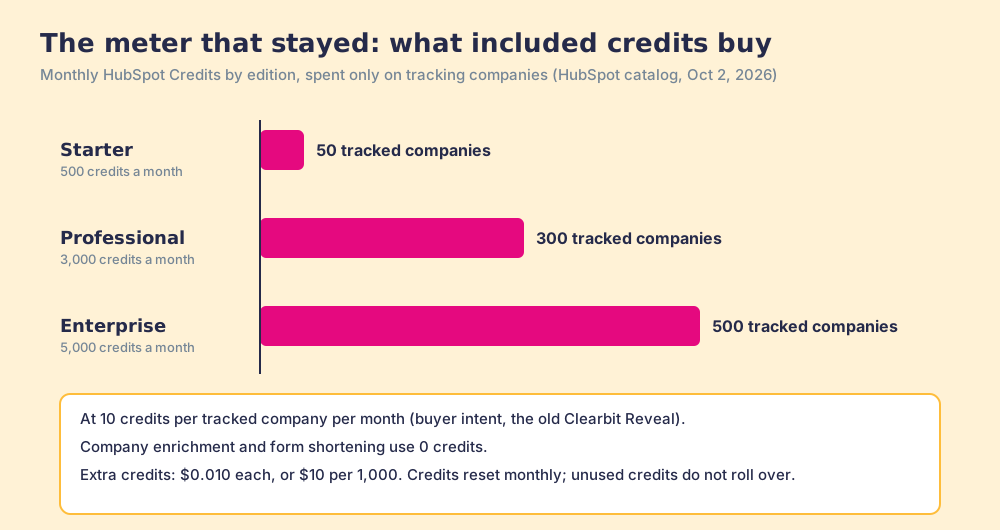
HubSpot sells credits at “$0.010 per credit,” either pay as you go, “invoiced monthly after they’re incurred in increments of ten (10) credits,” or as capacity packs of 1,000 for $10. Each subscription includes an allowance: 500 credits a month on Starter editions, 3,000 on Professional, 5,000 on Enterprise. The catalog adds two rules a finance team will want in writing: “Your HubSpot Credits reset monthly during your subscription term. Unused credits do not roll over into the following month,” and included credits “are not additive across products,” so a portal with two Professional hubs still gets 3,000 (HubSpot Product and Services Catalog, October 2, 2026).
What the old Clearbit jobs draw from that allowance:
- Company enrichment and form shortening. Zero credits.
- Buyer intent, the old Reveal. “Tracking a company costs 10 credits,” and “tracking continues to be charged monthly” after the first period (HubSpot knowledge base, September 1, 2026).
- Custom intent signals. 50 credits to monitor one company for one custom signal for one month.
- Smart properties, the data agent’s research fields. 10 credits per answer, and HubSpot’s own article warns that “Running a smart property consumes HubSpot Credits, even when a value isn’t filled for the property” (HubSpot knowledge base, July 24, 2026).
Do the division on the included allowance. Starter’s 500 credits track 50 companies a month and nothing else. Professional’s 3,000 track 300; Enterprise’s 5,000 track 500. A team that wants to watch 1,000 target accounts on Professional needs 10,000 credits a month, buys 7,000 of them, and pays $70 a month on top of its seats, or $840 a year.
Set that beside how Clay prices the same kind of lookup. Clay’s pricing page says, “If an enrichment returns no result, you’re not charged Data Credits or Actions” (clay.com/pricing, checked October 2, 2026). HubSpot’s smart properties charge for the empty answer; Clay’s waterfall does not. Neither rule is wrong. They put the cost of a miss on different shoulders, and a team that runs thousands of lookups a month should know which shoulders are its own.
Why trust this breakdown?
I started RevPartners, a HubSpot partner that did only sales implementations, sold roughly twice as much Sales Hub as any other partner, and reached Elite tier in 13 months. Supered came out of that work. It is the #1 sales enablement app on the HubSpot marketplace and a HubSpot Premier Tech Partner, with 5.0 stars from 122 reviews on its marketplace listing and 4.9 out of 5 from 81 reviews on G2, both checked October 1, 2026. Two disclosures. We make Supered Prospector, which appears below for the one Clearbit job HubSpot no longer covers. And we are a HubSpot partner writing about a HubSpot price, which happens to be the good news on this page: the enrichment most Clearbit customers bought now costs a HubSpot customer nothing extra. Every price here was opened on the vendor’s own page on October 2, 2026 unless another date is shown.
Which option fits which Clearbit job?
The lens is a mid-market or SMB sales team of 10 to 50 reps. Each option is graded in its own lane, against the job it replaces.
| Rank | Option | Grade (in its lane) | Best fit | CRM integration | Setup effort | Pricing (plan with the feature) | Reason to choose it |
|---|---|---|---|---|---|---|---|
| 1 | HubSpot data enrichment | A | HubSpot teams that bought Clearbit for company fields and forms | Native, HubSpot only | A settings change | Included from Starter; no credits | You already pay for it |
| 2 | Supered Prospector on Clay | A | Teams with Clay whose reps found emails and phones with Connect | One click to HubSpot, Salesforce or Pipedrive | Admin enables Clay inside Supered; live in under a week | $45 per rep per month, billed annually, plus your Clay plan | Clay’s waterfall across 200+ vendors on the rep’s screen |
| 3 | HubSpot buyer intent | B+ | Marketing teams that used Reveal | Native, HubSpot only | A settings change | 10 credits per tracked company per month | The Reveal job, metered by the company |
| 4 | Apollo | B | Teams without Clay that want one database and outreach | HubSpot and Salesforce integrations | Self-serve | Basic $49 per seat per month, annual | Posted price and a Chrome extension |
| ref | Clearbit renewal | C | Existing customers mid-contract | HubSpot and Salesforce connectors | Already installed | Private quote | Stay only for a job HubSpot cannot do |
Apollo’s price is from its own pricing data captured September 25, 2026; it meters 1 credit per email and 8 per phone. Re-rank for a team that never touched Connect and Prospector drops out, since its whole job is the email and phone.
What does Clearbit’s replacement cost a ten-rep team?
Ten reps, one year, list prices, for three common shapes of Clearbit customer.
| Team shape | What it buys | Annual cost |
|---|---|---|
| HubSpot Sales Hub Starter, 10 seats | Enrichment, forms, 500 credits a month (50 tracked companies) | 10 x $7 x 12 = $840 |
| HubSpot Sales Hub Professional, 10 seats | Enrichment, forms, 3,000 credits a month (300 tracked companies) | 10 x $90 x 12 = $10,800, plus $1,500 onboarding |
| Add Prospector on Clay Growth | Emails and phones from Clay’s waterfall, on the rep’s screen | $5,940 Clay + 10 x $540 Prospector = $11,340 |
| Or add Apollo Basic | Emails and phones from Apollo’s database | 10 x $49 x 12 = $5,880 |
HubSpot prices from hubspot.com/pricing/sales (Starter $7 a seat a month annual, $20 monthly; Professional $90 annual), checked October 2, 2026. Clay Growth is $495 a month billed monthly, $5,940 a year, or $446 a month on annual billing. Prospector is $540 a rep a year.
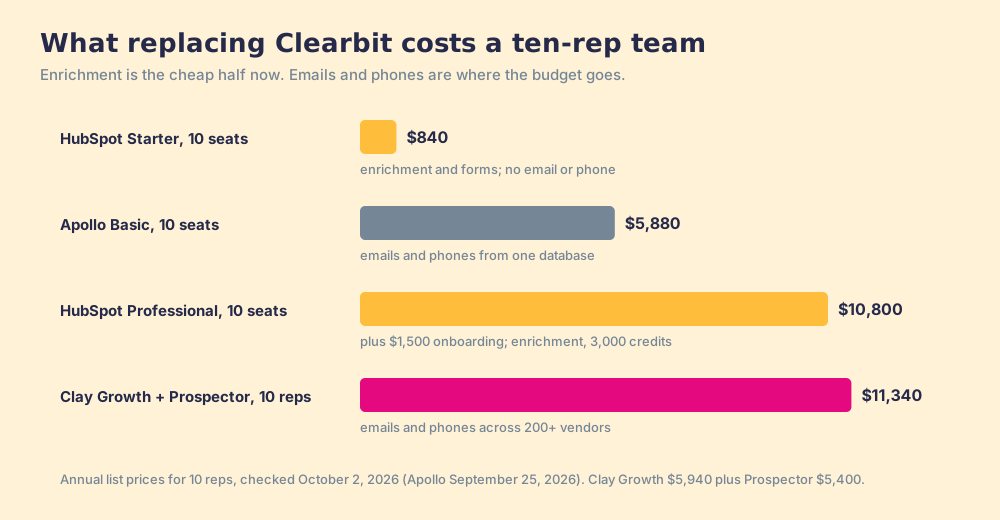
The table makes one point plainly. The enrichment half of Clearbit is now close to free for a HubSpot team: $840 a year buys it on Starter, and the Professional seats are a sales-software decision you were making anyway. The money in a Clearbit replacement goes to the other half, the person’s email and phone, and that half was never one database. HubSpot’s own memo announcing the deal described Clearbit’s data as coming from “250+ public and private data sources” (HubSpot, November 1, 2023).
Where does Supered Prospector fit?
Clearbit Connect was a waterfall wearing one brand, and the replacement that keeps that shape is another waterfall, run from where the rep already works. Supered does not bring its own database. It brings Clay’s waterfall, which is every database, routed. We chose Clay as our only data provider for that reason. Clay checks provider after provider until one returns a verified email or phone, across what its homepage calls “200+ data and AI vendors” (clay.com, September 25, 2026), and charges nothing for a miss.
Prospector puts the tables your GTM engineer built in Clay into the rep’s hands, inside the Supered Chrome extension:
- Start points where reps already are. A LinkedIn profile, a Sales Navigator list, a company’s website, or a HubSpot, Salesforce, or Pipedrive record, with no Clay login. Prospector works within LinkedIn’s terms and does not copy search results in bulk; the contact data comes from Clay’s waterfall on the customer’s Clay account.
- A CRM check before the add. The rep sees the matching CRM record and whether the person was already worked, before creating a duplicate.
- Lists that go to work. A whole list pushed to a custom Clay workflow, or contacts synced to the CRM in one click with field mapping set once.
- Found, worked, closed. The manager sees which lists reps work and how each lead ends (qualified, recycled, or disqualified, the way your process defines it) and coaches from what is converting.
Prospector costs $45 per rep per month, billed annually, from one user, on its own plan (Supered pricing), and runs on your Clay account and your Clay credits. The Prospector page shows the rep’s view.
Choose something else in three cases. If you only ever used Clearbit for company fields and you are on HubSpot, HubSpot’s enrichment is the answer and it costs nothing extra. If you do not have Clay and do not want to build tables, Apollo’s posted price is simpler. And if your reps work from a phone in the field, Supered has no mobile product.
Which should you choose?
Name the job first, and the bill follows. A single Clearbit price no longer exists to quote, so the decision runs on two questions: which Clearbit job you lost, and whether you already pay for Clay.
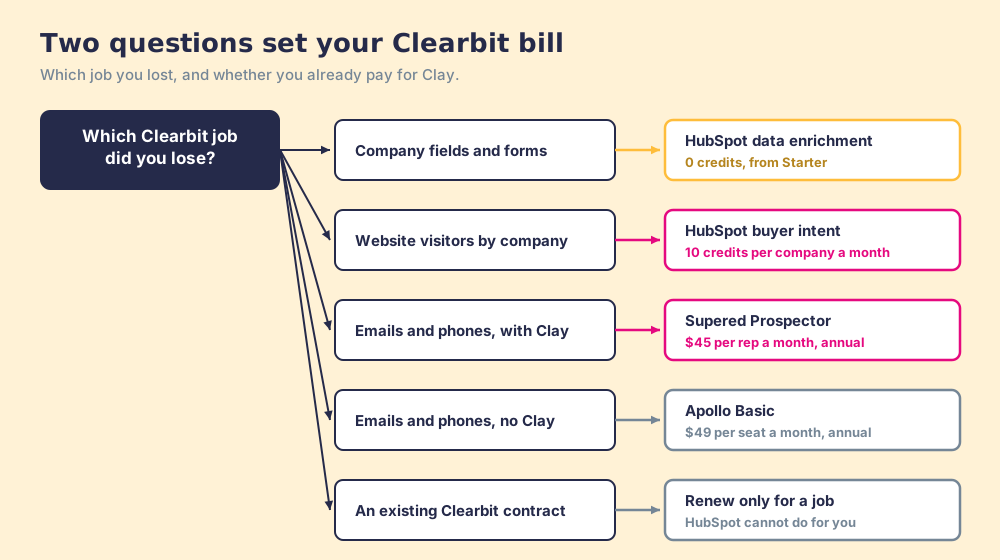
- Company fields and shorter forms, on HubSpot. HubSpot data enrichment, switched on this week. It costs no credits, and paying Clearbit separately for the same fields is paying twice.
- Website visitors by company. HubSpot buyer intent, budgeted at 10 credits per tracked company per month against your edition’s allowance.
- Emails and phones for reps, with Clay. Supered Prospector at $45 a rep a month on your Clay account.
- Emails and phones for reps, without Clay. Apollo from $49 a seat a month, or the Clay pricing page if you are weighing whether Clay belongs in the stack at all.
- An existing Clearbit contract. Renew only for a job HubSpot cannot do for you, and price the replacement before the notice date.
My recommendation, as someone who spent years inside HubSpot portals: stop shopping for Clearbit and start pricing jobs. The enrichment job got cheaper when HubSpot bought it, cheap enough that its price is now a rounding error on a Starter bill. The email-and-phone job did not get cheaper; it got unsold. Put your budget there, and buy it as a waterfall the rep can run from the page they are on. The Clearbit review grades what is left of the product itself, and HubSpot data enrichment covers the free half in depth.
Frequently asked questions
How much does Clearbit cost in 2026?+
Does Breeze Intelligence still cost credits?+
How much do HubSpot Credits cost?+
Was Clearbit ever free?+
What is the cheapest way to get Clearbit's data now?+
Should an existing Clearbit customer renew?+
Everything we have written on Clearbit
More on Clearbit
Looking past Clearbit? See Supered Prospector on your own Clay account- Clearbit Alternatives in 2026: HubSpot Kept Two Blades of the Pocketknife
- Clearbit Review 2026: A 4.4-Star Product You Can No Longer Buy
- The Clearbit Chrome Extension in 2026: The Switch Is Still on the Wall, the Light Is Gone
- Clearbit Salesforce Integration (2026): Two Pipes Still in the Wall, No Parts on the Shelf
- ZoomInfo vs Clearbit in 2026: The Restaurant That Moved Into the Hotel
Your Clay waterfall, where reps already work.