Snov.io Pricing in 2026: Four Meters on One Wall, and the One That Sets the Bill
Snov.io pricing checked on October 2, 2026: Starter at $39 to Ultra at $738 a month, 25% off annual, what a credit buys, why yellow emails cost a credit, phones at $0.20 or $0.44 in tokens, and ten-rep team math.
Snov.io pricing in 2026 is a free plan and five Sales Suite tiers from Starter at $39 a month to Ultra at $738 ($29.25 to $553.50 annual), where credits pay for emails, recipients pay for outreach, and phones cost separate tokens at $0.02 each.
A rented flat has one rent and several meters. The rent is on the lease, and the lease is easy to read. The meters sit in a cupboard by the door, one for electricity, one for gas, one for water, each turning at its own speed and each billing on its own day. A tenant who reads only the lease knows what the flat costs to hold. The meters tell what it costs to live in.
Snov.io pricing in 2026 is a free plan and five Sales Suite tiers from Starter at $39 a month to Ultra at $738 ($29.25 to $553.50 annual), where credits pay for emails, recipients pay for outreach, and phones cost separate tokens at $0.02 each. A custom Ultra plan sits above them (snov.io/pricing, opened October 2, 2026). The plan price is the lease. Credits, recipients, tokens and LinkedIn slots are the meters, and for a team that dials, the token meter decides the bill.
The quick answer, three ways:
- Snov.io Pro S or Pro M, annual. A small team doing email-first outbound that wants finding, verifying and sequencing under one login, with unlimited seats, from $891 a year.
- Snov.io on your own API key inside Clay. A team already on Clay that likes Snov.io’s sequencer or its credit price: run Snov.io as one step of Clay’s waterfall instead of the whole stack.
- Supered Prospector, $540 a rep a year on your own Clay account. A team on Clay whose reps should run the GTM engineer’s tables from LinkedIn, a company site or the CRM record, without opening Clay.
How much does Snov.io cost in 2026?
Snov.io prints both billing cycles into its page source, so the table below needed no guessing. The figures come from the pricing page and its compare table, opened today.
| Snov.io pricing (Oct 2, 2026) | Free | Starter | Pro S | Pro M | Pro L | Ultra | Custom Ultra |
|---|---|---|---|---|---|---|---|
| Monthly billing | $0 | $39 | $99 | $189 | $369 | $738 | Quoted |
| Annual, per month | n/a | $29.25 | $74.25 | $141.75 | $276.75 | $553.50 | Quoted |
| Billed for the year | n/a | $351 | $891 | $1,701 | $3,321 | $6,642 | Quoted |
| Credits a month | 50 | 1,000 | 5,000 | 20,000 | 50,000 | 100,000 | From 200,000 |
| Recipients a month | 100 | 5,000 | 25,000 | 50,000 | 100,000 | 200,000 | From 400,000 |
| Enrichment tokens a month | 25, once | 75 | 150 | 300 | 500 | 750 | 750 |
| Cents per credit, monthly | n/a | 3.9 | 1.98 | 0.95 | 0.74 | 0.74 | Quoted |
| Cents per credit, annual | n/a | 2.9 | 1.5 | 0.71 | 0.55 | 0.55 | Quoted |
| Email warm-up accounts | 1 | 3 | Unlimited | Unlimited | Unlimited | Unlimited | Unlimited |
A three-month option sits between the two cycles (Starter $37.05 a month, Pro S $94.05), and the annual banner reads “25% off for annual subscriptions.” The savings Snov.io prints match the arithmetic: $117 a year on Starter, $297 on Pro S, $567 on Pro M, $1,107 on Pro L and $2,214 on Ultra.
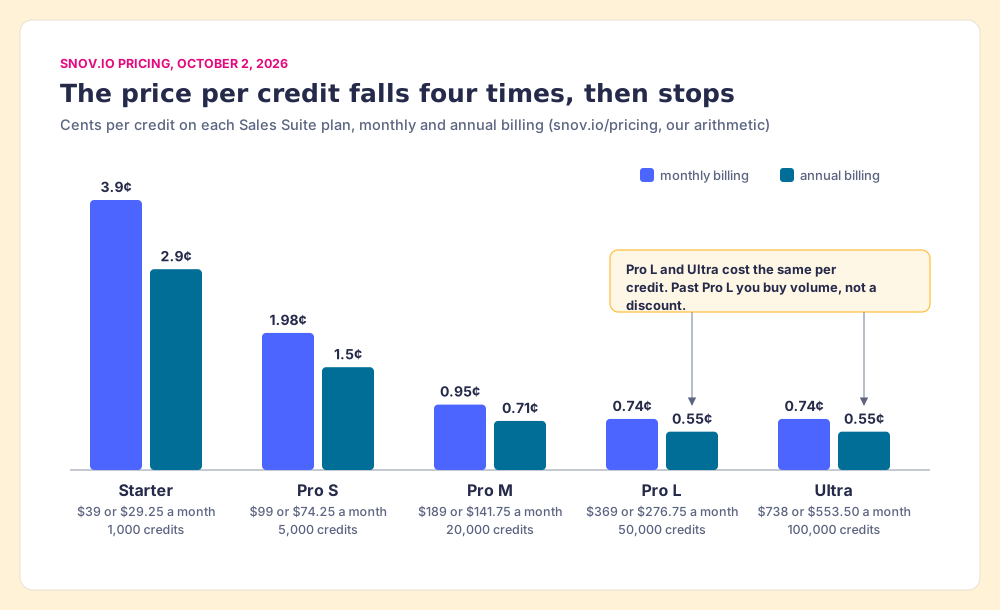
Snov.io’s own FAQ makes the case for climbing: “one credit on our Starter plan costs 3.9¢ while on one of our most popular Pro M plans it’s only around 0.9¢ (over x4 less!).” True, and the chart shows where the climb stops paying. From Pro L to Ultra the price per credit does not move. A team that lands on Ultra for the discount has paid $3,321 a year more than Pro L annual for the same rate. Buy Ultra when you need 100,000 credits a month, never to make a credit cheaper.
Seats are the pleasant surprise. The Starter, Pro and Custom Ultra cards each say “Includes unlimited team seats,” so one plan can cover a whole team. The fine print sits in Snov.io’s plans overview, which reserves “full teamwork functionality” (shared credits, permissions, per-member statistics) for Pro and Custom Ultra (Snov.io plans overview). For a team of more than two, Pro S is the practical floor.
What are the four meters on a Snov.io bill?
A Snov.io bill measures four different jobs, and each meter keeps its own clock.
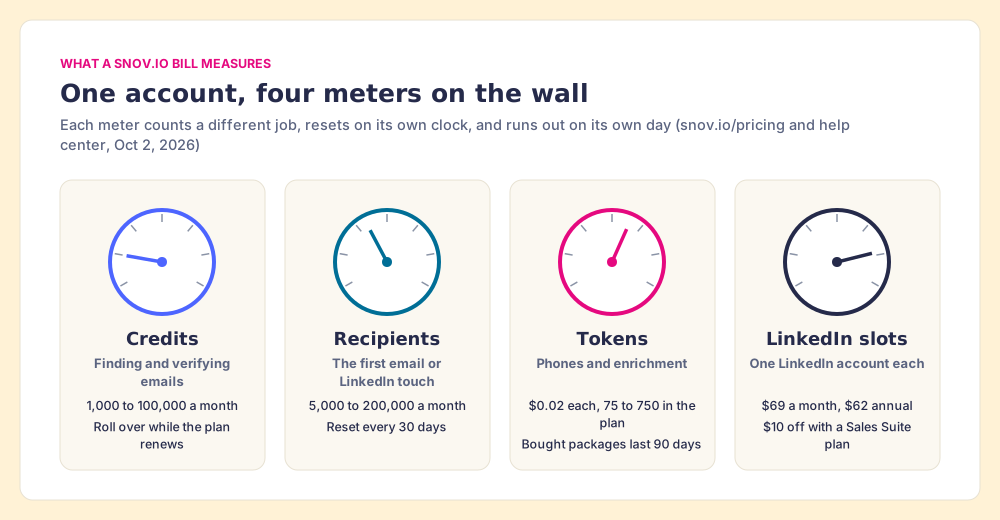
- Credits. Finding emails, finding prospects, verifying addresses. One credit per result, spent across the Finder and Verifier tools as you like. A deliverability test costs 50 credits; opening a company profile costs one.
- Recipients. Outreach. Snov.io charges one recipient “when you first contact a lead via email or LinkedIn,” and follow-ups to that person in the same billing period are free. Recipients never roll over.
- Tokens. Phones and enrichment. The FAQ is plain that this is “a separate subscription”: “Enrichment tokens can be used for … phone number search … The price per operation varies.”
- LinkedIn slots. Automation, sold per LinkedIn account at $69 a month, or $62 a month on annual billing, with $10 off each slot for Sales Suite customers.
Read the lease alone and Snov.io looks like an email tool with a generous seat policy. Read the meters and it is four products sharing a login. Each one is fairly priced. None of them is on the plan card’s headline number.
What does one Snov.io credit buy?
One email, found or checked. The help center spells out when the coin drops (Snov.io, “What is a credit limit”, updated September 8, 2026), and it uses a traffic light to do it. Snov.io colors every email result: green for valid, yellow for unknown, red for invalid, gray for not found.
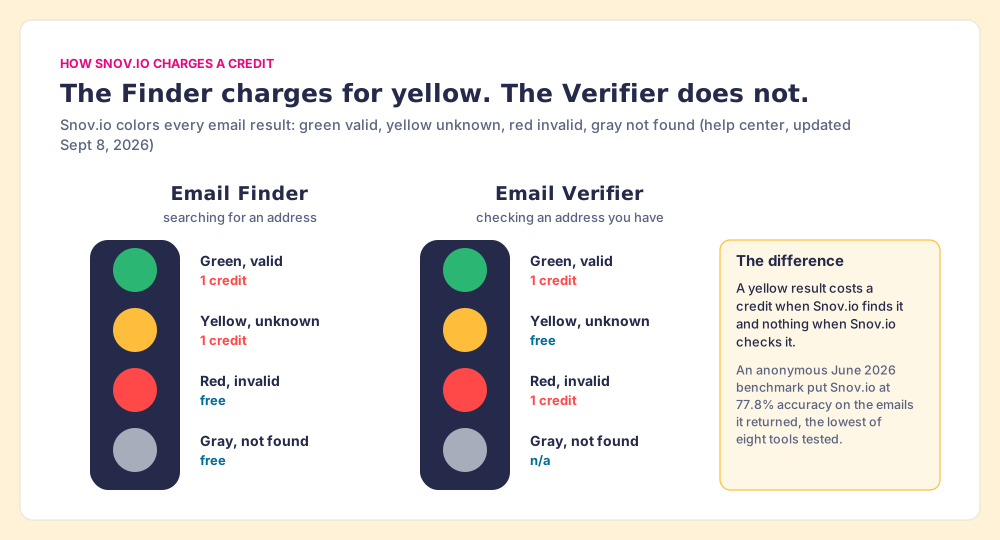
The Finder charges for yellow. Snov.io’s reasoning is fair on its face: “While we couldn’t fully verify them, they may still be deliverable and can be valuable contacts.” The Verifier, checking the same kind of address, charges nothing for yellow. So the light that means “we are not sure” costs a coin on the way in and nothing on the way out.
That would be a footnote if accuracy were high. The best outside test we found is a benchmark from b2b-email-finder.com, an anonymous review site that ranks Findymail first, so weigh it accordingly. It ran 500 contacts with known emails in May 2026 and measured Snov.io at 74.3% coverage and 77.8% accuracy, the lowest accuracy of the eight tools it tested; Findymail scored 93.2% and Hunter 84.7% (b2b-email-finder.com, June 8, 2026). G2 reviewers point the same way. “Sometimes even verified emails bounce, so accuracy can vary depending on the source,” wrote Vikas K. in January 2026 (G2, Snov.io reviews).
The cents still look small. Divide the credit price by the benchmark’s accuracy and an accurate email costs about 5 cents on Starter monthly and under a cent on Pro M annual (our arithmetic). The cost that matters is the bounce, which spends sender reputation the warm-up meter was bought to protect. Run Snov.io’s own Verifier on yellow results before they enter a sequence; checking a yellow costs nothing.
How much do phone numbers cost on Snov.io?
Here the lease and the meters part company. Credits buy nothing on the phone side. Phones run on enrichment tokens, and Snov.io’s help center gives the rate (Snov.io, “What are enrichment tokens”, updated October 1, 2026):
- Wiza. 10 tokens per phone found, about $0.20 at $0.02 a token.
- Zeliq. 22 tokens per phone found, about $0.44.
- The rule for both. “Charged only when a phone number is found.”
Read the provider names twice. A Snov.io phone number comes from Wiza or Zeliq, picked by the user, and resold in tokens. Snov.io is a reseller on the phone side, with two doors to choose between. That is a reasonable product. It also means a team comparing Snov.io’s phones with someone else’s is comparing Wiza’s or Zeliq’s data, and our Wiza pricing page covers the first of those directly.
Tokens arrive two ways. The plan includes 75 to 750 a month, which on Wiza’s rate is 7 phones a month on Starter, 30 on Pro M and 75 on Ultra. Plan tokens reset at renewal and never roll over. Packages run from 1,000 tokens for $20 to 50,000 for $1,000, each “Billed once,” and each must be used within 90 days. The page’s own pitch for tokens is a fair one: “We don’t charge for the search, we only charge for actual results provided.”
What is in the Snov.io free plan?
The Snov.io free plan is a working sample: 50 credits, 100 recipients, one warm-up slot and 25 tokens. It leaves out integrations, bulk search, bulk verification, data export and credit rollover, so no list built on it reaches a CRM. The two Snov.io sources disagree on one point. The pricing page FAQ says the free quotas “renew every 30 days.” The help center, updated a day before our visit, says the 25 tokens are “given once and not renewed.” Plan on the help center’s version, and use the free plan to test accuracy on 50 people you already know.
Is Snov.io cheaper on monthly or annual billing?
Annual, by exactly a quarter, on every tier. The catch is in what happens to credits when the year ends or the plan changes. From Snov.io’s billing FAQ (FAQ, Plans and Billing, updated September 30, 2026):
- Monthly plans. Unused credits roll over “as long as your premium monthly plan remains active.”
- Annual plans. Credits “accumulate throughout the year … but will expire when your annual plan ends.”
- Annual to monthly. “Any unused credits from the multi-month plan do not carry over and will be lost.”
- Downgrades. Charged immediately and applied “right away,” with no waiting for the period to end.
- Refunds. “We do not offer partial or full refunds for monthly subscription payments and annual plan payments.”
- A failed renewal. The account drops to the free plan.
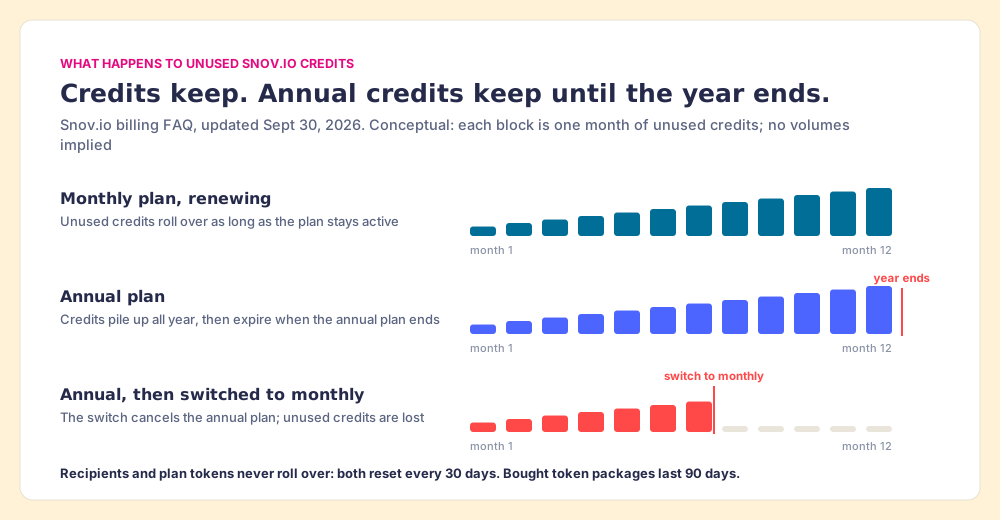
So annual is the right buy for a team that knows its volume, and a poor one for a team that is guessing. Start on monthly, watch the credit meter for two months, then move up a tier on annual. Move up, never across: an annual-to-annual upgrade gets a prorated discount and keeps the credits, while a switch to monthly forfeits them.
Why do teams leave Snov.io?
Fair first. On G2, Snov.io held 4.5 out of 5 from 499 reviews on October 2, 2026 (G2, Snov.io reviews), and its price list is one of the most complete in the category: every tier, both cycles, every meter’s rules published. For a founder or a three-person team running email-first outbound, Snov.io Starter puts finding, verifying, warming and sequencing behind one login for less than a single Apollo Basic seat ($351 a year against $588). We found no 2026 acquisition, merger or rebrand.
The complaints gather around the meters:
- Credits that run fast in bulk. “The credit system is our biggest pain point. Running bulk lookups for Zymplify high-intent accounts burns through credits quickly, raising costs for our ABM campaigns” (Talia B., B2B ABM Specialist, Mid-Market, September 2026).
- Coverage by region and industry. “The database coverage can be limited in certain regions or industries” (Ali R., Small Business, May 2026).
- Bounces on verified emails. The Vikas K. review above, and the 77.8% benchmark behind it.
- CRM reach. The pricing page lists native two-way sync for HubSpot and Pipedrive. On snov.io/integrations, the Salesforce card links to Zapier, so a Salesforce team syncs through a connector.
The second and third complaints share a cause, and no plan upgrade fixes them. One source has the contacts it has.
Why should you trust this breakdown?
We sell no contact data. Supered has no database of its own, on purpose; Prospector runs on Clay, our only data provider. Whether you buy Snov.io, Apollo or Hunter changes nothing for us. Our stake is what reps do with a contact once it lands in the CRM.
Supered started inside RevPartners, the HubSpot partner I founded, which sold roughly twice as much Sales Hub as any other partner and reached HubSpot’s Elite tier in 13 months. Supered is the #1 sales enablement app on the HubSpot marketplace, with 6,000+ installs and a 5.0 rating from 122 reviews there, and on G2 it held a 4.9 out of 5 from 81 reviews on October 1, 2026 (G2, Supered reviews). Each Snov.io figure on this page links to the page it came from, opened October 2.
Which Snov.io plan, or which alternative, fits your team?
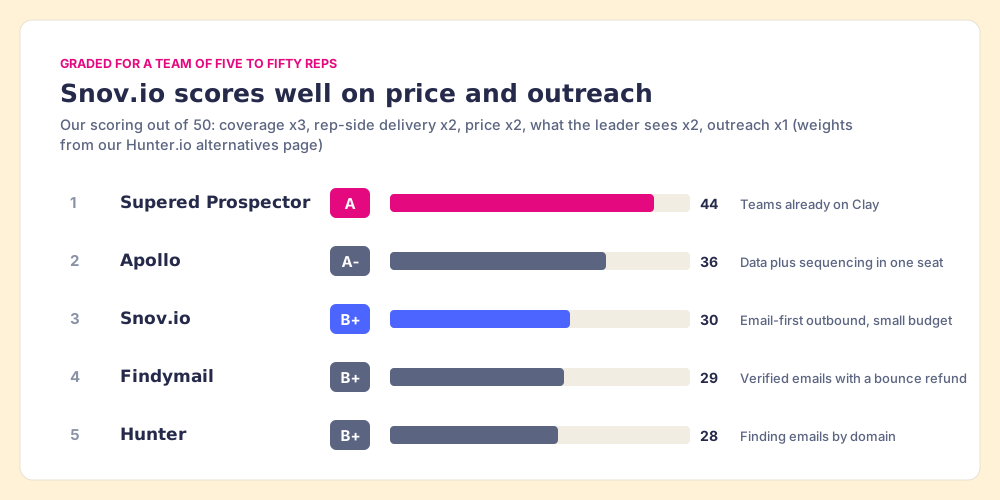
The grades reuse the five weights from our Hunter.io alternatives page: coverage of the contact you need (x3), delivery where the rep already works (x2), price for a mid-market team (x2), what the leader sees after the export (x2), and bundled outreach (x1), out of 50. The weights serve one job, a team of five to fifty reps building its own lists. Flip the lens to “one founder, cheapest email-and-sequence bundle” and Snov.io moves to the top.
| Rank | Option | Grade | Best fit | CRM integration | Setup effort | Pricing (plan with the feature) | Reason to switch |
|---|---|---|---|---|---|---|---|
| 1 | Supered Prospector | A (44) | Teams already paying for Clay | Native: HubSpot, Salesforce, Pipedrive | Demo, then live on your own Clay account | $45 a rep a month, billed annually, plus your Clay plan | Clay’s waterfall across 200+ vendors from the rep’s screen; lists tracked found, worked, closed |
| 2 | Apollo | A- (36) | Data plus sequencing per seat | Native | Self-serve | Basic $49 a seat a month, annual | One database with phones on the same credit |
| 3 | Snov.io | B+ (30) | Email-first outbound on a small budget | Native HubSpot, Pipedrive; Salesforce via Zapier | Self-serve, minutes | Pro S $74.25 a month annual, unlimited seats | Cheapest finder plus sequencer bundle here |
| 4 | Findymail | B+ (29) | Verified emails, bounce refund | Native, Clay included | Self-serve | Starter $99 a month | Refunds credits above a 5% bounce rate |
| 5 | Hunter | B+ (28) | Emails by company domain | Native | Self-serve | Growth $104 a month yearly | Lowest price per email; no phones sold |
What does Snov.io cost for a team of ten?
Less than almost anything else on this page, until the team starts dialing. Unlimited seats mean ten reps can share one Pro M plan: $1,701 a year on annual billing, 20,000 credits a month, about 2,000 per rep. For email-first outbound that is a strong price.
Turn on the phone meter. Suppose the team wants 1,000 phone numbers found a month, about five per rep per working day. On Wiza’s rate that is 10,000 tokens a month; the plan covers 300, and the other 9,700 cost $194 a month, $2,328 a year. On Zeliq’s rate it is 21,700 extra tokens, $434 a month, $5,208 a year. A supposition, labelled as one: your phone volume sets the figure.
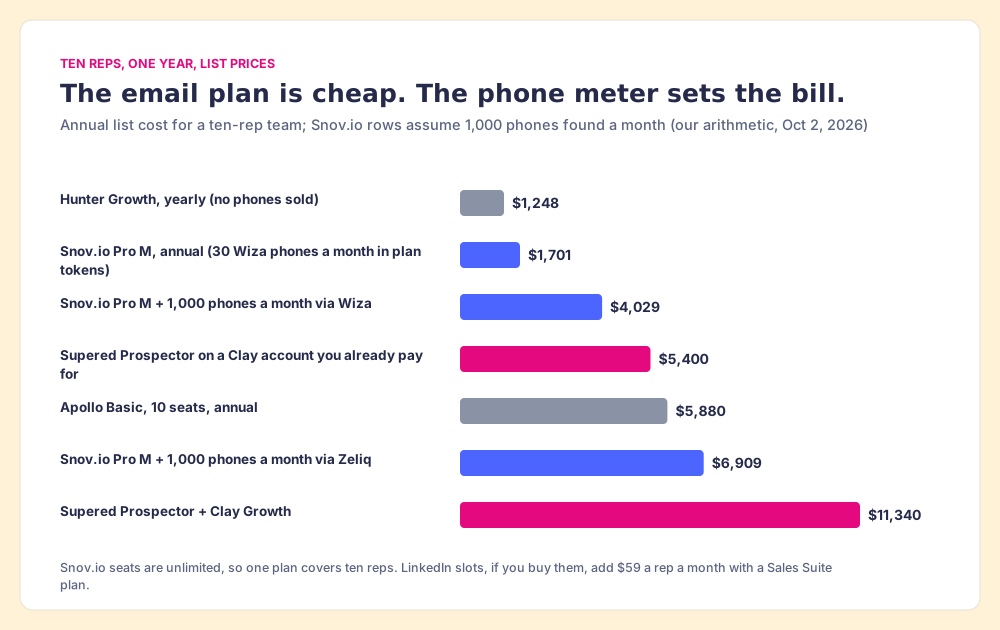
Two lines on the chart deserve a second look. Snov.io with Wiza phones, at $4,029, still undercuts ten Apollo Basic seats at $5,880 (apollo.io/pricing, captured September 25, 2026). And the LinkedIn meter, if the team buys it, outweighs everything else: ten slots at $59 a month is $7,080 a year, four times the Pro M plan.
That meter carries a second cost. LinkedIn’s User Agreement, section 8.2, says members will not “Use bots or other unauthorized automated methods to access the Services, add or download contacts, send or redirect messages” (LinkedIn User Agreement). Snov.io sells LinkedIn Automation with its own safety settings. We do not recommend automation tools, and the account a rep risks is the one they prospect from. Ask every vendor what its tool does on LinkedIn, ours included.
How does Supered Prospector compare to Snov.io pricing?
Go back to the phone lookup. Snov.io opens one door, Wiza or Zeliq, chosen by you, and charges only when the door has a number behind it. When it does not, the rep has nothing. Clay is the corridor: its waterfall asks provider after provider until one returns a verified email or phone, across 200+ data and AI vendors under one contract (clay.com, September 25, 2026), and “If an enrichment returns no result, you’re not charged Data Credits or Actions” (clay.com/pricing).
Snov.io can be one of the doors. Its own Clay page offers to “Use your Snov.io account to run enrichments in Clay, so you don’t pay twice,” either through the Clay-managed account (Clay credits) or your own Snov.io API key (Snov.io credits, paid Clay plans only), and it can enroll Clay’s enriched leads in a Snov.io sequence (snov.io/clay-integration). A team on Clay that likes Snov.io’s credit price can keep it as a step and stop paying for it as a stack.
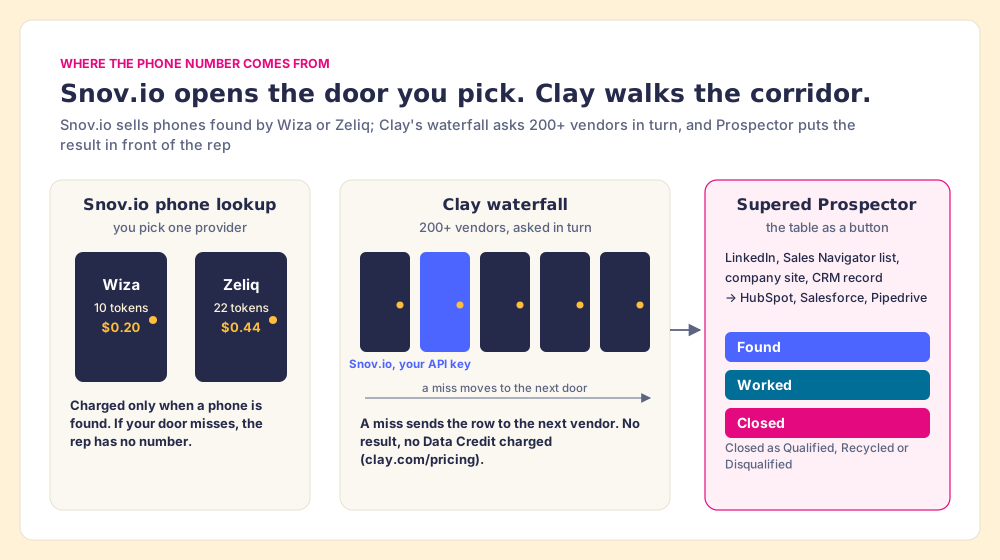
The corridor has one weakness. The GTM engineer built it, and reps rarely walk down it; they Slack the GTM engineer for a list instead, and the person who designed the waterfall becomes the list desk. Clay plus Supered is the best way for a sales team to prospect: GTM engineers build in Clay, and reps never open Clay. Prospector runs inside the Supered Chrome extension, on your team’s own Clay account:
- The table as a button. The GTM engineer builds named flows once, say person enrichment or buying committee, and reps pick one from a Push menu on a LinkedIn profile, a company website, or a HubSpot, Salesforce or Pipedrive record. From Sales Navigator, reps add leads to a prospect list and push the list to a Clay table. Your waterfalls, tiers, tags and sequence variables stay yours.
- A check before the duplicate. Before pushing, the rep sees whether the person already has a CRM record, who owns it, and whether a teammate prospected them before. No duplicate work across reps.
- One click to the CRM. The contact lands in the CRM, or your sales engagement tool, with the team’s process applied.
- Found, worked, closed. The leader sees which lists reps found, who is working them and who is not, and how each lead ended the way the process says: Qualified, Recycled or Disqualified. The Clay budget grows on that view.
Prospector is $45 per rep per month, billed annually, from one user, on its own plan separate from Supered’s process products (Prospector, Supered pricing). Start from the Supered Clay template or bring your own tables. Prospector works within LinkedIn’s terms and does not copy search results in bulk; the contact data comes from Clay’s waterfall on the customer’s Clay account. The sourcing use case walks the rep’s side, and our Clay Chrome extension guide covers how teams put Clay on LinkedIn today.
Choose something else if any of these is true:
- No Clay account. Prospector needs one. A founder or a three-person team without Clay gets more for the money from Snov.io Pro S. If you want Clay and need someone to build the tables, RevPartners, the HubSpot partner I founded (now a Walker Sands company), is a Clay Elite Studio Partner.
- A sequencer in the same bill. Snov.io’s recipients meter is a cheap sequencer with unlimited seats, and Prospector sends no email. If one invoice for data and sending matters most, stay on Snov.io.
- Phones on the same credit as emails. Apollo’s pricing meters both on one balance, per seat.
What are the cheaper or better Snov.io plans and alternatives?
Within Snov.io, pick the plan by the meter you will run hardest:
- Starter, $39 or $29.25 a month. One person. Unlimited seats in name, but shared credits and permissions arrive on Pro.
- Pro S, $99 or $74.25. The floor for a team: 5,000 credits, 25,000 recipients, unlimited warm-up, full teamwork.
- Pro M, $189 or $141.75. The best rate per credit before the ladder flattens, 0.71 cents annual, and 300 tokens.
- Pro L, $369 or $276.75. The lowest rate Snov.io sells, 0.55 cents annual. Ultra matches it at twice the volume.
Outside Snov.io, the options split by job, and our Snov.io alternatives page compares them in full:
- Hunter, for emails by domain. Growth is $104 a month billed yearly for 10,000 credits, unlimited users, and no phones sold (hunter.io/pricing, October 1, 2026).
- Findymail, for accuracy with a guarantee. Starter is $99 a month for 5,000 finder credits, a phone at 10 credits, and a credit refund if bounces pass 5%. See Findymail alternatives.
- Apollo, for one seat with data and sequencing. Basic is $49 a seat a month on annual billing; Apollo pricing walks the credit meter.
- A ranked view of the field. Our email finder tools page grades the category, and Clay’s email finder shows how the waterfall handles the same job.
What we recommend
Three ways forward, and our view on each.
- One founder, email first. Snov.io Starter monthly for two months, then Pro S annual if the volume holds. Verify every yellow result before it enters a campaign; checking it costs nothing.
- A small team that also dials. Price the token meter before the plan. At 1,000 phones a month, Pro M with Wiza tokens is about $4,029 a year for ten reps, still under Apollo Basic. Skip the LinkedIn slots.
- A team already on Clay. Keep Snov.io as a step, on your own API key, if its rate suits you. Put the tables in reps’ hands with Supered Prospector at $540 a rep a year, and watch which lists get worked and close.
A rented flat is a fair deal when the tenant reads the meters as well as the lease, and Snov.io’s lease is one of the clearest in contact data. Read the token meter before you sign, and the LinkedIn meter before you plug it in. Then ask where the next phone number comes from when the first door has nothing behind it; waterfall enrichment answers that one.
Frequently asked questions
How much does Snov.io cost in 2026?+
Does Snov.io have a free plan?+
What does one Snov.io credit buy?+
How much do phone numbers cost on Snov.io?+
Do Snov.io credits roll over?+
Can I use Snov.io inside Clay?+
Your process, running itself.