Waterfall Enrichment: What It Is, Why One Provider Misses, and How Clay's Cascade Charges Only for the Catch
Waterfall enrichment asks provider after provider for the same email or phone, in a set order, and stops at the first verified hit. Why match rates differ by geography and segment, how Clay orders the cascade, what a miss costs (nothing), and where it should meet the rep.
Waterfall enrichment is a data-enrichment method that asks a sequence of providers for the same field, one after another in a set order, stops at the first verified result, and charges only for the provider that returned it.
The rep has a name, a company, and a LinkedIn headline, and no phone number. The database the team pays for returns nothing. So she opens the second tool, the one Ops bought after the first one kept missing, and it returns nothing either. She asks a colleague, who has a login to a third. Between the three tabs and the favor, twelve minutes pass, and the org has paid three seat fees to run, by hand and in the wrong order, the thing this page is about.
Waterfall enrichment is a data-enrichment method that asks a sequence of providers for the same field, one after another in a set order, stops at the first verified result, and charges only for the provider that returned it. A buyer usually meets the term on Clay’s product pages, so Clay waterfall enrichment is the version to define from, in Clay’s own line: “Clay’s signature data waterfalls check multiple providers to return the most verified emails (lower bounce rate) and phone numbers (higher connect rate)” (clay.com/use-cases/rep-prospecting, opened September 25, 2026), across 200+ data and AI vendors on one contract (clay.com, same day). We run on our customers’ own Clay accounts and read Clay’s documentation the way a customer does. What follows is the mechanism, credited to Clay throughout, and the one question Clay’s docs leave to the buyer: where the cascade should meet the rep.
What is waterfall enrichment, in plain words?
Think of a hillside of stocked ponds, terraced one above the next, each pond fed by a different river. You want one fish, a particular person’s mobile number. You pour your query into the top pond: a name and a company domain. If the fish is in that pond, you pay that pond’s price and stop. If it is not, the water spills over the lip into the next pond down, and the next, until a pond has the fish or the hillside runs out.
The ponds hold the whole mechanism, and Clay’s own lesson describes it without them: a waterfall queries “providers in a specific order, usually starting with the most cost-effective, until the required data is found,” and “Once Clay finds what it needs from one provider, it won’t check the others” (Clay University, Enriching Company Data, opened September 25, 2026). The lesson’s example is a funding-stage waterfall: check the first provider at 1 credit, then the second at 3 credits, then the third at 4 credits, “and so on,” stopping the moment one returns the value.
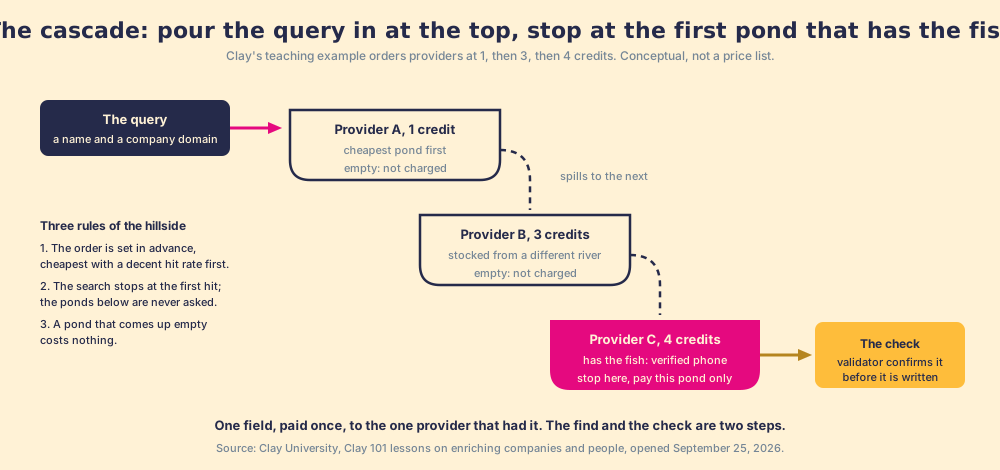
A pond cannot tell a live fish from a painted one, and that limit is the important one. A provider can return an address that looks right and bounces. So Clay runs a second step after the catch: “Clay’s email waterfall doesn’t just find people’s emails,” the people-enrichment lesson says, it “validates them as well,” with ZeroBounce as the default validator, and it notes that catch-all addresses are treated as valid unless you switch on “Only mark ‘Safe to Send’ emails as valid” (Clay University, Enriching People Data, opened September 25, 2026). The find and the check are two different things, and the waterfall is only the first.
Why do provider match rates differ by segment, geography, and seniority?
Because each pond was stocked from a different river. A contact database is a collection method with a name on it, and the method decides who ends up inside.
Cognism, which sells one such database, says this about all of them, including its own competitors: “Each provider applies different collection methods, refresh cycles and standards, increasing the likelihood of inconsistency, duplication and compliance exposure, particularly in Europe” (cognism.com/cognism-vs-clay, opened September 25, 2026). Cognism meant it as a warning against mixing providers. Read it the other way and it is the reason a waterfall works: the ponds hold different fish because the rivers run through different country.
- Geography. Vendr’s buyer guide describes ZoomInfo’s data as “Global; strong North America coverage” and Cognism’s as “Strong EMEA coverage; growing North America” (vendr.com/marketplace/zoominfo), and one Cognism buyer on Vendr reports “using ZoomInfo in tandem with Cognism,” which is a two-pond waterfall run on two contracts. Clay added Lusha to its marketplace in March 2026 and said why in one line: “Add Lusha as a step in your existing contact enrichment waterfall for better EMEA match rates” (clay.com/changelog/lusha).
- Law, which shapes geography. Cognism scrubs its data against Do Not Call and telephone-preference lists in twelve countries and “generally” keeps the data it collects inside the European Economic Area (cognism.com/compliance). A pond stocked under those rules holds a different set of mobiles than one stocked without them. Neither is wrong; they are different rivers.
- Segment. Verification is expensive, so vendors verify where they sell. Cognism’s pricing page reserves “higher-quality, accurate mobile data” and on-demand verification for its Pro package, and its manually phone-verified mobiles carry their own name, Diamond Data (cognism.com/pricing). A provider’s best-verified pond is its own target market, and yours may not overlap it.
- Seniority. No vendor we opened publishes match rates by seniority, so this one is the mechanism’s prediction rather than a printed number: a collection method that harvests published contact pages and signatures will hold more mid-level names than executive ones, and a method built on phone verification will hold the reverse, because that is where the verification budget goes. Clay’s lesson gives the builder the lever for exactly this case: “if you know a certain provider has better coverage for your ICP, you can reorder the providers accordingly.”
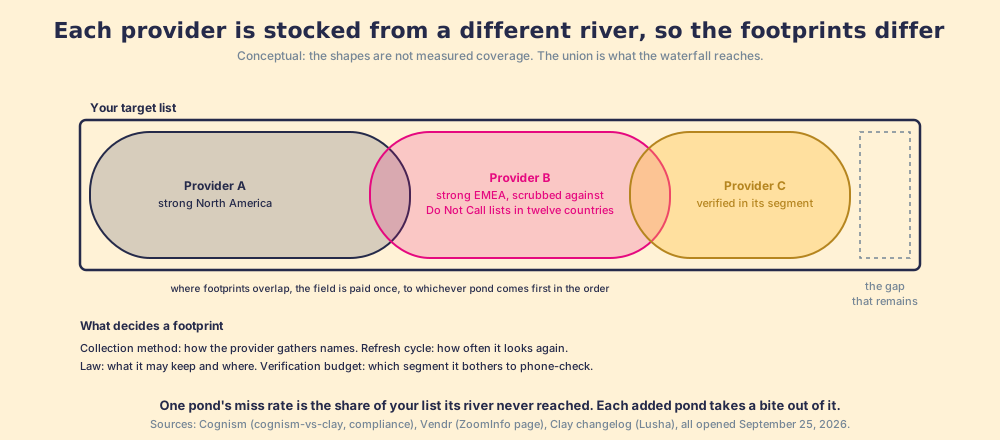
This is also why Clay’s headline number reads the way it does. Its waterfall page says searching providers in sequence “routinely triples our customers’ data coverage and quality” (clay.com/waterfall-enrichment). That is Clay’s claim about Clay’s customers, and we print it as such. The mechanism says why it is plausible: a single pond’s miss rate is the share of your list its river never reached, and every added pond, stocked from a different river, takes a bite out of that share.
How does a waterfall decide the order, and what does a miss cost?
Two decisions make a waterfall, and Clay makes the first one for you. Its lesson says each waterfall comes “pre-configured based on our experience with hundreds of thousands of enrichments,” with “a pre-arranged order of providers, optimized for cost and coverage.” The cheapest pond with a decent hit rate goes first; an expensive pond with a rare fish goes last. The builder can drag the order around, and Clay’s advice is to run “Save & Run (10 Rows)” before turning a full table loose.
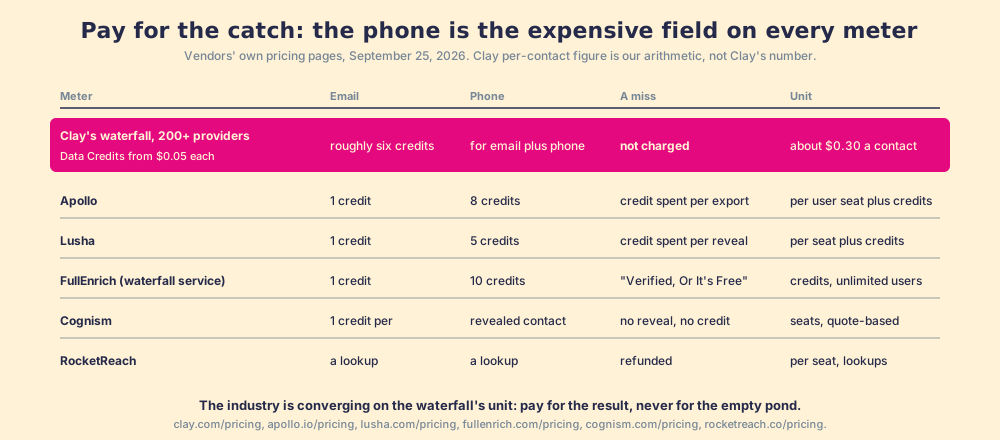
The second decision is the meter, and it is the part a buyer coming from a seat-priced database has to re-learn. Clay’s pricing page states it in one sentence: “If an enrichment returns no result, you’re not charged Data Credits or Actions” (clay.com/pricing, opened September 25, 2026). The people-enrichment lesson says the same from the builder’s chair: if a provider “doesn’t return an email, you get your data credits refunded automatically.” Data Credits “start at $0.05 each,” per the same pricing page, and get cheaper down the ladder.
You might say a waterfall must cost more, since it asks more providers. Fair, and it would if every ask were billed. It is not. Each field is paid once, to the one pond that had the fish, and the ponds that came up empty cost nothing. Compare the meters on the single databases, all from their own pricing pages on September 25, 2026: Apollo charges 1 credit for an email and 8 for a phone (apollo.io/pricing); Lusha 1 and 5 (lusha.com/pricing); Cognism spends a credit per revealed contact (cognism.com/pricing); FullEnrich, a smaller waterfall service, prices work emails at 1 credit and mobiles at 10 under the headline “Verified, Or It’s Free” (fullenrich.com/pricing); RocketReach says “A lookup is used if we find and verify email or phone, otherwise it is refunded” (rocketreach.co/pricing). The industry is converging on the waterfall’s meter, pay for the catch, because the seat was the wrong unit all along.
Our own arithmetic, from Clay’s pricing calculator: a work email plus a phone number consumes roughly six Data Credits, which is about $0.30 per fully enriched contact at the $0.05 entry rate. That is our estimate of a tool whose internal rates Clay does not publish; the Clay pricing page shows the working.
Where should the waterfall meet the rep?
Clay answers half of this. Its CRM enrichment page describes the batch direction: “Trigger enrichments automatically when new leads enter your CRM, ensuring new records are complete before routing. Schedule regular refreshes to catch job changes and company growth” (clay.com/use-cases/crm-enrichment). A table watches the CRM, the waterfall runs overnight, the record wakes up with a phone number.
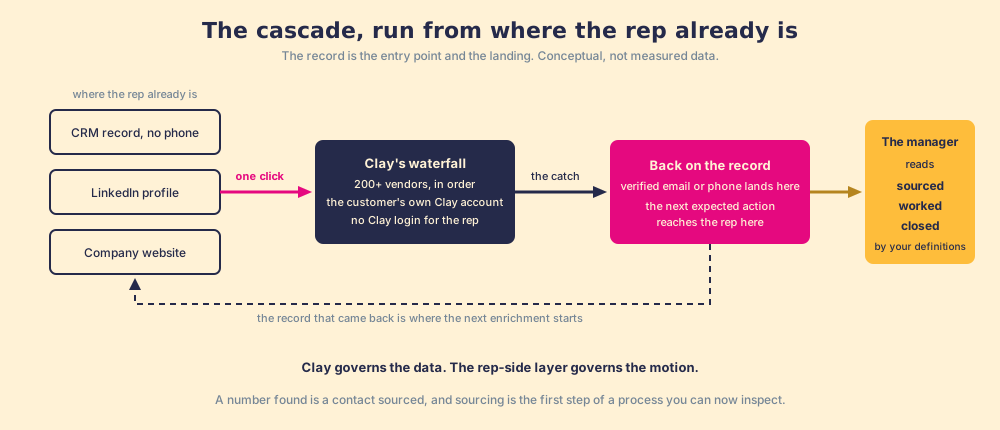
Now the other direction, and it starts on the rep’s screen. The rep from the first paragraph is on an account record in HubSpot or Salesforce, or on the LinkedIn profile of the champion she found this morning, and she needs the number now, not overnight. The Bridge Group’s 2025 SDR report, 351 B2B companies, puts the median rep’s day at 112 activities, 44 of them phone (Bridge Group, 2025). None of those activities is “open a Clay table.” So the waterfall has to run from where she is, from the record or the profile, one click, no Clay login, and the result has to land on the record she was looking at.
Then the part no data tool measures. A number found is a contact sourced, and sourcing is the first step of a process. Whether the second step happens is a behavior question, and our field data says how that question usually goes: across 198 sales leaders, 89% have a defined process and 36% see reps run it; reps who get the next step in the flow of work report 49% quota attainment against 15% for reps who have to go elsewhere for it; and teams that inspect deals against the process consistently hit quota at 6.3x the rate of teams that rarely do (The State of Sales Enablement).
Supered sits at this point, once and late. It brings no database of its own, on purpose; it brings Clay’s waterfall, which is every database, routed, on the customer’s own Clay account, so the rep on the record or the profile gets the cascade in one click with no Clay login. The enriched contact then enters a motion the Behavior Layer guides and inspects: the next expected action reaches the rep on the record, and the manager reads sourced, worked, closed, with “worked” and “closed” defined by the customer, against the expectation the manager set. Clay governs the data. Supered governs the motion.
What we recommend
We recommend running Clay’s waterfall from the record, with a standard behind it, because a miss costs nothing and the step after the catch decides the number. The three ways a sales team gets contact data, and where each one stops:
- One pond. A single database with a seat fee. The pond is deep in its own river and empty everywhere else, and the miss costs a second contract; Vendr’s median buyer pays $33,500 a year for ZoomInfo and $32,750 for Cognism (vendr.com, opened September 25, 2026).
- The cascade, run by Ops. Clay’s waterfall in a table, triggered from the CRM, paid per catch, Growth plan at $495 a month for the CRM connector. Coverage goes up by Clay’s account and the meter is fair. The rep never sees it run.
- The cascade, run from the record, with a standard behind it. The same Clay account, the same waterfall, started by the rep from the record or the profile, and the sourced contact inspected to close.
The mechanism says coverage comes from asking many rivers, so keep the waterfall and credit Clay for it. The meter says a miss is free, so run it wherever the rep is. And our data says the step after the catch is the one that decides the number: 49% against 15%, and 6.3x. How the waterfall fits the CRM record specifically, in both directions, is the subject of CRM data enrichment; the tools that do parts of this job, sorted by the job, are in contact enrichment tools; and the workshop the cascade lives in is drawn in what is Clay.
Frequently asked questions
What is waterfall enrichment?+
How does Clay waterfall enrichment decide the order of providers?+
Why do different data providers find different people?+
Does waterfall enrichment cost more because it asks more providers?+
Is a waterfall the same as a validated email?+
Can a sales rep run a waterfall from the CRM record?+
Your process, running itself.