Snov.io Alternatives in 2026: When One Blade Becomes the Job
Snov.io packs a finder, a verifier, a sequencer, warm-up, LinkedIn automation and a CRM into a $39 plan with unlimited seats. The Snov.io alternatives graded for a sales team, with the phone-token math Snov's own help center makes possible.
Snov.io alternatives are the tools sales teams weigh against Snov.io, the all-in-one email finder and cold-email platform: all-in-ones like Apollo and lemlist, finders like Findymail and Prospeo, or Clay's waterfall across 200+ vendors run from Supered Prospector.
People search for Snov.io alternatives (or snov io alternatives, without the dot) for one of two reasons. The team started dialing and found that phones live behind a second currency, or the team grew and the built-in sequencer and CRM stopped being enough. The short answer, graded in full below:
- Supered Prospector. For teams that already have Clay: Clay’s waterfall across 200+ vendors, with Snov.io as one possible step, run from a LinkedIn profile, a Sales Navigator list, a company website, or the CRM record, at $45 per rep per month billed annually.
- Apollo. For a team that wants a big database, phones, sequences, and a dialer in one plan, from $49 a seat billed annually.
- lemlist. The closest all-in-one swap for outreach-first teams, from $55 a month billed yearly with unlimited users.
A Swiss Army knife is the best tool to carry in your pocket and a poor one to build a deck with. It has a blade, a saw, scissors, a screwdriver and a corkscrew, and each is about two inches long. Owners do not complain about the knife. They complain on the day one job, say cutting forty boards, becomes the whole afternoon.
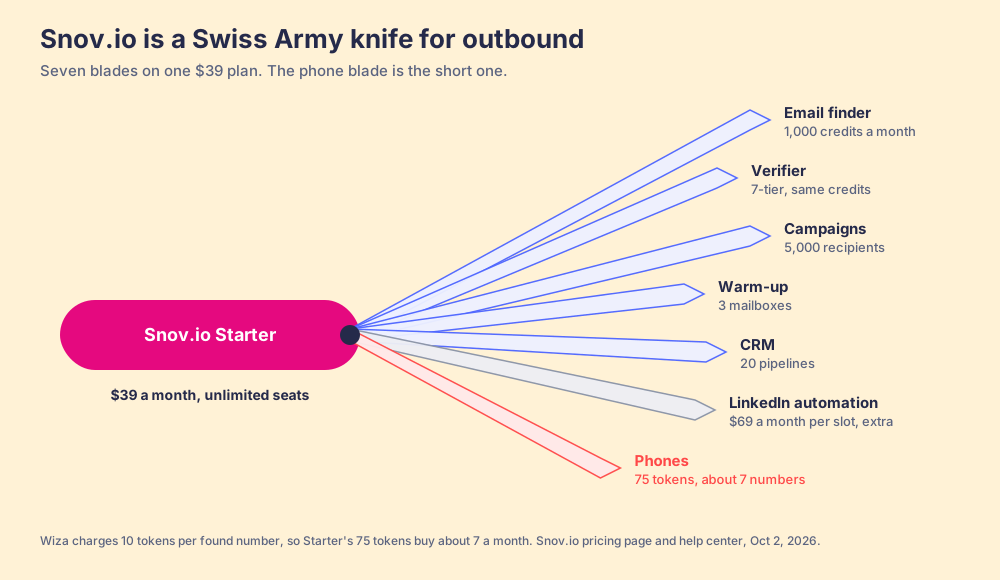
Snov.io is that knife for outbound. One plan, opened on Snov’s pricing page on October 2, 2026, carries an email finder, a 7-tier verifier, drip campaigns, mailbox warm-up, LinkedIn automation, a sales CRM with 20 pipelines, a phone finder, and unlimited team seats, for $39 a month. Snov says more than 175,000 businesses use it. For a founder or a three-person agency that is a remarkable amount of pocket.
Snov.io alternatives are the tools sales teams weigh against Snov.io, the all-in-one email finder and cold-email platform. They are all-in-ones built bigger in one direction (Apollo for data, lemlist for multichannel outreach), single-purpose finders that go deeper on one blade (Findymail, Prospeo, Hunter), or Clay’s waterfall across 200+ data and AI vendors (clay.com, September 25, 2026), which a rep can run from Supered Prospector on the team’s own Clay account. The useful question is which blade became the job.
Why do teams look for Snov.io alternatives?
Snov.io holds a 4.5 out of 5 on G2 from 499 reviews (G2, Snov.io reviews, checked October 2, 2026), and its Email Finder extension has 400,000 users and a 4.9 from 6K ratings on the Chrome Web Store, last updated September 28, 2026. People like it. The reasons they leave are specific, and they show up in the reviews again and again.
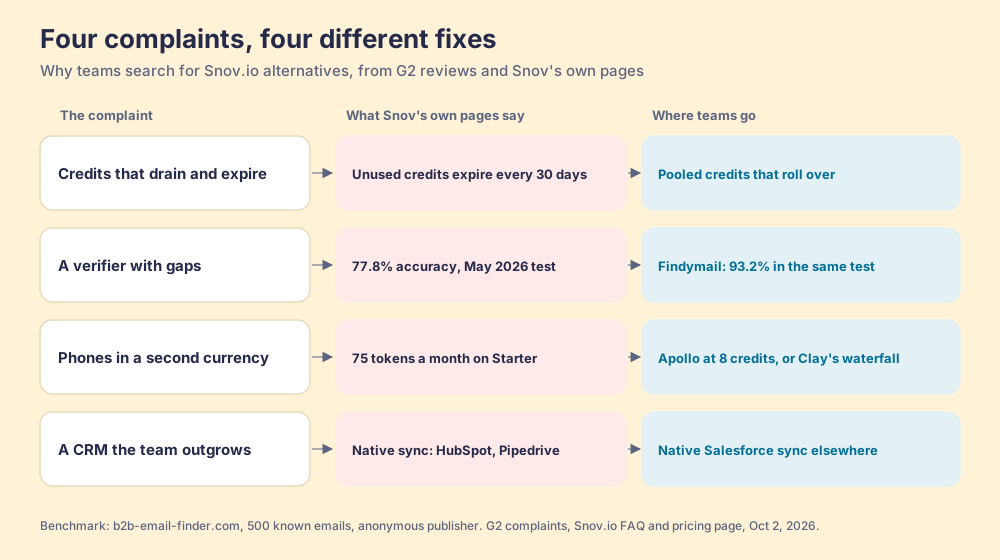
- Credits that drain and expire. A mid-market ABM specialist wrote in September 2026 that “the credit system is our biggest pain point,” and a founder wrote in May 2026 that “unused monthly credits expiring feels frustrating, especially during slower months.” Snov’s FAQ confirms it: unused credits expire every 30 days unless you are on annual billing or have plan renewal on.
- A verifier with gaps. “Email verification isn’t 100% accurate, and a few bounced emails slip through,” a mid-market marketing analyst wrote in March 2026. An anonymous benchmark site tested eight finders on 500 contacts with known emails in May 2026 and put Snov.io at 74.3% coverage and 77.8% accuracy, against Apollo’s 88.2% coverage and Findymail’s 93.2% accuracy (b2b-email-finder.com, June 8, 2026). The publisher names no people, so treat it as one signal.
- Phones in a second currency. Phone numbers are not bought with credits. They cost enrichment tokens, and Starter includes 75 of them a month. More on that blade below, because it explains most of the switching.
- A CRM the team outgrows. Snov’s built-in CRM holds 10,000 active deals. Its pricing page lists native two-way sync for HubSpot and Pipedrive; Salesforce connects through Zapier. A team moving its pipeline into Salesforce feels that first.
None of the complaints says the tool is bad. Each says one blade was too short for the job it became.
Why trust this comparison?
I started RevPartners, a HubSpot partner that did only sales implementations, sold roughly twice as much Sales Hub as any other partner, and reached Elite tier in 13 months. Supered came out of that work and is the #1 sales enablement app on the HubSpot marketplace, rated 5.0 from 122 reviews there and 4.9 out of 5 from 81 reviews on G2 (both checked October 1, 2026). That is also the disclosure. We make Supered Prospector, and it sits first on this page for teams that have Clay. The grading below states its weights, and for an email-only founder without Clay, Snov.io or lemlist wins on price and the page says so.
The Snov.io alternatives, graded
A ranking that hides its math is an advertisement. The lens is a mid-market or SMB sales team, ten to fifty reps, who email and dial, and a leader who wants to know which lists turn into pipeline. Each criterion is scored 1 to 5 and multiplied by its weight, for a maximum of 50. The scores for Prospector, Apollo, Findymail, Prospeo, Hunter and Snov.io are the same ones used on the Hunter.io alternatives page, so the pages read together; lemlist is new here.
| Criterion | Weight | What it rewards |
|---|---|---|
| Coverage of the contact you need | 30% (x3) | Verified emails and mobiles, including when the first source misses |
| Rep-side delivery | 20% (x2) | Works on the profile, the company site, the CRM record; no new tab or login |
| Price structure for mid-market | 20% (x2) | Published prices, per-result or per-team, no platform fee |
| What the leader sees after the export | 20% (x2) | Which sourced lists were worked and which closed |
| Bundled outreach | 10% (x1) | Sequences, dialer, or drafting in the same plan |
| Rank | Tool | Grade | Score | Best fit | CRM integration | Setup effort | Pricing (plan with the feature) | Reason to switch from Snov.io |
|---|---|---|---|---|---|---|---|---|
| ref | Snov.io | B+ | 30 | Founders and agencies who want one cheap outbound tool | Native two-way (HubSpot, Pipedrive); Salesforce via Zapier | A day | Starter $39 a month ($29.25 billed yearly), unlimited seats | Stay if you mostly send email |
| 1 | Supered Prospector | A | 44 | Teams that already have Clay | Native (HubSpot, Salesforce, Pipedrive) | Under a week on an existing Clay account | $45 per rep per month billed annually, plus your Clay plan | Snov plus every other vendor per lookup, from any page, lists you follow to closed |
| 2 | Apollo | A- | 36 | Teams wanting a big database, phones, and outreach in one tool | Native (HubSpot, Salesforce) | A day | $49 a seat a month billed annually, phone 8 credits | More data per seat, phones in the same credits, a dialer |
| 3 | lemlist | B+ | 33 | Outreach-first teams running email, LinkedIn, calls, and SMS | Native (HubSpot, Salesforce, Pipedrive) | A day | Email $55 a month billed yearly, unlimited users; data add-on from $16 | Multichannel sequences and a data add-on drawn from 25+ providers |
| 4 | Findymail | B+ | 29 | Like-for-like finder with better verification | Native (HubSpot, Salesforce, Pipedrive, Clay) | Minutes | Starter $99 a month for the team | Catch-all checks, a bounce refund, phones at 10 credits |
| 5 | Prospeo | B+ | 29 | Email and mobile finder for outbound volume | HubSpot and Salesforce on Growth | Minutes | $37 a user a month billed yearly, CRM sync from $74 | Mobiles in the same credit, a searchable lead database |
| 6 | Hunter | B+ | 28 | Email-only teams that want the cleanest finder | Native (HubSpot, Salesforce, Pipedrive, Zoho) | Minutes | $34 to $209 a month billed yearly, unlimited users | A careful public-web index, misses free |
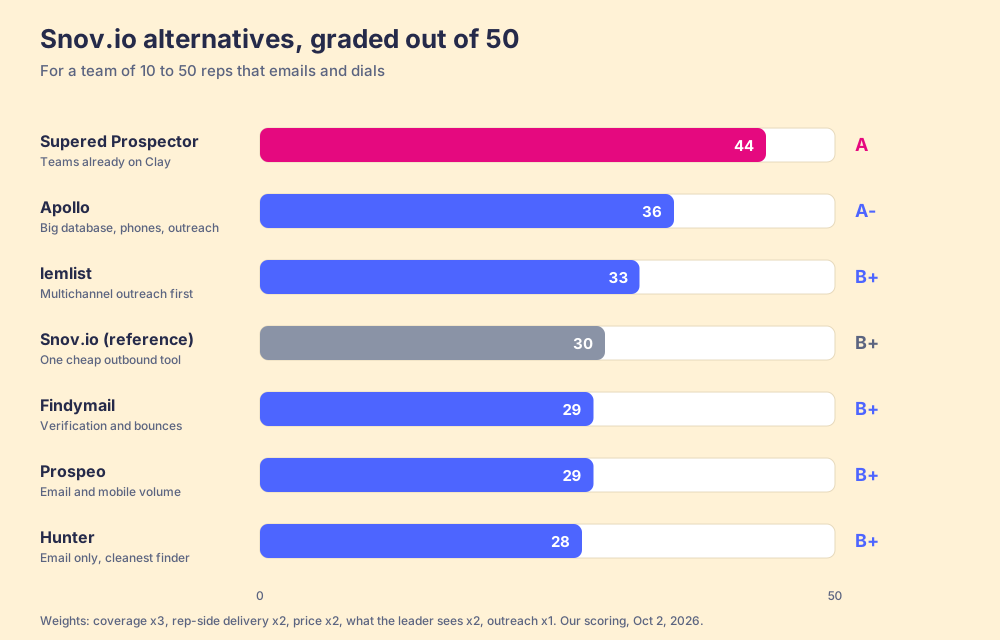
Snov.io’s 30 breaks down as coverage 3, rep-side delivery 3, price 4, what the leader sees 1, outreach 5. Outreach earns the 5: unlimited senders, campaigns and follow-ups on every paid plan. Price loses a point because credits, recipients, tokens and LinkedIn slots are four meters to watch. Coverage gets a 3 for its own database plus a single-provider phone lookup. lemlist scores 4/3/4/1/5, a point higher on coverage because its data add-on draws on 25+ providers (lemlist.com/pricing, October 2, 2026)
Corporate status, checked October 2, 2026. Snov.io is independent, with no 2026 acquisition, funding round, or rebrand found. lemlist is independent and acquired the French AI company Claap in October 2025 (EU-Startups). Apollo is independent and launched what it calls an “AI GTM System” on September 30, 2026. Findymail, Prospeo and Hunter are independent. Clay is independent; NYT reported in January 2026 that its employees sold shares at a $5B valuation.
How do Snov.io phone numbers work?
Snov’s own help center explains the phone blade plainly, and it is the one buyers tend to find last.
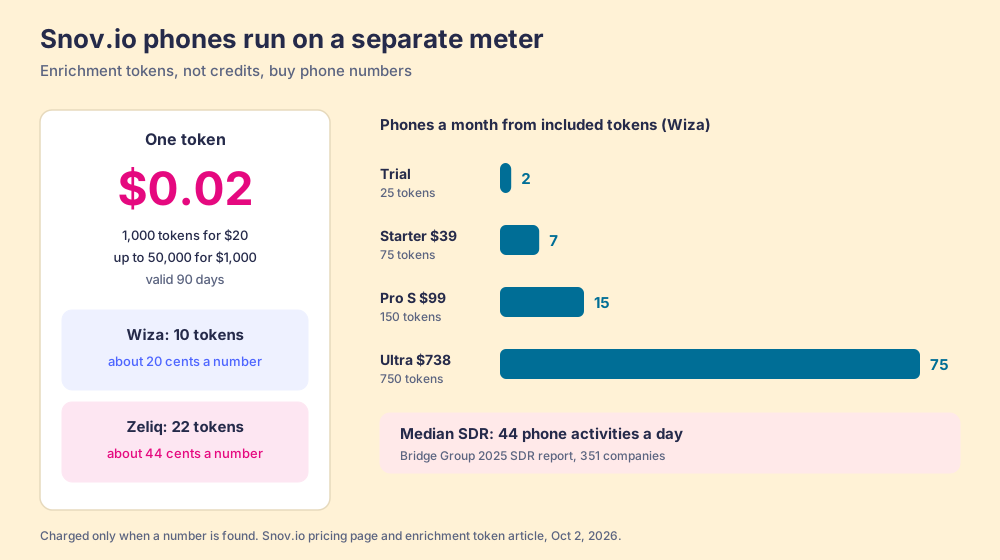
Snov runs on three meters. Credits buy email searches, prospect saves and verifications, one each. Recipients meter the campaigns: one per new lead contacted, follow-ups free. Enrichment tokens buy everything else, phones included. The phone lookup does not come from Snov’s database. Its enrichment token article (dated September 30, 2026) lists two phone providers and their prices: Wiza at 10 tokens per prospect and Zeliq at 22, “charged only when a phone number is found.” Token packages on the pricing page run from 1,000 tokens for $20 to 50,000 for $1,000, which is $0.02 a token, valid for 90 days.
So a found number costs about 20 cents through Wiza and 44 cents through Zeliq. The plan tokens set the monthly ceiling before you buy more:
| Snov.io plan | Monthly price (monthly billing) | Enrichment tokens a month | Phones a month at Wiza’s 10 tokens | At Zeliq’s 22 tokens |
|---|---|---|---|---|
| Trial | $0 | 25 | 2 | 1 |
| Starter | $39 | 75 | 7 | 3 |
| Pro S | $99 | 150 | 15 | 6 |
| Ultra | $738 | 750 | 75 | 34 |
The Bridge Group’s 2025 SDR report, 351 companies, puts the median SDR at 44 phone activities a day (Bridge Group, 2025). Starter’s included tokens cover about seven numbers a month for the whole team. A dialing team buys token packs from day one, which is fine, as long as the budget knows the phone line lives outside the $39.
The price is fair. The mechanism matters more. Snov’s phone enrichment FAQ (June 18, 2026) says it in one line: “Phone enrichment doesn’t work as a waterfall. You pick one provider for each search, and if it finds nothing, try another provider.”
Suppose you call directory enquiries for a number. The operator checks one book. If the name is not in it, she says so and the line goes dead, and you dial a second service and ask again. That is Snov’s phone lookup, and the second call is your job. A waterfall is an operator who, finding nothing in her book, rings the next service herself, then the next, and only calls you back with a number or a final no. The difference sounds small until a rep has two hundred names on a list and has to re-run the misses by hand, provider by provider.
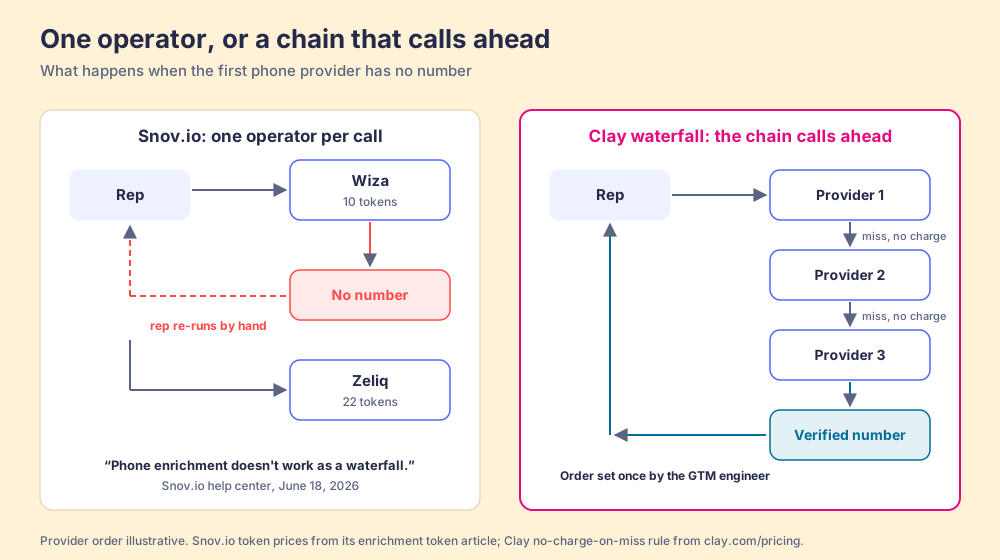
Snov is open about the gap, says it adds providers over time, and warns that coverage in South America and Asia “might have limited results.”
A Snov.io review, blade by blade
The other blades hold up better, which is why small teams keep it.
- The email finder. Domain search, name-and-company search, a LinkedIn search, and a B2B database, all on one credit pool. Starter’s 1,000 credits a month is about 3.9 cents each, and Snov’s FAQ says Pro M brings it to “around 0.9¢.”
- The sequencer. Unlimited senders, follow-ups and campaigns on every paid plan, with mailbox rotation and a bounce-rate safeguard that pauses a campaign when bounces climb.
- Warm-up and deliverability. Warm-up for 3 mailboxes on Starter and unlimited on Pro, plus DNS and blacklist checks.
- LinkedIn automation. $69 a month per account slot, $62 billed yearly, with randomized limits and a dedicated proxy per slot. LinkedIn’s User Agreement, section 8.2 (linkedin.com/legal/user-agreement), says members will not use “software, devices, scripts, robots or any other means or processes (such as crawlers, browser plugins and add-ons or any other technology) to scrape or copy the Services,” nor bypass its use limits. A vendor that sells proxies and randomized limits is telling you the risk exists. We do not recommend automation on LinkedIn, and the risk lands on the rep’s own account.
- The Clay connection. Snov lists Clay among its integrations: “Use Snov.io credits inside Clay.” Clay’s action “Enrich Person from LinkedIn URL with Snov.io” runs on Clay credits or your own Snov account (Clay, Snov.io action, October 1, 2026). Hold that thought for the next section.
Where does Supered Prospector fit?
The alternatives above swap one knife for another, or buys a longer blade for one job. Apollo brings a bigger database. Findymail brings a sharper verifier. lemlist brings more channels. When the contact is not in their book either, the rep is back to calling a second operator, and the company signs a second contract.
Clay works more like a workshop wall. The GTM engineer hangs the tools on a pegboard in the order they should be tried: this email provider first, then that one, then a phone source, stop when a verified answer comes back. “Clay’s signature data waterfalls check multiple providers to return the most verified emails (lower bounce rate) and phone numbers (higher connect rate)” across 200+ vendors under one contract (Clay, rep prospecting), and Clay’s waterfall page names Snov among its work-email providers (clay.com/waterfall-enrichment, September 25, 2026). Clay also charges nothing for a miss: “If an enrichment returns no result, you’re not charged Data Credits or Actions” (clay.com/pricing). Snov.io can hang on that wall, on your own Snov account if you like. You do not have to throw the knife away.
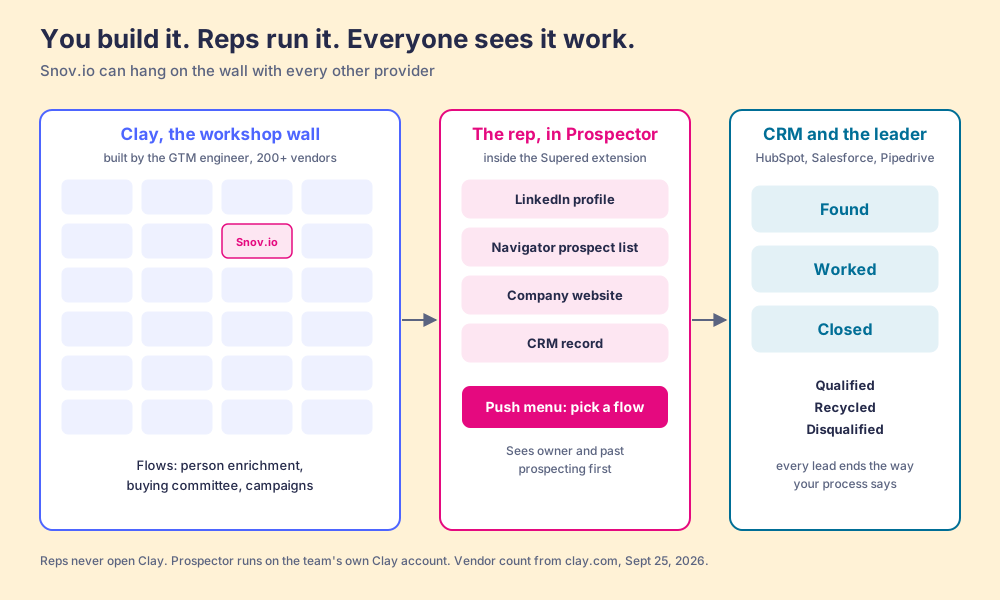
Prospector does not bring its own database. It brings Clay’s waterfall, which is every database, routed. We chose Clay as our only data provider for that reason, which is why Clay is not a row in the tables above. Clay plus Supered is the best way for a sales team to prospect: GTM engineers build in Clay, reps never open Clay. Prospector runs inside the Supered Chrome extension, on the team’s own Clay account, and each of three people gets something different from it.
- The GTM engineer, off the list desk. You built great Clay tables, and reps still Slack you for every list. With Prospector you build named flows once (person enrichment, a buying committee, a campaign) and reps pick them from a Push menu. Your waterfalls, tiers, tags and sequence variables stay yours. Start from the Supered Clay template or bring your own tables.
- The rep, with the table as a button. On a LinkedIn profile, a company’s website, or the HubSpot, Salesforce, or Pipedrive record already open, the rep runs the flow in one click. From Sales Navigator, the rep adds leads to a prospect list and pushes the list to a Clay table. Before pushing, the rep sees the matching CRM record, who owns it, and whether someone already prospected this person, so two reps do not email the same buyer.
- The leader, watching lists become pipeline. Each list shows as Found, Worked and Closed: which leads reps found with your tables, who is working their list and who is not, and how each lead ended, Qualified, Recycled or Disqualified, the way your process says. Your VP sees it too, and the Clay budget grows on that evidence.
On LinkedIn, the same rule applies to us as to Snov. Prospector works within LinkedIn’s terms and does not copy search results in bulk; the contact data comes from Clay’s waterfall on the customer’s Clay account.
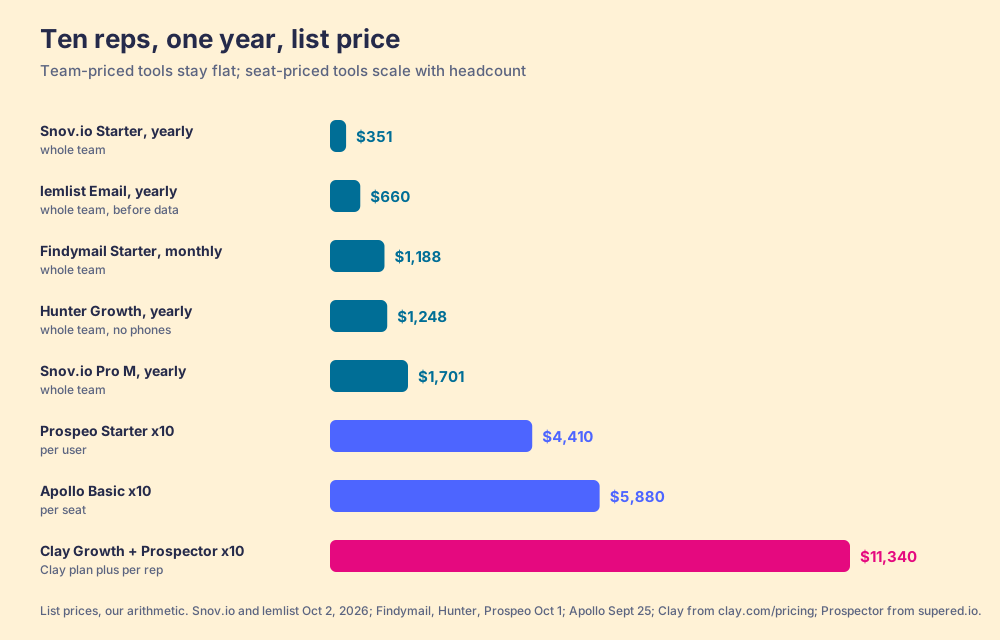
The arithmetic, because Snov.io is cheaper than any slogan. Clay’s Growth plan lists at $495 a month, $5,940 a year, with 6,000 data credits a month and CRM sync. Prospector is $45 per rep per month, billed annually, from one rep (Prospector). Ten reps come to $11,340 a year. Snov.io Pro M on annual billing is $141.75 a month, $1,701 a year, for the whole team with 20,000 credits a month. On email alone, Snov wins by a mile. On our reading of Clay’s pricing calculator, a work email plus a phone costs roughly six data credits, about 30 cents at the entry rate, a supposition since Clay does not publish the calculator’s rates (the Clay pricing page shows the working). The extra money buys every other provider behind Snov, the phone waterfall, and lists the leader can follow to closed.
Choose something else if you do not have Clay. Prospector runs on the customer’s Clay account and does nothing without one, and someone has to build the tables; Clay’s homepage says “GTM engineers build on Clay.” Choose something else, too, if your team is three people sending cold email from one tool. Snov.io Starter at $351 a year for unlimited seats, with a sequencer and warm-up included, is a better deal for that job than anything on this page. And Prospector does not send email; it hands the contact to your CRM or your sales engagement tool. Sourcing on Clay walks through the full rep loop for teams that dial.
What are the best Snov.io competitors for each job?
- Apollo. The alternative teams graduate to when the job needs more data per seat. Basic is $49 a seat a month billed annually with 30,000 credits a seat a year; an email costs 1 credit and a phone 8, so a Basic seat that spent everything on phones would get about 312 a month at about 16 cents each (apollo.io/pricing, September 25, 2026). G2 4.7 from 9,778 reviews (October 1, 2026). One database priced per seat, so ten reps cost $5,880 a year.
- lemlist. The like-for-like knife with more blades for outreach. Email is $69 a month or $55 billed yearly with unlimited users and 50,000 emails a month; Multichannel, with LinkedIn, SMS, WhatsApp and a built-in dialer, starts at $109 or $87 billed yearly. Data is an add-on: $20 a month, $16 yearly, for 2,000 credits, “400 emails or 100 phones,” from 25+ providers. G2 4.6 from 2,321 reviews (October 2, 2026). It carries the same LinkedIn automation risk as Snov.
- Findymail. The swap for a team whose real complaint is bounces. Starter is $99 a month for 5,000 finder credits plus 5,000 verifier credits, “1 email = 1 credit OR 1 phone = 10 credits,” charged only on verified results, with a credit refund “if your bounce rate exceeds 5%” (findymail.com/pricing, October 1, 2026). Its mobile finder is “Non-EU only.” G2 4.9 from 57 reviews. The Findymail alternatives page covers its own competitors.
- Prospeo. An email and mobile finder with a searchable lead database. Starter is $37 a user a month billed yearly ($441 a year) with 2,000 credits a month; a mobile costs 10 credits, and credits “do not roll over.” HubSpot and Salesforce sync starts on Growth at $74 a user billed yearly (prospeo.io/pricing, October 1, 2026). G2 4.6 from 849 reviews. Ten reps on Starter are $4,410 a year.
- Hunter. The email-only pick. Growth is $104 a month billed yearly, $1,248 a year, for 10,000 credits a month shared across unlimited users, about a cent an email, with misses free (hunter.io/pricing, October 1, 2026). No phone product. G2 4.4 from 657 reviews.
Two notes on lists you will see elsewhere. Most pages ranking for this search are written by vendors selling a competing tool (a CRM, a finder, a sequencer), so read any rank order with that in mind, ours included. And if what you want is a finder on a LinkedIn profile, the LinkedIn prospecting tools page and the email finder tools roundup are closer to that job; the Snov.io pricing page breaks down every plan and meter.
Which Snov.io alternative should you choose?
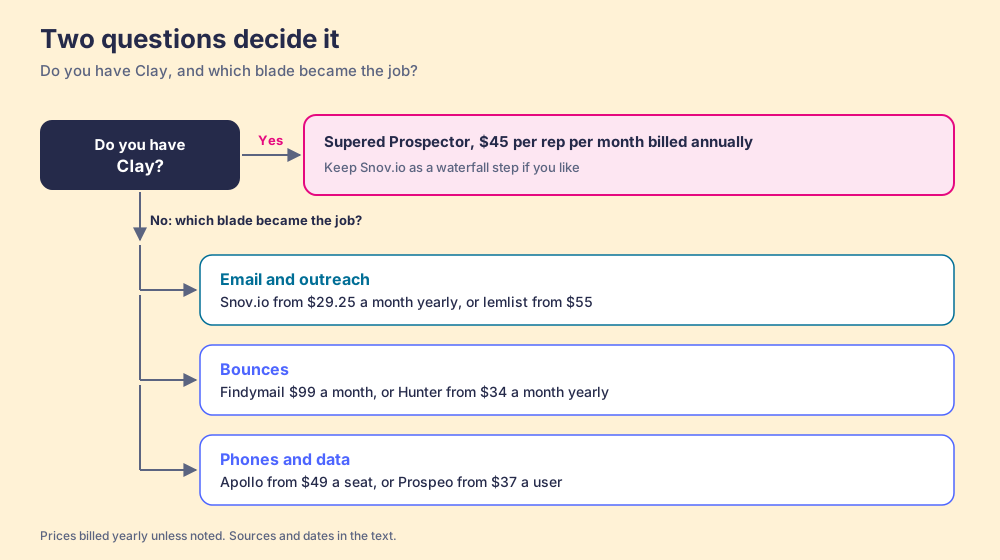
The choice resolves on two questions: do you have Clay, and which blade became the job. The ways forward:
- Snov.io itself. The pick when the team is small, mostly emails, and wants a finder, a sequencer and warm-up in one tool, from $351 a year.
- lemlist. The pick when outreach is the job and it now spans LinkedIn, calls and SMS, from $55 a month billed yearly for email with unlimited users.
- Findymail or Hunter. The pick when bounces are the complaint and you already have a sequencer. Findymail adds phones at 10 credits; Hunter stays email-only at about a cent an email.
- Apollo or Prospeo. The pick when phones and database size are the job and one source is enough.
- Supered Prospector. The pick when the team already has Clay, and you want Snov and every other provider asked in turn from the page the rep is on, with the list landing in HubSpot, Salesforce, or Pipedrive and the leader watching it get worked.
What we recommend follows from what Snov.io is. If your team is small and mostly emails, keep it; it is the most pocket you can buy for $39, and an alternative mostly buys blades you will not open. If your reps dial and you do not have Clay, look at Apollo first, because it puts phones in the same credit as email and prices a found number at about 16 cents, under Snov’s 20. If you have Clay, stop shopping for a longer blade. Hang Snov on the wall with everything else, let the GTM engineer set the order, put the flows in your reps’ hands on the page they are already on, and watch each list go from found to closed. A knife is a fine thing to own; the trouble starts when a team tries to frame a house with it. The Clay Chrome extension page shows what the rep sees when the whole wall is one click away.
Frequently asked questions
What are the best Snov.io alternatives in 2026?+
How much does Snov.io cost in 2026?+
Does Snov.io find phone numbers?+
Snov.io review: is it any good?+
Is Snov.io's LinkedIn automation safe?+
Do I need a Clay account to use Supered Prospector?+
Your process, running itself.