AeroLeads Pricing in 2026: The Monthly Pass Became a Fare Card
AeroLeads pricing checked on October 2, 2026: three one-time credit packs at $49, $149 and $299 that used to be monthly subscriptions at the same prices, what a credit buys now, what one rival's benchmark found, and the ten-rep arithmetic against SalesQL, Apollo and Clay.
AeroLeads pricing in 2026 is three one-time credit packs, Take Off at $49 for 2,000 credits, Climb at $149 for 8,000 and Cruise at $299 for 20,000, where a verified business email costs 1 credit, a personal phone number 5, and a search that finds nothing costs 0.
A city bus pass and a fare card can cost the same twenty dollars and still be different purchases. The pass buys a month: ride every day or not at all, and on the first of the month the unused days vanish. The fare card buys rides: tap when you board, pay only for the trips you take, and the balance waits for you.
AeroLeads pricing in 2026 is three one-time credit packs, Take Off at $49 for 2,000 credits, Climb at $149 for 8,000 and Cruise at $299 for 20,000, where a verified business email costs 1 credit, a personal phone number 5, and a search that finds nothing costs 0 (aeroleads.com/pricing, opened October 2, 2026). Until this summer those were the same names at the same prices, sold as monthly passes. The switch happened in September, AeroLeads’ own help center still describes the old plans, and the change matters more to your bill than any of the numbers on the cards.
The quick answer, three ways:
- AeroLeads Climb, $149 once. An occasional prospector who hates renewals and wants 8,000 credits that wait, at about 1.86 cents an email.
- SalesQL Basic, $351 a year. A steady LinkedIn prospector who wants a whole contact, phones included, for about 1.5 cents.
- Supered Prospector, $540 a rep a year on your own Clay account. A team that already pays for Clay, where reps build lists from LinkedIn, a company site or the CRM record and the waterfall asks 200+ providers instead of one.
How much does AeroLeads cost in 2026?
The page renders its prices in the browser, so the table below comes from a rendered capture of the live page, cross-checked against the Wayback Machine’s capture of September 30, 2026, which matches it line for line.
| AeroLeads pricing (Oct 2, 2026) | Free | Take Off | Climb | Cruise |
|---|---|---|---|---|
| Price | $0 | $49 one time | $149 one time | $299 one time |
| Credits | 10 | 2,000 | 8,000 | 20,000 |
| Per verified email (AeroLeads’ figure) | n/a | 2.45 cents | 1.86 cents | 1.50 cents |
| Business emails, if all spent on email | n/a | up to 2,000 | up to 8,000 | up to 20,000 |
| Personal phones, if all spent on phones | n/a | up to 400 | up to 1,600 | up to 4,000 |
| Email plus phone for one person (6 credits) | n/a | about 15 cents | about 11 cents | about 9 cents |
| Renewal | none | ”No auto-renewal” | same | same |
| Checkout | n/a | Razorpay or PayPal, USD | same | same |
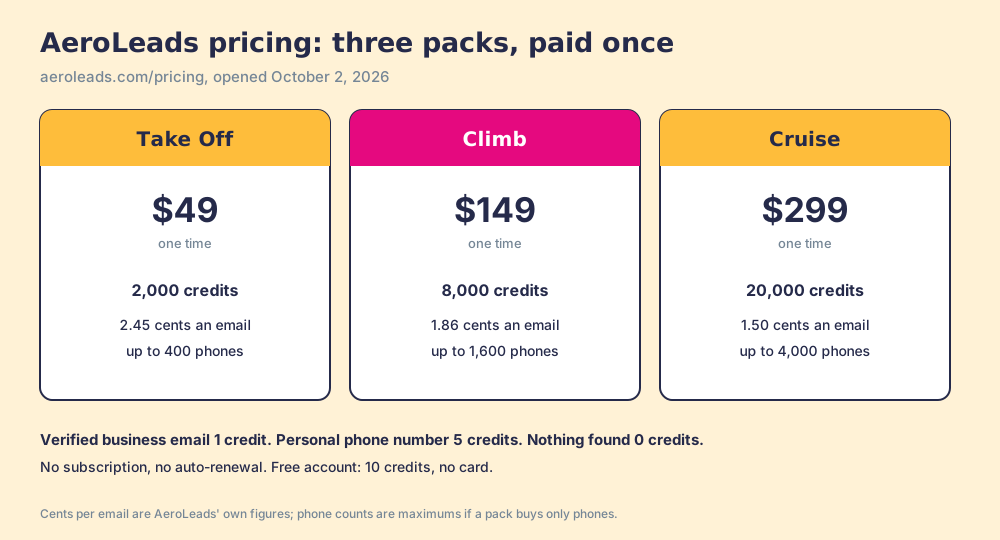
The pricing FAQ answers the three questions a buyer asks first. “Am I charged if no email or phone is found? No.” “Will I be billed again automatically? No. Each pack is a one-time payment. No subscription or recurring payment mandate is created.” “Can I buy more than one pack? Yes. Credits from each pack you buy are added to your balance.” Above 20,000 credits, AeroLeads asks you to describe your market and volume for a custom package.
The rest of the page is AeroLeads’ own claims: “Searchable profiles 750M+,” “Serving B2B teams since 2015,” and a Chrome Web Store rating of 4.5 out of 5. The Chrome store agrees on the rating: 4.5 from 226 ratings and 20,000 users, updated August 31, 2026 (Chrome Web Store, checked October 2, 2026).
Did AeroLeads drop its subscription?
Yes, on the pricing page, and the change is recent enough that AeroLeads’ own help center has not caught up. The Wayback Machine keeps the before and after.
A capture from December 4, 2025 shows subscriptions on both billing cycles: Take Off at $49 a month (or $39 a month billed annually) for 2,000 credits a month and 1 user, Climb at $149 ($129 annually) for 8,000 credits and 5 users, Cruise at $299 ($249 annually) for 20,000 credits and unlimited users. A capture from August 1, 2026 shows the same three at $49, $149 and $299 a month, with “80 personal phone numbers included” on Take Off, 200 on Climb and 400 on Cruise, and two rules in the FAQ: “1 credit is used when you save 1 profile or company to your workspace” and “Credits reset every month. Unused credits don’t roll over” (Wayback, August 1, 2026).
Then the page began to flicker. Captures from August 28 and August 31 show one-time packs; captures from September 8, 9 and 11 show the monthly plans again; captures from September 20, 27 and 30 show only packs, as does the live page today. That pattern looks like a test that ended in favor of the packs, though AeroLeads has not announced it.
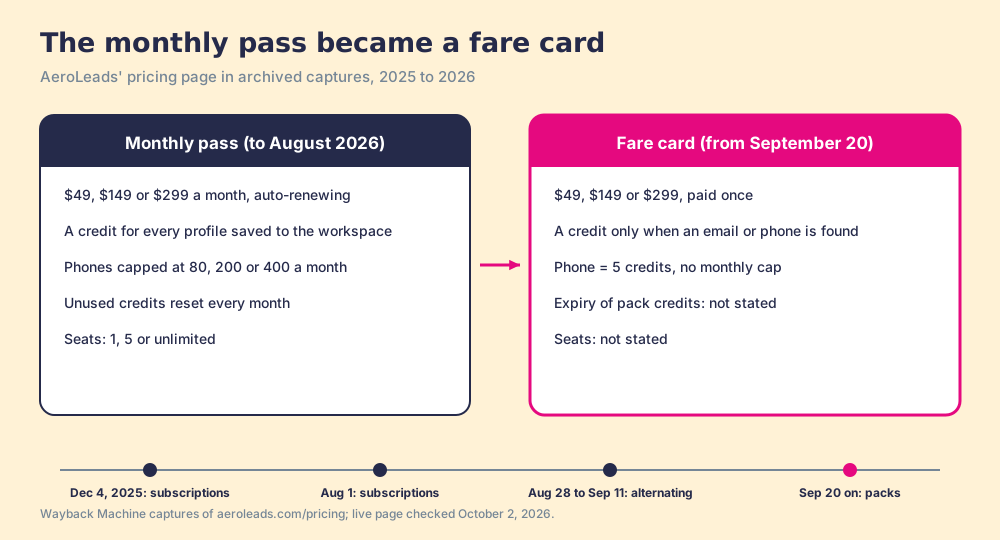
Go back to the bus. Under the pass, a rep who prospected hard in the first week and then went to a conference lost the rest of the month. Under the fare card, the balance waits. Under the pass, the meter ran when a profile was saved, so a saved profile with no findable email still cost a credit; under the fare card, “Credits are only used when we find a verified email or a phone number.” And under the pass, phones were rationed at 80 a month on Take Off; under the fare card, a Take Off pack can buy up to 400.
Two questions stay open, and a careful buyer closes both before paying. First, the pricing page does not say whether pack credits expire, and it does not say how many people can share a balance; the old plans listed 1, 5 and unlimited users. Second, AeroLeads’ help center has not caught up with its pricing page. Its pricing articles, checked October 2, 2026, still answer “Am I charged automatically every month?” with “Yes it will be renewed automatically” and describe a renewal date one month after the start (AeroLeads help center). Trust the checkout screen, save the order confirmation, and ask support in writing which model your purchase is on.
What does one AeroLeads credit buy?
An email or a fifth of a phone. “A verified business email uses 1 credit. A personal phone number uses 5 credits,” and “you can spend a pack on any mix.” The page’s own calculator shows the arithmetic: 5,000 business emails plus 300 phone numbers need 6,500 credits.
So the useful unit for a rep who dials is one person with both, 6 credits. On Take Off that is about 15 cents, on Climb about 11, on Cruise about 9. Set against the rest of the market at list, plan used in full:
| One email-and-phone contact, at list | Plan | Credits | Works out to |
|---|---|---|---|
| SalesQL Basic, annual | $351 for 24,000 | 1 | about 1.5 cents |
| AeroLeads Cruise | $299 for 20,000 | 6 | about 9 cents |
| AeroLeads Climb | $149 for 8,000 | 6 | about 11 cents |
| AeroLeads Take Off | $49 for 2,000 | 6 | about 15 cents |
| Apollo Basic | $588 for 30,000 | 9 | about 18 cents |
| RocketReach Pro | $899 for 3,600 exports | 1 export | 25 cents |
| Lusha Starter | $449.10 for 4,800 | 6 | about 56 cents |
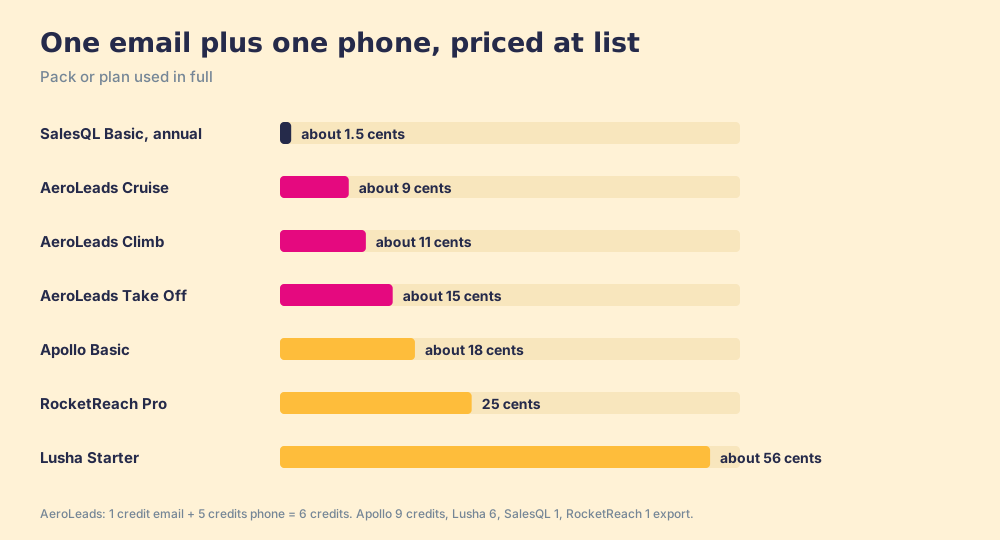
AeroLeads sits in the cheap half of the table, behind SalesQL’s one-credit whole contact and ahead of Apollo’s per-ingredient meter. Sources for the neighbors: salesql.com/pricing and apollo.io/pricing, opened October 2, 2026; RocketReach’s Pro at $899 for 3,600 exports from rocketreach.co/pricing the same day; Lusha’s ladder captured October 1 for Apollo vs Lusha. The word “personal” in “personal phone number” deserves a line of its own. A personal mobile is the number a buyer gave their family, and whether and how you may call it depends on where they live and what your counsel says. Ask AeroLeads, and any vendor, where the number came from.
How good is AeroLeads data?
A price per found email is only half a price. The other half is how many of those emails reach a real inbox at the right company, and on that AeroLeads publishes nothing independent.
The one large public test comes from a rival, and it should be read as one. Dropcontact, a French email finder, ran 20,000 real contacts (9,800 US, 9,700 European, 500 elsewhere) through 15 tools using first name, last name and company name only, sent a live email to every address found, and checked every domain by hand (Dropcontact, Email Finder Benchmark, updated February 2026). Dropcontact designed the study, paid for it, and ranked itself first at 54.9% usable. AeroLeads ranked 15th of 15.
The AeroLeads row: 8,650 emails found, a raw rate of 50.5%. Of those, 1,298 hard-bounced (15.0%), leaving 7,352, and 1,273 had a domain that did not match the company (14.7%), leaving 6,080 usable, 35.5% of contacts submitted. Dropcontact puts that at €47.75 per 1,000 usable emails.
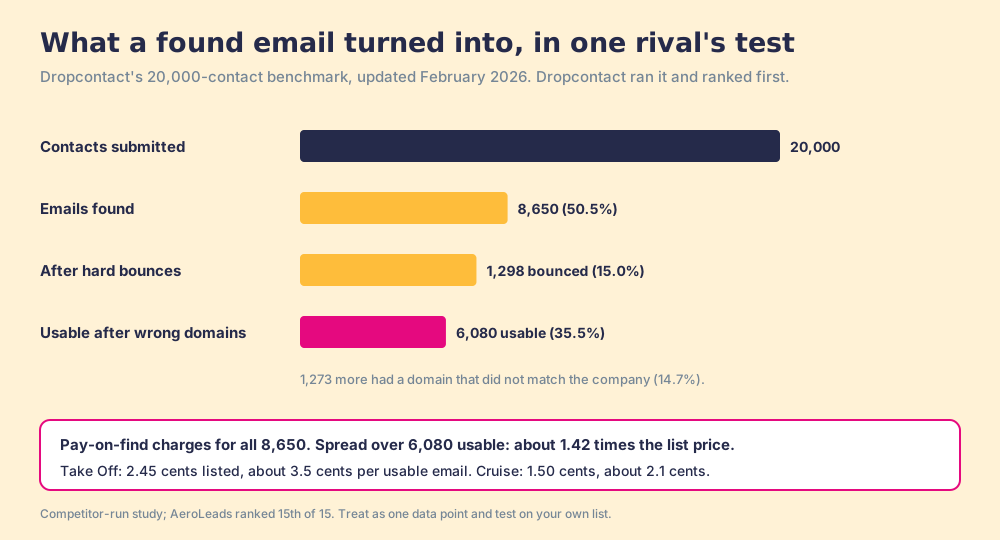
The test teaches something that holds for every pay-on-find vendor, AeroLeads included. “Only pay for what we find” counts a bounced address and a wrong-domain address as found. If the benchmark’s ratio held on your list, you would pay for 8,650 finds to get 6,080 usable emails, so each usable email costs about 1.42 times the price on the card: about 3.5 cents on Take Off instead of 2.45, and about 2.1 cents on Cruise instead of 1.50. The refund rule protects you from the empty search. It does nothing for the wrong answer.
Reviewers fill in the rest. On G2, AeroLeads held 4.0 out of 5 from 66 reviews on October 2, 2026, newest dated September 22 (G2, AeroLeads reviews); one account manager praised how “with just one search, I was able to quickly find all the information I needed,” and also wrote that “The Credits need to be more.” On Capterra it held 4.6 from 74, where a principal consultant called the database’s Canadian contact information “very shallow” (Capterra, AeroLeads). Run a Take Off pack against 200 contacts from deals you already won, send to them, and count the bounces yourself.
Why should you trust this breakdown?
We sell no contact data. Supered has no database of its own, on purpose; Prospector runs on Clay, our only data provider. So we gain nothing from whether you buy AeroLeads, SalesQL or Apollo. Our stake is what reps do with a contact once it lands in the CRM.
Supered started inside RevPartners, the HubSpot partner I founded, which sold roughly twice as much Sales Hub as any other partner and reached HubSpot’s Elite tier in 13 months. Supered is the #1 sales enablement app on the HubSpot marketplace, with 6,000+ installs and a 5.0 rating from 122 reviews there, and on G2 it held a 4.9 out of 5 from 81 reviews on October 1, 2026 (G2, Supered reviews). Each AeroLeads figure here links to the page it came from, and the history comes from the Wayback Machine, capture by capture.
Which AeroLeads pack, or which alternative, fits your team?
The grades use the five weights from our RocketReach pricing and UpLead pricing pages: coverage of the contact you need (x3), delivery where the rep already works (x2), price structure for a mid-market team (x2), what happens to the list after the export (x2), and bundled outreach (x1), out of 50. The weights serve one job, a team of five to fifty reps building its own lists. Flip the lens to “never sign a subscription” and AeroLeads ranks first.
| Rank | Option | Grade | Best fit | CRM integration | Setup effort | Pricing (plan with the feature) | Reason to switch |
|---|---|---|---|---|---|---|---|
| 1 | Supered Prospector | A (44) | Teams already paying for Clay | Native: HubSpot, Salesforce, Pipedrive | Demo, then live in under a week on your own Clay account | $45 a rep a month, billed annually, plus your Clay plan | Clay’s waterfall across 200+ providers from the rep’s own screen; see which lists get worked and close |
| 2 | Apollo | A- (36) | Small teams wanting data plus sequencing | Native | Self-serve | Basic $49 a seat a month, annual | Sequences and a dialer in the same seat |
| 3 | SalesQL | B+ (31) | LinkedIn-first reps and small teams on one pool | HubSpot native; Salesforce via Zapier | Self-serve | Basic $351 a year | One credit per whole contact, phones included |
| 4 | Lusha | B+ (29) | Low-commitment LinkedIn reps | Native | Self-serve | Starter $449.10 a year | Free tier of 40 credits a month |
| ref | AeroLeads | B- (23) | Occasional buyers who hate renewals | Exports to Salesforce, HubSpot, Pipedrive and Zoho, plus Zapier (December 2025 page) | Self-serve, minutes | Take Off $49, Climb $149, Cruise $299, one time | No subscription, pay only on a find |
| 5 | RocketReach | B- (23) | Small teams that dial | Native from Pro | Self-serve | Pro $899 a seat a year | Posted export count with phones; misses refunded |
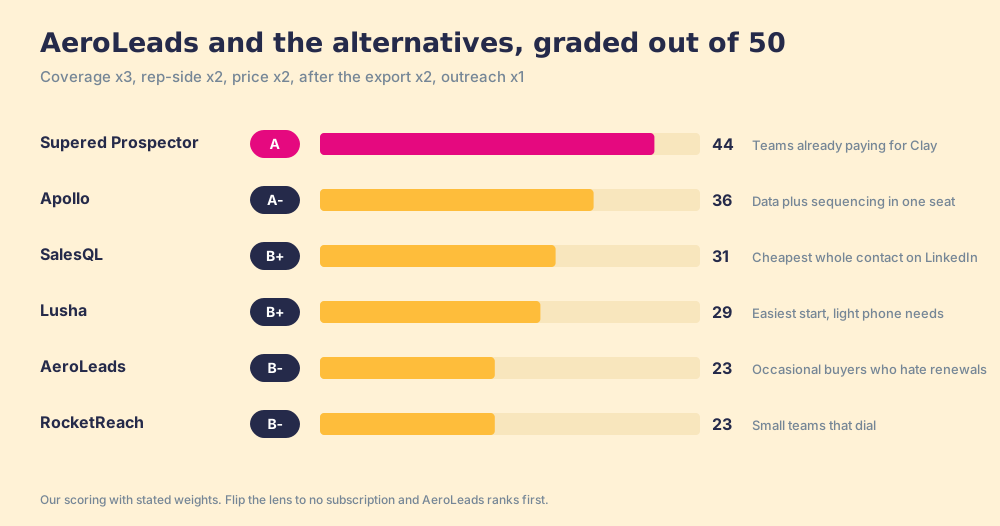
AeroLeads’ 23 breaks down as coverage 2, rep-side delivery 3, price 4, what the leader sees 1, outreach 1. The coverage 2 rests on the only large public test and on reviewers’ accuracy notes; a better test on your list would move it. The price 4 is the friendliest structure on the page for an irregular buyer and loses a point because seats and expiry are unstated.
What does AeroLeads cost for a team of ten?
Packs have no seat price, so a team prices AeroLeads by volume. Take a team of ten reps who each need 100 email-and-phone contacts a month. That is 12,000 contacts a year, and at 6 credits each, 72,000 credits. Four Cruise packs buy 80,000 credits for $1,196, with room for misses on the phone side.
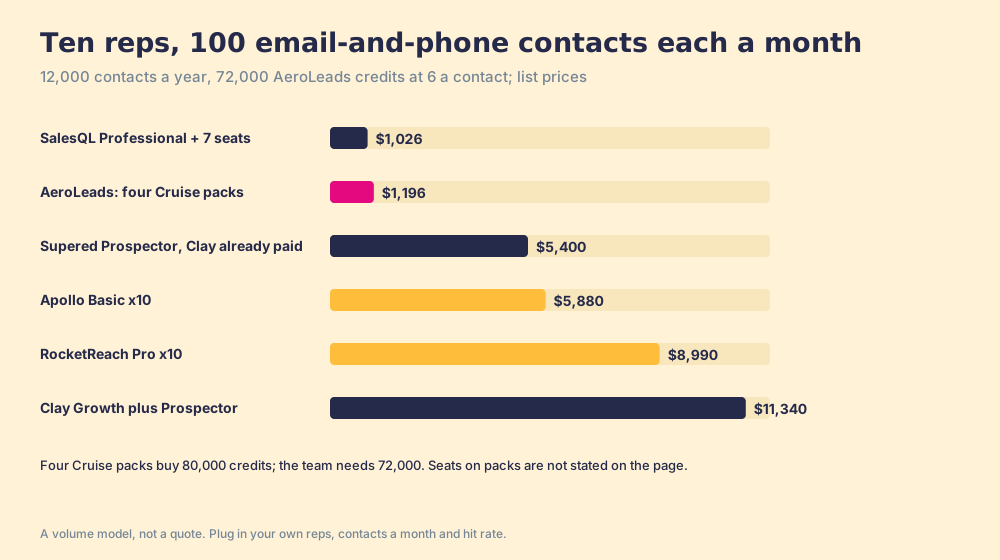
Against that, a SalesQL Professional plan with seven extra seats costs $1,026 a year for 60,000 pooled whole-contact credits, enough for 6,000 contacts a rep. Ten Apollo Basic seats list at $5,880, ten RocketReach Pro seats at $8,990. On list price, AeroLeads and SalesQL are the two cheapest ways to put ten reps on a contact database, and they run within $200 of each other. The open questions that would change this are AeroLeads’ unstated seat rules and the hit rate on your list; the benchmark above suggests budgeting for about 1.42 times the credits you think you need on email alone. The full SalesQL ladder is on SalesQL pricing.
How does Supered Prospector compare to AeroLeads pricing?
Back to the bus. AeroLeads is one line with a fare card: tap on, and if the stop you need is not on the line, you pay nothing and you do not get there. Clay is the transit network: 200+ data and AI vendors under one contract (clay.com, checked October 2, 2026), with a waterfall that transfers the trip to the next line until one reaches the stop, and “If an enrichment returns no result, you’re not charged Data Credits or Actions” (clay.com/pricing). One line refunds the trip it cannot make. The network finds a route.
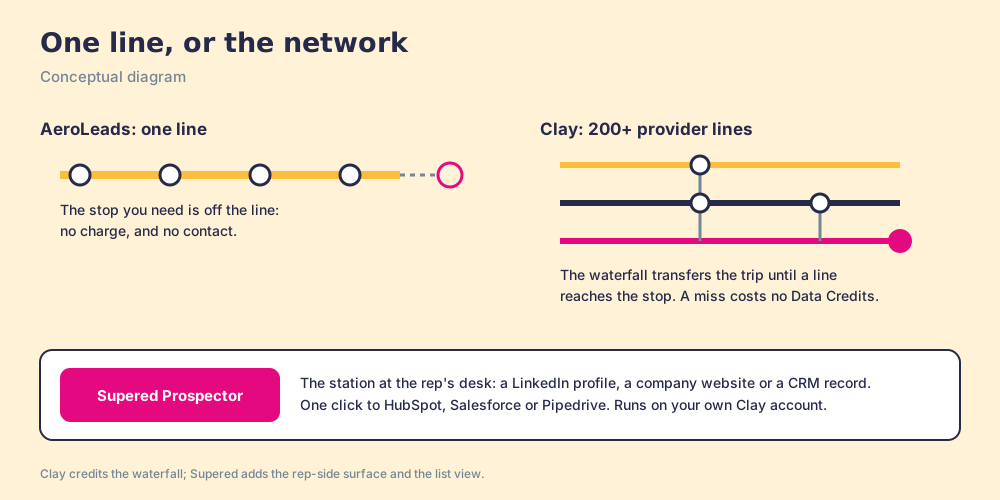
Prospector does not bring its own database. It brings Clay’s waterfall, which is every database, routed. We chose Clay as our only data provider for that reason. The network has had one weakness: the GTM engineer draws the routes, and reps rarely ride them. Prospector puts what the GTM engineer built in the rep’s hands:
- Where the rep already is. A LinkedIn profile, a Sales Navigator list, a company’s website, or a HubSpot, Salesforce or Pipedrive record. One click runs the waterfall, and reps never log in to Clay. Prospector runs inside the Supered Chrome extension, works within LinkedIn’s terms and does not copy search results in bulk; ask any vendor what it reads from a LinkedIn page, ours included.
- A check before the duplicate. On a LinkedIn profile, the rep sees whether the person already has a matching record in the CRM, who owns it, and whether the prospect was worked before.
- The GTM engineer’s tables, on a button. Any custom Clay workflow runs from Prospector, a whole list can go into a Clay workflow, and the buying-committee lookup is tuned by title, department and seniority.
- The list after the export. The contact arrives in the CRM with the team’s process applied, and the manager sees which lists get worked and which ones close, then coaches from what is converting.
Prospector is $45 per rep per month, billed annually, from one user (Prospector, Supered pricing), on your Clay account and your Clay credits. Ten reps on a Clay account you already pay for add $5,400 a year; with Clay Growth at its $495 monthly rate, which comes with 72,000 Data Credits a year, the total is $11,340. Both cost more than four AeroLeads packs, and this page will not pretend otherwise. The case for the network is the stop one line does not serve, the rep’s own surface, and a leader who can see which lists turned into pipeline. The sourcing use case walks the rep’s side.
Choose something else if any of these is true:
- No Clay account. Prospector needs one. An occasional buyer without Clay is better served by an AeroLeads pack or a month of SalesQL.
- No waterfall owner. Someone decides which providers sit in which order. If no one on the team owns that, a single database with a posted price is less work.
- Outreach from the same vendor. If you want data, sequencing and a dialer in one seat, Apollo’s pricing bundles them.
What are the best AeroLeads alternatives?
The AeroLeads alternatives below all sell contacts; the useful question is which one fits the job.
- SalesQL, for a whole contact per credit. Basic is $39 a month or $351 a year for 2,000 credits a month, and one credit reveals emails, phones and company data on paid plans. Cheaper per contact than AeroLeads at list, on a subscription. SalesQL pricing covers its seat change.
- Apollo, for data plus sequencing. Basic is $49 a seat a month on annual billing with 30,000 credits a year, 1 per email and 8 per phone, plus sequences and a dialer. Apollo pricing walks the meter.
- RocketReach, for a small team that dials. Pro is $899 a seat a year for 3,600 exports with phones, and lookups that find nothing verified are refunded. RocketReach pricing explains the export meter.
- UpLead, for the other clean meter. One credit per whole contact, Essentials from $74 a month billed annually, and a trial that defaults to an annual plan. UpLead pricing has the details.
- Dropcontact, for emails built and checked in Europe. The vendor behind the benchmark above finds business emails with its own algorithms on EU servers. Dropcontact alternatives prices it and the field around it.
What we recommend
Three ways forward, and our view on each.
- An occasional prospector. Buy Take Off at $49 once, spend it on 200 contacts from deals you already won, and count the bounces. If the data holds, move up to Climb or Cruise when the balance runs low. Ask in writing whether pack credits expire before you buy Cruise.
- A steady prospector or a small team. Price SalesQL alongside AeroLeads. The two land within a few hundred dollars for ten reps; pick the one whose hit rate on your list is higher, and whose seat rules you can read.
- A team with Clay. Skip a second database and run Clay’s waterfall from where reps already work with Supered Prospector, at $540 a rep a year, so a miss on one line becomes a transfer instead of a dead end.
The fare card is a fairer ticket than the pass for anyone who prospects in bursts, and AeroLeads deserves credit for the switch. A fair ticket on a line that does not reach your stop is still a long walk, so test the route before you load the card. For a team on Clay, a Prospector demo shows the whole network running on your own account.
Frequently asked questions
How much does AeroLeads cost in 2026?+
Is AeroLeads a subscription?+
What does an AeroLeads credit buy?+
Do AeroLeads credits expire?+
Is AeroLeads data accurate?+
What are the best AeroLeads alternatives?+
Everything we have written on AeroLeads
More on AeroLeads
Looking past AeroLeads? See Supered Prospector on your own Clay accountYour Clay waterfall, where reps already work.